
Skip to the main content.

7 min read

John Harris 1952-2025

John Harris 1952-2025

John Harris was born on Friday, the 13th day of June in 1952. He was not a triskaidekaphobe (someone who fears the number 13); nor did he suffer from paraskevidekatriaphobia (fear of Friday the 13th).

Instead, like a lot of families with kids born on Friday the 13th, the Harrises considered it kind of lucky, and in the case of John, he was more lucky than unlucky. But mainly, he was just remarkably talented, and he had one of the most spectacularly successful amateur careers in the history of Minnesota athletics. 

Harris, who died Wednesday from a recurrence of AML, Acute Myeloid Leukemia, a rare cancer that affects bone marrow and blood, was the MGA Player of the Year for nine consecutive years (1987-95) and claimed his 10th Player of the Year crown in 2000, the same year that he won the State Amateur for the fourth time, at the age of 48.

In addition to his four State Ams, he also won two State Opens ('94, '95), a Minnesota Golf Champions (1991), and three MGA Four-Balls, with two different partners. In 1973, he won with Rick Ehrmanntraut, a pairing that didn't seem fair, because they were the best two amateurs in the state. Having won then, when he and Ehrmanntraut were both college kids, Harris won two more times as a mid-am with partner Dick Blooston.

There were also five Mid-Am titles represented in the trophy case, which got to be so crowded that Harris's wife, Jennifer, began threatening to have a golf trophy garage sale.

Harris would have added to his list of victories, except that in the 1990s, he concentrated more on bigtime national tournaments, and didn't play, for example, in the State Amateur from 1993 to '99. That strategy paid off in the form of notable victories such as the Porter 'Cup, Sunnehanna and the Terra Cotta Invitational -- not to mention Harris being named to the U.S. Walker Cup team four times (1993, '95, '97 and 2001).  

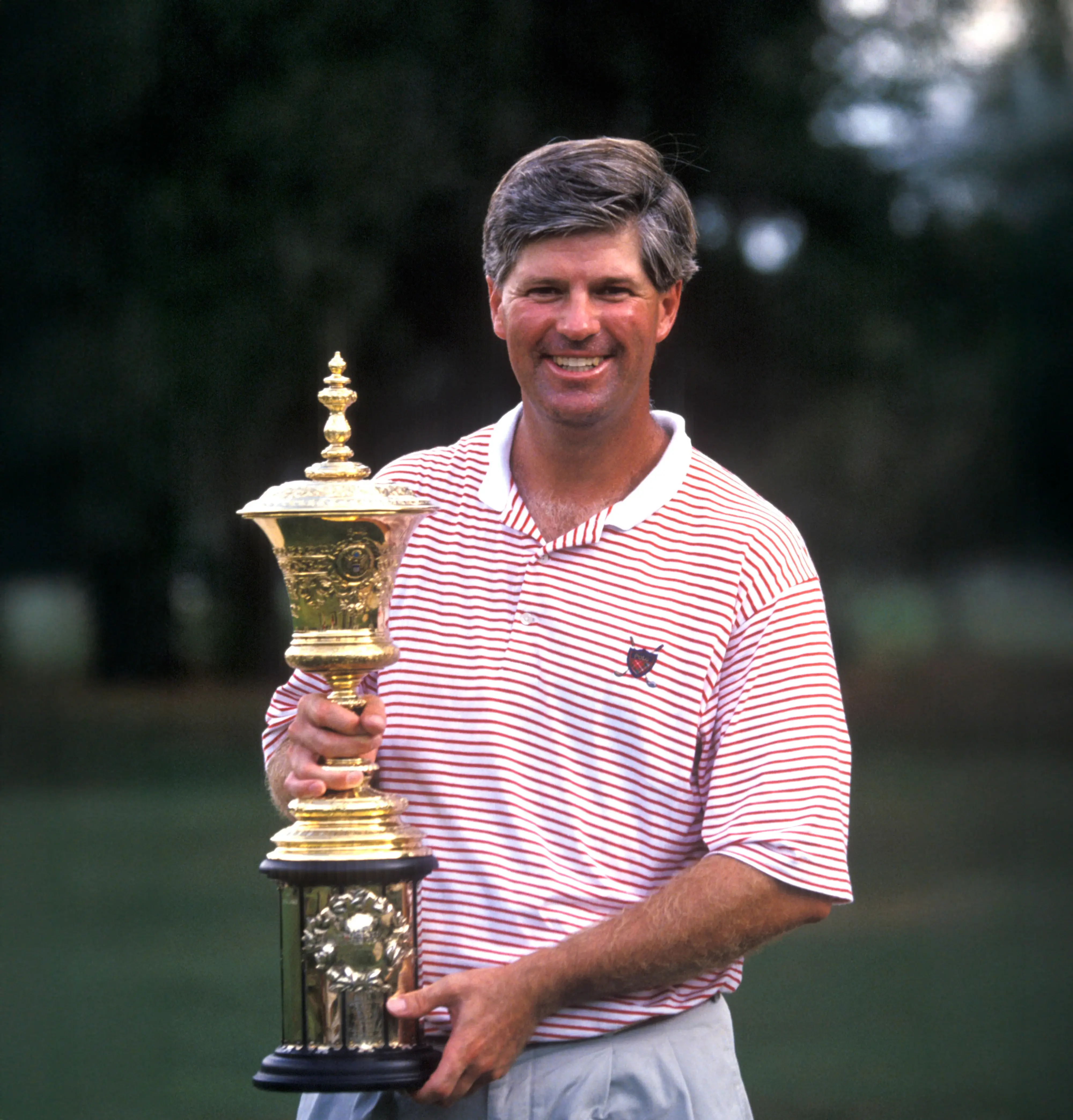
And testing himself against the best amateurs in the country/world also led to what could be considered the crowning achievement of his career -- the victory in the 1993 U.S. Amateur. Along the way to that triumph, he defeated Justin Leonard, who would go on to a very successful career on the PGA Tour that included winning the 1997 British Open. 

Harris also missed out on the chance to win more Minnesota amateur titles by playing as a professional from 1976 to '80 -- and then serving what was, at the time, the mandatory three years in purgatory ('80-83) for pros returning to the amateur ranks. And he had a second, longer stint as a pro, which began in 2002, when he turned 50 and joined the PGA Champions Tour. 

That second stint as a pro worked out pretty well. By that time, he had established a successful insurance business. (One of his partners was Bill Homeyer, the former Minnesota State Publinx champion whose daughter Hilary Lunke won the 2003 U.S. Women's Open.) So he was able to keep that going by working at it part-time, and he "supplemented" the insurance income with the $3.2 million that he earned on the Champions Tour.

The highlight of his more than a decade on Champions Tour was a victory at the 2006 Commerce Bank Championship, at the Eisenhower Park Red Course in East Meadow, N.Y. 

It should probably be pointed out that Harris had a significant advantage when it came to sports -- great genes. There have been very few families -- and maybe not any -- who achieved as much cumulative athletic success as the Harrises. 

The patriarch, Dr. Bob Harris, set a record at the Minnesota state high school hockey tournament in 1946 by racking up three points (2 goals and an assist) in 51 seconds while he and Rube Bjorkman were leading Roseau to a 6-0 victory over Rochester in the championship game. 

He went on to be the captain of the University of Minnesota hockey team. Golf got his attention after he finished Dental School at Minnesota, and despite the late start, he became an accomplished tournament player.

Dr. Bob and John won the National Father & Son tournament in 1974, and the Harris family owned the Minnesota Father and Son tournament during the '70s and '80s, winning it 12 times, five of those with the lineup of Dad and John. 

The two of them also accomplished what no other father and son have ever done in a one-year period -- both making the final of a USGA national championship. First, Bob Harris finished second in the U.S. Senior Amateur (1992), and 11 months later, John claimed his U.S. Am title ('93). 

Robbie Harris, the second-oldest boy in the family was captain of the Gopher hockey team in 1975, played on the U.S. Olympic team in '76. And he's got an MGA title on his resume, too. He and John Hawkinson won the State Senior Four-Ball championship in 2016.  

As successful as the Harris males have been, none of them has had as prolific stretch as Nancy Harris (now Nancy Blanchard) had from the mid-80s to the early '90s. She won just about everything there was to win. There were five MGA Women's Am titles in a span of seven years '83 to '89, plus two more in '93 and '94, and two four-ball titles, with two different partners, in '84 and '85. Nancy won the MGA Women's Match Play three times in 1984-85 and 1990, and was also the qualifying medalist five times during that span.

She played for the Gophers in the mid-80s -- and won nine college tournaments, then coached the team for five years (1987-91), before earning a degree in Physical Therapy, getting married and starting a family.

Like his father and his younger brother, John played hockey for Minnesota, and in 1974, he had what might rank as the best all-around sports year by an amateur in 1974. It started with hockey, and Harris was the second-leading scorer for the Gophers' first NCAA championship team. Two months after the hockey season ended, Harris won the Big Ten individual championship in golf, and two months after that he won this first State Am title. 

There were a lot of years that were really good for Harris on the golf course, but the best one had to be 1993. It was also a great year for Minnesota golf. The Walker Cup was played at Interlachen, and there were two Minnesotans -- Harris and Tim Herron -- on the U.S. team.

Heavy rain the night before the first day of competition wiped out the morning foursome matches. So that meant things started with the afternoon singles matches. Both Harris and Herron, who was an All-American at New Mexico that year, won, Harris by a score of 4&3 over Bradley Dredge. Herron edged a relatively unknown Padraig Harrington 1-up.

The next morning, Harris and Herron were paired together the in foursomes, and they won 1-up over Raymond Russell and Dean Robertson.

For anyone who wondered why Harris was so successful as a golfer, all they really needed to do was watch his second shot at the 545-yard, par-5 12th hole that August morning in 1993. This was 32 years ago, and the equipment wasn't nearly as souped up then as it is now, so when Herron hit a 300-yard drive down the hill off the tee, leaving Harris with a 245-yard second shot up the mountain that you have to climb to get to the 12th green at Interlachen, most of the people in the gallery simply assumed that he would lay up.

After all, that 245-yard shot was really more like a 265-yarder, given the elevation. And when Harris pulled out his 1-iron, everyone was sure he was laying up, probably trying to leave Herron a 30 -or maybe 40-yard pitch to the green. Even if Harris could hit a 1-iron that far, there was no way he could hit it that high.

But he did. He hit this majestic, towering 1 iron that landed in the middle of the green -- softly -- rolled about 20 feet and left Herron a 20-footer for eagle. They two-putted and won the hole with a birdie. 

Then came the afternoon singles matches. Ian Pyman was considered to be the Next Big Thing in European golf at the time, and coming into the Walker Cup Matches, he was easily the most publicized player for the Great Britain & Ireland team. (He had just finished as the low am in the British Open with the lowest score ever shot by an amateur.) Harris played him, beat him 3&2, and that was the clinching point in a 19-5 U.S. drubbing of the GB&I team. 

In the process, Harris demonstrated that what he had done in the morning at No. 12 was no fluke -- when he did it again. It was almost eerie how close his drive against Pyman was to where Herron's had ended up in the morning. Right next to the 245 plate in the middle of the fairway. And once again, Harris hit a 1-iron shot that soared higher than most elite golfers at that time could hit a 7 or an 8 iron. It landed softly, once again, and wound up within 25 feet of the cup.

(Of course, there was actually at least one guy in the field that year who could hit those kinds of moon-shot long irons that Harris was hitting. But that guy was only 17 years old, and Tiger Woods wouldn't win his first U.S. Amateur crown until the following year.) 

Back then, in 1993, there was only one Minnesotan who had won the U.S. Amateur in the century since the tournament had first been played, and that was the legendary Jimmy Johnston. In sort of the same way that Harris dominated Minnesota amateur golf in the late '80s and early '90s, Johnston dominated the '20s, winning seven State Ams in a row, from 1921 to '27, and he capped off the decade by winning the 1929 U.S. Am, beating Dr. Oscar Willing 4&3.

Harris went Johnston one better. He won the '93 final 5&3 over Danny Ellis.


Reflections:

“At all times John conducted himself as a gentleman. He was a longtime friend, business partner, Godfather to one of my daughters and he will be missed by all who knew him.” -- business partner and friend, Bill Homeyer. 


“He and I played a lot of golf together over the past 40 years, and you never knew if he made five birdies or five bogeys in a row, his disposition on the course never changed. John’s tremendous competitive attitude served him well playing two sports at the University of Minnesota including hockey under the legendary Herb Brooks. Watching him play [golf], I was never surprised by the success he found at the highest amateur and professional levels of golf.” -- fellow Edina Country Club member and golf partner, Dick Blooston.


“If you were around John, he never talked about his golf or any of his accomplishments. He always wanted to know how you were doing, whether or not it was golf related. He had a great memory in that he knew, for example, who your favorite sports team was, how your family was, or what you liked to do away from the game. On the golf course, John was the ‘ultimate grinder,’ there was never any quit in his game until the last putt was dropped. That competitive nature I believe he got from his dad, Dr. Bob Harris, and it carried over whether he was playing cards, board games, or whatever. When it was over, you'd shake hands and look forward to the next game.” – retired head golf professional at Edina CC, Marty Lass.  

John Harrigan 1932-2025

John Harrigan 1932-2025

John Harrigan, 93, passed away at his home in Boynton Beach, Fla., November 15. Originally from Waterloo, Iowa, Harrigan graduated from Stillwater...
Continue Reading →
Where They're Going - Class of 2026

Where They're Going - Class of 2026

NAME HOMETOWN COLLEGE LEVEL Nora Benson (Long Lake, Minn.) Augustana University – Division II Brooke Brekke (Atwater, Minn.) Colorado Mesa...

Continue Reading →
How They're Doing: Minnesotans on Pro Tour Money Lists -- Nov. 17

How They're Doing: Minnesotans on Pro Tour Money Lists -- Nov. 17

Players from Minnesota or with Minnesota connections:2025 PGA TOUR Pos. Name (Prev.) From Events Money won 48. Tom Hoge (48), Fargo, N.D., 28...

Continue Reading →