




Directory 2021




















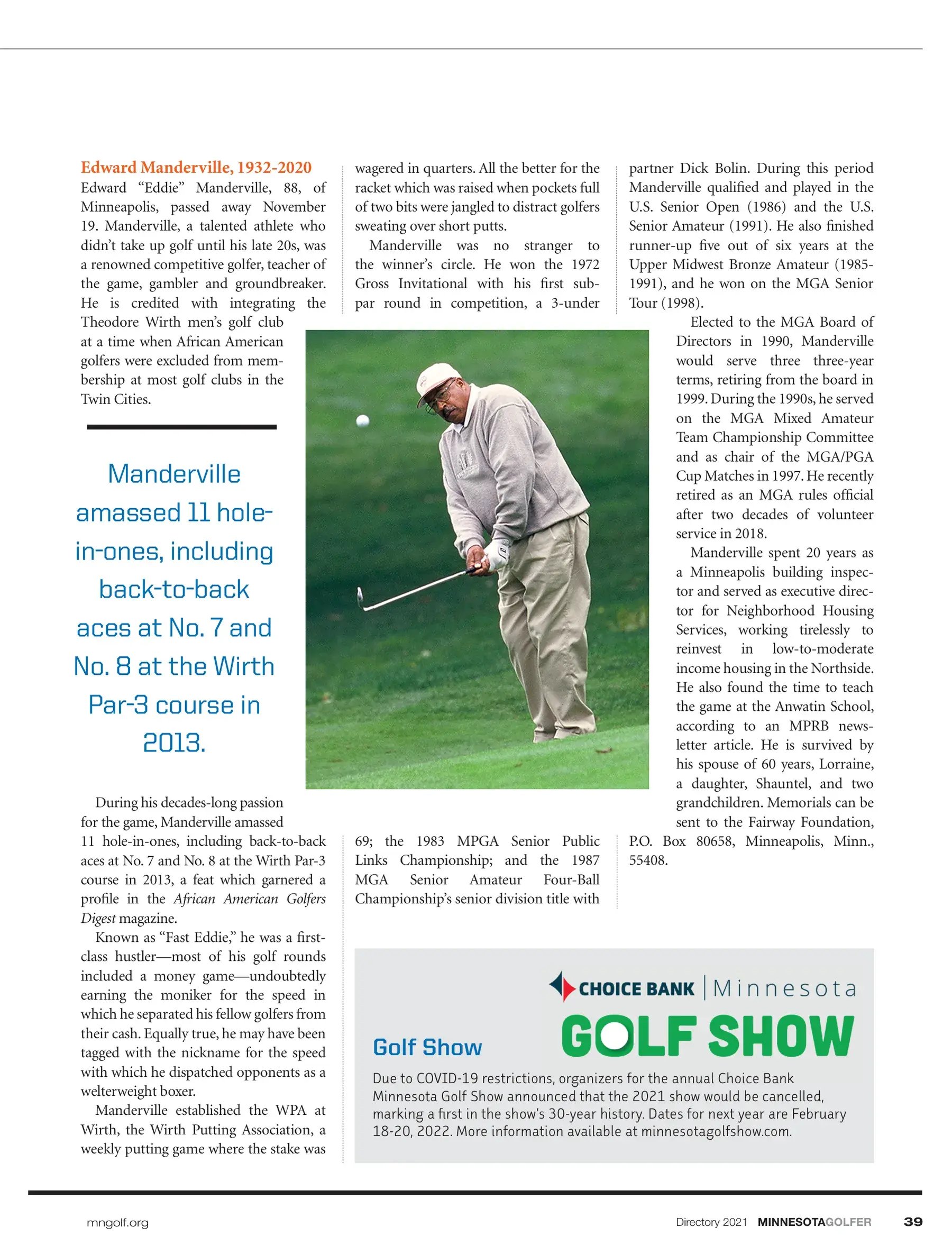




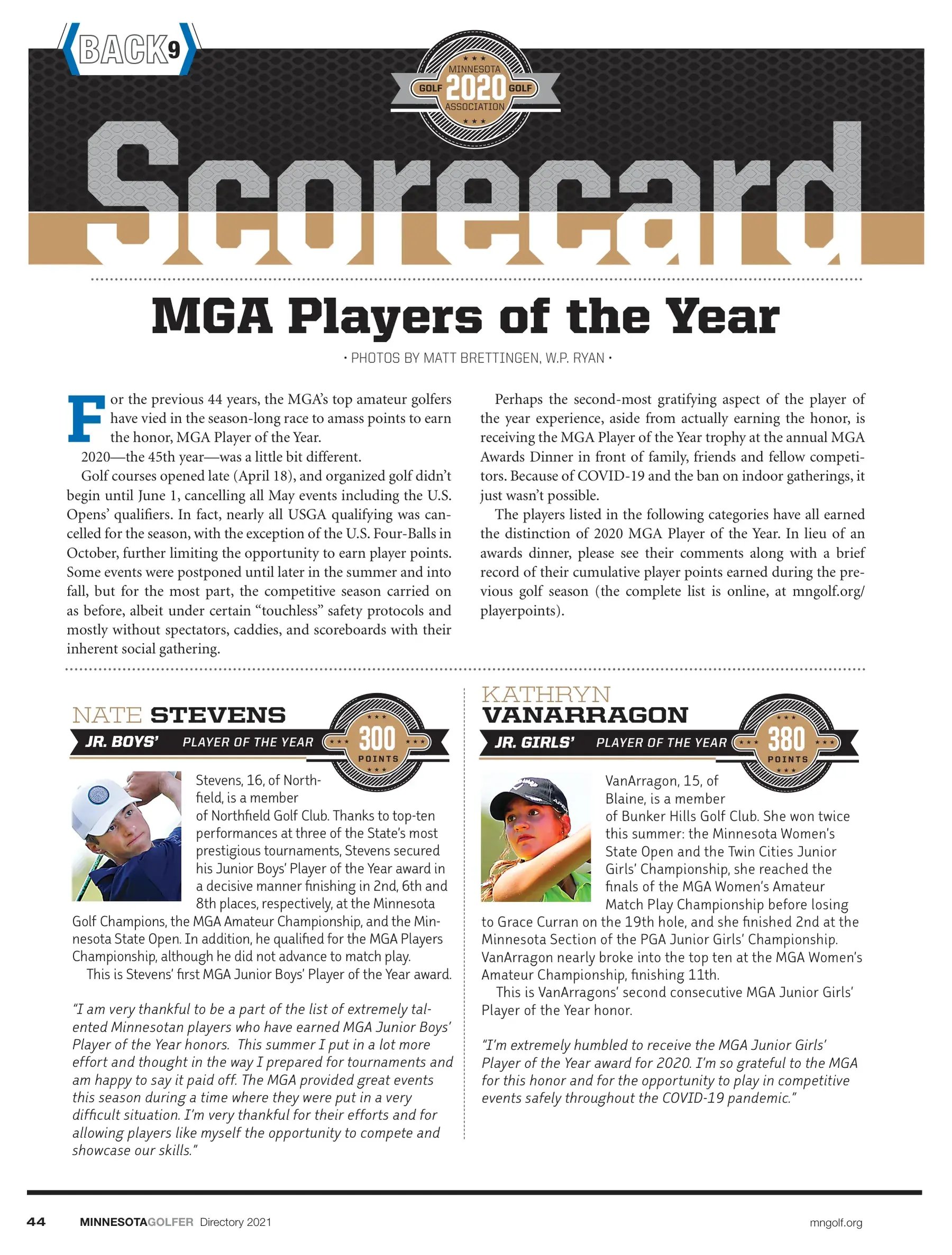

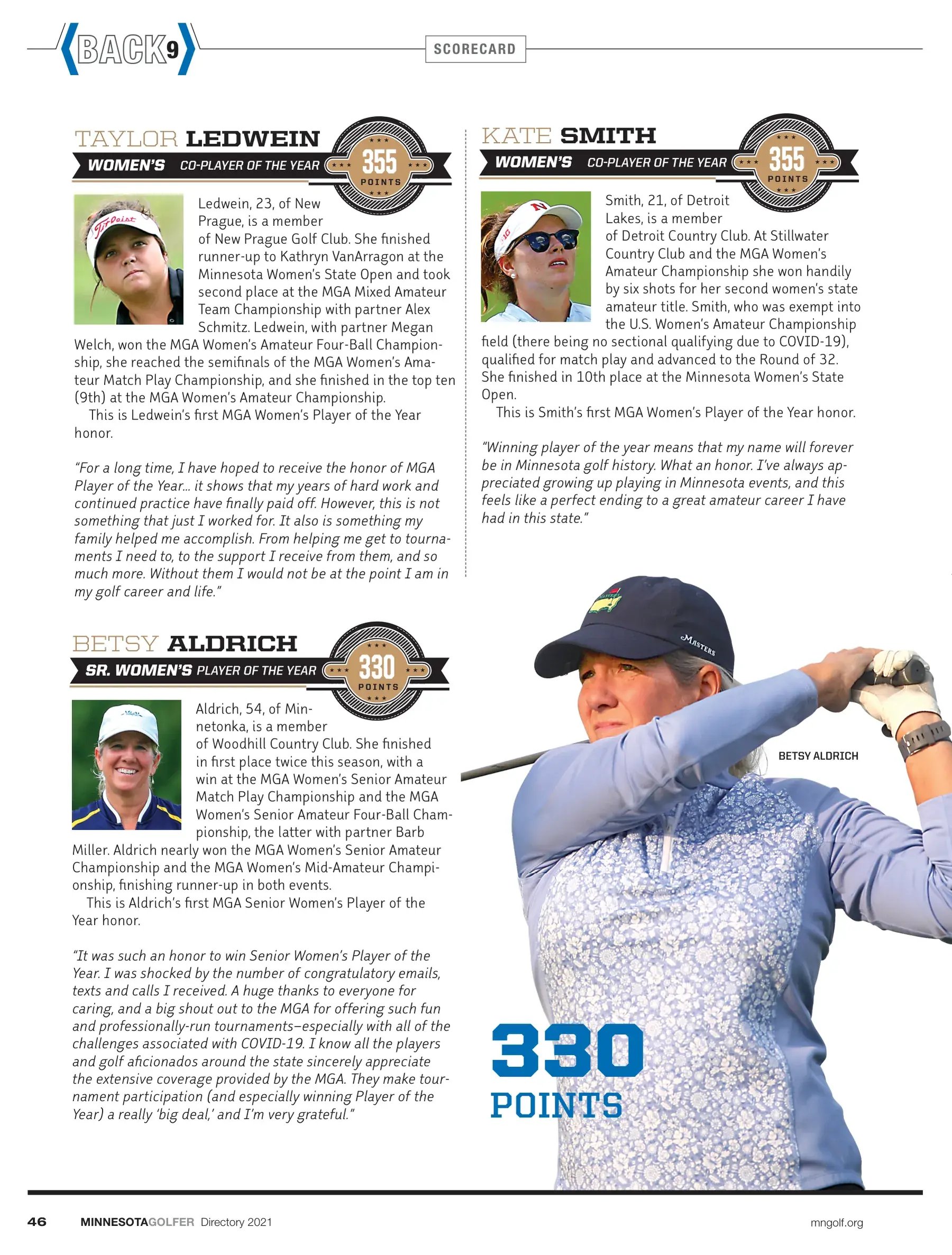

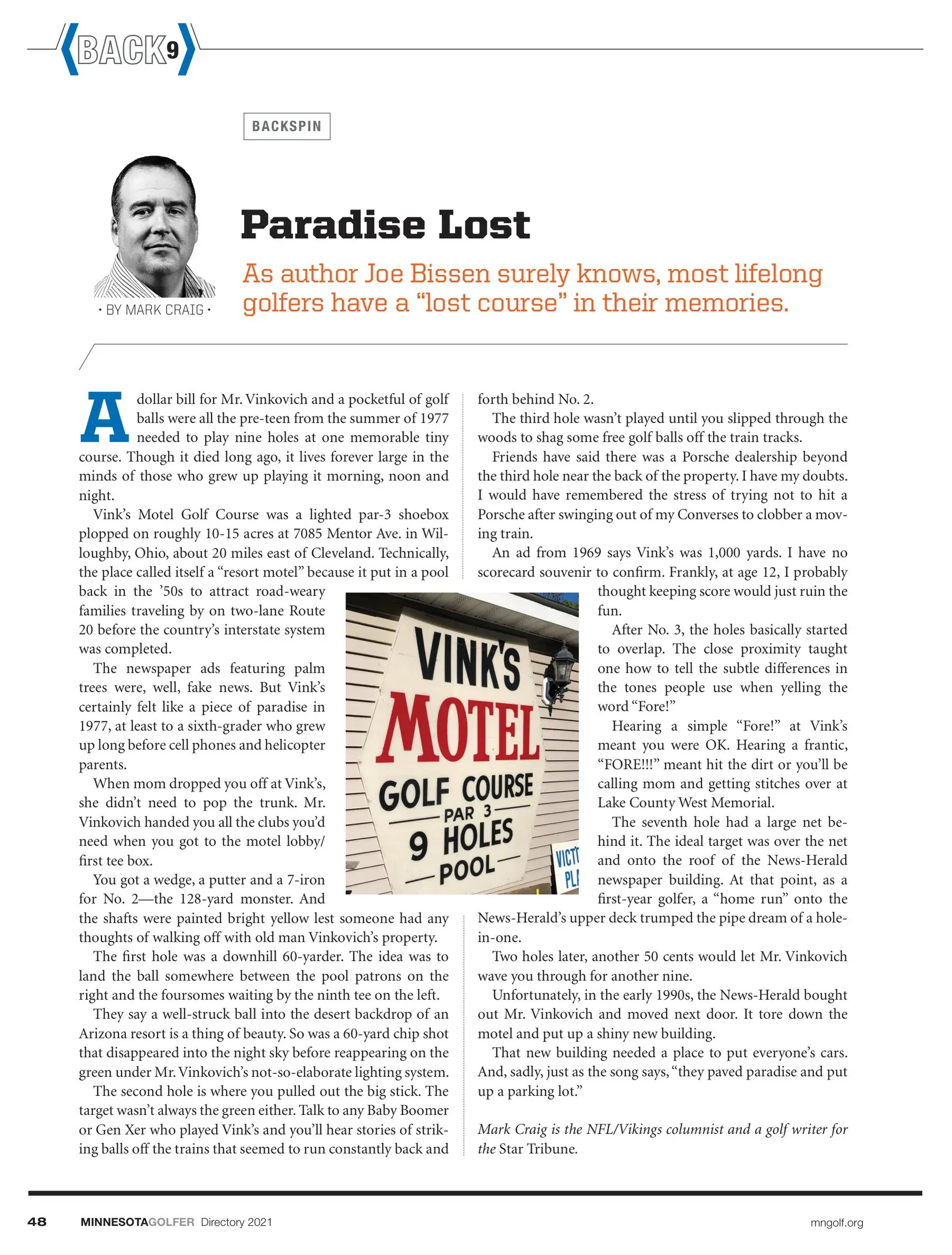










Back to The Minnesota Golfer Archive
Read the text of this issue
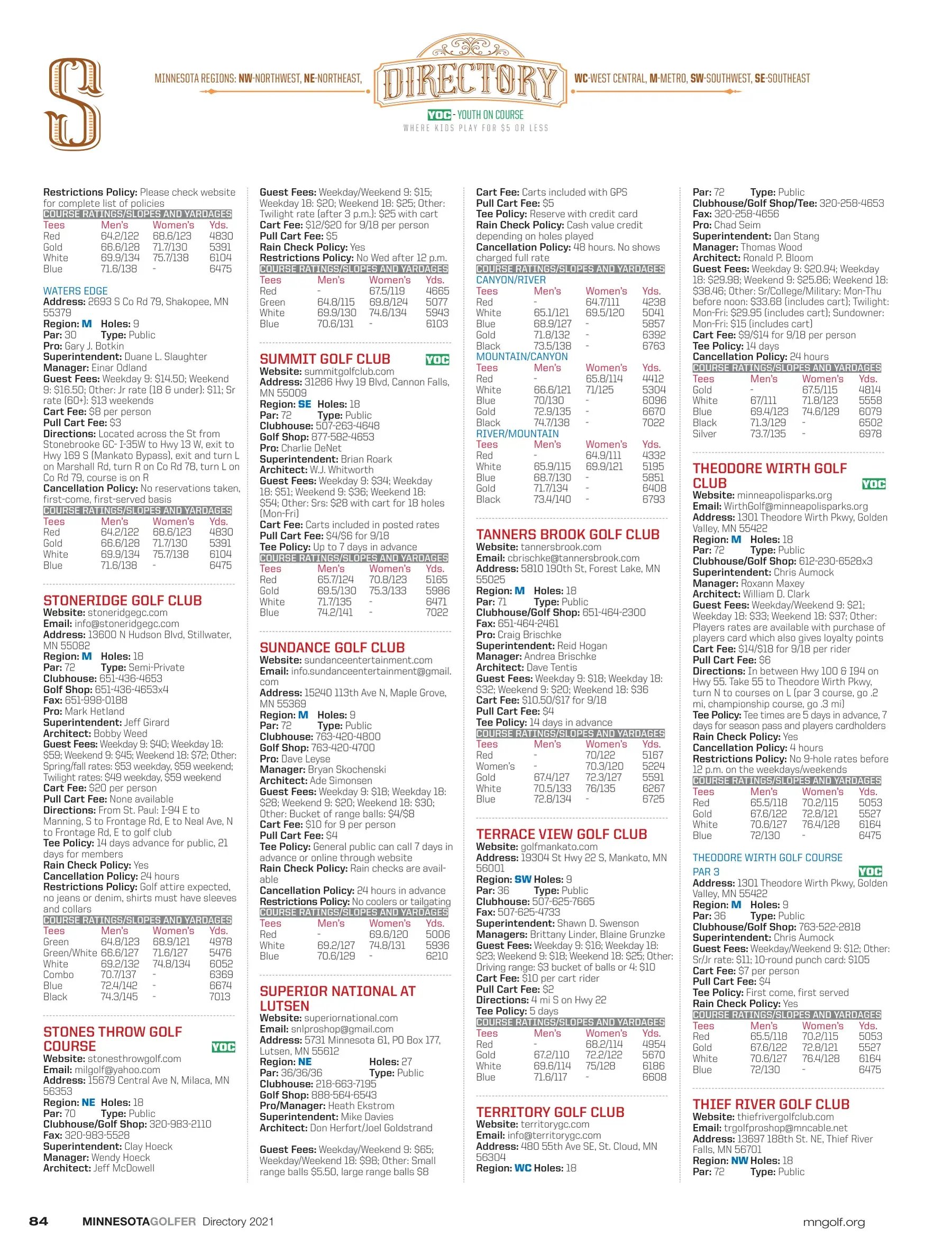
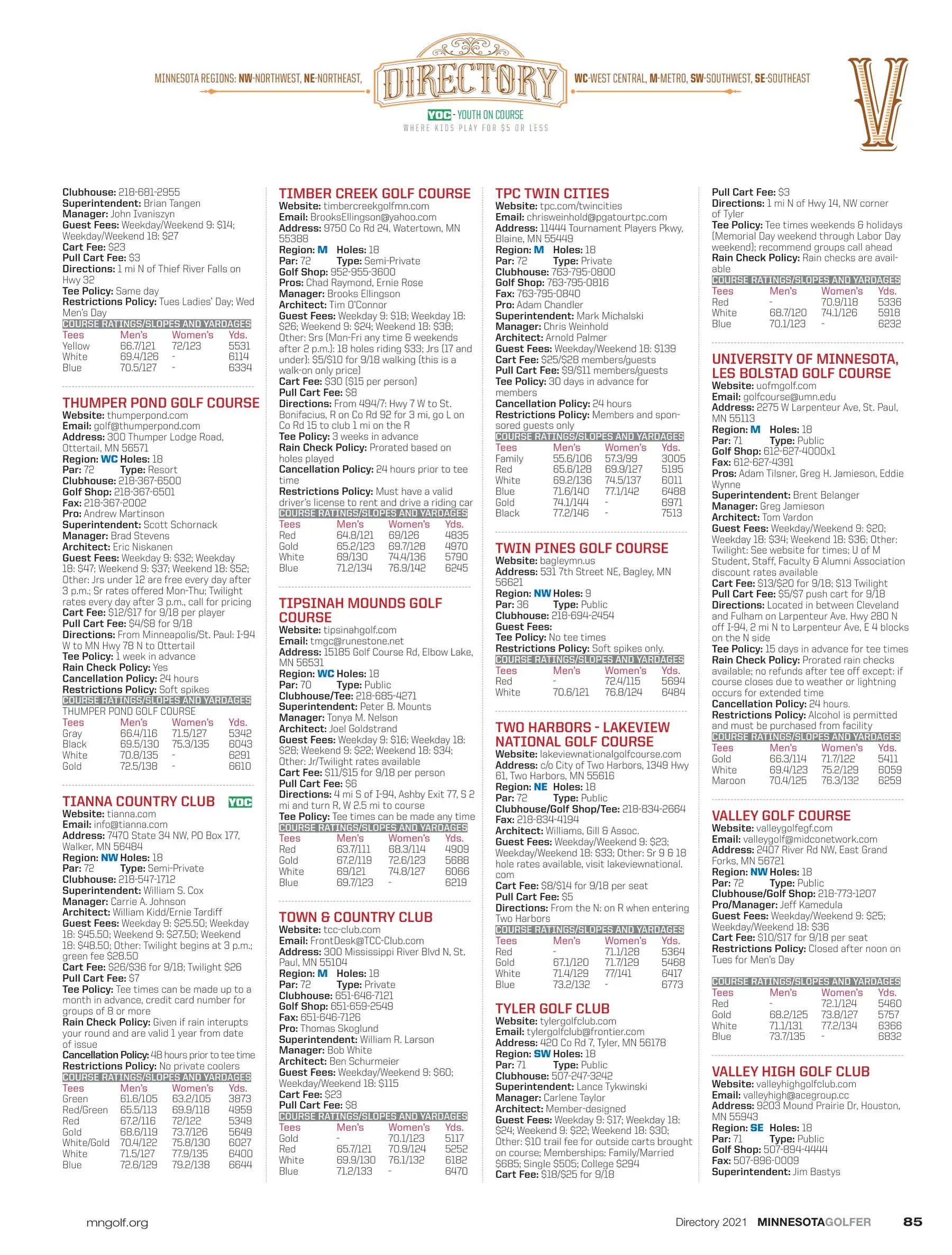
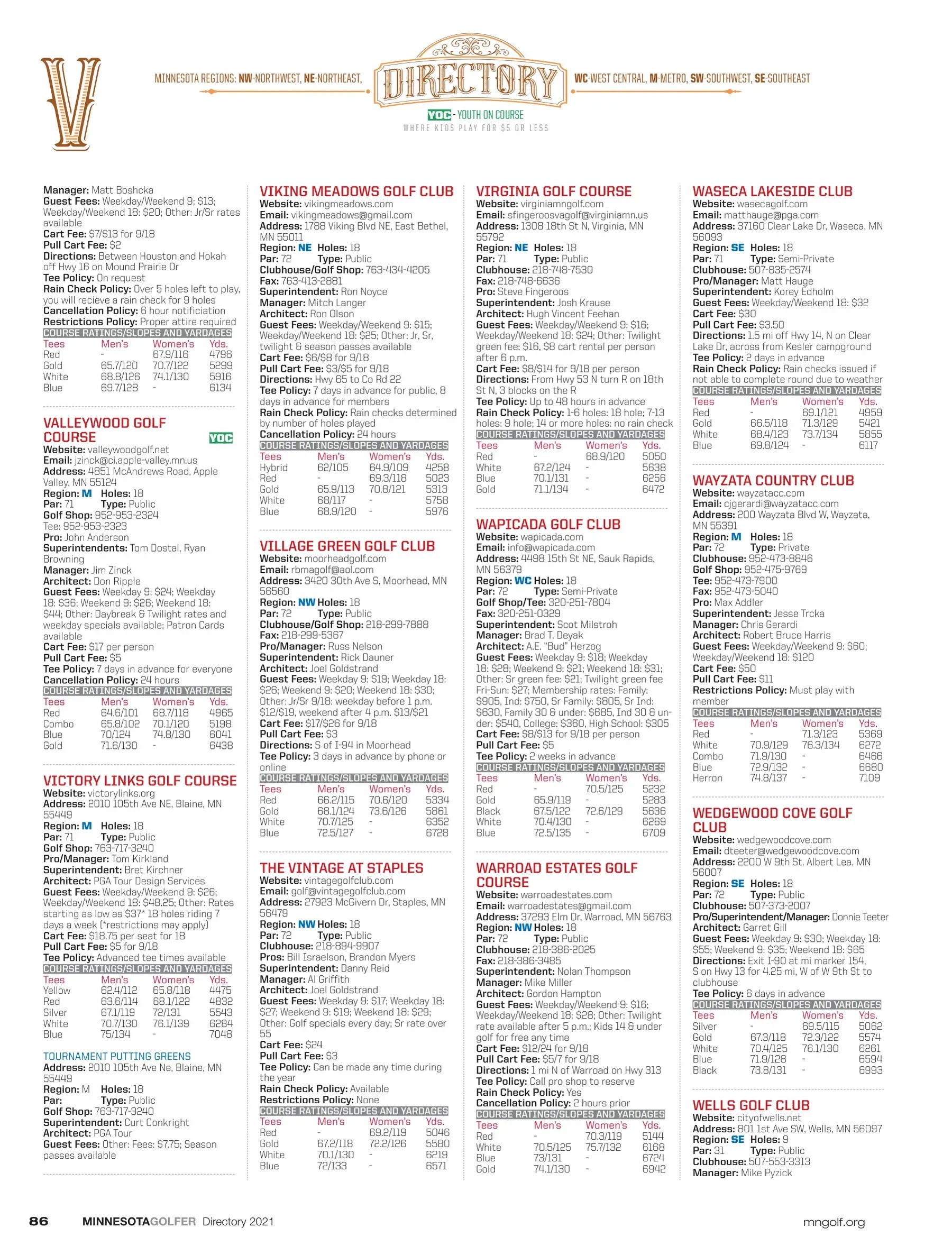
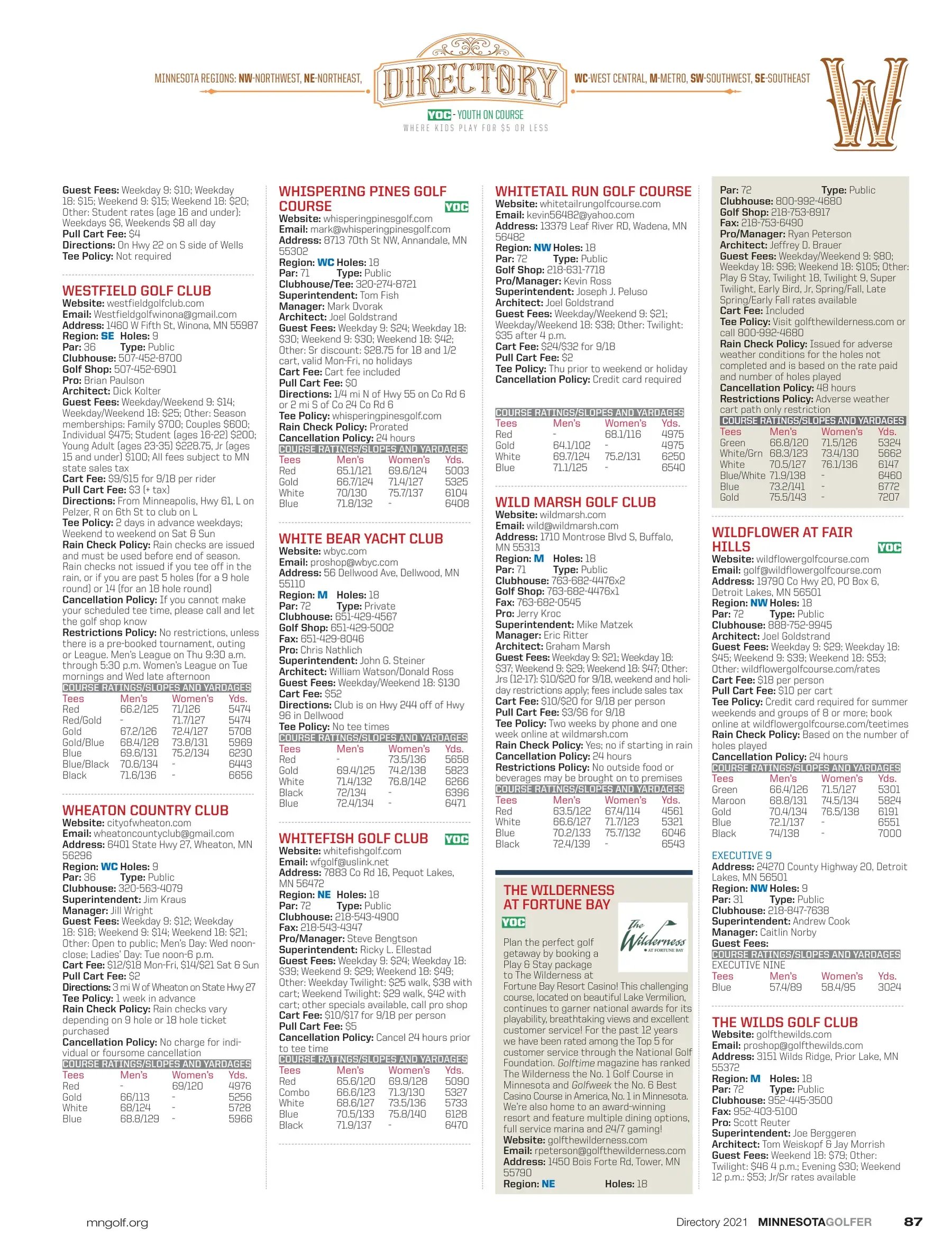
Text from the printed pages, so it can be searched and read by screen readers. Layout and photography are in the reader above.
Harris, MI • www.islandresortgolf.com • 877-ISL-GREEN #13 Sweetgrass #4 Sage Run Award-winning golf has become a centerpiece of the Island Resort & Casino. Sweetgrass, consistently ranked among Golfweek’s Best Courses, features an open layout with some of the game’s most fun greens to putt (Redan, Biarritz, Island, and Double-green). The Island Resort Championship at Sweetgrass is part of the Symetra Tour - “Road to the LPGA” and the future of women’s golf. Sage Run Golf Club provides a different kind of golf experience where holes flow through the hardwoods and around a drumlin ridge.
Sweetgrass and Sage Run: dramatically different, but equally exceptional. MGA is now mobile. Smartphone owners will find web content displayed in a mobilefriendly format, while MGA members who log in with their GHIN ID and last name will be able to post scores, search for courses by “nearest” location, and follow live scoring during MGA and USGA events.
16 | DRIVING MINNESOTA IRON RANGE TOUR By Chuck Lennon Golf in the Far North, where birdies and wildlife mingle. 20 | LOST ON THE RIVER By Joe Bissen, Art by Dean Lavato An excerpt from the author’s new book: “More! Gone. Minnesota’s Lost Golf Courses, Part II.”
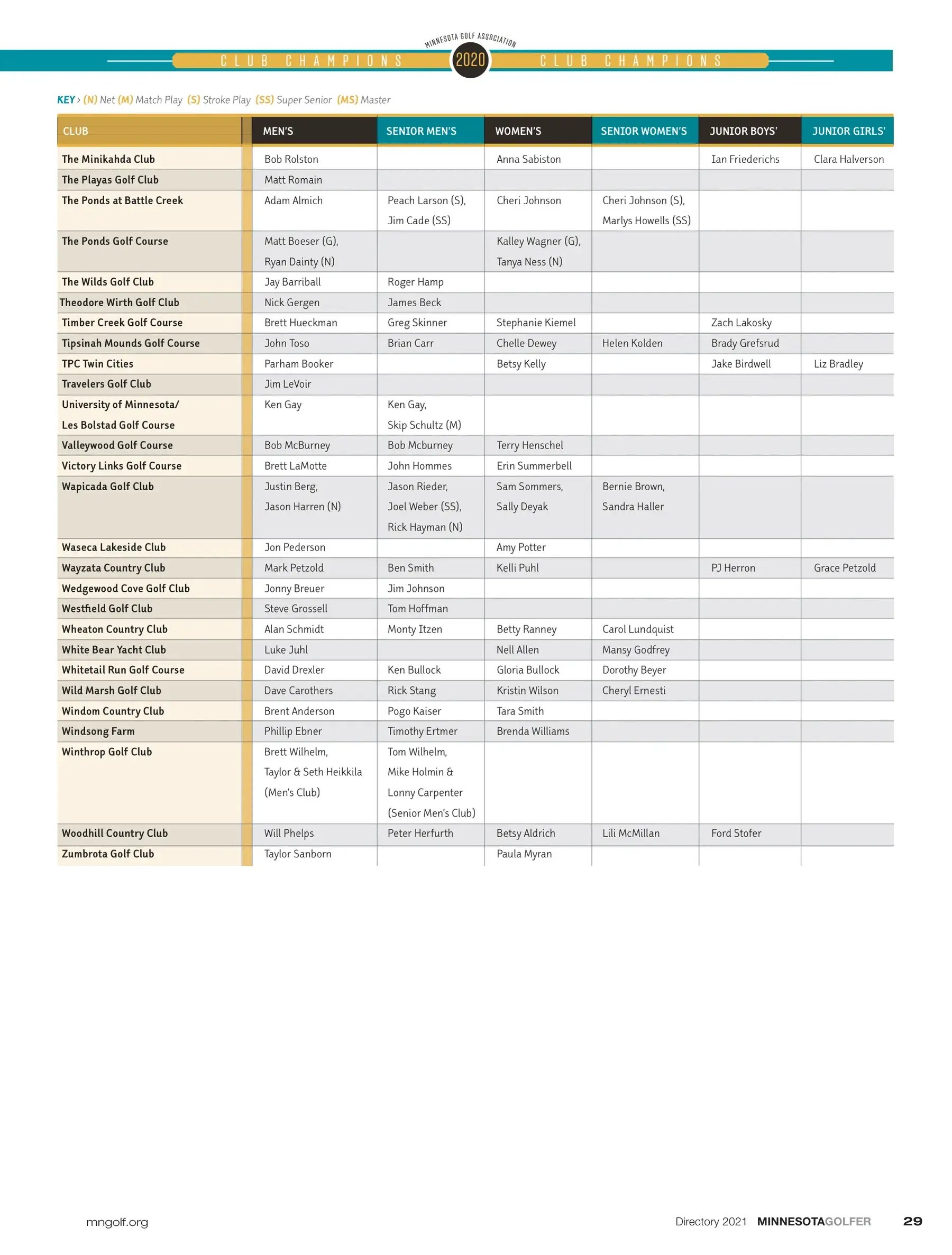
24 | CLUB CHAMPIONS The Club Championship winners roll call from around the MGA. 30 | GOLF TALES By Joseph Oberle and W.P. Ryan Kathy Williams’ golf life and Doug Carnival—lobbying on the game’s behalf.
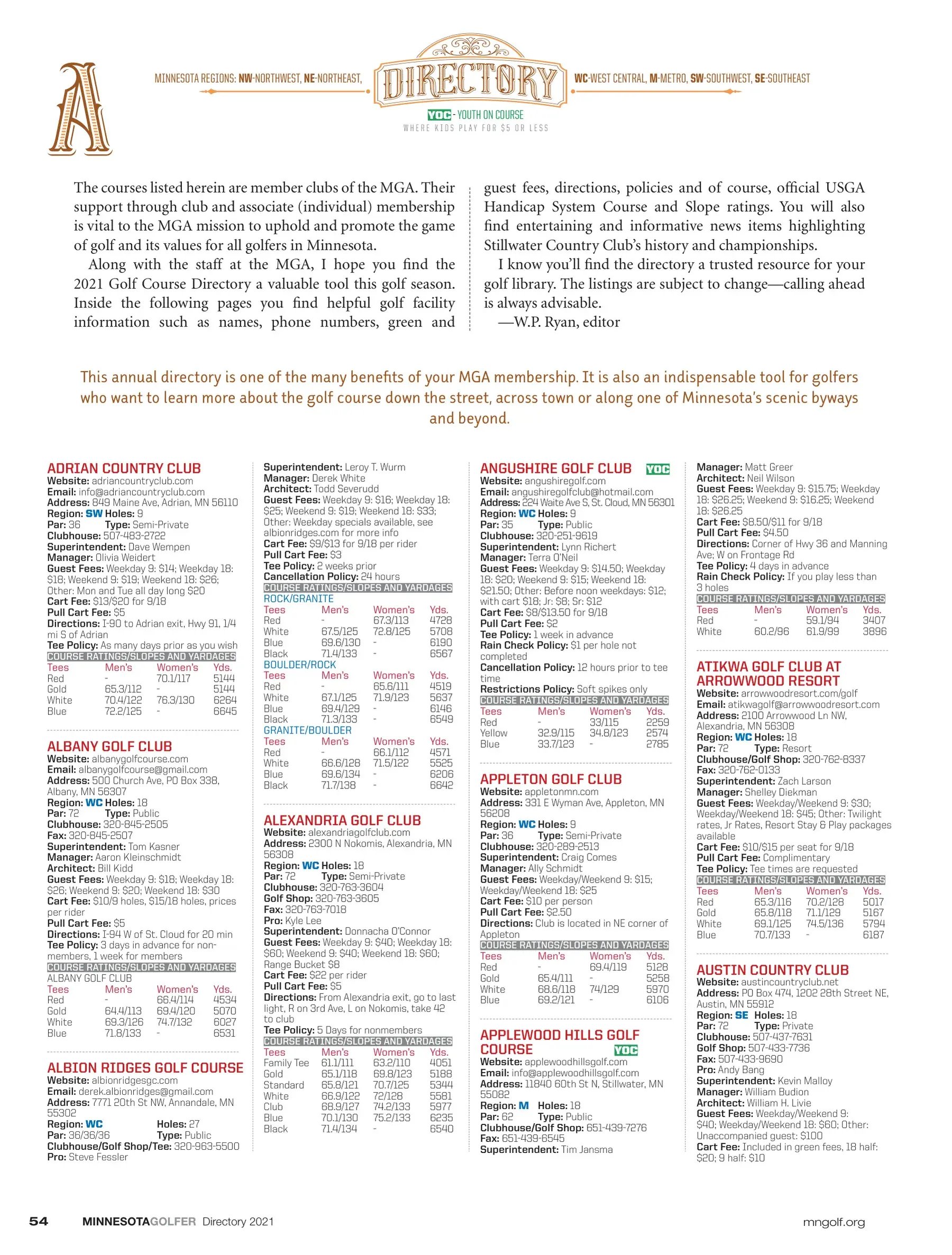
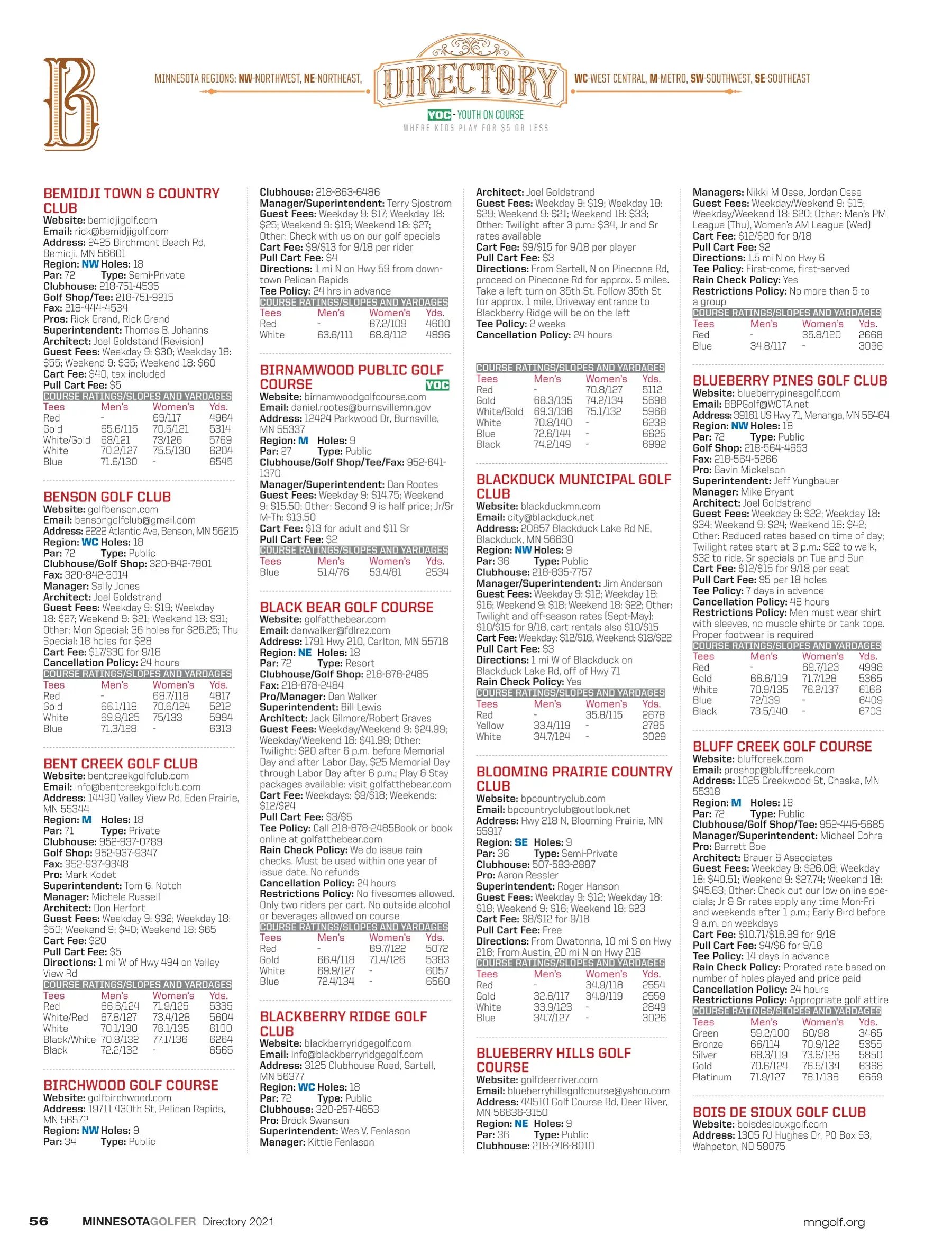
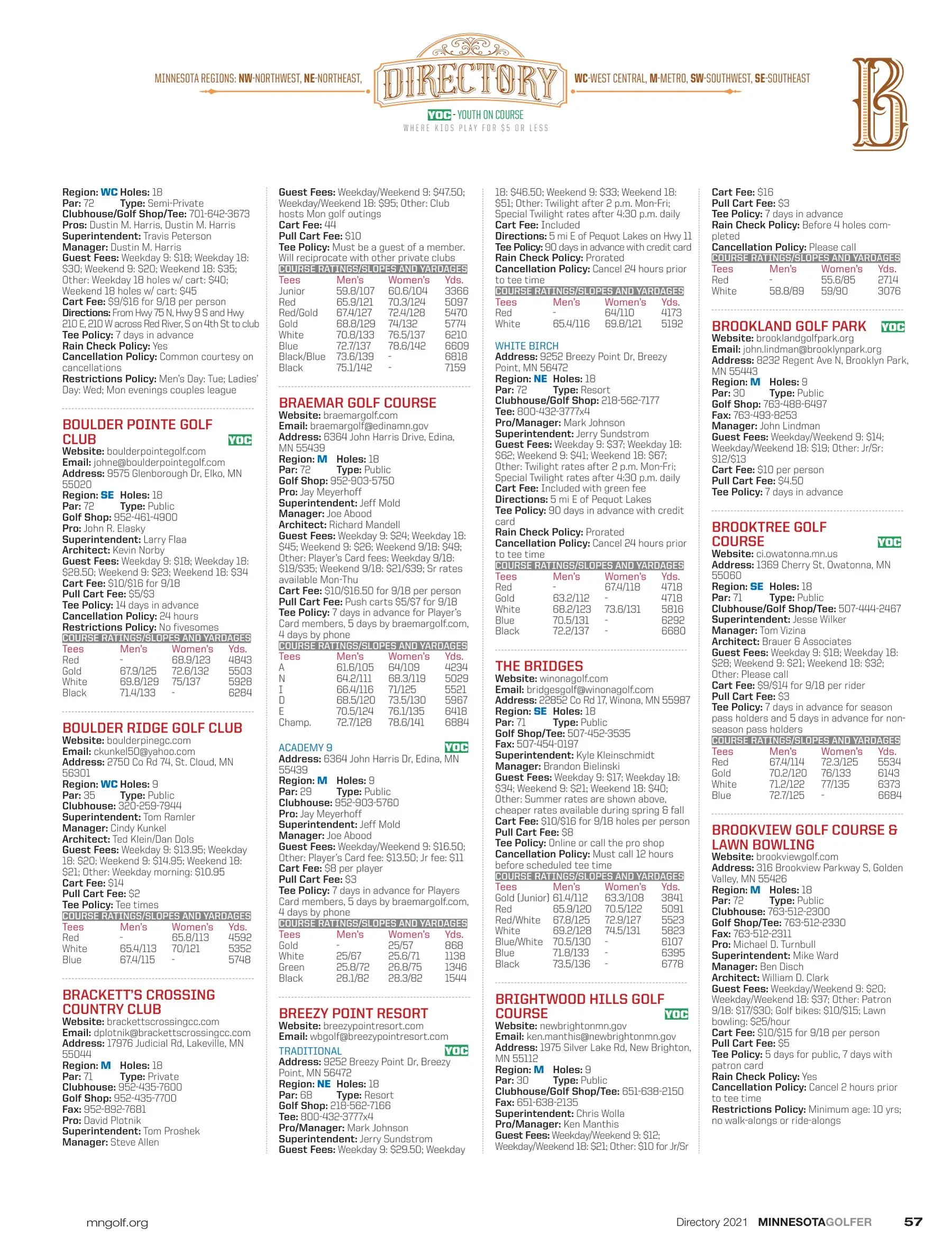
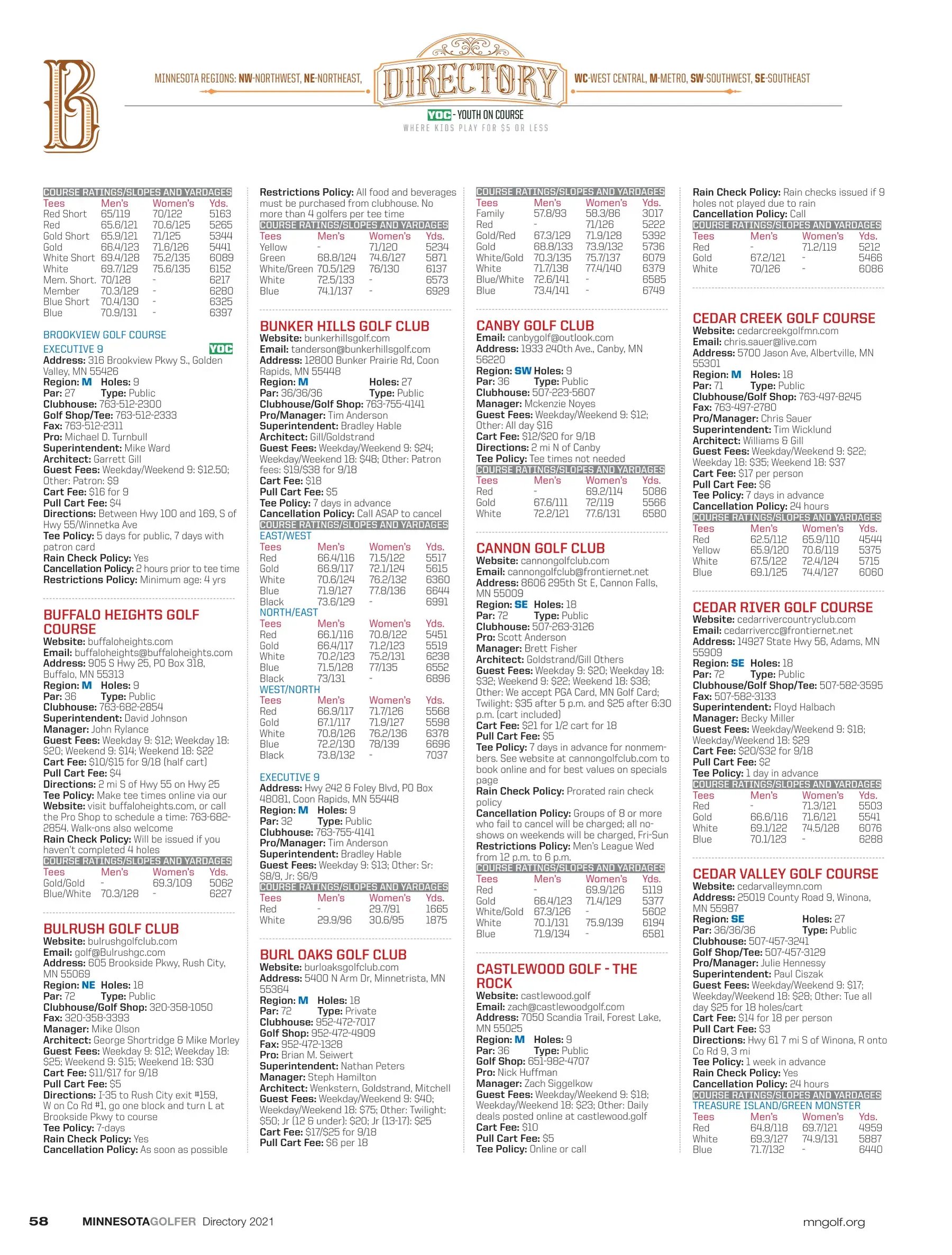
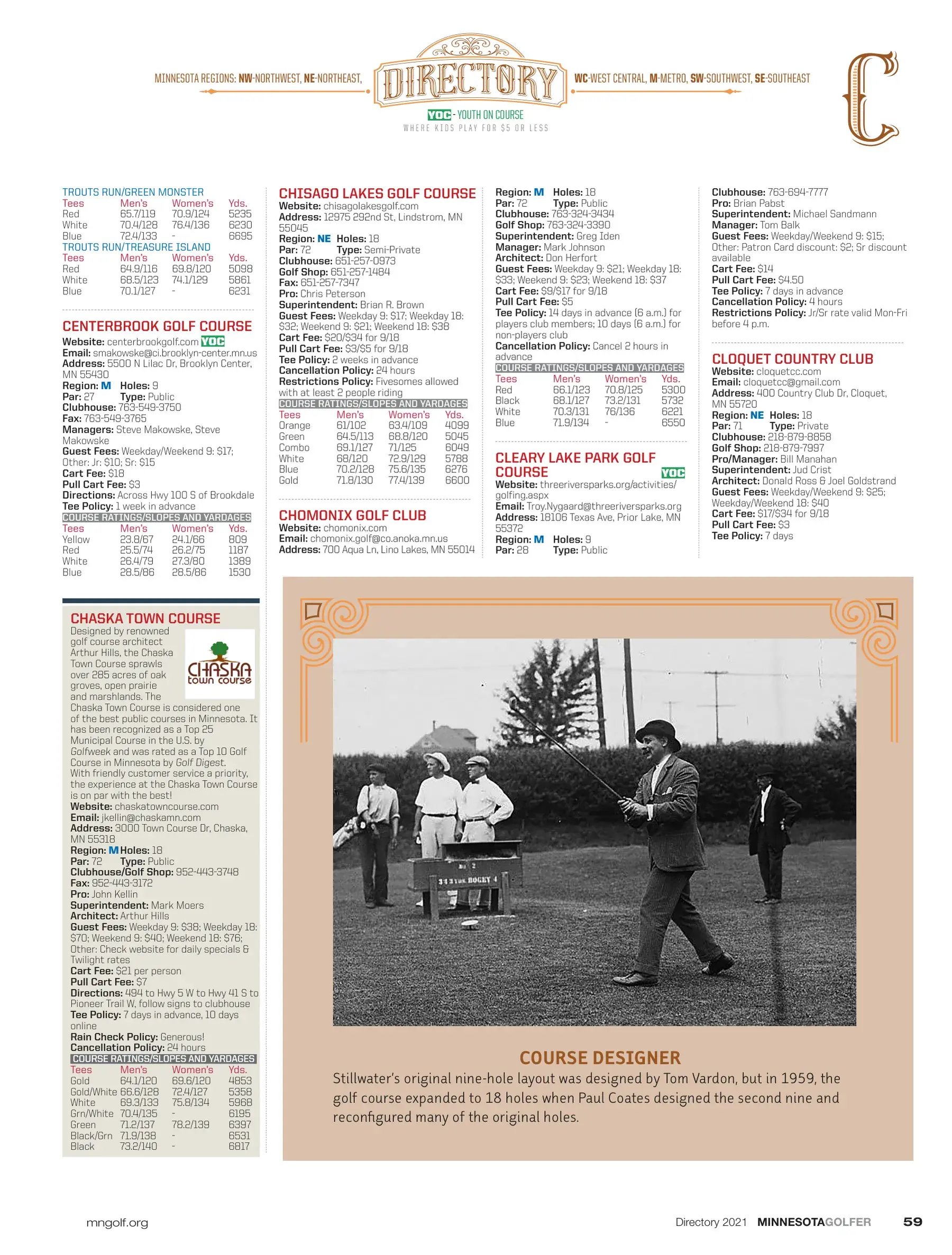
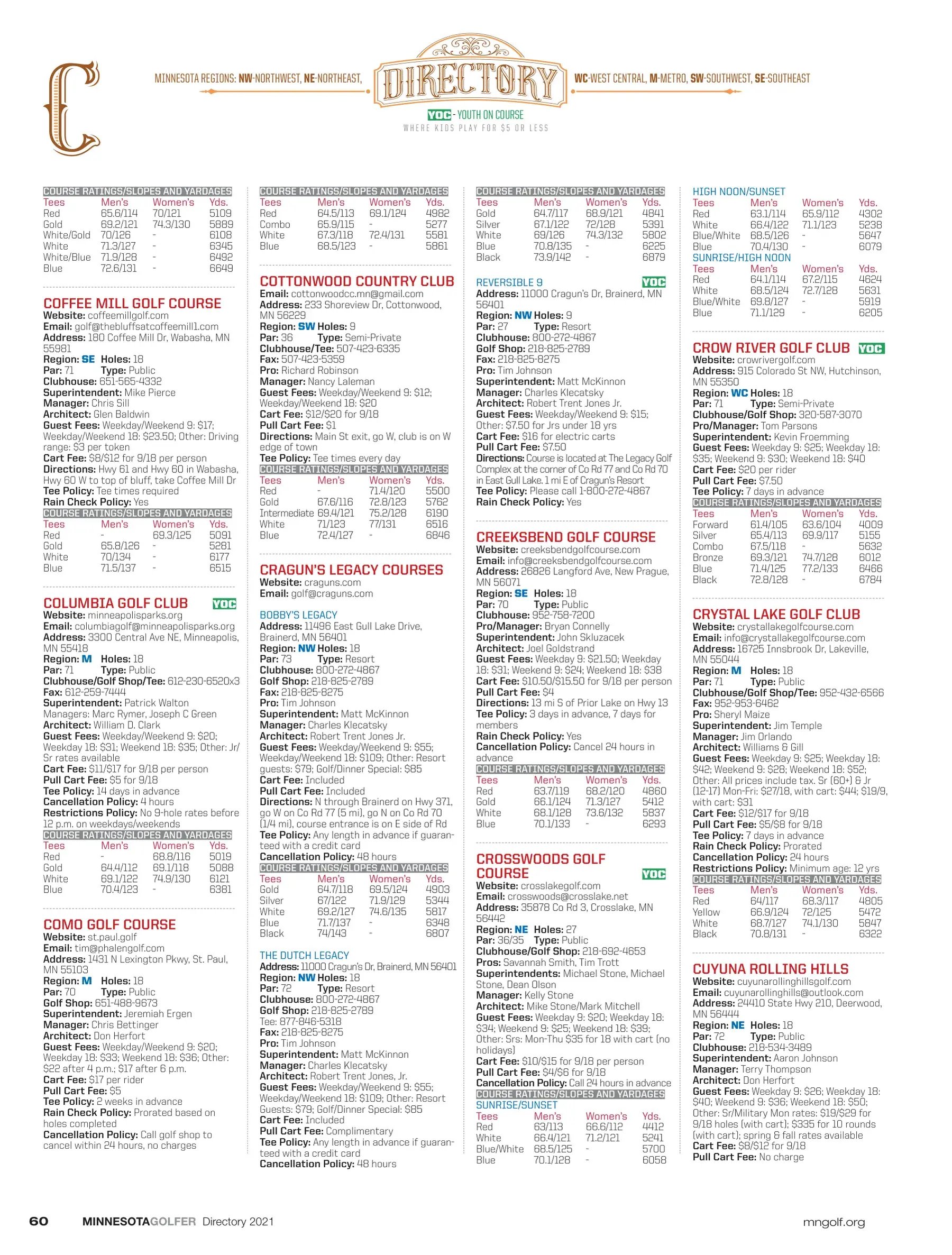
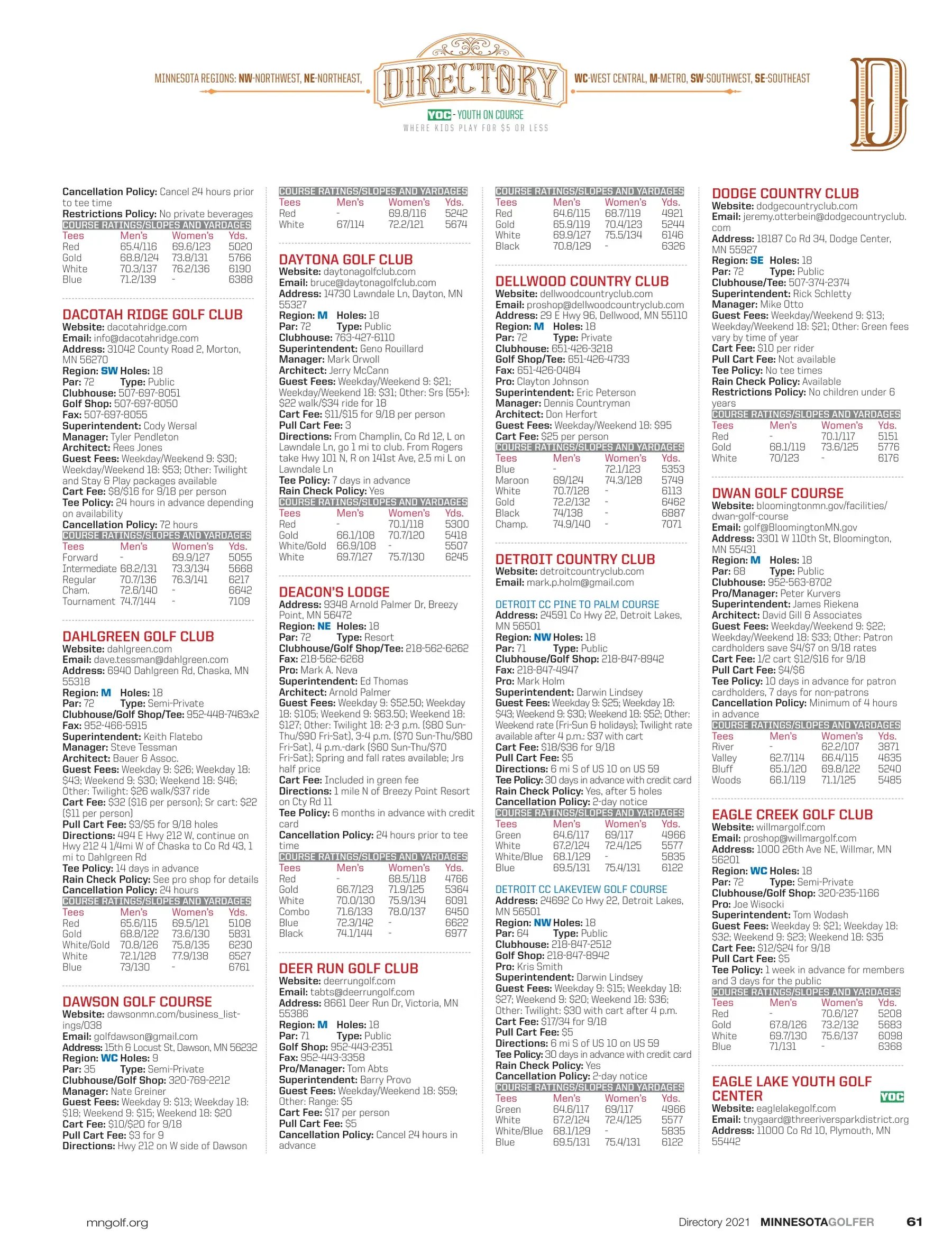
52 | MGA GOLF COURSE DIRECTORY By W.P. Ryan, Introduction by Rick Shefchik, Boxouts by Eric St. Peter Your complete guide to Minnesota golf courses.
Subscriptions: Regular U.S. one year (4 issues) $18. Directory issue of Minnesota Golfer: $9.95 plus shipping, pre-paid. Other single copies: $2.95 per copy plus shipping, pre-paid.
Copyright © 2020 MGA The MGA upholds and promotes the game of golf and its values for all golfers in Minnesota. Minnesota Golf Association Inc.
Legislative Counsel McGrann Shea Carnival Straughn & Lamb, Chartered OFFICE Volume 49, Number 1 Directory 2021 A s with any great party, there is a letdown and cleanup. If there is any doubt that the game and business of golf experienced a rollercoaster of a ride during 2020 and the great x-factor, the COVID-19 pandemic, consider that at one point last spring we weren’t even sure golf courses would be open for play. Once we understood that golf would open and that we could safely play both recreational and competitive golf under Play Safe Minnesota protocols, golf participation exploded.
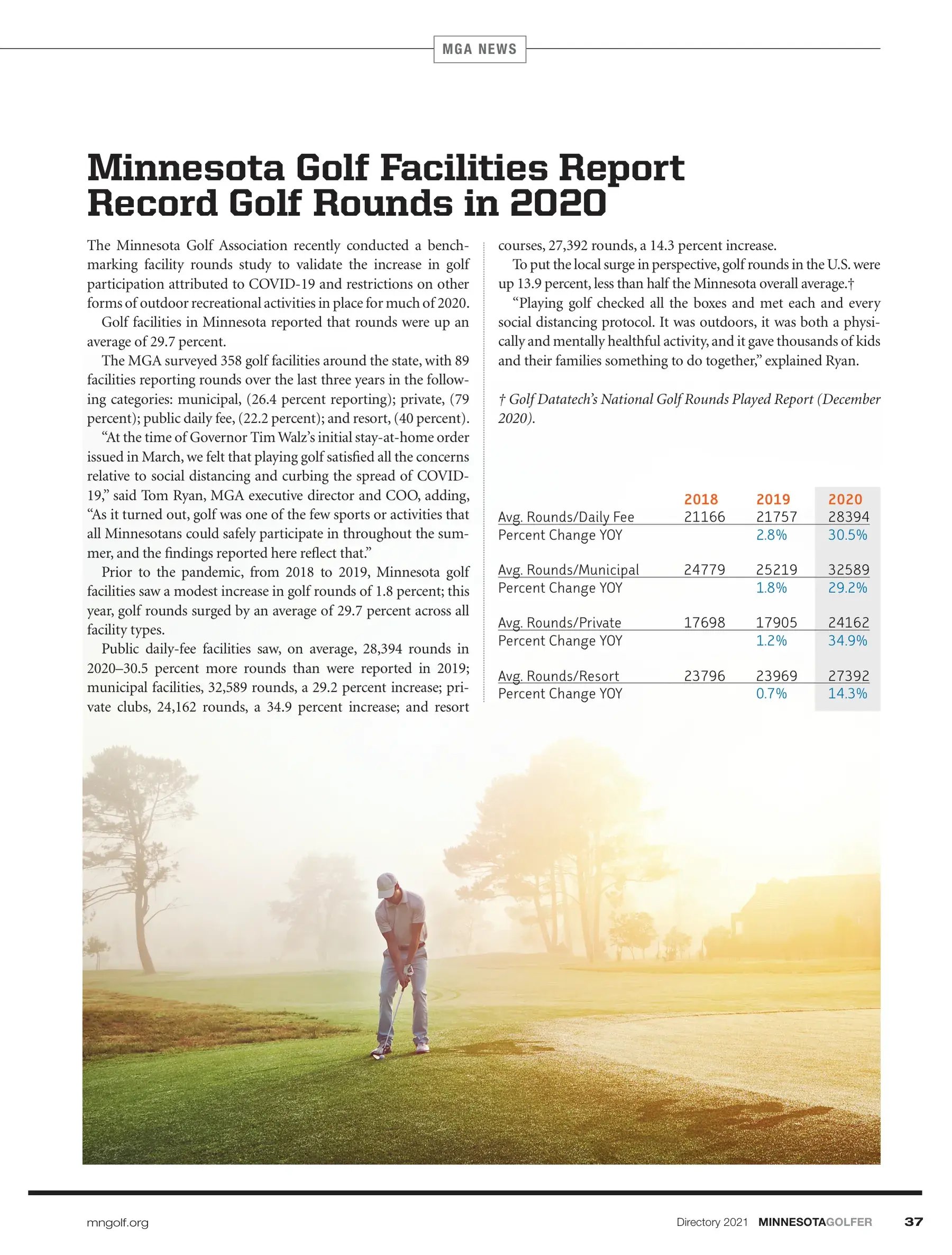
Rounds surged nearly 30 percent over the previous year, according to a golf facility survey completed by the MGA at the end of 2020 (see more results, p. 37).
Likewise, MGA members posted 1.4 million rounds for 2020, up 48 percent, with the average member posting 18.7 rounds. Among other programs and services, the MGA administers the USGA Handicap System in Minnesota, providing handicap indexes for its 75,000 members at nearly 400 member clubs across the state†.
The National Golf Foundation reports that 20 percent of Core golfers, those who play eight or more rounds per year, “upped their engagement” significantly in 2020, due to COVID-19 restrictions on travel and thanks, in part, to the flexibility of playing golf while working remotely. However, NGF says this “zealous” golfer expects to play 10-15 percent less in 2021, regardless of the circumstances surrounding the pandemic.
On the other hand, the remaining Core group, about 4 million golfers who said they reduced their play and golf spend during COVID-19, expect to be more engaged in 2021 regardless of the pandemic situation.
You might say this is called finding the silver lining. Weather aside, the NGF believes 2021 will see a rebound in golf travel and “event golf,” such as leagues, outings and the like. Most golf industry stakeholders concur.
As the COVID-19 vaccine is more widely available in 2021 and pandemic restrictions ease further, it bodes well for organized golf and our public and private facilities who thrive on dining, weddings and banquet operations. Pent-up demand may well create a surge in these golf-related social activities in 2021.
Largely unknown is what happens when society returns to normal. For example, Minnesota Youth on Course golfers, ages 6 to 18 who can play golf for $5 or less, joined in record numbers during COVID-19, up nearly 250 percent. When schools reopen and other organized youth sports return to normal levels of participation and operations, will golf retain these kids?
Very likely, we’ll see some attrition in MNYOC participation. Joel Comstock, the MGA’s director for MNYOC, has budgeted for 25 percent fewer YOC golfers in 2021.
Since post-pandemic planning is partly educated conjecture, these waters are largely uncharted. While the only thing to celebrate about COVID-19 is that one day it will be in our collective rear-view mirror, for the industry, 2020 will be remembered as the summer that golf participation made a comeback.
Let’s skip the hangover. Last year’s surge will surely impact golf 2021, and beyond. See you on the tee. Will Golf Experience a Post-Surge Hangover?
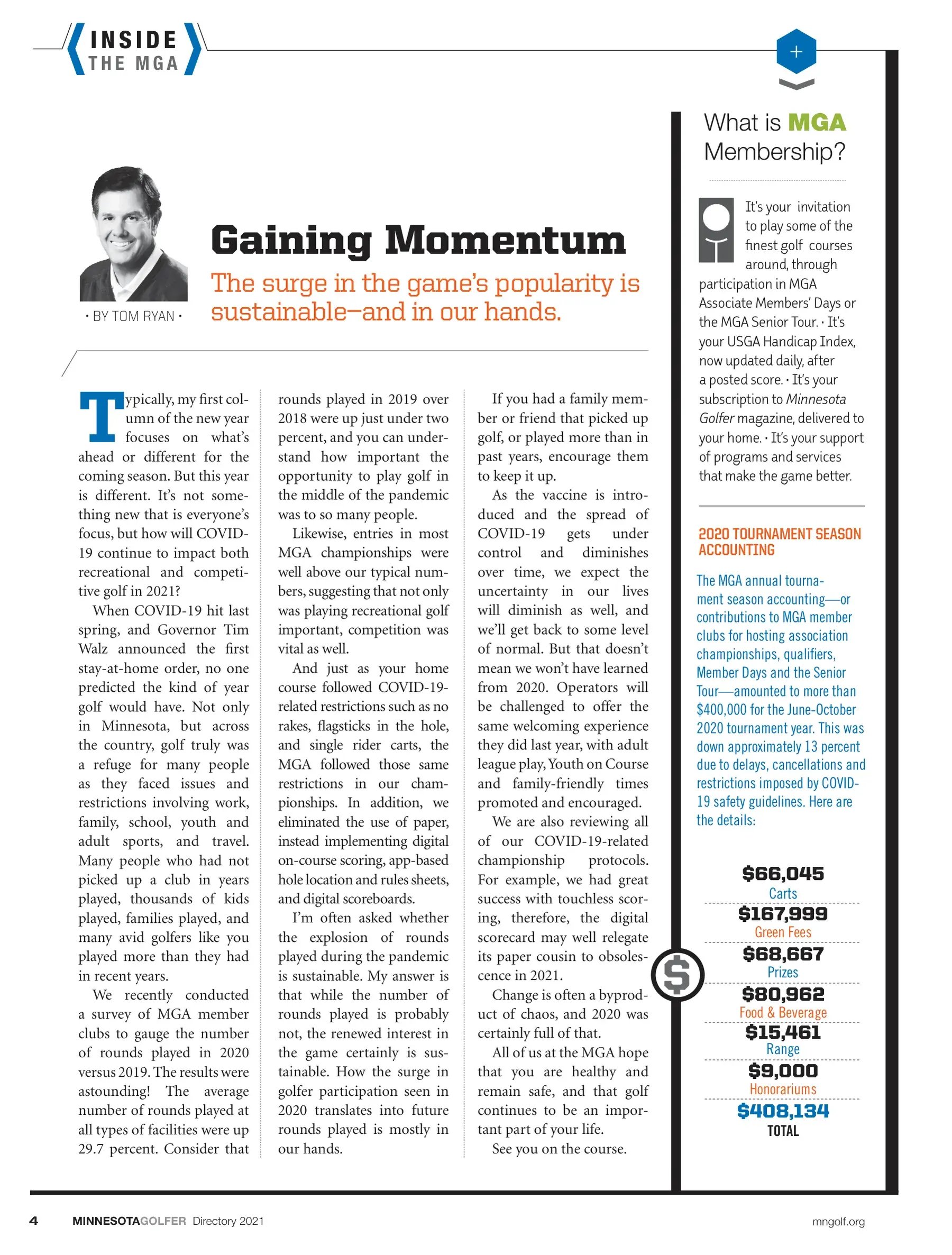
T ypically, my first column of the new year focuses on what’s ahead or different for the coming season. But this year is different. It’s not something new that is everyone’s focus, but how will COVID19 continue to impact both recreational and competitive golf in 2021?
When COVID-19 hit last spring, and Governor Tim Walz announced the first stay-at-home order, no one predicted the kind of year golf would have. Not only in Minnesota, but across the country, golf truly was a refuge for many people as they faced issues and restrictions involving work, family, school, youth and adult sports, and travel.
Many people who had not picked up a club in years played, thousands of kids played, families played, and many avid golfers like you played more than they had in recent years.
We recently conducted a survey of MGA member clubs to gauge the number of rounds played in 2020 versus 2019. The results were astounding! The average number of rounds played at all types of facilities were up 29.7 percent. Consider that rounds played in 2019 over 2018 were up just under two percent, and you can understand how important the opportunity to play golf in the middle of the pandemic was to so many people.
Likewise, entries in most MGA championships were well above our typical numbers, suggesting that not only was playing recreational golf important, competition was vital as well.
And just as your home course followed COVID-19related restrictions such as no rakes, flagsticks in the hole, and single rider carts, the MGA followed those same restrictions in our championships. In addition, we eliminated the use of paper, instead implementing digital on-course scoring, app-based hole location and rules sheets, and digital scoreboards.
I’m often asked whether the explosion of rounds played during the pandemic is sustainable. My answer is that while the number of rounds played is probably not, the renewed interest in the game certainly is sustainable. How the surge in golfer participation seen in 2020 translates into future rounds played is mostly in our hands.
If you had a family member or friend that picked up golf, or played more than in past years, encourage them to keep it up. As the vaccine is introduced and the spread of COVID-19 gets under control and diminishes over time, we expect the uncertainty in our lives will diminish as well, and we’ll get back to some level of normal. But that doesn’t mean we won’t have learned from 2020. Operators will be challenged to offer the same welcoming experience they did last year, with adult league play, Youth on Course and family-friendly times promoted and encouraged.
We are also reviewing all of our COVID-19-related championship protocols. For example, we had great success with touchless scoring, therefore, the digital scorecard may well relegate its paper cousin to obsolescence in 2021.
Change is often a byproduct of chaos, and 2020 was certainly full of that. All of us at the MGA hope that you are healthy and remain safe, and that golf continues to be an important part of your life.
• BY TOM RYAN • Gaining Momentum The surge in the game’s popularity is sustainable—and in our hands. 2020 TOURNAMENT SEASON ACCOUNTING The MGA annual tournament season accounting—or contributions to MGA member clubs for hosting association championships, qualifi ers, Member Days and the Senior Tour—amounted to more than $400,000 for the June-October 2020 tournament year. This was down approximately 13 percent due to delays, cancellations and restrictions imposed by COVID19 safety guidelines. Here are the details: $66,045 Carts $167,999 Green Fees $68,667 Prizes $80,962 Food & Beverage $15,461 Range $9,000 Honorariums $408,134 TOTAL $ PHOTO BY MATT SEEFELDT, ILLUSTRATION BY DEAN LAVATO FRONT T he longest par-5 in Red Wing (and in Minnesota) is Highlands No. 10, a long, curving dogleg-right surrounded by towering trees. A solid and straight drive puts you in a great position for a second shot around the corner.
“Part of the challenge is from the tee to the fairway, as it drops about 125 feet into troublesome woods,” says head golf professional Nathan Gale. “So you want to hit it straight.”
An MNGL in painted rocks is planted on the left side of the dogleg, perhaps offering respite from the diffi culty ahead—as attacking the green on your second shot could leave you engulfed by trees near the green.
It’s best to play this No. 2 handicap hole as a three-to-four shot approach and walk to No. 11 with a sly par or quick bogey to start your back nine. —Rachel Blauert GREAT DRIVES Mississippi National Golf Links Red Wing | Highlands No. 10 » par 5 » 553–656 yards Opened 1986 | Architect Wendell Pittenger | Superintendent Mike Walz Head Professional Nathan Gale | Course Record 63 “The main struggle for most amateur golfers is the length and basically forest on either side.”
Dialing (in) Long Distance G olfers have been searching for more distance for as long as I can remember. There’s no doubt distance can be an advantage, although many accomplished players have lost their games in that quest. It’s fair to say most of us are not maximizing our potential distance due to a variety of factors.
In striving for more distance, let’s take care of step one, which is making solid contact. Especially with the driver, missing the center of the face by even a half inch can reduce distance by 5-10%. Now miss by an inch or more and you can see the signifi cance.
Most golfers can feel and hear solid contact, but for accurate feedback a foot spray on the clubface can help. Most drivers respond best with center and slightly higher on the face contact. Once you see this, you are on your way to longer drives.
Maximize the length of your shot by making center-of-the-face contact on your driver. Book Your Getaway! Set in natural beauty and surrounded by rugged prairieland, Dacotah Ridge golf course offers challenges and exciting play for golfers of all skill levels. A Rees Jones Designed Course.
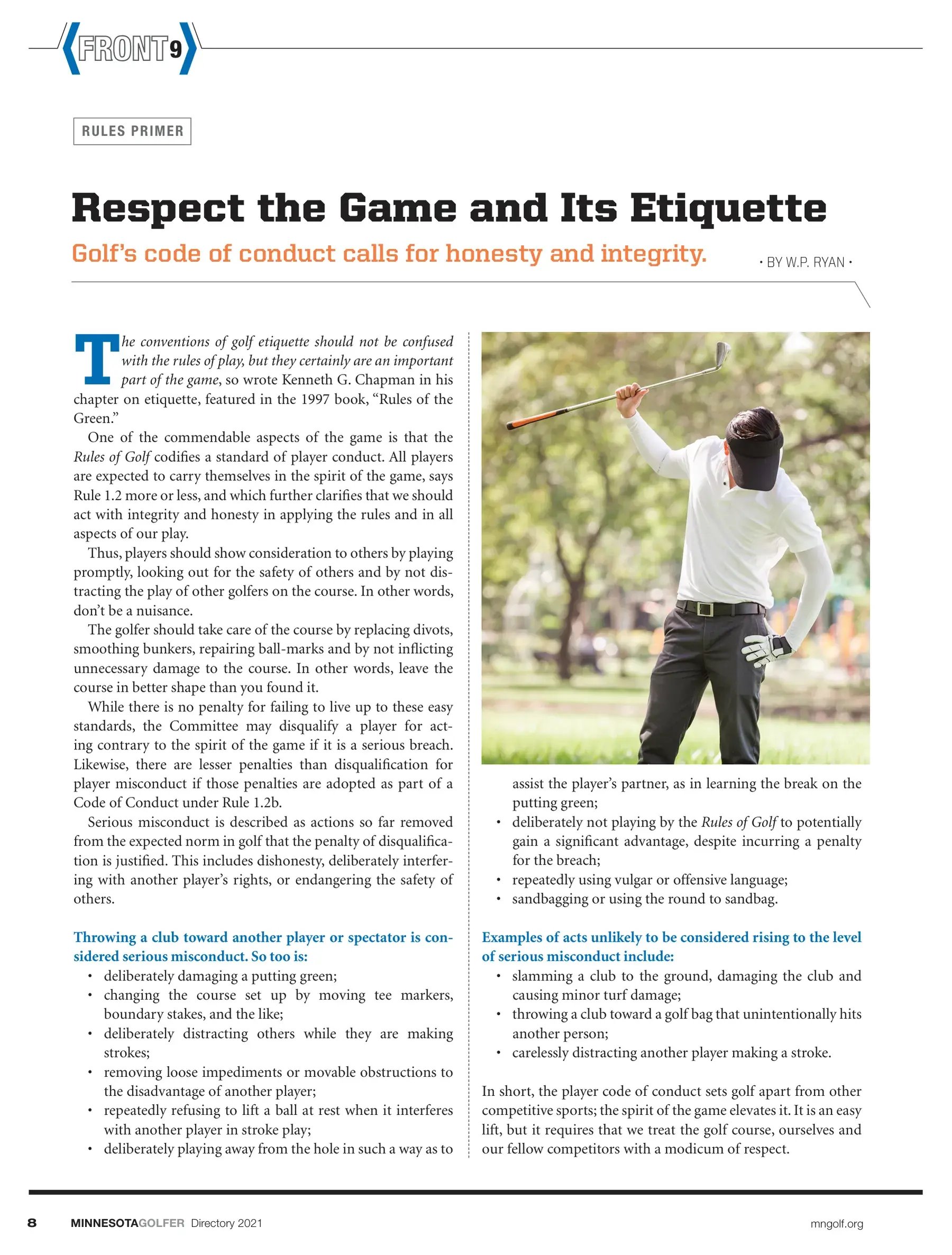
FRONT RULES PRIMER • BY W.P. RYAN • T he conventions of golf etiquette should not be confused with the rules of play, but they certainly are an important part of the game, so wrote Kenneth G. Chapman in his chapter on etiquette, featured in the 1997 book, “Rules of the Green.”
One of the commendable aspects of the game is that the Rules of Golf codifies a standard of player conduct. All players are expected to carry themselves in the spirit of the game, says Rule 1.2 more or less, and which further clarifies that we should act with integrity and honesty in applying the rules and in all aspects of our play.
Thus, players should show consideration to others by playing promptly, looking out for the safety of others and by not distracting the play of other golfers on the course. In other words, don’t be a nuisance.
The golfer should take care of the course by replacing divots, smoothing bunkers, repairing ball-marks and by not inflicting unnecessary damage to the course. In other words, leave the course in better shape than you found it.
While there is no penalty for failing to live up to these easy standards, the Committee may disqualify a player for acting contrary to the spirit of the game if it is a serious breach.
Likewise, there are lesser penalties than disqualification for player misconduct if those penalties are adopted as part of a Code of Conduct under Rule 1.2b.
Serious misconduct is described as actions so far removed from the expected norm in golf that the penalty of disqualification is justified. This includes dishonesty, deliberately interfering with another player’s rights, or endangering the safety of others.
Throwing a club toward another player or spectator is considered serious misconduct. So too is: • deliberately damaging a putting green; • changing the course set up by moving tee markers, boundary stakes, and the like; • deliberately distracting others while they are making strokes; • removing loose impediments or movable obstructions to the disadvantage of another player; • repeatedly refusing to lift a ball at rest when it interferes with another player in stroke play; • deliberately playing away from the hole in such a way as to assist the player’s partner, as in learning the break on the putting green; • deliberately not playing by the Rules of Golf to potentially gain a significant advantage, despite incurring a penalty for the breach; • repeatedly using vulgar or offensive language; • sandbagging or using the round to sandbag.
Examples of acts unlikely to be considered rising to the level of serious misconduct include: • slamming a club to the ground, damaging the club and causing minor turf damage; • throwing a club toward a golf bag that unintentionally hits another person; • carelessly distracting another player making a stroke.
In short, the player code of conduct sets golf apart from other competitive sports; the spirit of the game elevates it. It is an easy lift, but it requires that we treat the golf course, ourselves and our fellow competitors with a modicum of respect.
PLAN YOUR MINNESOTA ROAD TRIP Check out the places mentioned here and plan your next “Guys Weekend” or “Girls Getaway” road trip. ExploreMinnesota.com PLACE YOUR BETS ON NORTHWEST MINNESOTA By Jerard Fagerberg Wherever your next Minnesota road trip takes you, finding lakes and links is a lock. What else will you find? Well, that’s up to you. If your compass points northwest, this may be an experience you bring to life.
The northwest corner of Minnesota feels like outlaw territory. Casinos dot the landscape, and ATV trails snake off into the backcountry along highways, ditches and county roads—the ideal destination for a raucous guys getaway. So two summers ago, I gathered my buddies and we burned northward for a weekend escape.
Mahnomen’s Shooting Star Casino was the first post on the road. Shooting Star is little more than a stucco lodge on the White Earth Reservation, but it’s one of the larger casinos in the region.
This no-frills card den is where you can make the trip. We strolled right by the slot machines to the three-card poker tables. Bets last longer there than at the blackjack tables, and a big win can send you sailing the rest of the weekend. That was not our luck. Some in the group busted early.
Some hung around and busted late. In either case, the drink carts were busy, and the night ran long. After two nights at Shooting Star, we traded its neon lights for a chance to explore the FourtownGrygla ATV trails. We rolled into Grygla and unloaded our trailer of ATVs (we brought our own, but you can have rentals delivered from the Twin Cities or Brainerd). With 170 miles of trails on the Fourtown-Grygla system alone, it was easy to forget any lost bets.
We opened the throttles wide, the snorts of our ATVs battling as we toured the edges of Beltrami Island State Forest. When the trails broke into the trees, we were glancing out the sides of our goggles, hoping to spy some wildlife. But the only bear that afternoon was my hangover from the night before, and I quenched it with two-stroke engine exhaust.
The adventure continued toward the U.S.-Canada border, with a final stop in Warroad and the Seven Clans Casino. We spent the morning at Warroad Estates Golf Course, only 10 minutes from the hotel, wagering over putts. Lowest score got the best chair at the blackjack table, highest two had to share beds.
Of the state’s three Seven Clans Casino locations, Warroad is the only one that serves alcohol, so it was the obvious option for our group’s final stop.
One last shot at a jackpot. The night started coy with slots, but it wasn’t long before well drinks had us throwing chips together to make the blackjack minimums. On the last night of your trip, there’s not much else to do but go for it.
We must’ve sworn it was our last hand a dozen times, just to ante up for the next hand. Every split or double felt like it would be the one that switched our luck, each dealer flop a cresting frontier. We were chasing, we knew it and we loved it.
Seven Clans Casino Photo by Barb McLean TAP INTO BREWERIES The taprooms of Northwest Minnesota make for perfect pit stops on the road north. Start at Bemidji Brewing, a standby known for their classic styles. In nearby Moorhead, Junkyard Brewing does the exact opposite, with over-the-top candy stouts and bizarre sours dominating the menu. We loaded the trunk with crowlers to share back home.
In the tiny town of Hallock, only 25 miles from Manitoba, Revelation Ale Works sits in the most remote location of any brewery in Minnesota. There, we became part of the select class of travelers to drink their decadent Peanut Butter Stout on site.
Photo by Arctic Cat Inc. Edge of the Wilderness scenic byway Walking for Your Health Explore new options for walking your next round and potentially keeping COVID-19 at bay.
FRONT W alking the golf course has been a fundamental challenge and essential joy of the game of golf since its inception, and many golfers continue the practice today. Here are the latest creations to get you out of the motorized cart and back on your feet.
Club Car’s Tempo Walk Hands-Free remote-controlled caddie car rolled onto fairways last season and is primed for popularity in 2021. Mark Dvorak, owner and general manager at Whispering Pines GC in Annandale, reupped his golf cart contract with Club Car and the Tempo Walk was part of the package. The three-wheeled walker caddie features a remote control device that attaches to the golfer’s belt and with a simple flip of the switch follows the operator throughout the round.
“It’s fun to promote it,” Dvorak says. “People who use it love it, and they call in advance to reserve it.” A full golf bag slips easily into the bag well of the Tempo Walk, which features a cup or sand bottle holder, a cooler and GPS. It travels up and down hills, through the rough and all kinds of terrain, which is a bonus for the hilly Whispering Pines course.
“It’s something, other than the golf cart, that I don’t feel like I am going to get sued over,” Dvorak says. “Electronic bikes? That’s a liability waiting to happen on this course.”
The unit rents for $15 (the same cost of a golf car) and is easier to operate than your TV remote. When you approach a green or tee with the Tempo Walk, switch it off, grab your club and go swing away. The unit is so quiet you can forget it is following you. The Tempo Walk gives the impression of walking the course with a caddie. It does not, however, offer advice.
“Unfortunately it cannot read putts, or else everybody would be renting that thing,” Dvorak says. If the fear of inadvertently backing your “stalker caddie” into the creek when searching for lost golf balls concerns you, perhaps more control from a push cart, such as the new Walker Trolley Cape, is your style. Constructed from anodized aluminum for a lightweight and sturdy three-wheel cart, the Trolley Cape model features two pouches made from waxed canvas to hold your tees, balls or personal items and a leather handle for a solid and secure grip and maximum control. The Trolley breaks down and folds at one point “making it the simplest folding trolley on the market,” according to the company website. Walkertrolleys.com; $399.
For perhaps the purest form of walking your next round, there are numerous carry bags available to suit golfers’ needs. We suggest the SL1 Golf bag from Stitch Golf that weighs in as one of the lighter carry bags on the market (57 ounces). The bag features two side pockets, a single cushioned carrying strap and convenient leg stand. According to the website, the SL1 was designed to “give you a vintage feel with a classic bag.” Stitchgolf.com; $328.
Sunday Golf’s Loma bag is designed to carry even a lighter load—say, eight clubs for a par-3 course, the range or a quick nine. At 31 inches long and 1.85 lbs., it has a carry handle, a dual-flex stand system and pockets for only the essentials. Sundaygolf.com; $99.
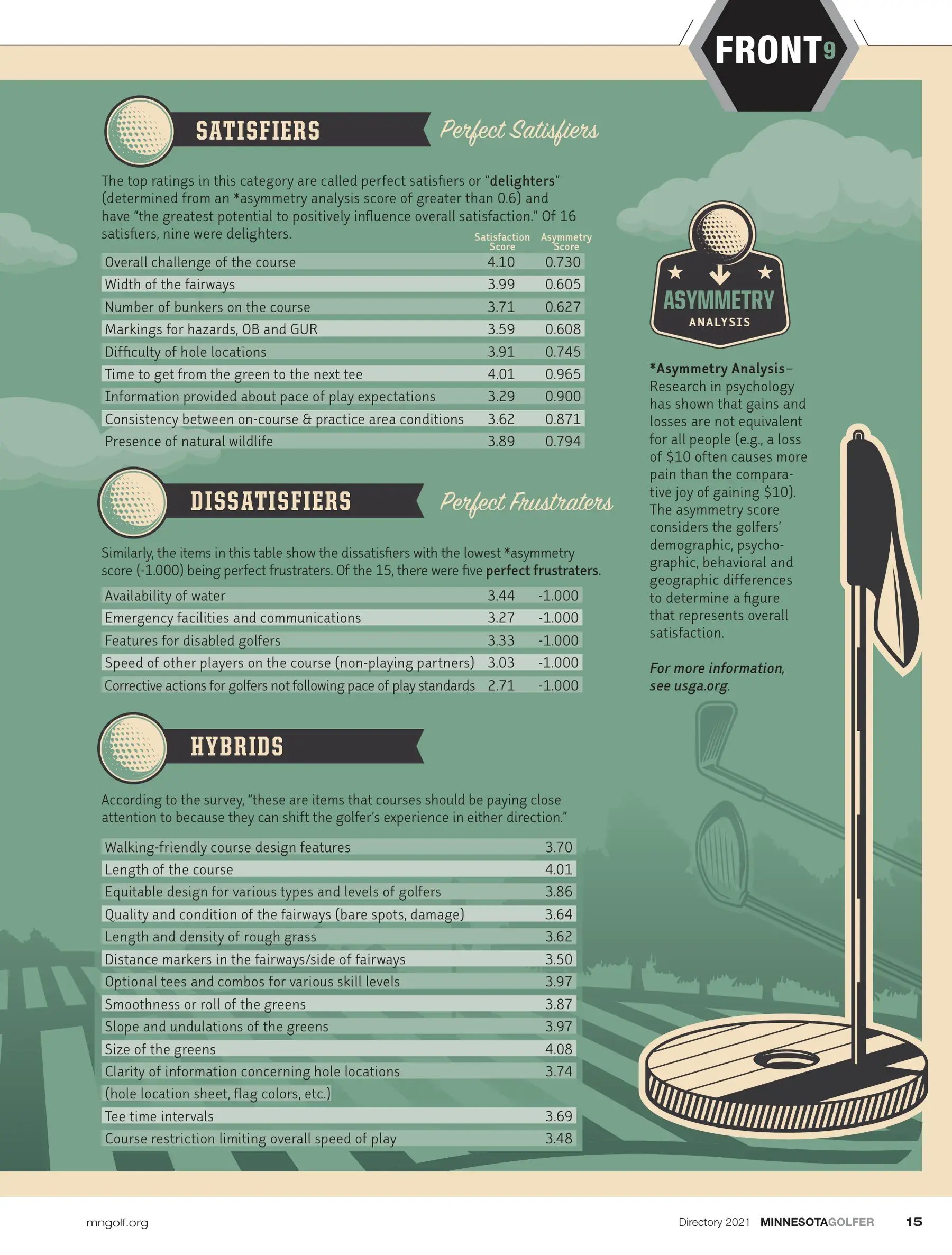
(determined from an *asymmetry analysis score of greater than 0.6) and have “the greatest potential to positively infl uence overall satisfaction.” Of 16 satisfi ers, nine were delighters.
Availability of water 3.44 -1.000 Emergency facilities and communications 3.27 -1.000 Features for disabled golfers 3.33 -1.000 Speed of other players on the course (non-playing partners) 3.03 -1.000 Corrective actions for golfers not following pace of play standards 2.71 -1.000 Similarly, the items in this table show the dissatisfi ers with the lowest *asymmetry score (-1.000) being perfect frustraters. Of the 15, there were five perfect frustraters.
SATISFIERS Satisfaction Score Asymmetry Score According to the survey, “these are items that courses should be paying close attention to because they can shift the golfer’s experience in either direction.”
Walking-friendly course design features 3.70 Length of the course 4.01 Equitable design for various types and levels of golfers 3.86 Quality and condition of the fairways (bare spots, damage) 3.64 Length and density of rough grass 3.62 Distance markers in the fairways/side of fairways 3.50 Optional tees and combos for various skill levels 3.97 Smoothness or roll of the greens 3.87 Slope and undulations of the greens 3.97 Size of the greens 4.08 Clarity of information concerning hole locations 3.74 (hole location sheet, flag colors, etc.) Tee time intervals 3.69 Course restriction limiting overall speed of play 3.48 HYBRIDS ASYMMETRY ANALYSIS Overall challenge of the course 4.10 0.730 Width of the fairways 3.99 0.605 Number of bunkers on the course 3.71 0.627 Markings for hazards, OB and GUR 3.59 0.608 Diffi culty of hole locations 3.91 0.745 Time to get from the green to the next tee 4.01 0.965 Information provided about pace of play expectations 3.29 0.900 Consistency between on-course & practice area conditions 3.62 0.871 Presence of natural wildlife 3.89 0.794 DISSATISFIERS *Asymmetry Analysis— Research in psychology has shown that gains and losses are not equivalent for all people (e.g., a loss of $10 often causes more pain than the comparative joy of gaining $10).
The asymmetry score considers the golfers’ demographic, psychographic, behavioral and geographic differences to determine a figure that represents overall satisfaction.
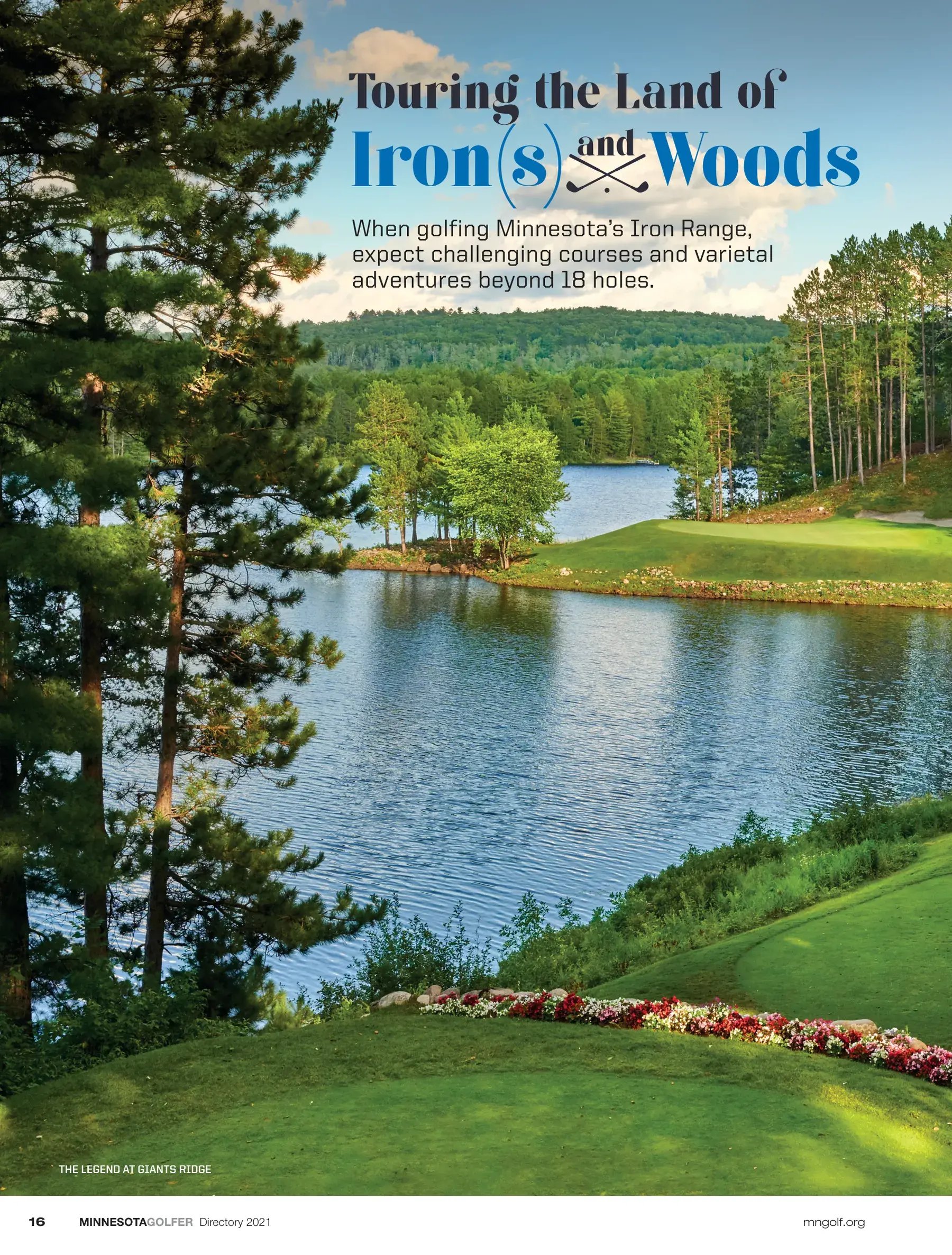
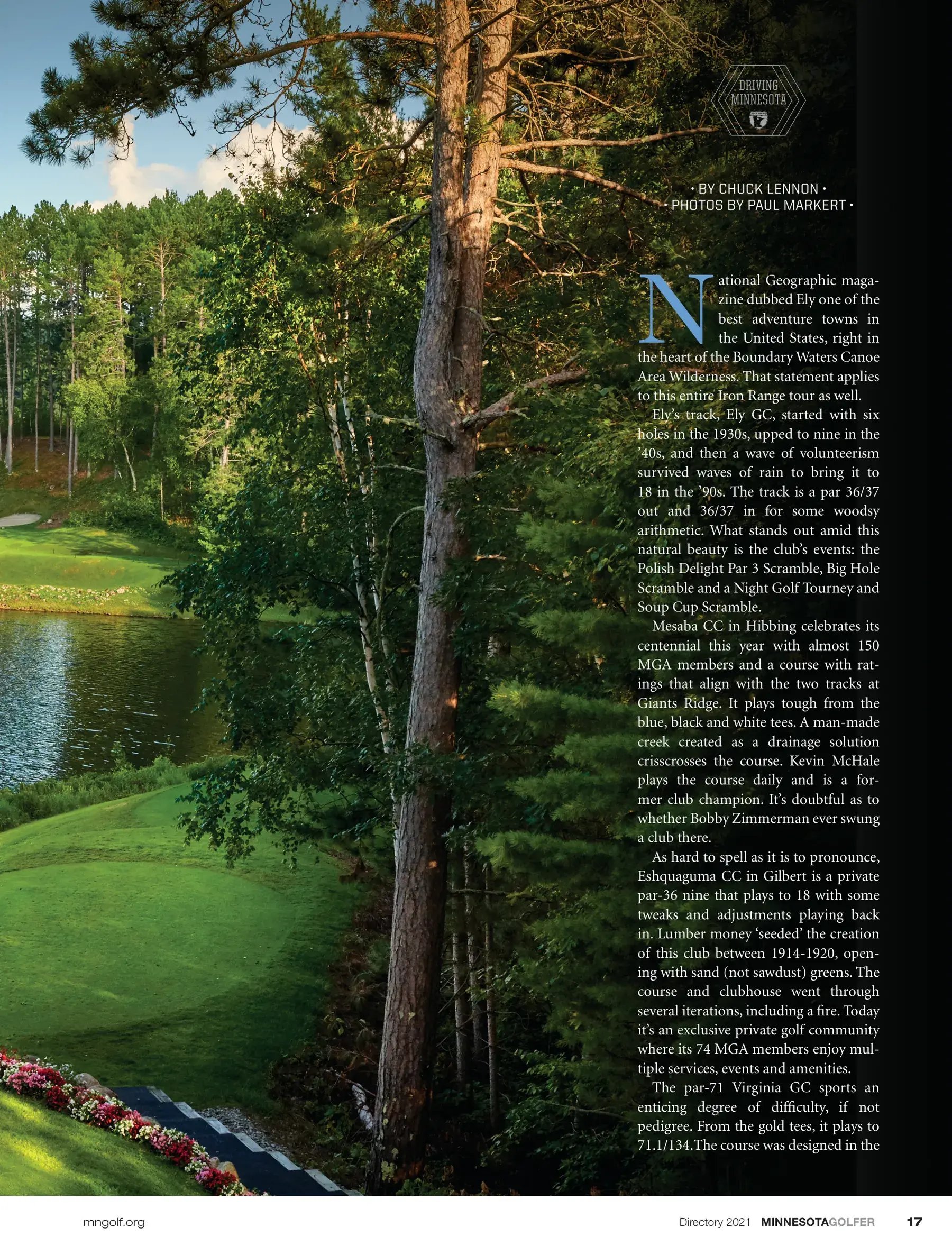
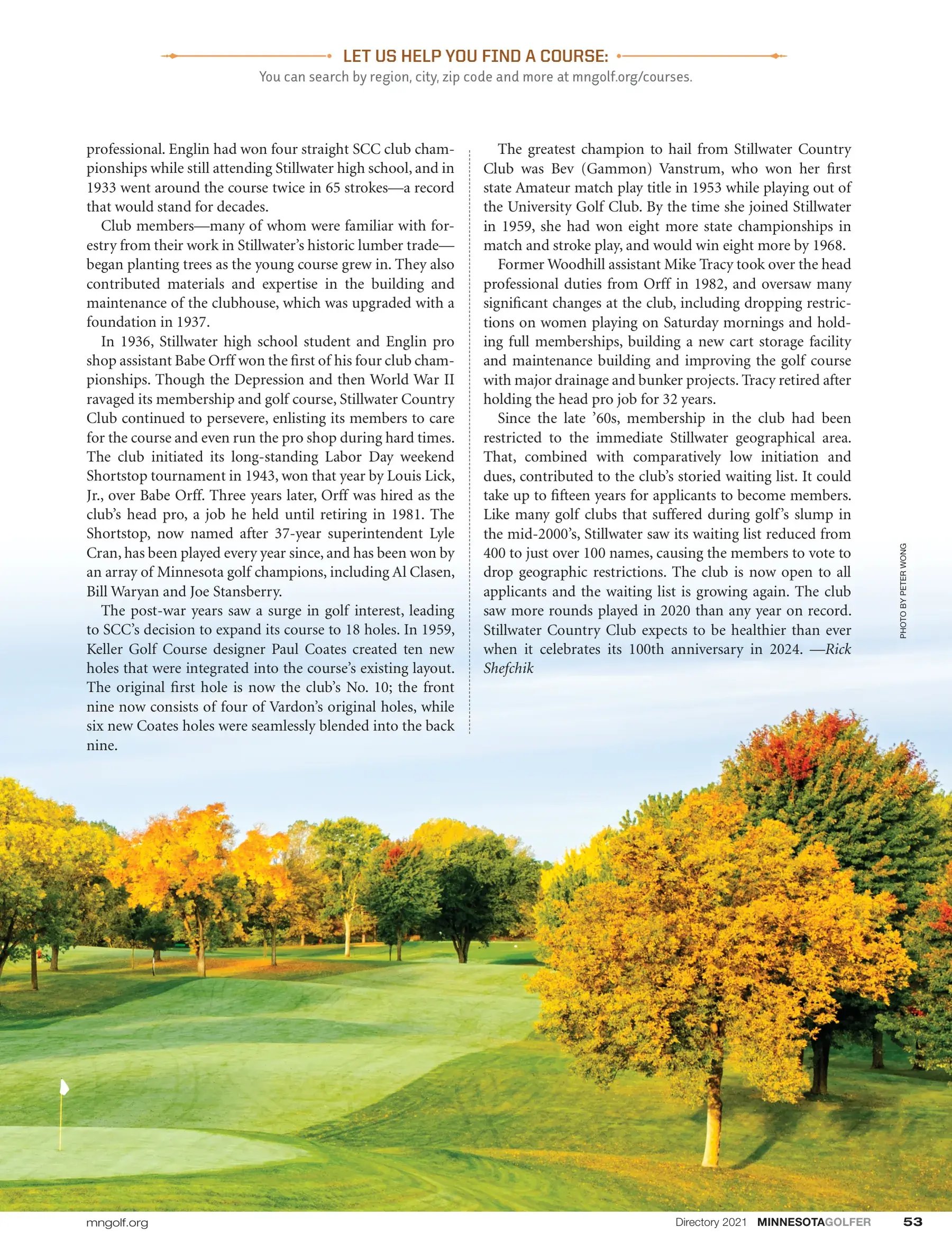
For more information, see usga.org. When golfing Minnesota’s Iron Range, expect challenging courses and varietal adventures beyond 18 holes. THE LEGEND AT GIANTS RIDGE Directory 2021 MINNESOTAGOLFER 17 N ational Geographic magazine dubbed Ely one of the best adventure towns in the United States, right in the heart of the Boundary Waters Canoe Area Wilderness. That statement applies to this entire Iron Range tour as well.
Ely’s track, Ely GC, started with six holes in the 1930s, upped to nine in the ’40s, and then a wave of volunteerism survived waves of rain to bring it to 18 in the ’90s. The track is a par 36/37 out and 36/37 in for some woodsy arithmetic. What stands out amid this natural beauty is the club’s events: the Polish Delight Par 3 Scramble, Big Hole Scramble and a Night Golf Tourney and Soup Cup Scramble.
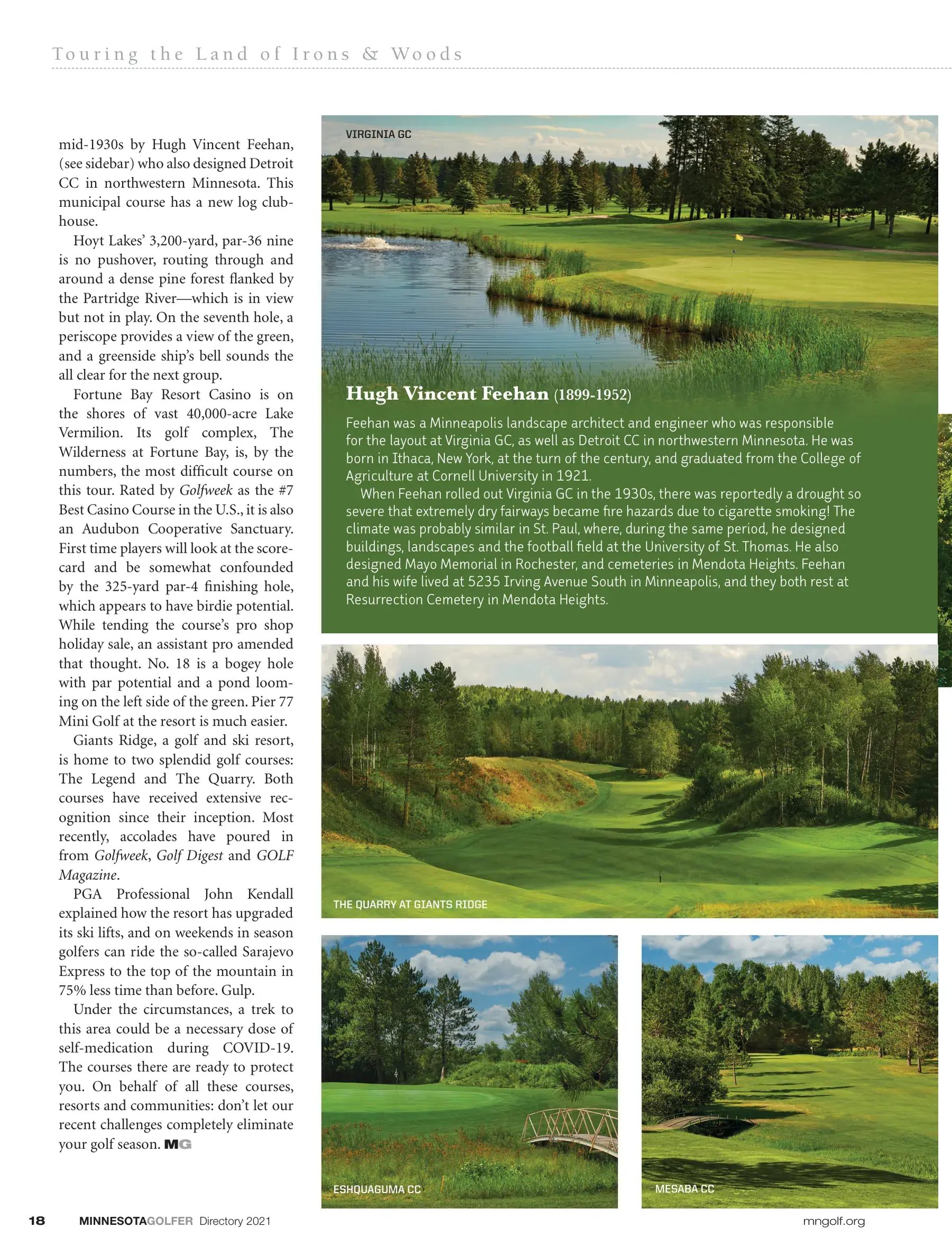
Mesaba CC in Hibbing celebrates its centennial this year with almost 150 MGA members and a course with ratings that align with the two tracks at Giants Ridge. It plays tough from the blue, black and white tees. A man-made creek created as a drainage solution crisscrosses the course. Kevin McHale plays the course daily and is a former club champion. It’s doubtful as to whether Bobby Zimmerman ever swung a club there.
As hard to spell as it is to pronounce, Eshquaguma CC in Gilbert is a private par-36 nine that plays to 18 with some tweaks and adjustments playing back in. Lumber money ‘seeded’ the creation of this club between 1914-1920, opening with sand (not sawdust) greens. The course and clubhouse went through several iterations, including a fire. Today it’s an exclusive private golf community where its 74 MGA members enjoy multiple services, events and amenities.
The par-71 Virginia GC sports an enticing degree of difficulty, if not pedigree. From the gold tees, it plays to 71.1/134.The course was designed in the • BY CHUCK LENNON • • PHOTOS BY PAUL MARKERT • mid-1930s by Hugh Vincent Feehan, (see sidebar) who also designed Detroit CC in northwestern Minnesota. This municipal course has a new log clubhouse.
Hoyt Lakes’ 3,200-yard, par-36 nine is no pushover, routing through and around a dense pine forest flanked by the Partridge River—which is in view but not in play. On the seventh hole, a periscope provides a view of the green, and a greenside ship’s bell sounds the all clear for the next group.
Fortune Bay Resort Casino is on the shores of vast 40,000-acre Lake Vermilion. Its golf complex, The Wilderness at Fortune Bay, is, by the numbers, the most difficult course on this tour. Rated by Golfweek as the #7 Best Casino Course in the U.S., it is also an Audubon Cooperative Sanctuary.
First time players will look at the scorecard and be somewhat confounded by the 325-yard par-4 finishing hole, which appears to have birdie potential.
While tending the course’s pro shop holiday sale, an assistant pro amended that thought. No. 18 is a bogey hole with par potential and a pond looming on the left side of the green. Pier 77 Mini Golf at the resort is much easier.
Giants Ridge, a golf and ski resort, is home to two splendid golf courses: The Legend and The Quarry. Both courses have received extensive recognition since their inception. Most recently, accolades have poured in from Golfweek, Golf Digest and GOLF Magazine.
PGA Professional John Kendall explained how the resort has upgraded its ski lifts, and on weekends in season golfers can ride the so-called Sarajevo Express to the top of the mountain in 75% less time than before. Gulp.
When Feehan rolled out Virginia GC in the 1930s, there was reportedly a drought so severe that extremely dry fairways became fire hazards due to cigarette smoking! The climate was probably similar in St. Paul, where, during the same period, he designed buildings, landscapes and the football field at the University of St. Thomas. He also designed Mayo Memorial in Rochester, and cemeteries in Mendota Heights. Feehan and his wife lived at 5235 Irving Avenue South in Minneapolis, and they both rest at Resurrection Cemetery in Mendota Heights.
• AdventureSeaplanes.com has offered flightseeing excursions of the area since 1995 for 2-4 passengers out of Tower Airport and Seaplane Base.
• Lake Vermilion Mailboat excursions from AronsonBoatWorks.com are available in Tower. For twenty bucks, enjoy an 80-mile cruise on the beautiful big water.
• ATV Excursions with rental units are available throughout the area, and there is an extensive system of trails. Adventures in the Northwoods • International Wolf Center, Ely • North American Bear Center, Ely Restaurant Recommendations from Locals • Boomtown Grill, Hibbing • Burnt Onion, Giants Ridge • Whistling Bird, Gilbert ELY GC HOYT LAKES GC THE WILDERNESS AT FORTUNE BAY NORTH AMERICAN BEAR CENTER The Lost Courses author unearths a spot near his hometown in the sequel: “More! Gone. Minnesota’s Lost Golf Courses, Part II.”
PHOTO ILLUSTRATION BY DEAN LAVATO Directory 2021 MINNESOTAGOLFER 21 B en Knight, the first professional at Winona Country Club and head man there for 32 years, starting in 1919, was an ambitious and accomplished figure in southeastern Minnesota golf.
In addition to his teaching, playing and organizing duties at Winona CC, Knight designed, by his estimation in a 1954 Winona Daily News story, “about 40 or 50” courses in Minnesota, Wisconsin and Iowa.
All of which made Ben—forgive me for this—the Knight in shining ardor of Minnesota golf. Spare the rim shot, and let’s move on. Operating in a hilly region called the Driftless Area, the native Scotsman Knight became a specialist in working in tight quarters. He helped wedge a course in between hillsides, intertwined with a creek at his home base on the southeast side of Winona.
(Formerly Winona Country Club, the course is now known as The Bridges.) He dropped nine holes onto a Root River blufftop in 1929 at Lanesboro, southwest of Winona.
He did similar work at places such as Rushford, Preston and Sleepy Eye (a geographic outlier) in Minnesota, and Arcadia, Mondovi and Whitehall in Wisconsin.
Knight also designed now-lost courses at Winona, Wabasha and Caledonia in Minnesota, and at La Crosse, Galesville and West Salem in Wisconsin—plus a few more, including the following lost curiosity.
In early 1931, halfway between Winona and La Crosse, Wis., Knight was stuck between a rock and a wet place. The former: An enormous slab of sandstone and dolomite, known as Queens Bluff, quickly rising almost 500 feet high. The latter: The Mississippi River—perhaps you’ve heard of it.
Knight’s charge was to build a nine-hole golf course at the bottom of the bluffside, near the unincorporated community of Donehower. This plot, shaped like a strip of bacon, offered all the architectural elbow room of a sumo wrestler in a Smart car.
On the east, Knight’s boundary was Highway 3 (U.S. highways 61 and 14 in today’s terms). Only 50 yards beyond that was the Mississippi River shore. On the west, Knight’s boundary was the foot of the bluffs. All told, the golf course tract was an estimated 300 feet wide and 1,500 feet long—around 10 acres total.
The typical par-3 golf course, Google searches suggest, covers about 30 acres. (There are notable exceptions.) How Knight did it is beyond me. Three architectural wonders come to mind: Stonehenge, the Great Pyramid of Cheops and Ben Knight’s Golf Course in a Straitjacket.
I grew up 25 miles away and have crossed this spot hundreds of times. Until stumbling across a few newspaper stories in early 2020, I had not the foggiest idea there was ever a golf course here, and I remain stunned and captivated over how Knight could have pulled it off.
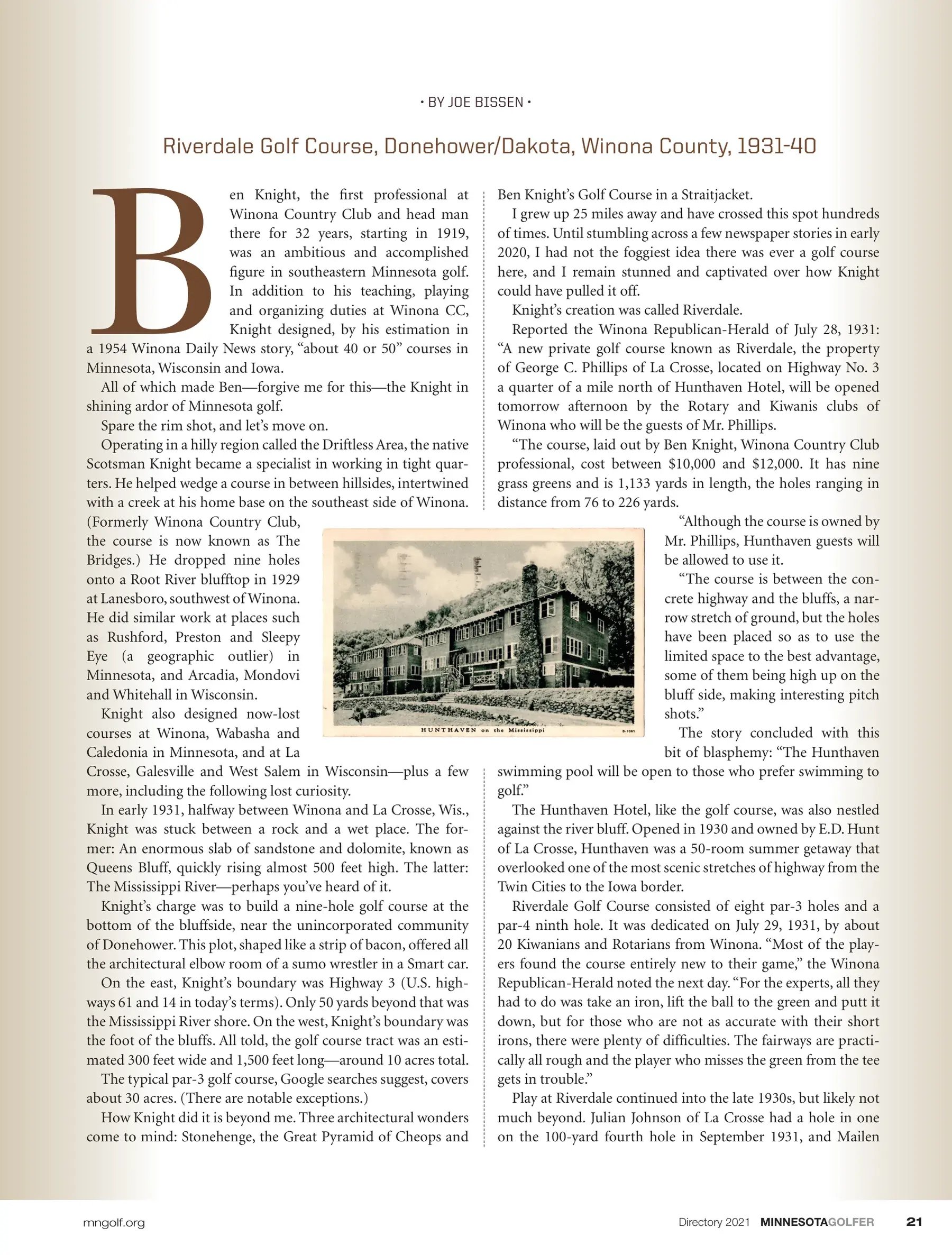
Knight’s creation was called Riverdale. Reported the Winona Republican-Herald of July 28, 1931: “A new private golf course known as Riverdale, the property of George C. Phillips of La Crosse, located on Highway No. 3 a quarter of a mile north of Hunthaven Hotel, will be opened tomorrow afternoon by the Rotary and Kiwanis clubs of Winona who will be the guests of Mr. Phillips.
“The course, laid out by Ben Knight, Winona Country Club professional, cost between $10,000 and $12,000. It has nine grass greens and is 1,133 yards in length, the holes ranging in distance from 76 to 226 yards.
“Although the course is owned by Mr. Phillips, Hunthaven guests will be allowed to use it. “The course is between the concrete highway and the bluffs, a narrow stretch of ground, but the holes have been placed so as to use the limited space to the best advantage, some of them being high up on the bluff side, making interesting pitch shots.”
The story concluded with this bit of blasphemy: “The Hunthaven swimming pool will be open to those who prefer swimming to golf.” The Hunthaven Hotel, like the golf course, was also nestled against the river bluff. Opened in 1930 and owned by E.D. Hunt of La Crosse, Hunthaven was a 50-room summer getaway that overlooked one of the most scenic stretches of highway from the Twin Cities to the Iowa border.
Riverdale Golf Course consisted of eight par-3 holes and a par-4 ninth hole. It was dedicated on July 29, 1931, by about 20 Kiwanians and Rotarians from Winona. “Most of the players found the course entirely new to their game,” the Winona Republican-Herald noted the next day. “For the experts, all they had to do was take an iron, lift the ball to the green and putt it down, but for those who are not as accurate with their short irons, there were plenty of diffi culties. The fairways are practically all rough and the player who misses the green from the tee gets in trouble.”
Play at Riverdale continued into the late 1930s, but likely not much beyond. Julian Johnson of La Crosse had a hole in one on the 100-yard fourth hole in September 1931, and Mailen • BY JOE BISSEN • Riverdale Golf Course, Donehower/Dakota, Winona County, 1931-40 Mills, a former all-city football and basketball player at La Crosse Central High School, aced the 105-yard seventh hole in July 1938.
Course-record rounds were posted by J.R. Johnson with a 27 in 1932, Trifon Harritos with a 26 in 1936, and Harry Kubiak with a 26-29--55 in 1938.
A best guess on the Riverdale routing: It was more or less out-and-back, heading north and returning south. A handful of holes were likely situated in a sort of staggered, parallel formation, some heading diagonally up the bluff to the green and some returning diagonally down. Another handful of holes likely ran parallel to the highway.
Adjacent or near the golf course, the Philips estate featured an arboretum and animal life, as reported by the Tribune: a flock of sheep, guinea hens, swans, Canada geese, green peacocks (“including the gorgeous golden”) and several wild ducks.
Note: If your social inclinations lean toward the prudish side, you may skip the following paragraph. A May 1937 Daily News story said the Riverdale summer resort would open “with a new vacation feature—portable cabinets for nude sunbathing, similar to those being used in Southern resorts.”
A 1940 La Crosse Tribune ad touted the “sporty 9-hole golf course with bent grass greens and beautiful well-kept fairways.” That was the last mention of Riverdale Golf Course I found.
Just down the road, the Hunthaven Hotel carried on, albeit in different iterations, until the three-story building was demolished starting in December 1975 to make way for the development of O.L. Kipp State Park, now Great River Bluffs State Park.
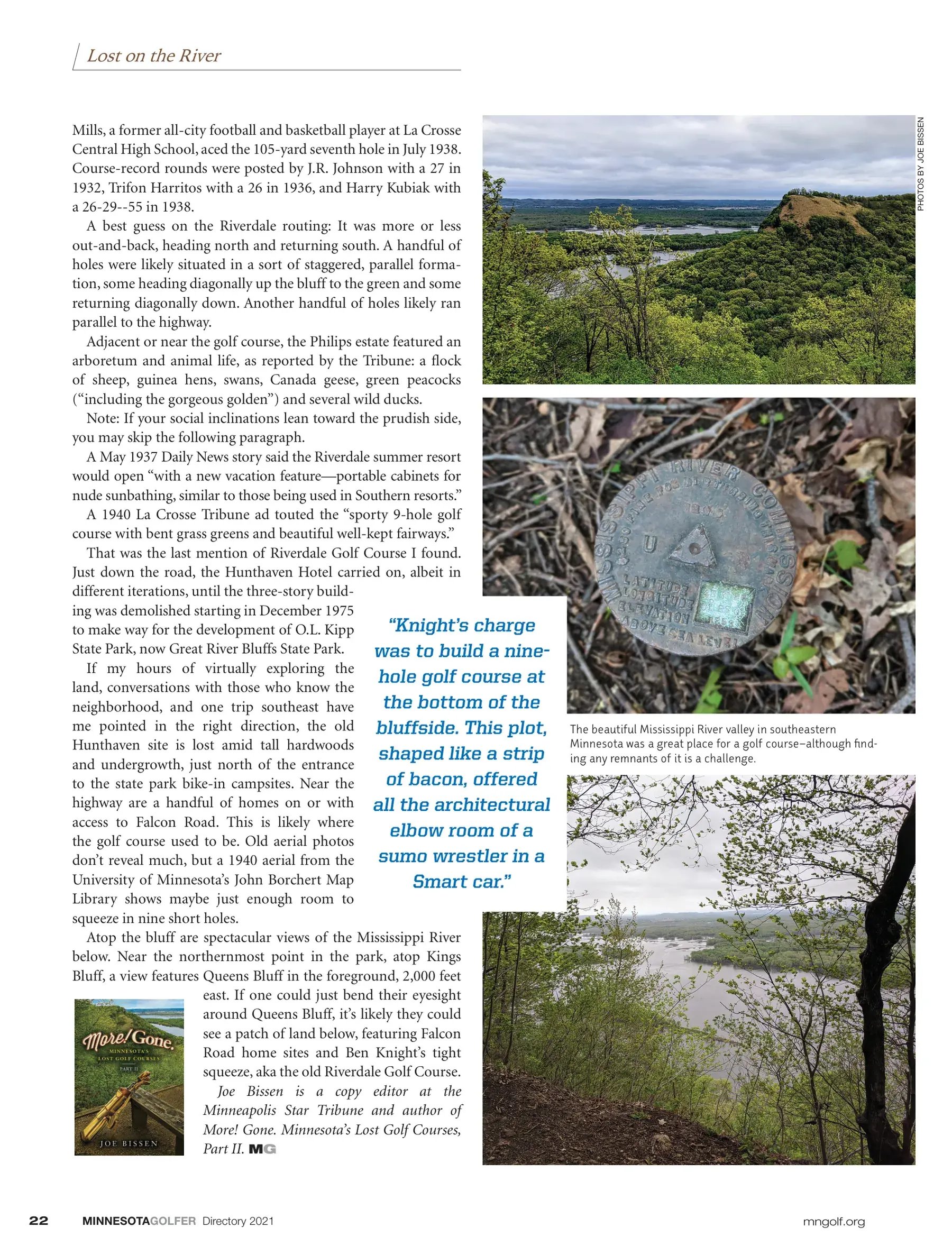
If my hours of virtually exploring the land, conversations with those who know the neighborhood, and one trip southeast have me pointed in the right direction, the old Hunthaven site is lost amid tall hardwoods and undergrowth, just north of the entrance to the state park bike-in campsites. Near the highway are a handful of homes on or with access to Falcon Road. This is likely where the golf course used to be. Old aerial photos don’t reveal much, but a 1940 aerial from the University of Minnesota’s John Borchert Map Library shows maybe just enough room to squeeze in nine short holes.
Atop the bluff are spectacular views of the Mississippi River below. Near the northernmost point in the park, atop Kings Bluff, a view features Queens Bluff in the foreground, 2,000 feet east. If one could just bend their eyesight around Queens Bluff, it’s likely they could see a patch of land below, featuring Falcon Road home sites and Ben Knight’s tight squeeze, aka the old Riverdale Golf Course.
Joe Bissen is a copy editor at the Minneapolis Star Tribune and author of More! Gone. Minnesota’s Lost Golf Courses, Part II. MG “Knight’s charge was to build a ninehole golf course at the bottom of the bluffside. This plot, shaped like a strip of bacon, offered all the architectural elbow room of a sumo wrestler in a Smart car.”
Lost on the River The beautiful Mississippi River valley in southeastern Minnesota was a great place for a golf course—although finding any remnants of it is a challenge.
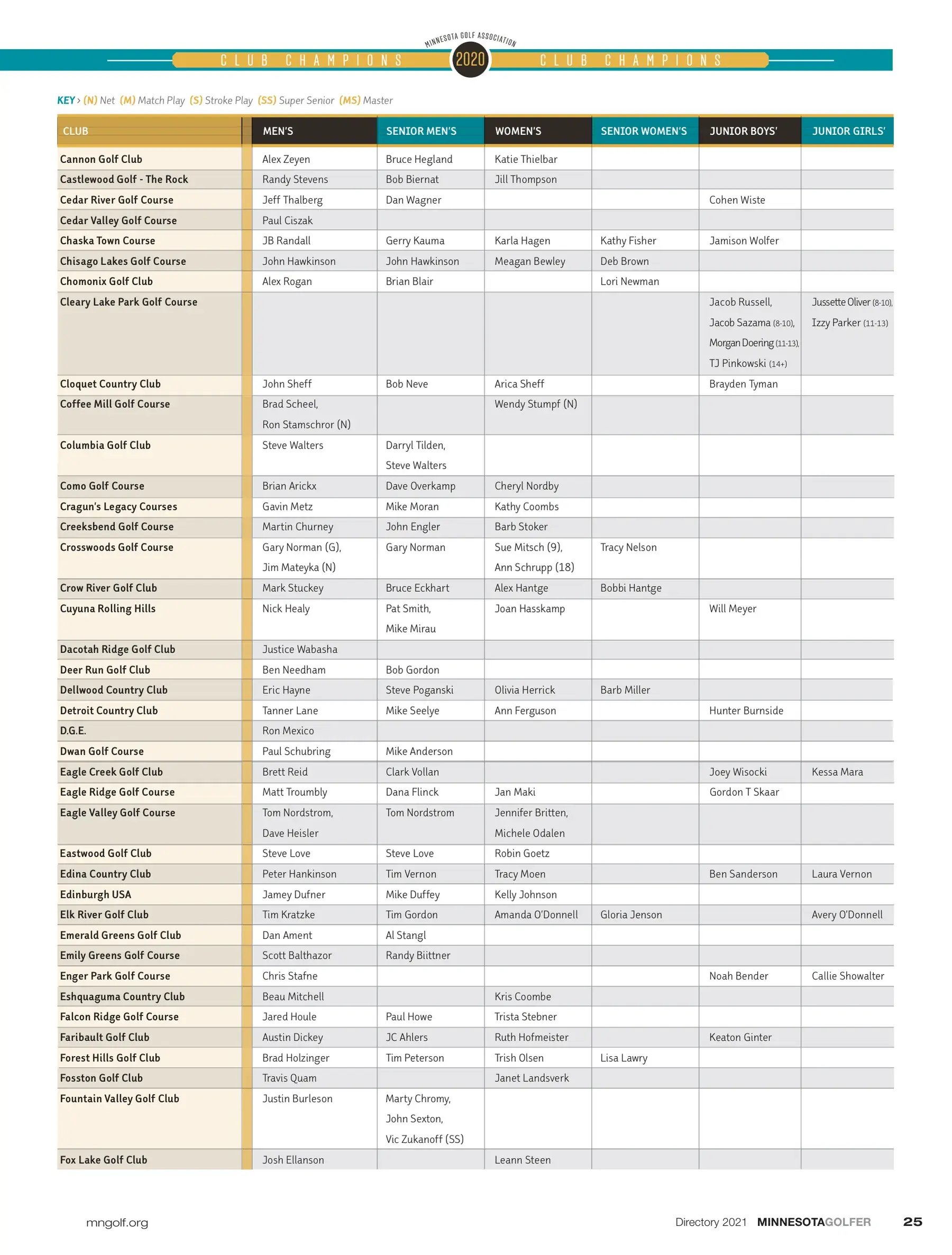
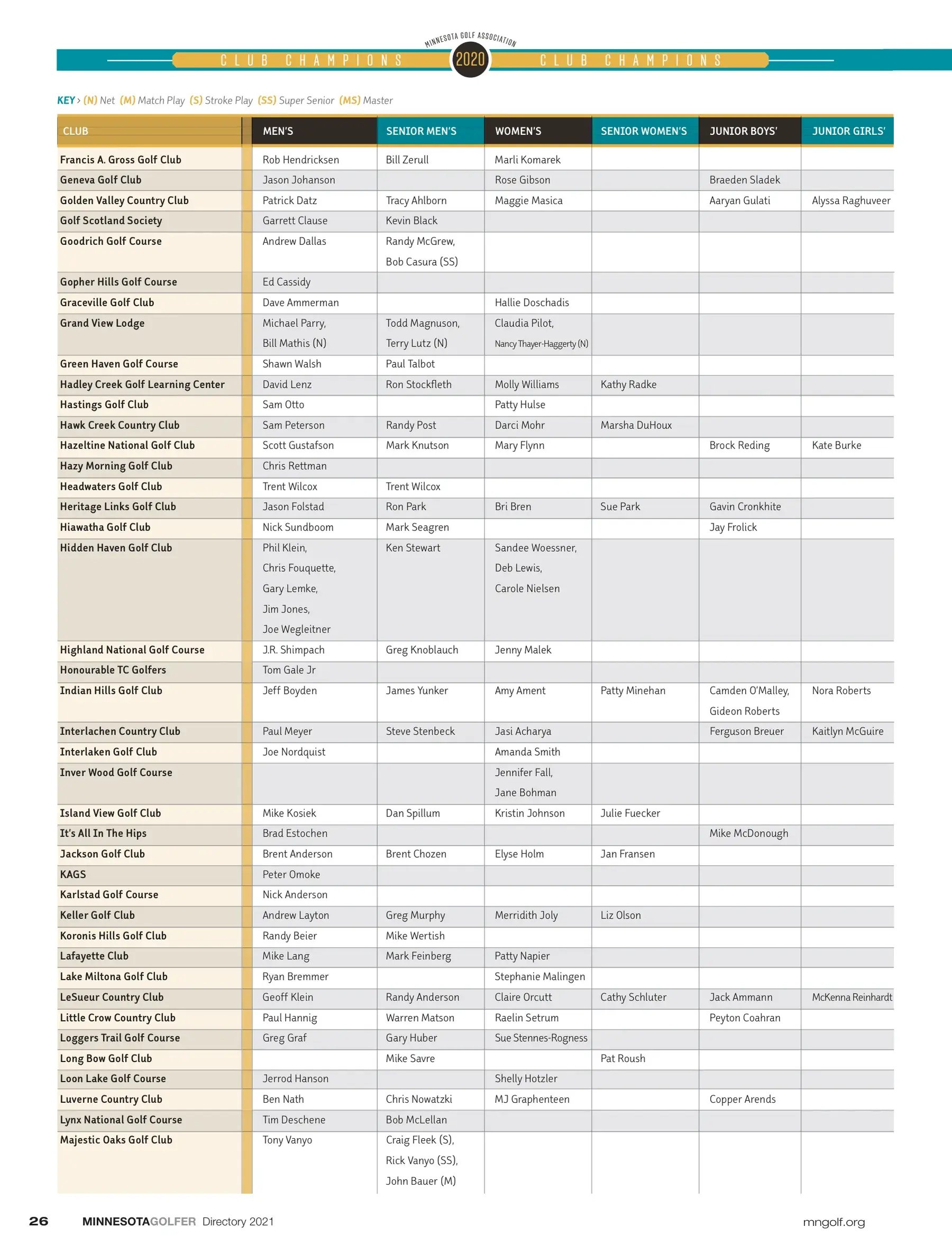
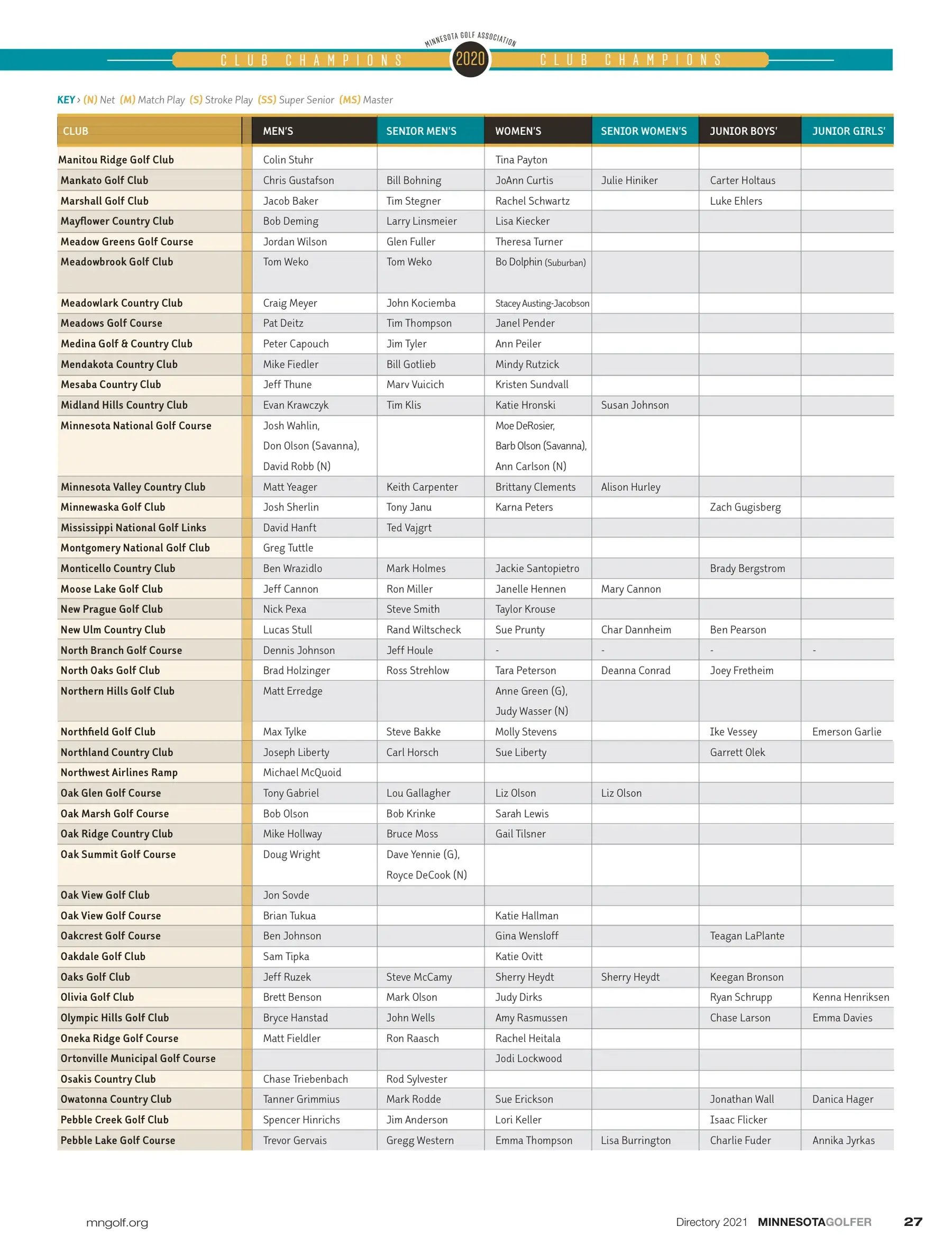
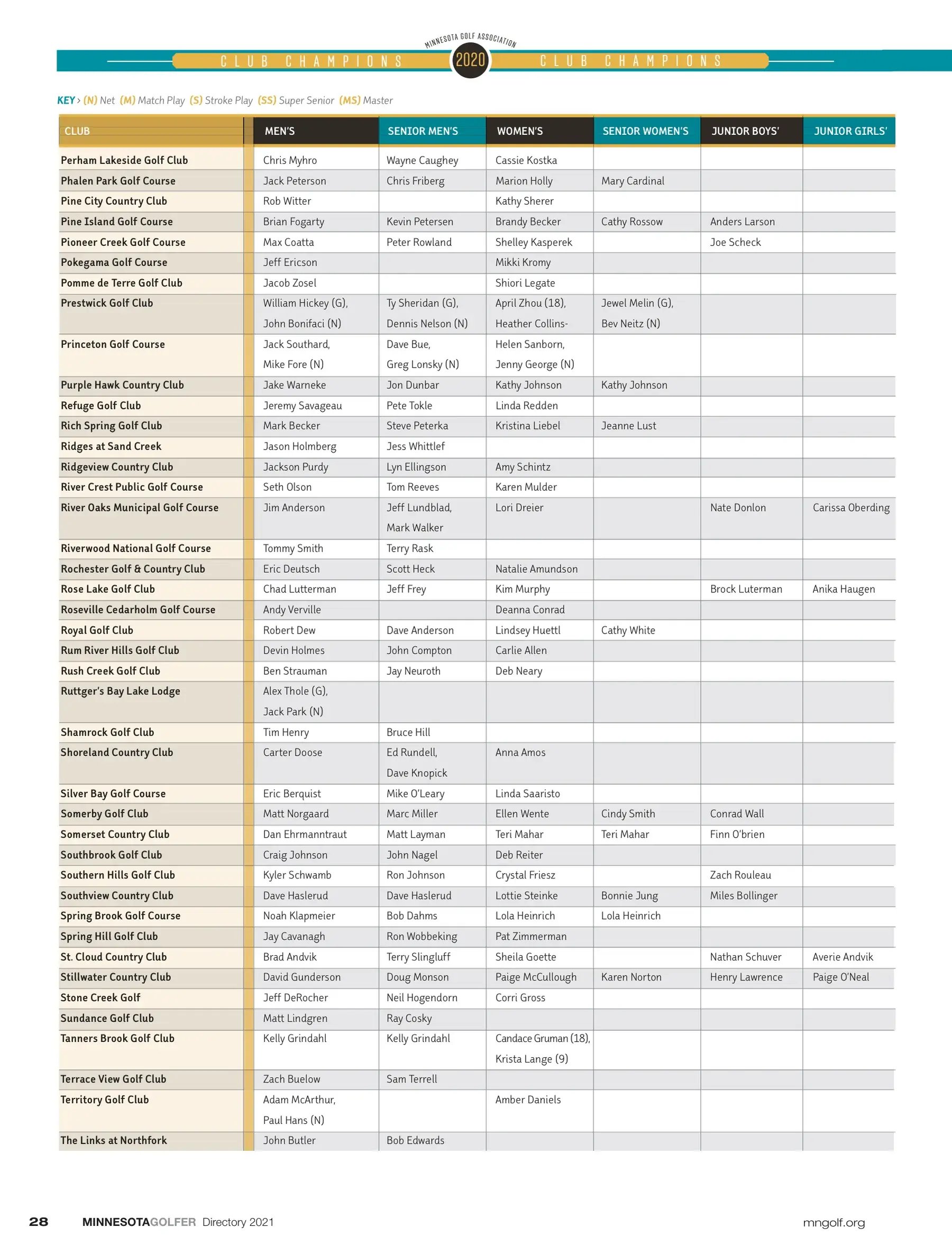
PHOTOS BY JOE BISSEN – Mike Malone, MGA President CLUB MEN’S SENIOR MEN’S WOMEN’S SENIOR WOMEN’S JUNIOR BOYS’ JUNIOR GIRLS’ Adrian Country Club Alex Kremer Katie Wieneke Albany Golf Club Ryan Sauerer Kevin Kohorst Deb Kersting Zac Kreuzer Alexandria Golf Club Jerry Rose Larry Novotny, Emily Monroe Weston Nyberg Gene Seashore (MS) American Family Golf League Matt Duevel Augusta National North Golf Club Tom Rammer Beth Pearson Austin Country Club Ben Meyer Clark Cipra Cindy Fuhrman Cindy Fuhrman Eli Krueger Reagan Harty Baker National Golf Course Ben Scharenbroich Dave Gaebel Mary Ann Perry Mary Ann Perry Balmoral Golf Course Tim Maaske Diana Fuder Cam Alt Bearpath Golf & Country Club Adam Rosenthal Paul Mortell Adele Peterson Jacob Van Dusen Bemidji Town & Country Club Jay Gregory Curt Howard Pam Johnson Bent Creek Golf Club Matt Opsal Scott Ainsworth Denise Zeyen Denise Zeyen Sam Haines Haley Wegscheid Bent Irons Golf Club Mike Wolff Roger Blossom Black Bear Golf Course Devyn Selnes Dapper Danielson Sami Mattson Bluff Creek Golf Course Jason Folstad Clayton Sodetani Annette Ellson Bois De Sioux Golf Club Robert Schuler Mike Ferrell MJ Krause Bridger Hansen Madison Bohn Boulder Pointe Golf Club Steve Pribyl Bob Stinnett Cindy Budd, Bonnie Kragness Mary Pritchett Brackett’s Crossing Country Club Paul Meyer Doug Piper Donna Turner Laura Miler Fred Moede Maggie Flicek Braemar Golf Course Bryan Francis Tim Smith Hillary Zuleger Kore Grate Pranay Singh Stella Bodensteiner Brightwood Hills Golf Course Jay Jaques Jeff Super Cheryl Baker Bev Stalberger Connor Wolf Brooktree Golf Course Dave Johnson Mike Ehlert Karin Steffenson Brookview Golf Course & Lawn Bowling Howard Hoffman Tom Hansen Sue Mahle Bulrush Golf Club Dustin Hjeny Rick Wright Bunker Hills Golf Club Craig Blowers Nicki Reuterfeldt Burl Oaks Golf Club Jordan Peters John Glenn Bev Limberg Amy Anderson Burning Cow Golf Club Mike McCollow Bushwood Country Club Scott Seymour IN 2020, 223 MGA member golf courses reported more than 701 club champions. Read our listing of who holds the titles at those clubs.
Champions Club 20 20 Directory 2021 MINNESOTAGOLFER 25 CLUB MEN’S SENIOR MEN’S WOMEN’S SENIOR WOMEN’S JUNIOR BOYS’ JUNIOR GIRLS’ KEY > (N) Net (M) Match Play (S) Stroke Play (SS) Super Senior (MS) Master Cannon Golf Club Alex Zeyen Bruce Hegland Katie Thielbar Castlewood Golf - The Rock Randy Stevens Bob Biernat Jill Thompson Cedar River Golf Course Jeff Thalberg Dan Wagner Cohen Wiste Cedar Valley Golf Course Paul Ciszak Chaska Town Course JB Randall Gerry Kauma Karla Hagen Kathy Fisher Jamison Wolfer Chisago Lakes Golf Course John Hawkinson John Hawkinson Meagan Bewley Deb Brown Chomonix Golf Club Alex Rogan Brian Blair Lori Newman Cleary Lake Park Golf Course Jacob Russell, Jussette Oliver (8-10), Jacob Sazama (8-10), Izzy Parker (11-13) Morgan Doering (11-13), TJ Pinkowski (14+) Cloquet Country Club John Sheff Bob Neve Arica Sheff Brayden Tyman Coffee Mill Golf Course Brad Scheel, Wendy Stumpf (N) Ron Stamschror (N) Columbia Golf Club Steve Walters Darryl Tilden, Steve Walters Como Golf Course Brian Arickx Dave Overkamp Cheryl Nordby Cragun’s Legacy Courses Gavin Metz Mike Moran Kathy Coombs Creeksbend Golf Course Martin Churney John Engler Barb Stoker Crosswoods Golf Course Gary Norman (G), Gary Norman Sue Mitsch (9), Tracy Nelson Jim Mateyka (N) Ann Schrupp (18) Crow River Golf Club Mark Stuckey Bruce Eckhart Alex Hantge Bobbi Hantge Cuyuna Rolling Hills Nick Healy Pat Smith, Joan Hasskamp Will Meyer Mike Mirau Dacotah Ridge Golf Club Justice Wabasha Deer Run Golf Club Ben Needham Bob Gordon Dellwood Country Club Eric Hayne Steve Poganski Olivia Herrick Barb Miller Detroit Country Club Tanner Lane Mike Seelye Ann Ferguson Hunter Burnside D.G.E.
Play a round with a stranger and a new ripple forms. Teach someone a different grip or swing and a current can change course. Work on behalf of golf and the betterment of the game and a sturdy swell may rise.
long been making waves in the game, and the contributions of two—U of M trailblazing golfer and instructor Kathy Williams and MGA legislative counselor and Capitol lobbyist Doug Carnival— keep flowing through the game. Read on to discover the huge wakes they’ve left in golf and their continuing impact.
Directory 2021 MINNESOTAGOLFER 31 hen Minnesota’s first confi rmed case of COVID-19 was spotted in early February of last year—coincidentally, from a golfer and MGA member just returned from a cruise—few could have imagined what lay ahead. Fast forward to now, and we’re still dealing with the consequences of a global pandemic well into the new year.
The curtain came up on March 16 with the Governor’s pending announcement of a closure order for all except essential business and services. This was early spring when most golfers were eagerly anticipating their first round of golf on damp but frost-free public courses.
These were heady days: anxiety and frustration ran high with state offi cials who had not yet deemed golf course maintenance work essential, while turf work was underway at Target Field in anticipation of the spring baseball opener. Certainly, golf course maintenance work was essential to protecting the golf course asset, yet at this stage industry stakeholders weren’t even sure whether there would be a golf season at all in 2020.
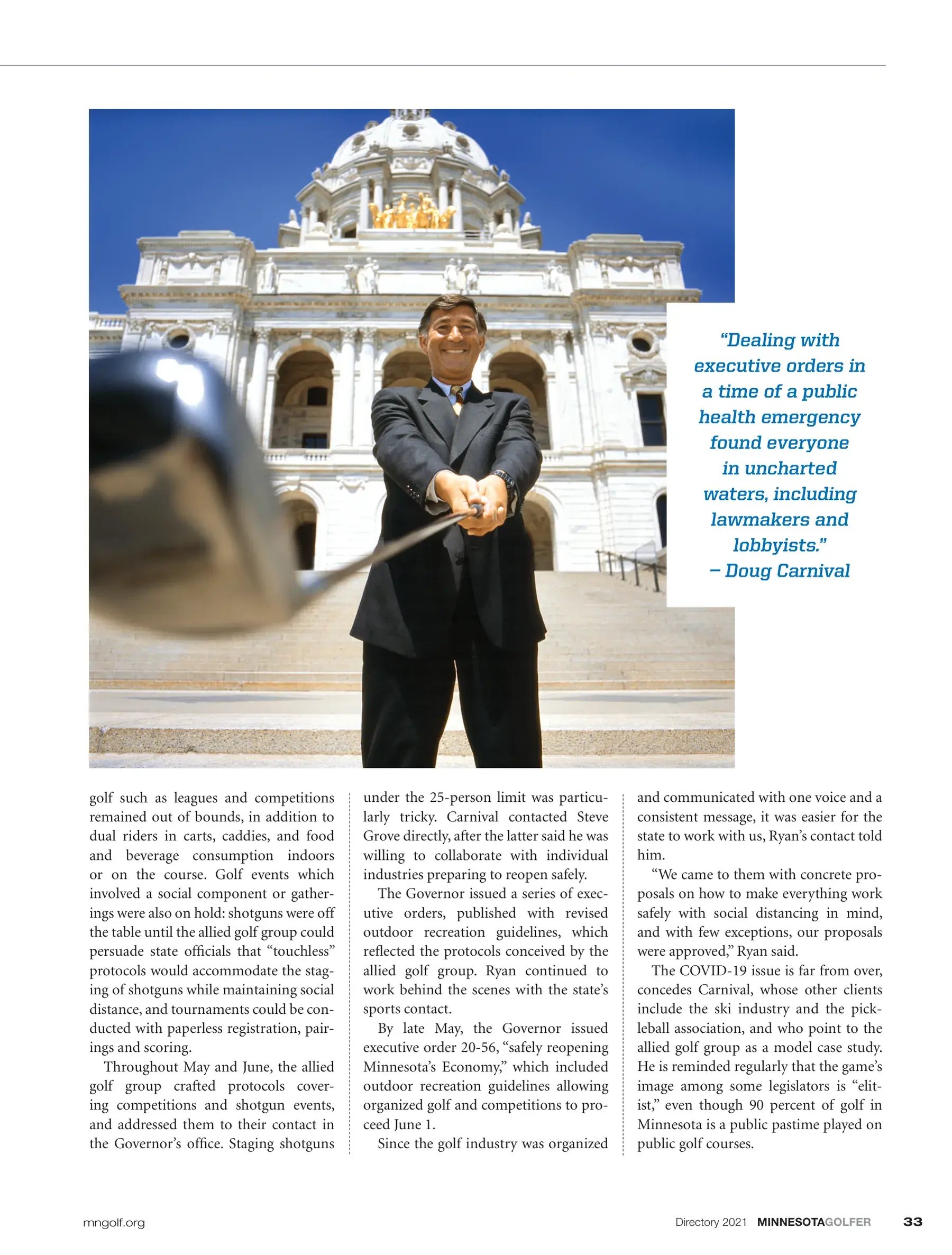
Into the breach gathered Minnesota’s allied golf leadership including the MGA, the PGA Section, the golf course owners, the club managers and the golf course superintendents associations, and the MGA’s man on point at the State Capitol, Doug Carnival.
Carnival, a product of Boston College and Georgetown University, has been the MGA’s legislative counselor for the better part of three decades.
While he has helped the industry navigate thorny legislative issues including tax liability and greenspace classifi cation, and pesticide and phosphorus use during that time, nothing was as potentially catastrophic as the effects of COVID-19 on golfers and the golf business.
An inside look at how the MGA’s legislative counselor guided the golf industry toward success in 2020. • BY W.P. RYAN • Carnival’s medium is the spokenword community and his vocation, “the confluence of education and advocacy best delivered in person,” he says. Yet, as of Thanksgiving, he had not met with a single lawmaker in person since last March. All communication had been via telephone, email, texts and virtual meetings online.
“The key is relationship building,” he says, adding, “lawmakers know you and trust you and have faith that you’re being straight with them. It’s knowing who to call, and how to phrase the request.”
Dealing with executive orders in a time of a public health emergency found everyone in uncharted waters, including lawmakers and lobbyists, says Carnival.
The closure, and subsequent stay-athome order caught everyone by surprise. No one quite knew what it meant, or whether industries related to essential businesses and services were likewise considered essential.
Golf’s leaders were equally perplexed but, above all, they sought clarification and desired a dialogue with those writing the language in the executive orders. The path ahead wasn’t necessarily clearly paved, and thus developing consensus among the group’s members on certain tactics was occasionally difficult. Some wanted to be aggressive advocates for opening up golf, despite the industry’s classification as nonessential, while others counseled patience.
“Tom Ryan was our quarterback,” says Carnival, explaining, “Tom was the one who kept all of the allied golf associations under one tent, on strategy and with one consistent message.”
In the meantime, Carnival was delivering the golf industry’s message to his contacts who had the ear of the Governor’s chief of staff. Golf has support from the highest levels of government, Carnival assured the allied group.
Correspondence was crafted to persuade the Governor and his commissioners that golf course maintenance was crucial to protecting the golf product, that the window of opportunity was narrowing with warming spring temperatures, and that maintenance could be done safely with social distancing.
Perceiving the department of health was a bottleneck in the process, the allied group stressed that social distancing is an inherent part of the game, and that they, the allied golf associations, would introduce best practices for the entire industry to abide by and follow. These golf operations safety protocols and best practices came together in a document titled “We’re Ready to Go.” Some were cribbed from other golf associations and trade groups, while others were conceived by the allied group.
These initiatives seemed to resonate well, as comments favorable to the opening of golf courses began to appear in the Governor’s remarks during his daily pressers. On April 8, Walz acknowledged that golf turf needed work. Later in the same presser, Steve Grove, the DEED commissioner, said the department was continuing to add exemptions for non-essential industries.
“We’re encouraging people to get outdoors and be healthy,” Walz said. “It’s not going to be a typical summer... [but] golf is a healthy, mental health activity that many people prefer,” he said, declaring, “[it is] not elitist.”
Whether or not the timing was coincidental, the April 8 presser was validating. The allied golf group was eager to communicate with the Governor’s people that the golf industry was indeed “ready to go” and could be opened safely.
Shortly thereafter on April 17, the Governor signed executive order 20-38 opening outdoor recreational facilities including public and private golf courses and outdoor driving ranges, effective the next day.
Not surprisingly, given it came on a Saturday and the weather was ideal, the opener brought 275 and 300 golfers, respectively, to Oak Marsh Golf Club in Woodbury, and the Ridges of Sand Creek in Jordan. The pent-up demand would feed a golf surge that continued for the remainder of the season and well into the fall as golfers showed up in record numbers. By November, daily fee rounds were up a staggering 30 percent. In spite of the late opening, municipal, private and resort facilities would all report double-digit increases over the previous year.
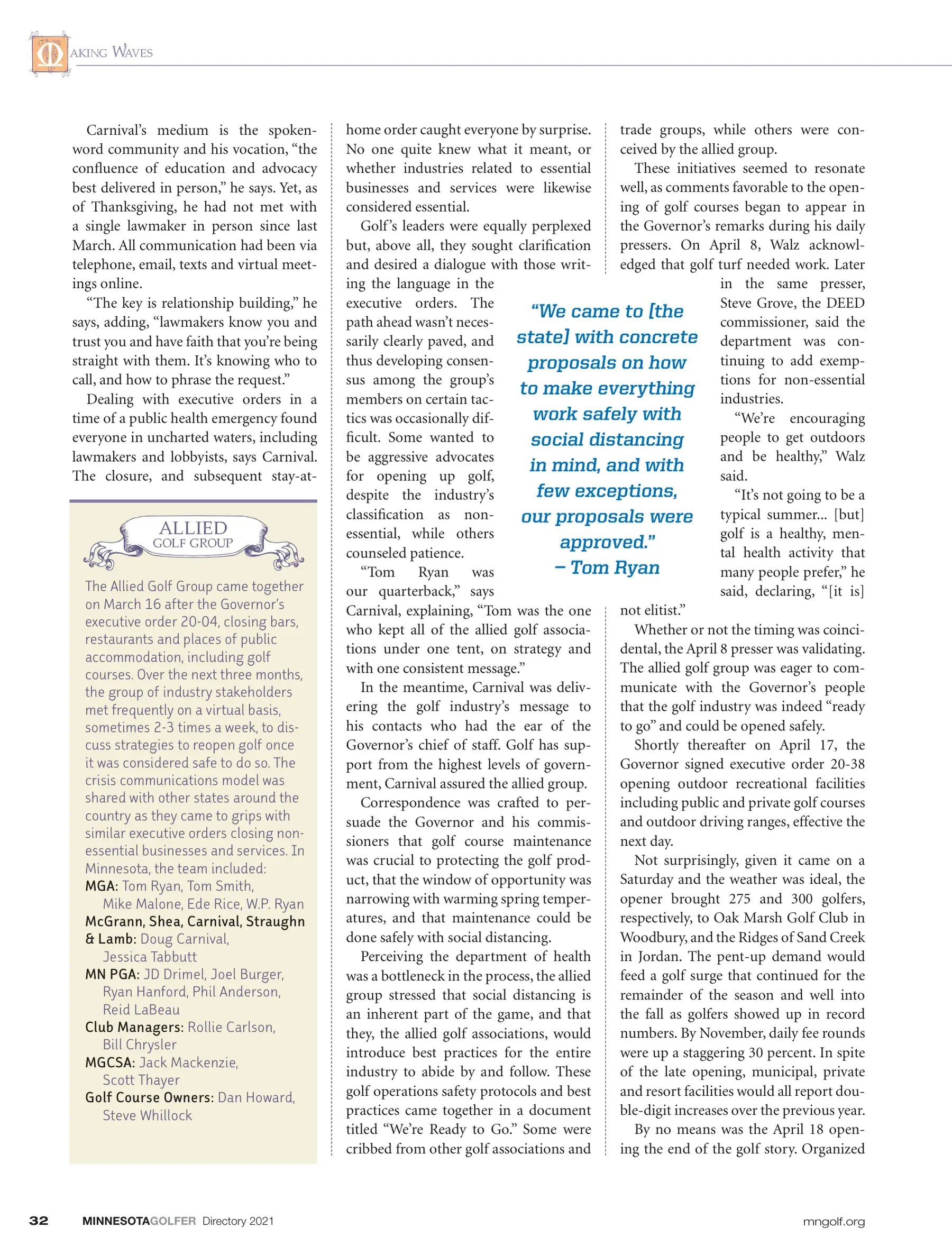
By no means was the April 18 opening the end of the golf story. Organized The Allied Golf Group came together on March 16 after the Governor’s executive order 20-04, closing bars, restaurants and places of public accommodation, including golf courses. Over the next three months, the group of industry stakeholders met frequently on a virtual basis, sometimes 2-3 times a week, to discuss strategies to reopen golf once it was considered safe to do so. The crisis communications model was shared with other states around the country as they came to grips with similar executive orders closing nonessential businesses and services. In Minnesota, the team included: MGA: Tom Ryan, Tom Smith, Mike Malone, Ede Rice, W.P. Ryan McGrann, Shea, Carnival, Straughn & Lamb: Doug Carnival, Jessica Tabbutt MN PGA: JD Drimel, Joel Burger, Ryan Hanford, Phil Anderson, Reid LaBeau Club Managers: Rollie Carlson, Bill Chrysler MGCSA: Jack Mackenzie, Scott Thayer Golf Course Owners: Dan Howard, Steve Whillock “We came to [the state] with concrete proposals on how to make everything work safely with social distancing in mind, and with few exceptions, our proposals were approved.”
— Tom Ryan Directory 2021 MINNESOTAGOLFER 33 golf such as leagues and competitions remained out of bounds, in addition to dual riders in carts, caddies, and food and beverage consumption indoors or on the course. Golf events which involved a social component or gatherings were also on hold: shotguns were off the table until the allied golf group could persuade state officials that “touchless”
protocols would accommodate the staging of shotguns while maintaining social distance, and tournaments could be conducted with paperless registration, pairings and scoring.
Throughout May and June, the allied golf group crafted protocols covering competitions and shotgun events, and addressed them to their contact in the Governor’s office. Staging shotguns under the 25-person limit was particularly tricky. Carnival contacted Steve Grove directly, after the latter said he was willing to collaborate with individual industries preparing to reopen safely.
The Governor issued a series of executive orders, published with revised outdoor recreation guidelines, which reflected the protocols conceived by the allied golf group. Ryan continued to work behind the scenes with the state’s sports contact.
By late May, the Governor issued executive order 20-56, “safely reopening Minnesota’s Economy,” which included outdoor recreation guidelines allowing organized golf and competitions to proceed June 1.
Since the golf industry was organized and communicated with one voice and a consistent message, it was easier for the state to work with us, Ryan’s contact told him.
“We came to them with concrete proposals on how to make everything work safely with social distancing in mind, and with few exceptions, our proposals were approved,” Ryan said.
The COVID-19 issue is far from over, concedes Carnival, whose other clients include the ski industry and the pickleball association, and who point to the allied golf group as a model case study.
He is reminded regularly that the game’s image among some legislators is “elitist,” even though 90 percent of golf in Minnesota is a public pastime played on public golf courses.
“Dealing with executive orders in a time of a public health emergency found everyone in uncharted waters, including lawmakers and lobbyists.”
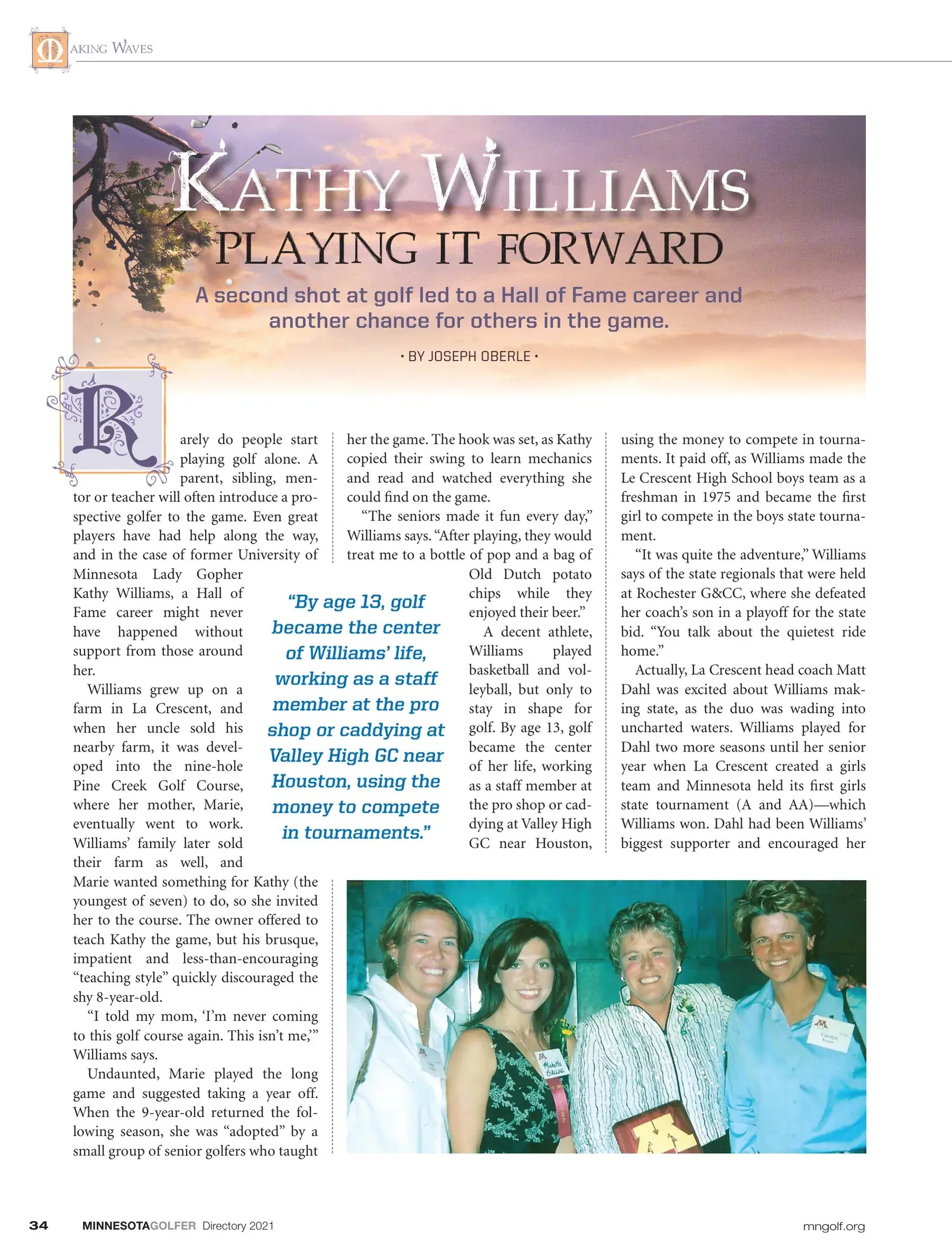
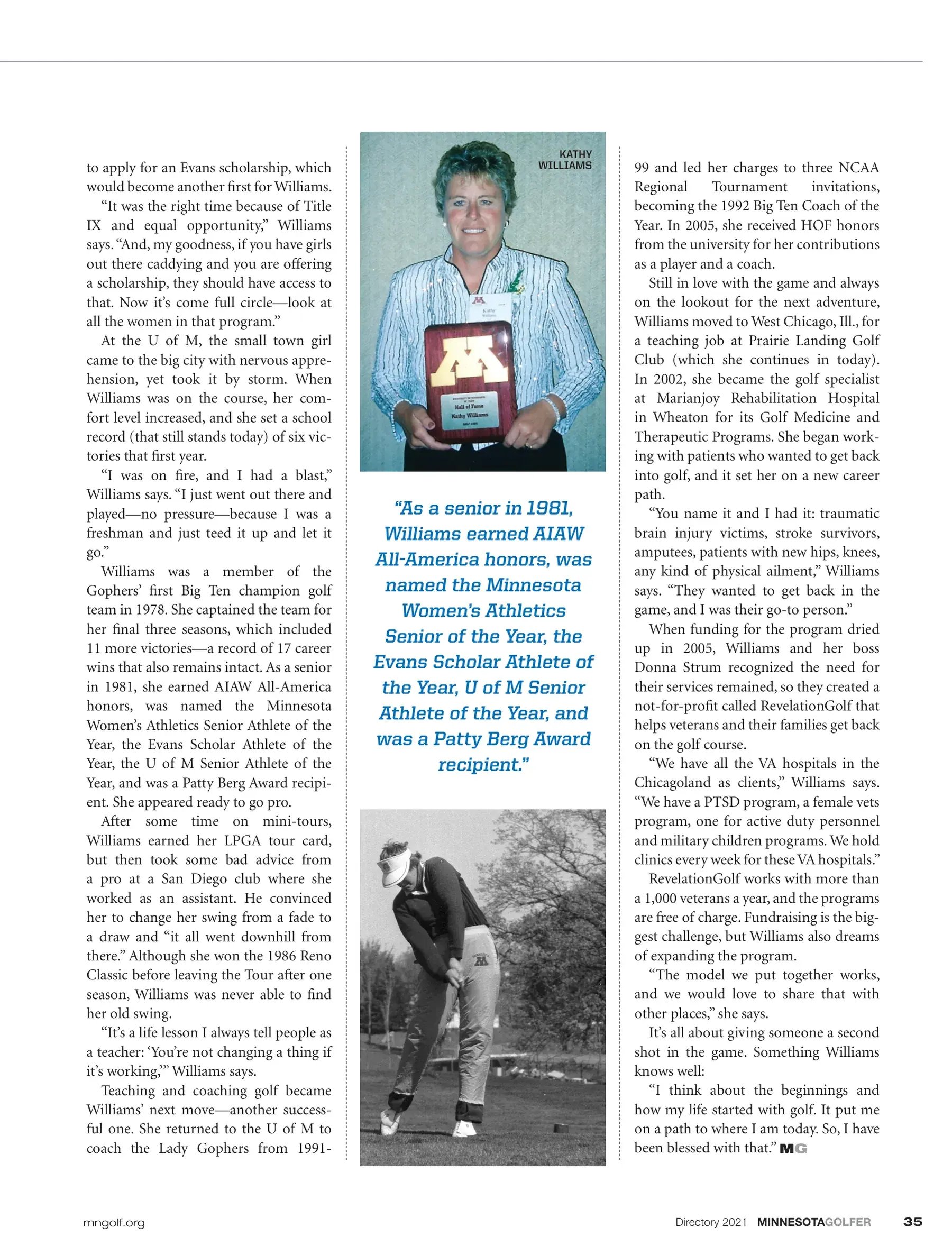
— Doug Carnival arely do people start playing golf alone. A parent, sibling, mentor or teacher will often introduce a prospective golfer to the game. Even great players have had help along the way, and in the case of former University of Minnesota Lady Gopher Kathy Williams, a Hall of Fame career might never have happened without support from those around her.
Williams grew up on a farm in La Crescent, and when her uncle sold his nearby farm, it was developed into the nine-hole Pine Creek Golf Course, where her mother, Marie, eventually went to work.
Williams’ family later sold their farm as well, and Marie wanted something for Kathy (the youngest of seven) to do, so she invited her to the course. The owner offered to teach Kathy the game, but his brusque, impatient and less-than-encouraging “teaching style” quickly discouraged the shy 8-year-old.
“I told my mom, ‘I’m never coming to this golf course again. This isn’t me,’” Williams says. Undaunted, Marie played the long game and suggested taking a year off.
When the 9-year-old returned the following season, she was “adopted” by a small group of senior golfers who taught her the game. The hook was set, as Kathy copied their swing to learn mechanics and read and watched everything she could find on the game.
“The seniors made it fun every day,” Williams says. “After playing, they would treat me to a bottle of pop and a bag of Old Dutch potato chips while they enjoyed their beer.”
A decent athlete, Williams played basketball and volleyball, but only to stay in shape for golf. By age 13, golf became the center of her life, working as a staff member at the pro shop or caddying at Valley High GC near Houston, using the money to compete in tournaments. It paid off, as Williams made the Le Crescent High School boys team as a freshman in 1975 and became the first girl to compete in the boys state tournament.
“It was quite the adventure,” Williams says of the state regionals that were held at Rochester G&CC, where she defeated her coach’s son in a playoff for the state bid. “You talk about the quietest ride home.”
Actually, La Crescent head coach Matt Dahl was excited about Williams making state, as the duo was wading into uncharted waters. Williams played for Dahl two more seasons until her senior year when La Crescent created a girls team and Minnesota held its first girls state tournament (A and AA)—which Williams won. Dahl had been Williams’ biggest supporter and encouraged her • BY JOSEPH OBERLE • A second shot at golf led to a Hall of Fame career and another chance for others in the game.
“By age 13, golf became the center of Williams’ life, working as a staff member at the pro shop or caddying at Valley High GC near Houston, using the money to compete in tournaments.”
Directory 2021 MINNESOTAGOLFER 35 to apply for an Evans scholarship, which would become another first for Williams. “It was the right time because of Title IX and equal opportunity,” Williams says. “And, my goodness, if you have girls out there caddying and you are offering a scholarship, they should have access to that. Now it’s come full circle—look at all the women in that program.”
At the U of M, the small town girl came to the big city with nervous apprehension, yet took it by storm. When Williams was on the course, her comfort level increased, and she set a school record (that still stands today) of six victories that first year.
“I was on fire, and I had a blast,” Williams says. “I just went out there and played—no pressure—because I was a freshman and just teed it up and let it go.”
Williams was a member of the Gophers’ first Big Ten champion golf team in 1978. She captained the team for her final three seasons, which included 11 more victories—a record of 17 career wins that also remains intact. As a senior in 1981, she earned AIAW All-America honors, was named the Minnesota Women’s Athletics Senior Athlete of the Year, the Evans Scholar Athlete of the Year, the U of M Senior Athlete of the Year, and was a Patty Berg Award recipient. She appeared ready to go pro.
After some time on mini-tours, Williams earned her LPGA tour card, but then took some bad advice from a pro at a San Diego club where she worked as an assistant. He convinced her to change her swing from a fade to a draw and “it all went downhill from there.” Although she won the 1986 Reno Classic before leaving the Tour after one season, Williams was never able to find her old swing.
“It’s a life lesson I always tell people as a teacher: ‘You’re not changing a thing if it’s working,’” Williams says. Teaching and coaching golf became Williams’ next move—another successful one. She returned to the U of M to coach the Lady Gophers from 199199 and led her charges to three NCAA Regional Tournament invitations, becoming the 1992 Big Ten Coach of the Year. In 2005, she received HOF honors from the university for her contributions as a player and a coach.
Still in love with the game and always on the lookout for the next adventure, Williams moved to West Chicago, Ill., for a teaching job at Prairie Landing Golf Club (which she continues in today).
In 2002, she became the golf specialist at Marianjoy Rehabilitation Hospital in Wheaton for its Golf Medicine and Therapeutic Programs. She began working with patients who wanted to get back into golf, and it set her on a new career path.
“You name it and I had it: traumatic brain injury victims, stroke survivors, amputees, patients with new hips, knees, any kind of physical ailment,” Williams says. “They wanted to get back in the game, and I was their go-to person.”
When funding for the program dried up in 2005, Williams and her boss Donna Strum recognized the need for their services remained, so they created a not-for-profit called RevelationGolf that helps veterans and their families get back on the golf course.
“We have all the VA hospitals in the Chicagoland as clients,” Williams says. “We have a PTSD program, a female vets program, one for active duty personnel and military children programs. We hold clinics every week for these VA hospitals.”
RevelationGolf works with more than a 1,000 veterans a year, and the programs are free of charge. Fundraising is the biggest challenge, but Williams also dreams of expanding the program.
“The model we put together works, and we would love to share that with other places,” she says. It’s all about giving someone a second shot in the game. Something Williams knows well: “I think about the beginnings and how my life started with golf. It put me on a path to where I am today. So, I have been blessed with that.” MG “As a senior in 1981, Williams earned AIAW All-America honors, was named the Minnesota Women’s Athletics Senior of the Year, the Evans Scholar Athlete of the Year, U of M Senior Athlete of the Year, and was a Patty Berg Award recipient.”
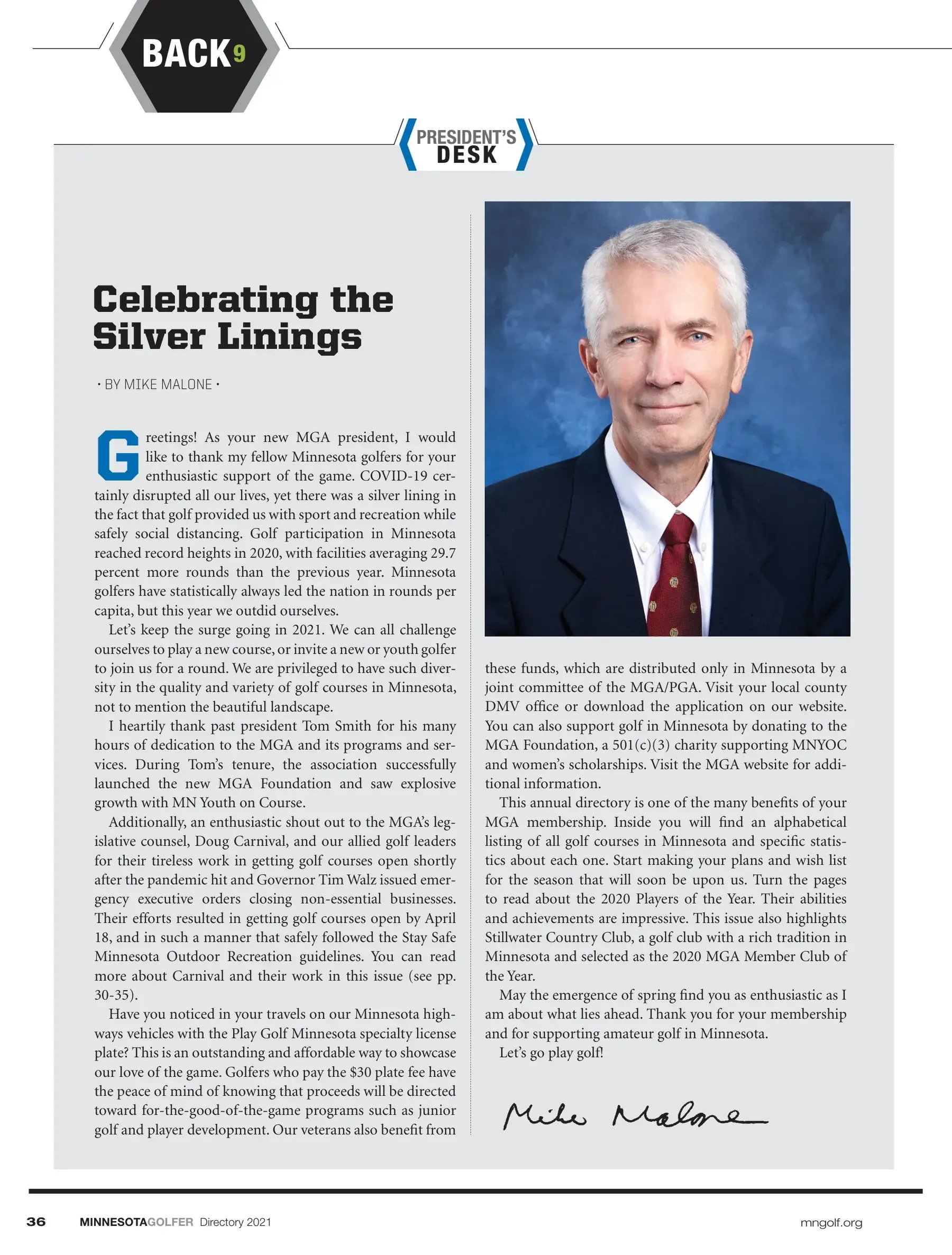
KATHY WILLIAMS BACK PRESIDENT’S DESK Celebrating the Silver Linings G reetings! As your new MGA president, I would like to thank my fellow Minnesota golfers for your enthusiastic support of the game. COVID-19 certainly disrupted all our lives, yet there was a silver lining in the fact that golf provided us with sport and recreation while safely social distancing. Golf participation in Minnesota reached record heights in 2020, with facilities averaging 29.7 percent more rounds than the previous year. Minnesota golfers have statistically always led the nation in rounds per capita, but this year we outdid ourselves.
Let’s keep the surge going in 2021. We can all challenge ourselves to play a new course, or invite a new or youth golfer to join us for a round. We are privileged to have such diversity in the quality and variety of golf courses in Minnesota, not to mention the beautiful landscape.
I heartily thank past president Tom Smith for his many hours of dedication to the MGA and its programs and services. During Tom’s tenure, the association successfully launched the new MGA Foundation and saw explosive growth with MN Youth on Course.
Additionally, an enthusiastic shout out to the MGA’s legislative counsel, Doug Carnival, and our allied golf leaders for their tireless work in getting golf courses open shortly after the pandemic hit and Governor Tim Walz issued emergency executive orders closing non-essential businesses.
Their efforts resulted in getting golf courses open by April 18, and in such a manner that safely followed the Stay Safe Minnesota Outdoor Recreation guidelines. You can read more about Carnival and their work in this issue (see pp.