




Fall 2017




























Back to The Minnesota Golfer Archive
Read the text of this issue
Text from the printed pages, so it can be searched and read by screen readers. Layout and photography are in the reader above.
There’s something transcendent about golf in the desert— where vivid green fairways and bright blue skies meet rugged terrain. With Troon Golf Arizona, you’ll be playing some of the best courses the Southwest has to offer, and experiencing the finest playing conditions and friendliest customer service in the game.
MGA is now mobile. Smartphone owners will find web content displayed in a mobilefriendly format, while MGA members who log in with their GHIN ID and last name will be able to post scores, search for courses by “nearest” location, and follow live scoring during MGA and USGA events.
Subscriptions: Regular U.S. one year (4 issues) $18. Directory issue of Minnesota Golfer: $9.95 plus shipping, pre-paid. Other single copies: $2.95 per copy plus shipping, pre-paid.
“I can’t believe how many people comment to me about how they follow the live scoring. I’m even more astonished by how many non-golfers enjoy the live scoring,”
says Andy Jacobson, runner-up at the recent Mid-Amateur, who plays out of Eagle Creek Golf Club in Willmar, Minn. “It amazes me when I return home how many people tell me ‘I was following you online’ or ‘I was glued to the live scoring link.’”
Those eyeballs (and thousands more like them) attribute to the spike in traffic we see at mngolf.org during events where live scoring is featured. Live scoring also adds a touch of professionalism to MGA championships, adds Jacobson. So yeah, the extra labor is worth it.
The USGA and R&A are currently considering sweeping changes to the Rules in an effort to modernize them, as well as clarify and simplify the language to make them more accessible to golfers worldwide.
In fact, the new Rule 3–3 (Stroke Play) replaces the old Rule 6–6, and explains that a “score card” may be any paper or electronic form approved by the Committee. The new Rule allows for “certification” via a physical or electronic signature. Clearly the rulesmakers are making way for the day when paper scorecards are complemented by—if not outright replaced by—digital media.
How soon that day arrives depends a lot on how quickly golf administrators and competitors accept the intrusion of these digital tools inside the ropes. I have no doubt that technology will soon catch up with the needs of our competitive players (who are already familiar with range finders, yardage books, smartphone apps and “wearable technology”). Harder to convince will be the old guard who regard paper scorecards as immutable. Whatever form the new scoring technology takes, it will have to be as easy to use as putting pencil to paper—and valid in the eyes of those both inside and outside of the ropes.
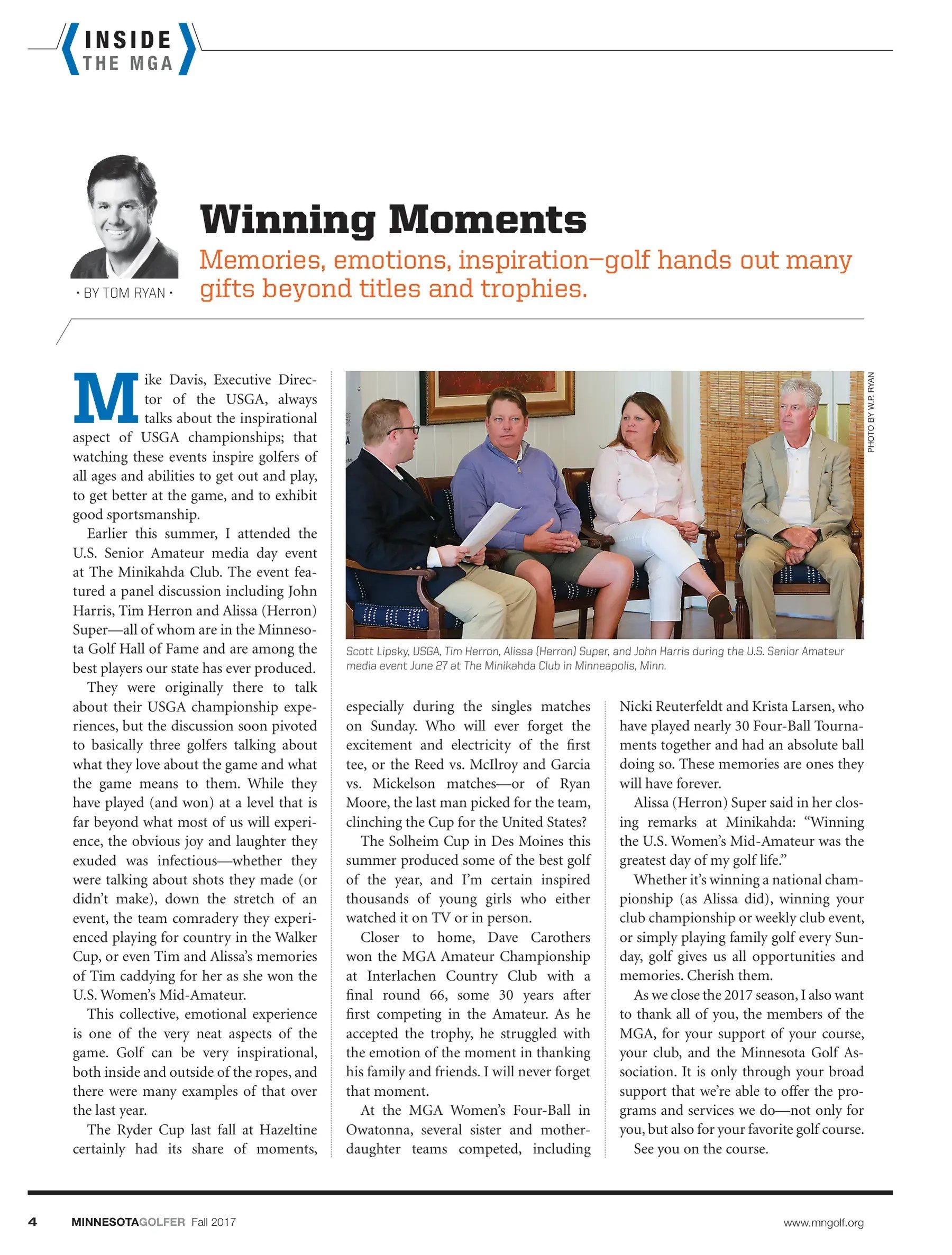
www.mngolf.org Fall 2017 MINNESOTAGOLFER 3 M ike Davis, Executive Director of the USGA, always talks about the inspirational aspect of USGA championships; that watching these events inspire golfers of all ages and abilities to get out and play, to get better at the game, and to exhibit good sportsmanship.
Earlier this summer, I attended the U.S. Senior Amateur media day event at The Minikahda Club. The event featured a panel discussion including John Harris, Tim Herron and Alissa (Herron) Super —all of whom are in the Minnesota Golf Hall of Fame and are among the best players our state has ever produced.
They were originally there to talk about their USGA championship experiences, but the discussion soon pivoted to basically three golfers talking about what they love about the game and what the game means to them. While they have played (and won) at a level that is far beyond what most of us will experience, the obvious joy and laughter they exuded was infectious—whether they were talking about shots they made (or didn’t make), down the stretch of an event, the team comradery they experienced playing for country in the Walker Cup, or even Tim and Alissa’s memories of Tim caddying for her as she won the U.S. Women’s Mid-Amateur.
This collective, emotional experience is one of the very neat aspects of the game. Golf can be very inspirational, both inside and outside of the ropes, and there were many examples of that over the last year.
The Ryder Cup last fall at Hazeltine certainly had its share of moments, especially during the singles matches on Sunday. Who will ever forget the excitement and electricity of the first tee, or the Reed vs. McIlroy and Garcia vs. Mickelson matches —or of Ryan Moore, the last man picked for the team, clinching the Cup for the United States?
The Solheim Cup in Des Moines this summer produced some of the best golf of the year, and I’m certain inspired thousands of young girls who either watched it on TV or in person.
Closer to home, Dave Carothers won the MGA Amateur Championship at Interlachen Country Club with a final round 66, some 30 years after first competing in the Amateur. As he accepted the trophy, he struggled with the emotion of the moment in thanking his family and friends. I will never forget that moment.
At the MGA Women’s Four-Ball in Owatonna, several sister and motherdaughter teams competed, including Nicki Reuterfeldt and Krista Larsen, who have played nearly 30 Four-Ball Tournaments together and had an absolute ball doing so. These memories are ones they will have forever.
Alissa (Herron) Super said in her closing remarks at Minikahda: “Winning the U.S. Women’s Mid-Amateur was the greatest day of my golf life.” Whether it’s winning a national championship (as Alissa did), winning your club championship or weekly club event, or simply playing family golf every Sunday, golf gives us all opportunities and memories. Cherish them.
As we close the 2017 season, I also want to thank all of you, the members of the MGA, for your support of your course, your club, and the Minnesota Golf Association. It is only through your broad support that we’re able to offer the programs and services we do—not only for you, but also for your favorite golf course.
Scott Lipsky, USGA, Tim Herron, Alissa (Herron) Super, and John Harris during the U.S. Senior Amateur media event June 27 at The Minikahda Club in Minneapolis, Minn.
PHOTO BY W.P. RYAN Enjoy a seven-night, all-inclusive hotel stay for the price of six nights at the exceptional and elegant Grand Isla Navidad Resort in Manzanillo, Mexico. You’ll get unlimited rounds of golf per adult at the 27-hole Isla Navidad championship golf course. We’ll even save you the drive with free transportation between the hotel and golf course.
Some of those champions are familiar names such as Claudia Pilot (13 wins) or Lester Bolstad (10)— both of whom have certainly filled trophy cases in their time. Other golfers have fewer but no less impressive wins. For example, Champions Tour player and 1996 British Open champ Tom Lehman won five state titles in Minnesota before heading off to the PGA Tour, and Patty Berg had three local victories before launching her illustrious career.
Still, there are some names and numbers that stand out. With 17, George Shortridge leads the way for most victories by a professional golfer, garnering the lion’s share of his wins in the Minnesota Section Championship (eight in match play and six in stroke). Shortridge bests local pros Don Berry at 15 wins and Joe Coria with 11 titles.
A couple prolifi c amateur winners include Harry Legg, who among his 11 wins won 10 MGA Amateurs (match play), and Harrison “Jimmy” Johnston, who set a record with seven consecutive MGA Amateur match play titles.
On the women’s side, the top winners are Bev Vanstrum with 17 state titles, and Joan Garvin right behind her with 16. That pair is followed by Nancy (Harris) Blanchard and Gertrude (Boothby) Dansingburg with 11 and Beatrice (Barrett) Altmeyer with 10.
When you consider combined regular and senior women’s tournaments, no golfer has more trouble finding trophy case room than Leigh Klasse, who won her 25th individual title in September (the 2017 MGA Women’s Senior Amateur) and is showing no signs of slowing down.
On the youthful end of the spectrum are rising amateur stars such as 21-year-old Sarah Burnham, who has already compiled eight state wins in her short career, and University of Nebraska sophomore Kate Smith, a five-time state high school champ who just claimed her first MGA Women’s Amateur Championship.
Perhaps the most versatile golfer on the list is Charles “Pat” Sawyer, who won one high school title, two state juniors, and then compiled seven state titles as an amateur and later as a professional, including four MGA Amateurs and three State Opens—the most since Jimmy Johnston.
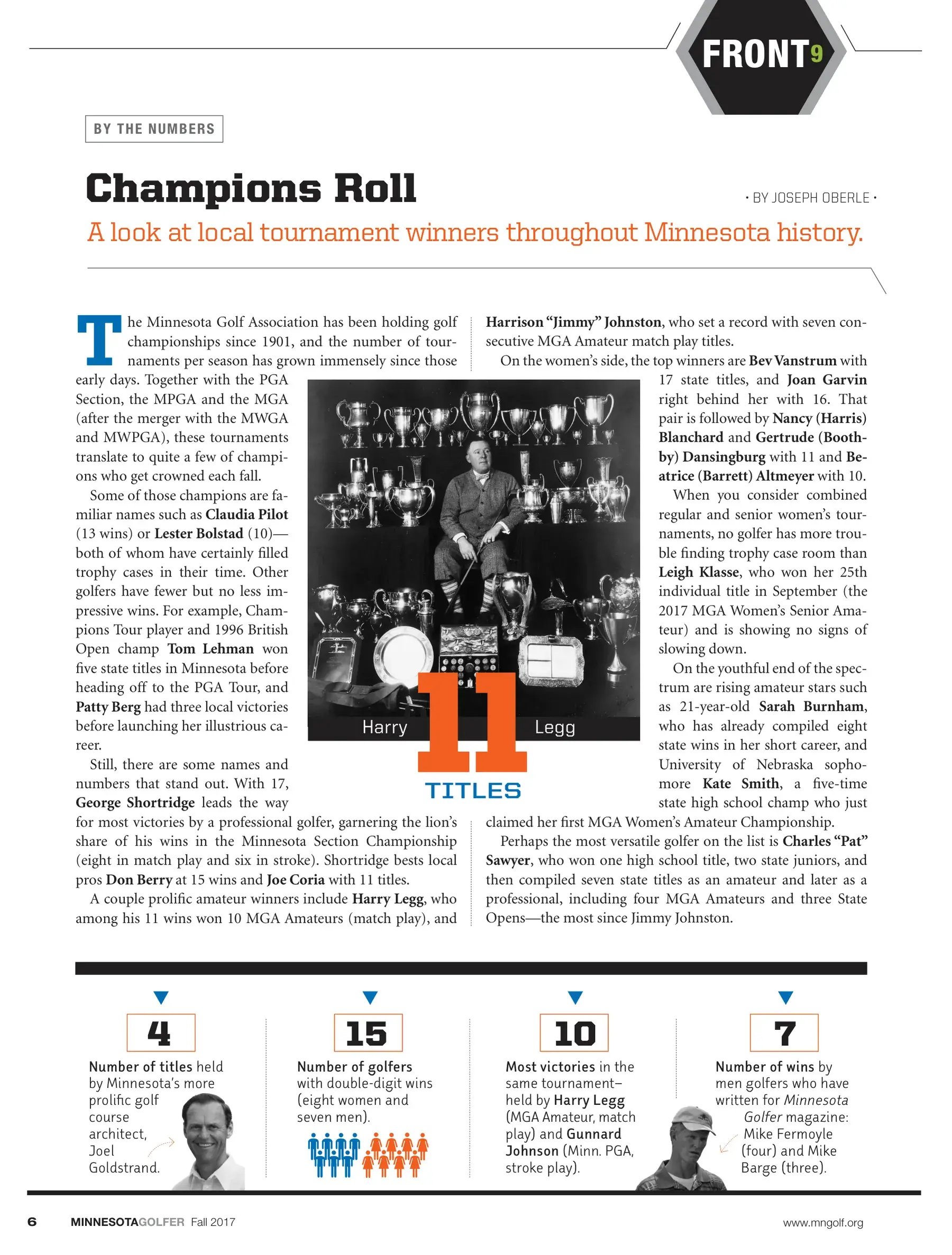
Champions Roll A look at local tournament winners throughout Minnesota history. • BY JOSEPH OBERLE • BY THE NUMBERS Number of titles held by Minnesota’s more prolifi c golf course architect, Joel Goldstrand.
Number of golfers with double-digit wins (eight women and seven men). Most victories in the same tournament— held by Harry Legg (MGA Amateur, match play) and Gunnard Johnson (Minn. PGA, stroke play).
Number of wins by men golfers who have written for Minnesota Golfer magazine: Mike Fermoyle (four) and Mike Barge (three). www.mngolf.org TITLES Harry Legg FRONT PHOTO BY PAUL MARKERT, ILLUSTRATION BY DEAN LAVATO T ipsinah Mounds Golf Course recently dressed up the forward tees of the beautiful hole number 16, but that can’t disguise the treachery that awaits at this No. 4 handicap hole.
From the tips, it’s 195 yards over a pond bordering the length of the hole on the right and curling in front of the green. With no run-up to the putting surface, the hole requires a strong tee shot—especially with the wind blowing off nearby Pomme de Terre Lake.
“The lake is right there, so you can get some wind off the lake, which is usually more of a crosswind from the left,” says clubhouse manager Tonya M. Nelson.
The large green itself is no picnic, with a hefty slope from back to front. Nelson recommends staying below the hole or else a downhill putt could wind up in the rocks (or even a watery grave). —Joseph Oberle GREAT DRIVES Tipsinah Mounds GC Elbow Lake | No. 16 » par 3 » 135–195 yards “It’s a pretty hole—but I don’t know that our senior players love it.” —Tonya M. Nelson www.mngolf.org Fall 2017 MINNESOTAGOLFER 7 Opened 1982 | Architect Joel Goldstrand | Clubhouse Manager Tonya M. Nelson | Superintendent Peter B. Mounts | Course Record 67—Corey Johnson I ’m a believer in teaching the swing as a swing—not a series of positions that need to be found. That said, if there is one position I don’t want to stray far from, it’s halfway in the backswing. Starting the swing correctly goes a long way toward achieving the desired result of the shot— and having to make the least amount of adjustments in the downswing.
In this position (see photo), the clubface should not be overly closed or open, but rather in a “toe up” position. Having the shaft parallel to your target line gives you a better chance of seeing this position again on the downswing. I see many good players rehearsing this move in their pre-shot routine. Try it and see if it helps you with your own swing.
Finding Your Better Half When it comes to the backswing, there’s plenty to learn at the halfway point. • BY MIKE BARGE • Mike Barge is the director of instruction at Hazeltine National GC and a Class A member of the PGA of America.
Adidas ClimaheatTM Primaloft Full Zip Jacket Fall layers can encumber your body— and your game. A good solution? Adidas ClimaheatTM Primaloft Full Zip Jacket (or ClimaheatTM Puffer Jacket for women). Made from 100 percent polyester, the jacket’s zonal insulation maintains core warmth without sacrificing mobility. Bonus: The internal mesh pocket makes it easy to pack and store.
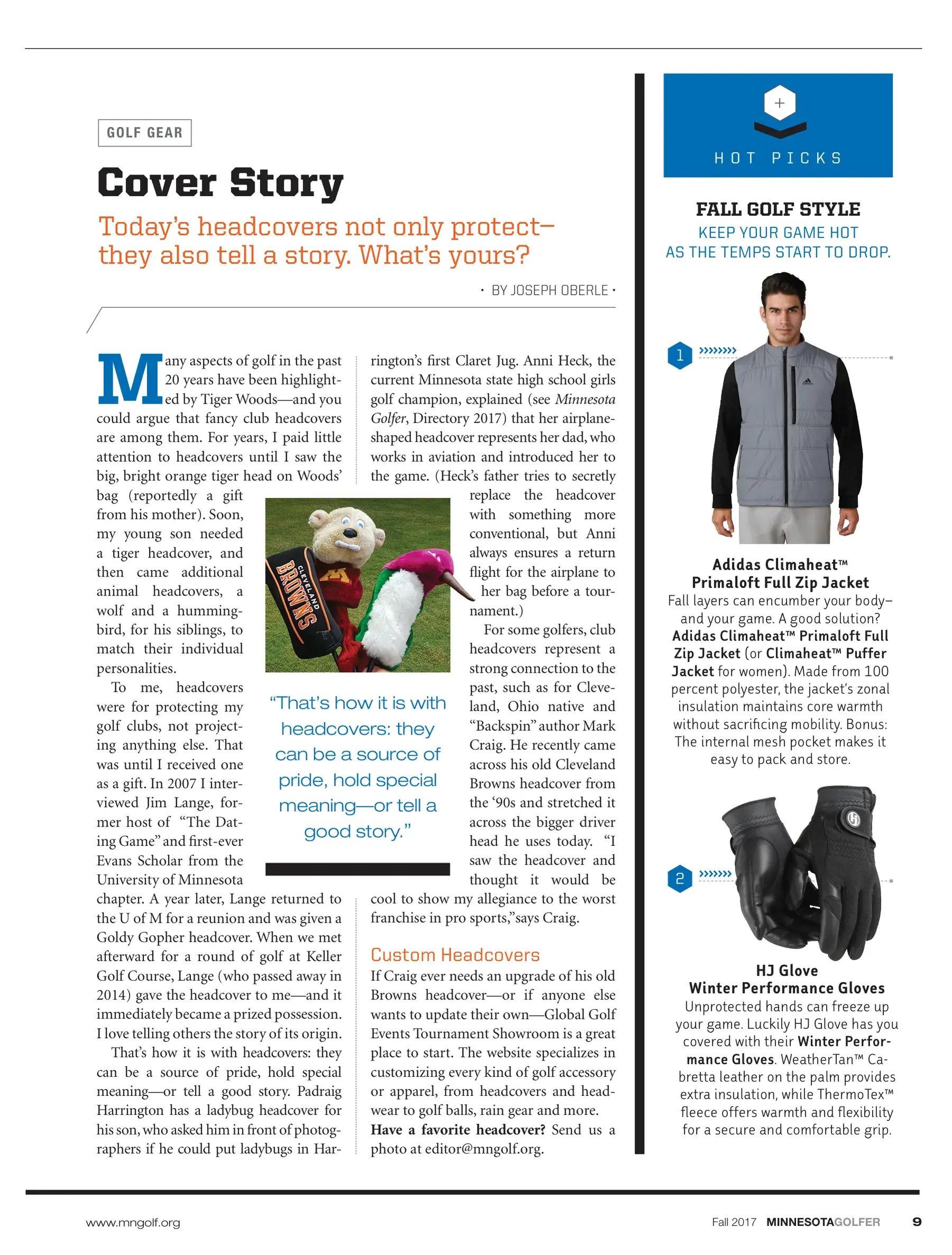
M any aspects of golf in the past 20 years have been highlighted by Tiger Woods—and you could argue that fancy club headcovers are among them. For years, I paid little attention to headcovers until I saw the big, bright orange tiger head on Woods’ bag (reportedly a gift from his mother). Soon, my young son needed a tiger headcover, and then came additional animal headcovers, a wolf and a hummingbird, for his siblings, to match their individual personalities.
To me, headcovers were for protecting my golf clubs, not projecting anything else. That was until I received one as a gift. In 2007 I interviewed Jim Lange, former host of “The Dating Game” and first-ever Evans Scholar from the University of Minnesota chapter. A year later, Lange returned to the U of M for a reunion and was given a Goldy Gopher headcover. When we met afterward for a round of golf at Keller Golf Course, Lange (who passed away in 2014) gave the headcover to me—and it immediately became a prized possession.
Custom Headcovers If Craig ever needs an upgrade of his old Browns headcover—or if anyone else wants to update their own—Global Golf Events Tournament Showroom is a great place to start. The website specializes in customizing every kind of golf accessory or apparel, from headcovers and headwear to golf balls, rain gear and more.
Have a favorite headcover? Send us a photo at editor@mngolf.org. Cover Story Today’s headcovers not only protect— they also tell a story. What’s yours?
• BY JOSEPH OBERLE • “That’s how it is with headcovers: they can be a source of pride, hold special meaning—or tell a good story.” >>>>>>> the ball is in a water hazard. The player is the sole judge as to whether his ball is unplayable.”
This meant that no one could compel Spieth to get a club on his golf ball. Spieth deemed it unplayable, and combined it with the TIO Rule (Appendix I, Part A, 4b—Temporary Immovable Obstructions) to find himself a much better situation. As a result, no Rules need changing— unless we want to consider a name change.
Unplayable? Indeed, Spieth “played the unplayable” to his full advantage. R ulings in a Major tournament are often, well, major. Another big ruling happened during the 2017 Open Championship, when Jordan Spieth used Rule 28—Ball Unplayable to extricate himself from a tough situation and went on to win the tournament.
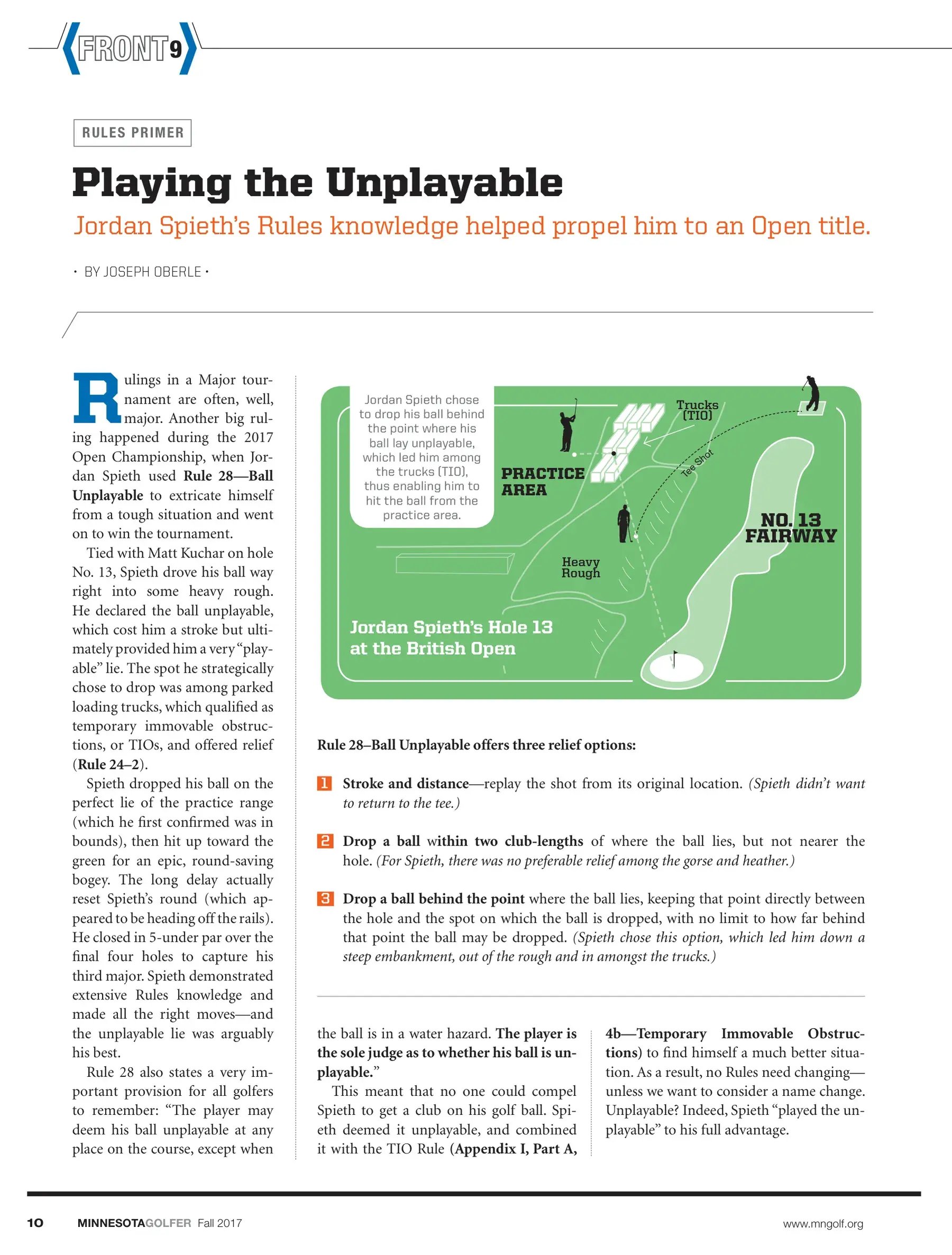
Tied with Matt Kuchar on hole No. 13, Spieth drove his ball way right into some heavy rough. He declared the ball unplayable, which cost him a stroke but ultimately provided him a very “playable” lie. The spot he strategically chose to drop was among parked loading trucks, which qualified as temporary immovable obstructions, or TIOs, and offered relief (Rule 24–2).
Spieth dropped his ball on the perfect lie of the practice range (which he first confirmed was in bounds), then hit up toward the green for an epic, round-saving bogey. The long delay actually reset Spieth’s round (which appeared to be heading off the rails).
He closed in 5-under par over the final four holes to capture his third major. Spieth demonstrated extensive Rules knowledge and made all the right moves—and the unplayable lie was arguably his best.
Rule 28 also states a very important provision for all golfers to remember: “The player may deem his ball unplayable at any place on the course, except when Playing the Unplayable Jordan Spieth’s Rules knowledge helped propel him to an Open title.
• BY JOSEPH OBERLE • RULES PRIMER Rule 28–Ball Unplayable offers three relief options: 1 Stroke and distance—replay the shot from its original location. (Spieth didn’t want to return to the tee.) 2 Drop a ball within two club-lengths of where the ball lies, but not nearer the hole. (For Spieth, there was no preferable relief among the gorse and heather.) 3 Drop a ball behind the point where the ball lies, keeping that point directly between the hole and the spot on which the ball is dropped, with no limit to how far behind that point the ball may be dropped. (Spieth chose this option, which led him down a steep embankment, out of the rough and in amongst the trucks.) NO. 13 FAIRWAY Heavy Rough T ee S ho t Jordan Spieth’s Hole 13 at the British Open Trucks (TIO) Jordan Spieth chose to drop his ball behind the point where his ball lay unplayable, which led him among the trucks (TIO), thus enabling him to hit the ball from the practice area.
Did we follow the correct procedure? Find the answer on page 26. www.mngolf.org Fall 2017 MINNESOTAGOLFER 11 Spike Marks on the Green While the current Rule (16–1c) restricts fixing imperfections on the green to ball-marks or hole plugs, the proposed new Rule allows a player to repair almost any damage (including spike marks and animal damage, but not natural imperfections). The change is a good one and had been seemingly coming for some time, as Rules in this area have become more lenient and PGA players have appeared to be doing plenty of green repair in recent years. It protects the tournament playing field, in so much that a spike mark made by a player no longer has to potentially affect only those coming after that group. It can be fixed by whoever notices it—no questions asked. Putting surfaces, we hope, can only improve.
There are a number of proposed Rules changes for the 2019 season (see Minnesota Golfer, Spring 2017). Therefore, we will be looking at some we feel will make the cut.
Spieth used the unplayable lie Rule to extricate himself from a tough situation. NOTED AND QUOTED “If you think it’s hard to meet new people, try picking up the wrong golf ball.”
www.mngolf.org S cottsdale lays squarely within the “Valley of the Sun” at the upper reaches of the Sonoran Desert, and is the only place in the world where the distinctive saguaro cactus grows in the wild. It’s also home to the Sonoran sidewinder, a poisonous viper, and the North American bobcat (known to stalk jackrabbits, varmints and unwary travelers—more on that last one later).
Scottsdale proper is home to more than 50 golf courses, boasts the most destination spas per capita of any city in the United States, and is blessed with agreeable temperatures and ample sunshine all winter long. In 2006, the Robb Report called Scottsdale “America’s Best Place to Live for Golf.”
CACTI & COYOTES A short trek east of Phoenix International Airport is We-Ko-Pa (wekopa.com), home to a newly renovated hotel and spa, the Fort McDowell Casino, and two golf courses, Cholla and Saguaro—operated by the Fort McDowell Yavapai Nation.
Cholla, designed by Scott Miller and opened for play in 2001, recently underRoadrunners, rum and rugged desert beauty — it’s all in a day’s play when you’re golfing in Scottsdale.
SOUTHERN ESCAPES + • BY W.P. RYAN • www.mngolf.org Fall 2017 MINNESOTAGOLFER 13 went a $1.8 million renovation, which included replacing the greens, adding new bunkers and irrigation, and replacing about six acres of turf with native desert flora. Cholla’s No. 8, a 605-yard par 5, was given a gentle makeover with some of the arroyo reclaimed by fairway, allowing a larger playing surface and less-risky layup and approach to the green. However, the hole still retains its signature backdrop of mountains and the Sonoran Desert.
On the tee at Cholla’s home hole— a 430-yard par 4 with a gently sloping landing area bisected by cross bunkers and an approach over a pond and supersized bunker—a lightning-quick roadrunner darted across our path (“meepmeep”). After the round, seated on the sun-soaked clubhouse patio enjoying a Buffalo chicken wrap from the We-KoPa Grille and views of the We-Ko-Pa (Four Peaks) Mountains, we watched a coyote saunter through cacti toward the 18th hole (perhaps making plans to catch the roadrunner).
We-Ko-Pa’s other course, Saguaro, opened in 2006 and was designed by Ben Crenshaw and Bill Coore. Both courses rank in the top 50 courses you can play, according to GOLF magazine.
They are closed in October for winter overseeding. STADIUM SWINGING PGA Tour fans who tune in for the annual Waste Management Phoenix Open (airs on Golf Channel/CBS Sports, Feb. 1–4) are familiar with the “loudest hole in golf”—the par-3 16th hole at TPC Scottsdale’s Stadium course (tpc.com/scottsdale).
Skyboxes and general admissions seats circle the coliseum-like space, which swells to 16,000 spectators on tournament days. In 1997, a 21-year-old Tiger Woods aced the hole (a 152-yard 9-iron) and the beer cans went flying, recalls Joe Passov, Scottsdale resident and senior editor of GOLF magazine.
Woods is linked to another hole at the Stadium course: the 558-yard par5 13th, where his ball came to rest in a waste area behind a one-ton granite boulder (which was deemed a loose impediment). Tiger persuaded a posse of spectators to move the rock so he could play toward the green. The spot, and the favorable ruling, are now commemorated by a plaque.
Designed by Tom Weiskopf and Jay Morrish, the Stadium course was recently renovated in 2014. Weiskopf added a coffi n bunker to the 13th green and church pew bunkers at the 18th—the last in a memorable stretch of closing holes.
It’s Always Sunny in Scottsdale Scottsdale sees more than 300 days of sunshine per year, and about 10 inches of average annual rainfall. With temps ranging in the low 70s during the months of January through April (the average low/high is 49/79 degrees), it’s easy to understand how the weather is a strong selling point, especially to the mind of a typical Midwesterner seeking respite from winter.
“It’s fairly simple,” says Joe Passov, Scottsdale resident and senior editor of GOLF Magazine. “There’s no other place in the country with the same terrain, desert flora, variety of traditional parkland, and desert target-style golf courses with consistent, reliable weather in winter.”
TPC Stadium Course www.mngolf.org SOUTHERN ESCAPES The TPC clubhouse is home to Toro, a restaurant and rum bar featuring PanLatin cuisine, a “suviche bar” (sushi and cviche), and a selection of 151 rums.
Sipping the Venezuelan Diplomatico Reserva, a dark golden molasses rum, my petite, blue-eyed brunette neighbor at the bar said, “I’m here for a drink and dinner—the whole nine yards.”
“I’m here for the golf,” I lamely responded. BIRDIES OF PREY Up the road from the Stadium course, is Grayhawk Golf Club (grayhawkgolf.com), home to the Raptor and Talon courses.
The Raptor, a Tom Fazio design opened in 1995 and renovated two years ago, was recently awarded the NCAA DI championship beginning in 2020. Phil Mickelson, like Crenshaw a three-time NCAA champ, has been affiliated with the club since its opening; some of his career memorabilia adorns the walls of Phil’s Grill inside the clubhouse.
Fazio was brought in to revamp hole numbers 15, 16 and 17. The 15th, a 305– 437 yard par 4, was rerouted in the opposite direction, while the 16th, a short par 3, measures 83–151 yards and offers a menacing greenside bunker. The 17th was foreshortened to create a driveable par 4, measuring 226–331 yards long.
Music is piped into the staging area, adding a distinctively young and hip vibe to the golf experience. The Grayhawk courses are closed (alternately) in late September and part of October for winter overseeding.
BOBCATS & BOULDERS Up the road from Grayhawk is Boulders Resort & Spa (theboulders.com), home to two golf courses and a world-class spa where ancient, gigantic granite boulders loom over portions of the property, pool and golf course.
After dinner (a tender beef filet) and dessert (a “chocolate mess”), the chef sent us back to our casitas with a nightcap, Taylor’s 20-year-old Tawny Port. While on the balcony sipping the + Grayhawk Raptor Course We-Ko-Pa Saguaro www.mngolf.org Fall 2017 MINNESOTAGOLFER 15 Tawny, and enjoying the view of a giant saguaro lit in red, white and blue lights halfway up a nearby mountain, an adult bobcat padded softly along the cart path below. In a rush to exit the other side with my camera-phone, I heard the door click shut behind me. Locked out, I spent a few tense moments under the faint light of a waxing moon intently self-refl ecting.
The Scottsdale Open is a 2-person amateur team competition with gross, net and senior net divisions, played over three of the area’s finer public and resort courses: the Cholla course at WeKo-Pa in nearby Fort McDowell; the Stadium course at the TPC Scottsdale, home to the Waste Management Phoenix Open; and the Raptor course at Grayhawk Golf Club.
My partner made a valiant effort in the final round on a glorious Sonoran Desert morning at Grayhawk (despite suffering from mysterious, debilitating flu-like symptoms). I feared for my own health while watching him, very often doubled over in pain reading a putt or gathering himself to make the next swing. Needless to say, the esteemed press finished dead last in the net contest.
Boulders www.mngolf.org F lorida golf is like a Florida orange: you can squeeze it just about anywhere and the juice will be pretty good. That said, there’s no question that Orlando and its surrounding area has been a real sweet spot as of late, particularly when one factors in the new Black course at the spectacular Streamsong—a resort replete with rolling hills, dramatic dunes and natural lakes.
Adding the new Gil Hanse routing to a resort that already has a Coore–Crenshaw track (the Red) and one by Tom Doak (the Blue) makes for a resort that is edging toward an embarrassment of riches—though certainly a must-play when traveling to the area for golf.
Minnesotans who play at Streamsong have extra incentive to brag: the courses were sculpted from reclaimed phosphate mining land by The Mosaic Company, headquartered in Plymouth.
The company often reclaims its mining sites for parks or recreational areas, but building a world-class golf resort in Central Florida has taken reclamation to a whole new level.
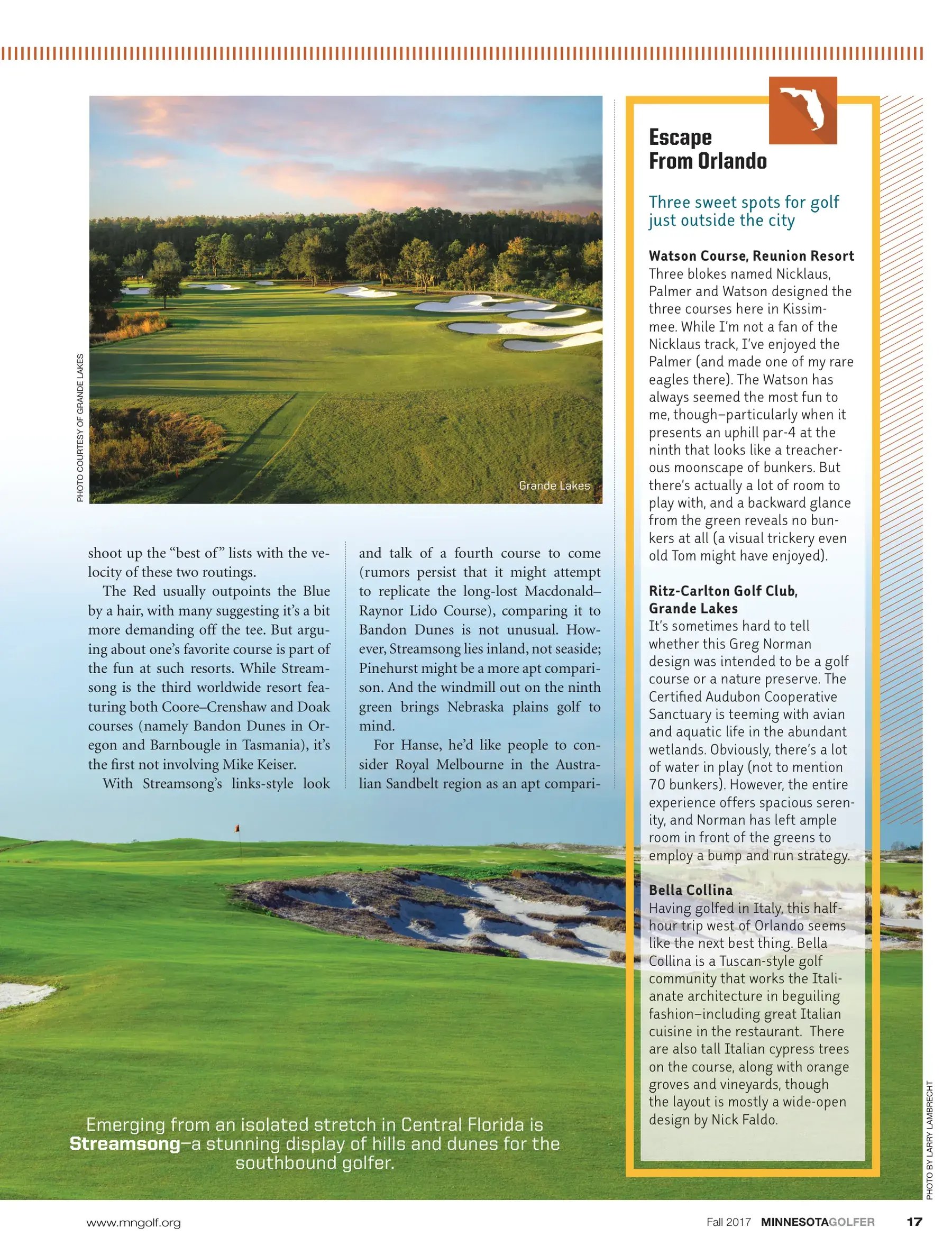
It only made sense, though, for this stretch of land: the former mining site was already 16,000 acres of rolling sand dunes, punctuated with dramatic hills and lagoons that were formed during its working life. The Red and Blue courses opened in 2013 to not a little trepidation at the speed and diffi culty of putting on some of the massive greens. Nonetheless, the wide-open grandeur of both tracks won most over; rarely do courses For links lovers, a journey outside Orlando leads to the spectacular Streamsong—plus a trio of worthy day trips.
SOUTHERN ESCAPES + • BY TOM BEDELL • Streamsong Black www.mngolf.org Fall 2017 MINNESOTAGOLFER 17 shoot up the “best of” lists with the velocity of these two routings.
The Red usually outpoints the Blue by a hair, with many suggesting it’s a bit more demanding off the tee. But arguing about one’s favorite course is part of the fun at such resorts. While Streamsong is the third worldwide resort featuring both Coore–Crenshaw and Doak courses (namely Bandon Dunes in Oregon and Barnbougle in Tasmania), it’s the first not involving Mike Keiser.
With Streamsong’s links-style look and talk of a fourth course to come (rumors persist that it might attempt to replicate the long-lost Macdonald– Raynor Lido Course), comparing it to Bandon Dunes is not unusual. However, Streamsong lies inland, not seaside; Pinehurst might be a more apt comparison. And the windmill out on the ninth green brings Nebraska plains golf to mind.
For Hanse, he’d like people to consider Royal Melbourne in the Australian Sandbelt region as an apt compariGrande Lakes Emerging from an isolated stretch in Central Florida is Streamsong—a stunning display of hills and dunes for the southbound golfer.
Three sweet spots for golf just outside the city Watson Course, Reunion Resort Three blokes named Nicklaus, Palmer and Watson designed the three courses here in Kissimmee. While I’m not a fan of the Nicklaus track, I’ve enjoyed the Palmer (and made one of my rare eagles there). The Watson has always seemed the most fun to me, though —particularly when it presents an uphill par-4 at the ninth that looks like a treacherous moonscape of bunkers. But there’s actually a lot of room to play with, and a backward glance from the green reveals no bunkers at all (a visual trickery even old Tom might have enjoyed).
Ritz-Carlton Golf Club, Grande Lakes It’s sometimes hard to tell whether this Greg Norman design was intended to be a golf course or a nature preserve. The Certifi ed Audubon Cooperative Sanctuary is teeming with avian and aquatic life in the abundant wetlands. Obviously, there’s a lot of water in play (not to mention 70 bunkers). However, the entire experience offers spacious serenity, and Norman has left ample room in front of the greens to employ a bump and run strategy.
Bella Collina Having golfed in Italy, this halfhour trip west of Orlando seems like the next best thing. Bella Collina is a Tuscan-style golf community that works the Italianate architecture in beguiling fashion—including great Italian cuisine in the restaurant. There are also tall Italian cypress trees on the course, along with orange groves and vineyards, though the layout is mostly a wide-open design by Nick Faldo.
Escape From Orlando PHOTO BY LARRY LAMBRECHT PHOTO COURTESY OF GRANDE LAKES www.mngolf.org SOUTHERN ESCAPES son, because that’s the kind of grand-scale vision he had in mind when fashioning the Black course. He had 800 acres to choose from and word is he chose 250 of them very wisely.
I’ve played a bit of golf here and there in the last two decades, but the RTJ Golf Trail statistics could make anyone’s eyes widen: 26 golf courses at 11 facilities throughout the state, totaling about 100 miles of courses. Nearly 12 million rounds have been played on them in 25 years, and more than half a million golfers visit each year, coming from all 50 states and about 20 foreign countries. And despite the uniformly excellent quality and condition of the courses, the average green fee is a very reasonable $50. Even during peak season the highest fee at most courses is $64 (and there have been a lot of $25 specials this anniversary year).
Blazing the Trail The fact that the Guinness World Records calls the 12-course layout at Mission Hills Golf Club in China the world’s largest golf club makes Roger Rulewich chuckle a little. Only 216 holes? Child’s play! Rulewich graduated from Yale Celebrating 25 years of the Robert Trent Jones Trail— one course (and craft beer) at a time.
All the works of the pharaohs of Egypt have nothing on the early years of the Golf Trail, when there was a construction crew of more than 700 building 18 golf courses at seven very different locations all at the same time. Even now, 25 years removed from the initial herculean labors, Rulewich can still shake his head in awe at the enormity of the job and say with well-understated meaning: “It was something.” It remains something—a wonder, really—that so much was done so quickly and so well.
The project was the brainchild of Dr. David G. Bronner, the CEO of the Retirement Systems of Alabama, which funded the project and has done very well for the state ever since, bringing in billions of tourist dollars. (For more about Bronner, see Minnesota Golfer, Fall 2009.) Indeed, the RTJ Golf Trail has since been a model for other such trails in other states, though no one has topped the original.
Though technically an Iowa native, Bronner clearly came by his smarts in Minnesota: He grew up in Austin, Minn., where his father ran a pool hall.
He then went on to earn his bachelor’s and master’s degrees at Mankato State University, where he subsequently taught for two years in the School of Business and Finance. By 1972, he had earned both his law degree and Ph.D. at the University of Alabama—and has been in the Heart of Dixie ever since.
Strokes for Different Folks No RTJ Golf Trail site is more than two hours removed from another in the state, and with so many routings there is bound to be something unique wherever one winds up teeing off. Speaking of tees: every course on the Trail has five sets of tees, so sensible choices can lead to pleasurable rounds.
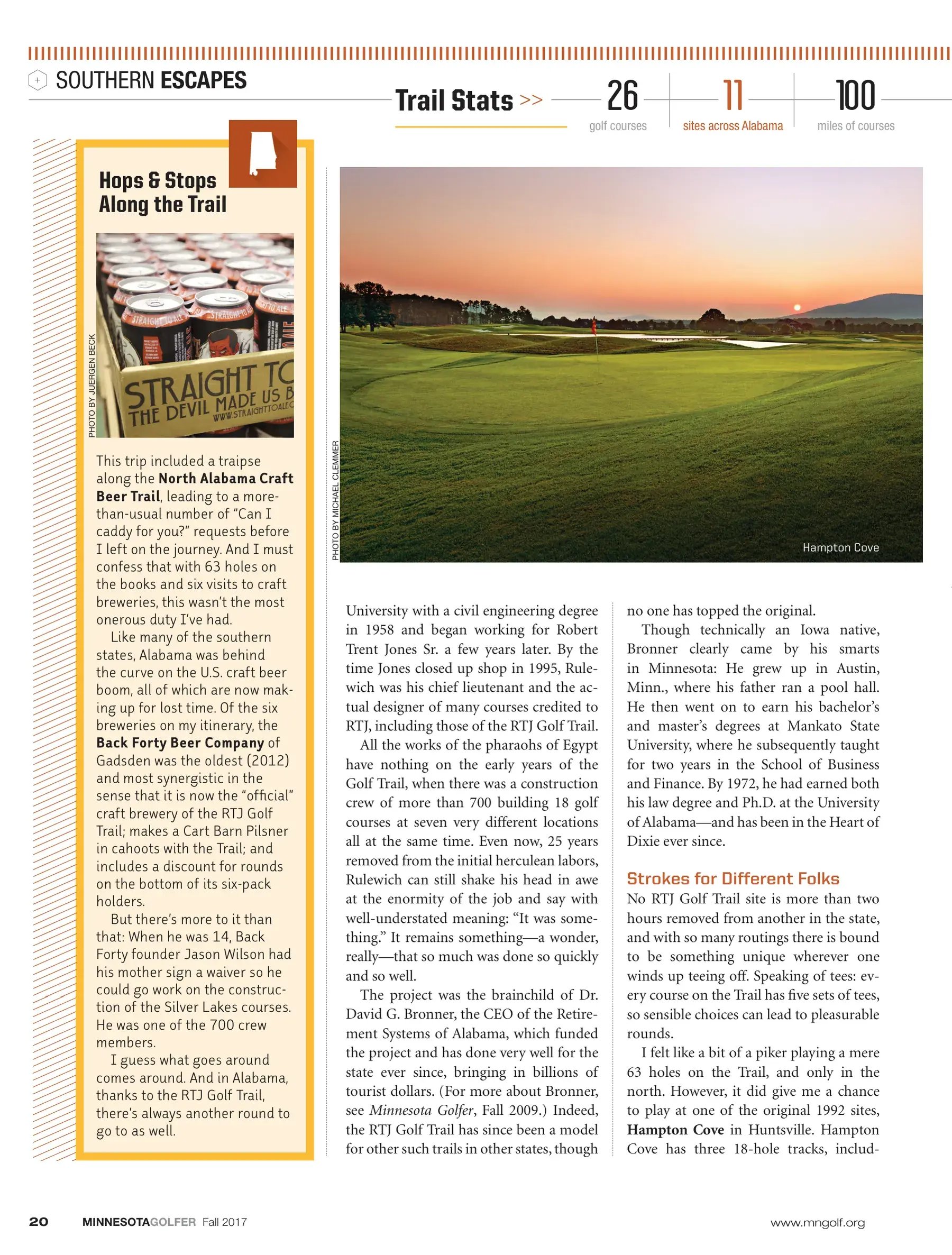
I felt like a bit of a piker playing a mere 63 holes on the Trail, and only in the north. However, it did give me a chance to play at one of the original 1992 sites, Hampton Cove in Huntsville. Hampton Cove has three 18-hole tracks, includSOUTHERN ESCAPES + This trip included a traipse along the North Alabama Craft Beer Trail, leading to a morethan-usual number of “Can I caddy for you?” requests before I left on the journey. And I must confess that with 63 holes on the books and six visits to craft breweries, this wasn’t the most onerous duty I’ve had.
Like many of the southern states, Alabama was behind the curve on the U.S. craft beer boom, all of which are now making up for lost time. Of the six breweries on my itinerary, the Back Forty Beer Company of Gadsden was the oldest (2012) and most synergistic in the sense that it is now the “official”
craft brewery of the RTJ Golf Trail; makes a Cart Barn Pilsner in cahoots with the Trail; and includes a discount for rounds on the bottom of its six-pack holders.
But there’s more to it than that: When he was 14, Back Forty founder Jason Wilson had his mother sign a waiver so he could go work on the construction of the Silver Lakes courses.
He was one of the 700 crew members. I guess what goes around comes around. And in Alabama, thanks to the RTJ Golf Trail, there’s always another round to go to as well.
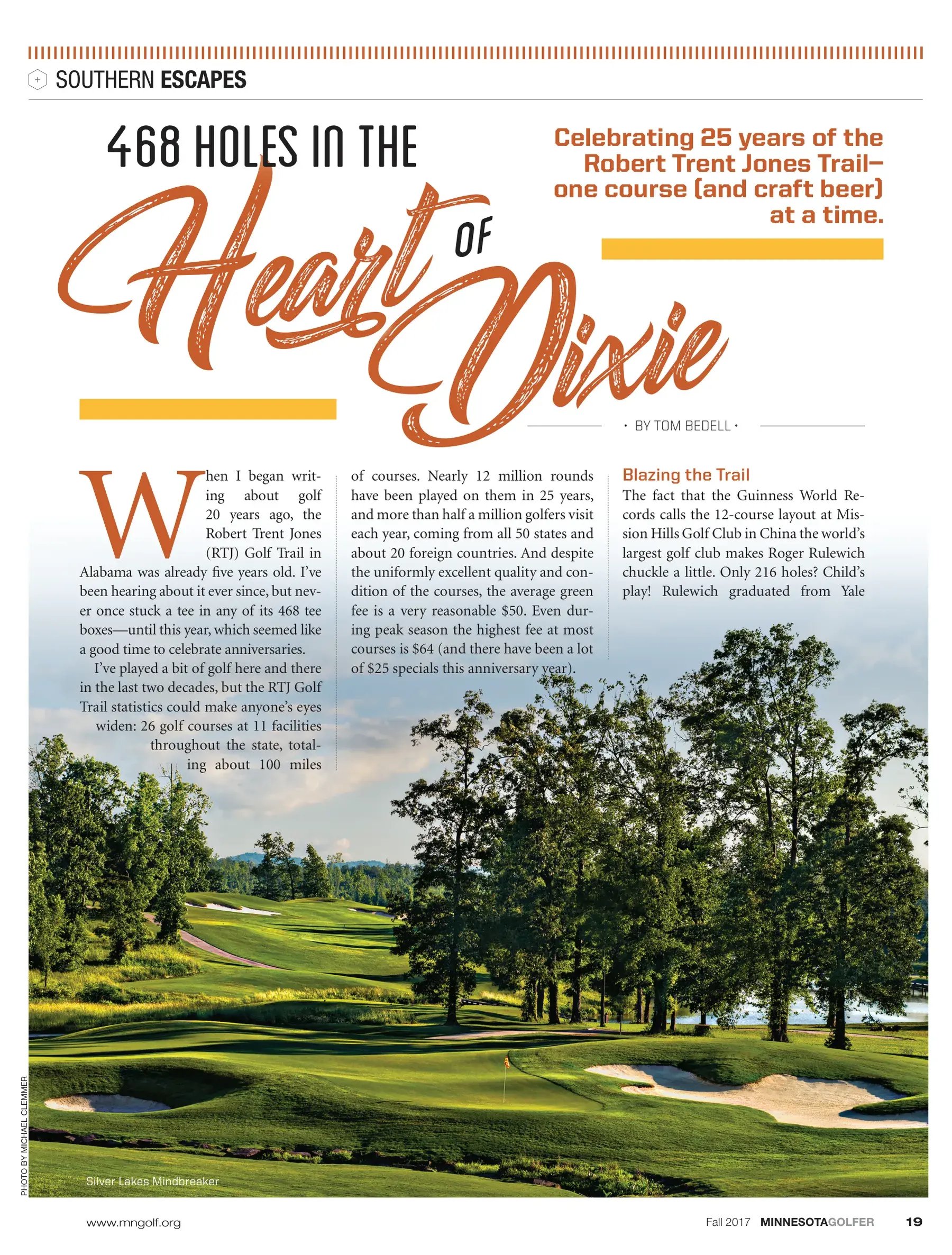
Hops & Stops Along the Trail sites across Alabama miles of courses golf courses26 1OO Hampton Cove Trail Stats >> PHOTO BY MICHAEL CLEMMER PHOTO BY JUERGEN BECK www.mngolf.org Fall 2017 MINNESOTAGOLFER 21 ing a Short Course (an option offered at most Golf Trail sites) and a River Course—the only course without a single bunker. It also sports a 250-year-old black oak behind the 18th green, said to be the third oldest in the state.
Silver Lakes from 1993 was also on the dance card, near Anniston and Gadsden. The three regulation nines are called Backbreaker, Mindbreaker and Heartbreaker—and the latter is said to be just that (or worse) if played from the championship tees.
For the foolhardy, though, there’s the Fighting Joe course at The Shoals in Muscle Shoals—the first Trail course (though not the last) to exceed 8,000 yards from the tips. But hey, it’s only rated 78.7/138, so feel free. MG length in yards of the Ross Bridge course in Hoover, Ala.
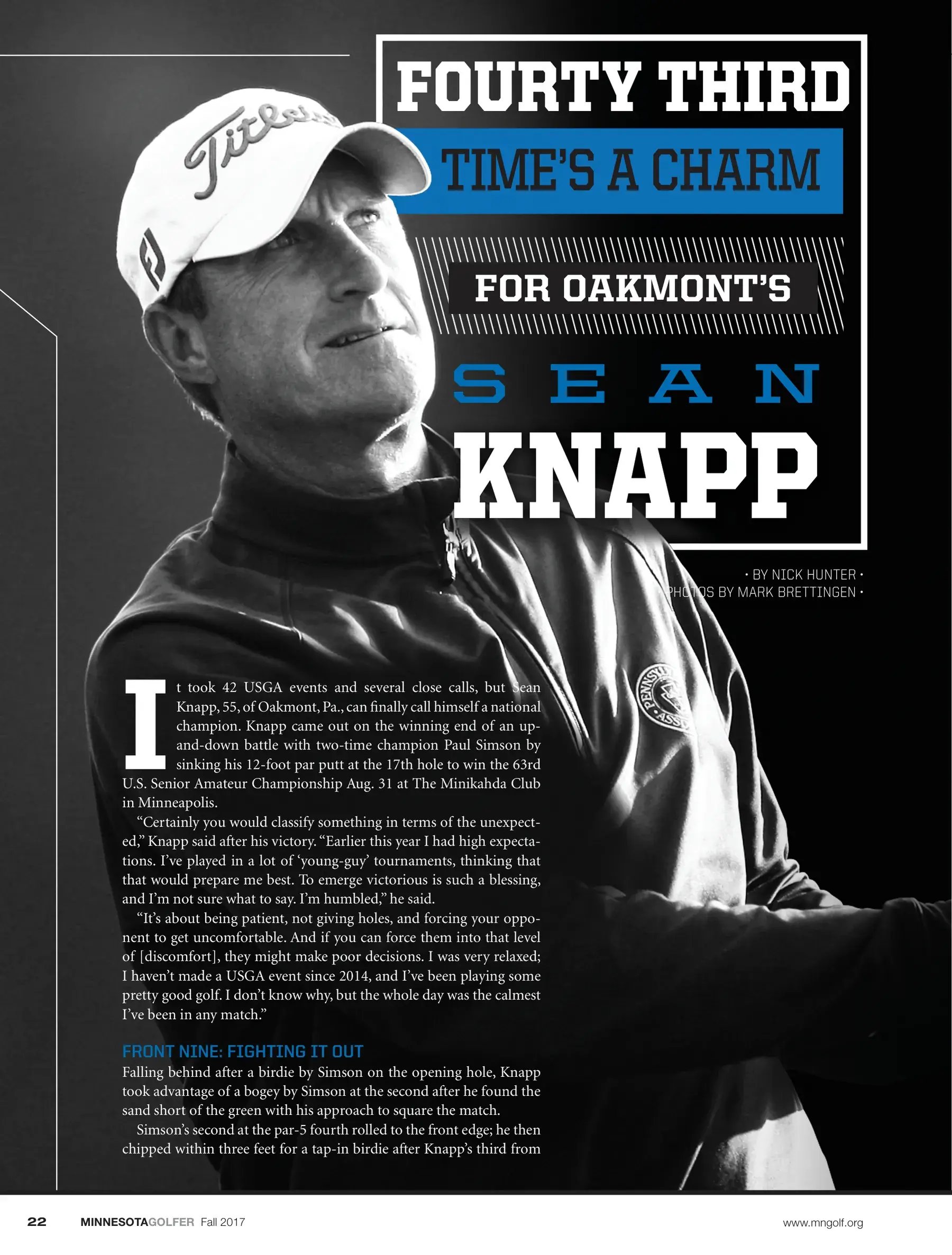
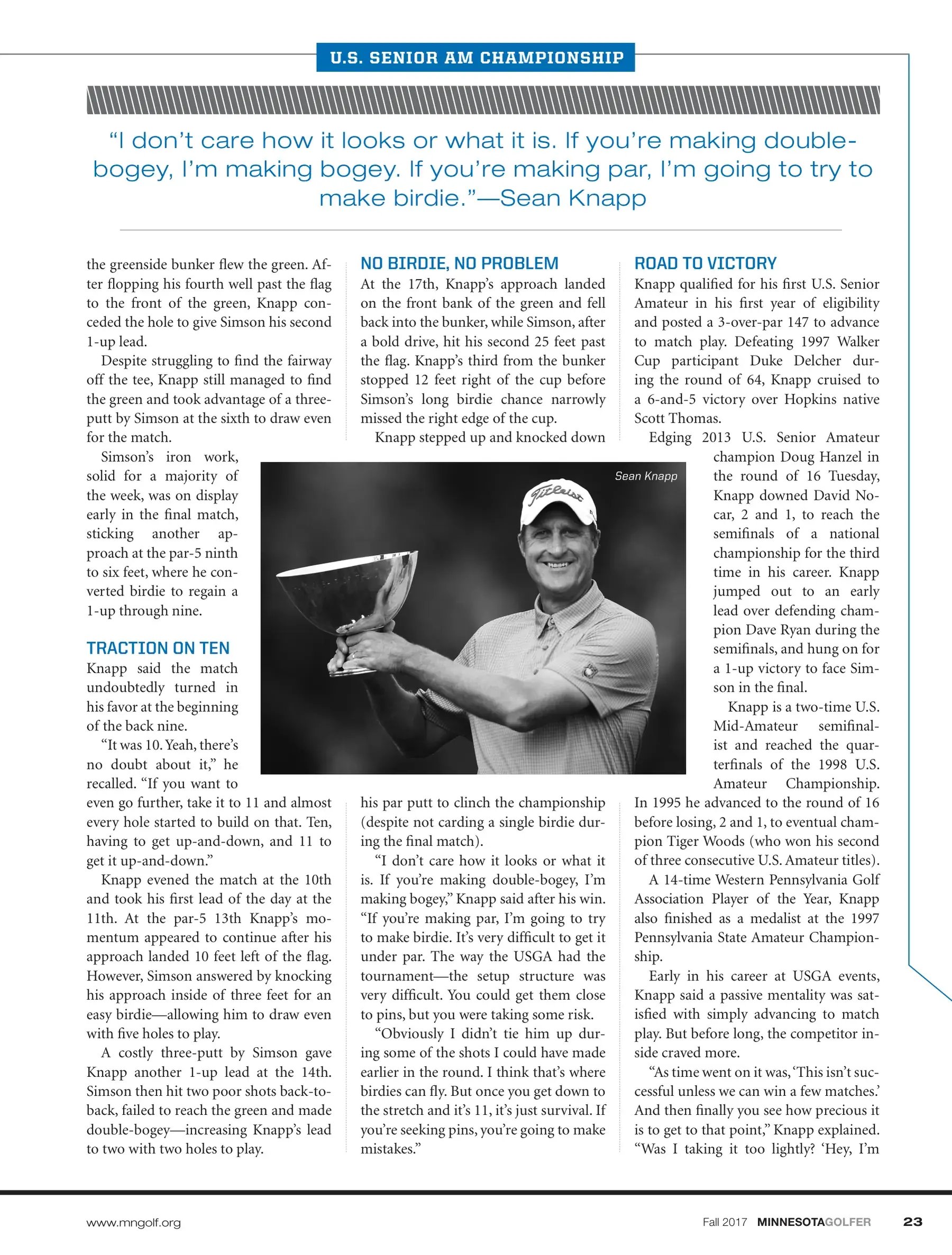
Edina Keep your game strong all winter long! Measure your ball speed and flight with our Smart Tee Dividers! www.mngolf.org I t took 42 USGA events and several close calls, but Sean Knapp, 55, of Oakmont, Pa., can finally call himself a national champion. Knapp came out on the winning end of an upand-down battle with two-time champion Paul Simson by sinking his 12-foot par putt at the 17th hole to win the 63rd U.S. Senior Amateur Championship Aug. 31 at The Minikahda Club in Minneapolis.
“Certainly you would classify something in terms of the unexpected,” Knapp said after his victory. “Earlier this year I had high expectations. I’ve played in a lot of ‘young-guy’ tournaments, thinking that that would prepare me best. To emerge victorious is such a blessing, and I’m not sure what to say. I’m humbled,” he said.
“It’s about being patient, not giving holes, and forcing your opponent to get uncomfortable. And if you can force them into that level of [discomfort], they might make poor decisions. I was very relaxed; I haven’t made a USGA event since 2014, and I’ve been playing some pretty good golf. I don’t know why, but the whole day was the calmest I’ve been in any match.”
FRONT NINE: FIGHTING IT OUT Falling behind after a birdie by Simson on the opening hole, Knapp took advantage of a bogey by Simson at the second after he found the sand short of the green with his approach to square the match.
Simson’s second at the par-5 fourth rolled to the front edge; he then chipped within three feet for a tap-in birdie after Knapp’s third from • BY NICK HUNTER • • PHOTOS BY MARK BRETTINGEN • FOURTY THIRD TIME’S A CHARM FOR OAKMONT’S KNAPP S E A N the greenside bunker flew the green. After flopping his fourth well past the flag to the front of the green, Knapp conceded the hole to give Simson his second 1-up lead.
Despite struggling to find the fairway off the tee, Knapp still managed to find the green and took advantage of a threeputt by Simson at the sixth to draw even for the match.
Simson’s iron work, solid for a majority of the week, was on display early in the final match, sticking another approach at the par-5 ninth to six feet, where he converted birdie to regain a 1-up through nine.
TRACTION ON TEN Knapp said the match undoubtedly turned in his favor at the beginning of the back nine. “It was 10. Yeah, there’s no doubt about it,” he recalled. “If you want to even go further, take it to 11 and almost every hole started to build on that. Ten, having to get up-and-down, and 11 to get it up-and-down.”
Knapp evened the match at the 10th and took his first lead of the day at the 11th. At the par-5 13th Knapp’s momentum appeared to continue after his approach landed 10 feet left of the flag.
However, Simson answered by knocking his approach inside of three feet for an easy birdie —allowing him to draw even with five holes to play.
A costly three-putt by Simson gave Knapp another 1-up lead at the 14th. Simson then hit two poor shots back-toback, failed to reach the green and made double-bogey —increasing Knapp’s lead to two with two holes to play.
NO BIRDIE, NO PROBLEM At the 17th, Knapp’s approach landed on the front bank of the green and fell back into the bunker, while Simson, after a bold drive, hit his second 25 feet past the flag. Knapp’s third from the bunker stopped 12 feet right of the cup before Simson’s long birdie chance narrowly missed the right edge of the cup.
Knapp stepped up and knocked down his par putt to clinch the championship (despite not carding a single birdie during the final match). “I don’t care how it looks or what it is. If you’re making double-bogey, I’m making bogey,” Knapp said after his win.
“If you’re making par, I’m going to try to make birdie. It’s very difficult to get it under par. The way the USGA had the tournament—the setup structure was very difficult. You could get them close to pins, but you were taking some risk.
“Obviously I didn’t tie him up during some of the shots I could have made earlier in the round. I think that’s where birdies can fly. But once you get down to the stretch and it’s 11, it’s just survival. If you’re seeking pins, you’re going to make mistakes.”
ROAD TO VICTORY Knapp qualified for his first U.S. Senior Amateur in his first year of eligibility and posted a 3-over-par 147 to advance to match play. Defeating 1997 Walker Cup participant Duke Delcher during the round of 64, Knapp cruised to a 6-and-5 victory over Hopkins native Scott Thomas.
Edging 2013 U.S. Senior Amateur champion Doug Hanzel in the round of 16 Tuesday, Knapp downed David Nocar, 2 and 1, to reach the semifinals of a national championship for the third time in his career. Knapp jumped out to an early lead over defending champion Dave Ryan during the semifinals, and hung on for a 1-up victory to face Simson in the final.
Knapp is a two-time U.S. Mid-Amateur semifinalist and reached the quarterfinals of the 1998 U.S. Amateur Championship. In 1995 he advanced to the round of 16 before losing, 2 and 1, to eventual champion Tiger Woods (who won his second of three consecutive U.S. Amateur titles).
A 14-time Western Pennsylvania Golf Association Player of the Year, Knapp also finished as a medalist at the 1997 Pennsylvania State Amateur Championship.
Early in his career at USGA events, Knapp said a passive mentality was satisfied with simply advancing to match play. But before long, the competitor inside craved more.
“As time went on it was, ‘This isn’t successful unless we can win a few matches.’ And then finally you see how precious it is to get to that point,” Knapp explained.
“Was I taking it too lightly? ‘Hey, I’m www.mngolf.org Fall 2017 MINNESOTAGOLFER 23 U.S. SENIOR AM CHAMPIONSHIP Sean Knapp “I don’t care how it looks or what it is. If you’re making doublebogey, I’m making bogey. If you’re making par, I’m going to try to make birdie.”—Sean Knapp having a good week, things aren’t going my way in a match, [but] it’s okay, we’ll be home tonight.’ That’s not good enough.
You really have to grind it out.” HIS FATHER’S LEGACY The last USGA event Knapp qualifi ed for was the 2014 U.S. Amateur Championship at the Atlanta Athletic Club, but before he hit his first tee shot, Knapp was beckoned home to be with his ailing father, Roger.
He withdrew from the championship and made the 11-hour drive back to Pennsylvania with his wife and two daughters. Upon arriving at his father’s bedside, Knapp put his hand on his father’s chest and said, “Dad, I’m so proud of you. We’ve made it home for you.”
“Sean, just in time,” his father replied not long before he passed away. The eldest Knapp, a school superintendent with his doctorate, received a Division I baseball scholarship even though his high school didn’t even offer baseball as a varsity sport.
“He pitched semi-pros for the White Sox,” Knapp said. “I’ve never seen a man with more talent who was more humble. He was a very religious man and helped so many people. That’s his legacy. I’m not five percent of that, but I’m proud to say I’m his.”
SIMSON TAKES SECOND A disappointing finish Thursday, but impressive performance nonetheless this week for Simson. He finished two rounds of qualifying at 1-under par 143 before earning two tight victories to begin match play. Jumping out to big leads beginning in the round of 16, Simson cruised through his next three matches to reach the finals against Knapp.
“I didn’t have my best game and three-putted both 10 and 11,” Simson said after his runner-up finish. “That kind of surmises the day. I had a lot of missed chances and when you’re playing this kind of match, you just can’t afford that stuff.”
Simson said that overall he had a great week, especially after a rough first two matches. “The three after that, I was on fire. I was hoping that would carry into today, because it might have been a different story had I played that much better.”
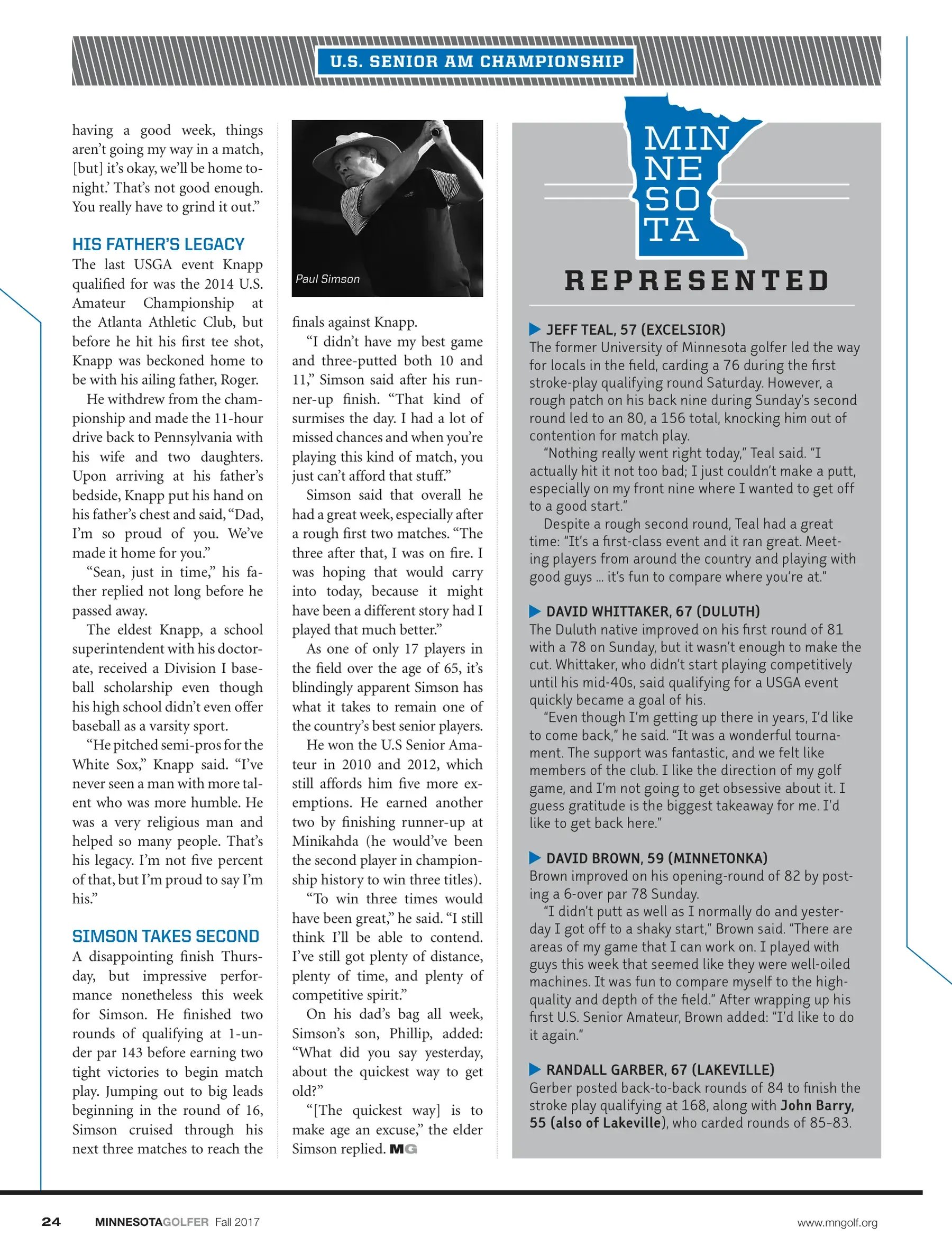
As one of only 17 players in the field over the age of 65, it’s blindingly apparent Simson has what it takes to remain one of the country’s best senior players.
He won the U.S Senior Amateur in 2010 and 2012, which still affords him five more exemptions. He earned another two by finishing runner-up at Minikahda (he would’ve been the second player in championship history to win three titles).
“To win three times would have been great,” he said. “I still think I’ll be able to contend. I’ve still got plenty of distance, plenty of time, and plenty of competitive spirit.”
On his dad’s bag all week, Simson’s son, Phillip, added: “What did you say yesterday, about the quickest way to get old?” “[The quickest way] is to make age an excuse,” the elder Simson replied. MG JEFF TEAL, 57 (EXCELSIOR) The former University of Minnesota golfer led the way for locals in the field, carding a 76 during the first stroke-play qualifying round Saturday. However, a rough patch on his back nine during Sunday’s second round led to an 80, a 156 total, knocking him out of contention for match play.
“Nothing really went right today,” Teal said. “I actually hit it not too bad; I just couldn’t make a putt, especially on my front nine where I wanted to get off to a good start.”
Despite a rough second round, Teal had a great time: “It’s a first-class event and it ran great. Meeting players from around the country and playing with good guys ... it’s fun to compare where you’re at.”
DAVID WHITTAKER, 67 (DULUTH) The Duluth native improved on his first round of 81 with a 78 on Sunday, but it wasn’t enough to make the cut. Whittaker, who didn’t start playing competitively until his mid-40s, said qualifying for a USGA event quickly became a goal of his.
“Even though I’m getting up there in years, I’d like to come back,” he said. “It was a wonderful tournament. The support was fantastic, and we felt like members of the club. I like the direction of my golf game, and I’m not going to get obsessive about it. I guess gratitude is the biggest takeaway for me. I’d like to get back here.”
DAVID BROWN, 59 (MINNETONKA) Brown improved on his opening-round of 82 by posting a 6-over par 78 Sunday. “I didn’t putt as well as I normally do and yesterday I got off to a shaky start,” Brown said. “There are areas of my game that I can work on. I played with guys this week that seemed like they were well-oiled machines. It was fun to compare myself to the highquality and depth of the field.” After wrapping up his first U.S. Senior Amateur, Brown added: “I’d like to do it again.”
RANDALL GARBER, 67 (LAKEVILLE) Gerber posted back-to-back rounds of 84 to finish the stroke play qualifying at 168, along with John Barry, 55 (also of Lakeville), who carded rounds of 85–83.
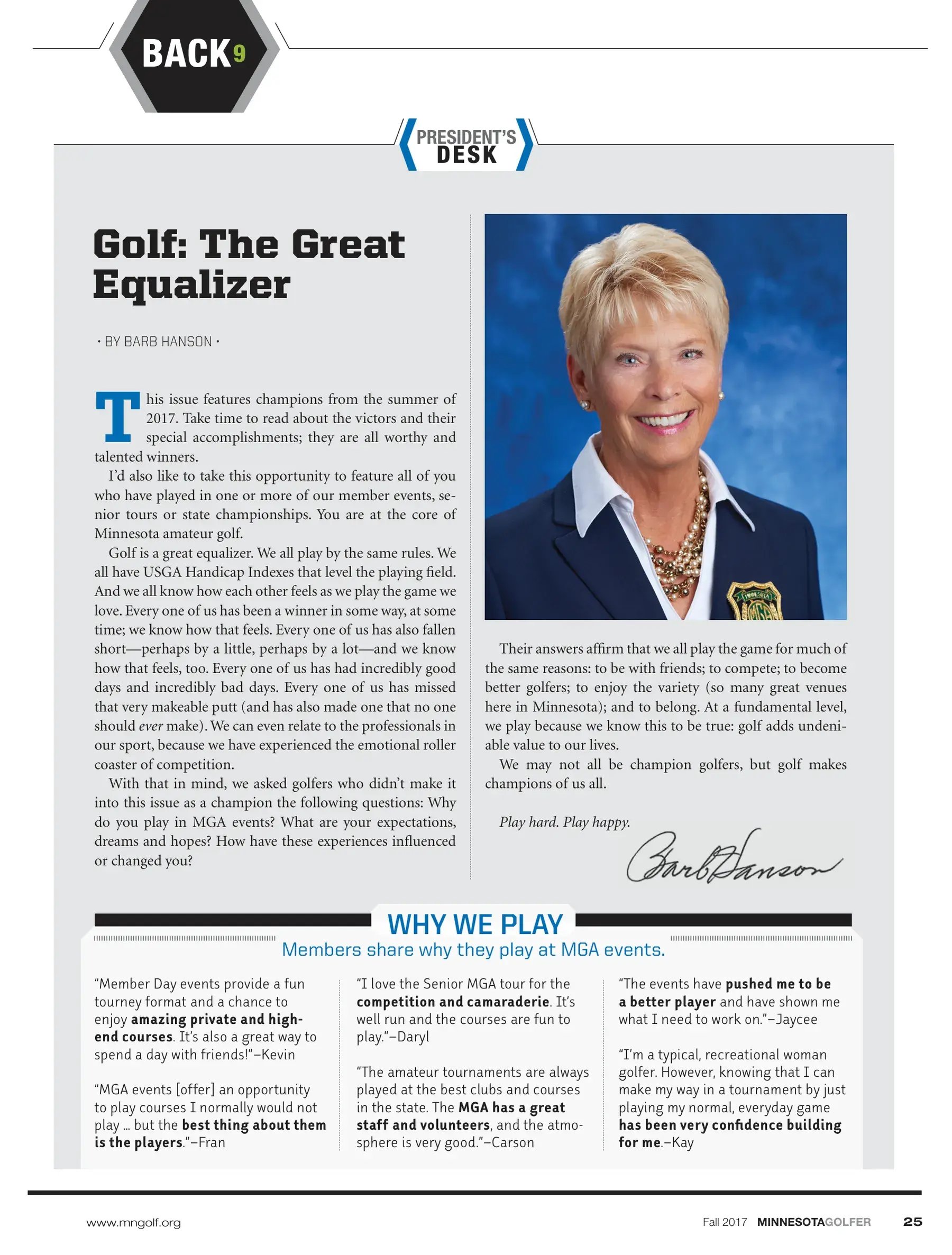
I’d also like to take this opportunity to feature all of you who have played in one or more of our member events, senior tours or state championships. You are at the core of Minnesota amateur golf.
Golf is a great equalizer. We all play by the same rules. We all have USGA Handicap Indexes that level the playing field. And we all know how each other feels as we play the game we love. Every one of us has been a winner in some way, at some time; we know how that feels. Every one of us has also fallen short—perhaps by a little, perhaps by a lot—and we know how that feels, too. Every one of us has had incredibly good days and incredibly bad days. Every one of us has missed that very makeable putt (and has also made one that no one should ever make). We can even relate to the professionals in our sport, because we have experienced the emotional roller coaster of competition.
With that in mind, we asked golfers who didn’t make it into this issue as a champion the following questions: Why do you play in MGA events? What are your expectations, dreams and hopes? How have these experiences infl uenced or changed you?
Their answers affi rm that we all play the game for much of the same reasons: to be with friends; to compete; to become better golfers; to enjoy the variety (so many great venues here in Minnesota); and to belong. At a fundamental level, we play because we know this to be true: golf adds undeniable value to our lives.
We may not all be champion golfers, but golf makes champions of us all. Play hard. Play happy. • BY BARB HANSON • “Member Day events provide a fun tourney format and a chance to enjoy amazing private and highend courses. It’s also a great way to spend a day with friends!”—Kevin “MGA events [offer] an opportunity to play courses I normally would not play ... but the best thing about them is the players.”—Fran “I love the Senior MGA tour for the competition and camaraderie. It’s well run and the courses are fun to play.”—Daryl “The amateur tournaments are always played at the best clubs and courses in the state. The MGA has a great staff and volunteers, and the atmosphere is very good.”—Carson “The events have pushed me to be a better player and have shown me what I need to work on.”—Jaycee “I’m a typical, recreational woman golfer. However, knowing that I can make my way in a tournament by just playing my normal, everyday game has been very confi dence building for me.—Kay Members share why they play at MGA events.
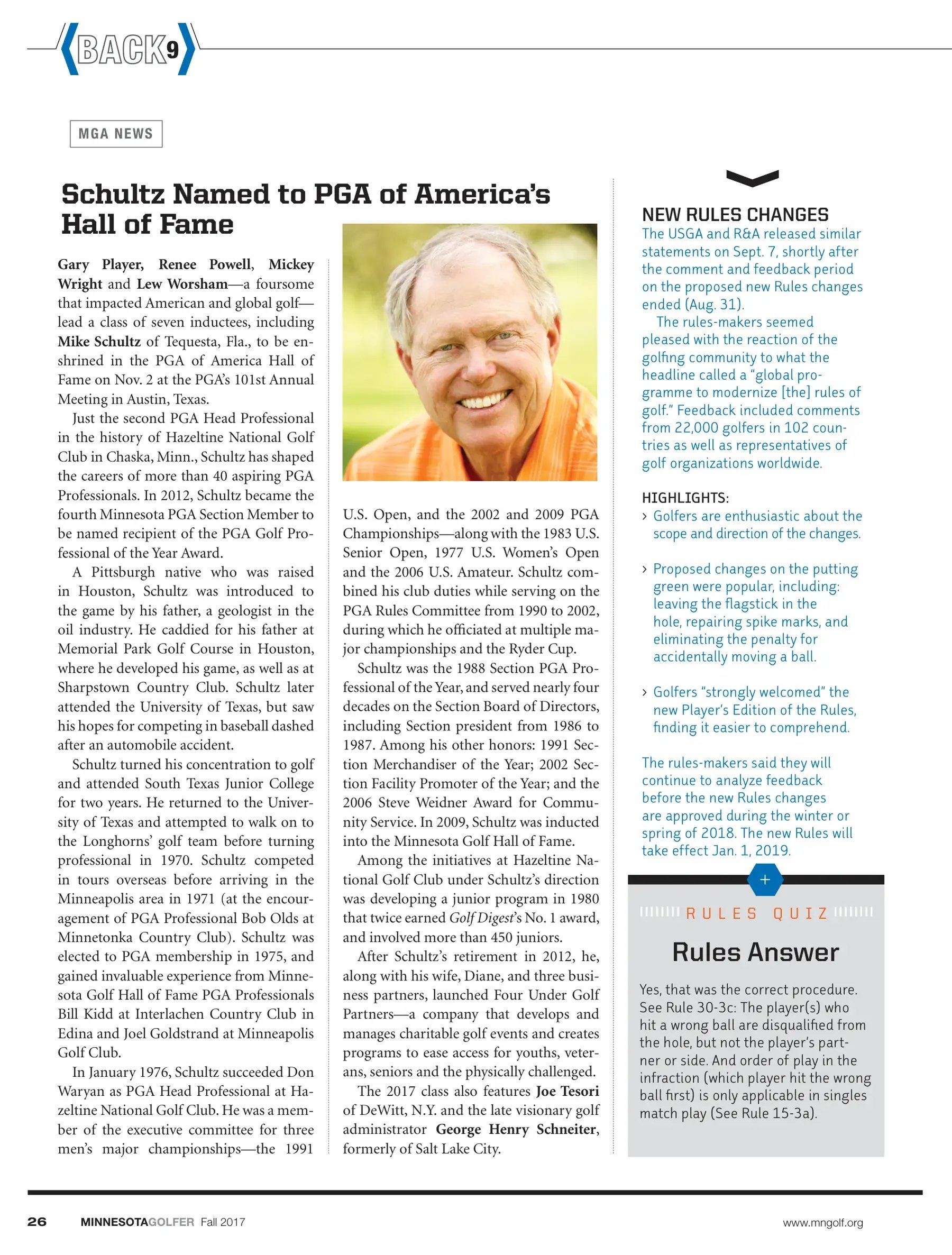
Just the second PGA Head Professional in the history of Hazeltine National Golf Club in Chaska, Minn., Schultz has shaped the careers of more than 40 aspiring PGA Professionals. In 2012, Schultz became the fourth Minnesota PGA Section Member to be named recipient of the PGA Golf Professional of the Year Award.
A Pittsburgh native who was raised in Houston, Schultz was introduced to the game by his father, a geologist in the oil industry. He caddied for his father at Memorial Park Golf Course in Houston, where he developed his game, as well as at Sharpstown Country Club. Schultz later attended the University of Texas, but saw his hopes for competing in baseball dashed after an automobile accident.
Schultz turned his concentration to golf and attended South Texas Junior College for two years. He returned to the University of Texas and attempted to walk on to the Longhorns’ golf team before turning professional in 1970. Schultz competed in tours overseas before arriving in the Minneapolis area in 1971 (at the encouragement of PGA Professional Bob Olds at Minnetonka Country Club). Schultz was elected to PGA membership in 1975, and gained invaluable experience from Minnesota Golf Hall of Fame PGA Professionals Bill Kidd at Interlachen Country Club in Edina and Joel Goldstrand at Minneapolis Golf Club.
In January 1976, Schultz succeeded Don Waryan as PGA Head Professional at Hazeltine National Golf Club. He was a member of the executive committee for three men’s major championships—the 1991 U.S. Open, and the 2002 and 2009 PGA Championships —along with the 1983 U.S.
Senior Open, 1977 U.S. Women’s Open and the 2006 U.S. Amateur. Schultz combined his club duties while serving on the PGA Rules Committee from 1990 to 2002, during which he officiated at multiple major championships and the Ryder Cup.
Schultz was the 1988 Section PGA Professional of the Year, and served nearly four decades on the Section Board of Directors, including Section president from 1986 to 1987. Among his other honors: 1991 Section Merchandiser of the Year; 2002 Section Facility Promoter of the Year; and the 2006 Steve Weidner Award for Community Service. In 2009, Schultz was inducted into the Minnesota Golf Hall of Fame.
Among the initiatives at Hazeltine National Golf Club under Schultz’s direction was developing a junior program in 1980 that twice earned Golf Digest’s No. 1 award, and involved more than 450 juniors.
After Schultz’s retirement in 2012, he, along with his wife, Diane, and three business partners, launched Four Under Golf Partners—a company that develops and manages charitable golf events and creates programs to ease access for youths, veterans, seniors and the physically challenged.
The 2017 class also features Joe Tesori of DeWitt, N.Y. and the late visionary golf administrator George Henry Schneiter, formerly of Salt Lake City.
Schultz Named to PGA of America’s Hall of Fame Yes, that was the correct procedure. See Rule 30-3c: The player(s) who hit a wrong ball are disqualified from the hole, but not the player’s partner or side. And order of play in the infraction (which player hit the wrong ball first) is only applicable in singles match play (See Rule 15-3a).
The rules-makers seemed pleased with the reaction of the golfing community to what the headline called a “global programme to modernize [the] rules of golf.” Feedback included comments from 22,000 golfers in 102 countries as well as representatives of golf organizations worldwide.
HIGHLIGHTS: > Golfers are enthusiastic about the scope and direction of the changes. > Proposed changes on the putting green were popular, including: leaving the flagstick in the hole, repairing spike marks, and eliminating the penalty for accidentally moving a ball.
> Golfers “strongly welcomed” the new Player’s Edition of the Rules, finding it easier to comprehend. The rules-makers said they will continue to analyze feedback before the new Rules changes are approved during the winter or spring of 2018. The new Rules will take effect Jan. 1, 2019.
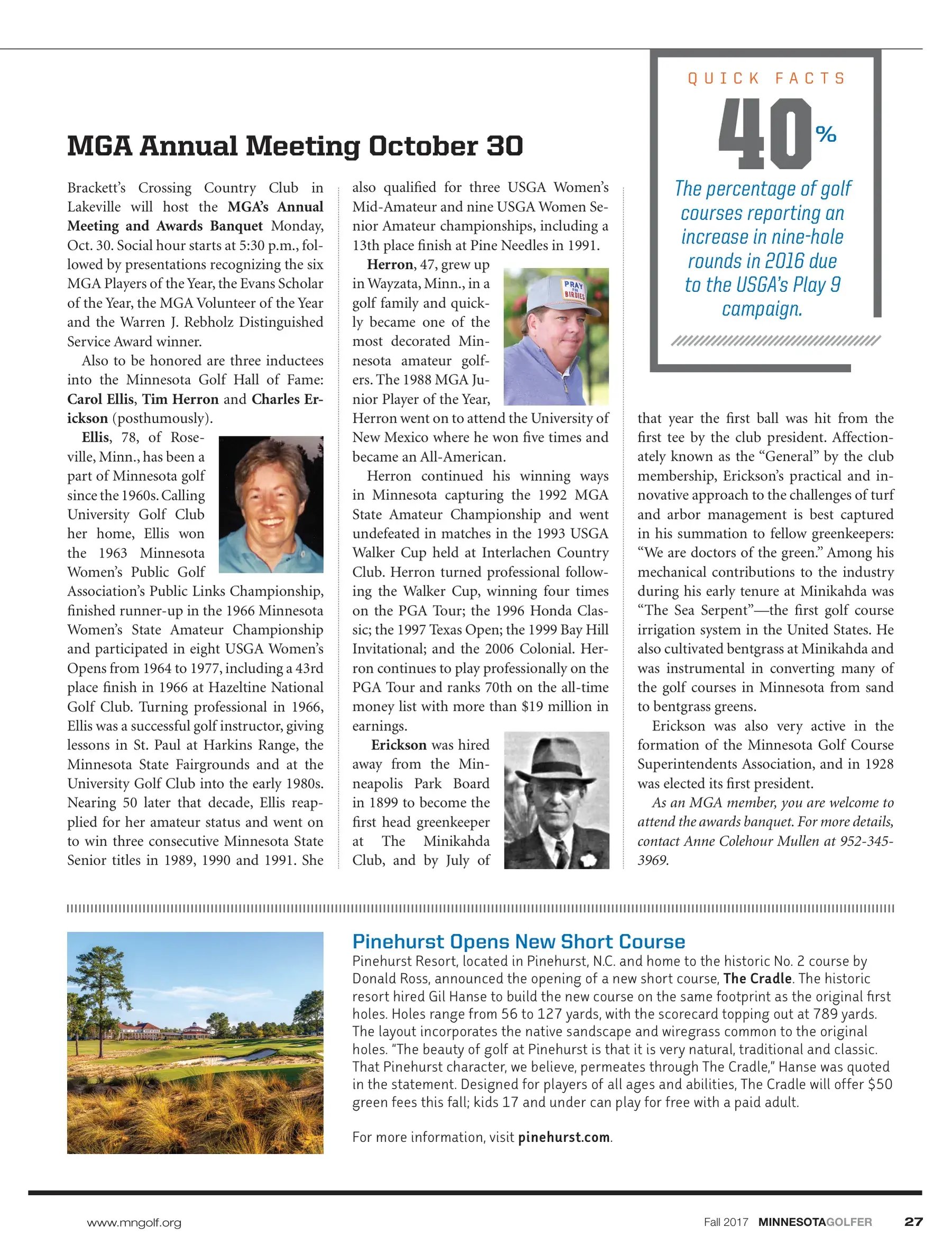
www.mngolf.org Fall 2017 MINNESOTAGOLFER 27 Brackett’s Crossing Country Club in Lakeville will host the MGA’s Annual Meeting and Awards Banquet Monday, Oct. 30. Social hour starts at 5:30 p.m., followed by presentations recognizing the six MGA Players of the Year, the Evans Scholar of the Year, the MGA Volunteer of the Year and the Warren J. Rebholz Distinguished Service Award winner.
Also to be honored are three inductees into the Minnesota Golf Hall of Fame: Carol Ellis, Tim Herron and Charles Erickson (posthumously). Ellis, 78, of Roseville, Minn., has been a part of Minnesota golf since the 1960s. Calling University Golf Club her home, Ellis won the 1963 Minnesota Women’s Public Golf Association’s Public Links Championship, finished runner-up in the 1966 Minnesota Women’s State Amateur Championship and participated in eight USGA Women’s Opens from 1964 to 1977, including a 43rd place finish in 1966 at Hazeltine National Golf Club. Turning professional in 1966, Ellis was a successful golf instructor, giving lessons in St. Paul at Harkins Range, the Minnesota State Fairgrounds and at the University Golf Club into the early 1980s.
Nearing 50 later that decade, Ellis reapplied for her amateur status and went on to win three consecutive Minnesota State Senior titles in 1989, 1990 and 1991. She also qualified for three USGA Women’s Mid-Amateur and nine USGA Women Senior Amateur championships, including a 13th place finish at Pine Needles in 1991.
Herron, 47, grew up in Wayzata, Minn., in a golf family and quickly became one of the most decorated Minnesota amateur golfers. The 1988 MGA Junior Player of the Year, Herron went on to attend the University of New Mexico where he won five times and became an All-American.
Herron continued his winning ways in Minnesota capturing the 1992 MGA State Amateur Championship and went undefeated in matches in the 1993 USGA Walker Cup held at Interlachen Country Club. Herron turned professional following the Walker Cup, winning four times on the PGA Tour; the 1996 Honda Classic; the 1997 Texas Open; the 1999 Bay Hill Invitational; and the 2006 Colonial. Herron continues to play professionally on the PGA Tour and ranks 70th on the all-time money list with more than $19 million in earnings.
Erickson was hired away from the Minneapolis Park Board in 1899 to become the first head greenkeeper at The Minikahda Club, and by July of that year the first ball was hit from the first tee by the club president. Affectionately known as the “General” by the club membership, Erickson’s practical and innovative approach to the challenges of turf and arbor management is best captured in his summation to fellow greenkeepers: “We are doctors of the green.” Among his mechanical contributions to the industry during his early tenure at Minikahda was “The Sea Serpent”—the first golf course irrigation system in the United States. He also cultivated bentgrass at Minikahda and was instrumental in converting many of the golf courses in Minnesota from sand to bentgrass greens.
Erickson was also very active in the formation of the Minnesota Golf Course Superintendents Association, and in 1928 was elected its first president.
As an MGA member, you are welcome to attend the awards banquet. For more details, contact Anne Colehour Mullen at 952-3453969. MGA Annual Meeting October 30 Pinehurst Opens New Short Course Pinehurst Resort, located in Pinehurst, N.C. and home to the historic No. 2 course by Donald Ross, announced the opening of a new short course, The Cradle. The historic resort hired Gil Hanse to build the new course on the same footprint as the original first holes. Holes range from 56 to 127 yards, with the scorecard topping out at 789 yards.
The layout incorporates the native sandscape and wiregrass common to the original holes. “The beauty of golf at Pinehurst is that it is very natural, traditional and classic.
That Pinehurst character, we believe, permeates through The Cradle,” Hanse was quoted in the statement. Designed for players of all ages and abilities, The Cradle will offer $50 green fees this fall; kids 17 and under can play for free with a paid adult.
For more information, visit pinehurst.com. The percentage of golf courses reporting an increase in nine-hole rounds in 2016 due to the USGA’s Play 9 campaign.
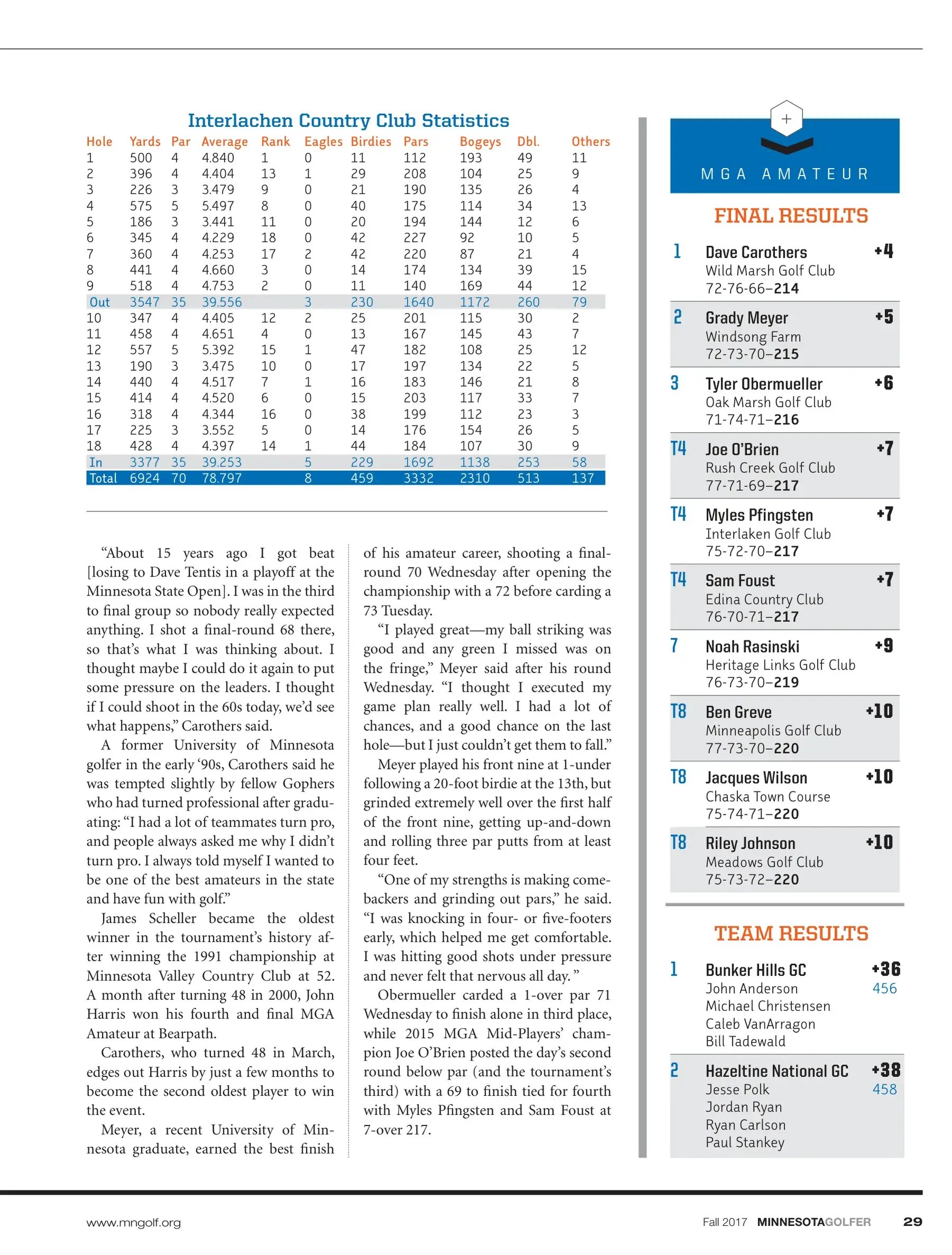
“This means the world—I’ve been playing in this thing for 30 years and my best finish was up at [Northland Country Club] about 15 years ago when I finished eighth or ninth,”
Carothers said afterward. “This tournament represents a lot of the best players in the state.” Carothers, of Wild Marsh Golf Club, opened the championship with a 2-over par Monday, but struggled during the second round Tuesday, recording eight bogeys with two birdies to shoot 6-over par 76—three shots behind leaders Troy Johnson, Tyler Obermueller and Grady Meyer heading into Wednesday’s final round.
Starting his day on the tenth tee, an early bogey put Carothers at 9-over and five shots out before he stuck his approach to a foot at the par4 18th for a tap-in birdie to turn at even par for the round.
Following an important up-and-down at the first where he sank his eight-footer for par, Carothers jumped into contention at the par-4 second hole when he holed his approach from 130 yards with a wedge to move within two of Meyer.
“That’s when I said, ‘If we can do something special on the last seven holes, we might be able to get there,’” Carothers said. Meyer’s lead fell to one following a bogey at the third before Carothers drew even when he converted a short birdie at the par-5 fourth. Carothers went on to take the outright lead at the fifth after sinking a downhill bender from 15 feet.
Managing to erase a four-shot defi cit in a matter of six holes, Carothers then hit the shot that would firmly give him a hold on the tournament, leading to a spectacular up-and-down at the par-4 sixth. Carothers’ drive found the rough right of the fairway leaving without a clear shot at the green, but he managed to punch out below the trees, lag inside of three feet and save his par to maintain a one-stroke lead with three holes left to play.
After leaving back-to-back birdie putts short at the seventh and eighth holes, Carothers hit what he called the best drive of the tournament on the final hole, but nearly ran it through the fairway and into the water hazard. From the rough and three feet from the water, Carothers’ approach rolled past the back-left pin to the fringe, 10 feet away where he would two-putt for par to post a 4-over par 214.
Needing a birdie to force a playoff heading to the final hole, Meyer’s approach came to rest in nearly the same spot as Carothers’, but Meyer pushed his putt right to give Carothers his biggest amateur victory at 48 years old.
A former University of Minnesota golfer in the early ‘90s, Carothers said he was tempted slightly by fellow Gophers who had turned professional after graduating: “I had a lot of teammates turn pro, and people always asked me why I didn’t turn pro. I always told myself I wanted to be one of the best amateurs in the state and have fun with golf.”
James Scheller became the oldest winner in the tournament’s history after winning the 1991 championship at Minnesota Valley Country Club at 52.