




Fall 2021




















Back to The Minnesota Golfer Archive
Read the text of this issue
Text from the printed pages, so it can be searched and read by screen readers. Layout and photography are in the reader above.
12 c AFTER THE STORMS By Jeff Babineau Puerto Rico offers renewed beauty and allure as a golf travel destination. 16 c HEADING WEST By Tom Bedell A driving tour to Arizona for snowbirds looking to take the scenic route this winter.
20 c WHERE’S JOSH? By Josh Miller The peripatetic infl uencer travels Minnesota in search of golf and a social media connection. 22 c GOLF TALES By Joseph Oberle Woodbury golfer Lindsey Huettl is scoring holes- in-one at an epic pace.
+ page 32 Sophia Yoemans PHOTO COURTESY OF VISIT PUERTO RICO golfer MINNESOTA ® The purpose of Minnesota Golfer—the offi cial publication of the Minnesota Golf Association, a nonprofi t serving all golfers in Minnesota—is to provide relevant and entertaining information on the Minnesota golf scene, including MGA activities.
Subscriptions: Regular U.S. one year (4 issues) $18. Directory issue of Minnesota Golfer: $9.95 plus shipping, pre-paid. Other single copies: $2.95 per copy plus shipping, pre-paid.
Copyright © 2021 MGA The MGA upholds and promotes the game of golf and its values for all golfers in Minnesota. Minnesota Golf Association Inc.
Legislative Counsel McGrann Shea Carnival Straughn & Lamb, Chartered OFFICE Volume 49, Number 4 Fall 2021 Your support helps our mission to provide a vision for the future of the game by supporting programs and initiatives that enhance the golfer experience, drive participation among youth, beginners and disabled golfers, endeavoring to make the game more sustainable, and foster educational and experiential opportunities for children and young adults who are interested in golf and who represent the game’s future in Minnesota.
Ben Hogan famously said that golf is a game of the fewest (or best) misses: he was happy if he hit two shots a round exactly the way he intended.
Laughs aside, Williams’ and Hogan’s insights are remarkably similar: the better we manage our worst efforts, the lower our score. But who dwells on their whiffs, scuffs or shanks? It’s the clutch putt, the sound up-anddown from a greenside bunker, and the fairway split with the best drive of the day shots that keep us enthralled with the game.
Likewise, in four-plus decades playing golf, I’ve seen at least four aces, but not my own, which came at an uphill, partially blind par 3. After briefly searching in the frog hair short of the green, I was dumbstruck to find the ball in the cup: it was a perfect miss (I was aiming left of the green). Although not a witness, the late Jack Emich, a member of the club and the longtime executive director of the Maryland State Golf Association, gave the ace his blessing, but only if I agreed to make it official by returning the next day and finishing the round.
MGA Staffer Anne Mullen, 45, of Eden Prairie, and a member of LeSueur Country Club, bucked the odds, or mocked the golf gods (take your pick), after acing the par-3 10th hole at LeSueur, not once but twice during consecutive rounds in July (see story, p.
22). This writer witnessed the first “perfect shot,” a 140-yard 8-iron, which Mullen, a 17.6 handicap index, expertly banked the ball off of a hill and, destiny taking over, it rolled into the cup. There were hugs and kisses from husband Don, high-fives, and lots of hooting and hollering from the nearby clubhouse patio.
On her next visit three weeks later, and with infinitely more skill than luck, Mullen threw a dart at the 10th green, one-hopping a 9-iron from 108 yards directly into the cup.
Mullen was again accompanied by Don, who, for the record, is without an ace after taking up the game 35 years ago. Coincidentally, another MGA staffer, Joel Comstock, who also belongs to the rarified hole-in-one club, witnessed Mullen’s second ace.
The odds of joining the hole-in-one club are 13,000 to 1; lower for the scratch golfer, say 5,000 to 1. The odds of two players in the same foursome acing the same hole are 17 million to 1, and the odds of acing the same hole more than once in 1,000 rounds are 1 in 200. That puts Mullen’s efforts somewhere between 17 million and 200,000 to 1.
To our MGA member clubs who have made their golf facilities available to host an MGA or USGA event in 2021 and to our many volunteers... we couldn’t do it without you!
Yet with all the successes of the last two years, there was one area of the golf business that suffered. Due to restrictions on food and beverage service, and space limitations related to social distancing on indoor and outdoor activities, facilities that relied on weddings, corporate outings, and fundraising events saw a sharp decline in revenue. While this business has come back in 2021 as restrictions loosened, it’s far from fully recovered.
The other type of activities that suffered in 2020 were major club events where the social component is often as important as the golf, and annual open or invitational golf tournaments at facilities that rely on these as a key revenue component of their budget. Many of these were cancelled in 2020 and dearly missed, as they are so important to the facility and community.
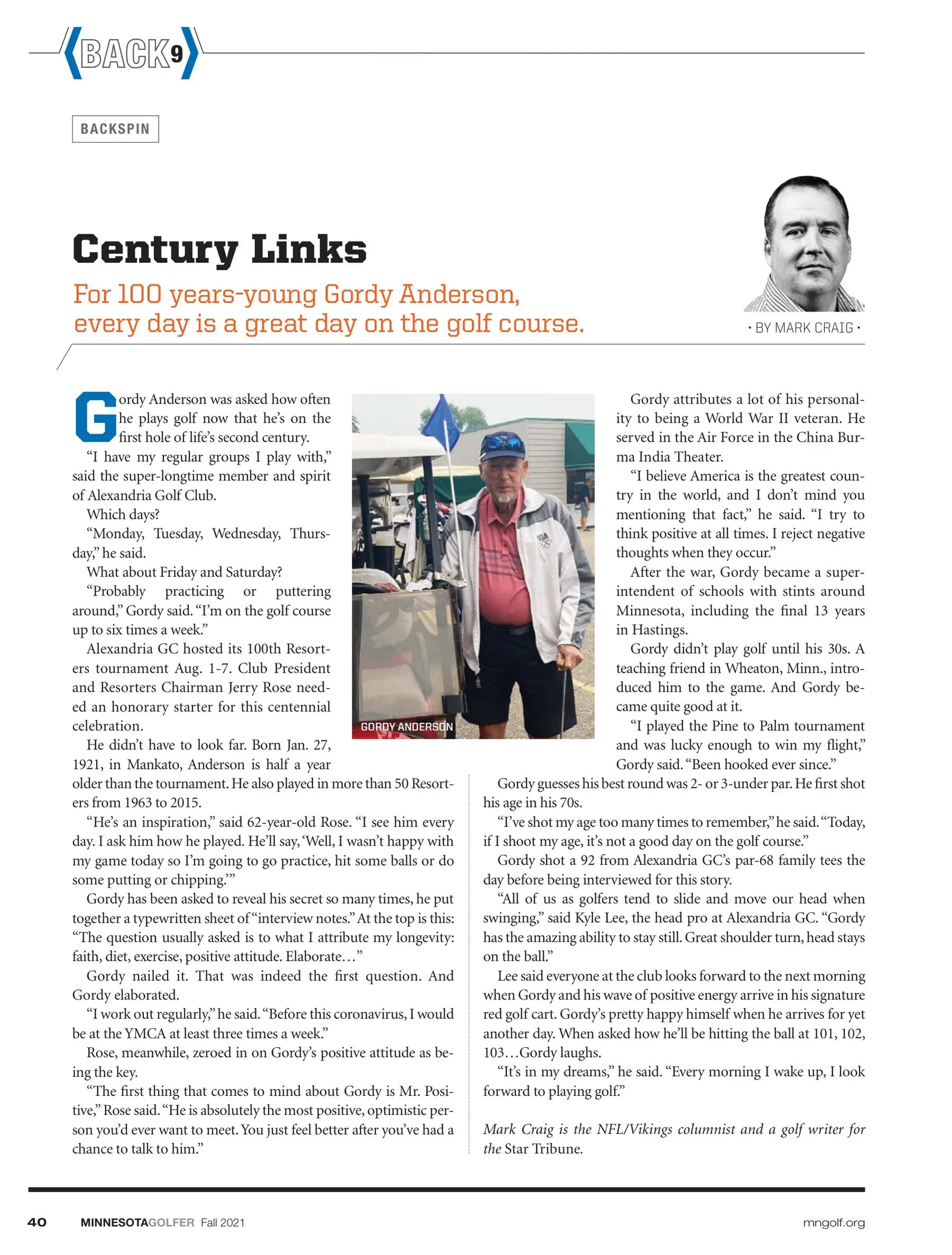
One of those events is the Resorters, hosted by the Alexandria Golf Club. I had the opportunity to participate in the 100th playing of the Resorters this year, and the club rolled out the red carpet for the more than 475 players who had the good fortune to get into the tournament. Along with the Birchmont at Bemidji Town & Country Club, and the Pine to Palm at the Detroit Golf Club, these events are a celebration of golf and the lake-country lifestyle of Northern Minnesota.
Each event is a weeklong tournament utilizing a match play format, and includes multiple age divisions for men, women and juniors. They are so well attended that the MGA has long avoided scheduling any championships during the three-week run of these events. As the number of MGA events has increased over the last few years, it’s become increasingly diffi cult to hold absolutely firm to that policy and believe me, I do hear about it when it happens!
This being my last column of the year, I want to take this opportunity to thank the MGA member clubs that have hosted events this past year. Between our men’s and women’s championships and qualifi ers, USGA qualifi ers, senior tour and member days, we need more than 120 venues each year. It is only through the generosity of our member clubs that our overall tournament program can operate.
Thank you as well to the volunteers who generously give their time and talent to further the mission of the MGA. The men and women who participate on the board of directors, committees and as tournament volunteers are the lifeblood of the organization, and critical to the success of the associations’ programs and services.
We hope you have a great off season, and we’re already looking forward to a great 2022! See you on the course! What is MGA Membership? It’s your invitation to play some of the finest golf courses around, through participation in MGA Associate Members’ Days or the MGA Senior Tour. • It’s your USGA Handicap Index, now updated daily, after a posted score. • It’s your subscription to Minnesota Golfer magazine, delivered to your home. • It’s your support of programs and services that make the game better.
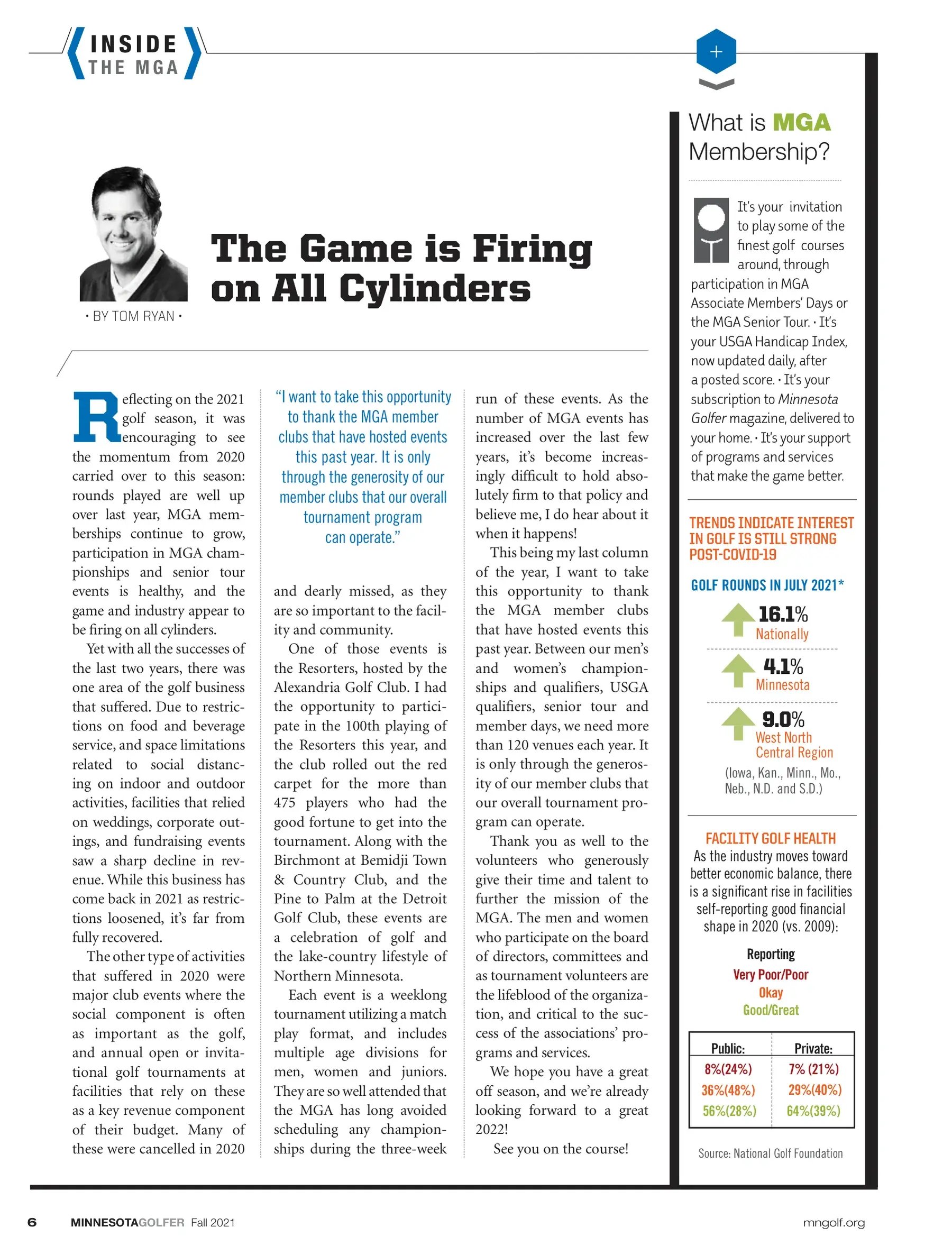
• BY TOM RYAN • The Game is Firing on All Cylinders TRENDS INDICATE INTEREST IN GOLF IS STILL STRONG POST-COVID-19 GOLF ROUNDS IN JULY 2021* 16.1% Nationally 4.1% Minnesota 9.0% West North Central Region (Iowa, Kan., Minn., Mo., Neb., N.D. and S.D.) “I want to take this opportunity to thank the MGA member clubs that have hosted events this past year. It is only through the generosity of our member clubs that our overall tournament program can operate.”
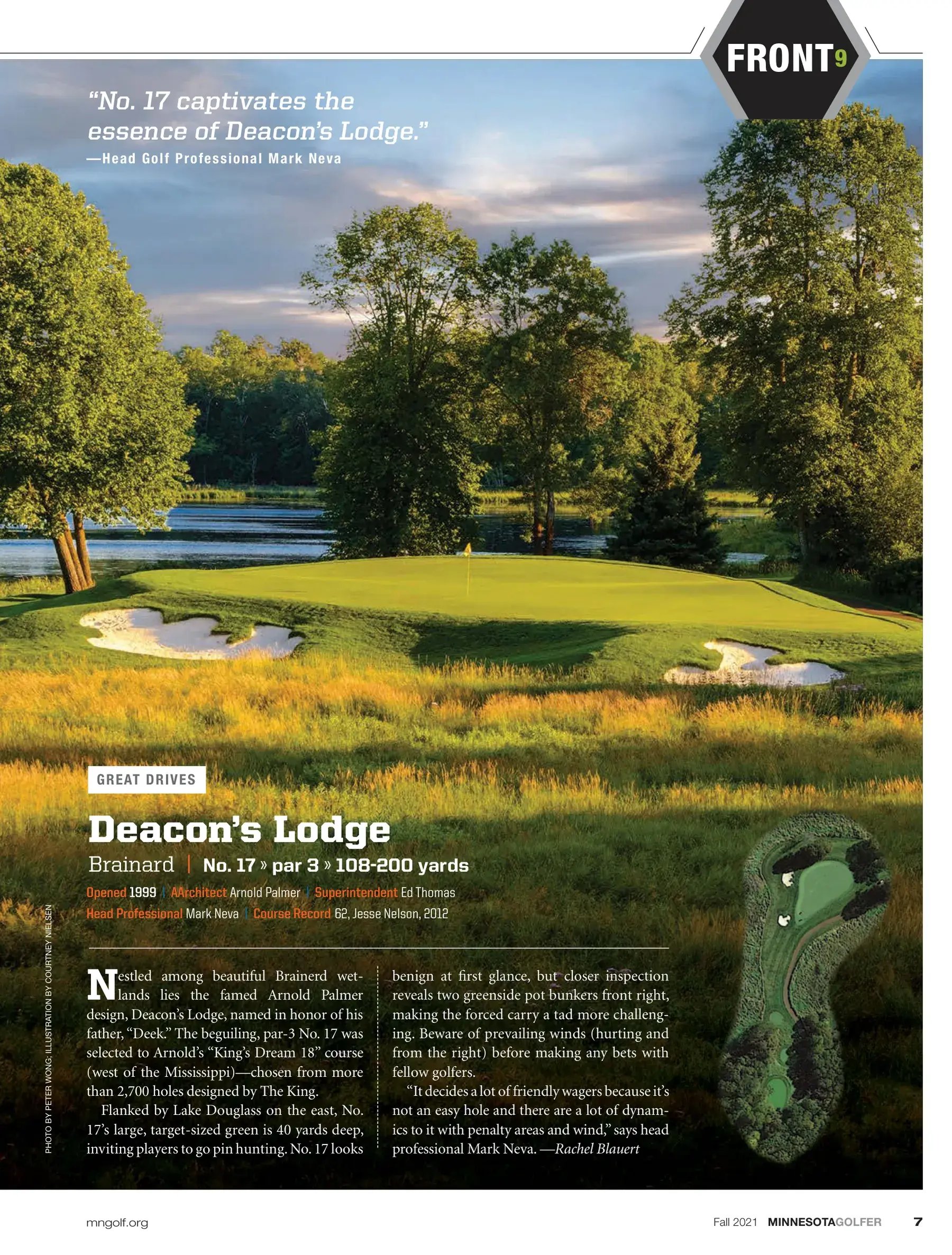
FACILITY GOLF HEALTH As the industry moves toward better economic balance, there is a signifi cant rise in facilities self-reporting good financial shape in 2020 (vs. 2009): Reporting Very Poor/Poor Okay Good/Great Public: 8%(24%) 36%(48%) 56%(28%) Private: 7% (21%) 29%(40%) 64%(39%) Source: National Golf Foundation Fall 2021 MINNESOTAGOLFER 7 PHOTO BY PETER WONG; ILLUSTRATION BY COURTNEY NIELSEN N estled among beautiful Brainerd wetlands lies the famed Arnold Palmer design, Deacon’s Lodge, named in honor of his father, “Deek.” The beguiling, par-3 No. 17 was selected to Arnold’s “King’s Dream 18” course (west of the Mississippi)—chosen from more than 2,700 holes designed by The King.
Flanked by Lake Douglass on the east, No. 17’s large, target-sized green is 40 yards deep, inviting players to go pin hunting. No. 17 looks benign at first glance, but closer inspection reveals two greenside pot bunkers front right, making the forced carry a tad more challenging. Beware of prevailing winds (hurting and from the right) before making any bets with fellow golfers.
“It decides a lot of friendly wagers because it’s not an easy hole and there are a lot of dynamics to it with penalty areas and wind,” says head professional Mark Neva. —Rachel Blauert Deacon’s Lodge Brainard | No. 17 » par 3 » 108-200 yards Opened 1999 | AArchitect Arnold Palmer | Superintendent Ed Thomas Head Professional Mark Neva | Course Record 62, Jesse Nelson, 2012 “No. 17 captivates the essence of Deacon’s Lodge.”
—Head Golf Professional Mark Neva GREAT DRIVES FRONT • BY MIKE BARGE • Mike Barge is the director of instruction at Hazeltine National GC, and a Class A member of the PGA of America and the Minnesota Golf Hall of Fame.
Swing Balance At the core of every athletic move is good balance—try this drill to achieve it in your swing. W hen you hear someone comment about an athlete and how they “make it look so easy,” it’s a compliment to their balance. There is not a single athletic move that doesn’t require good balance, including the golf swing. As golfers, we need to be aware of our balance on all shots.
We mostly focus on our balance during the set-up and finish position, but balance needs to be maintained throughout the swing. A drill that can help you feel whether this is occurring is hitting balls while standing on one leg. Tee up a 7-iron and make a less-than-full swing. The goals are to make solid contact and avoid wobbling. This is not an easy drill, but it can identity any balance issues.
TIPS FROM THE PROS PHOTO BY MATT SEEFELDT Fall 2021 MINNESOTAGOLFER 9 G olf is centuries old, rich with tradition and frankly, has long been considered “analog”—play a hole, write down the score with a stubby pencil and then play the next one.
But the advent of smart phones changed that; the game has now become downright digital. Golf apps are ubiquitous, and the numbers show a clientele moving into a new age.
A recent National Golf Foundation survey revealed that 78% of core golfers (who play eight or more rounds a year) carry at least one golf-specifi c app on their smart phones. This number is up from 37% in 2011 and 56% in 2018. While rounds played in general got a boost from new golfers playing during the pandemic in 2020, the NGF numbers refl ect core golfers, who have likely been playing the game longer, so the jump to more than three-quarters having mobile golf apps this season is signifi cant.
In fact, among the core golfers with one app, more than half have three or more golf-specifi c apps, which can include everything from posting scores (58%), a GPS app (46%) and scorekeeping/stat tracking (42%) on the highest end of use to swing analysis (13%), golf podcasts (7%), and social golf engagement (6%) on the low end.
Golfers in the survey use smart phone apps to reserve third-party tee times (39%), play games (14%), download golf instruction (14%) and check tournament leaderboards (37%) when not golfi ng. But 43% always use at least one app during play, while 71% say they are actively engaged with golf apps while playing. It appears that with the increase of mobile device ownership (nearly eight billion worldwide) and hundreds of apps available, mobile golf app usage is trending upward.
“It’s just the way the world is heading,” says Stacy Sazama, MGA member services director. “We’re all on the go.” In Minnesota, Sazama has tracked a precipitous rise in use of the USGA’s GHIN Mobile app that was introduced in 2012. Use has grown from 24% in 2016 to 66% in 2020. And thus far in 2021, the trend continues.
“Every month, so far, we have surpassed last year’s monthly usage,” Sazama says. “So we are on track to have another record year for score posting.”
Internet score posting, as an alternative to posting on kiosks at golf clubs, was first allowed in 2002. At the time, golfers were limited to posting less than 50% of their scores online, but in 2006 that restriction was lifted, and internet posting has been growing ever since, with the mobile app accelerating it.
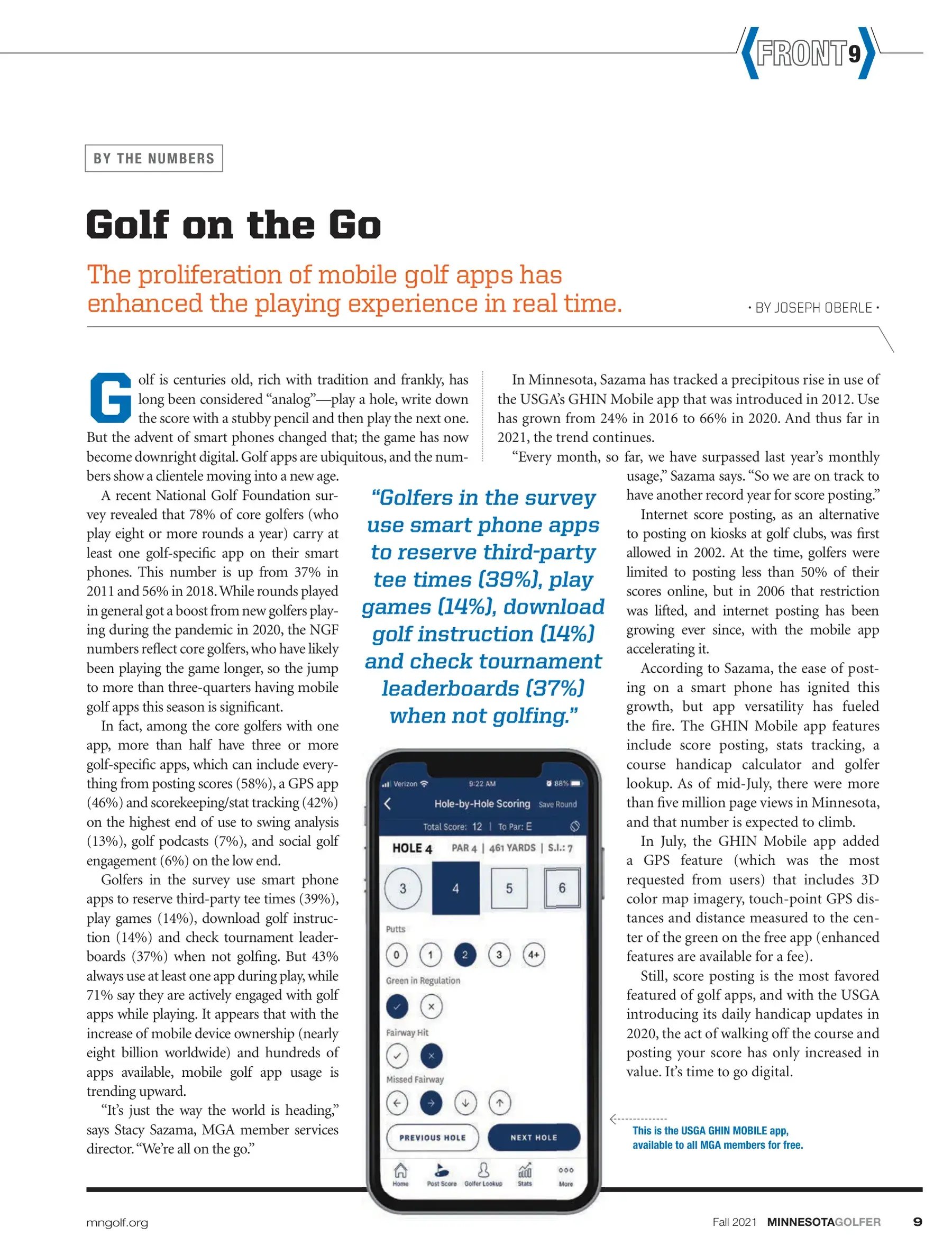
According to Sazama, the ease of posting on a smart phone has ignited this growth, but app versatility has fueled the fire. The GHIN Mobile app features include score posting, stats tracking, a course handicap calculator and golfer lookup. As of mid-July, there were more than five million page views in Minnesota, and that number is expected to climb.
In July, the GHIN Mobile app added a GPS feature (which was the most requested from users) that includes 3D color map imagery, touch-point GPS distances and distance measured to the center of the green on the free app (enhanced features are available for a fee).
Still, score posting is the most favored featured of golf apps, and with the USGA introducing its daily handicap updates in 2020, the act of walking off the course and posting your score has only increased in value. It’s time to go digital.
Golf on the Go The proliferation of mobile golf apps has enhanced the playing experience in real time. • BY JOSEPH OBERLE • “Golfers in the survey use smart phone apps to reserve third-party tee times (39%), play games (14%), download golf instruction (14%) and check tournament leaderboards (37%) when not golfing.”
This is the USGA GHIN MOBILE app, available to all MGA members for free. Live to Play Another Stroke An unplayable ball is not the end of the world, especially if you know Rule 19.
• BY BILL HOMEYER • T o some golfers, the Rules and procedures surrounding Rule 19, Unplayable Ball, may seem like a “get out of jail free card.” While that’s not true, Rule 19 can help golfers out of bad situations.
In the previous issue of Minnesota Golfer, we discussed players’ different options when their ball is in a yellow or red penalty area—which can come into play here.
A player has several options when their ball is unplayable, and it’s important to first determine whether or not their ball is in a penalty area.
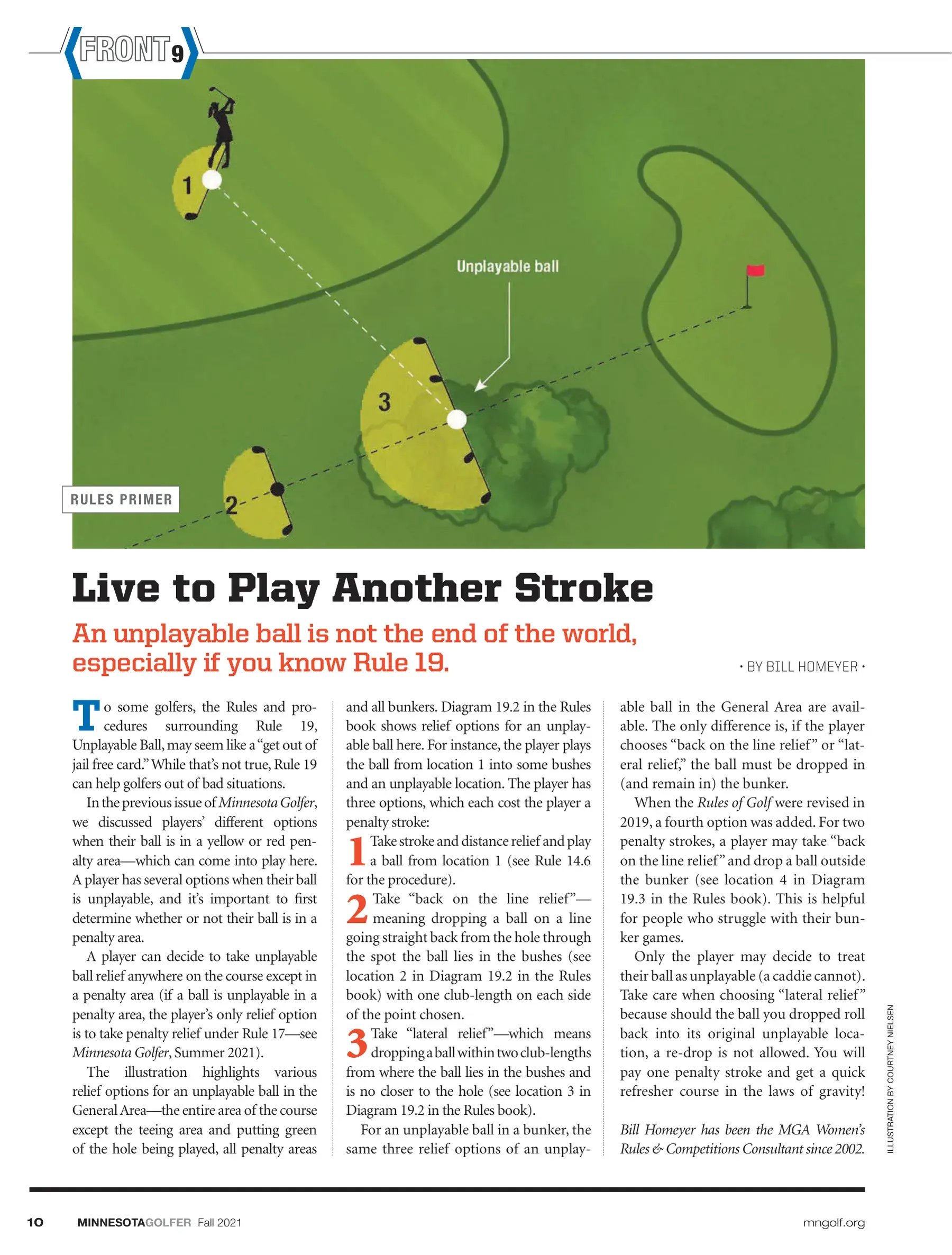
A player can decide to take unplayable ball relief anywhere on the course except in a penalty area (if a ball is unplayable in a penalty area, the player’s only relief option is to take penalty relief under Rule 17—see The illustration highlights various relief options for an unplayable ball in the General Area—the entire area of the course except the teeing area and putting green of the hole being played, all penalty areas and all bunkers. Diagram 19.2 in the Rules book shows relief options for an unplayable ball here. For instance, the player plays the ball from location 1 into some bushes and an unplayable location. The player has three options, which each cost the player a penalty stroke: Take stroke and distance relief and play a ball from location 1 (see Rule 14.6 for the procedure).
Take “back on the line relief”— meaning dropping a ball on a line going straight back from the hole through the spot the ball lies in the bushes (see location 2 in Diagram 19.2 in the Rules book) with one club-length on each side of the point chosen.
Take “lateral relief”—which means dropping a ball within two club-lengths from where the ball lies in the bushes and is no closer to the hole (see location 3 in Diagram 19.2 in the Rules book).
For an unplayable ball in a bunker, the same three relief options of an unplayable ball in the General Area are available. The only difference is, if the player chooses “back on the line relief” or “lateral relief,” the ball must be dropped in (and remain in) the bunker.
When the Rules of Golf were revised in 2019, a fourth option was added. For two penalty strokes, a player may take “back on the line relief” and drop a ball outside the bunker (see location 4 in Diagram 19.3 in the Rules book). This is helpful for people who struggle with their bunker games.
Only the player may decide to treat their ball as unplayable (a caddie cannot). Take care when choosing “lateral relief” because should the ball you dropped roll back into its original unplayable location, a re-drop is not allowed. You will pay one penalty stroke and get a quick refresher course in the laws of gravity!
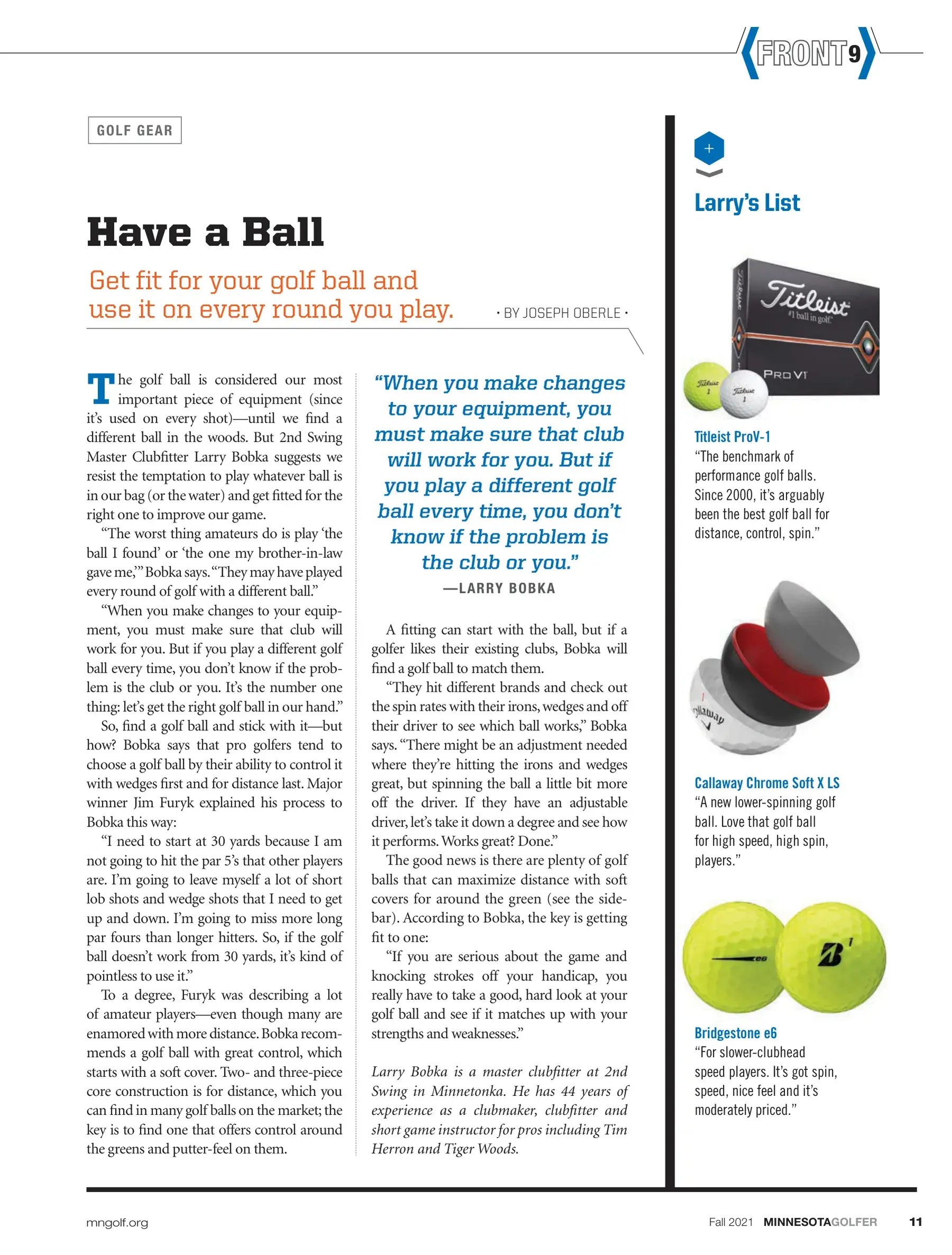
Bill Homeyer has been the MGA Women’s Rules & Competitions Consultant since 2002. RULES PRIMER ILLUSTRATION BY COURTNEY NIELSEN Fall 2021 MINNESOTAGOLFER 11 Bridgestone e6 “For slower-clubhead speed players. It’s got spin, speed, nice feel and it’s moderately priced.”
Callaway Chrome Soft X LS “A new lower-spinning golf ball. Love that golf ball for high speed, high spin, players.” Have a Ball Get fit for your golf ball and use it on every round you play.
T he golf ball is considered our most important piece of equipment (since it’s used on every shot)—until we find a different ball in the woods. But 2nd Swing Master Clubfitter Larry Bobka suggests we resist the temptation to play whatever ball is in our bag (or the water) and get fitted for the right one to improve our game.
“The worst thing amateurs do is play ‘the ball I found’ or ‘the one my brother-in-law gave me,’” Bobka says. “They may have played every round of golf with a different ball.”
“When you make changes to your equipment, you must make sure that club will work for you. But if you play a different golf ball every time, you don’t know if the problem is the club or you. It’s the number one thing: let’s get the right golf ball in our hand.”
So, find a golf ball and stick with it—but how? Bobka says that pro golfers tend to choose a golf ball by their ability to control it with wedges first and for distance last. Major winner Jim Furyk explained his process to Bobka this way: “I need to start at 30 yards because I am not going to hit the par 5’s that other players are. I’m going to leave myself a lot of short lob shots and wedge shots that I need to get up and down. I’m going to miss more long par fours than longer hitters. So, if the golf ball doesn’t work from 30 yards, it’s kind of pointless to use it.”
To a degree, Furyk was describing a lot of amateur players—even though many are enamored with more distance. Bobka recommends a golf ball with great control, which starts with a soft cover. Two- and three-piece core construction is for distance, which you can find in many golf balls on the market; the key is to find one that offers control around the greens and putter-feel on them.
A fitting can start with the ball, but if a golfer likes their existing clubs, Bobka will find a golf ball to match them. “They hit different brands and check out the spin rates with their irons, wedges and off their driver to see which ball works,” Bobka says. “There might be an adjustment needed where they’re hitting the irons and wedges great, but spinning the ball a little bit more off the driver. If they have an adjustable driver, let’s take it down a degree and see how it performs. Works great? Done.”
The good news is there are plenty of golf balls that can maximize distance with soft covers for around the green (see the sidebar). According to Bobka, the key is getting fit to one: “If you are serious about the game and knocking strokes off your handicap, you really have to take a good, hard look at your golf ball and see if it matches up with your strengths and weaknesses.”
Larry Bobka is a master clubfitter at 2nd Swing in Minnetonka. He has 44 years of experience as a clubmaker, clubfitter and short game instructor for pros including Tim Herron and Tiger Woods.
—LARRY BOBKA • BY JOSEPH OBERLE • Larry’s List Titleist ProV-1 “The benchmark of performance golf balls. Since 2000, it’s arguably been the best golf ball for distance, control, spin.”
TPC DORADO BEACH io Grande, Puerto Rico—The towering, rubberlike palm trees that dance so majestically across Puerto Rico are far from the only living things that sway so easily on the island. Jeff Willenberg could attest to that.
He was a young golf professional from Texas visiting Puerto Rico on a four-month teaching contract that began in November of 1997. He’d purchased a round-trip ticket to bounce back to Texas the following March, but never used the return portion. Willenberg, PGA, is the director of golf at TPC Dorado Beach, home to one of the finest courses in the Caribbean, TPC Dorado’s decorated East Course. He loved the island so much he never left it.
“My first night here, I had dinner in the old (Dorado) hotel in what they called The Surfing Room,” Willenberg said. “I sat right in front of the ocean, the waves are crashing ... Now, I had a great job in Dallas, and was about to start another as a tournament director. But I called my mom that night and I said, ‘I’m staying.’”
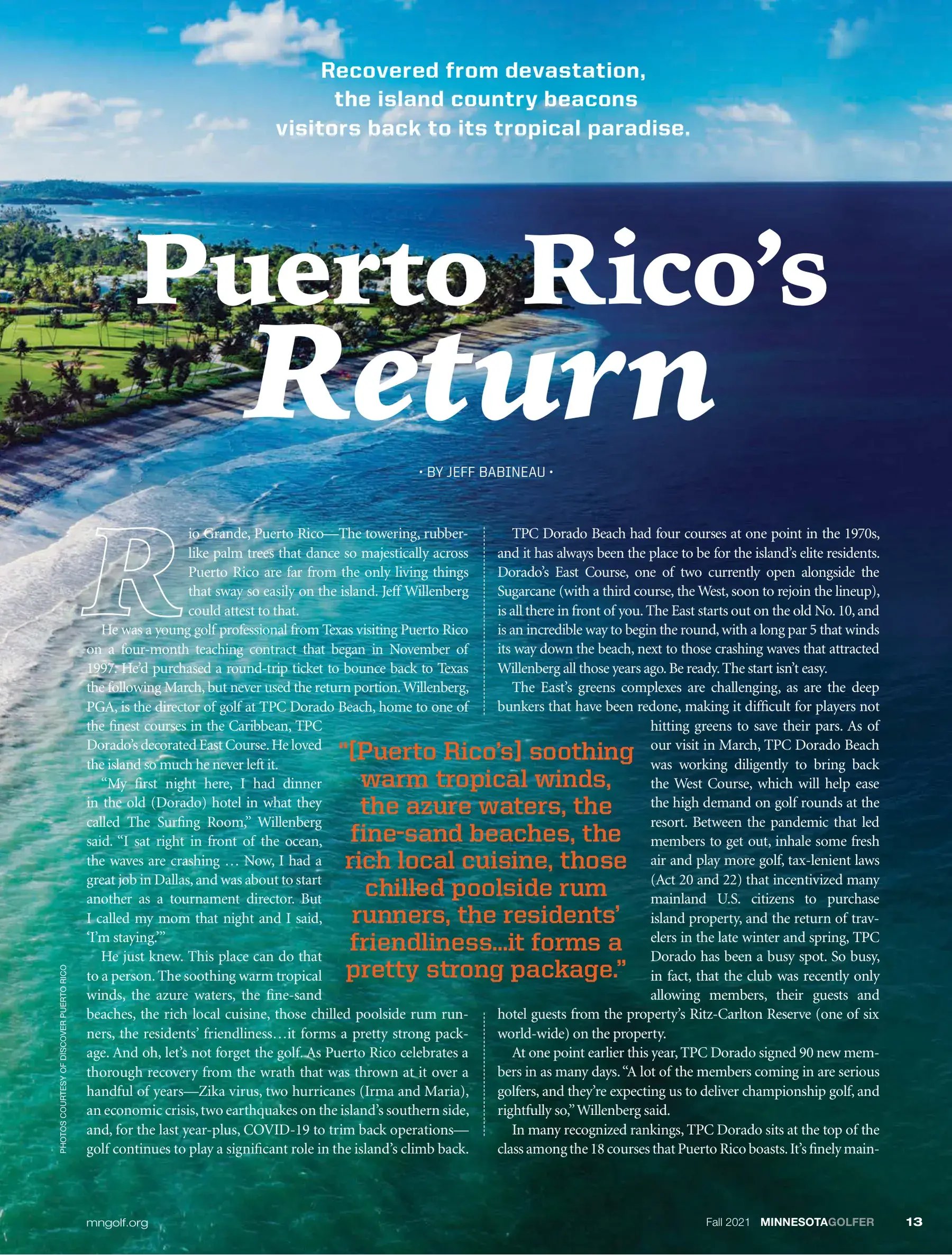
He just knew. This place can do that to a person. The soothing warm tropical winds, the azure waters, the fine-sand beaches, the rich local cuisine, those chilled poolside rum runners, the residents’ friendliness...it forms a pretty strong package. And oh, let’s not forget the golf. As Puerto Rico celebrates a thorough recovery from the wrath that was thrown at it over a handful of years—Zika virus, two hurricanes (Irma and Maria), an economic crisis, two earthquakes on the island’s southern side, and, for the last year-plus, COVID-19 to trim back operations— golf continues to play a significant role in the island’s climb back.
TPC Dorado Beach had four courses at one point in the 1970s, and it has always been the place to be for the island’s elite residents. Dorado’s East Course, one of two currently open alongside the Sugarcane (with a third course, the West, soon to rejoin the lineup), is all there in front of you. The East starts out on the old No. 10, and is an incredible way to begin the round, with a long par 5 that winds its way down the beach, next to those crashing waves that attracted Willenberg all those years ago. Be ready. The start isn’t easy.
The East’s greens complexes are challenging, as are the deep bunkers that have been redone, making it difficult for players not hitting greens to save their pars. As of our visit in March, TPC Dorado Beach was working diligently to bring back the West Course, which will help ease the high demand on golf rounds at the resort. Between the pandemic that led members to get out, inhale some fresh air and play more golf, tax-lenient laws (Act 20 and 22) that incentivized many mainland U.S. citizens to purchase island property, and the return of travelers in the late winter and spring, TPC Dorado has been a busy spot. So busy, in fact, that the club was recently only allowing members, their guests and hotel guests from the property’s Ritz-Carlton Reserve (one of six world-wide) on the property.
At one point earlier this year, TPC Dorado signed 90 new members in as many days. “A lot of the members coming in are serious golfers, and they’re expecting us to deliver championship golf, and rightfully so,” Willenberg said.
In many recognized rankings, TPC Dorado sits at the top of the class among the 18 courses that Puerto Rico boasts. It’s finely mainPHOTOS COURTESY OF DISCOVER PUERTO RICO Puerto Rico’s Return “[Puerto Rico’s] soothing warm tropical winds, the azure waters, the fine-sand beaches, the rich local cuisine, those chilled poolside rum runners, the residents’ friendliness...it forms a pretty strong package.”
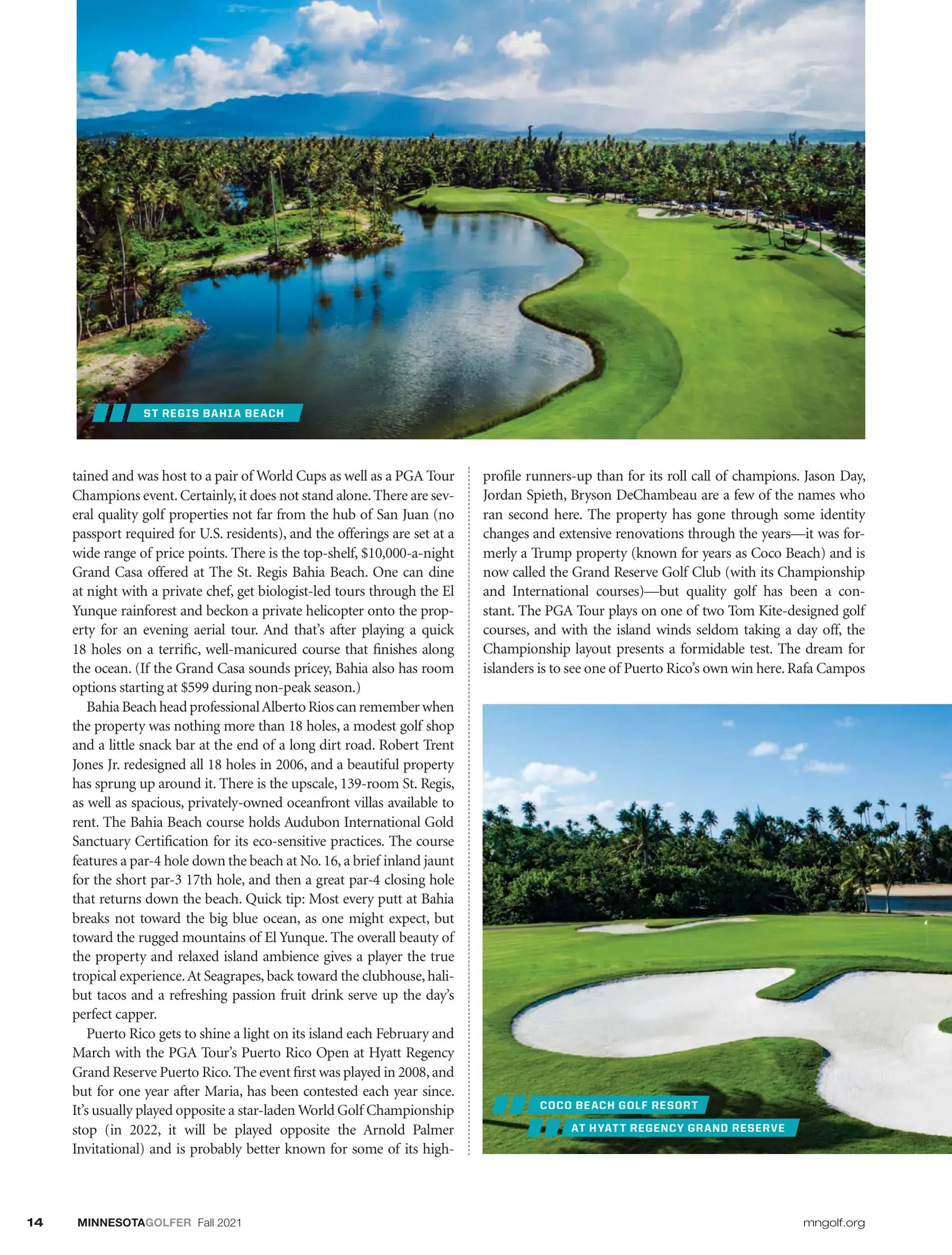
Recovered from devastation, the island country beacons visitors back to its tropical paradise. • BY JEFF BABINEAU • Fall 2021 MINNESOTAGOLFER 13 tained and was host to a pair of World Cups as well as a PGA Tour Champions event. Certainly, it does not stand alone. There are several quality golf properties not far from the hub of San Juan (no passport required for U.S. residents), and the offerings are set at a wide range of price points. There is the top-shelf, $10,000-a-night Grand Casa offered at The St. Regis Bahia Beach. One can dine at night with a private chef, get biologist-led tours through the El Yunque rainforest and beckon a private helicopter onto the property for an evening aerial tour. And that’s after playing a quick 18 holes on a terrific, well-manicured course that finishes along the ocean. (If the Grand Casa sounds pricey, Bahia also has room options starting at $599 during non-peak season.) Bahia Beach head professional Alberto Rios can remember when the property was nothing more than 18 holes, a modest golf shop and a little snack bar at the end of a long dirt road. Robert Trent Jones Jr. redesigned all 18 holes in 2006, and a beautiful property has sprung up around it. There is the upscale, 139-room St. Regis, as well as spacious, privately-owned oceanfront villas available to rent. The Bahia Beach course holds Audubon International Gold Sanctuary Certification for its eco-sensitive practices. The course features a par-4 hole down the beach at No. 16, a brief inland jaunt for the short par-3 17th hole, and then a great par-4 closing hole that returns down the beach. Quick tip: Most every putt at Bahia breaks not toward the big blue ocean, as one might expect, but toward the rugged mountains of El Yunque. The overall beauty of the property and relaxed island ambience gives a player the true tropical experience. At Seagrapes, back toward the clubhouse, halibut tacos and a refreshing passion fruit drink serve up the day’s perfect capper.
Puerto Rico gets to shine a light on its island each February and March with the PGA Tour’s Puerto Rico Open at Hyatt Regency Grand Reserve Puerto Rico. The event first was played in 2008, and but for one year after Maria, has been contested each year since.
It’s usually played opposite a star-laden World Golf Championship stop (in 2022, it will be played opposite the Arnold Palmer Invitational) and is probably better known for some of its highprofile runners-up than for its roll call of champions. Jason Day, Jordan Spieth, Bryson DeChambeau are a few of the names who ran second here. The property has gone through some identity changes and extensive renovations through the years—it was formerly a Trump property (known for years as Coco Beach) and is now called the Grand Reserve Golf Club (with its Championship and International courses)—but quality golf has been a constant. The PGA Tour plays on one of two Tom Kite-designed golf courses, and with the island winds seldom taking a day off, the Championship layout presents a formidable test. The dream for islanders is to see one of Puerto Rico’s own win here. Rafa Campos ST REGIS BAHIA BEACH COCO BEACH GOLF RESORT AT HYATT REGENCY GRAND RESERVE Fall 2021 MINNESOTAGOLFER 15 nearly fulfilled that vision in March, making a great run and tying for third. As for the cuisine at Grand R eserve, it offers nice variety, ranging from Asian fusion ( Nori) to a classic steakhouse, 787 P rime, where one enters past a wall of artsy bottles behind a stylish martini bar.
Campos is a great ambassador for golf on the island, familiar with all the properties. H is family still keeps a condo at R io Mar, he has a sponsorship deal with Grand R eserve, and he often practices and plays at TP C Dorado Beach, only 10 minutes from his home. Campos is a giver, and he does what he can when home to get young children on the island interested in the game. H e sees great potential in P uerto R ico as a burgeoning golf destination and with the generation of players behind him.
“It took us a good year and a half to kind of start coming back after Maria,” Campos said at this year’s P uerto R ico Open, referring to the devastating 2017 Category 5 hurricane that delivered winds in ex cess of 155 mph. “Now it’s completely back to normal. You would never tell we had a huge hurricane come by us only three years ago. The tournament, for us, is huge. We thrive on tourism, and the P uerto R ico Open is a time to showcase the island— one of the biggest opportunities we have.”
The Wyndham Grand R io Mar Golf and Beach R esort, a 36-hole facility where Campos grew up playing, fits the bill as a well-rounded family destination. ( Though we traveled without children, my wife and I adored the kids’ bunk bed nook in our ocean suite.) Multiple pools, the adjacent beach, Margaritaville just nex t door, activities galore, a terrific variety of restaurants and a full on-site casino...
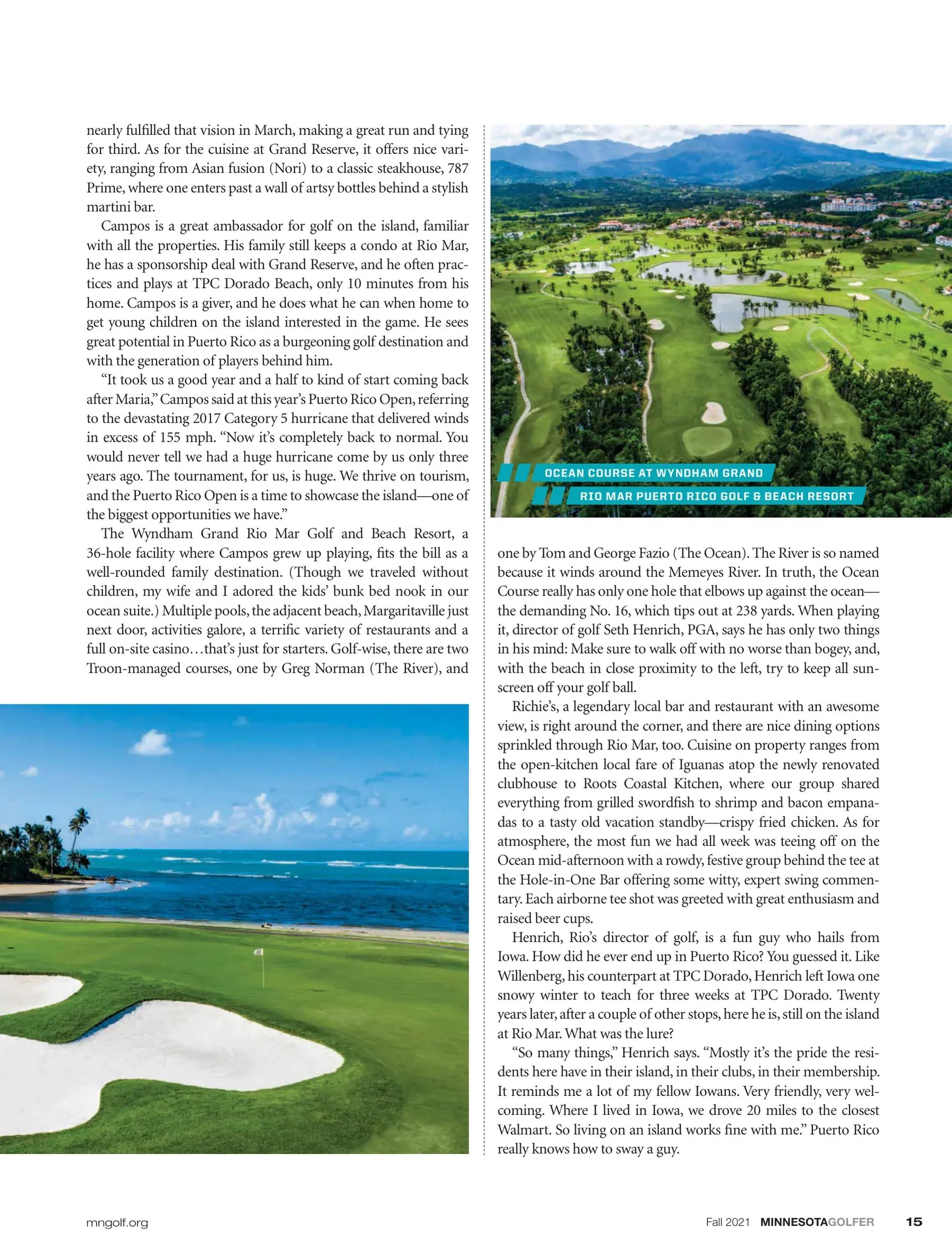
that’s just for starters. Golf-wise, there are two Troon-managed courses, one by Greg Norman ( The R iver) , and one by Tom and George F az io ( The Ocean) . The R iver is so named because it winds around the Memeyes R iver. In truth, the Ocean Course really has only one hole that elbows up against the ocean— the demanding No. 16, which tips out at 238 yards. When playing it, director of golf Seth H enrich, P GA, says he has only two things in his mind: Make sure to walk off with no worse than bogey, and, with the beach in close prox imity to the left, try to keep all sunscreen off your golf ball.
R ichie’s, a legendary local bar and restaurant with an awesome view, is right around the corner, and there are nice dining options sprinkled through R io Mar, too. Cuisine on property ranges from the open-kitchen local fare of Iguanas atop the newly renovated clubhouse to R oots Coastal K itchen, where our group shared everything from grilled swordfish to shrimp and bacon empanadas to a tasty old vacation standby— crispy fried chicken. As for atmosphere, the most fun we had all week was teeing off on the Ocean mid-afternoon with a rowdy, festive group behind the tee at the H ole-in-One Bar offering some witty, ex pert swing commentary. Each airborne tee shot was greeted with great enthusiasm and raised beer cups.
H enrich, R io’s director of golf, is a fun guy who hails from Iowa. H ow did he ever end up in P uerto R ico? You guessed it. Like Willenberg, his counterpart at TP C Dorado, H enrich left Iowa one snowy winter to teach for three weeks at TP C Dorado. Twenty years later, after a couple of other stops, here he is, still on the island at R io Mar. What was the lure?
“So many things,” H enrich says. “Mostly it’s the pride the residents here have in their island, in their clubs, in their membership. It reminds me a lot of my fellow Iowans. Very friendly, very welcoming. Where I lived in Iowa, we drove 20 miles to the closest Walmart. So living on an island works fine with me.” P uerto R ico really knows how to sway a guy.
OCEAN COURSE AT WYNDHAM GRAND RIO MAR PUERTO RICO GOLF & BEACH RESORT • BY TOM BEDELL • S ure, you snowbirds can replace your masks, hop on a plane and be at your winter headquarters in or near Phoenix within hours. But why not line up some tee times, pack the sticks into the wagon train, leave the mask off while driving, and take a more leisurely, golf-laden journey?
We’ve mapped out a route that lets you smell the roses, with a blend of interstates and prettier scenic routes, trying to keep any day’s driving to five hours or under, leaving time for a round and maybe some sights before hitting the pillow. There’s also a fork in the road, and the good news is that you can take it (well, one time going, one coming back).
Minn. « S.D.: Assuming you’re leaving from somewhere near Minneapolis, your first stop is a mere four hours distant, west on Route 212, stepping your way down to scenic Route 23 through Marshall (pondering a stop at the Pipestone National Monument), polishing off your last leg on I-90.
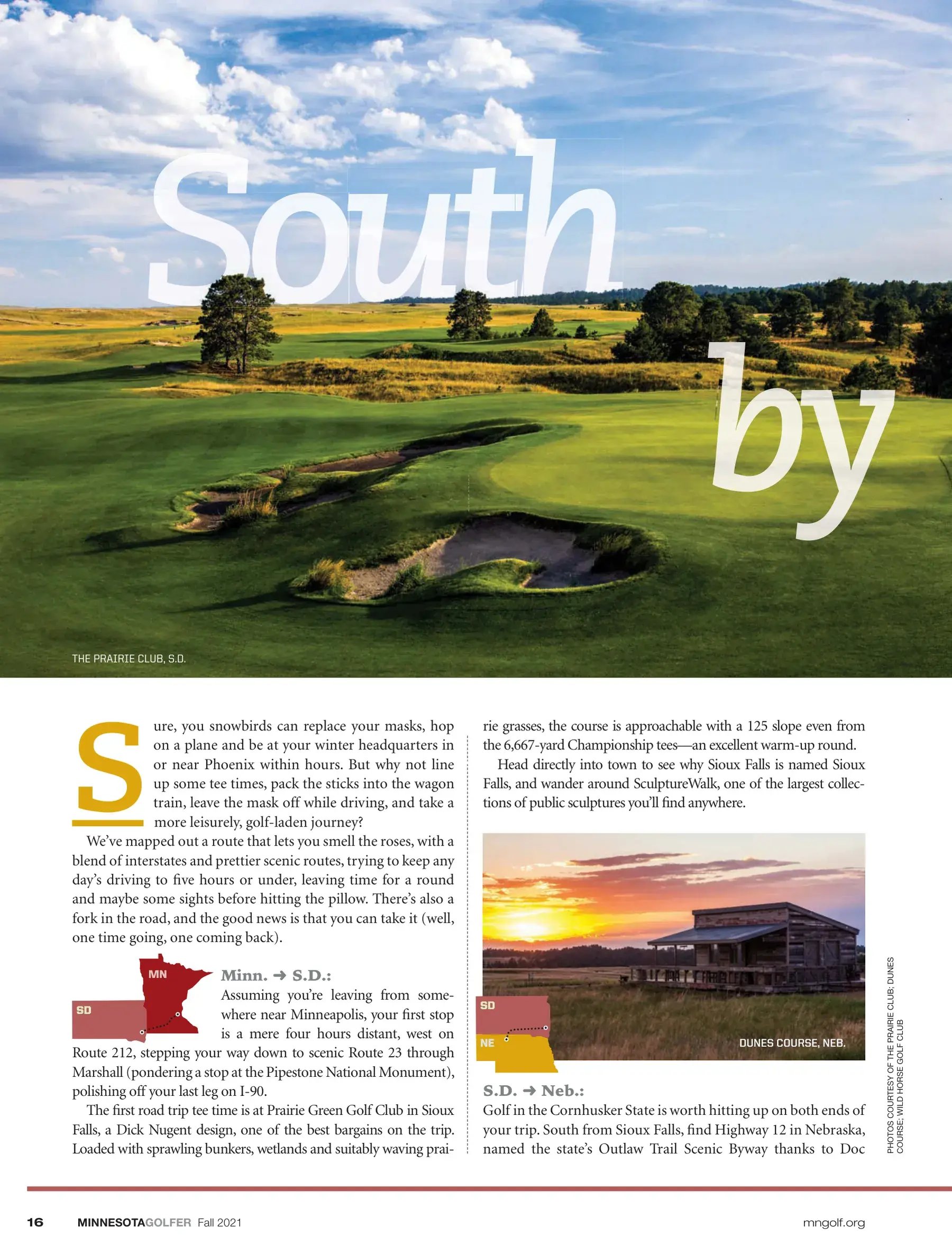
The first road trip tee time is at Prairie Green Golf Club in Sioux Falls, a Dick Nugent design, one of the best bargains on the trip. Loaded with sprawling bunkers, wetlands and suitably waving prairie grasses, the course is approachable with a 125 slope even from the 6,667-yard Championship tees—an excellent warm-up round.
Head directly into town to see why Sioux Falls is named Sioux Falls, and wander around SculptureWalk, one of the largest collections of public sculptures you’ll find anywhere.
S.D. « Neb.: Golf in the Cornhusker State is worth hitting up on both ends of your trip. South from Sioux Falls, find Highway 12 in Nebraska, named the state’s Outlaw Trail Scenic Byway thanks to Doc DUNES COURSE, NEB.
Valentine, about 4.5 hours from Sioux Falls, is where you’ll bunk in at The Prairie Club, a Great Plains can’t-miss golf oasis, a private club and resort. Stay long enough to take advantage of the Tom Lehman- and Chris Brands-designed Dunes Course and the Graham Marsh-designed Pines Course, plus the Gil Hanse- and Geoff Shackleford-designed ten-hole free-form Horse Course. And don’t miss the Chris Brands-designed Old Wagon Putting Course. It’s not cheap, but think Bandon Dunes without the Pacifi c Ocean and you get the drift.
Valentine « Gothenburg, Neb.: If your club has decent reciprocals, by all means try to get on the private Sand Hills in Mullen. It was that minimalist links-style course that in 1995 put the state on traveling golfers’ radars.
Soon set sail for Wild Horse Golf Club in Gothenburg, taking Route 2 past the Nebraska National Forest to Broken Bow and thence to the course, about three hours. Course designers Dave Axland and Dan Proctor learned their lessons well when helping designers Bill Coore and Ben Crenshaw construct Sand Hills. In a flat panorama, with its sense of breadth, vast sky and benign nothingness, with old style windmills in the infi nite horizon and cattle skulls as tee markers, an utterly enjoyable round of golf awaits.
From New Mexico’s Organ Mountains to Utah’s Fishlake National Forest, the west is filled with beauty, adventure and one-of-a-kind golf destinations.
BY TOM BEDELL WILD HORSE GOLF CLUB, NEB. NE Southwest Decision Point Interlude Now: continue on a northern southwest route, through Utah, or a southern southwest route through Colorado and New Mexico? We’ll use the latter for now, but you can take the other reversed when homeward bound.
Neb. « Colo.: Use interstates for the five-hour plus trip to Colorado Springs, stopping in Denver at the Wynkoop Brewing Co., which helped kickstart the craft brewing movement in Colorado, not to mention the political career of John Hickenlooper, first Denver’s mayor, then a Presidential candidate, and now a U.S. Senator.
Have the kids along? Take a free half-hour tour of the Hammond’s Candies factory, where sweet stuff has been manufactured for just shy of 100 years.
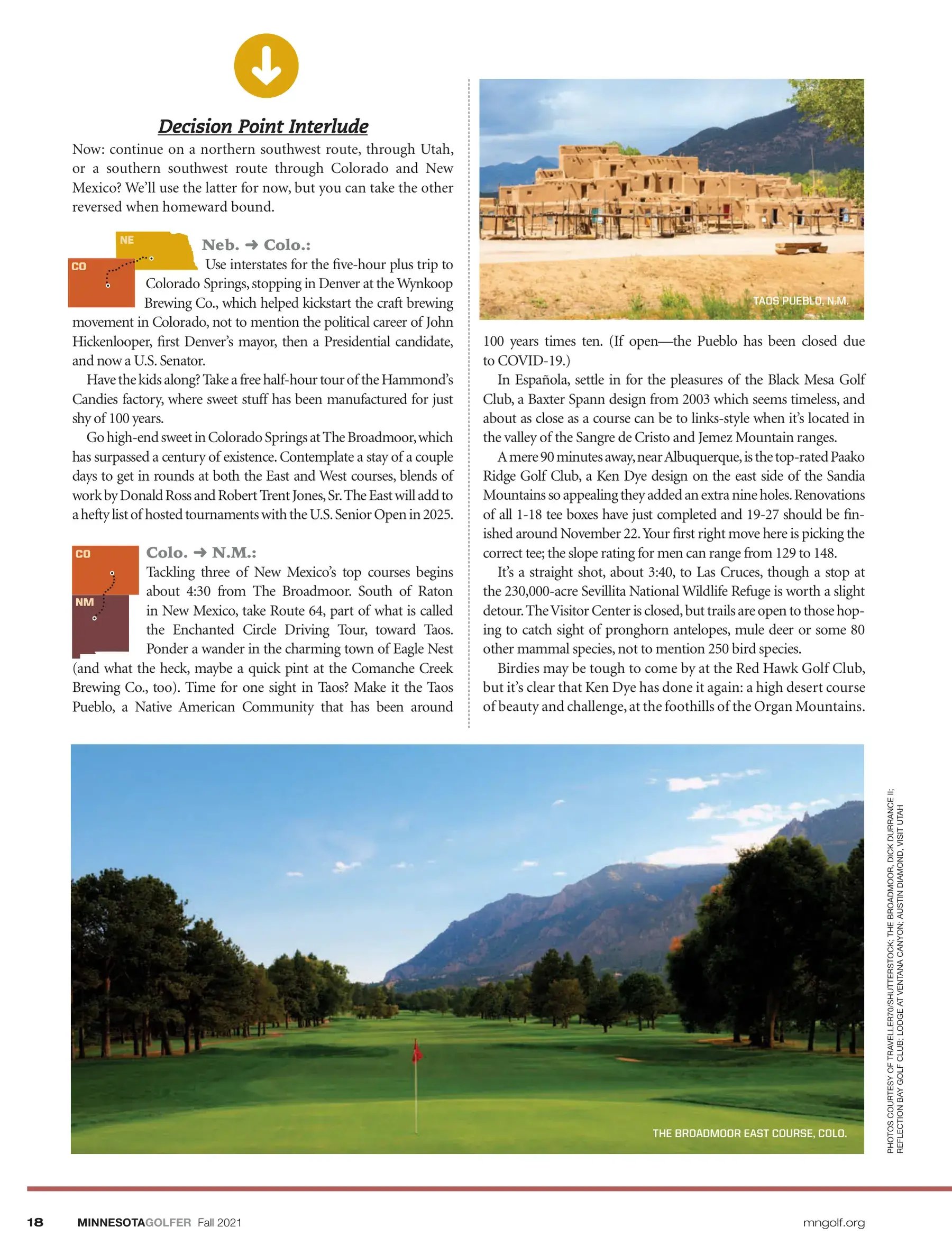
Go high-end sweet in Colorado Springs at The Broadmoor, which has surpassed a century of existence. Contemplate a stay of a couple days to get in rounds at both the East and West courses, blends of work by Donald Ross and Robert Trent Jones, Sr. The East will add to a hefty list of hosted tournaments with the U.S. Senior Open in 2025.
Colo. « N.M.: Tackling three of New Mexico’s top courses begins about 4:30 from The Broadmoor. South of Raton in New Mexico, take Route 64, part of what is called the Enchanted Circle Driving Tour, toward Taos.
Ponder a wander in the charming town of Eagle Nest (and what the heck, maybe a quick pint at the Comanche Creek Brewing Co., too). Time for one sight in Taos? Make it the Taos Pueblo, a Native American Community that has been around 100 years times ten. (If open—the Pueblo has been closed due to COVID-19.) In Española, settle in for the pleasures of the Black Mesa Golf Club, a Baxter Spann design from 2003 which seems timeless, and about as close as a course can be to links-style when it’s located in the valley of the Sangre de Cristo and Jemez Mountain ranges.
A mere 90 minutes away, near Albuquerque, is the top-rated Paako Ridge Golf Club, a Ken Dye design on the east side of the Sandia Mountains so appealing they added an extra nine holes. Renovations of all 1-18 tee boxes have just completed and 19-27 should be finished around November 22. Your first right move here is picking the correct tee; the slope rating for men can range from 129 to 148.
It’s a straight shot, about 3:40, to Las Cruces, though a stop at the 230,000-acre Sevillita National Wildlife Refuge is worth a slight detour. The Visitor Center is closed, but trails are open to those hoping to catch sight of pronghorn antelopes, mule deer or some 80 other mammal species, not to mention 250 bird species.
Birdies may be tough to come by at the Red Hawk Golf Club, but it’s clear that Ken Dye has done it again: a high desert course of beauty and challenge, at the foothills of the Organ Mountains.
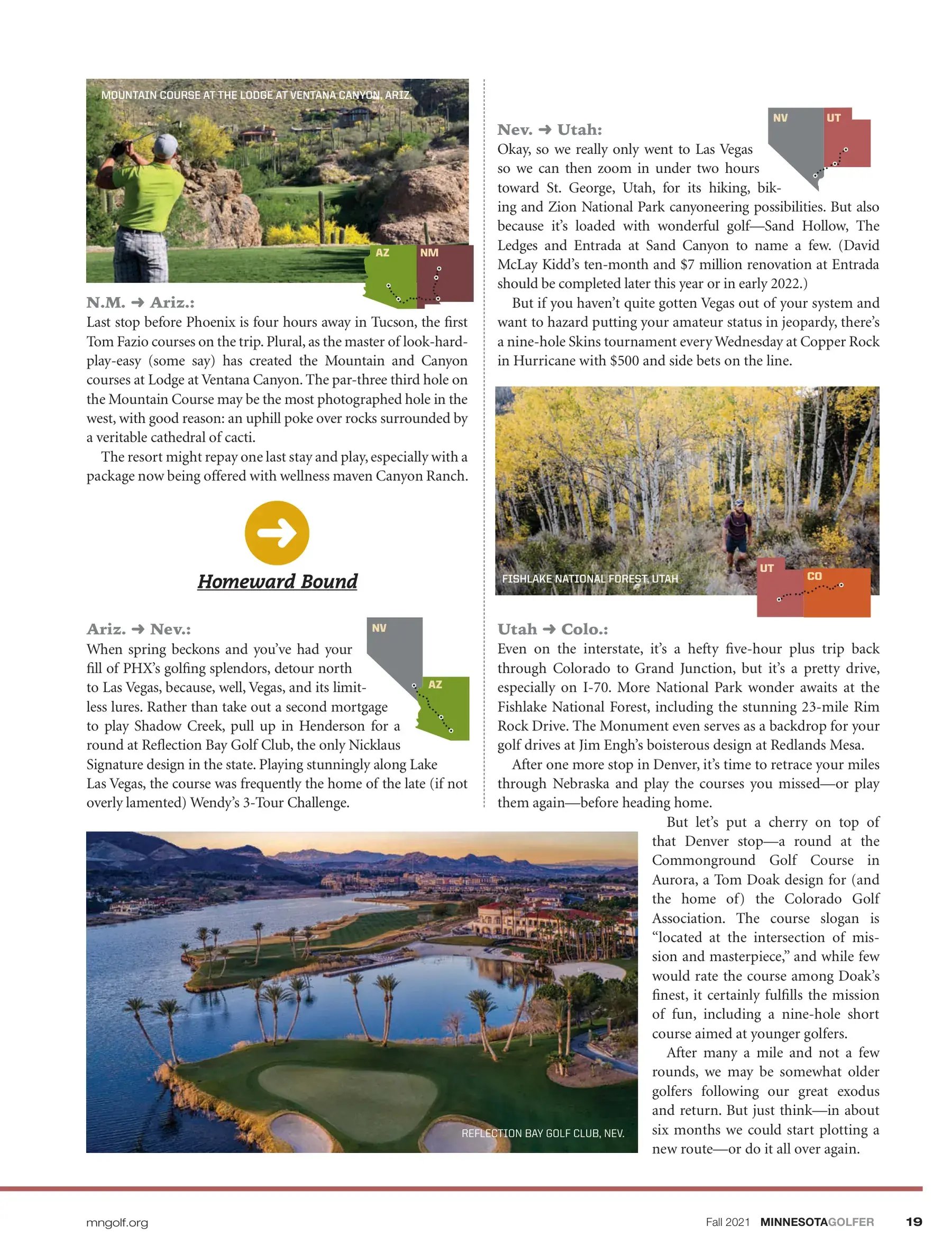
The resort might repay one last stay and play, especially with a package now being offered with wellness maven Canyon R anch. Homeward Bound Ariz. « Nev.: When spring beckons and you’ve had your fill of P H X ’s golfing splendors, detour north to Las Vegas, because, well, Vegas, and its limitless lures. R ather than take out a second mortgage to play Shadow Creek, pull up in H enderson for a round at R eflection Bay Golf Club, the only Nicklaus Signature design in the state. P laying stunningly along Lake Las Vegas, the course was frequently the home of the late ( if not overly lamented) Wendy’s 3-Tour Challenge.
Nev. « Utah: Okay, so we really only went to Las Vegas so we can then z oom in under two hours toward St. George, U tah, for its hiking, biking and Z ion National P ark canyoneering possibilities. But also because it’s loaded with wonderful golf— Sand H ollow, The Ledges and Entrada at Sand Canyon to name a few. ( David McLay K idd’s ten-month and $ 7 million renovation at Entrada should be completed later this year or in early 2022.) But if you haven’t quite gotten Vegas out of your system and want to haz ard putting your amateur status in jeopardy, there’s a nine-hole Skins tournament every Wednesday at Copper R ock in H urricane with $ 500 and side bets on the line.
Utah « Colo.: Even on the interstate, it’s a hefty five-hour plus trip back through Colorado to Grand Junction, but it’s a pretty drive, especially on I-70. More National P ark wonder awaits at the F ishlake National F orest, including the stunning 23-mile R im R ock Drive. The Monument even serves as a backdrop for your golf drives at Jim Engh’s boisterous design at R edlands Mesa.
After one more stop in Denver, it’s time to retrace your miles through Nebraska and play the courses you missed— or play them again— before heading home.
But let’s put a cherry on top of that Denver stop— a round at the Commonground Golf Course in Aurora, a Tom Doak design for ( and the home of) the Colorado Golf Association. The course slogan is “located at the intersection of mission and masterpiece,” and while few would rate the course among Doak’s finest, it certainly fulfills the mission of fun, including a nine-hole short course aimed at younger golfers.
After many a mile and not a few rounds, we may be somewhat older golfers following our great ex odus and return. But just think— in about six months we could start plotting a new route— or do it all over again.
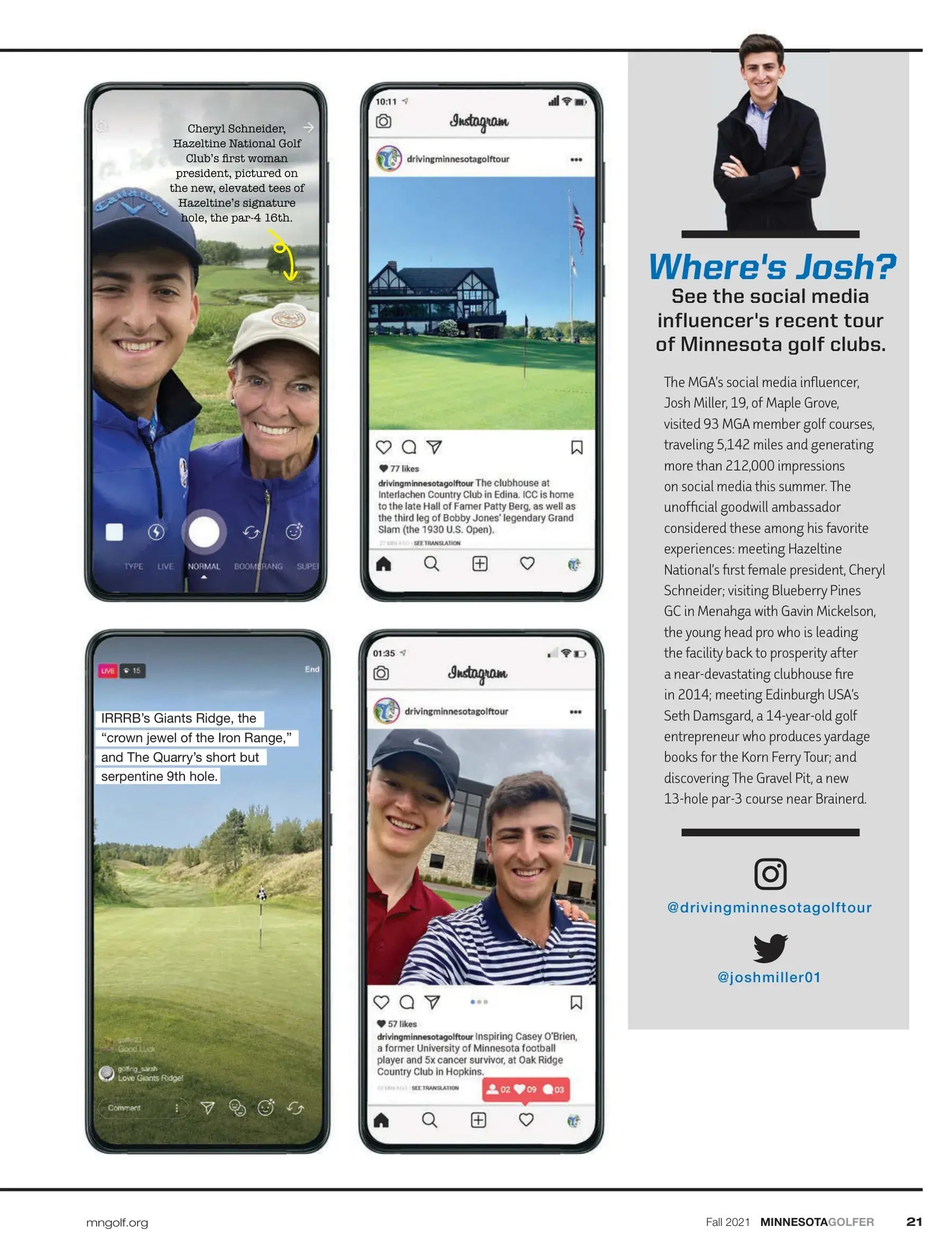
Dacotah Ridge Golf Club, Minnesota’s only Rees Jones design, located in Morton. Fall 2021 MINNESOTAGOLFER 21 Where's Josh? See the social media influencer's recent tour of Minnesota golf clubs.
The MGA’s social media infl uencer, Josh Miller, 19, of Maple Grove, visited 93 MGA member golf courses, traveling 5,142 miles and generating more than 212,000 impressions on social media this summer. The unoffi cial goodwill ambassador considered these among his favorite experiences: meeting Hazeltine National’s first female president, Cheryl Schneider; visiting Blueberry Pines GC in Menahga with Gavin Mickelson, the young head pro who is leading the facility back to prosperity after a near-devastating clubhouse fire in 2014; meeting Edinburgh USA’s Seth Damsgard, a 14-year-old golf entrepreneur who produces yardage books for the Korn Ferry Tour; and discovering The Gravel Pit, a new 13-hole par-3 course near Brainerd.
@drivingminnesotagolftour @joshmiller01 IRRRB’s Giants Ridge, the “crown jewel of the Iron Range,” and The Quarry’s short but serpentine 9th hole.
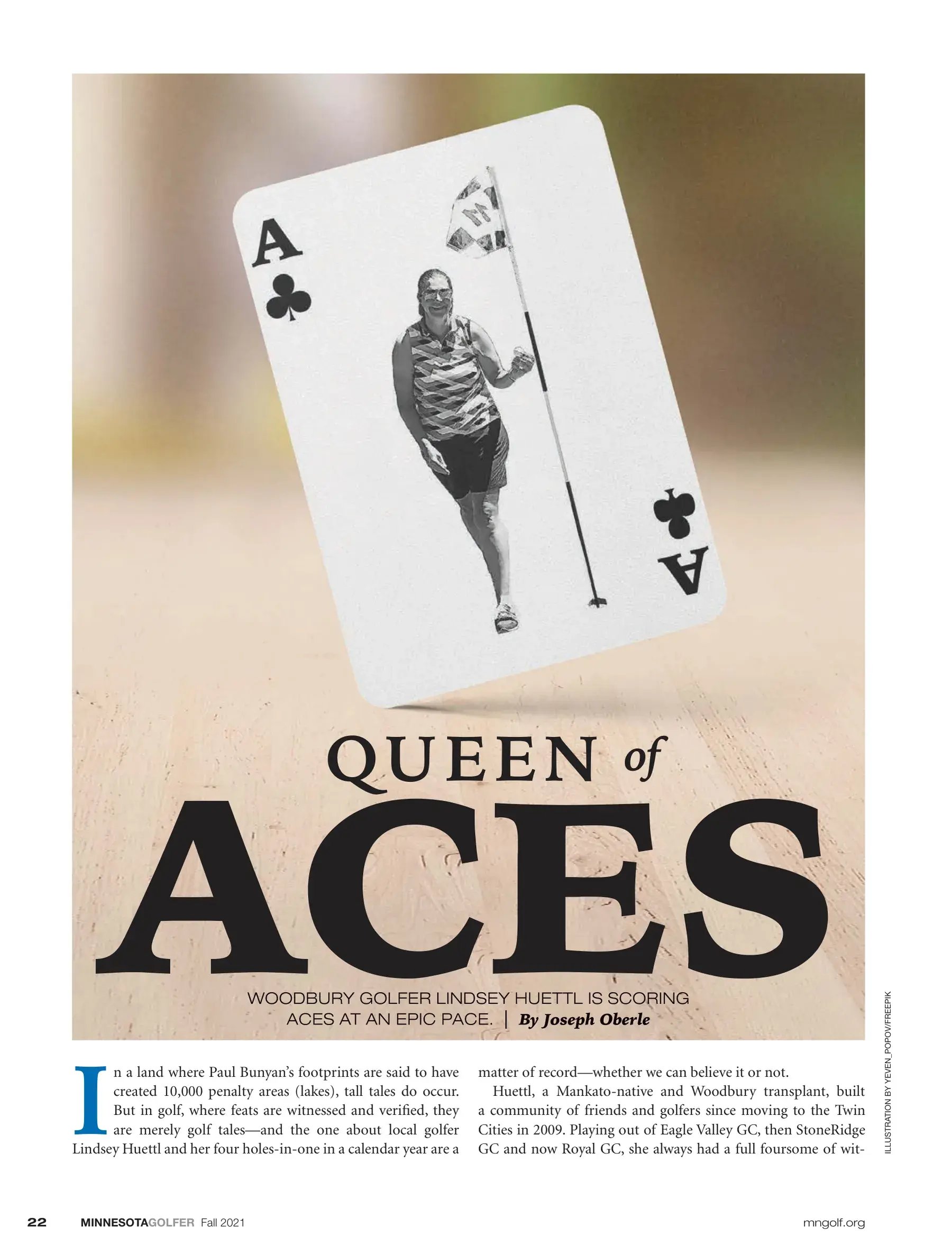
ACES QUEEN of I n a land where Paul Bunyan’s footprints are said to have created 10,000 penalty areas (lakes), tall tales do occur. But in golf, where feats are witnessed and verifi ed, they are merely golf tales—and the one about local golfer Lindsey Huettl and her four holes-in-one in a calendar year are a matter of record—whether we can believe it or not.
Huettl, a Mankato-native and Woodbury transplant, built a community of friends and golfers since moving to the Twin Cities in 2009. Playing out of Eagle Valley GC, then StoneRidge GC and now Royal GC, she always had a full foursome of witILLUSTRATION BY YEVEN_POPOV/FREEPIK Fall 2021 MINNESOTAGOLFER 23 nesses when hitting one of her five-career holes-in-one, incredulous though those witnesses may be.
“I was in complete shock,” H uettl said of her most recent hole-in-one on June 7, 2021, on R oyal’s 12th hole. “I dropped my club, dropped my jaw and just stared at my buddy [who said] ‘Are you kidding me? H ow is this even possible? ’”
You see, H uettl had just made an ace three days prior at Troy Burne GC’s 11th hole. And another 33 days before that on May 2 on R oyal’s No. 7— and one more last season ( June 22, 2020, at StoneR idge’s No. 14) . H er first was on September 18, 2013, at Eagle Valley No. 5. The odds for a single ace are 12,500 to one. The odds of them occurring with this frequency are off the charts. ( Although, Minnetrista golfer Brenda Williams holds the Guinness World R ecord for aces in a year with four in 11 months and 3 days. Lindsey falls just shy at 11 months and 15 days) . The question remains: H ow, indeed?
“It’s all luck,” H uettl says without a hint of false modesty. “It really is. Yes, you have to be able to put the ball in the vicinity of the hole, but for it to actually go in, you don’t know what line to hit and or break to play.
You have a general idea, but that’s all luck.” Many athletes say, “the harder I work, the luckier I get.” H uettl, a former college soccer player at MSU - Mankato, defi nitely puts in time on the course. She’s a self-proclaimed golf nut, playing 5-6 rounds a week and posting more than 200 rounds in 2020. But, actually, it’s not work for H uettl.
“I do not practice,” she says. “I don’t go to the putting green; I don’t go to the chipping green; I don’t go to the driving range and just hit balls. I play. P laying is my practice.”
Okay, so maybe she is lucky. But H uettl recently put a golf simulator in her house and credits a gift from a friend for helping improve her short game.
“I am decent around the greens,” says H uettl, who also jarred an eagle on a par 4 this past summer at R oyal. “I credit a birthday gift of the Tiger Woods 14 game on P layStation 3. I played it all winter. It showed me all these different chip shots [and I wanted] to try them on the course.”
H uettl’s a student of the game— but it wasn’t always that way. She grew up with golf-playing parents, who coerced Lindsey to the course so they could play.
“My parents started me playing at age 5 or 6, but I had no interest in it,” Lindsey says. “I was only going willingly with a ride in a golf cart and M& Ms at the turn.”
She played soccer and basketball in high school— only joining the Mankato East golf team at the insistence of her mom. But her heart wasn’t in it, even though she made varsity her sophomore year.
“If my high school coach could see me now, he wouldn’t believe how much I love golf,” Lindsey says. Lindsey got hooked after meeting up with a former college soccer teammate for some competitive rounds and then realiz ing how golf had become a continuing connection to her parents. There was competition with them, as well: Lindsey happily reports that her five aces “finally tie” her parents’ five combined ( three for dad and two for mom) .
Luck, genetics or solid golf— perhaps all are at play— but Lindsey’s story is even more amaz ing. She is 36 and single, but her friend Marie, hoping to help change that, gave her golf balls inscribed with the following note: “Married, old, female? Drop this ball at once! 30-40 male, single? Tex t: [Lindsey’s phone number].” Those golf balls are lost ( doing their job) , but balls from a later iteration are not.
“Last year, my friend Tom continued the tradition of birthday golf balls with ones that say: “If found, I putt out.’” U nfortunately, three of those golf balls are mounted on a wall of Lindsey’s home in a display of her hole-in-one golf balls.
Lindsey recently discovered another sleeve of those birthday golf balls, so the husband hunting ( or her quest for more aces) , continues. Either way, this golf tale just gets taller.
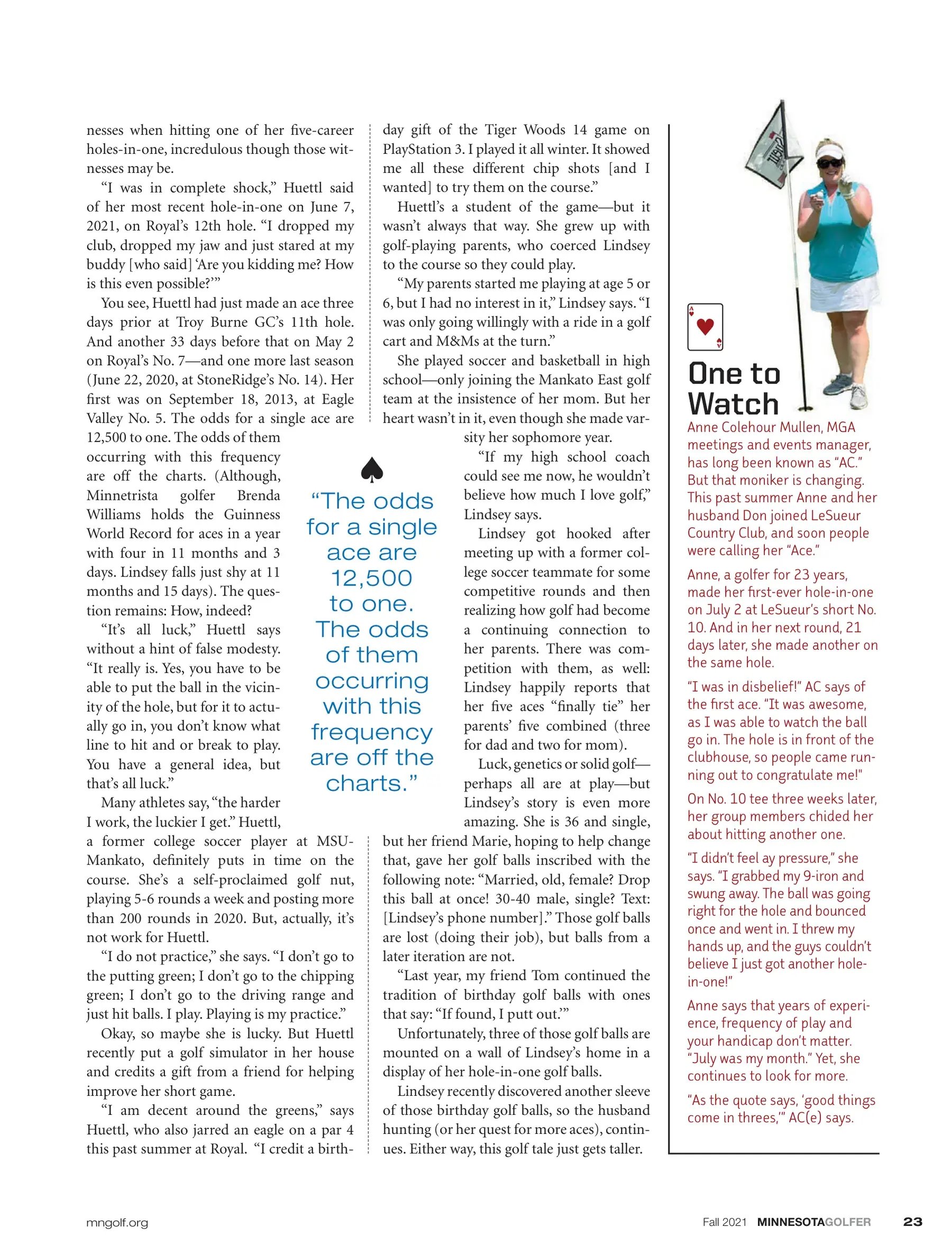
One to Watch Anne Colehour Mullen, MGA meetings and events manager, has long been known as “AC.” But that moniker is changing. This past summer Anne and her husband Don joined LeSueur Country Club, and soon people were calling her “Ace.”
Anne, a golfer for 23 years, made her first-ever hole-in-one on July 2 at LeSueur’s short No. 10. And in her next round, 21 days later, she made another on the same hole.
“I was in disbelief!” AC says of the first ace. “It was awesome, as I was able to watch the ball go in. The hole is in front of the clubhouse, so people came running out to congratulate me!"
On No. 10 tee three weeks later, her group members chided her about hitting another one. “I didn’t feel ay pressure,” she says. “I grabbed my 9-iron and swung away. The ball was going right for the hole and bounced once and went in. I threw my hands up, and the guys couldn’t believe I just got another holein-one!”
Anne says that years of experience, frequency of play and your handicap don’t matter. “July was my month.” Yet, she continues to look for more.
“As the quote says, ‘good things come in threes,’” AC(e) says. “The odds for a single ace are 12,500 to one. The odds of them occurring with this frequency are off the charts.”
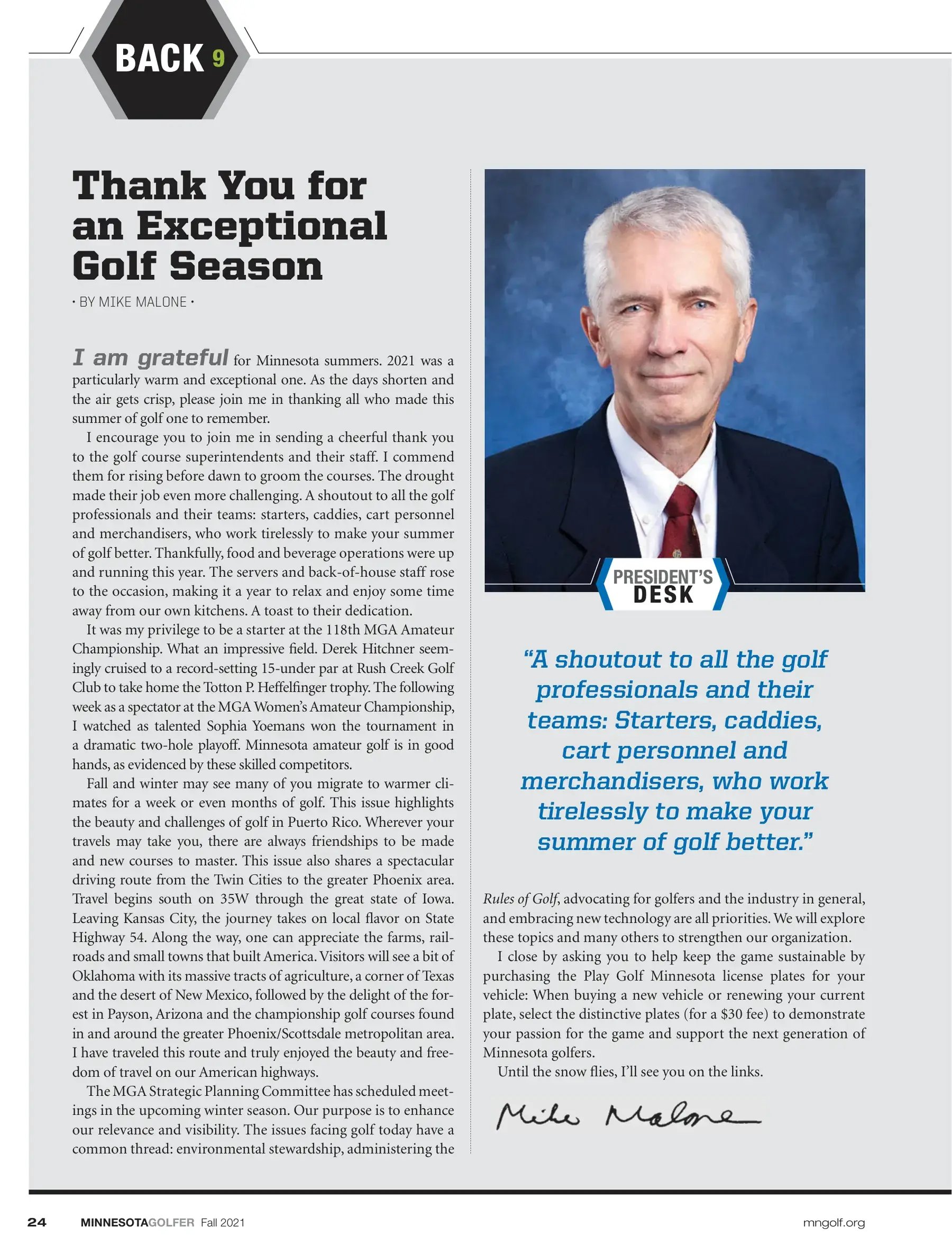
BACK Thank You for an Exceptional Golf Season I am grateful for Minnesota summers. 2021 was a particularly warm and ex ceptional one. As the days shorten and the air gets crisp, please join me in thanking all who made this summer of golf one to remember.
I encourage you to join me in sending a cheerful thank you to the golf course superintendents and their staff. I commend them for rising before dawn to groom the courses. The drought made their job even more challenging. A shoutout to all the golf professionals and their teams: starters, caddies, cart personnel and merchandisers, who work tirelessly to make your summer of golf better. Thankfully, food and beverage operations were up and running this year. The servers and back-of-house staff rose to the occasion, making it a year to relax and enjoy some time away from our own kitchens. A toast to their dedication.
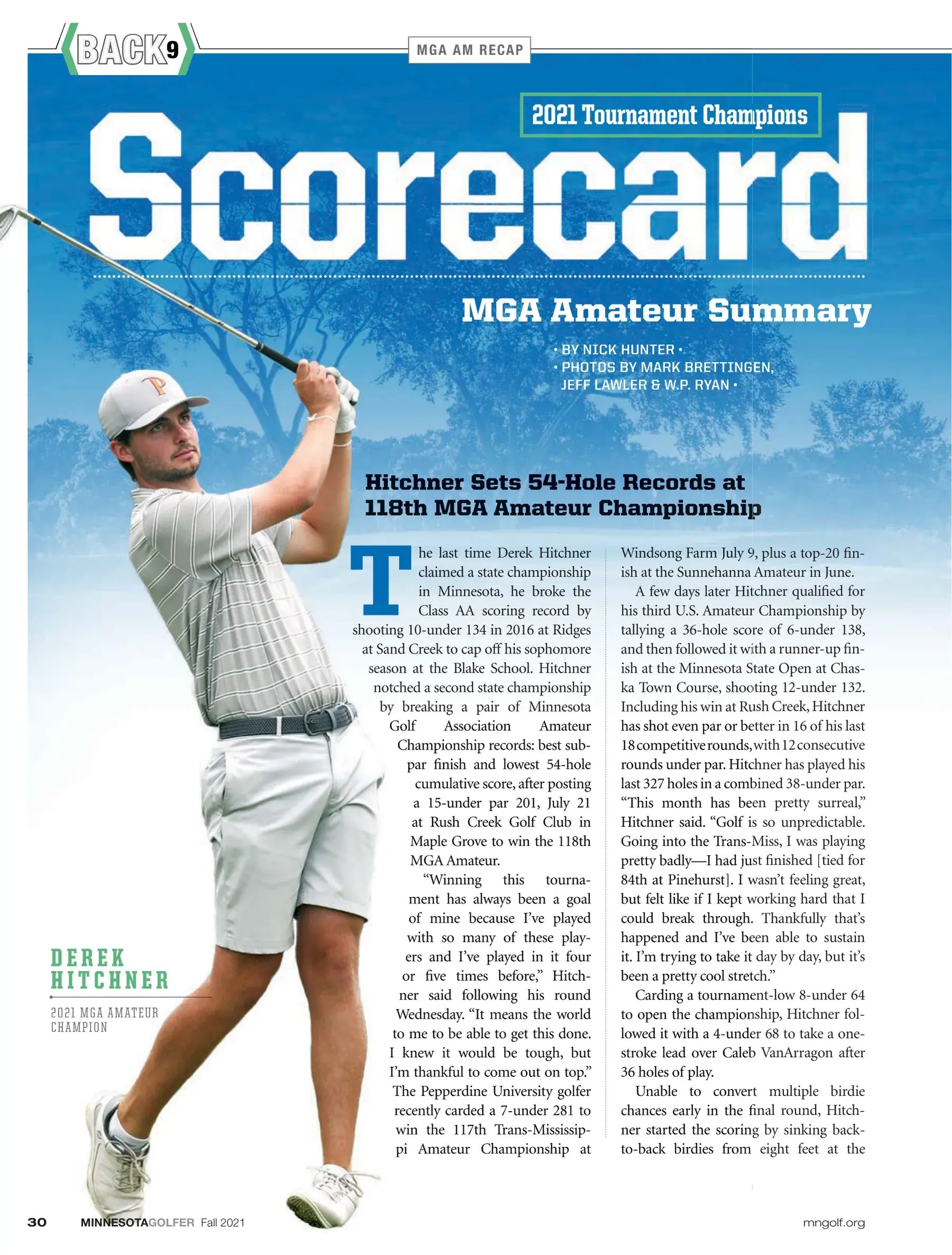
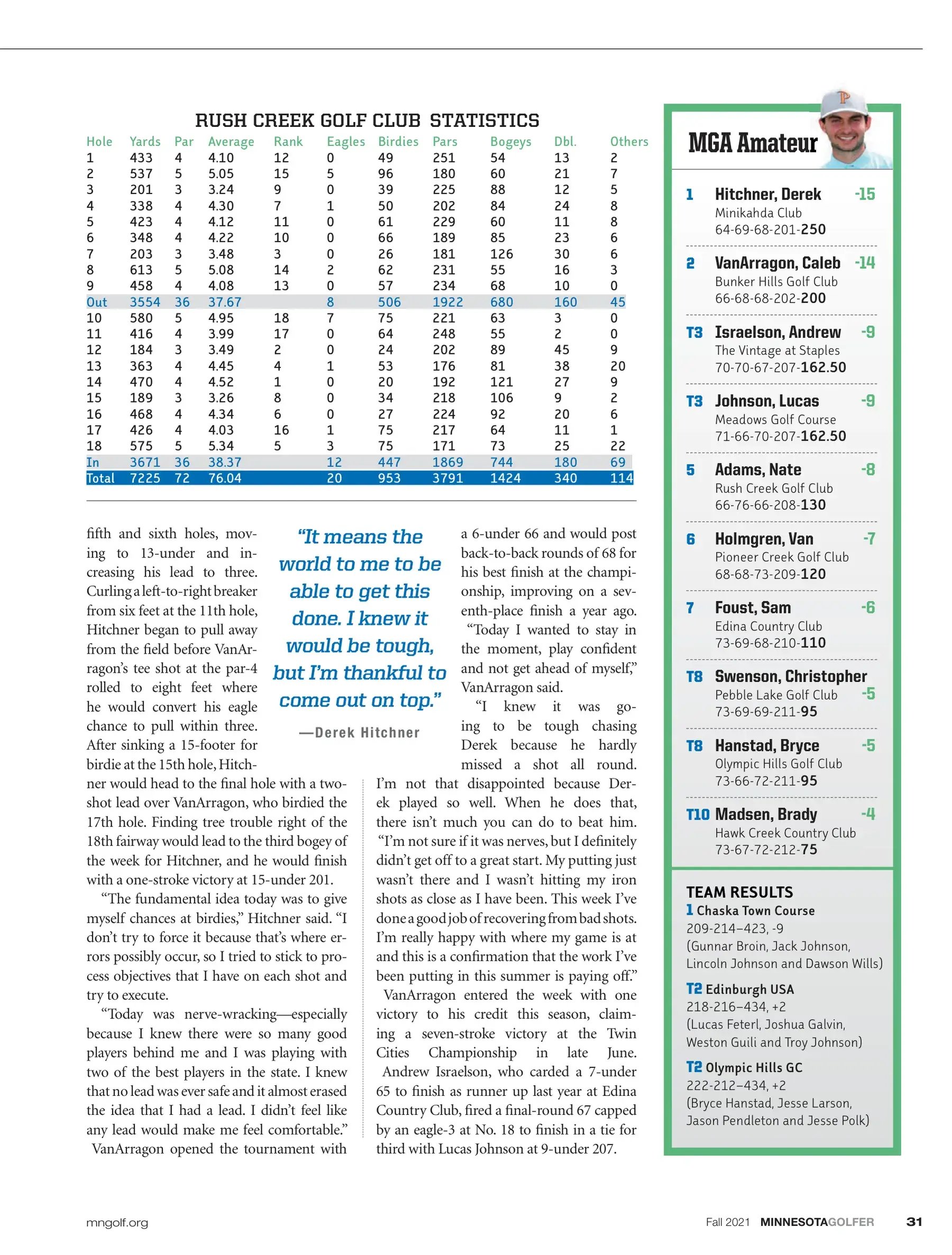
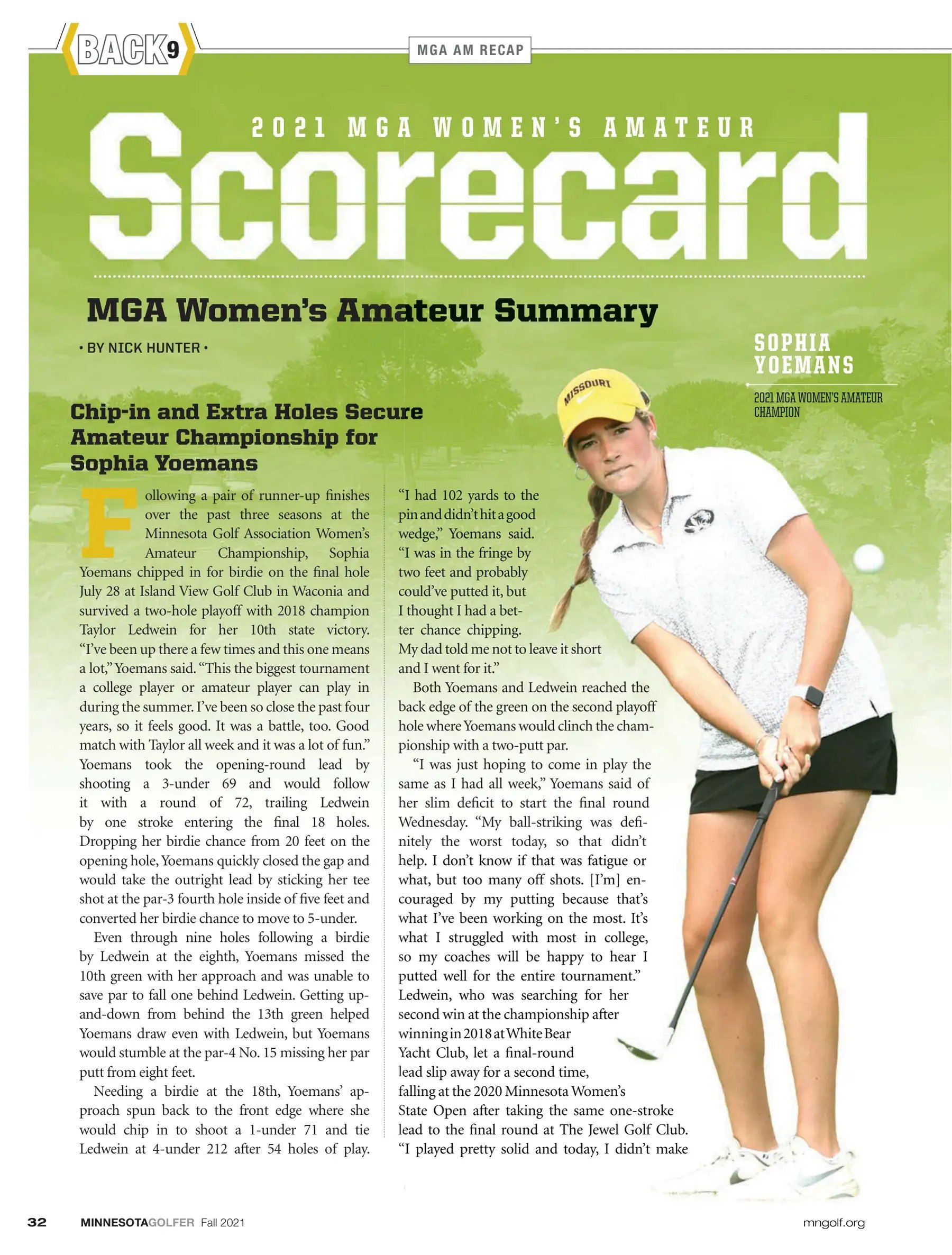
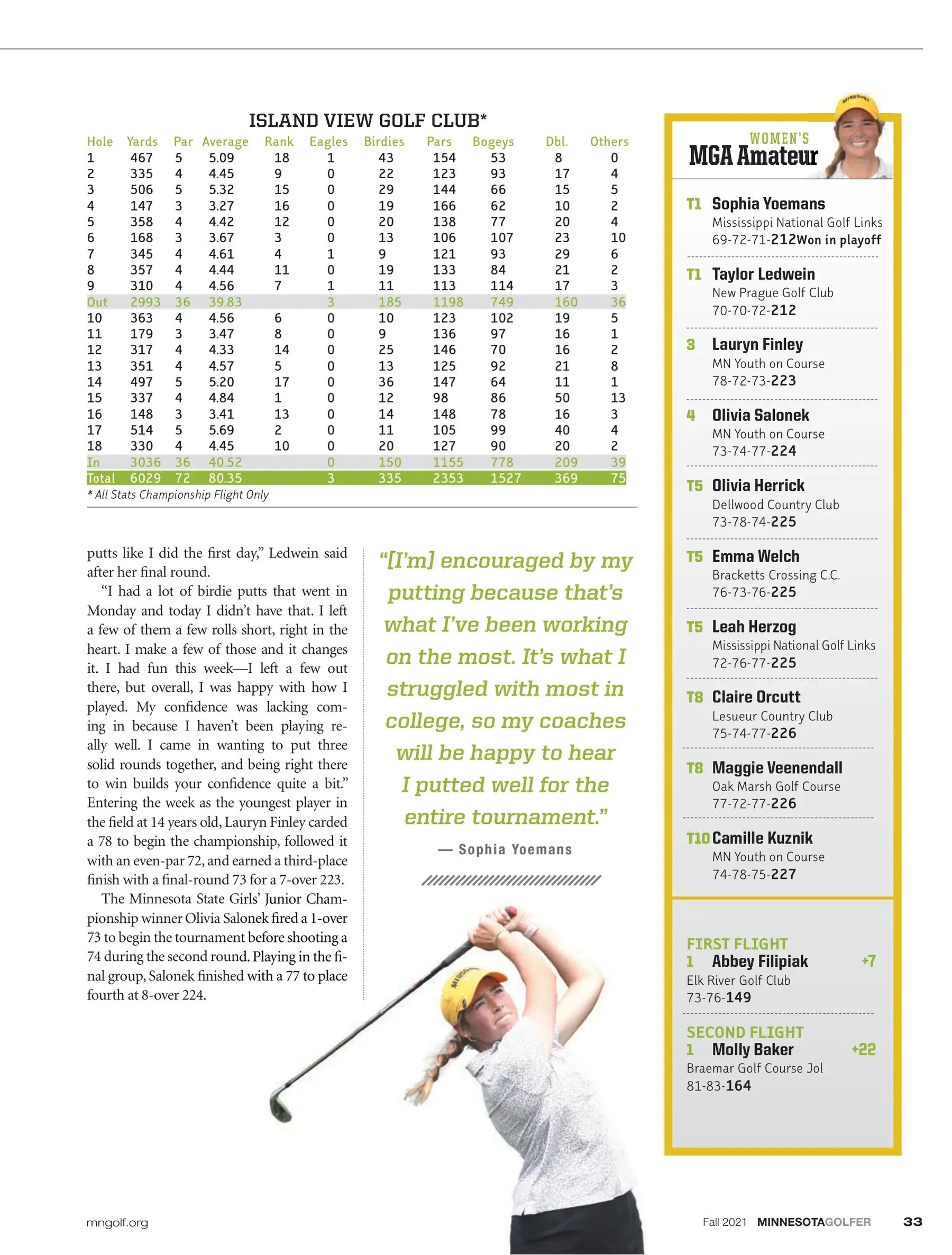
It was my privilege to be a starter at the 118th MGA Amateur Championship. What an impressive field. Derek H itchner seemingly cruised to a record-setting 15-under par at R ush Creek Golf Club to take home the Totton P . H effelfi nger trophy. The following week as a spectator at the MGA Women’s Amateur Championship, I watched as talented Sophia Yoemans won the tournament in a dramatic two-hole playoff. Minnesota amateur golf is in good hands, as evidenced by these skilled competitors.
F all and winter may see many of you migrate to warmer climates for a week or even months of golf. This issue highlights the beauty and challenges of golf in P uerto R ico. Wherever your travels may take you, there are always friendships to be made and new courses to master. This issue also shares a spectacular driving route from the Twin Cities to the greater P hoenix area.
Travel begins south on 35W through the great state of Iowa. Leaving K ansas City, the journey takes on local flavor on State H ighway 54. Along the way, one can appreciate the farms, railroads and small towns that built America. Visitors will see a bit of Oklahoma with its massive tracts of agriculture, a corner of Tex as and the desert of New Mex ico, followed by the delight of the forest in P ayson, Ariz ona and the championship golf courses found in and around the greater P hoenix / Scottsdale metropolitan area.
I have traveled this route and truly enjoyed the beauty and freedom of travel on our American highways. The MGA Strategic P lanning Committee has scheduled meetings in the upcoming winter season. Our purpose is to enhance our relevance and visibility. The issues facing golf today have a common thread: environmental stewardship, administering the Rules of Golf, advocating for golfers and the industry in general, and embracing new technology are all priorities. We will ex plore these topics and many others to strengthen our organiz ation.
I close by asking you to help keep the game sustainable by purchasing the P lay Golf Minnesota license plates for your vehicle: When buying a new vehicle or renewing your current plate, select the distinctive plates ( for a $ 30 fee) to demonstrate your passion for the game and support the nex t generation of U ntil the snow flies, I’ll see you on the links.
• BY MIKE MALONE • “A shoutout to all the golf professionals and their teams: Starters, caddies, cart personnel and merchandisers, who work tirelessly to make your summer of golf better.”
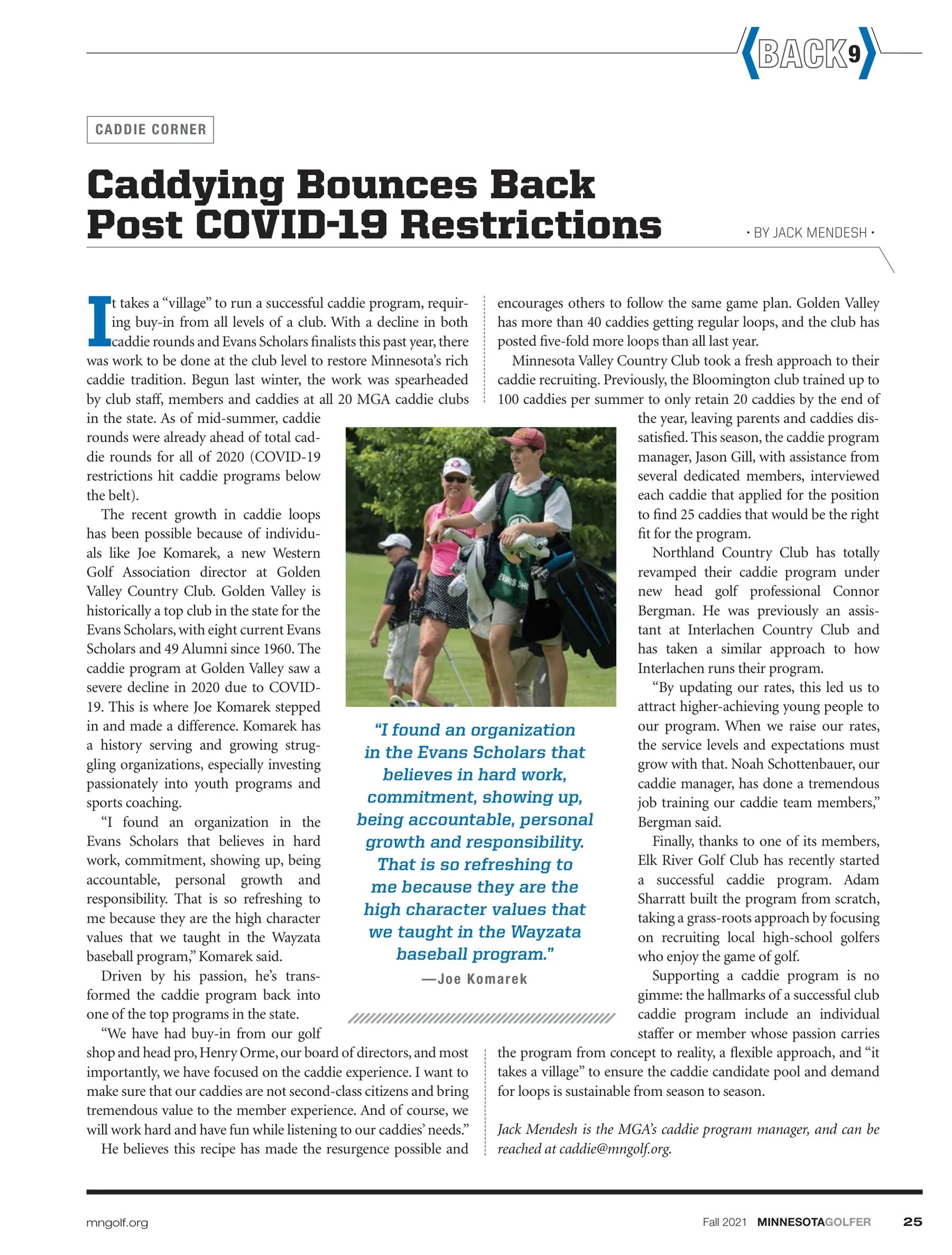
PRESIDENT’S DESK Fall 2021 MINNESOTAGOLFER 25 Caddying Bounces Back Post COVID-19 Restrictions CADDIE CORNER • BY JACK MENDESH • I t takes a “village” to run a successful caddie program, requiring buy-in from all levels of a club. With a decline in both caddie rounds and Evans Scholars finalists this past year, there was work to be done at the club level to restore Minnesota’s rich caddie tradition. Begun last winter, the work was spearheaded by club staff, members and caddies at all 20 MGA caddie clubs in the state. As of mid-summer, caddie rounds were already ahead of total caddie rounds for all of 2020 (COVID-19 restrictions hit caddie programs below the belt).
The recent growth in caddie loops has been possible because of individuals like Joe Komarek, a new Western Golf Association director at Golden Valley Country Club. Golden Valley is historically a top club in the state for the Evans Scholars, with eight current Evans Scholars and 49 Alumni since 1960. The caddie program at Golden Valley saw a severe decline in 2020 due to COVID19. This is where Joe Komarek stepped in and made a difference. Komarek has a history serving and growing struggling organizations, especially investing passionately into youth programs and sports coaching.
“I found an organization in the Evans Scholars that believes in hard work, commitment, showing up, being accountable, personal growth and responsibility. That is so refreshing to me because they are the high character values that we taught in the Wayzata baseball program,” Komarek said.
Driven by his passion, he’s transformed the caddie program back into one of the top programs in the state. “We have had buy-in from our golf shop and head pro, Henry Orme, our board of directors, and most importantly, we have focused on the caddie experience. I want to make sure that our caddies are not second-class citizens and bring tremendous value to the member experience. And of course, we will work hard and have fun while listening to our caddies’ needs.”
He believes this recipe has made the resurgence possible and encourages others to follow the same game plan. Golden Valley has more than 40 caddies getting regular loops, and the club has posted five-fold more loops than all last year.
Minnesota Valley Country Club took a fresh approach to their caddie recruiting. Previously, the Bloomington club trained up to 100 caddies per summer to only retain 20 caddies by the end of the year, leaving parents and caddies dissatisfied. This season, the caddie program manager, Jason Gill, with assistance from several dedicated members, interviewed each caddie that applied for the position to find 25 caddies that would be the right fit for the program.
Northland Country Club has totally revamped their caddie program under new head golf professional Connor Bergman. He was previously an assistant at Interlachen Country Club and has taken a similar approach to how Interlachen runs their program.
“By updating our rates, this led us to attract higher-achieving young people to our program. When we raise our rates, the service levels and expectations must grow with that. Noah Schottenbauer, our caddie manager, has done a tremendous job training our caddie team members,”
Bergman said. Finally, thanks to one of its members, Elk River Golf Club has recently started a successful caddie program. Adam Sharratt built the program from scratch, taking a grass-roots approach by focusing on recruiting local high-school golfers who enjoy the game of golf.
Supporting a caddie program is no gimme: the hallmarks of a successful club caddie program include an individual staffer or member whose passion carries the program from concept to reality, a flexible approach, and “it takes a village” to ensure the caddie candidate pool and demand for loops is sustainable from season to season.
Jack Mendesh is the MGA’s caddie program manager, and can be reached at caddie@mngolf.org. “I found an organization in the Evans Scholars that believes in hard work, commitment, showing up, being accountable, personal growth and responsibility.
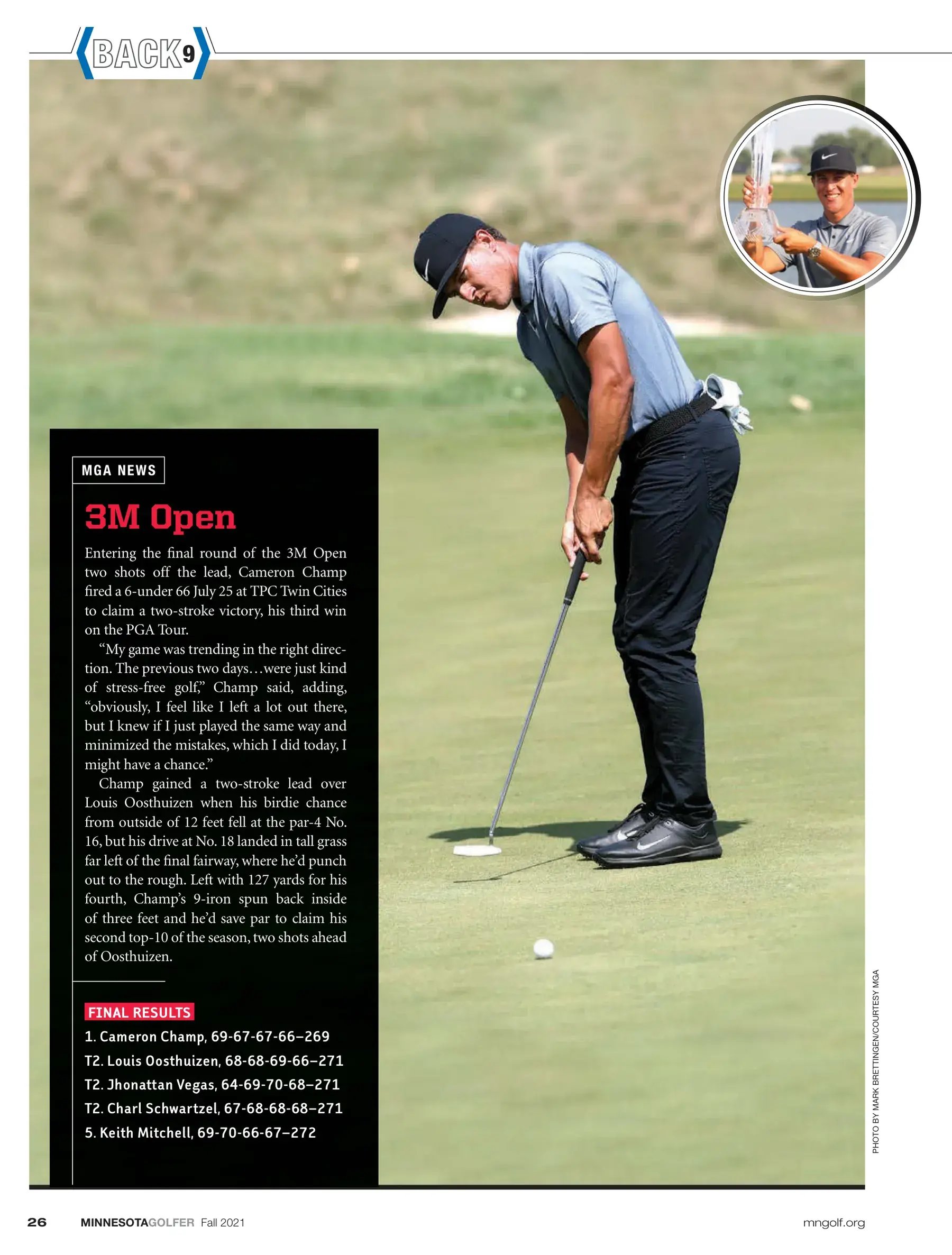
That is so refreshing to me because they are the high character values that we taught in the Wayzata baseball program.” —Joe Komarek MGA NEWS 3M Open Entering the final round of the 3M Open two shots off the lead, Cameron Champ fired a 6-under 66 July 25 at TP C Twin Cities to claim a two-stroke victory, his third win on the P GA Tour.
“My game was trending in the right direction. The previous two days... were just kind of stress-free golf,” Champ said, adding, “obviously, I feel like I left a lot out there, but I knew if I just played the same way and minimiz ed the mistakes, which I did today, I might have a chance.”
Champ gained a two-stroke lead over Louis Oosthuiz en when his birdie chance from outside of 12 feet fell at the par-4 No. 16, but his drive at No. 18 landed in tall grass far left of the final fairway, where he’d punch out to the rough. Left with 127 yards for his fourth, Champ’s 9-iron spun back inside of three feet and he’d save par to claim his second top-10 of the season, two shots ahead of Oosthuiz en.
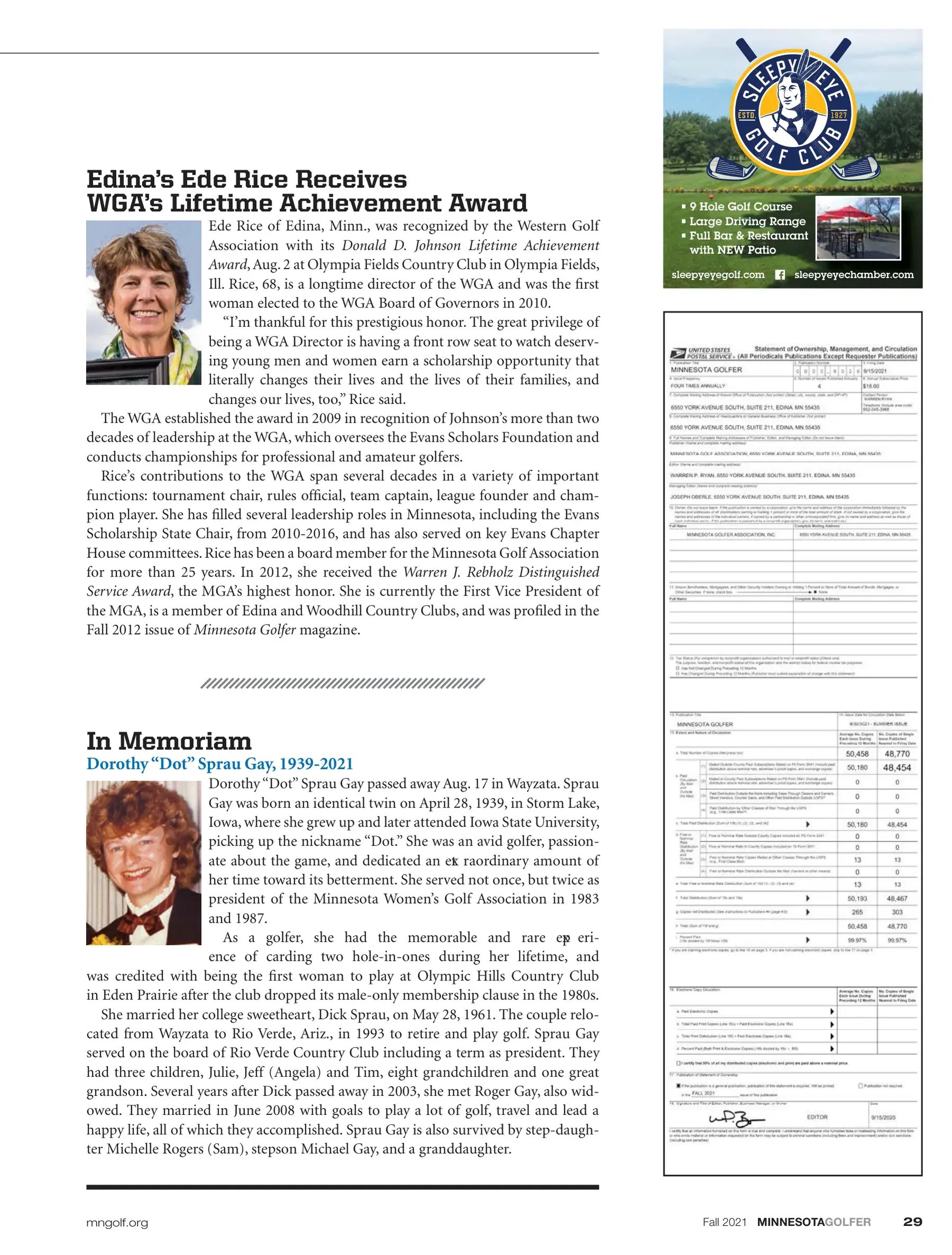
FINAL RESULTS 1. Cameron Champ, 69-67-67-66—269 T2. Louis Oosthuizen, 68-68-69-66—271 T2. Jhonattan Vegas, 64-69-70-68—271 T2. Charl Schwartzel, 67-68-68-68—271 5. Keith Mitchell, 69-70-66-67—272 PHOTO BY MARK BRETTINGEN/COURTESY MGA Fall 2021 MINNESOTAGOLFER 27 Minnesota Golf Hall of Fame The Minnesota Golf Hall of Fame announced the 2021 Class of Hall of Fame inductees Aug. 18: Carson Lee Herron, posthumously, and Sammy Schmitz, 40, of Hudson, Wis. The two will be inducted into the MGA-PGA Minnesota Golf Hall of Fame at the upcoming MGA Annual Meeting, Nov. 1 at Oak Ridge Country Club in Hopkins, Minn.
Carson Lee Herron Known by his middle name, Lee, Herron attended the University of Minnesota, where he helped form the school’s first golf team, led the challenge to achieve varsity sports status and was the first golfer to earn a varsity letter in 1925. He was a three-time medalist at the MGA State Amateur Championship in an era when stroke-play qualifying led to match-play brackets and the eventual champion. In 1933 at Interlachen CC, Herron defeated Bobby Campbell, 10 and 8, in the finals. Having won the Minnesota State Open the previous year, Herron became the third golfer to earn both open and amateur championships in the state. Further, thanks to a win at the 1927 Iowa State Amateur, he was the first competitor to be crowned the amateur champ from these two border states.
A year later, in 1934, Herron qualifi ed for the U.S. Open and the U.S. Amateur. He would qualify for the 1938 U.S. Amateur, as well. Herron joins two of his descendants in the Minnesota Golf Hall of Fame: granddaughter Alissa (Herron) Super, Class of 2015; and grandson Tim Herron, Class of 2017.
Sammy Schmitz After graduating from St. John’s University and playing golf professionally, Schmitz, a native of Farmington, Minn., regained amateur status and focused on winning state amateur championships. He won consecutive State Public Links Championships in 2012-2013; three MGA MidAmateur titles, in 2011, 2012 and 2016; and two MGA matchplay titles, the 2012 MGA Mid-Players’ and the 2018 MGA Players’ championships. Schmitz had twice qualifi ed for match play at the U.S. Mid-Amateur Championship, in 2011 and reaching the round of 32 the next year, before reaching the final match in 2015 at the John’s Island Club in Vero Beach, Fla. On the 33rd hole using a driver, Schmitz aced the par-4 15th hole to go “dormie”— three holes up with three to play. He would tie the next hole for a 3-and-2 victory over Marc Dull of Lakeland, Fla. Thanks to the U.S. Mid-Amateur win, Schmitz was invited to play Augusta National Golf Club the following spring at the annual Masters Tournament.
The Minnesota Hall of Fame was established in 1987 to recognize Minnesotans for their outstanding contributions to the game of golf. A selection committee meets annually to review nominations and select inductees.
A final-round 67 helped the 61-year-old Inkster secure her 47th win as a professional, and six th win on the LP GA Legends Tour. “It’s good to get back and get the juices flowing,” said Inkster, who entered the event coming off a top-10 finish at the U .S. Senior Women’s Open the week prior. “Even though it’s [Legends Tour], you still get nervous. Just to know that you can pull some shots off when you need to is nice. My swing feels really good— if I can just get that putter going, it’ll be good.”
FINAL RESULTS 1. Juli Inkster, 68-67—135 T2. Rosie Jones, 70-66—136 T2. Christa Johnson, 68-68—136 4. Cathy Johnston Forbes, 71-67—138 T5. Barb Moxness, 72-67—139 T5. Kris Tschetter, 71-68—139 T5. Michelle McGann, 67-72—139 MGA NEWS Land O’Lakes LPGA Legends Classic PHOTO BY MARK BRETTINGEN/COURTESY MGA Fall 2021 MINNESOTAGOLFER 29 Edina’s Ede Rice Receives WGA’s Lifetime Achievement Award Ede R ice of Edina, Minn., was recogniz ed by the Western Golf Association with its Donald D. Johnson Lifetime Achievement Award, Aug. 2 at Olympia F ields Country Club in Olympia F ields, Ill. R ice, 68, is a longtime director of the WGA and was the first woman elected to the WGA Board of Governors in 2010.