




Fall 2022








Back to The Minnesota Golfer Archive
Read the text of this issue
Text from the printed pages, so it can be searched and read by screen readers. Layout and photography are in the reader above.
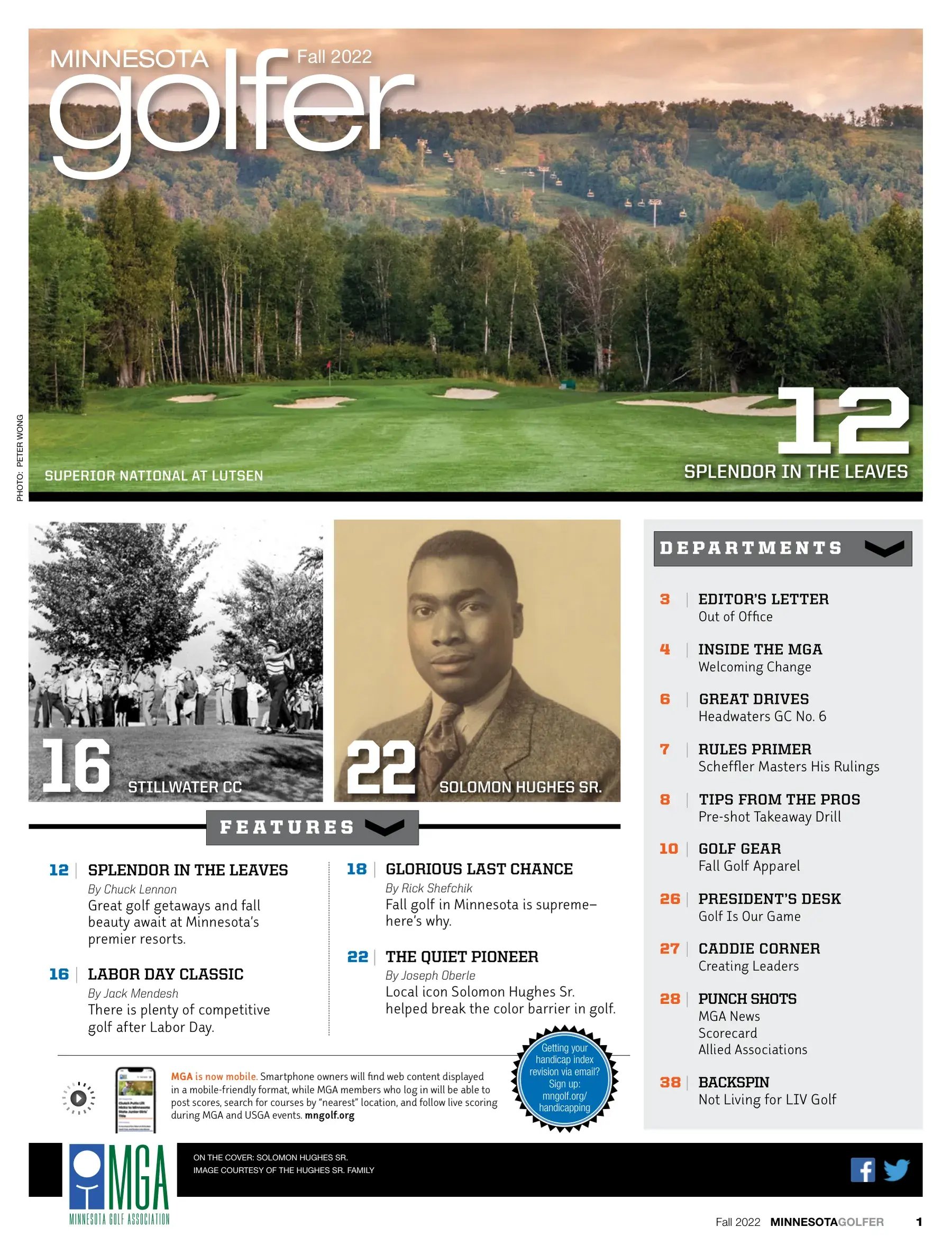
12 | SPLENDOR IN THE LEAVES By Chuck Lennon Great golf getaways and fall beauty await at Minnesota’s premier resorts. 16 | LABOR DAY CLASSIC By Jack Mendesh There is plenty of competitive golf after Labor Day.
Copyright © 2022 MGA The MGA upholds and promotes the game of golf and its values for all golfers in Minnesota. Minnesota Golf Association Inc.
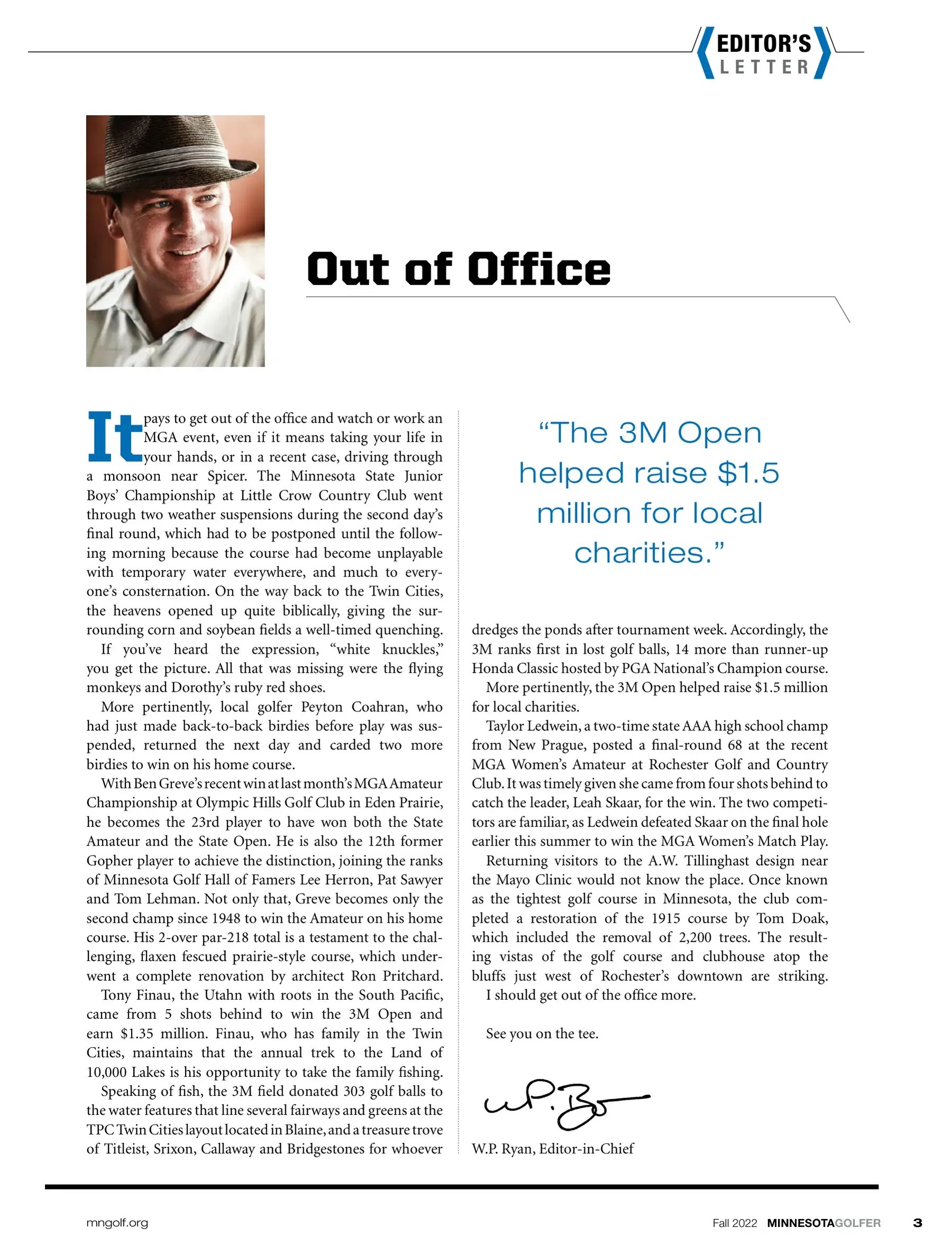
If you’ve heard the expression, “white knuckles,” you get the picture. All that was missing were the flying monkeys and Dorothy’s ruby red shoes.
More pertinently, local golfer Peyton Coahran, who had just made back-to-back birdies before play was sus pended, returned the next day and carded two more birdies to win on his home course.
With Ben Greve’s recent win at last month’s MGA Amateur Championship at Olympic Hills Golf Club in Eden Prairie, he becomes the 23rd player to have won both the State Amateur and the State Open. He is also the 12th former Gopher player to achieve the distinction, joining the ranks of Minnesota Golf Hall of Famers Lee Herron, Pat Sawyer and Tom Lehman. Not only that, Greve becomes only the second champ since 1948 to win the Amateur on his home course. His 2-over par-218 total is a testament to the chal lenging, flaxen fescued prairie-style course, which under went a complete renovation by architect Ron Pritchard.
Tony Finau, the Utahn with roots in the South Pacific, came from 5 shots behind to win the 3M Open and earn $1.35 million. Finau, who has family in the Twin Cities, maintains that the annual trek to the Land of 10,000 Lakes is his opportunity to take the family fishing.
Speaking of fish, the 3M field donated 303 golf balls to the water features that line several fairways and greens at the TPC Twin Cities layout located in Blaine, and a treasure trove of Titleist, Srixon, Callaway and Bridgestones for whoever dredges the ponds after tournament week. Accordingly, the 3M ranks first in lost golf balls, 14 more than runner-up Honda Classic hosted by PGA National’s Champion course.
More pertinently, the 3M Open helped raise $1.5 million for local charities. Taylor Ledwein, a two-time state AAA high school champ from New Prague, posted a final-round 68 at the recent MGA Women’s Amateur at Rochester Golf and Country Club. It was timely given she came from four shots behind to catch the leader, Leah Skaar, for the win. The two competi tors are familiar, as Ledwein defeated Skaar on the final hole earlier this summer to win the MGA Women’s Match Play.
Returning visitors to the A.W. Tillinghast design near the Mayo Clinic would not know the place. Once known as the tightest golf course in Minnesota, the club com pleted a restoration of the 1915 course by Tom Doak, which included the removal of 2,200 trees. The result ing vistas of the golf course and clubhouse atop the bluffs just west of Rochester’s downtown are striking.
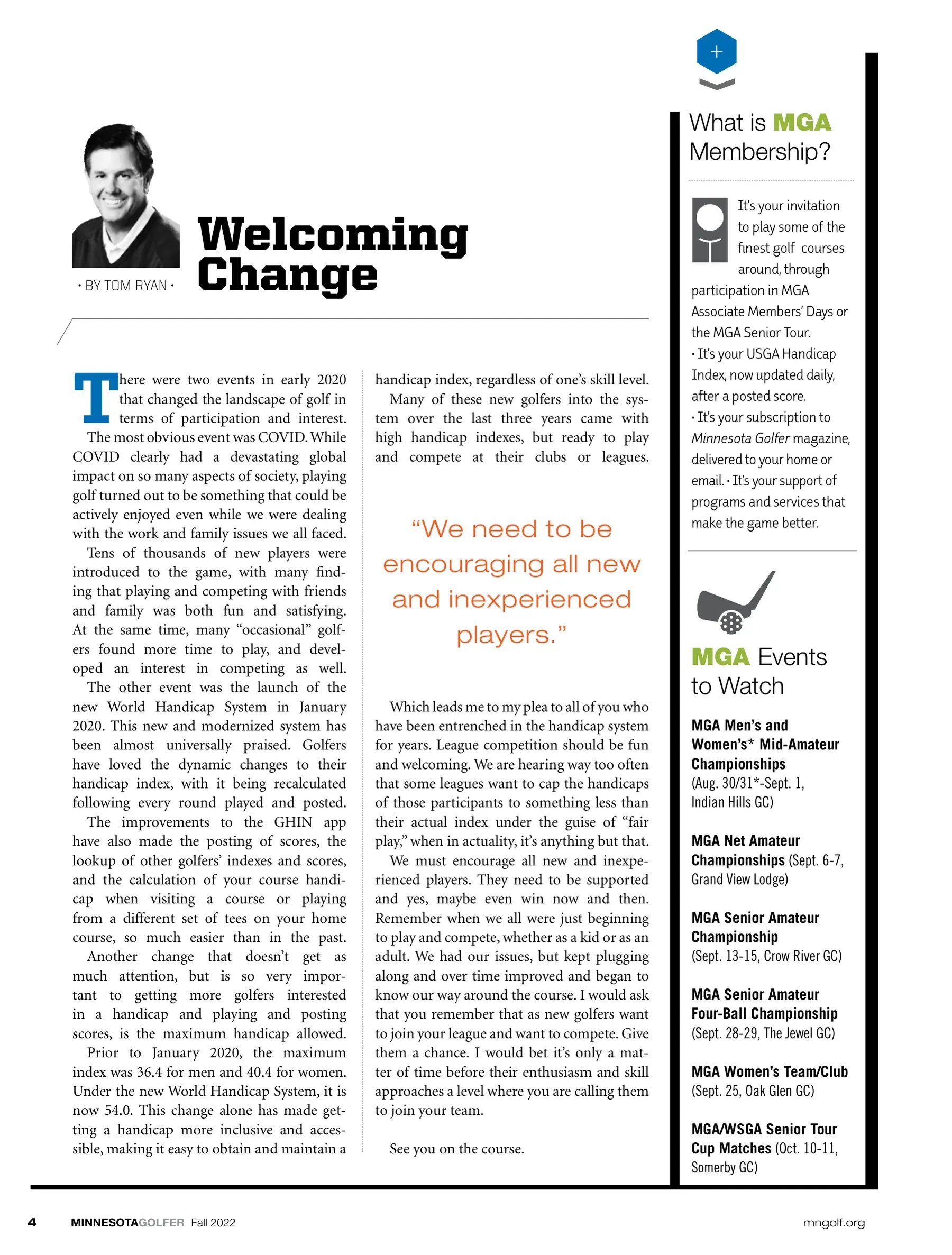
Fall 2022 MINNESOTAGOLFER 3 T here were two events in early 2020 that changed the landscape of golf in terms of participation and interest.
The most obvious event was COVID. While COVID clearly had a devastating global impact on so many aspects of society, playing golf turned out to be something that could be actively enjoyed even while we were dealing with the work and family issues we all faced.
Tens of thousands of new players were introduced to the game, with many find ing that playing and competing with friends and family was both fun and satisfying.
At the same time, many “occasional” golf ers found more time to play, and devel oped an interest in competing as well. The other event was the launch of the new World Handicap System in January 2020. This new and modernized system has been almost universally praised. Golfers have loved the dynamic changes to their handicap index, with it being recalculated following every round played and posted.
The improvements to the GHIN app have also made the posting of scores, the lookup of other golfers’ indexes and scores, and the calculation of your course handi cap when visiting a course or playing from a different set of tees on your home course, so much easier than in the past.
Another change that doesn’t get as much attention, but is so very impor tant to getting more golfers interested in a handicap and playing and posting scores, is the maximum handicap allowed.
Prior to January 2020, the maximum index was 36.4 for men and 40.4 for women. Under the new World Handicap System, it is now 54.0. This change alone has made get ting a handicap more inclusive and acces sible, making it easy to obtain and maintain a handicap index, regardless of one’s skill level.
Many of these new golfers into the sys tem over the last three years came with high handicap indexes, but ready to play and compete at their clubs or leagues.
Which leads me to my plea to all of you who have been entrenched in the handicap system for years. League competition should be fun and welcoming. We are hearing way too often that some leagues want to cap the handicaps of those participants to something less than their actual index under the guise of “fair play,” when in actuality, it’s anything but that.
We must encourage all new and inexpe rienced players. They need to be supported and yes, maybe even win now and then. Remember when we all were just beginning to play and compete, whether as a kid or as an adult. We had our issues, but kept plugging along and over time improved and began to know our way around the course. I would ask that you remember that as new golfers want to join your league and want to compete. Give them a chance. I would bet it’s only a mat ter of time before their enthusiasm and skill approaches a level where you are calling them to join your team.
See you on the course. What is MGA Membership? It’s your invitation to play some of the finest golf courses around, through participation in MGA Associate Members’ Days or the MGA Senior Tour.
• It’s your USGA Handicap Index, now updated daily, after a posted score. • It’s your subscription to delivered to your home or email. • It’s your support of programs and services that make the game better.
• BY TOM RYAN • Welcoming Change MGA Events to Watch MGA Men’s and Women’s* Mid-Amateur Championships (Aug. 30/31*-Sept. 1, Indian Hills GC) MGA Net Amateur Championships (Sept. 6-7, Grand View Lodge) MGA Senior Amateur Championship (Sept. 13-15, Crow River GC) MGA Senior Amateur Four-Ball Championship (Sept. 28-29, The Jewel GC) MGA Women’s Team/Club (Sept. 25, Oak Glen GC) MGA/WSGA Senior Tour Cup Matches (Oct. 10-11, Somerby GC) “We need to be encouraging all new and inexperienced players.”
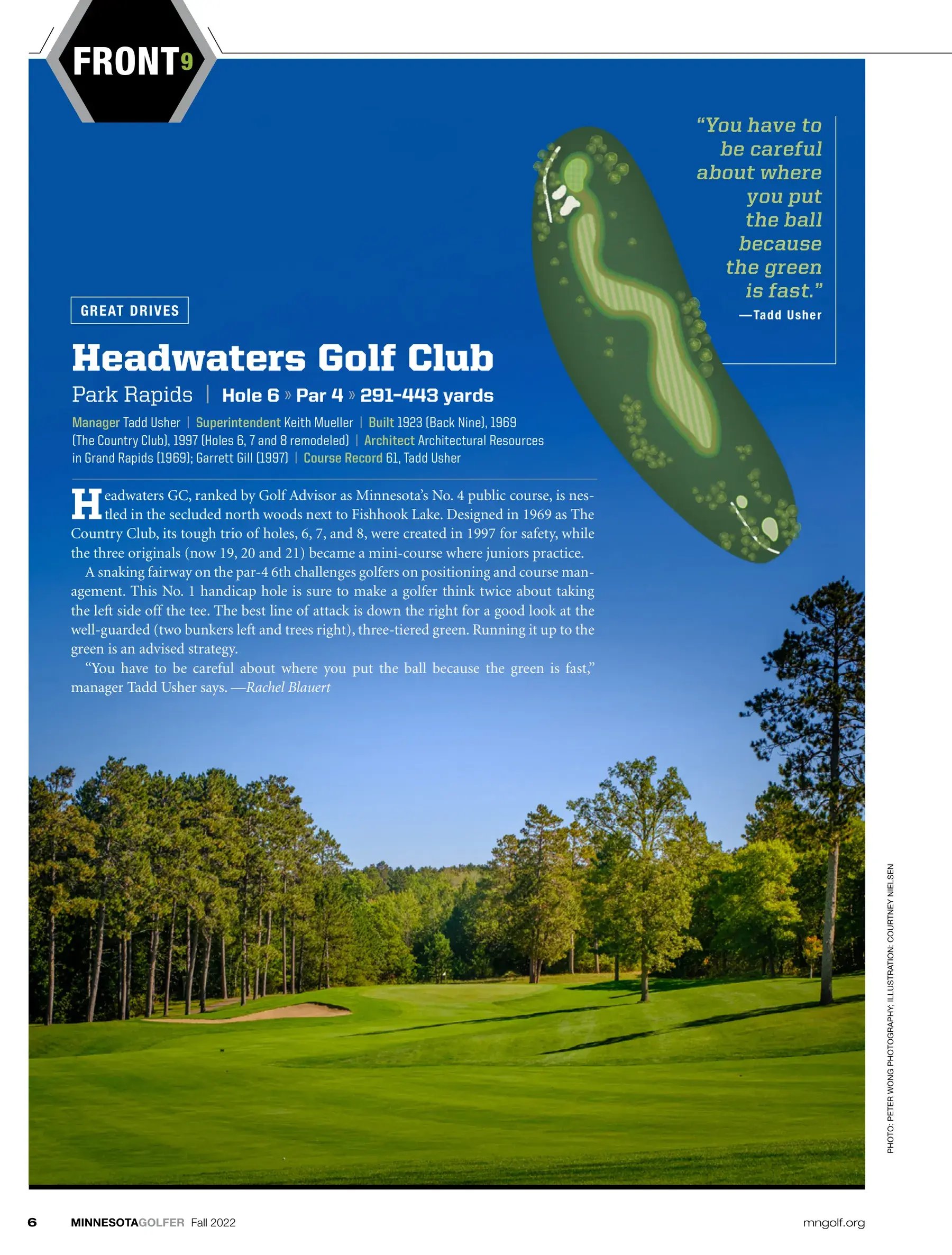
9 COURSES WITHIN 20 MILES BIWABIK MN LAKE VERMILION MN 3 TOP 10 PUBLIC COURSES IN MINNESOTA WITHIN 30 MILES GOLF THE NORTH H eadwaters GC, ranked by Golf Advisor as Minnesota’s No. 4 public course, is nestled in the secluded north woods next to Fishhook Lake. Designed in 1969 as The Country Club, its tough trio of holes, 6, 7, and 8, were created in 1997 for safety, while the three originals (now 19, 20 and 21) became a mini-course where juniors practice.
A snaking fairway on the par-4 6th challenges golfers on positioning and course management. This No. 1 handicap hole is sure to make a golfer think twice about taking the left side off the tee. The best line of attack is down the right for a good look at the well-guarded (two bunkers left and trees right), three-tiered green. Running it up to the green is an advised strategy.
“You have to be careful about where you put the ball because the green is fast,” manager Tadd Usher says. —Rachel Blauert Headwaters Golf Club Park Rapids | Hole 6 » Par 4 » 291–443 yards Manager Tadd Usher | Superintendent Keith Mueller | Built 1923 (Back Nine), 1969 (The Country Club), 1997 (Holes 6, 7 and 8 remodeled) | Architect Architectural Resources in Grand Rapids (1969); Garrett Gill (1997) | Course Record 61, Tadd Usher GREAT DRIVES FRONT PHOTO: PETER WONG PHOTOGRAPHY; ILLUSTRATION: COURTNEY NIELSEN “You have to be careful about where you put the ball because the green is fast.”
—Tadd Usher Fall 2022 MINNESOTAGOLFER 7 O n the 18th hole during the 3rd round of the 2022 Masters Tournament, eventual champion Scottie Scheffler had a number of Rules issues. Prior to hitting his tee shot, Scheffler’s caddie, Ted Scott, had the patrons move their shadows that were cast over Scheffler’s ball on the tee. Interpretation of Rule 10.2b(5)/1 says: “Although a player may not place an object or position a person for the purpose of blocking sunlight from the ball, the player may ask a person not to move when the spectator is already in position, so that the shadow remains over the ball, or may ask the spectator to move, so that their shadow is no longer over the ball.”
Scheffler eventually pulled the trigger on his drive, but unfortunately pulled his tee shot into the trees. The marshals and patrons started searching for the ball immediately, but the three-minute search time doesn’t start until either the player or their caddie begins to search for the ball. (Rule 18.2a: “A ball is lost if not found in three minutes after the player or caddie begins searching for it.”) The broadcast announcers also mentioned that Scheffler could not delay in getting to the area to try to delay the start of the search time (Interpretation of Lost/2 says: “Player may not delay the start of the search to gain an advantage.”) The ball was found within three minutes. But to confirm that the ball was his, Scheffler marked and lifted the ball. (Rule 7.3—“Lifting Ball to Identify It.”) Scheffler then decided to declare his ball unplayable and take lateral relief under Rule 19.2c. He measured two club-lengths (longest club in the player’s bag other than a putter) no nearer the hole to establish a Relief Area.
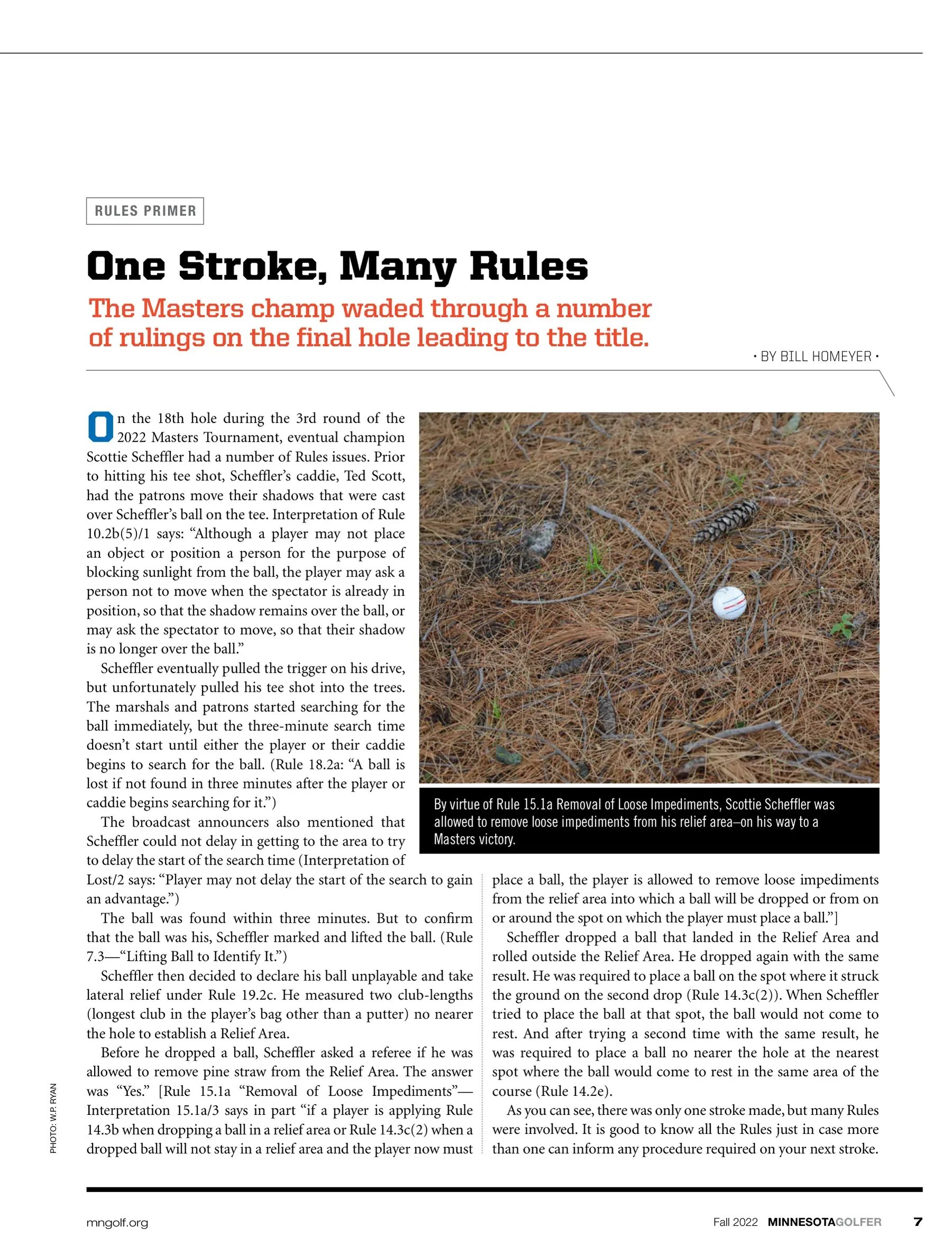
Before he dropped a ball, Scheffler asked a referee if he was allowed to remove pine straw from the Relief Area. The answer was “Yes.” [Rule 15.1a “Removal of Loose Impediments”— Interpretation 15.1a/3 says in part “if a player is applying Rule 14.3b when dropping a ball in a relief area or Rule 14.3c(2) when a dropped ball will not stay in a relief area and the player now must place a ball, the player is allowed to remove loose impediments from the relief area into which a ball will be dropped or from on or around the spot on which the player must place a ball.”] Scheffler dropped a ball that landed in the Relief Area and rolled outside the Relief Area. He dropped again with the same result. He was required to place a ball on the spot where it struck the ground on the second drop (Rule 14.3c(2)). When Scheffler tried to place the ball at that spot, the ball would not come to rest. And after trying a second time with the same result, he was required to place a ball no nearer the hole at the nearest spot where the ball would come to rest in the same area of the course (Rule 14.2e).
As you can see, there was only one stroke made, but many Rules were involved. It is good to know all the Rules just in case more than one can inform any procedure required on your next stroke.
RULES PRIMER PHOTO: W.P. RYAN One Stroke, Many Rules The Masters champ waded through a number of rulings on the final hole leading to the title.
• BY BILL HOMEYER • By virtue of Rule 15.1a Removal of Loose Impediments, Scottie Scheffler was allowed to remove loose impediments from his relief area–on his way to a Masters victory.
W hen making corrections in your golf swing, it’s important to know where to look and what to feel. Too many of us make a mistake early in the backswing and then try to recover from there. With the time it takes to swing the club, the proper adjustments are nearly impossible.
The most common mistake I see is the club head moving too far inside in the backswing. Two things can happen from there and both are bad. The club stays too far inside coming down, which causes pushed shots and hooks or the club reroutes too much to the outside and causes pulls and slices.
Ideally, the club head needs to stay outside the hands during the first few feet of the backswing. Watch how many tour players, especially recent PGA Championship winner Justin Thomas, rehearse this move during their pre- shot routine. They realize the importance of this position and how it can simplify the downswing. Practice this in front of a mirror until it becomes a natural move.
• BY MIKE BARGE • Mike Barge is the Director of Instruction at Hazeltine National GC and a Class A member of the PGA of America. Precluding Course Corrections Avoid the need for mid-swing fixes with the correct club head position on your takeaway.
TIPS FROM THE PROS PHOTOS: MATT SEEFELDT ✗ ✔︎ Gear Up for Fall Golf Don’t let cooler temps keep you from playing golf during the best time of the year.
I n this issue of Minnesota Golfer magazine—our newly-minted fall issue—we share with our readers reasons for golfing this fall (excellent course conditions), tournaments to watch in September and golf resort packages to find one last great getaway before the snow flies. There’s only one thing remaining: how should you dress when you go to the course this fall?
Fall golf apparel in Minnesota is not only functional, but fantastic-looking. Here is a short primer on some prime golf attire to acquire should November gales come early.
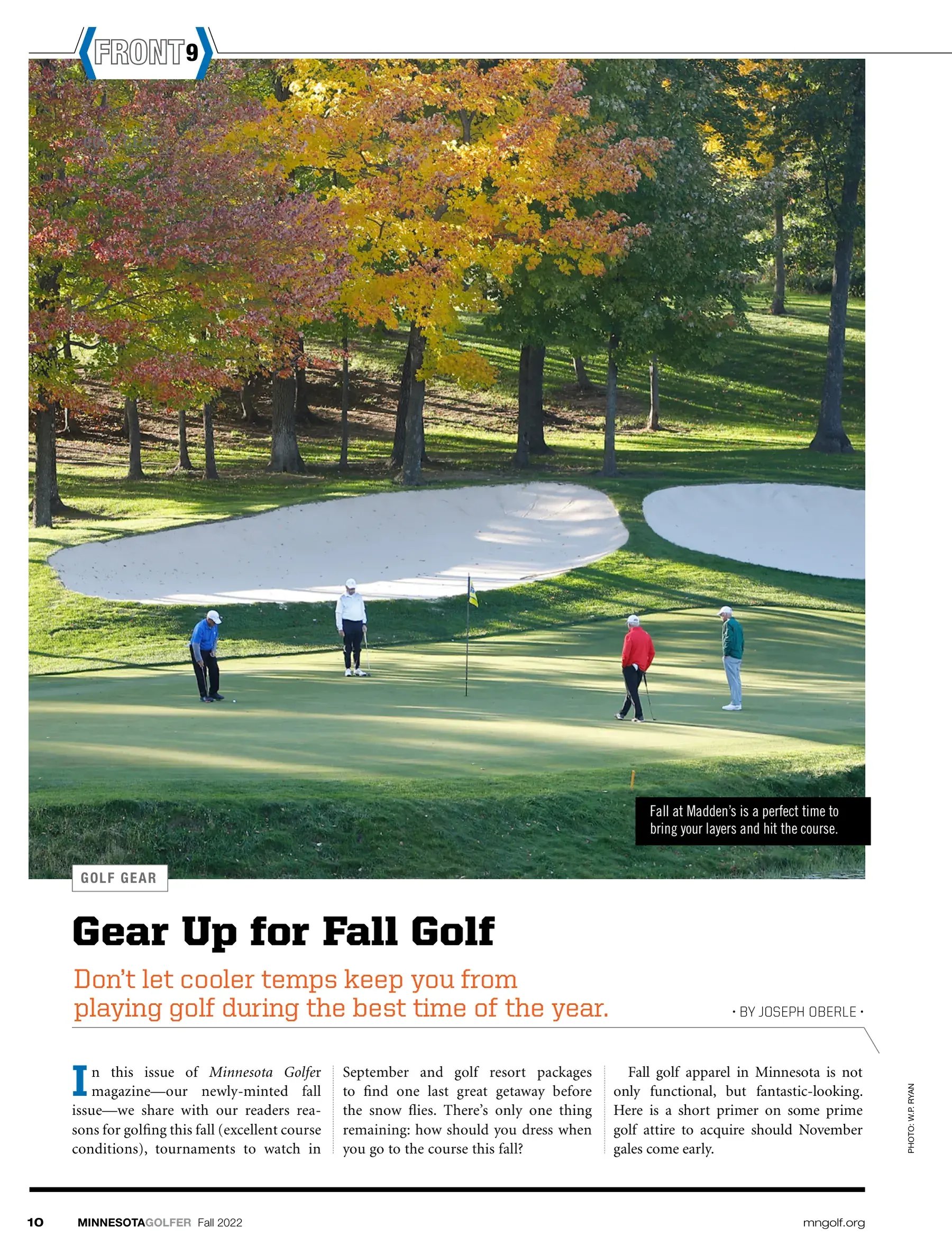
• BY JOSEPH OBERLE • Fall at Madden’s is a perfect time to bring your layers and hit the course. PHOTO: W.P. RYAN GOLF GEAR Fall 2022 MINNESOTAGOLFER 11 Men’s Curry Hooded Golf Shirt For form and function in cold weather golf, the Men’s Curry Hooded Golf Shirt from Under Armour may be a perfect match. The hoodie, a non-traditional golf item, is appearing more often on the course and is perfect for fall Minnesota golf. It comes from the Curry Golf collection (with design help from NBA star Steph Curry) and features an Under Armour Microthread fabric that doesn’t cling, dries quickly and contains UPF 50+.
Lands’ End weighs in with their Men’s Squall Waterproof Winter Hat that can handle everything Minnesota can throw at you. “The Squall hat boasts a classic style, is reliably warm, windproof and made from durable waterproof fabric,” according to Lands’ End.
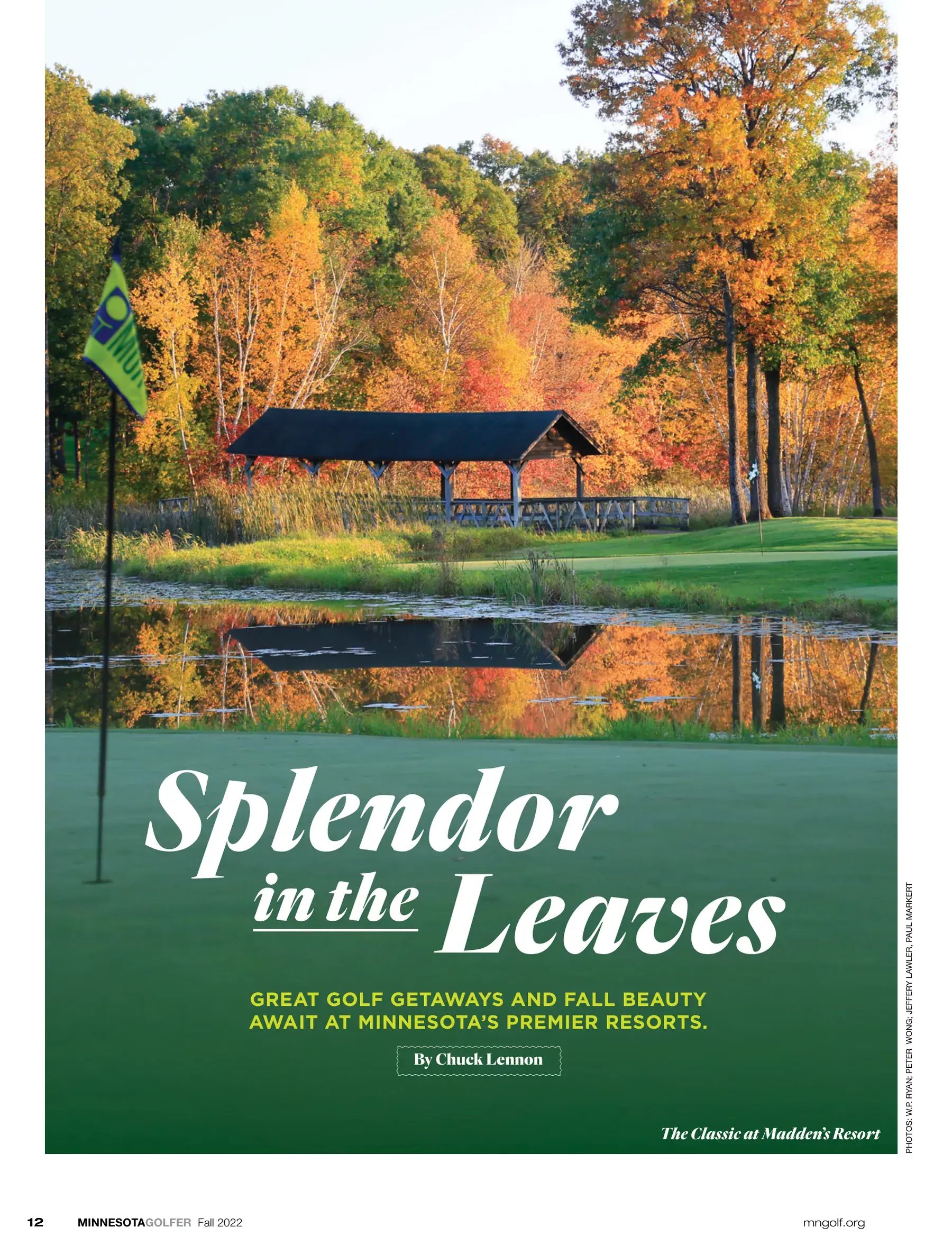
By Chuck Lennon in the Leaves The Classic at Madden’s Resort Fall 2022 MINNESOTAGOLFER 13 B onfires and s’mores tinge the crisp air as the seasons’ flavors and changing of the leaves take over. So goes the golf, with morning fairways accented with dew, and tee sheets beckoning eager players.
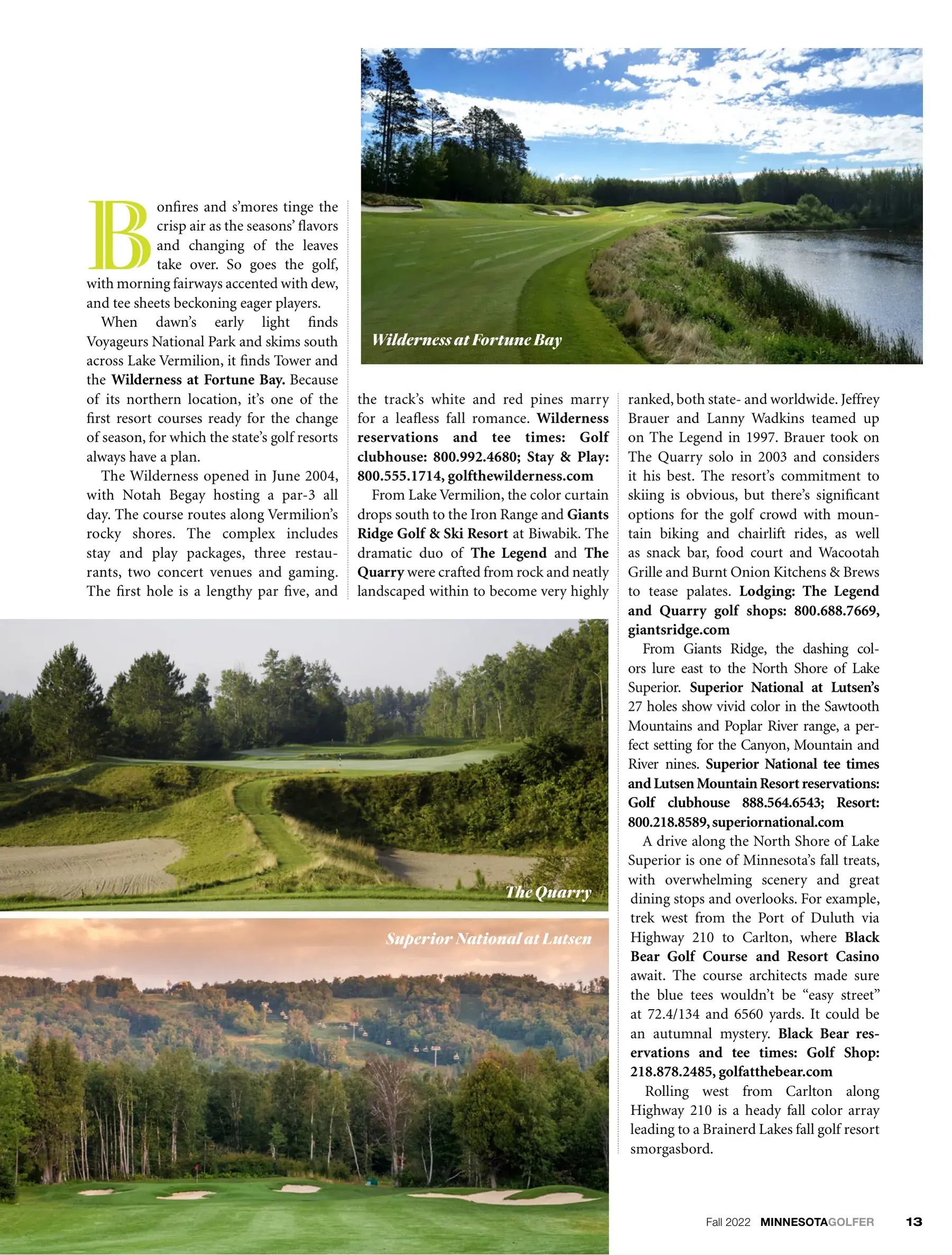
When dawn’s early light finds Voyageurs National Park and skims south across Lake Vermilion, it finds Tower and the Wilderness at Fortune Bay. Because of its northern location, it’s one of the first resort courses ready for the change of season, for which the state’s golf resorts always have a plan.
The Wilderness opened in June 2004, with Notah Begay hosting a par-3 all day. The course routes along Vermilion’s rocky shores. The complex includes stay and play packages, three restaurants, two concert venues and gaming.
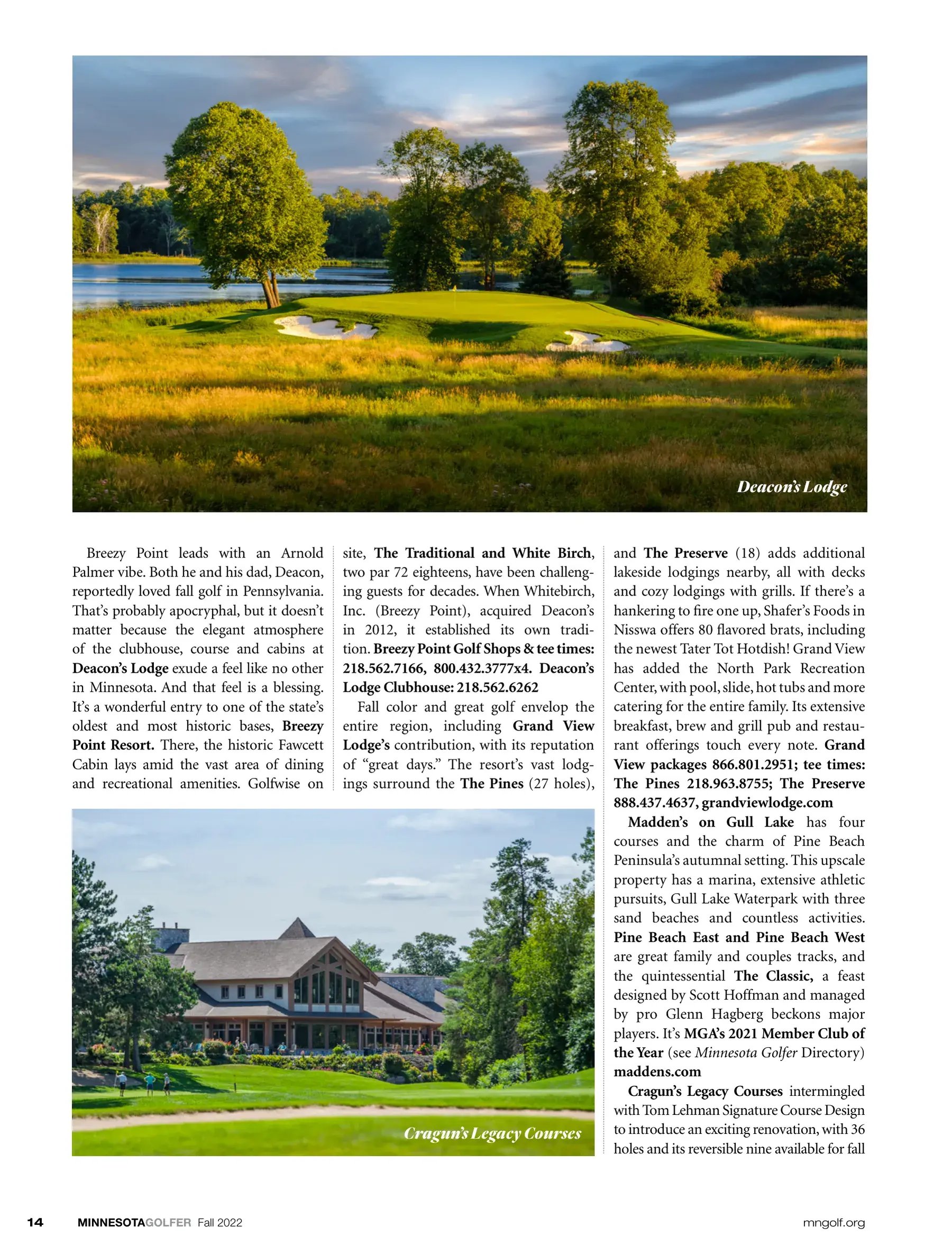
Superior National at Lutsen Wilderness at Fortune Bay The Quarry Breezy Point leads with an Arnold Palmer vibe. Both he and his dad, Deacon, reportedly loved fall golf in Pennsylvania.
That’s probably apocryphal, but it doesn’t matter because the elegant atmosphere of the clubhouse, course and cabins at Deacon’s Lodge exude a feel like no other in Minnesota. And that feel is a blessing.
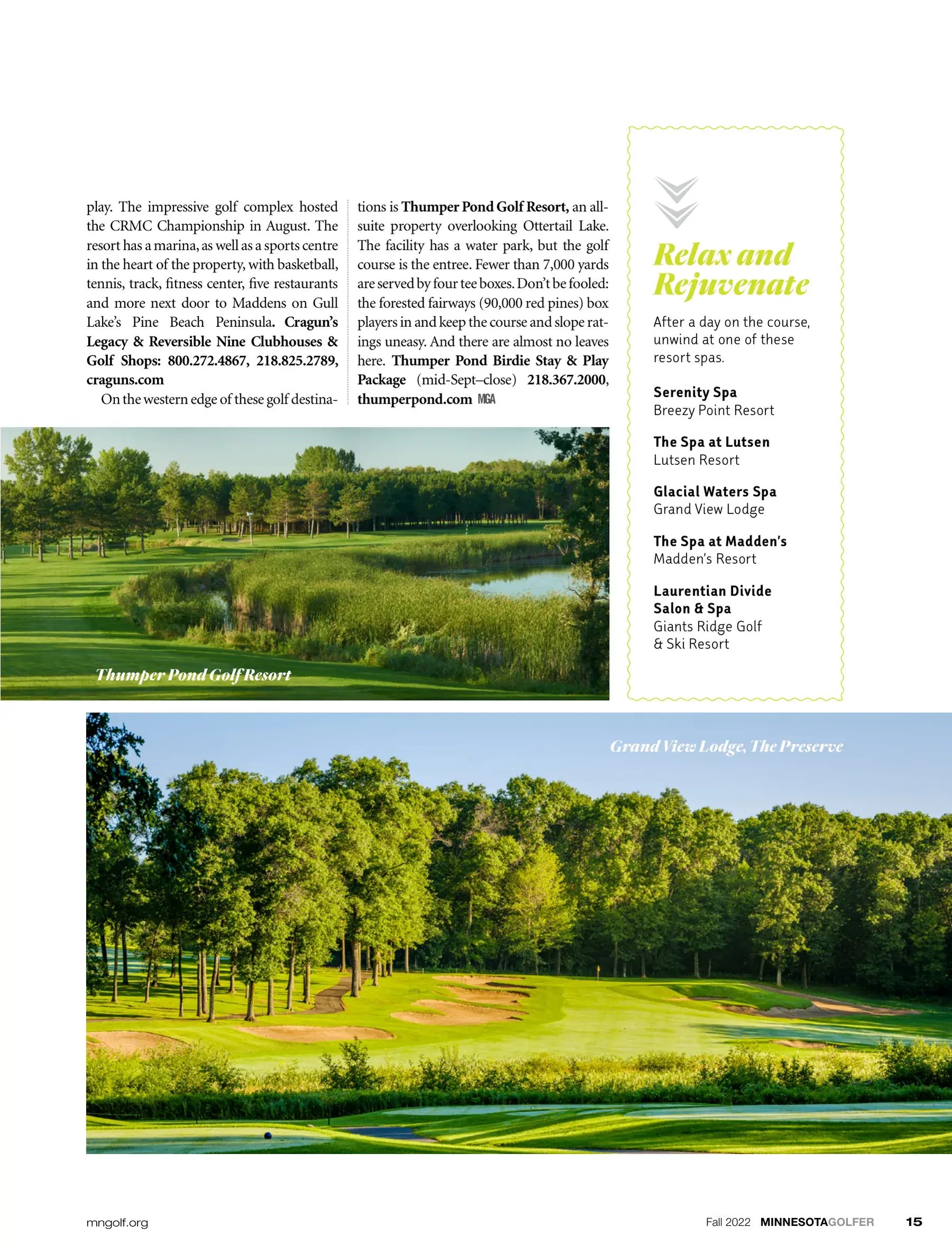
Pine Beach East and Pine Beach West are great family and couples tracks, and the quintessential The Classic, a feast designed by Scott Hoffman and managed by pro Glenn Hagberg beckons major players. It’s MGA’s 2021 Member Club of the Year (see Minnesota Golfer Directory) maddens.com Cragun’s Legacy Courses intermingled with Tom Lehman Signature Course Design to introduce an exciting renovation, with 36 holes and its reversible nine available for fall Deacon’s Lodge Cragun’s Legacy Courses Fall 2022 MINNESOTAGOLFER 15 Relax and Rejuvenate After a day on the course, unwind at one of these resort spas.
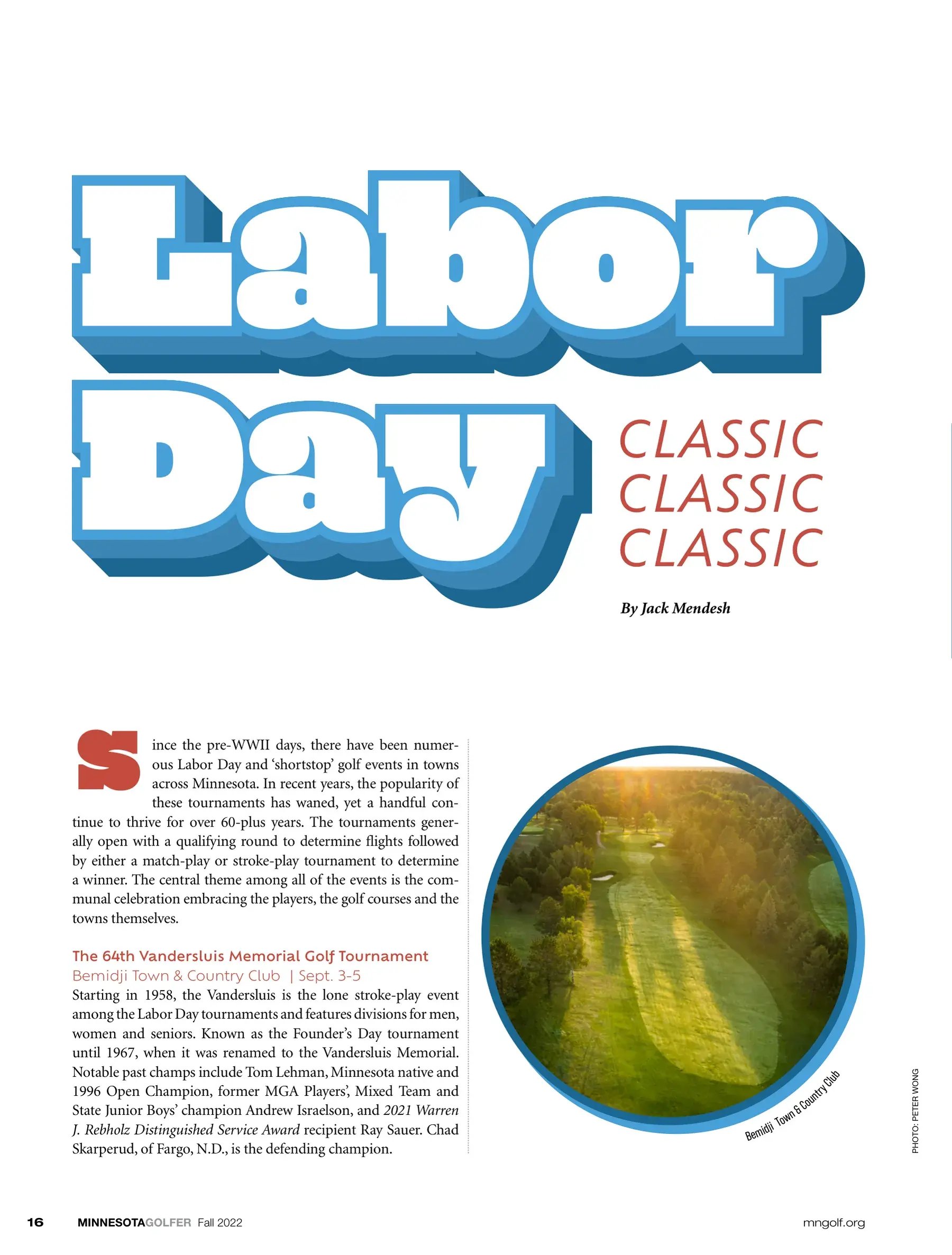
The 64th Vandersluis Memorial Golf Tournament Bemidji Town & Country Club | Sept. 3-5 Starting in 1958, the Vandersluis is the lone stroke-play event among the Labor Day tournaments and features divisions for men, women and seniors. Known as the Founder’s Day tournament until 1967, when it was renamed to the Vandersluis Memorial.
Notable past champs include Tom Lehman, Minnesota native and 1996 Open Champion, former MGA Players’, Mixed Team and State Junior Boys’ champion Andrew Israelson, and 2021 Warren J. Rebholz Distinguished Service Award recipient Ray Sauer. Chad Skarperud, of Fargo, N.D., is the defending champion.
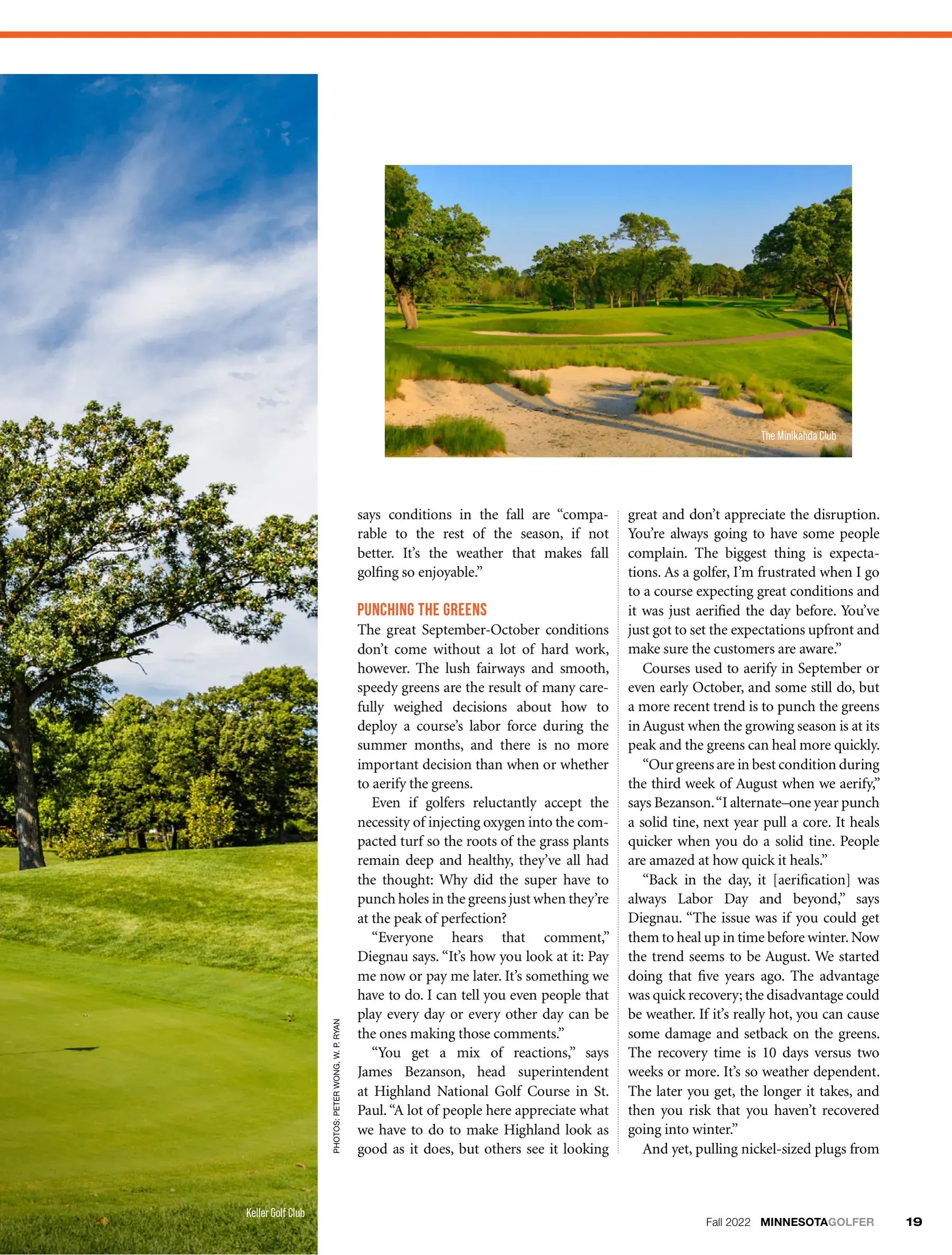
CLASSIC CLASSIC CLASSIC S By Jack Mendesh Be mid ji To wn & Co un try Cl ub Fall 2022 MINNESOTAGOLFER 17 96th Annual Shortstop Tournament Green Lea Golf Course | Sept. 3-5 The longest-running Labor Day tournament on our list is 95 years old and was first played in 1927 at Albert Lea Country Club. In 2006, with the closure of Albert Lea CC, Green Lea Golf assumed tournament operations. The shortstop is a match-play event with men’s and senior’s divisions and has a 16-person championship flight to determine the winner. Brent Miller, who has won the event six times since 2009, is the defending champion.
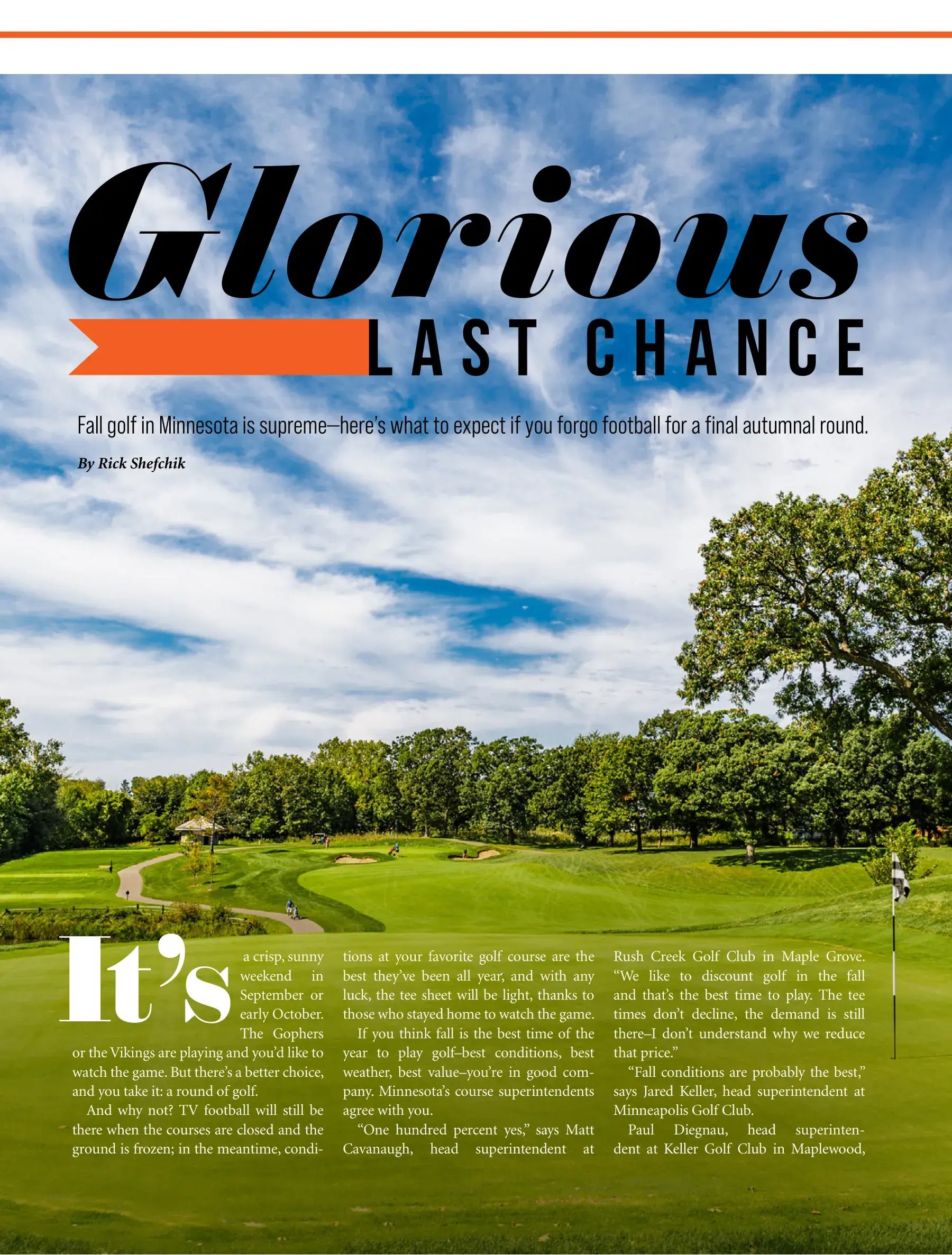
Notable champions include Chris Baas, seven-time winner of the shortstop, who has won the MGA Four-Ball and MGA Team championship twice. PHOTOS: MESABA COUNTRY CLUB, STILLWATER COUTRY CLUB, GREEN LEA SHORTSTOP 95th Vern Fryklund Northwest Invitational Mesaba Country Club | Sept. 2-5 Established in 1928, the match-play event is named for the longtime tournament director, Vern Fryklund, who passed away in 2005. It features divisions for men, senior men and super senior men. Kevin McHale, former Gopher and NBA Hall of Famer, has said it is his favorite golf event in Minnesota. Ryan Peterson, a former NHL player and MGA Junior Boy’s Player of the Year, is the defending champion. Notable past champions include R.J. Smiley, 1998 MGA Senior Amateur champion and four-time MGA Player of the Year and world-renowned golf course fantasy artist Bud Chapman.
69th Worthington Labor Day Classic Great Life Golf & Fitness Club (Worthington) | Sept. 3-5 Unique among the Labor Day tournaments, the Worthington Classic employs an unusual mix of match and stroke-play.
Established in 1953 at Worthington Country Club (now Great Life Golf & Fitness Club), the field is flighted after a qualifying round into a championship bracket plus six additional brackets of 16 golfers each. Match play ensues until four finalists remain per flight. The final four golfers in each flight then play 18 holes of stroke play to determine the winner. The defending champion is Brett Benson and notable past champions include prolific Minnesota golf course designer and former PGA Tour player Joel Goldstrand and current Champions Tour golfer Ken Duke.
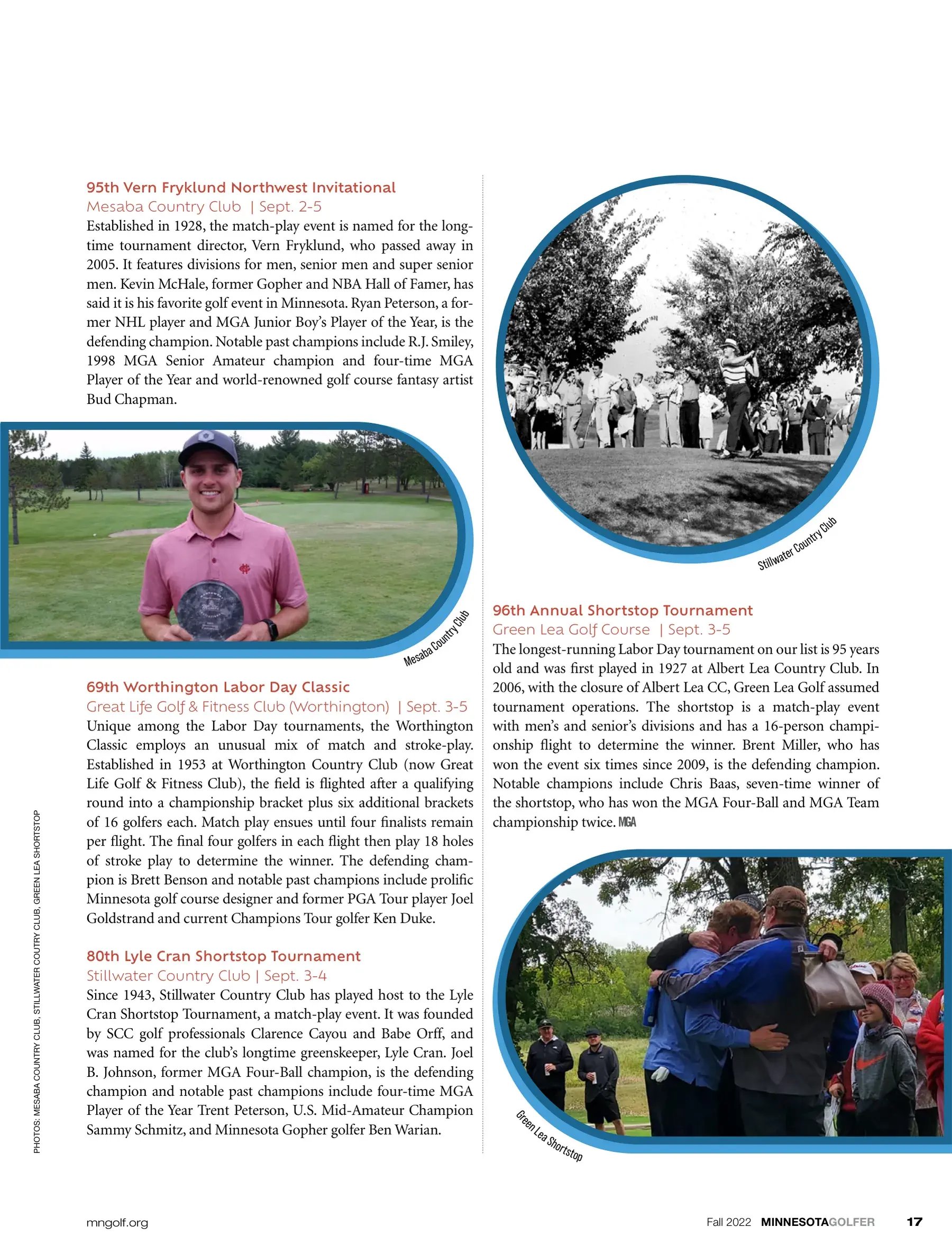
80th Lyle Cran Shortstop Tournament Stillwater Country Club | Sept. 3-4 Since 1943, Stillwater Country Club has played host to the Lyle Cran Shortstop Tournament, a match-play event. It was founded by SCC golf professionals Clarence Cayou and Babe Orff, and was named for the club’s longtime greenskeeper, Lyle Cran. Joel B. Johnson, former MGA Four-Ball champion, is the defending champion and notable past champions include four-time MGA Player of the Year Trent Peterson, U.S. Mid-Amateur Champion Sammy Schmitz, and Minnesota Gopher golfer Ben Warian.
Sti llw ate r C ou ntr y C lub M es ab a C ou nt r y Cl u b Gr ee n L ea S ho rt st o p PHOTOS: XXXXXXXXX Fall golf in Minnesota is supreme—here’s what to expect if you forgo football for a final autumnal round.
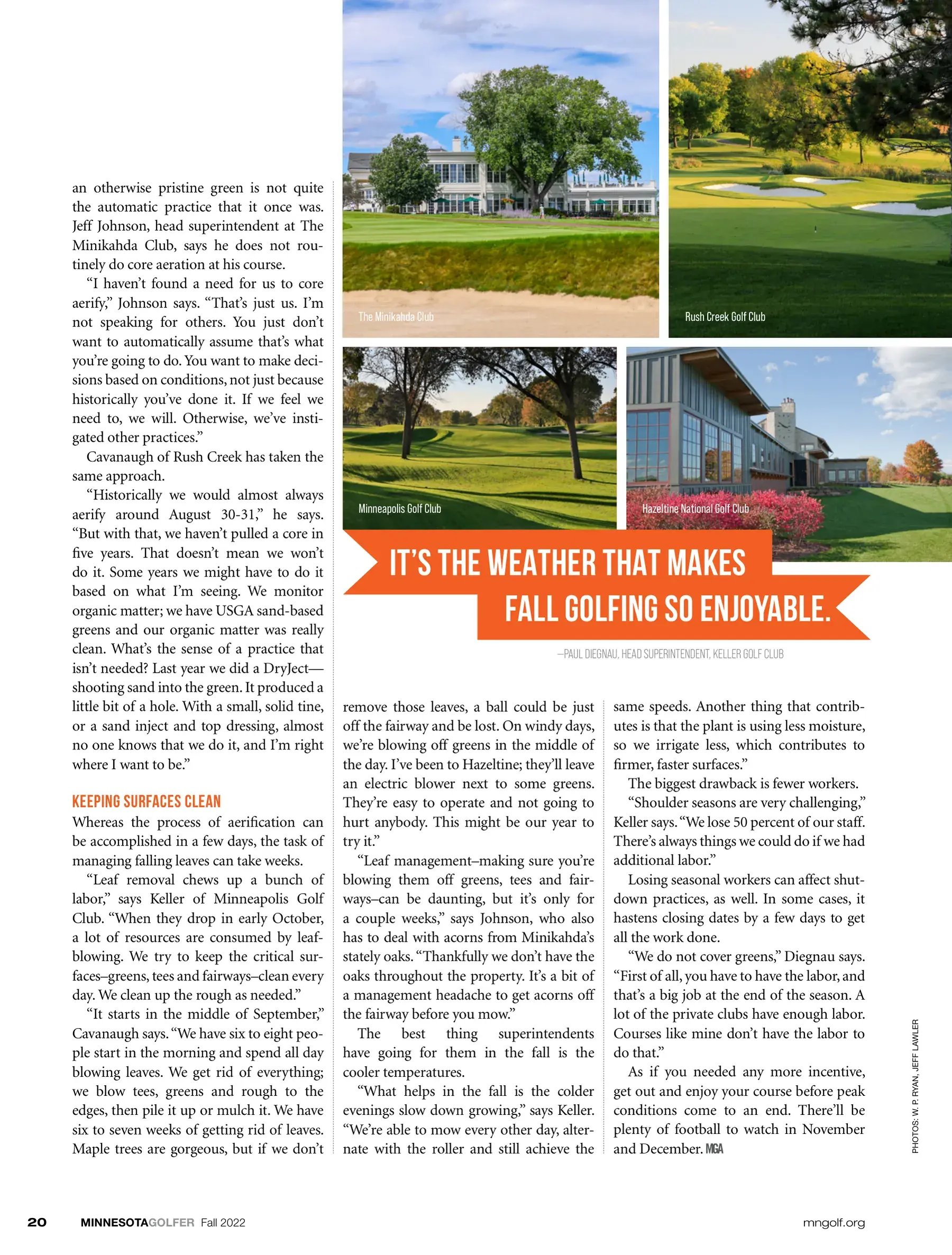
By Rick Shefchik Glorious a crisp, sunny weekend in September or early October. The Gophers or the Vikings are playing and you’d like to watch the game. But there’s a better choice, and you take it: a round of golf.
If you think fall is the best time of the year to play golf–best conditions, best weather, best value–you’re in good company. Minnesota’s course superintendents agree with you.
“One hundred percent yes,” says Matt Cavanaugh, head superintendent at Rush Creek Golf Club in Maple Grove. “We like to discount golf in the fall and that’s the best time to play. The tee times don’t decline, the demand is still there–I don’t understand why we reduce that price.”
“Fall conditions are probably the best,” says Jared Keller, head superintendent at Minneapolis Golf Club. Paul Diegnau, head superintendent at Keller Golf Club in Maplewood, Fall 2022 MINNESOTAGOLFER 19 says conditions in the fall are “comparable to the rest of the season, if not better. It’s the weather that makes fall golfing so enjoyable.”
Punching the Greens The great September-October conditions don’t come without a lot of hard work, however. The lush fairways and smooth, speedy greens are the result of many carefully weighed decisions about how to deploy a course’s labor force during the summer months, and there is no more important decision than when or whether to aerify the greens.
Even if golfers reluctantly accept the necessity of injecting oxygen into the compacted turf so the roots of the grass plants remain deep and healthy, they’ve all had the thought: Why did the super have to punch holes in the greens just when they’re at the peak of perfection?
“Everyone hears that comment,” Diegnau says. “It’s how you look at it: Pay me now or pay me later. It’s something we have to do. I can tell you even people that play every day or every other day can be the ones making those comments.”
“You get a mix of reactions,” says James Bezanson, head superintendent at Highland National Golf Course in St. Paul. “A lot of people here appreciate what we have to do to make Highland look as good as it does, but others see it looking great and don’t appreciate the disruption.
You’re always going to have some people complain. The biggest thing is expectations. As a golfer, I’m frustrated when I go to a course expecting great conditions and it was just aerified the day before. You’ve just got to set the expectations upfront and make sure the customers are aware.”
Courses used to aerify in September or even early October, and some still do, but a more recent trend is to punch the greens in August when the growing season is at its peak and the greens can heal more quickly.
“Our greens are in best condition during the third week of August when we aerify,” says Bezanson. “I alternate–one year punch a solid tine, next year pull a core. It heals quicker when you do a solid tine. People are amazed at how quick it heals.”
“Back in the day, it [aerification] was always Labor Day and beyond,” says Diegnau. “The issue was if you could get them to heal up in time before winter. Now the trend seems to be August. We started doing that five years ago. The advantage was quick recovery; the disadvantage could be weather. If it’s really hot, you can cause some damage and setback on the greens.
The recovery time is 10 days versus two weeks or more. It’s so weather dependent. The later you get, the longer it takes, and then you risk that you haven’t recovered going into winter.”
And yet, pulling nickel-sized plugs from The Minikahda Club Keller Golf Club PHOTOS: PETER WONG, W. P. RYAN remove those leaves, a ball could be just off the fairway and be lost. On windy days, we’re blowing off greens in the middle of the day. I’ve been to Hazeltine; they’ll leave an electric blower next to some greens.
They’re easy to operate and not going to hurt anybody. This might be our year to try it.” “Leaf management–making sure you’re blowing them off greens, tees and fairways–can be daunting, but it’s only for a couple weeks,” says Johnson, who also has to deal with acorns from Minikahda’s stately oaks. “Thankfully we don’t have the oaks throughout the property. It’s a bit of a management headache to get acorns off the fairway before you mow.”
The best thing superintendents have going for them in the fall is the cooler temperatures. “What helps in the fall is the colder evenings slow down growing,” says Keller.
“We’re able to mow every other day, alternate with the roller and still achieve the same speeds. Another thing that contributes is that the plant is using less moisture, so we irrigate less, which contributes to firmer, faster surfaces.”
The biggest drawback is fewer workers. “Shoulder seasons are very challenging,” Keller says. “We lose 50 percent of our staff. There’s always things we could do if we had additional labor.”
Losing seasonal workers can affect shutdown practices, as well. In some cases, it hastens closing dates by a few days to get all the work done.
“We do not cover greens,” Diegnau says. “First of all, you have to have the labor, and that’s a big job at the end of the season. A lot of the private clubs have enough labor.
Courses like mine don’t have the labor to do that.” As if you needed any more incentive, get out and enjoy your course before peak conditions come to an end. There’ll be plenty of football to watch in November and December.
an otherwise pristine green is not quite the automatic practice that it once was. Jeff Johnson, head superintendent at The Minikahda Club, says he does not routinely do core aeration at his course.
“I haven’t found a need for us to core aerify,” Johnson says. “That’s just us. I’m not speaking for others. You just don’t want to automatically assume that’s what you’re going to do. You want to make decisions based on conditions, not just because historically you’ve done it. If we feel we need to, we will. Otherwise, we’ve instigated other practices.”
Cavanaugh of Rush Creek has taken the same approach. “Historically we would almost always aerify around August 30-31,” he says. “But with that, we haven’t pulled a core in five years. That doesn’t mean we won’t do it. Some years we might have to do it based on what I’m seeing. We monitor organic matter; we have USGA sand-based greens and our organic matter was really clean. What’s the sense of a practice that isn’t needed? Last year we did a DryJect— shooting sand into the green. It produced a little bit of a hole. With a small, solid tine, or a sand inject and top dressing, almost no one knows that we do it, and I’m right where I want to be.”
Keeping Surfaces Clean Whereas the process of aerification can be accomplished in a few days, the task of managing falling leaves can take weeks.
“Leaf removal chews up a bunch of labor,” says Keller of Minneapolis Golf Club. “When they drop in early October, a lot of resources are consumed by leafblowing. We try to keep the critical surfaces–greens, tees and fairways–clean every day. We clean up the rough as needed.”
“It starts in the middle of September,” Cavanaugh says. “We have six to eight people start in the morning and spend all day blowing leaves. We get rid of everything; we blow tees, greens and rough to the edges, then pile it up or mulch it. We have six to seven weeks of getting rid of leaves.
Fall 2022 MINNESOTAGOLFER 23 On June 27, 2022, the local African American golf community of south Minneapolis held The Solomon Hughes Sr.
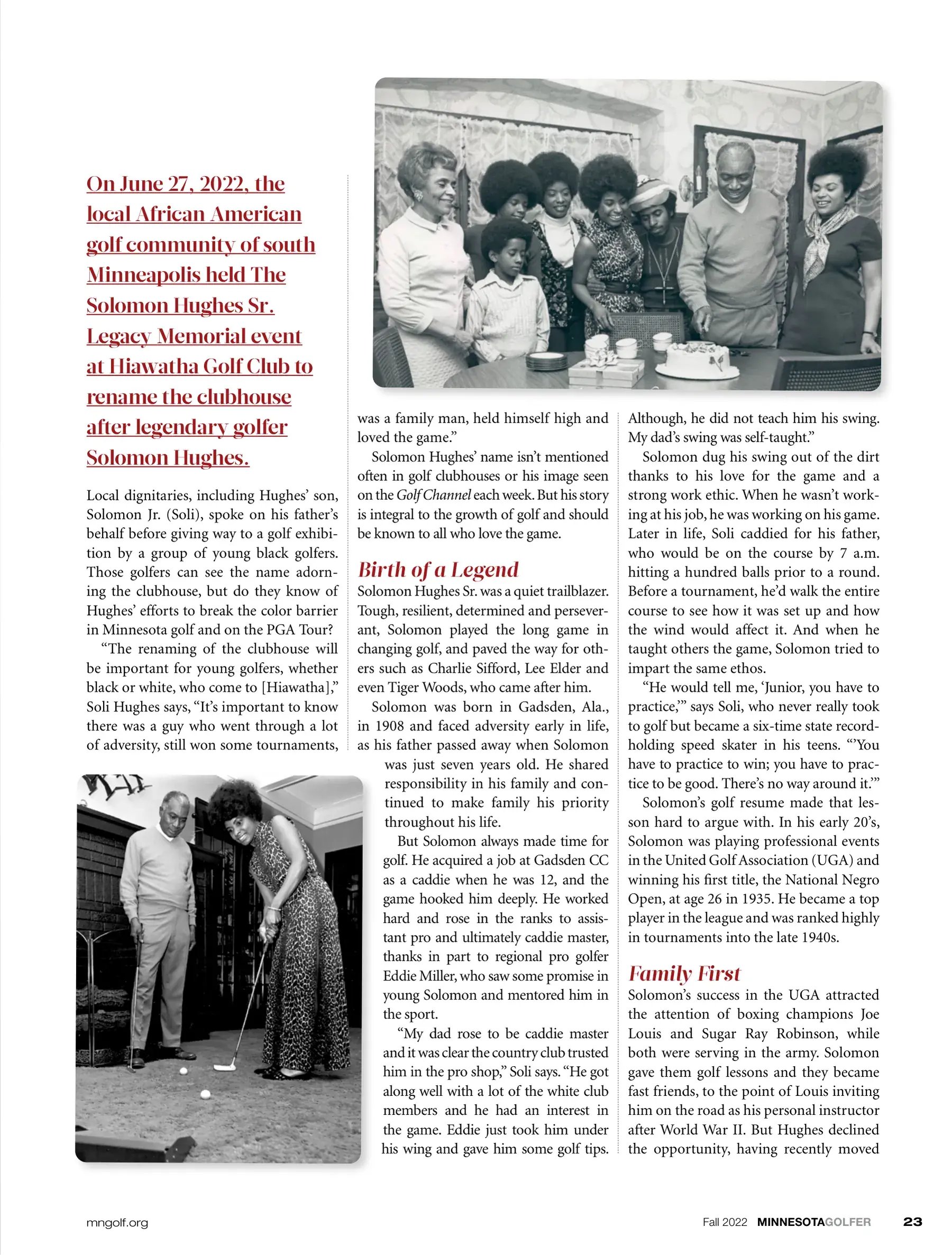
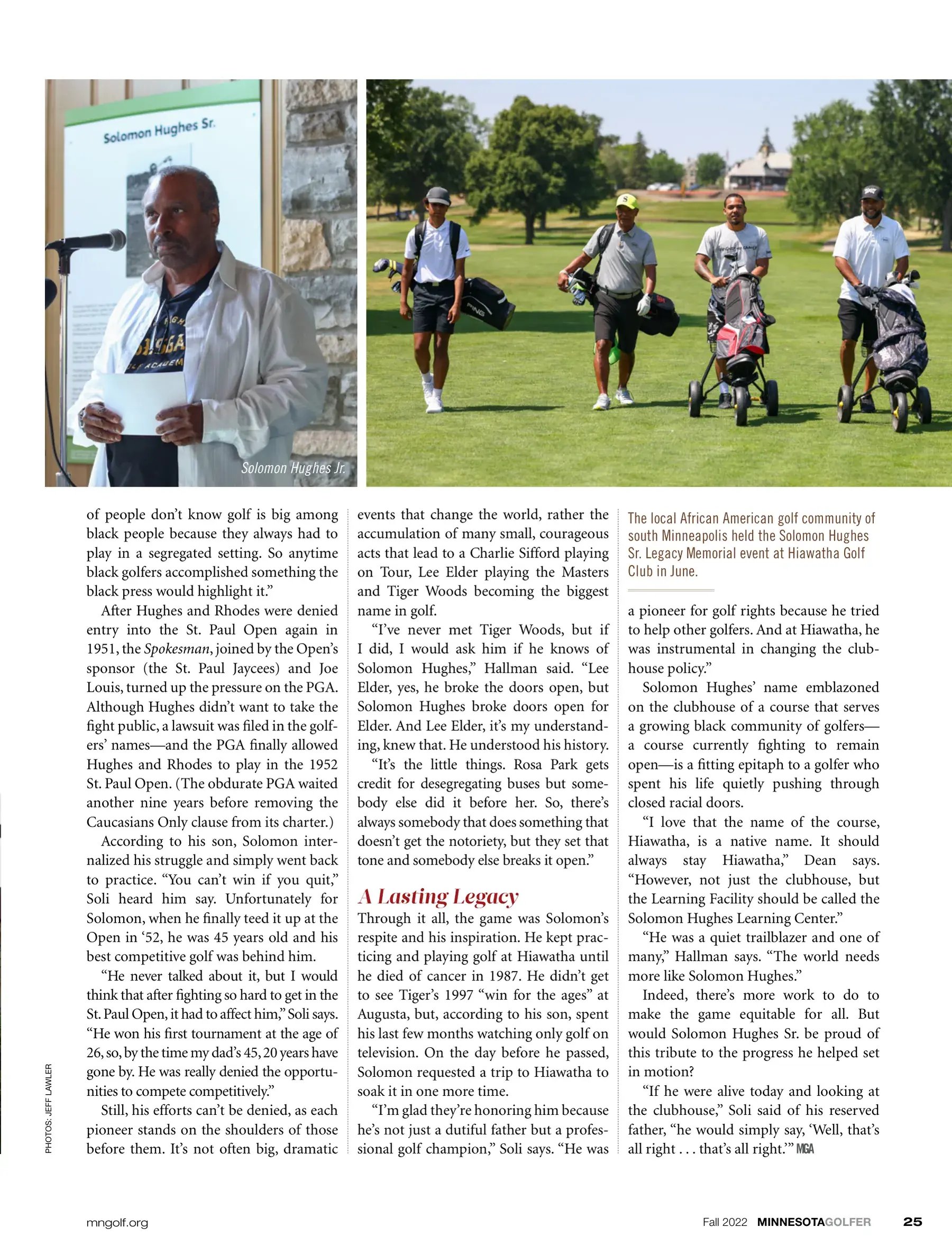
Legacy Memorial event at Hiawatha Golf Club to rename the clubhouse after legendary golfer Solomon Hughes. Local dignitaries, including Hughes’ son, Solomon Jr. (Soli), spoke on his father’s behalf before giving way to a golf exhibition by a group of young black golfers.
Those golfers can see the name adorning the clubhouse, but do they know of Hughes’ efforts to break the color barrier in Minnesota golf and on the PGA Tour?
“The renaming of the clubhouse will be important for young golfers, whether black or white, who come to [Hiawatha],” Soli Hughes says, “It’s important to know there was a guy who went through a lot of adversity, still won some tournaments, was a family man, held himself high and loved the game.”
Solomon Hughes’ name isn’t mentioned often in golf clubhouses or his image seen on the Golf Channel each week. But his story is integral to the growth of golf and should be known to all who love the game.
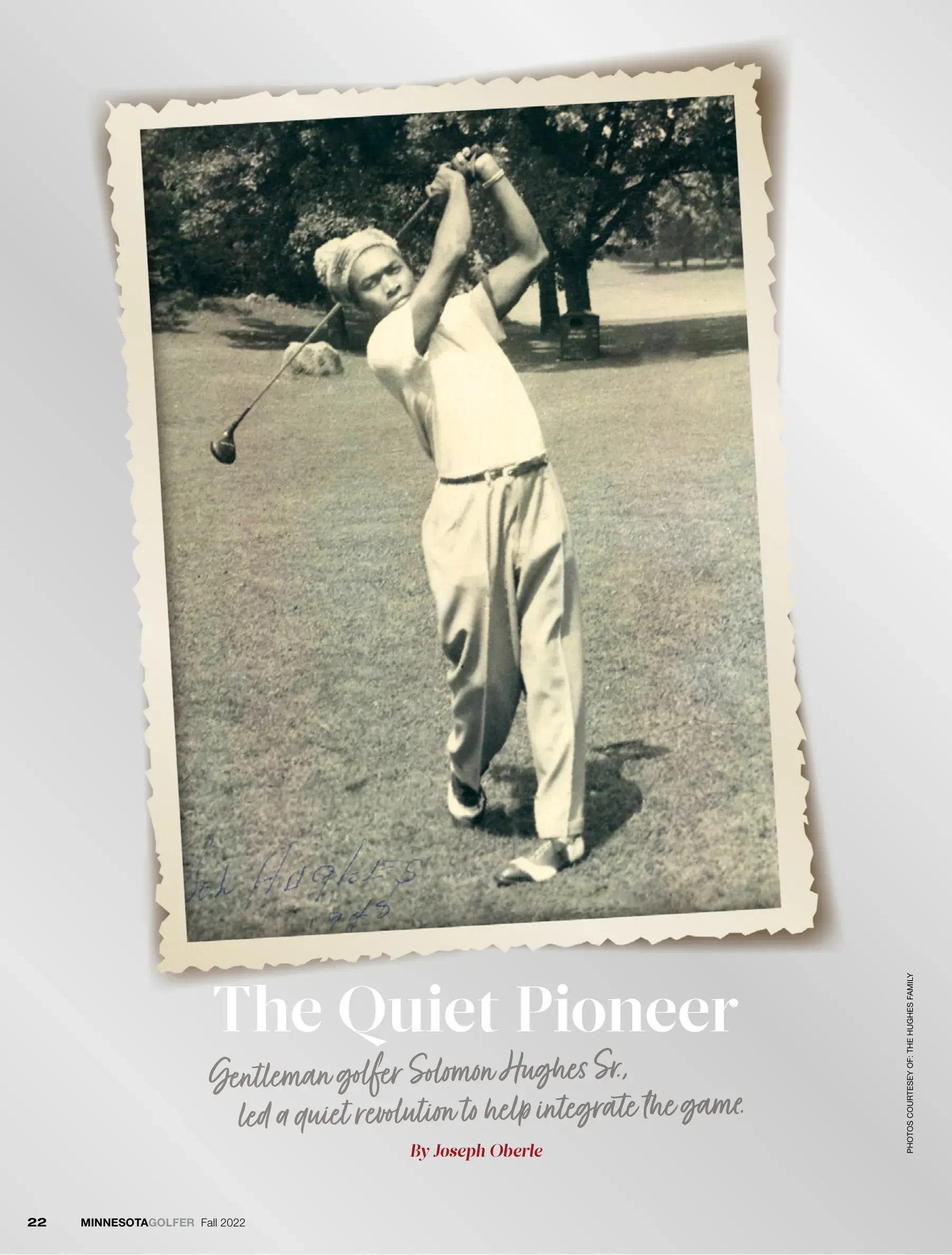
Birth of a Legend Solomon Hughes Sr. was a quiet trailblazer. Tough, resilient, determined and perseverant, Solomon played the long game in changing golf, and paved the way for others such as Charlie Sifford, Lee Elder and even Tiger Woods, who came after him.
Solomon was born in Gadsden, Ala., in 1908 and faced adversity early in life, as his father passed away when Solomon was just seven years old. He shared responsibility in his family and continued to make family his priority throughout his life.
But Solomon always made time for golf. He acquired a job at Gadsden CC as a caddie when he was 12, and the game hooked him deeply. He worked hard and rose in the ranks to assistant pro and ultimately caddie master, thanks in part to regional pro golfer Eddie Miller, who saw some promise in young Solomon and mentored him in the sport.
“My dad rose to be caddie master and it was clear the country club trusted him in the pro shop,” Soli says. “He got along well with a lot of the white club members and he had an interest in the game. Eddie just took him under his wing and gave him some golf tips.
Although, he did not teach him his swing. My dad’s swing was self-taught.” Solomon dug his swing out of the dirt thanks to his love for the game and a strong work ethic. When he wasn’t working at his job, he was working on his game.
Later in life, Soli caddied for his father, who would be on the course by 7 a.m. hitting a hundred balls prior to a round. Before a tournament, he’d walk the entire course to see how it was set up and how the wind would affect it. And when he taught others the game, Solomon tried to impart the same ethos.
“He would tell me, ‘Junior, you have to practice,’” says Soli, who never really took to golf but became a six-time state recordholding speed skater in his teens. “’You have to practice to win; you have to practice to be good. There’s no way around it.’”
Solomon’s golf resume made that lesson hard to argue with. In his early 20’s, Solomon was playing professional events in the United Golf Association (UGA) and winning his first title, the National Negro Open, at age 26 in 1935. He became a top player in the league and was ranked highly in tournaments into the late 1940s.
Family First Solomon’s success in the UGA attracted the attention of boxing champions Joe Louis and Sugar Ray Robinson, while both were serving in the army. Solomon gave them golf lessons and they became fast friends, to the point of Louis inviting him on the road as his personal instructor after World War II. But Hughes declined the opportunity, having recently moved his young family north in 1943 to escape the harsh segregation and discrimination of the Jim Crow South.
“Solomon Hughes gave the Bronze Tournament momentum,” says Darwin Dean, a retired technical project management professional from Wells Fargo, who’s been president of the Upper Midwest Amateur Memorial Bronze Tournament since 2011. “He had a bunch of hackers out there trying to learn to play golf, and he gave them instruction at a professional level. [He] told Joe Louis ‘I want to spend more time at home with my family, so I can’t be your personal trainer.’ He was a man who knew the value of being at home and raising your family.”
Dean said Solomon brought relevance and revenue to the Bronze Tournament. Friends such as Louis came to play and many others came with him. As a pro, Solomon never competed in the Bronze (which began as an amateur event), but he taught many who won it how to play the game.
“He loved the game so much that he was willing to share tips with anybody,” Soli says. “He taught a lot of black golfers when he came to Minnesota. He joined the Twin Cities Golf Club, which was a consortium of black golfers, and gave a lot of golf lessons to the players.”
Solomon and his wife, Bessie, took their two young daughters Antionette and Joyce (they would have another daughter Shirley before Soli) north to find an improved racial climate, greater educational opportunities and a better life in Minnesota. But they found Minneapolis wasn’t as racially enlightened as they’d hoped—particularly on the golf course. At the time, no public or private courses would hire Solomon as a pro, despite his qualifications.
Solomon worked, instead, as a pullman on the Great Northern Railway and a skycap for Northwest Airlines to support his family, but struggled to make headway in the sport that still segregated black golfers.
He found solace at his beloved Hiawatha GC, where he continued to practice, play and perfect his craft even though he was not allowed entrance into the clubhouse; Bessie made him sandwiches for lunch that he quietly ate on the building’s front steps.
“He never spoke about the things that happened to him. He never brought it home,” Soli says. “When he was at Northwest, I witnessed a white guy calling my dad a derogatory name, and my dad didn’t flinch. He took the bags and walked into the airport, and he never spoke of that.”
The Closed Open Solomon continued to travel and play tournaments (including three successive UGA wins in 1945), but like other black golfers, he was refused entrance into events run by the PGA Tournament Bureau—which maintained a Caucasianonly policy since 1934. Solomon was 40 in 1948 and qualified for the St. Paul Open at Keller Golf Course, but was denied entry because he didn’t belong to the PGA, which wouldn’t grant him membership.
Other black golfers of the time, such as Bill Spiller, Ted Rhodes and Madison Gunther, filed a lawsuit over similar treatment at the Los Angeles Open, stirring up long-hardened soil. Although the PGA dug in their heels, a movement had begun, and Hughes and his friend Rhodes continued the fight at the St. Paul Open. Though both qualified, Hughes and Rhodes were denied entry to that 1948 event.
Cecil Newman, editor of the Minneapolis Spokesman newspaper, jumped into the fray, pointing out the discrimination and how the major Twin Cities dailies’ scant coverage missed the mark. Newman alleged that the PGA had printed tickets for the St. Paul “Open” but changed its designation to “invitational” after receiving the black players’ entry forms.
“The black press highlighted people like Solomon,” says Charles Hallman, a recent US Basketball Writers Association Hall of Fame inductee who has written about Hughes for the Spokesman. “A lot “He loved the game so much that he was willing to share tips with anybody.
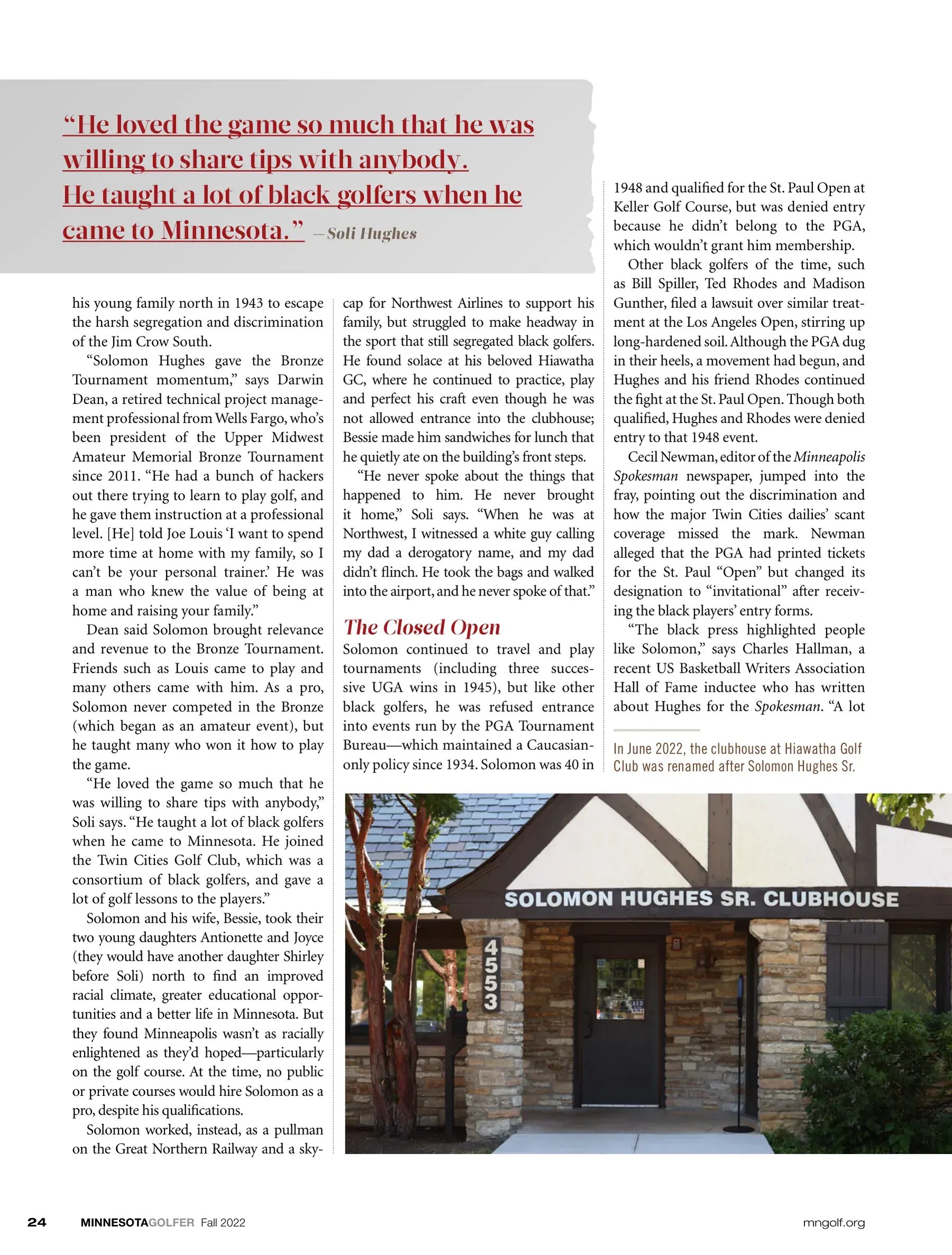
He taught a lot of black golfers when he came to Minnesota.” —Soli Hughes In June 2022, the clubhouse at Hiawatha Golf Club was renamed after Solomon Hughes Sr.
Fall 2022 MINNESOTAGOLFER 25 of people don’t know golf is big among black people because they always had to play in a segregated setting. So anytime black golfers accomplished something the black press would highlight it.”
After Hughes and Rhodes were denied entry into the St. Paul Open again in 1951, the Spokesman, joined by the Open’s sponsor (the St. Paul Jaycees) and Joe Louis, turned up the pressure on the PGA.
Although Hughes didn’t want to take the fight public, a lawsuit was filed in the golfers’ names—and the PGA finally allowed Hughes and Rhodes to play in the 1952 St. Paul Open. (The obdurate PGA waited another nine years before removing the Caucasians Only clause from its charter.) According to his son, Solomon internalized his struggle and simply went back to practice. “You can’t win if you quit,”
Soli heard him say. Unfortunately for Solomon, when he finally teed it up at the Open in ‘52, he was 45 years old and his best competitive golf was behind him.
“He never talked about it, but I would think that after fighting so hard to get in the St. Paul Open, it had to affect him,” Soli says. “He won his first tournament at the age of 26, so, by the time my dad’s 45, 20 years have gone by. He was really denied the opportunities to compete competitively.”
Still, his efforts can’t be denied, as each pioneer stands on the shoulders of those before them. It’s not often big, dramatic events that change the world, rather the accumulation of many small, courageous acts that lead to a Charlie Sifford playing on Tour, Lee Elder playing the Masters and Tiger Woods becoming the biggest name in golf.
“I’ve never met Tiger Woods, but if I did, I would ask him if he knows of Solomon Hughes,” Hallman said. “Lee Elder, yes, he broke the doors open, but Solomon Hughes broke doors open for Elder. And Lee Elder, it’s my understanding, knew that. He understood his history.
“It’s the little things. Rosa Park gets credit for desegregating buses but somebody else did it before her. So, there’s always somebody that does something that doesn’t get the notoriety, but they set that tone and somebody else breaks it open.”
A Lasting Legacy Through it all, the game was Solomon’s respite and his inspiration. He kept practicing and playing golf at Hiawatha until he died of cancer in 1987. He didn’t get to see Tiger’s 1997 “win for the ages” at Augusta, but, according to his son, spent his last few months watching only golf on television. On the day before he passed, Solomon requested a trip to Hiawatha to soak it in one more time.
“I’m glad they’re honoring him because he’s not just a dutiful father but a professional golf champion,” Soli says. “He was a pioneer for golf rights because he tried to help other golfers. And at Hiawatha, he was instrumental in changing the clubhouse policy.”
Solomon Hughes’ name emblazoned on the clubhouse of a course that serves a growing black community of golfers— a course currently fighting to remain open—is a fitting epitaph to a golfer who spent his life quietly pushing through closed racial doors.
“I love that the name of the course, Hiawatha, is a native name. It should always stay Hiawatha,” Dean says. “However, not just the clubhouse, but the Learning Facility should be called the Solomon Hughes Learning Center.”
“He was a quiet trailblazer and one of many,” Hallman says. “The world needs more like Solomon Hughes.” Indeed, there’s more work to do to make the game equitable for all. But would Solomon Hughes Sr. be proud of this tribute to the progress he helped set in motion?
“If he were alive today and looking at the clubhouse,” Soli said of his reserved father, “he would simply say, ‘Well, that’s all right . . . that’s all right.’”
The local African American golf community of south Minneapolis held the Solomon Hughes Sr. Legacy Memorial event at Hiawatha Golf Club in June.
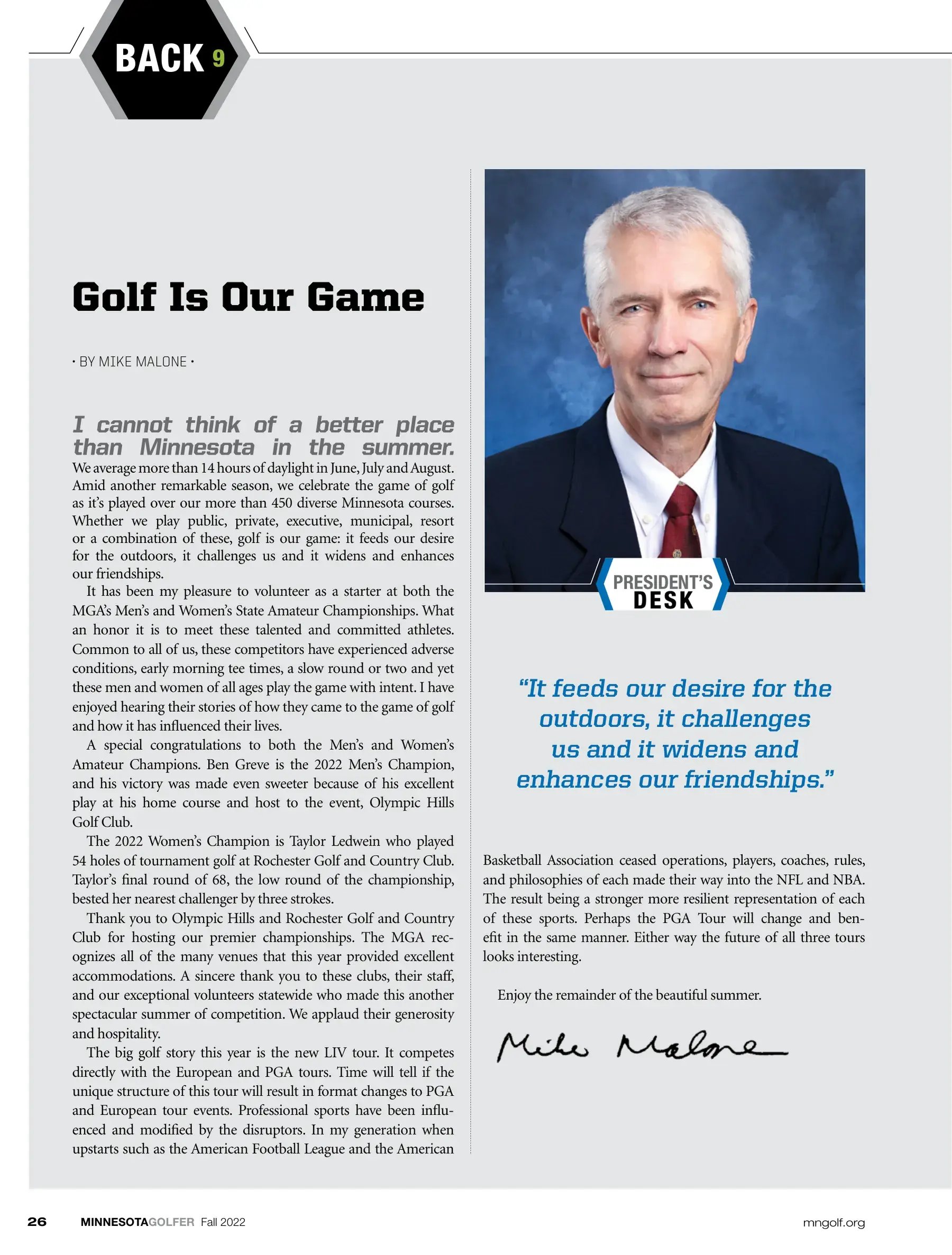
PHOTOS: JEFF LAWLER Solomon Hughes Jr. BACK Golf Is Our Game I cannot think of a better place than Minnesota in the summer. We average more than 14 hours of daylight in June, July and August.
Amid another remarkable season, we celebrate the game of golf as it’s played over our more than 450 diverse Minnesota courses. Whether we play public, private, executive, municipal, resort or a combination of these, golf is our game: it feeds our desire for the outdoors, it challenges us and it widens and enhances our friendships.
It has been my pleasure to volunteer as a starter at both the MGA’s Men’s and Women’s State Amateur Championships. What an honor it is to meet these talented and committed athletes.
Common to all of us, these competitors have experienced adverse conditions, early morning tee times, a slow round or two and yet these men and women of all ages play the game with intent. I have enjoyed hearing their stories of how they came to the game of golf and how it has influenced their lives.
A special congratulations to both the Men’s and Women’s Amateur Champions. Ben Greve is the 2022 Men’s Champion, and his victory was made even sweeter because of his excellent play at his home course and host to the event, Olympic Hills Golf Club.
The 2022 Women’s Champion is Taylor Ledwein who played 54 holes of tournament golf at Rochester Golf and Country Club. Taylor’s final round of 68, the low round of the championship, bested her nearest challenger by three strokes.
Thank you to Olympic Hills and Rochester Golf and Country Club for hosting our premier championships. The MGA recognizes all of the many venues that this year provided excellent accommodations. A sincere thank you to these clubs, their staff, and our exceptional volunteers statewide who made this another spectacular summer of competition. We applaud their generosity and hospitality.
The big golf story this year is the new LIV tour. It competes directly with the European and PGA tours. Time will tell if the unique structure of this tour will result in format changes to PGA and European tour events. Professional sports have been influenced and modified by the disruptors. In my generation when upstarts such as the American Football League and the American Basketball Association ceased operations, players, coaches, rules, and philosophies of each made their way into the NFL and NBA.
The result being a stronger more resilient representation of each of these sports. Perhaps the PGA Tour will change and benefit in the same manner. Either way the future of all three tours looks interesting.
Enjoy the remainder of the beautiful summer. • BY MIKE MALONE • “It feeds our desire for the outdoors, it challenges us and it widens and enhances our friendships.”
PRESIDENT’S DESK Fall 2022 MINNESOTAGOLFER 27 Creating Leaders CADDIE CORNER • BY JACK MENDESH • S ince 2010, there have been six Minnesota Evans Scholarship recipients out of Bearpath Country Club.
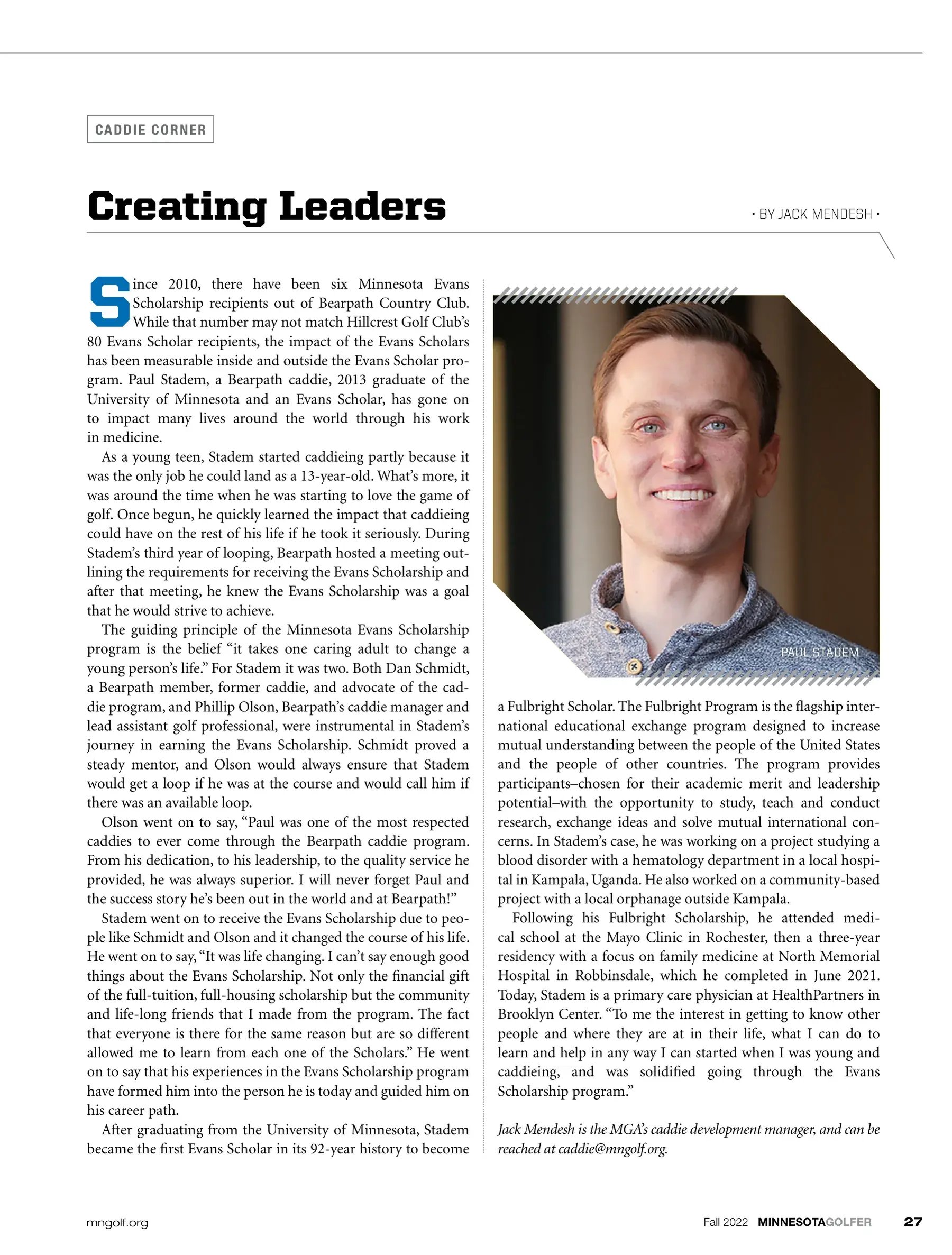
While that number may not match Hillcrest Golf Club’s 80 Evans Scholar recipients, the impact of the Evans Scholars has been measurable inside and outside the Evans Scholar program. Paul Stadem, a Bearpath caddie, 2013 graduate of the University of Minnesota and an Evans Scholar, has gone on to impact many lives around the world through his work in medicine.
As a young teen, Stadem started caddieing partly because it was the only job he could land as a 13-year-old. What’s more, it was around the time when he was starting to love the game of golf. Once begun, he quickly learned the impact that caddieing could have on the rest of his life if he took it seriously. During Stadem’s third year of looping, Bearpath hosted a meeting outlining the requirements for receiving the Evans Scholarship and after that meeting, he knew the Evans Scholarship was a goal that he would strive to achieve.
The guiding principle of the Minnesota Evans Scholarship program is the belief “it takes one caring adult to change a young person’s life.” For Stadem it was two. Both Dan Schmidt, a Bearpath member, former caddie, and advocate of the caddie program, and Phillip Olson, Bearpath’s caddie manager and lead assistant golf professional, were instrumental in Stadem’s journey in earning the Evans Scholarship. Schmidt proved a steady mentor, and Olson would always ensure that Stadem would get a loop if he was at the course and would call him if there was an available loop.
Olson went on to say, “Paul was one of the most respected caddies to ever come through the Bearpath caddie program. From his dedication, to his leadership, to the quality service he provided, he was always superior. I will never forget Paul and the success story he’s been out in the world and at Bearpath!”
Stadem went on to receive the Evans Scholarship due to people like Schmidt and Olson and it changed the course of his life. He went on to say, “It was life changing. I can’t say enough good things about the Evans Scholarship. Not only the financial gift of the full-tuition, full-housing scholarship but the community and life-long friends that I made from the program. The fact that everyone is there for the same reason but are so different allowed me to learn from each one of the Scholars.” He went on to say that his experiences in the Evans Scholarship program have formed him into the person he is today and guided him on his career path.
After graduating from the University of Minnesota, Stadem became the first Evans Scholar in its 92-year history to become a Fulbright Scholar. The Fulbright Program is the flagship international educational exchange program designed to increase mutual understanding between the people of the United States and the people of other countries. The program provides participants–chosen for their academic merit and leadership potential–with the opportunity to study, teach and conduct research, exchange ideas and solve mutual international concerns. In Stadem’s case, he was working on a project studying a blood disorder with a hematology department in a local hospital in Kampala, Uganda. He also worked on a community-based project with a local orphanage outside Kampala.
Following his Fulbright Scholarship, he attended medical school at the Mayo Clinic in Rochester, then a three-year residency with a focus on family medicine at North Memorial Hospital in Robbinsdale, which he completed in June 2021.
Today, Stadem is a primary care physician at HealthPartners in Brooklyn Center. “To me the interest in getting to know other people and where they are at in their life, what I can do to learn and help in any way I can started when I was young and caddieing, and was solidified going through the Evans Scholarship program.”
Jack Mendesh is the MGA’s caddie development manager, and can be reached at caddie@mngolf.org. PAUL STADEM T his curious reporter and a few other Minnesotans spent July 4, 2019, following Matthew Wolff, the 20-year-old with the herky-jerky swing that would make Jim Furyk scratch his head and wonder what the heck’s going on.
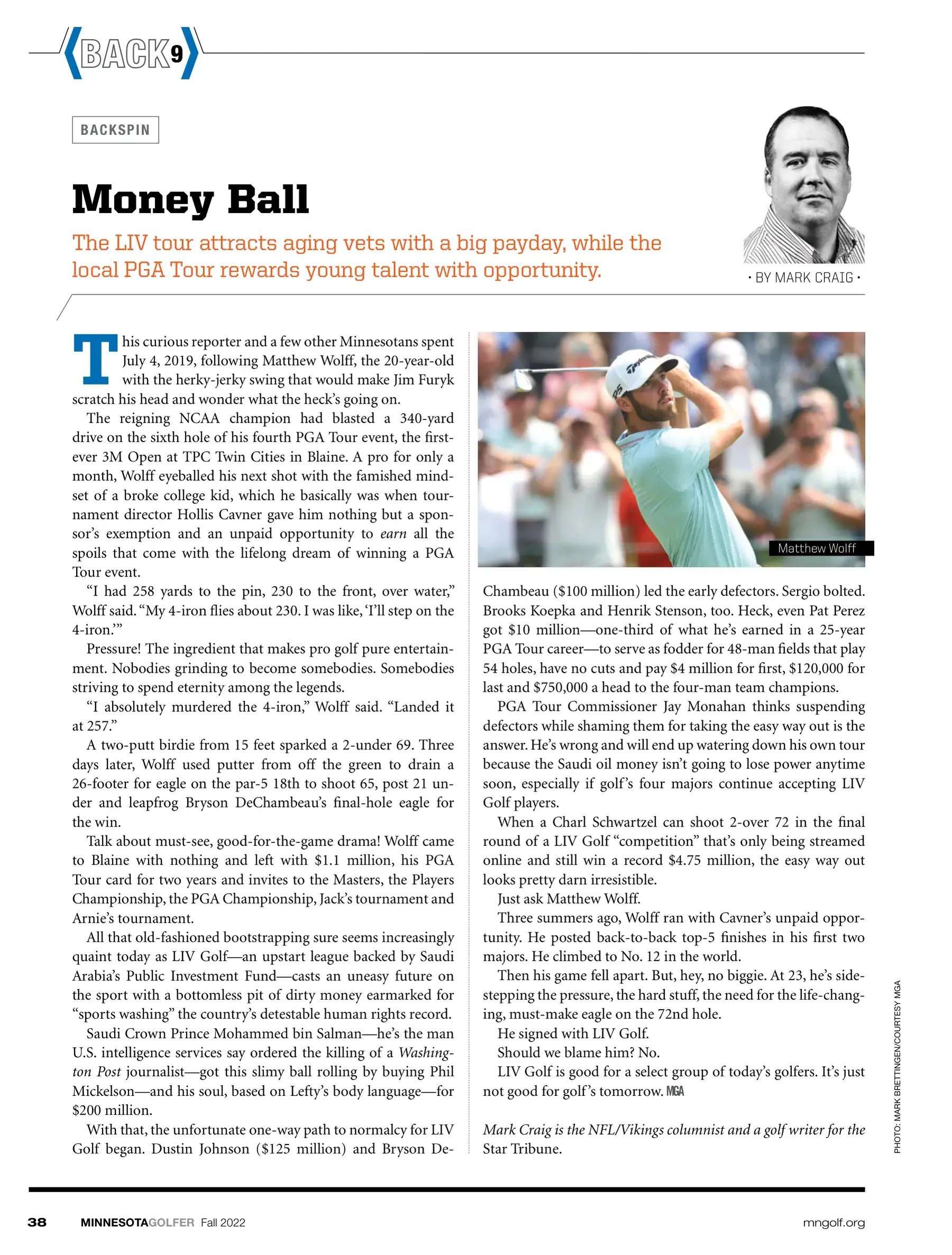
The reigning NCAA champion had blasted a 340-yard drive on the sixth hole of his fourth PGA Tour event, the first- ever 3M Open at TPC Twin Cities in Blaine. A pro for only a month, Wolff eyeballed his next shot with the famished mindset of a broke college kid, which he basically was when tournament director Hollis Cavner gave him nothing but a sponsor’s exemption and an unpaid opportunity to earn all the spoils that come with the lifelong dream of winning a PGA Tour event.
“I had 258 yards to the pin, 230 to the front, over water,” Wolff said. “My 4-iron flies about 230. I was like, ‘I’ll step on the 4-iron.’” Pressure! The ingredient that makes pro golf pure entertainment. Nobodies grinding to become somebodies. Somebodies striving to spend eternity among the legends.
“I absolutely murdered the 4-iron,” Wolff said. “Landed it at 257.” A two-putt birdie from 15 feet sparked a 2-under 69. Three days later, Wolff used putter from off the green to drain a 26-footer for eagle on the par-5 18th to shoot 65, post 21 under and leapfrog Bryson DeChambeau’s final-hole eagle for the win.
Talk about must-see, good-for-the-game drama! Wolff came to Blaine with nothing and left with $1.1 million, his PGA Tour card for two years and invites to the Masters, the Players Championship, the PGA Championship, Jack’s tournament and Arnie’s tournament.
All that old-fashioned bootstrapping sure seems increasingly quaint today as LIV Golf—an upstart league backed by Saudi Arabia’s Public Investment Fund—casts an uneasy future on the sport with a bottomless pit of dirty money earmarked for “sports washing” the country’s detestable human rights record.
Saudi Crown Prince Mohammed bin Salman—he’s the man U.S. intelligence services say ordered the killing of a Washington Post journalist—got this slimy ball rolling by buying Phil Mickelson—and his soul, based on Lefty’s body language—for $200 million.
With that, the unfortunate one-way path to normalcy for LIV Golf began. Dustin Johnson ($125 million) and Bryson DeChambeau ($100 million) led the early defectors. Sergio bolted.
Brooks Koepka and Henrik Stenson, too. Heck, even Pat Perez got $10 million—one-third of what he’s earned in a 25-year PGA Tour career—to serve as fodder for 48-man fields that play 54 holes, have no cuts and pay $4 million for first, $120,000 for last and $750,000 a head to the four-man team champions.
PGA Tour Commissioner Jay Monahan thinks suspending defectors while shaming them for taking the easy way out is the answer. He’s wrong and will end up watering down his own tour because the Saudi oil money isn’t going to lose power anytime soon, especially if golf’s four majors continue accepting LIV Golf players.
When a Charl Schwartzel can shoot 2-over 72 in the final round of a LIV Golf “competition” that’s only being streamed online and still win a record $4.75 million, the easy way out looks pretty darn irresistible.
Just ask Matthew Wolff. Three summers ago, Wolff ran with Cavner’s unpaid opportunity. He posted back-to-back top-5 finishes in his first two majors. He climbed to No. 12 in the world.
Then his game fell apart. But, hey, no biggie. At 23, he’s sidestepping the pressure, the hard stuff, the need for the life-changing, must-make eagle on the 72nd hole.
He signed with LIV Golf. Should we blame him? No. LIV Golf is good for a select group of today’s golfers. It’s just not good for golf’s tomorrow.
Mark Craig is the NFL/Vikings columnist and a golf writer for the Star Tribune. Money Ball The LIV tour attracts aging vets with a big payday, while the local PGA Tour rewards young talent with opportunity.