




Spring 2019

























Back to The Minnesota Golfer Archive
Read the text of this issue
Text from the printed pages, so it can be searched and read by screen readers. Layout and photography are in the reader above.
16 | LEAVE NO TRACE By Joseph Oberle Repairing the fairways after a divot should be common practice. 18 | THE KPMG COMES TO HAZELTINE By Tom Bedell A preview of the LPGA major, featuring the contenders and the course setup.
Subscriptions: Regular U.S. one year (4 issues) $18. Directory issue of Minnesota Golfer: $9.95 plus shipping, pre-paid. Other single copies: $2.95 per copy plus shipping, pre-paid.
Copyright © 2019 MGA The MGA upholds and promotes the game of golf and its values for all golfers in Minnesota. Minnesota Golf Association Inc.
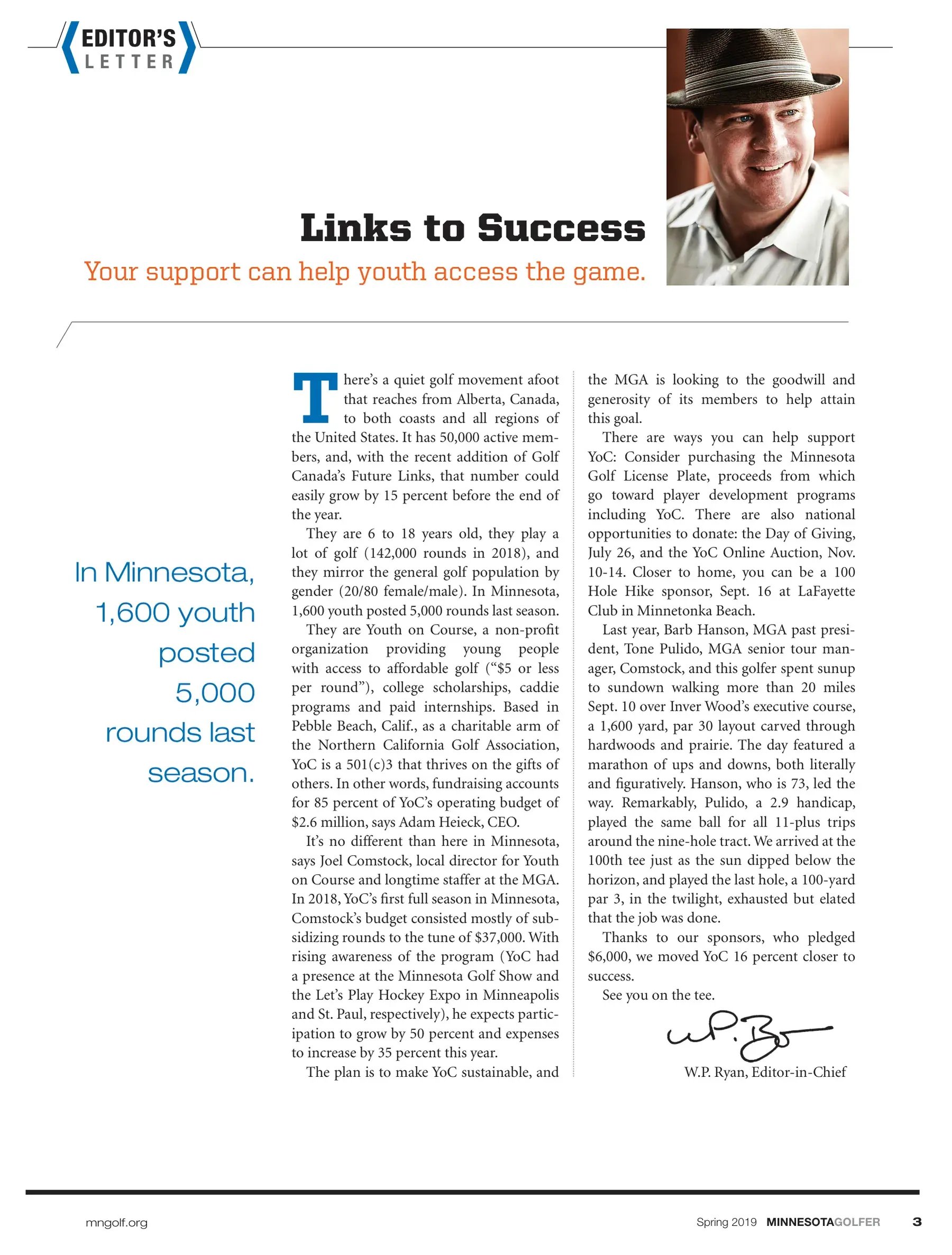
Legislative Counsel McGrann Shea Carnival Straughn & Lamb, Chartered OFFICE T here’s a quiet golf movement afoot that reaches from Alberta, Canada, to both coasts and all regions of the United States. It has 50,000 active members, and, with the recent addition of Golf Canada’s Future Links, that number could easily grow by 15 percent before the end of the year.
They are 6 to 18 years old, they play a lot of golf (142,000 rounds in 2018), and they mirror the general golf population by gender (20/80 female/male). In Minnesota, 1,600 youth posted 5,000 rounds last season.
They are Youth on Course, a non-profit organization providing young people with access to affordable golf (“$5 or less per round”), college scholarships, caddie programs and paid internships. Based in Pebble Beach, Calif., as a charitable arm of the Northern California Golf Association, YoC is a 501(c)3 that thrives on the gifts of others. In other words, fundraising accounts for 85 percent of YoC’s operating budget of $2.6 million, says Adam Heieck, CEO.
It’s no different than here in Minnesota, says Joel Comstock, local director for Youth on Course and longtime staffer at the MGA. In 2018, YoC’s first full season in Minnesota, Comstock’s budget consisted mostly of subsidizing rounds to the tune of $37,000. With rising awareness of the program (YoC had a presence at the Minnesota Golf Show and the Let’s Play Hockey Expo in Minneapolis and St. Paul, respectively), he expects participation to grow by 50 percent and expenses to increase by 35 percent this year.
The plan is to make YoC sustainable, and the MGA is looking to the goodwill and generosity of its members to help attain this goal. There are ways you can help support YoC: Consider purchasing the Minnesota Golf License Plate, proceeds from which go toward player development programs including YoC. There are also national opportunities to donate: the Day of Giving, July 26, and the YoC Online Auction, Nov.
10-14. Closer to home, you can be a 100 Hole Hike sponsor, Sept. 16 at LaFayette Club in Minnetonka Beach. Last year, Barb Hanson, MGA past president, Tone Pulido, MGA senior tour manager, Comstock, and this golfer spent sunup to sundown walking more than 20 miles Sept. 10 over Inver Wood’s executive course, a 1,600 yard, par 30 layout carved through hardwoods and prairie. The day featured a marathon of ups and downs, both literally and figuratively. Hanson, who is 73, led the way. Remarkably, Pulido, a 2.9 handicap, played the same ball for all 11-plus trips around the nine-hole tract. We arrived at the 100th tee just as the sun dipped below the horizon, and played the last hole, a 100-yard par 3, in the twilight, exhausted but elated that the job was done.
Watching the touring professionals grapple with new rules changes has been educational. While most of the changes seem to be well received, a few have created confusion, resulted in penalties and even brought embarrassment to the world’s best players.
The rule regarding the positioning of a caddie prior to a player taking a stroke was certainly an issue. While not intending to line up their players, some caddies were being caught standing directly behind them as they took their stance and moved too late for the player to avoid being penalized. Kudos to the USGA for clarifying and amending the language of the rule to address this issue.
Another change that’s getting a lot of attention is the flagstick rule. While not intended for the pros, it’s interesting to see them use it while putting. As time goes on, more and more golfers will keep it in on most putts.
Some may on all putts. Word from the snowbirds is that the rule has done its job to keep pace moving. But it’s the procedural change regarding dropping a ball when taking relief that has caused the most discussion. Frankly, I’m not sure the rules-makers saw this debate coming. The new drop has been characterized by some tour players as awkward looking, nonathletic and not cool. Even Jack Nicklaus has weighed in that the new procedure is “stupid.”
Those most critical of the change seem unaware of—or perhaps uninterested in— the reasons for changing the procedure, and the process and scrutiny all the new rules went through prior to their final release.
The old rules included up to nine scenarios under which a ball had to be re-dropped. The USGA’s position originally was to have the player place the ball in all relief situations—but the R&A objected. As a result, when the first draft of the new rules was released for public comment in March 2018, the drop was to be made from a couple inches off the surface, just above the turf.
But golfers didn’t like this, as evidenced by the quantity of feedback during the comment period. Thus, a compromise became the drop from knee height instead of from the shoulder, which would better control the distance the ball rolled after contact with the ground. This solution is practical, resolves the problem it was meant to address, and I’m sure will be accepted with common use.
If you haven’t already, I encourage you to check out all the new rules. Visit our website, mngolf.org, or attend an MGA rules workshop to brush up on the key changes.
Hopefully, we’ve seen the last big snow of the season. It’s been a winter of frigid weather, rain, ice and record snowfall. No one knows what turf conditions we’ll find once the thaw arrives, but there’s a good chance we’ll need patience this spring.
Remember, your superintendent is highly trained with a wonderful network of knowledgeable colleagues. They will be doing all they can to quickly get our facilities in top condition. Let’s remember to support their efforts and to do what’s asked of us as they prepare for the coming golf season.
Adapting to change can be challenging— even for the best of players. With the new Rules in effect as of Jan. 1, 2019, we asked members how you prefer to update your 2019 Rules of Golf knowledge.
RULES OF GOLF EDUCATION 59.43% Look to the MGA to help me update my knowledge 58.20% Read the new 2019 Rules of Golf 45.99% The USGA.org website 33.29% The USGA Rules of Golf app 19.48% USGA/PGA 2019 Rules of Golf Workshop 18.25% Watch professional golf on television 18.00% Rely on the knowledge of others 0.49% No plans to update my knowledge “While most of the [rules] changes seem to be well received, a few have created confusion.”
W e love to go long off the tee; it’s one of the great joys in golf. But longer driving distances are adversely affecting the game. When you watch touring pros continually hit wedges into position for eagle putts, you may sense the concern. High-tech golf equipment and finely conditioned athletes are rendering old, storied golf courses near obsolete and changing golf.
So, the USGA and R&A have stepped in to measure the numbers and attempt to safeguard the game. In 2015, the USGA and R&A released their first Annual Distance Report, a collection of driving stats from nearly 300,000 drives on seven tours: the PGA, LPGA, Champions, European, Ladies European, Japan Golf, and Web.com tours. But the most recent report, released in 2017 (noted last Spring in W.P.
Ryan’s “Editor’s Letter”), offered some startling numbers: The average distance on the PGA Tour from the early 1990s to 2017 increased by approximately 30 yards (while amateurs gained an average of 8 yards from 1996-2107).
Considering the entire report, however, 2017 shows up as a slight anomaly. Since 2003 (when Shotlink technology was introduced for tracking distances), the average driving distance on the seven worldwide tours increased by about 0.2 yards per year. But in 2017, the average distance gain of the seven tours was more than 3.0 yards over 2016—worth signaling some alarms.
And the distances may be continuing to climb. Sports Illustrated magazine reported recently that the average driving distance on the 2018 PGA Tour was 295.29 yards—which, for context, is an increase of 5.08 yards over 2015 numbers and a gain of 38.4 yards since 1980.
How does this increased distance change the game? Well, as distance goes up, scoring average can go down, and the 2017 Distance Report bears that out. The PGA Tour scoring average in 1980 was 72.6, and it dropped to 70.8 in 2017—nearly two strokes. Fitness and course conditioning may be contributing factors, but it is equipment technology that gets the most scrutiny.
The influence of golf equipment technology on driving distances is well known, and the game’s governing bodies have worked diligently to put restrictions on the drivers. However, since the introduction of the Titleist Pro-V1 in 2000 and the record 6-yard increase that year, the golf ball has been blamed, perhaps unfairly, for distance increases when clubhead speed may be the real culprit.
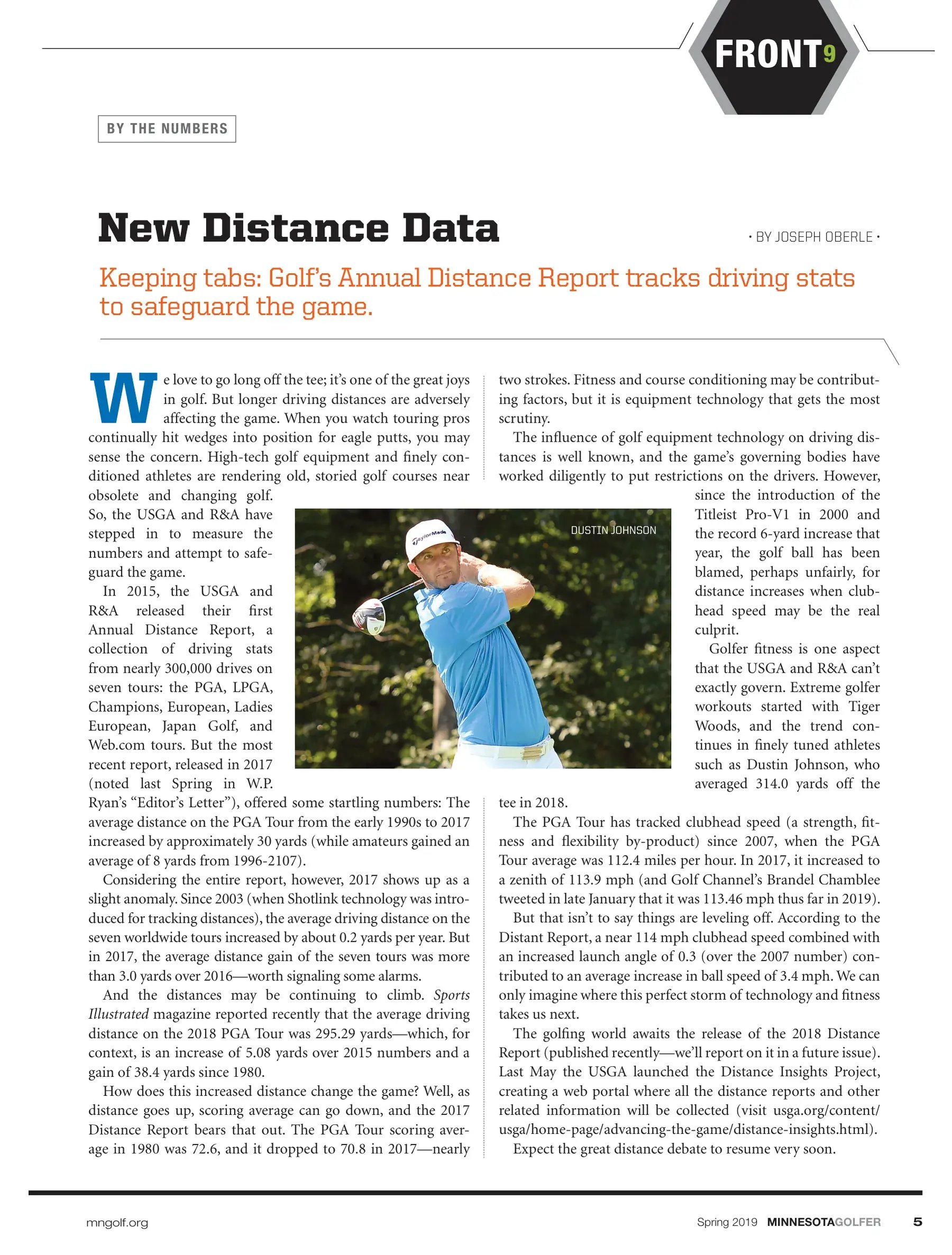
Golfer fitness is one aspect that the USGA and R&A can’t exactly govern. Extreme golfer workouts started with Tiger Woods, and the trend continues in finely tuned athletes such as Dustin Johnson, who averaged 314.0 yards off the tee in 2018.
The PGA Tour has tracked clubhead speed (a strength, fitness and flexibility by-product) since 2007, when the PGA Tour average was 112.4 miles per hour. In 2017, it increased to a zenith of 113.9 mph (and Golf Channel’s Brandel Chamblee tweeted in late January that it was 113.46 mph thus far in 2019).
But that isn’t to say things are leveling off. According to the Distant Report, a near 114 mph clubhead speed combined with an increased launch angle of 0.3 (over the 2007 number) contributed to an average increase in ball speed of 3.4 mph. We can only imagine where this perfect storm of technology and fitness takes us next.
The golfing world awaits the release of the 2018 Distance Report (published recently—we’ll report on it in a future issue). Last May the USGA launched the Distance Insights Project, creating a web portal where all the distance reports and other related information will be collected (visit usga.org/content/ usga/home-page/advancing-the-game/distance-insights.html).
Expect the great distance debate to resume very soon. New Distance Data Keeping tabs: Golf’s Annual Distance Report tracks driving stats to safeguard the game.
• BY MIKE BARGE • Mike Barge is the director of instruction at Hazeltine National GC and a Class A member of the PGA of America. TIPS FROM THE PROS I love watching unique swings, especially from Tour players. Through massive repetition and trust, they make them work. Each may be different, but the teacher in me has identifi ed the common denominator that is present in them all.
In order for the golf swing to be strong and repetitive, it must be athletic. The common thread in athletic movements throughout most sports is knee flex. Think of a tennis player about to receive serve, a downhill skier, or guarding someone in basketball. Just as proper knee flex provides power and stability during those movements, it also adds to athleticism during the golf swing. Get flexed, stay flexed and be an athlete.
PHOTO BY MATT SEEFELDT, ILLUSTRATION BY DEAN LAVATO I n 2010, Herfort-Norby Golf Course Architects renovated and rerouted Grand National. One of the few holes that went untouched was No.
14, and the stout challenge remains on this number one handicap hole. No. 14 offers a slight dogleg left (with a bunker positioned through the fairway at the turn for those unable to negotiate it).
But the fun starts on the second shot, which requires a precise approach through a narrow opening of trees to the green. The green is fronted by a pond nearly half the size of the putting surface and a bunker back right to catch any shots from golfers over-clubbing to clear the pond.
Pull a driver on the tee and work your ball around the corner of the dogleg for a shorter iron or wedge into the well-guarded green. —Joseph Oberle PHOTOS BY MATT SEEFELDT Spring 2019 MINNESOTAGOLFER 7 Grand National Golf Club Hinckley | No. 14 » par 4 » 334–416 yards GREAT DRIVES Opened 1995 | Architect Joel Goldstrand | General Manager Casey Fahey | Superintendent Steve Benson R ules 14.3 and 10.2b have thrown monkey wrenches in what has otherwise been a mostly smooth transition as the professional tours play under the new, modernized Rules of Golf. There have been only a handful of penalties associated with the new rules, but two of them have caused quite a stir on social media.
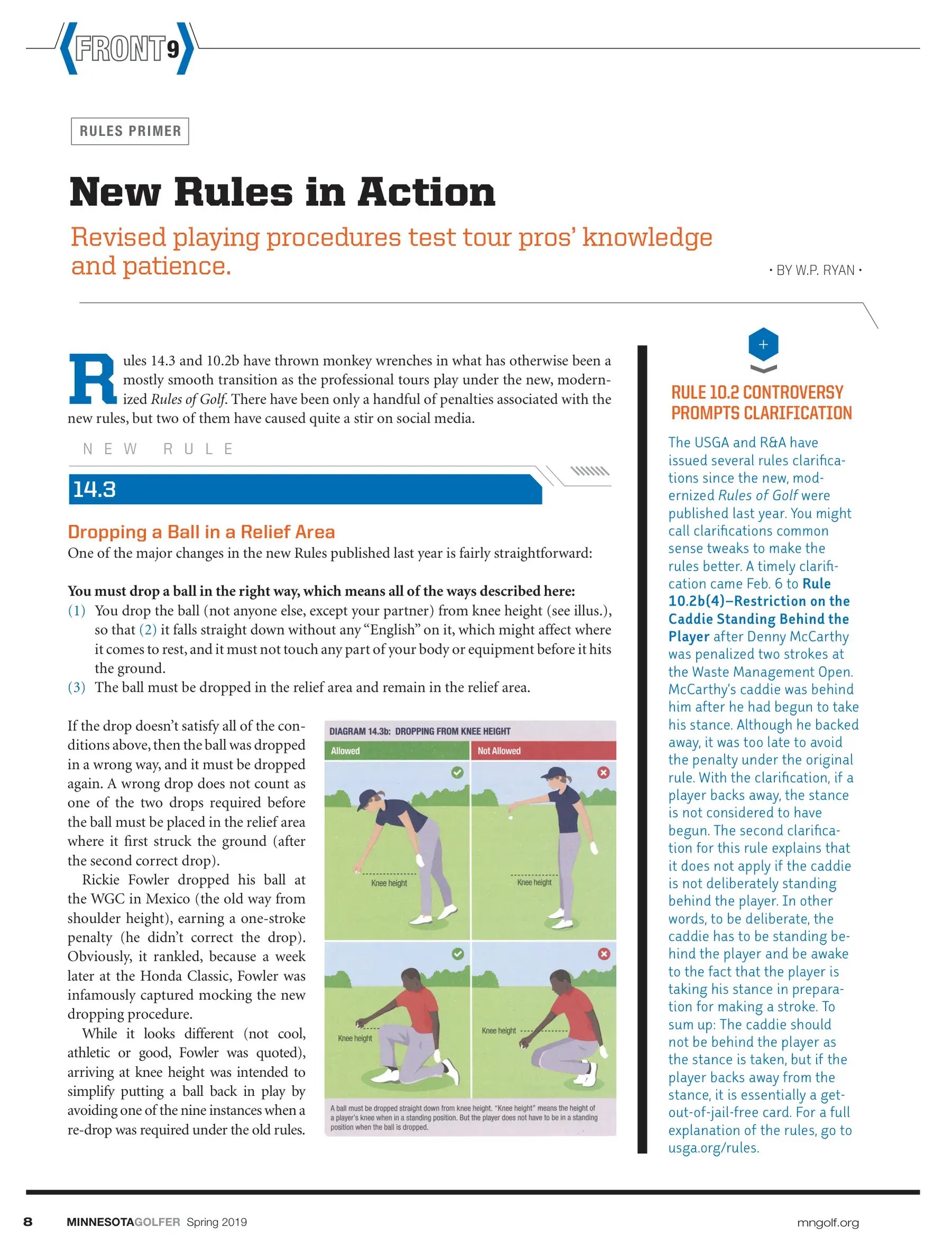
New Rules in Action Revised playing procedures test tour pros’ knowledge and patience. • BY W.P. RYAN • RULES PRIMER N E W R U L E 14.3 Dropping a Ball in a Relief Area One of the major changes in the new Rules published last year is fairly straightforward: You must drop a ball in the right way, which means all of the ways described here: (1) You drop the ball (not anyone else, except your partner) from knee height (see illus.), so that (2) it falls straight down without any “English” on it, which might affect where it comes to rest, and it must not touch any part of your body or equipment before it hits the ground.
(3) The ball must be dropped in the relief area and remain in the relief area. If the drop doesn’t satisfy all of the conditions above, then the ball was dropped in a wrong way, and it must be dropped again. A wrong drop does not count as one of the two drops required before the ball must be placed in the relief area where it first struck the ground (after the second correct drop).
Rickie Fowler dropped his ball at the WGC in Mexico (the old way from shoulder height), earning a one-stroke penalty (he didn’t correct the drop).
Obviously, it rankled, because a week later at the Honda Classic, Fowler was infamously captured mocking the new dropping procedure. While it looks different (not cool, athletic or good, Fowler was quoted), arriving at knee height was intended to simplify putting a ball back in play by avoiding one of the nine instances when a re-drop was required under the old rules.
The USGA and R&A have issued several rules clarifications since the new, modernized Rules of Golf were published last year. You might call clarifications common sense tweaks to make the rules better. A timely clarification came Feb. 6 to Rule 10.2b(4)—Restriction on the Caddie Standing Behind the Player after Denny McCarthy was penalized two strokes at the Waste Management Open.
McCarthy’s caddie was behind him after he had begun to take his stance. Although he backed away, it was too late to avoid the penalty under the original rule. With the clarification, if a player backs away, the stance is not considered to have begun. The second clarification for this rule explains that it does not apply if the caddie is not deliberately standing behind the player. In other words, to be deliberate, the caddie has to be standing behind the player and be awake to the fact that the player is taking his stance in preparation for making a stroke. To sum up: The caddie should not be behind the player as the stance is taken, but if the player backs away from the stance, it is essentially a getout-of-jail-free card. For a full explanation of the rules, go to usga.org/rules.
RULE 10.2 CONTROVERSY PROMPTS CLARIFICATION Breaking New Ground Jump-start your game with one of these innovative new drivers or driving irons.
• BY JOSEPH OBERLE • N othing gets the golf juices flowing like starting out the season with a new driver. Today’s golf tech is all about embracing innovation, so check out these state-of-the-art sticks.
» Full Speed Ahead Titleist hadn’t released a new driver since 2016, so golfers were excited when information on its TS2 and TS3 drivers began leaking last fall. TS stands for Tour Speed, and the company says it is Titleist’s “fastest ever driver” thanks to a speed chassis, a streamlined shape that reduces aerodynamic drag by 20 percent and a thinner clubface (by six grams), which is so thin that the score lines had to be lasered on rather than etched. The TS2 is the more forgiving of the two clubs and comes in an 11.5 degree loft, in addition to the 8.5, 9.5 and 10.5 degree lofts of the TS3.
You may want to speed your way to the golf shop and get one. $500; titleist.com » Less Weight, More Distance Lighter is better in drivers, as Wilson joined the less-weight race in golf club innovation. The new D7 driver for 2019 joins Wilson’s DL line with RE-AKT Technology that provides faster club head speed for longer distances, according to the company. The club was engineered with the [K]omposite Crown Design, and the D7 crown features a layer of Dupont Kevlar® between carbon fiber to neutralize vibration and produce a sharp, crisp sound and great feel. The club features Dynamic Launch Control, which allows for strategic placement of internal weights to aid different swing speeds. You can customize the D7 for optimal effectiveness.
$300; wilson.com » Introducing AI Callaway is trying something different to achieve speed and distance with its new driver, the Epic Flash. The driver’s new Flash Face technology was created by artifi cial intelligence. According to Callaway, it is “the first known instance of using AI in the golf equipment industry—and ‘Machine Learning,’ a field of computer science that uses statistical techniques to give computer systems the ability to ‘learn’ with data without being explicitly programmed.” The computer cycled through 15,000 face iterations before creating Flash Face—which sounds like something that Callaway golfer Phil Mickelson will enjoy explaining to reporters this season.
$530; callawaygolf.com » Power Meets Precision Is streamlined more your style off the tee? Driving irons are back in vogue, and today’s models are more accurate, offer more distance and might be just right for those long par 3s that are a little more out of reach each season. All the big club manufacturers are making them—here are four to consider: Callaway X-Forged UT has a tungsten insert for a higher MOI and forgiveness on off-center hits; Ping G400 Crossover uses a wide sole designed to get the ball airborne easily from diffi cult lies; TaylorMade P-790 UDI is only available in a 2-iron (17 degrees), but that works for Dustin Johnson, Rory McIlroy and Jason Day; and the Titleist 718 T-MB (2-iron) includes high-density tungsten weights in the heel and toe for enhanced stability. Try them all to see which one works for you.
Take it from golf nomad and longtime artisan Curt Soine, who merges his passions on the course. TOKHEIM STONEWARE Spring 2019 MINNESOTAGOLFER 11 C urt Soine has been scaling back on his art business and “doing what I want, you know?” Which mostly revolves around his grandkids (he has four) and golf. “My 6-year-old granddaughter has clubs, and I have hopes,” he quips.
Soine has owned and operated River Bank Folk Art in Granite Falls since 1983, creating hand-carved folk art, home accessories, rustic twig tables and more. The Raymond native (his wife, Paula, is from Granite Falls) competed in football, wrestling and baseball in high school. He took up golf in his 20s but only played sporadically. Since scaling back toward retirement, however, he has been playing the game with a vengeance, making his way to the course four to five times a week.
A golf nomad, Soine has teed it up at several courses in the area: Granite Run, Cottonwood, Marshall and The Crossings at Montevideo. About Granite Run, he says, “I played it many times when it was a nine with narrow fairways and lots of trees. Now the 18 is really nice.” Granite Run’s restaurant is his favorite eatery in town. Soine’s assessment of Marshall Golf Course is that it’s “really nice, right up there with other courses in the area.”
He and his golf cronies play in an annual charity event at Hawk Creek Country Club in Raymond to benefi t high school sports. They’ve also played courses in Renville, Glenwood, Benson and Alexandria.
Queried about his handicap, Soine utters the phrase that every club pro dreads at an event: “I’m a bogey golfer, so I’m about an 18.” However, he’s a member of the Timberwolf Golf Club, an MGA member club without real estate.
Asked about a mentor, Soine says, “Not really a mentor, but I was infl uenced by an artist from whom I took classes.” The artist, Keith Mueller, is a decoy maker and painter, “and it’s a medium I’m very interested in.”
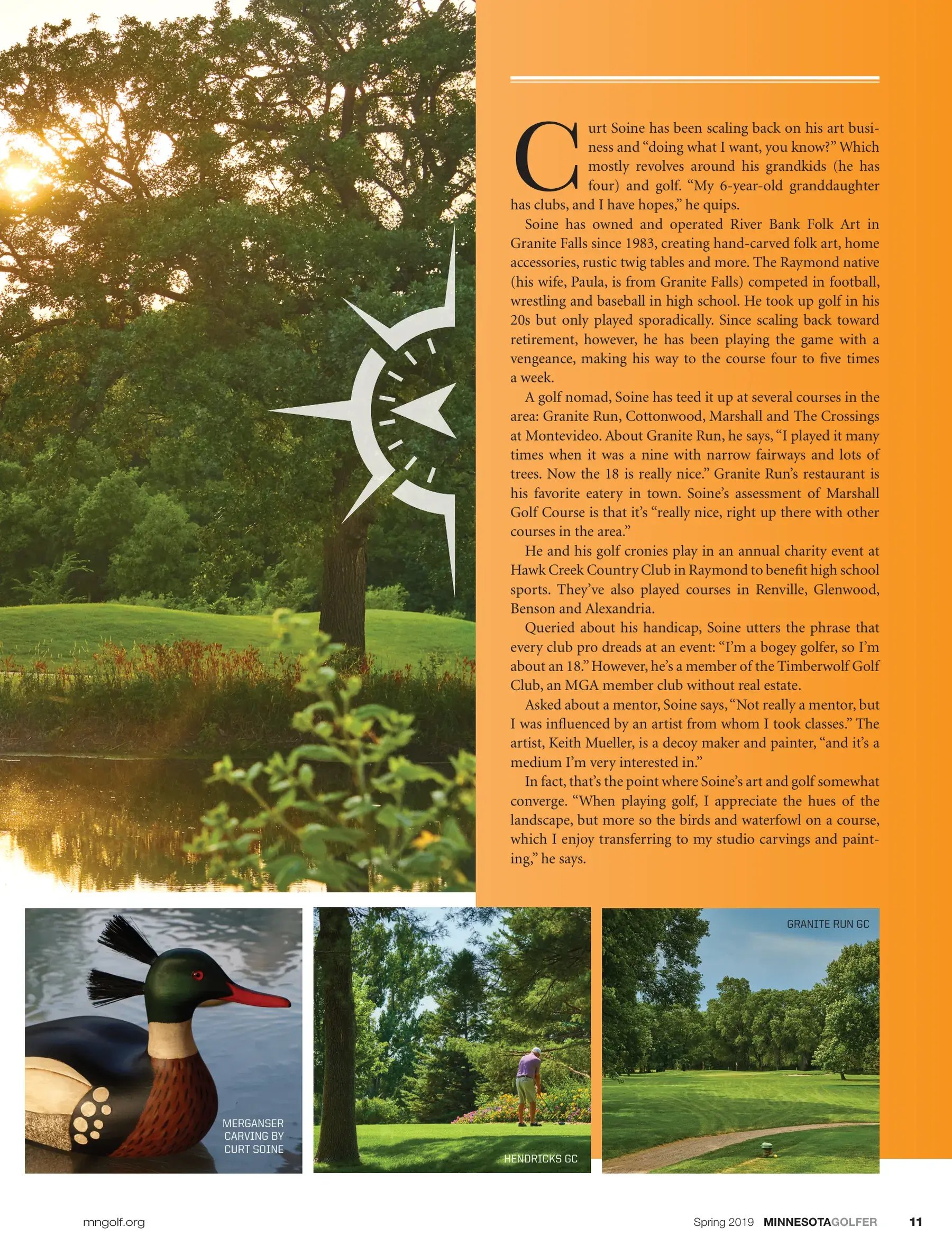
In fact, that’s the point where Soine’s art and golf somewhat converge. “When playing golf, I appreciate the hues of the landscape, but more so the birds and waterfowl on a course, which I enjoy transferring to my studio carvings and painting,” he says.
HENDRICKS GC GRANITE RUN GC MERGANSER CARVING BY CURT SOINE DRIVING MINNESOTA Soine’s studio is one of more than 33 artist spaces featured in the region’s annual Meander Art Crawl. At the award-winning celebration of local art and culture, visitors can take a self-guided tour of artist studios along the upper Minnesota River.
The event takes place in October and is free and open to the public. For more details, visit artsmeander.com. MG Scandinavian-inspired Stoneware Near Dawson Golf Course (Dawson) Just north of town, Lucy and Gene Tokheim own and operate Tokheim Stoneware, producing exquisite Scandinavian-infl uenced pottery, silver jewelry, traditional knives and more. Dawson is home to the Dawson-Boyd Arts Association, located in the Dawson-Boyd High School Memorial Auditorium. (It’s a town that has adopted gnomes as mascots—look for them.) There’s also T&D Barnwood Rustics (plus exhibits) at Lac Qui Parle Valley Vineyards.
Decoys, Baskets and Other Handmade Designs Near Granite Run Golf Course (Granite Falls) Curt Soine’s River Bank Folk Art is just west of the dam on the Minnesota River. You’ll also find Curt’s Decoys (another Soine creation), Bradley Hall Studio, Basketry by Claire and exhibits at American Legion and the F&M Insurance building.
One-of-a-kind Pottery Pieces Near The Crossings at Montevideo (Montevideo) At Handeen Pottery at Moonstone Farm (just 5 miles north of the golf course), Audrey Arner, a painter, and Richard Handeen, a pottery thrower, collaborate to create interesting and popular pieces. Moonstone Farm, previously Dakota land, raises grass-fed organic cattle, and there’s also a well-stocked farm store on site. Be sure to check out the exhibits at Java River coffee shop.
DAWSON GC GRANITE RUN GC “When playing golf, I appreciate the hues of the landscape, but more so the birds and waterfowl on a course, which I enjoy transferring to my studio carvings and painting.” —Curt Soine CURT SOINE MADISON CC Spring 2019 MINNESOTAGOLFER 13 “Our board of directors places a high priority on being the premier public course in southwestern Minnesota. Ours is one of the few mature parkland courses on the prairie, and we take pride in that. We have a ton of legacy members and two major events on our annual calendar: The Southwest Minnesota State Classic and The Pride of the Tiger, which benefits local schools.
But not every golf course employs the same methods, which can be confusing to golfers willing to repair the damage they’ve created. During an early October round at The Quarry with Giants Ridge director of golf John Kendall, I drove a cart equipped with sand bottles and used them frequently. Meanwhile, Kendall replaced large divots taken in the fairway.
It prompted a discussion on the various divot repair methods. “Courses use a mix of the options,” Kendall says. “It is dependent upon the type of grass and what works best for each facility.”
Not all divot repair is created equal. There are several ways—sand, green sand, soil and seed mix and replacing the actual cut turf—to fix the fairways.
There are also different climates, growing seasons and a public-versus-private component to consider. At Giants Ridge, the growing window for bentgrass fairways is relatively short, so the course promotes a combination of methods.
“Bentgrass in our climate is not the best to regrow replaced divots,” Kendall says. “When we have a divot taken, typically the root system is cut and we’ve most likely killed that piece of turf. We have to regrow it from the sides; we are not going to regrow it vertically.”
Kendall will replace a full divot when the conditions are wet and receptive to regrowth, but generally they use green sand (for aesthetics) in the bottles and ask golfers to fill in the divot and level it off.
“We use straight sand; we don’t put seed in that sand mix,” Kendall says. “We give those plants a base to try to regrow in from the sides. And playability is important. Leveling that hole off with sand lessens the likelihood of you getting an unplayable lie in the middle of the fairway.”
At Mankato Golf Club in southern Minnesota, there’s a slightly longer growth window for bentgrass, but course superintendent Fred Taylor says the club ran the gamut in search of a divot solution. He says the club members are very motivated to participate in the care of their course, so there were plenty of seed and soil bottles versus replacing the turf discussions—and sometimes emotional ones.
“It’s funny to be talking about this, because we’ve been through a whole round-robin on the issue,” Taylor says. “It’s pretty close to our hearts.”
Years ago, the club used the seed and soil bottles. It later switched to strictly replacing divots, but the members didn’t like that. If the divots weren’t tamped down, they would dry and die in the hot sun, then get caught up in the chains dragged daily by the maintenance crew.
There’s more than one way to repair your divots— but they’re all designed to leave no trace. FAIRWAYS Fixing the Spring 2019 MINNESOTAGOLFER 17 The sand in the strewn divots was wearing on mower reels.
So, this past season, Mankato went back to filling the bottles with a mix that includes some peat for moisture retention, malorganite (natural fertilizer) and two kinds of seed. Taylor still recommends replacing a divot under the right conditions, but seed and soil is the club’s primary method.
“Everybody’s back to doing what they did a long time ago,” Taylor says. “We occasionally see some of those deep divots not replaced like they should be, but at least we are getting some of the divots filled with deep soil, and the members are happy because they can participate in the upkeep of the course.”
At Giants Ridge, however, putting seed in the bottles didn’t work. There was no good way to determine on a public course which bottles had fresh seed and which were filled with germinating bentgrass seeds, rendering them useless.
“Every weekend, every golf cart goes out of the barn,” Kendall says. “Then you play the game of ‘who exactly is using sand, and who isn’t?’ So, if we are filling all of those bottles up, say, three times over the course of a weekend, it becomes a challenge.
There is no effective way for us to look at a bottle and know when it was refi lled.” For Taylor, the challenge was quite different. “We have four stations where they can refi ll the bottles,” Taylor says. “And if those stations are empty, I will get a call.
It is wonderful that people are taking that much ownership of the course.” There is some consensus among most courses, however: replace and tamp down Mankato fills bottles with a mix that includes some peat for moisture retention, malorganite and two kinds of seed.
It’s no wonder, then, that during the dog days of summer many practice tees look like they harvest divots rather than healthy turf. Effi cient tee station rotation along with the judicial use of synthetic turf can help practice tees recover during the growing season, he writes.
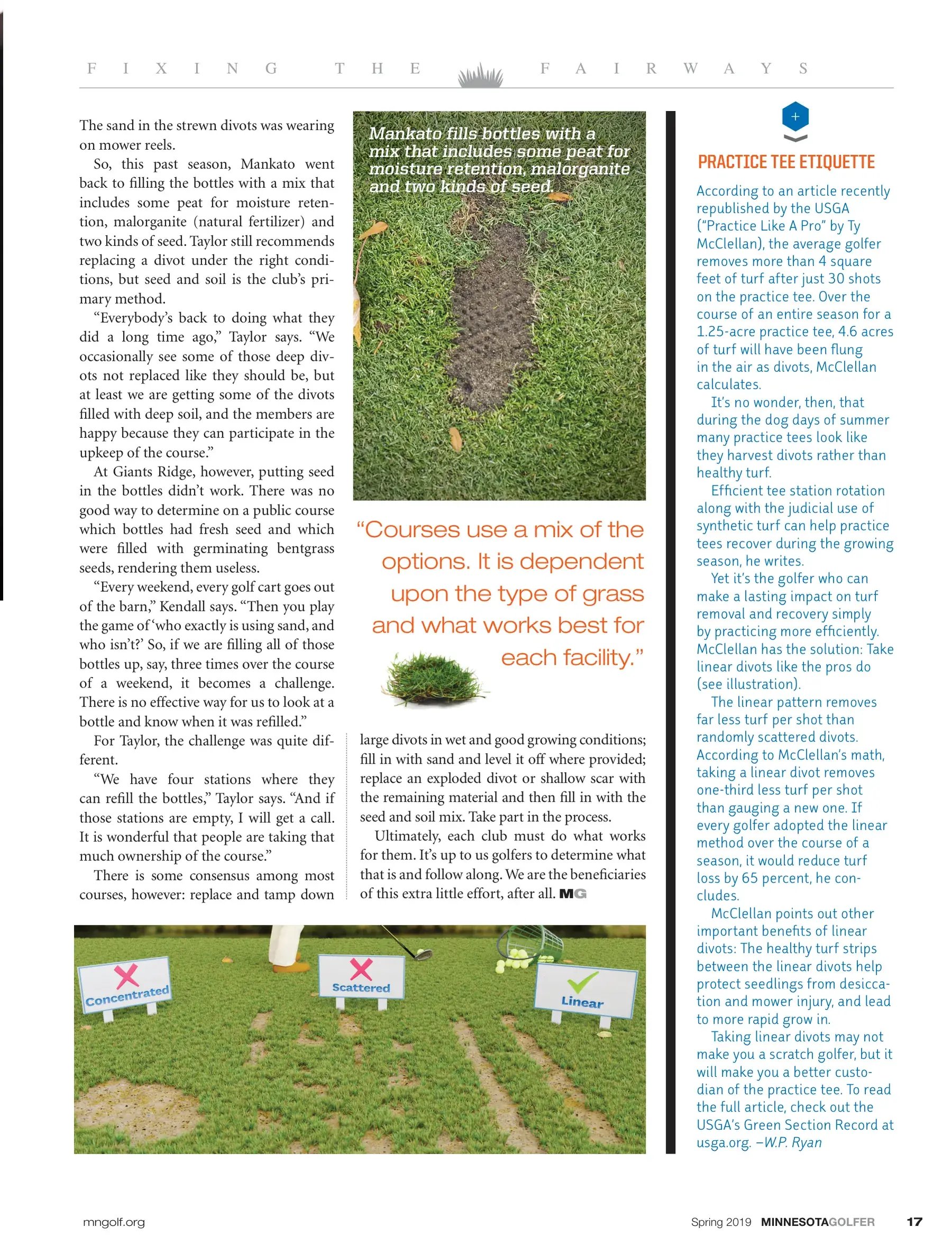
Yet it’s the golfer who can make a lasting impact on turf removal and recovery simply by practicing more effi ciently. McClellan has the solution: Take linear divots like the pros do (see illustration).
The linear pattern removes far less turf per shot than randomly scattered divots. According to McClellan’s math, taking a linear divot removes one-third less turf per shot than gauging a new one. If every golfer adopted the linear method over the course of a season, it would reduce turf loss by 65 percent, he concludes.
McClellan points out other important benefi ts of linear divots: The healthy turf strips between the linear divots help protect seedlings from desiccation and mower injury, and lead to more rapid grow in.
Taking linear divots may not make you a scratch golfer, but it will make you a better custodian of the practice tee. To read the full article, check out the USGA’s Green Section Record at usga.org. —W.P. Ryan PRACTICE TEE ETIQUETTE “Courses use a mix of the options. It is dependent upon the type of grass and what works best for each facility.”
large divots in wet and good growing conditions; fill in with sand and level it off where provided; replace an exploded divot or shallow scar with the remaining material and then fill in with the seed and soil mix. Take part in the process.
Ultimately, each club must do what works for them. It’s up to us golfers to determine what that is and follow along. We are the benefi ciaries of this extra little effort, after all. MG T he first player to jam a tee into the Hazeltine National Golf Club turf on Thursday morning, June 20, will be one of 156 vying for the chance to hoist the 2 1⁄2-foot tall and roughly 25-pound KPMG Women’s PGA Championship trophy on Sunday evening.
Kerry Haigh, for one, is excited about it. The chief championship offi cer for the PGA of America—hence the man responsible for the course setup—hasn’t lost his zest for seeing the best women players in the world plying their trade. Haigh worked directly for the LPGA from 1985 through 1988, working about 32 events a year.
“I certainly learned a lot and saw a lot in that time,” Haigh says. “And fortunately that was when Nancy Lopez was in her prime—among others, of course, but Nancy was No. 1 then.”
Lopez burst onto the scene in 1978 and pretty much brought down the house, earning dual titles by being named the LPGA Rookie of the Year and the Player of the Year. That feat wasn’t repeated for almost 40 years, until Sung Hyun Park pulled it off in 2017. Park will arrive at Hazeltine as the defending champion of the KPMG Women’s PGA Championship.
After 42 years, the top female golfers return to Minnesota for the KPMG Women’s PGA Championship. • BY TOM BEDELL • Spring 2019 MINNESOTAGOLFER 19 ARIYA JUTANUGARN SUNG HYUN PARK SO YEON RYU Tournament History For those a little rusty on the tournament history, it is, next to the U.S. Women’s Open, the second longest-running of LPGA events (the first staged in 1955 at the Orchard Ridge Country Club in Fort Wayne, Indiana). The format that year was an odd blend of three rounds of stroke play and a final 36-hole round of match play, and Beverly Hanson outlasted Louise Suggs, 4 and 3, to take the first title.
Then known as the LPGA Championship, the tournament became a partnership in 2015 between KPMG (one of the socalled “Big Four” of accounting firms), the LPGA and the PGA of America, the latter charged with managing the tournament.
One goal of the merger, Haigh notes, was to elevate the event into an even better major championship than it had been previously. Purses immediately leapt to $3.5 million. Last year, they climbed to $3.65 million. This year’s purse is up another $200,000 to $3.85 million.
“Another part of that change was to bring the tournament to prestigious and great golf courses, and Hazeltine certainly fits into that,” Haigh says.
Hazeltine is no stranger to majors, men and women’s, having hosted the U.S. Women’s Open in 1966 and 1977. (Win your bar trivia bets by being able to name the winners: Sandra Spuzich in 1966 [+9] and Hollis Stacy in 1977 [+4].) Course Setup Though this is the first go-round for the Women’s PGA Championship, the tournament reassembles much of the same team that handled logistics for the 2016 Ryder Cup.
Haigh and Hazeltine superintendent Chris Tritabaugh will deal with most of the action inside the ropes, while Renee DeLosh, who handled hospitality at the Ryder Cup, is now the championship director.
In a masterpiece of good timing, Tritabaugh was on a family vacation in Hawaii when the polar vortex descended on Minnesota in late January, but he expected no problems from the cold: “The almost 100 percent bentgrass we have on our short surfaces stands up really well to winter weather, and we have some snow on the ground which will help insulate it from the really cold temperatures. You never know, of course; Minnesota is always a little bit of a crap shoot. But I don’t expect any impact from the weather.”
Before the Ryder Cup, Haigh said to Tritabaugh, “You’re our agronomist for this event, and we’re going to trust your judgment when it comes to the course.” The partnership obviously worked well.
“Working with Kerry has been one of the highlights of my career so far,” Tritabaugh says. “He has his hand in so much at these events it’s mind-boggling. But his ability to set up a golf course in a way that’s fair and enjoyable for players? He’s just one of the best at it.”
With the Ryder Cup still fairly prominent in their rearview mirror, the pair haven’t really had any major adjustments to make. The two most notable changes will be the routing and the length of the rough. Unlike the Ryder Cup teams, the women will play the course in its normal sequence, par-72, from a maximum length of 6,807 yards.
“Kerry has set up a bit of a hybrid of our gold tees, which are our member tees, and our blue tees, which are the back tees,” Tritabaugh says. “The number is a bit longer than what our member tees normally play, which is a testament to the women—not only how far they hit the ball but how accurate they are from back there. But from the standpoint of our membership, I know they’ll be excited to watch the women playing from spots they play from daily.”
The fairways will be about the same width as they were at the Ryder Cup. The difference will be in the rough. “The rough will be higher and more difficult than it was at the Ryder Cup where, at the home captain’s request, we kept it fairly low,” Haigh says.
Tritabaugh chuckles a bit at the memory: “The European team had some criticisms about that—of course the losing team always does. But there was a lot of intent behind it: to make the course yield birdies, create excitement from the fans and get the crowd into it to make noise.
“For the women, it’s going to be tougher. We’ll do some mowing of the rough early in the week, but then we’ll allow it to grow up as the weekend goes on—about the same you’d anticipate for a major championship on the men’s side.”
Players to Watch As of early February when we went to press, the No. 1 ranked player was Ariya Jutanugarn of Thailand, who has 10 LPGA wins under her belt, including last year’s U.S. Women’s Open and the 2016 Ricoh Women’s British Open.
And if Ariya should falter, there’s always her sister, 2013 LPGA Rookie of the Year Moriya Jutanugarn, to watch out for. “We’ve always had a great turnout in Minnesota. ... I’m looking forward to it.”
-Karrie Webb, World Golf Hall of Famer LEXI THOMPSON Spring 2019 MINNESOTAGOLFER 21 But no one would deny Sung Hyun Park’s chances of defending her PGA title. The South Korean’s amazing full-season LPGA debut in 2017 included play in 23 tournaments and 23 cuts made. She had 11 top-10 finishes and two wins, including the 2017 Women’s Open. She finished No. 1 on the money list, copped the Rookie of the Year title and shared Player of the Year honors with So Yeon Ryu. In November 2017, she was ranked the No. 1 female golfer in the world.
Last year, Park missed a few cuts, finished a mere third in the overall money list and ceded the No. 1 ranking to Jutanugarn. But she won three times, including the KPMG Women’s PGA Championship at Kemper Lakes Golf Club in Illinois.
Haigh, who, naturally, was on hand for the three-way playoff between Park, Ryu and Nasa Hataoka, says, “Park is a wonderful player with a beautiful golf swing. She works hard on her game and played beautifully to win last year’s event. But I think anyone who has been to a tournament in recent years has seen how the ability and quality of play is unbelievably good and strong.”
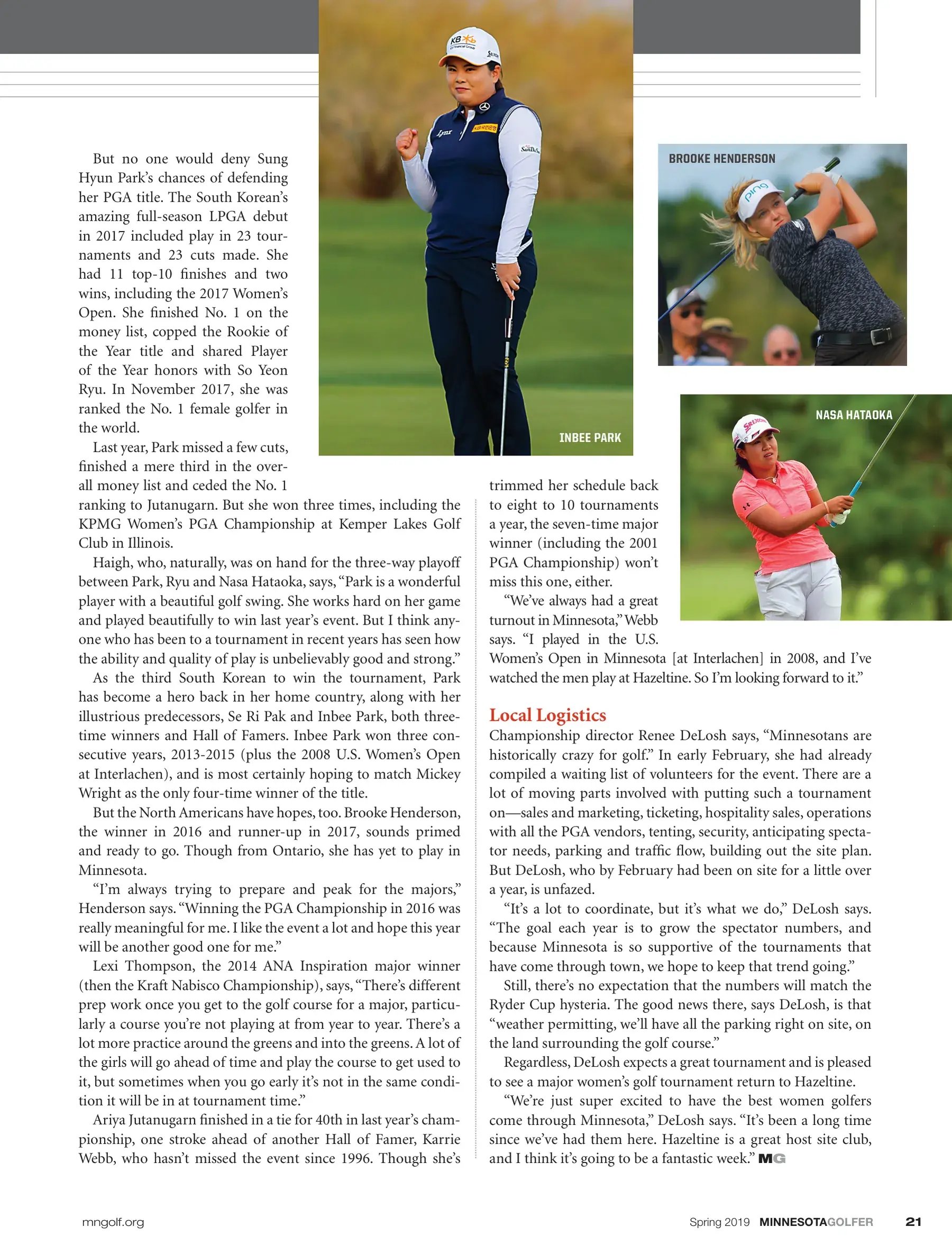
As the third South Korean to win the tournament, Park has become a hero back in her home country, along with her illustrious predecessors, Se Ri Pak and Inbee Park, both threetime winners and Hall of Famers. Inbee Park won three consecutive years, 2013-2015 (plus the 2008 U.S. Women’s Open at Interlachen), and is most certainly hoping to match Mickey Wright as the only four-time winner of the title.
But the North Americans have hopes, too. Brooke Henderson, the winner in 2016 and runner-up in 2017, sounds primed and ready to go. Though from Ontario, she has yet to play in Minnesota.
“I’m always trying to prepare and peak for the majors,” Henderson says. “Winning the PGA Championship in 2016 was really meaningful for me. I like the event a lot and hope this year will be another good one for me.”
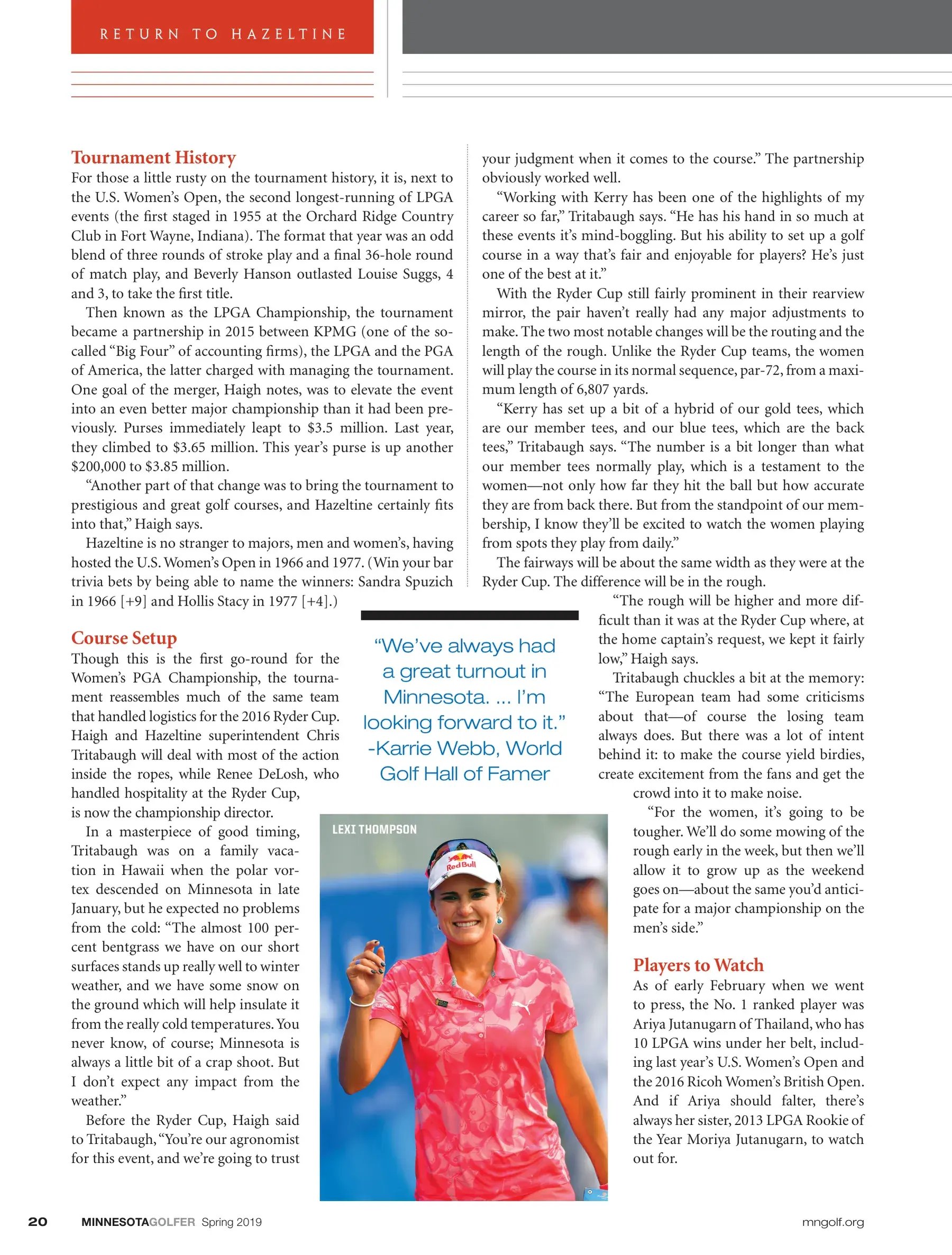
Lexi Thompson, the 2014 ANA Inspiration major winner (then the Kraft Nabisco Championship), says, “There’s different prep work once you get to the golf course for a major, particularly a course you’re not playing at from year to year. There’s a lot more practice around the greens and into the greens. A lot of the girls will go ahead of time and play the course to get used to it, but sometimes when you go early it’s not in the same condition it will be in at tournament time.”
Ariya Jutanugarn finished in a tie for 40th in last year’s championship, one stroke ahead of another Hall of Famer, Karrie Webb, who hasn’t missed the event since 1996. Though she’s trimmed her schedule back to eight to 10 tournaments a year, the seven-time major winner (including the 2001 PGA Championship) won’t miss this one, either.
“We’ve always had a great turnout in Minnesota,” Webb says. “I played in the U.S. Women’s Open in Minnesota [at Interlachen] in 2008, and I’ve watched the men play at Hazeltine. So I’m looking forward to it.”
Local Logistics Championship director Renee DeLosh says, “Minnesotans are historically crazy for golf.” In early February, she had already compiled a waiting list of volunteers for the event. There are a lot of moving parts involved with putting such a tournament on—sales and marketing, ticketing, hospitality sales, operations with all the PGA vendors, tenting, security, anticipating spectator needs, parking and traffic flow, building out the site plan.
But DeLosh, who by February had been on site for a little over a year, is unfazed. “It’s a lot to coordinate, but it’s what we do,” DeLosh says.
“The goal each year is to grow the spectator numbers, and because Minnesota is so supportive of the tournaments that have come through town, we hope to keep that trend going.”
Still, there’s no expectation that the numbers will match the Ryder Cup hysteria. The good news there, says DeLosh, is that “weather permitting, we’ll have all the parking right on site, on the land surrounding the golf course.”
Regardless, DeLosh expects a great tournament and is pleased to see a major women’s golf tournament return to Hazeltine. “We’re just super excited to have the best women golfers come through Minnesota,” DeLosh says. “It’s been a long time since we’ve had them here. Hazeltine is a great host site club, and I think it’s going to be a fantastic week.” MG INBEE PARK BROOKE HENDERSON NASA HATAOKA Join today!
Fulfillment of these promotions/offers is the sole responsibility of ClubCorp. MAKE YOUR NEXT GAME AN AWAY GAME. Tee it up with your Play Away Membership (formerly ClubCorp Travel). You’ll enjoy complimentary * green fees, savor complimentary * meals with spectacular views and so much more when you travel!
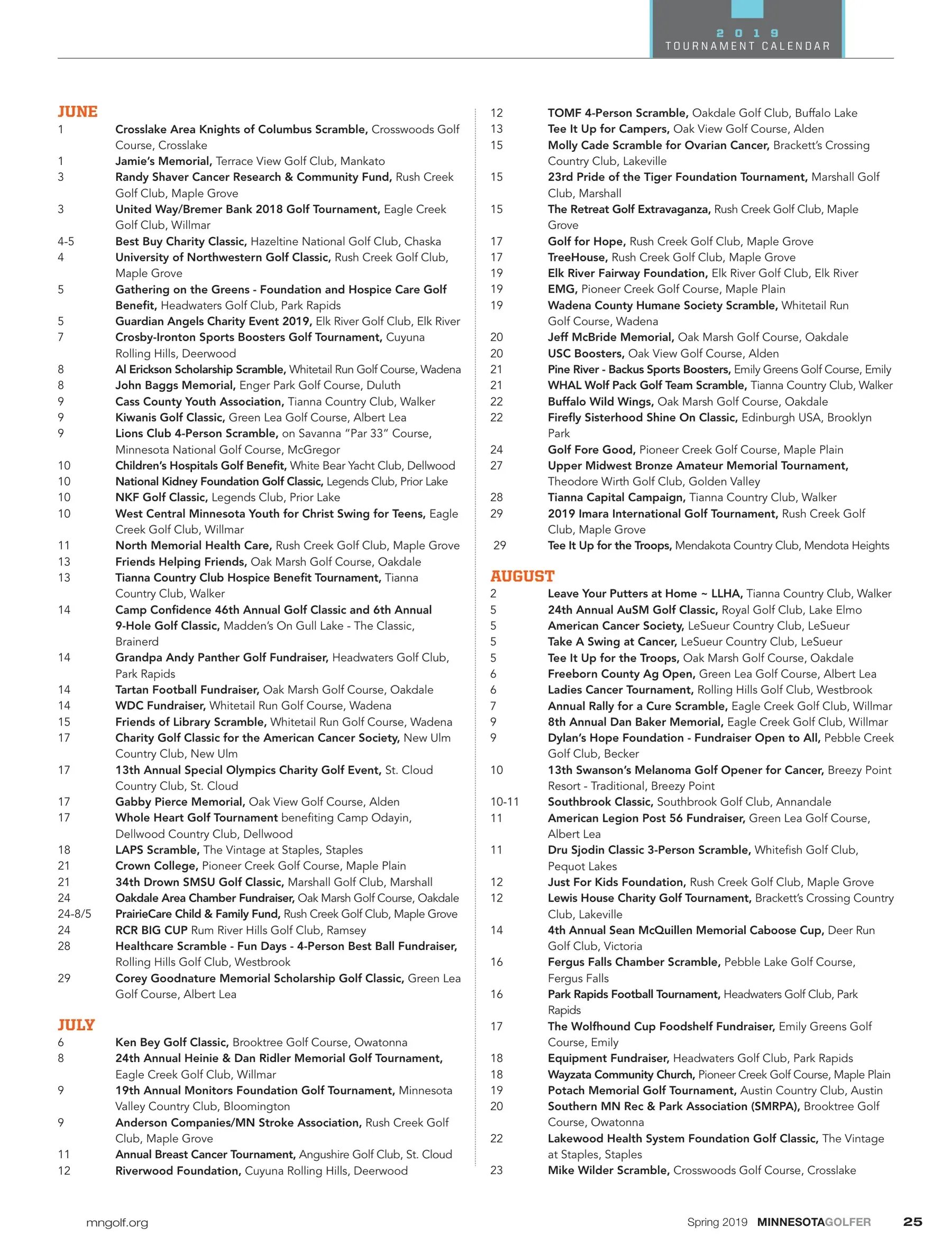
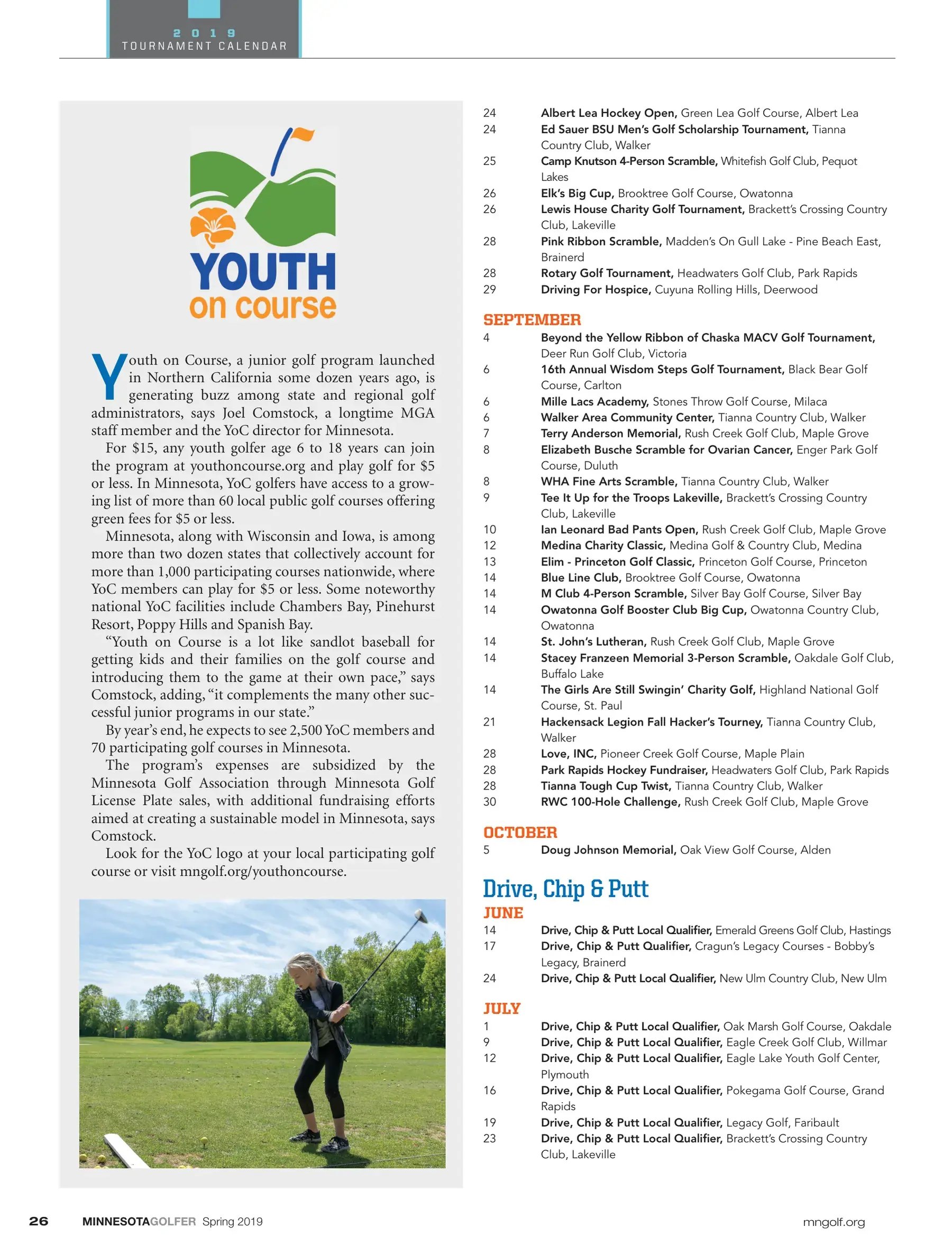
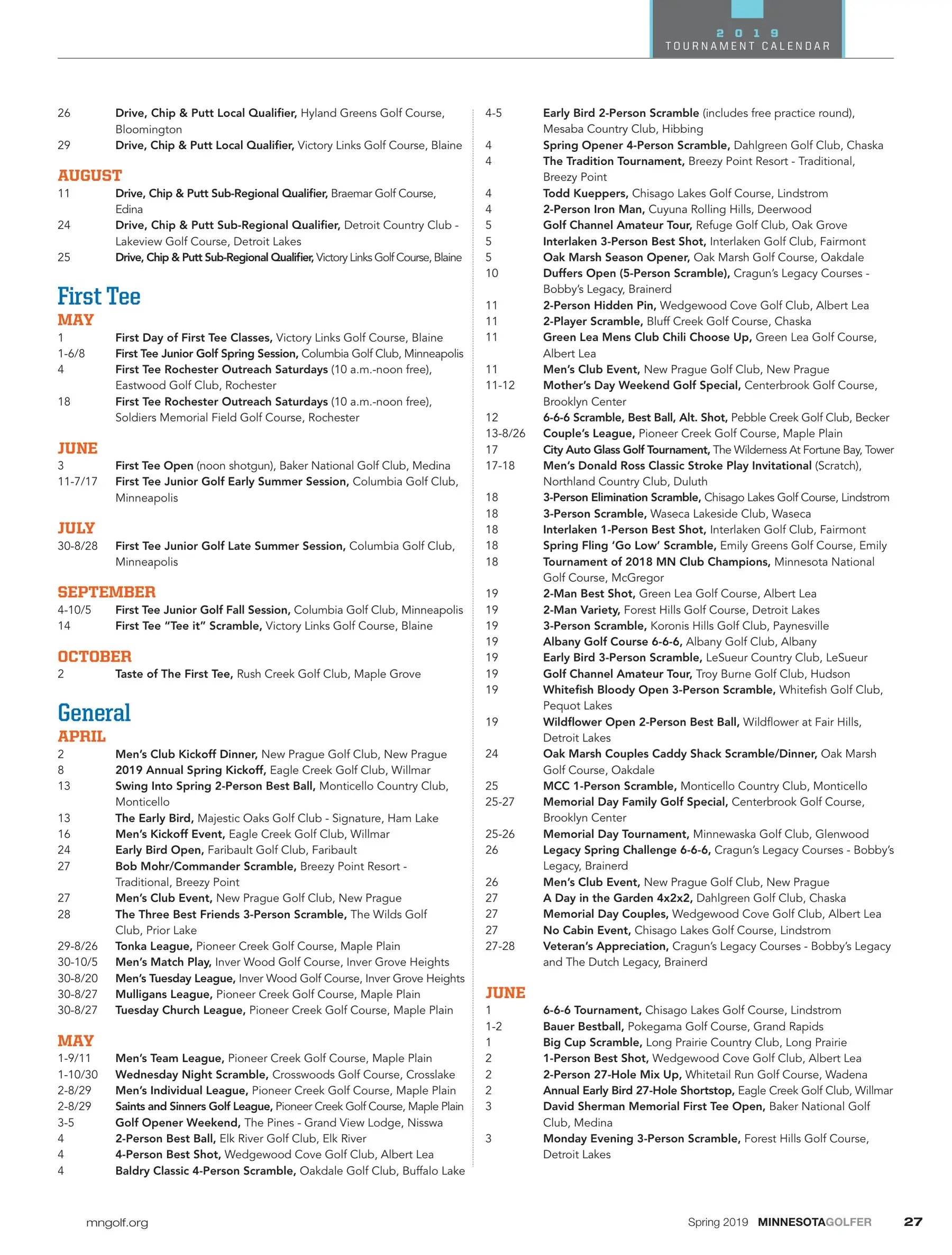
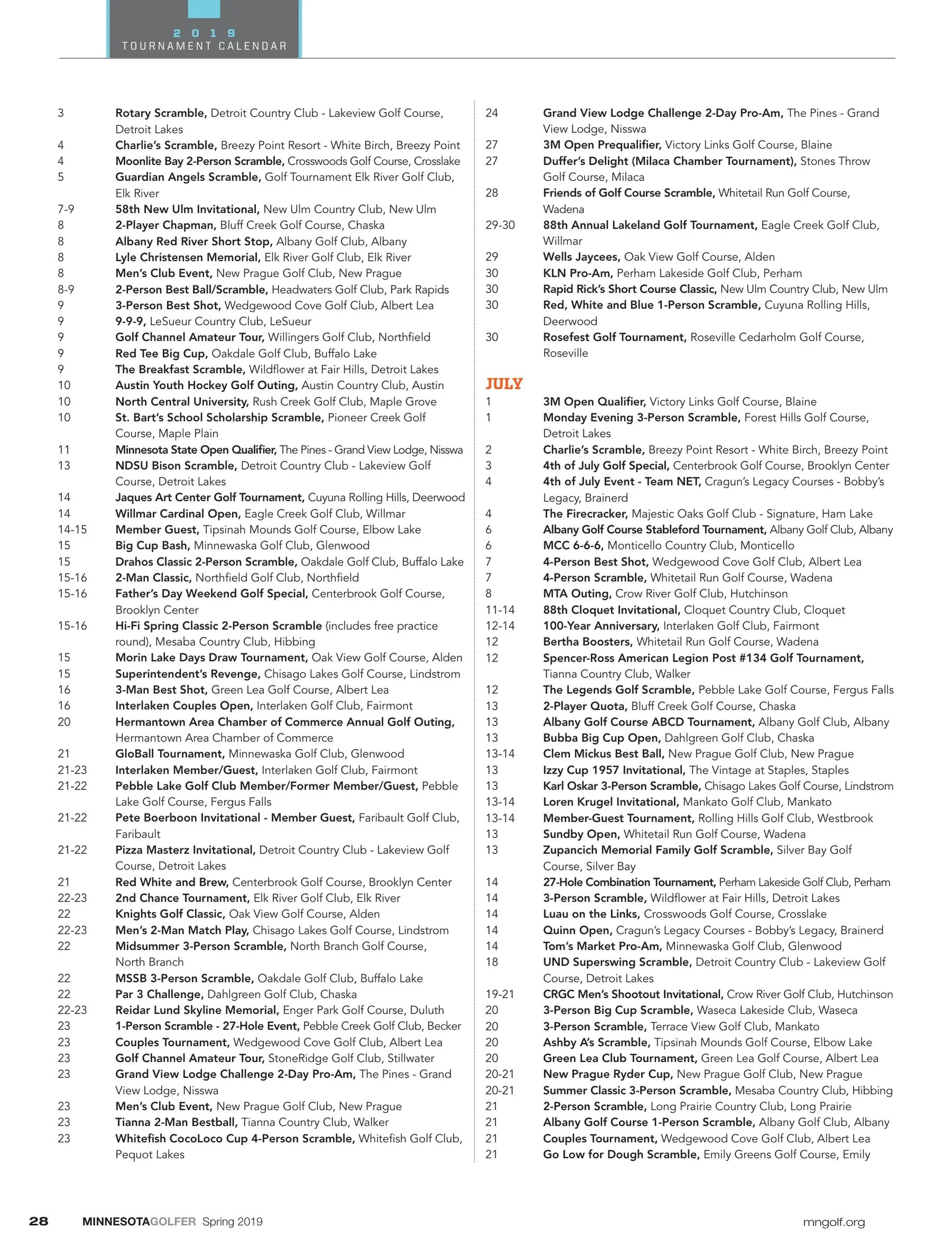
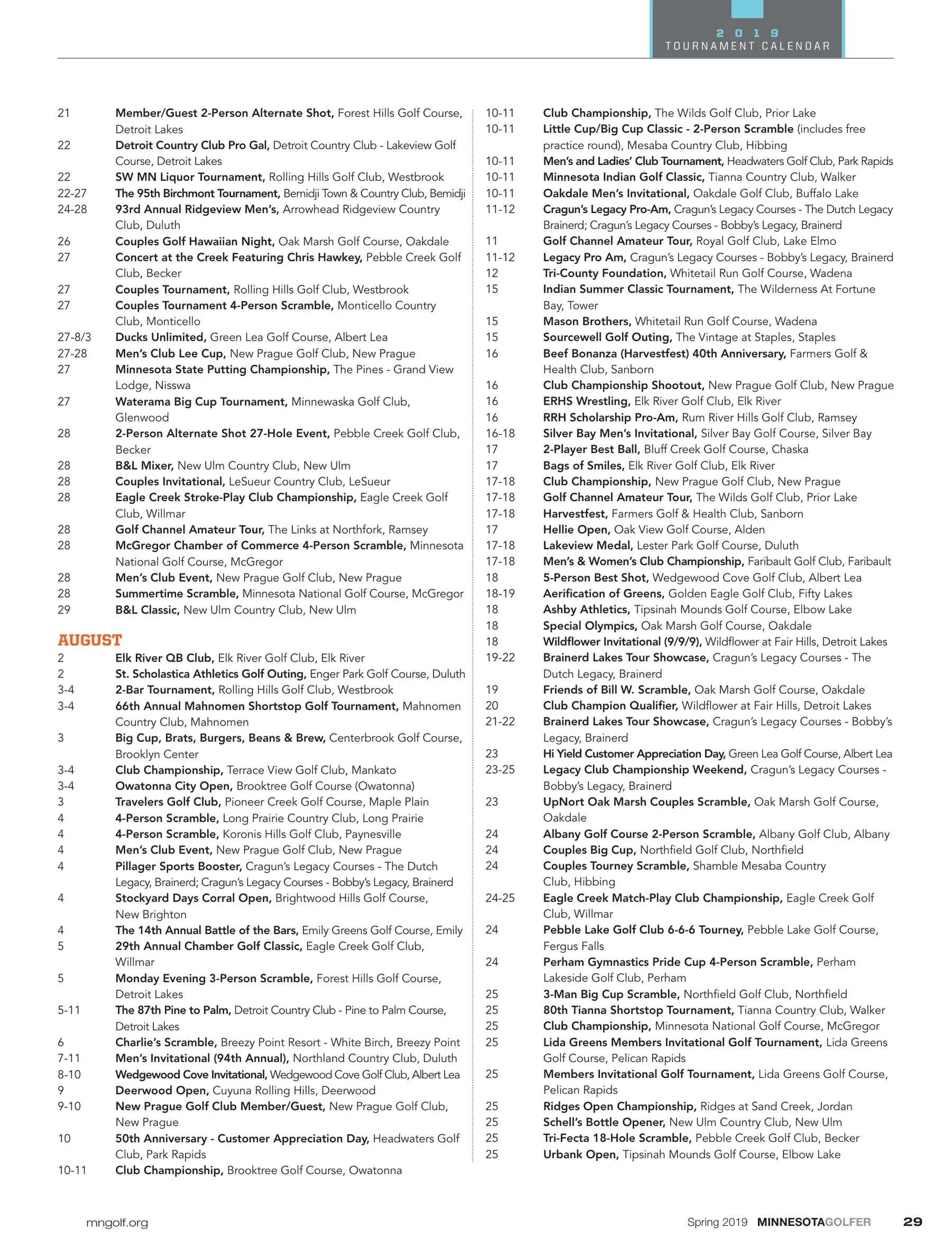
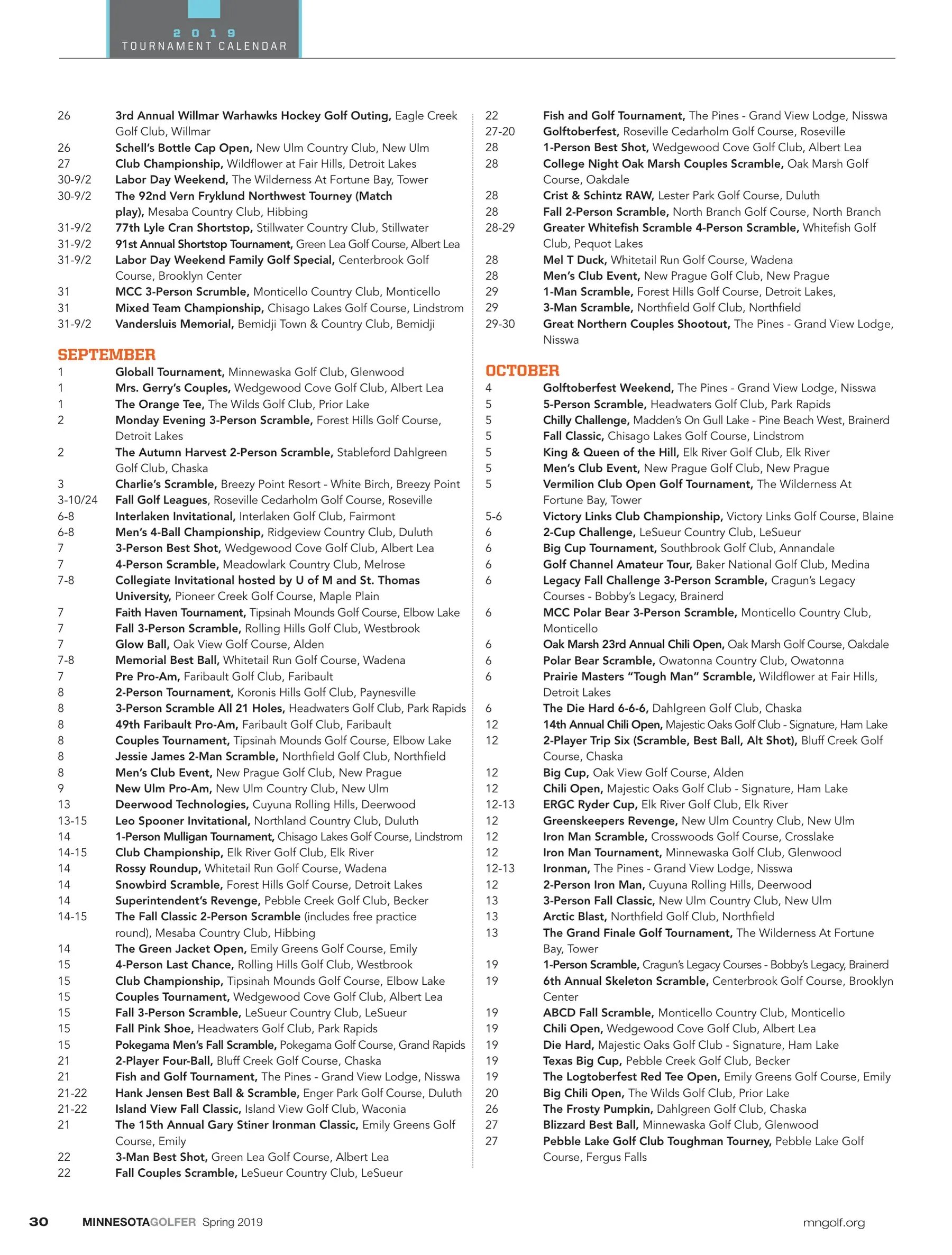
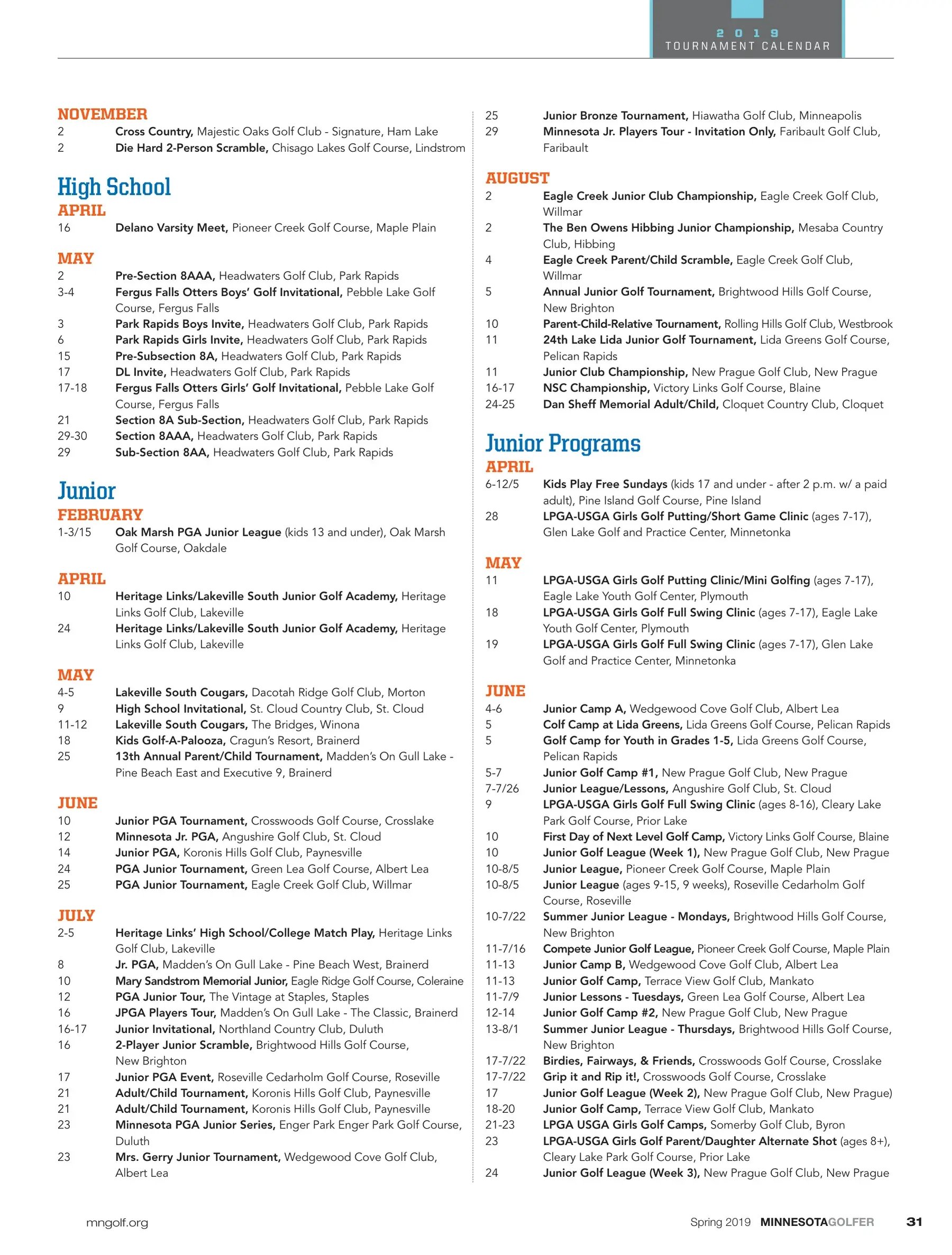
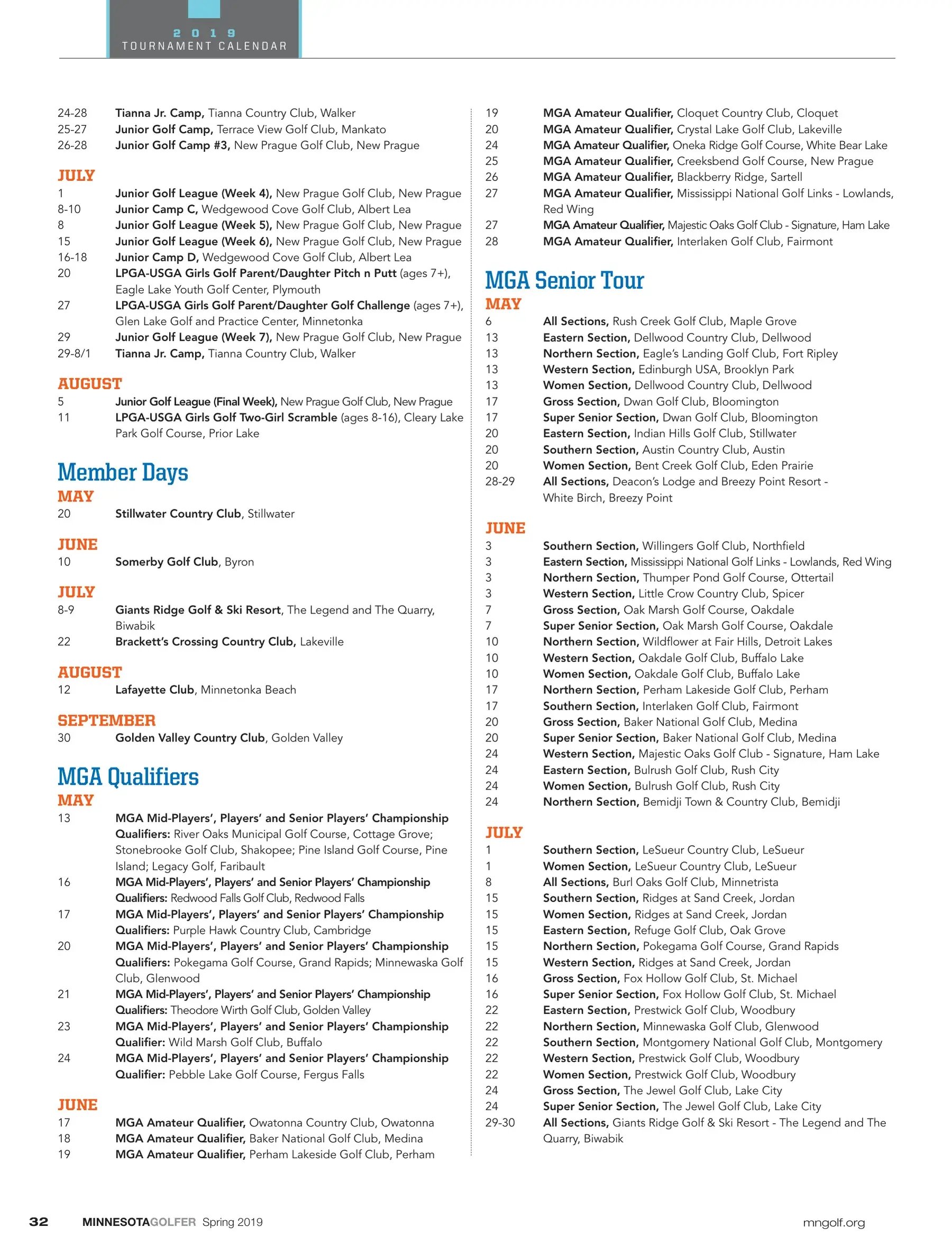
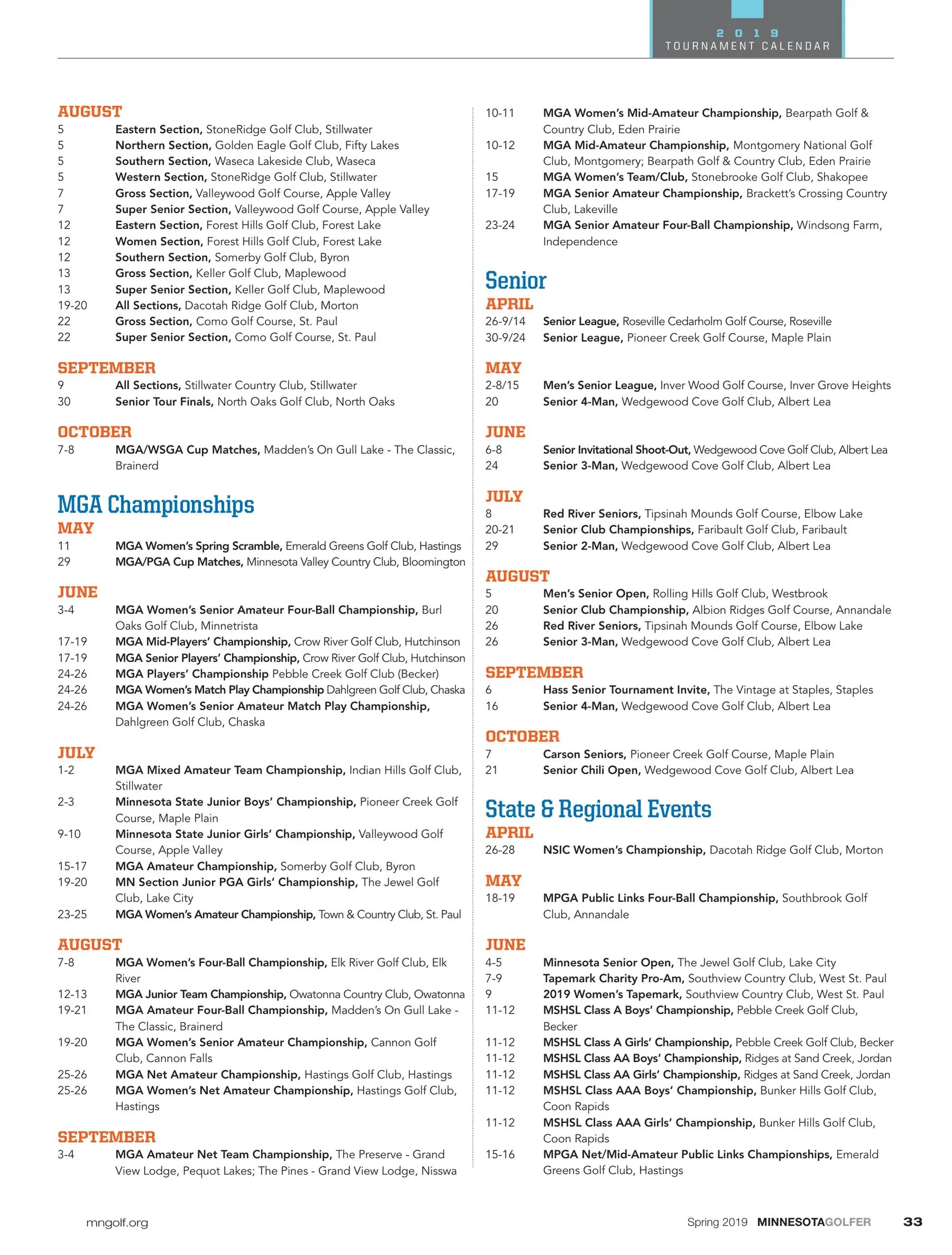
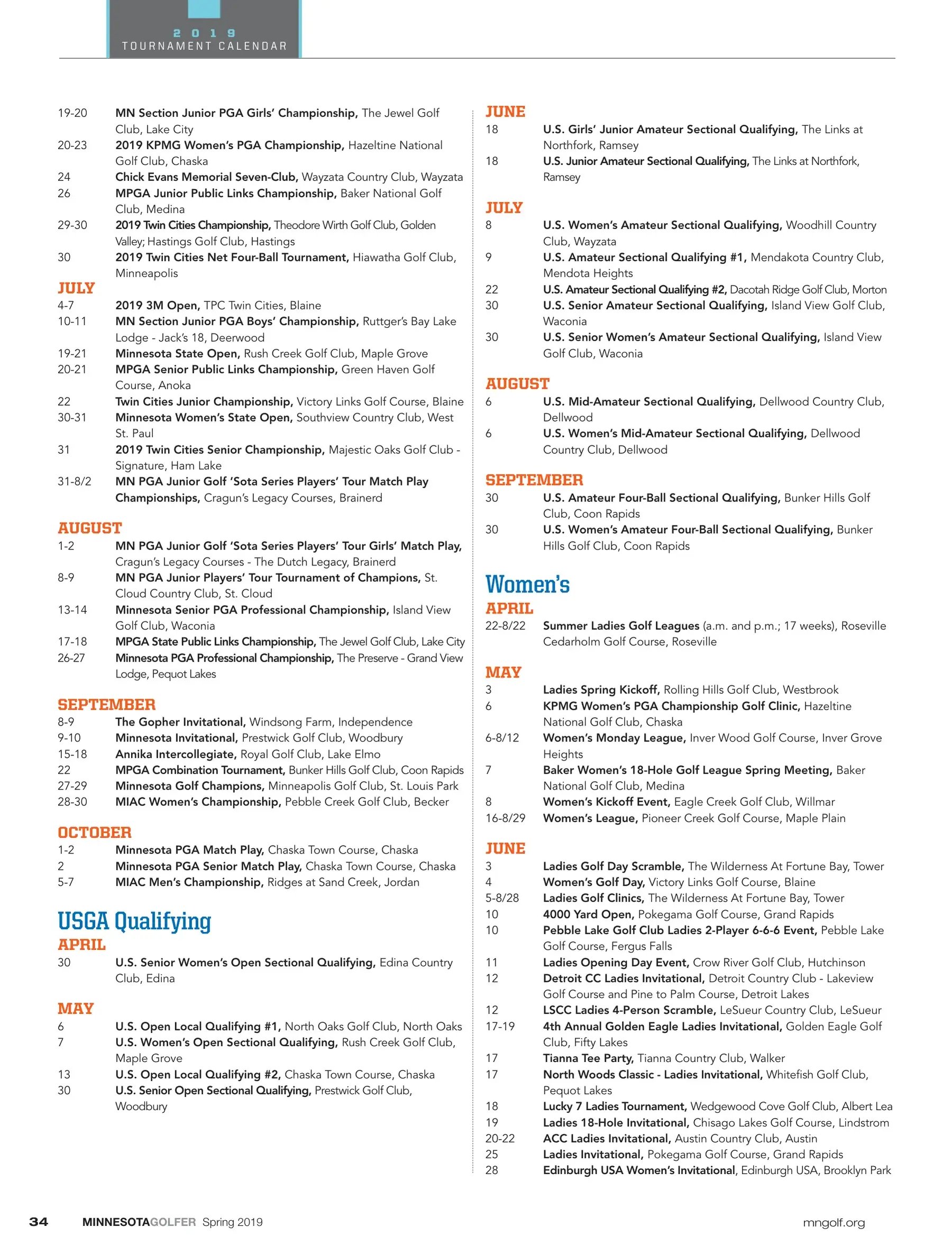
Bring Your Family APRIL 19-11/10 Family Fun Zone–play golf for $7, Brightwood Hills Golf Course, New Brighton MAY Mother’s Day, The Wilderness At Fortune Bay, Tower 19-8/25 FamScram League, Pioneer Creek Golf Course, Maple Plain Staples Lions Par 3 Challenge, The Vintage at Staples, Staples JUNE 2-Person Best Ball, Best Shot Rolling Hills Golf Club, Westbrook Father’s Day, The Wilderness At Fortune Bay, Tower Father’s Day, Best Ball Son/Daughter, The Vintage at Staples, Staples Nine and Dine on a Dime, Roseville Cedarholm Golf Course, Roseville Take your golf game on the road this summer. Check out this list of tournaments happening at MGA member golf courses all over the state. There’s golf for kids, seniors, men, women and mixed teams. If golfi ng for a good cause is your thing, start with the “Charity”
category (below). A special thank you to the MGA member clubs and program organizers who contributed to this listing. Would you like to see your favorite golf event listed here? Contact the MGA at editor@mngolf.org.
For $15, any youth golfer age 6 to 18 years can join the program at youthoncourse.org and play golf for $5 or less. In Minnesota, YoC golfers have access to a growing list of more than 60 local public golf courses offering green fees for $5 or less.
Minnesota, along with Wisconsin and Iowa, is among more than two dozen states that collectively account for more than 1,000 participating courses nationwide, where YoC members can play for $5 or less. Some noteworthy national YoC facilities include Chambers Bay, Pinehurst Resort, Poppy Hills and Spanish Bay.
“Youth on Course is a lot like sandlot baseball for getting kids and their families on the golf course and introducing them to the game at their own pace,” says Comstock, adding, “it complements the many other successful junior programs in our state.”
By year’s end, he expects to see 2,500 YoC members and 70 participating golf courses in Minnesota. The program’s expenses are subsidized by the Minnesota Golf Association through Minnesota Golf License Plate sales, with additional fundraising efforts aimed at creating a sustainable model in Minnesota, says Comstock.
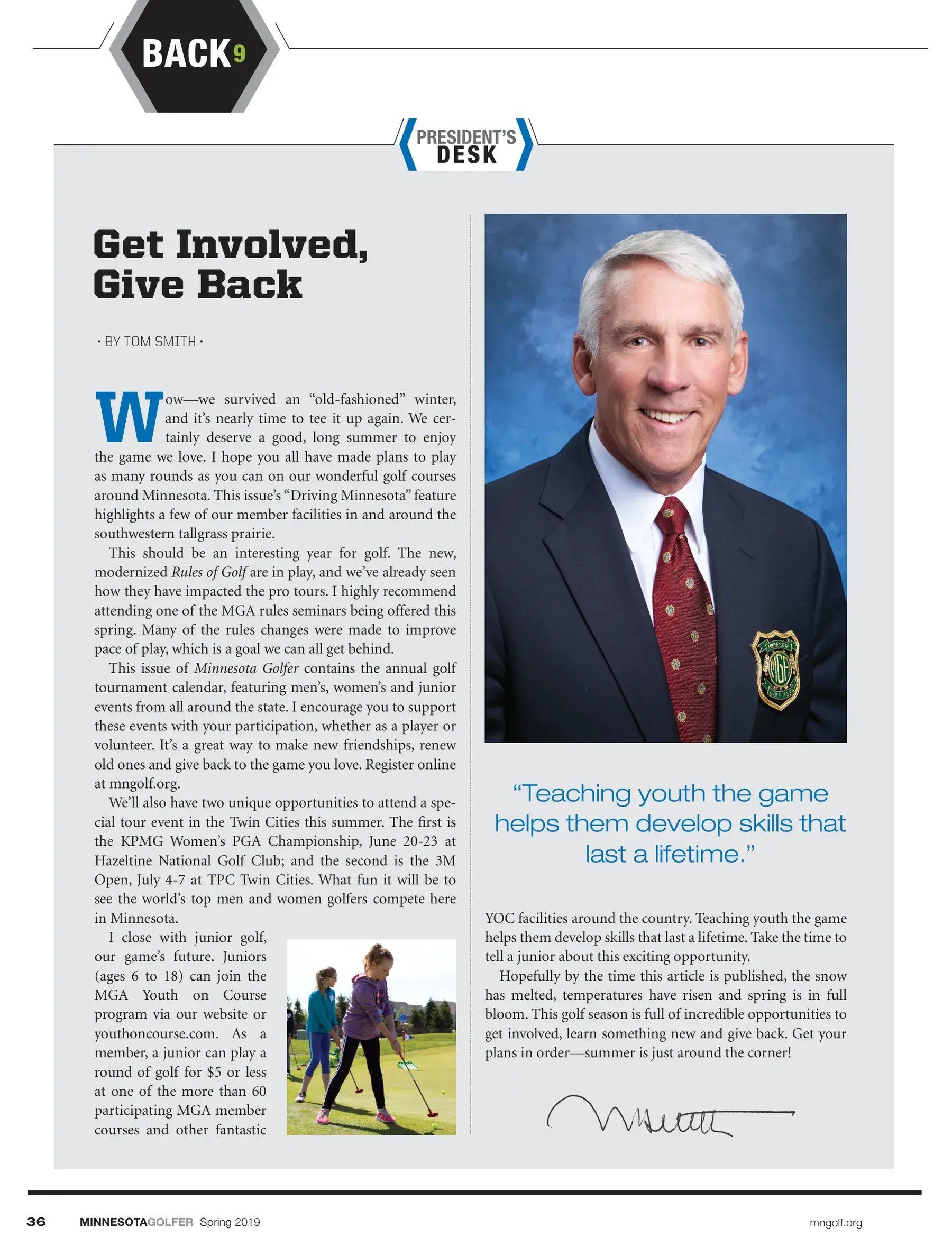
This should be an interesting year for golf. The new, modernized Rules of Golf are in play, and we’ve already seen how they have impacted the pro tours. I highly recommend attending one of the MGA rules seminars being offered this spring. Many of the rules changes were made to improve pace of play, which is a goal we can all get behind.
This issue of Minnesota Golfer contains the annual golf tournament calendar, featuring men’s, women’s and junior events from all around the state. I encourage you to support these events with your participation, whether as a player or volunteer. It’s a great way to make new friendships, renew old ones and give back to the game you love. Register online at mngolf.org.
We’ll also have two unique opportunities to attend a special tour event in the Twin Cities this summer. The first is the KPMG Women’s PGA Championship, June 20-23 at Hazeltine National Golf Club; and the second is the 3M Open, July 4-7 at TPC Twin Cities. What fun it will be to see the world’s top men and women golfers compete here in Minnesota.
I close with junior golf, our game’s future. Juniors (ages 6 to 18) can join the MGA Youth on Course program via our website or youthoncourse.com. As a member, a junior can play a round of golf for $5 or less at one of the more than 60 participating MGA member courses and other fantastic YOC facilities around the country. Teaching youth the game helps them develop skills that last a lifetime. Take the time to tell a junior about this exciting opportunity.
Hopefully by the time this article is published, the snow has melted, temperatures have risen and spring is in full bloom. This golf season is full of incredible opportunities to get involved, learn something new and give back. Get your plans in order—summer is just around the corner!
• BY TOM SMITH • “Teaching youth the game helps them develop skills that last a lifetime.” MGA NEWS Spring 2019 MINNESOTAGOLFER 37 The USGA announced a number of future sites for the U.S.
Amateur championship, and Hazeltine National Golf Club, the site of the 2006 Amateur, is among them. Hazeltine will host the 2024 Amateur (along with the Chaska Town Course), and it will become the club’s 10th USGA championship, as the course will also be the site of the 2020 U.S.
Junior Amateur. In 2006, Hazeltine was home to an exciting Amateur championship in which Richie Ramsay, the first player from Scotland to win the title since 1898, defeated John Kelly, 4 and 2, in the championship final.
U.S. Amateur Returns to Hazeltine National In January, multiple amateur champion Claudia Pilot was playing in a weekly ladies-day golf event at the Apache Course of Desert Mountain in Scottsdale, Ariz., with her friends Kathy Henderson, Gina Woodruff and Anita Wallace. The foursome reached the 78-yard third hole where something remarkable happened.
Pilot, who teed off second, hit her drive with a 54-degree Mack daddy wedge into the hole for a one. Not that extraordinary considering it was the sixth ace of her career. But the fun was only beginning. Henderson hit next with a gap wedge and matched Pilot’s ace.
“Mine was first,” Pilot says. “It looked like it was on the lip, but it was actually being held on the inside edge of the cup with the flagstick. I was a little bummed, thinking it was on the lip, but a gust of wind came up and it disappeared. We were all cheering and high-fiving.
Then Kathy said, ‘that’s so cool—I want one, too!’ And she gets up and drops it in the hole on top of mine! It was so surreal.” Friends had a bottle of champagne waiting for them in the clubhouse, and the group celebrated while calculating the odds of such a feat. The chances of a foursome scoring two holes-inone in a round have been set at 1.3 million to 1, but for two in a foursome acing the same hole they are 26 million to 1. Those odds might be a little high, however, when you consider Pilot and Henderson’s playing partners.
“Gina had witnessed a hole-in-one two days earlier—so she witnessed three of them in two rounds,” Pilot says. “And Anita had witnessed back-to-back aces in 2016 at the Desert Mountain Chiricahua course.
They were definitely good luck charms!” Two Is Better Than A One In February, the USGA Amateur Status Committee ruled that amateur golfer Lucy Li from California breached Rule 6-2 of the Rules of Amateur Status by participating in an Apple Watch “Close Your Rings”
advertisement campaign. The USGA reviewed the situation and conferred with Li, her family and Apple and “confirmed that Ms. Li has neither received, nor will receive in the future, any monetary or non-monetary compensation for her appearance in the advertisement,”
according to a USGA press release. As a result, the USGA has issued Ms. Li (who never intended to forfeit her amateur status) a one-time warning—and she will retain her amateur status.
To protect their amateur status, the USGA recommends golfers engage with their local governing body (in Minnesota, the MGA) early in the process.
Li Retains Amateur Status Corrections >> In the Directory issue’s 2018 Club Champions’ listings, Golden Valley Country Club’s champions were omitted by error. They are: Jesse Bull (men’s), Brad Swanson (senior men’s), Maggie Masica (women’s), and Stuart Handzel (junior boys’). In the Editor’s Letter, “Trending Topics,” Kapalua, home to the PGA Tour’s Tournament of Champions, was incorrectly identified as being on Hawaii’s Big Island. It is on Maui. In a tribute to Minnesota Valley Country Club’s history, architect Seth Raynor was incorrectly listed as having designed the University Golf Club/Les Bolstad golf course. Tom Vardon deserves credit for the Bolstad course. We regret the errors.
Changes >> Nick Klinkhammer is the new superintendent at Faribault Golf Club. Scott Peterson is the senior men’s club champion at Tanners Brook Golf Club.
3 in the world, joins Mickelson, who is ranked 20th in the world rankings, as the fifth top-20 golfer scheduled to play. In recent news, Bryson DeChambeau (5th), Jason Day (12th), Patrick Reed (16th), Siwoo Kim (54th) and K.J.
Choi (825th) have also made commitments. Mickelson, who has won 44 times on the PGA Tour—including this past January at Pebble Beach—called the timing of the tour stop over the national holiday perfect for his schedule, and said it was exciting to see the tour return to the Twin Cities. The last time a regular PGA Tour event was held in Minnesota was in 1969, when the long-running St. Paul Open, held at the Keller Golf Club from 1930-1968, was renamed the Minnesota Classic and moved to Braemar Golf Course. Frank Beard won with a 15-under-par 269.
Thanks to James E. Kelley and his book, “Minnesota Golf,” for the St. Paul Open history and this explanation of why the locals “loved” the event: “It was all there—drama, showmanship, thrills, heartbreaks and parblasting beyond reason,” he wrote.
The Fairway Foundation The Fairway Foundation uses the game of golf to teach lifetime values and skills to youth who would not otherwise have an opportunity to be exposed to the game.
The First Tee The First Tee was established to impact the lives of young people around the world by creating affordable and accessible golf facilities to primarily serve those not previously exposed to the game and its positive values. For more information, go to thefirsttee.org.
The Ladies Professional Golf Association, LPGA The Ladies Professional Golf Association encompasses both the LPGA Tour and the LPGA Teaching and Club Professionals.
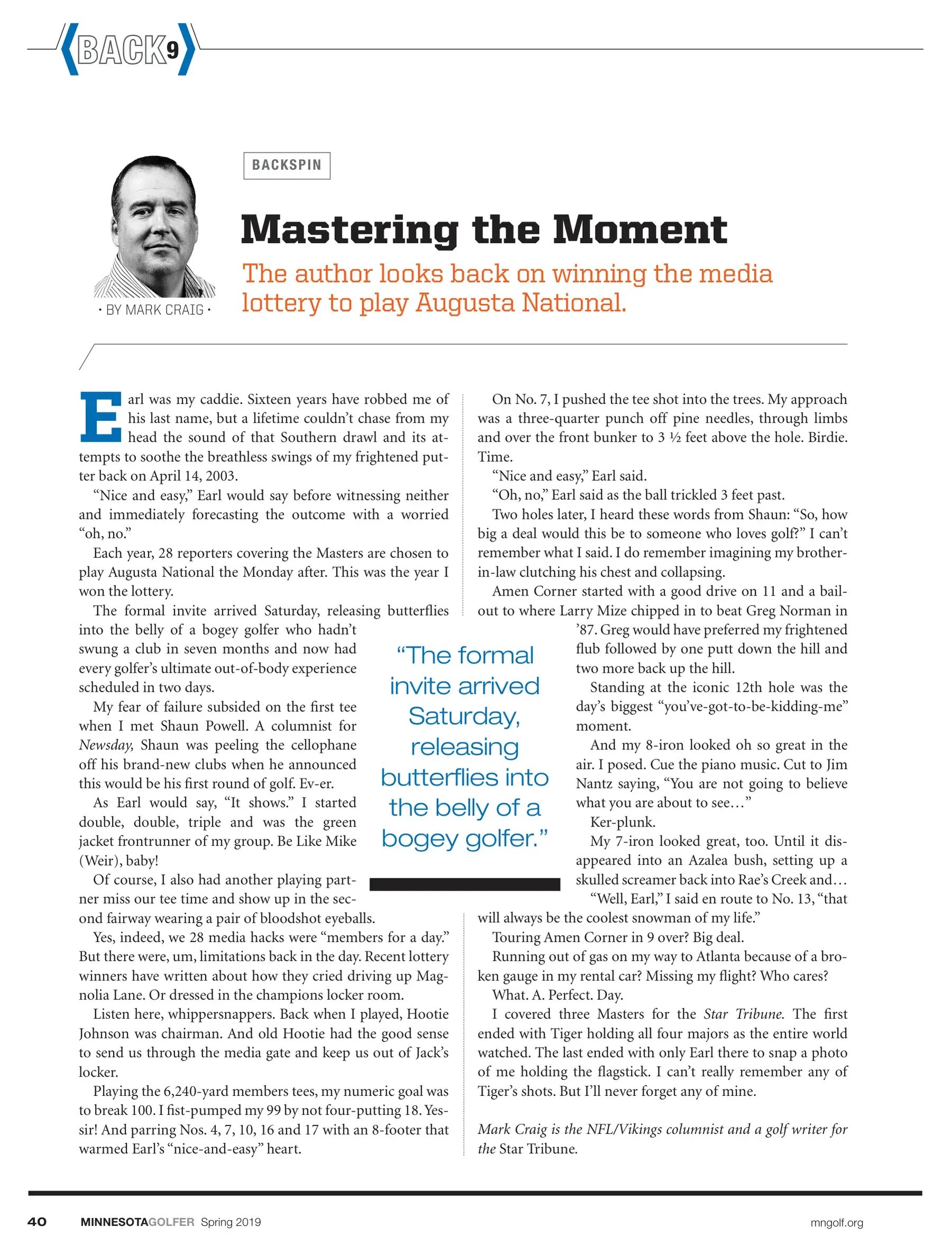
“Nice and easy,” Earl would say before witnessing neither and immediately forecasting the outcome with a worried “oh, no.” Each year, 28 reporters covering the Masters are chosen to play Augusta National the Monday after. This was the year I won the lottery.
The formal invite arrived Saturday, releasing butterflies into the belly of a bogey golfer who hadn’t swung a club in seven months and now had every golfer’s ultimate out-of-body experience scheduled in two days.
My fear of failure subsided on the first tee when I met Shaun Powell. A columnist for Newsday, Shaun was peeling the cellophane off his brand-new clubs when he announced this would be his first round of golf. Ev-er.
As Earl would say, “It shows.” I started double, double, triple and was the green jacket frontrunner of my group. Be Like Mike (Weir), baby! Of course, I also had another playing partner miss our tee time and show up in the second fairway wearing a pair of bloodshot eyeballs.
Yes, indeed, we 28 media hacks were “members for a day.” But there were, um, limitations back in the day. Recent lottery winners have written about how they cried driving up Magnolia Lane. Or dressed in the champions locker room.
Listen here, whippersnappers. Back when I played, Hootie Johnson was chairman. And old Hootie had the good sense to send us through the media gate and keep us out of Jack’s locker.
Playing the 6,240-yard members tees, my numeric goal was to break 100. I fist-pumped my 99 by not four-putting 18. Yessir! And parring Nos. 4, 7, 10, 16 and 17 with an 8-footer that warmed Earl’s “nice-and-easy” heart.
On No. 7, I pushed the tee shot into the trees. My approach was a three-quarter punch off pine needles, through limbs and over the front bunker to 3 1⁄2 feet above the hole. Birdie.
Time. “Nice and easy,” Earl said. “Oh, no,” Earl said as the ball trickled 3 feet past. Two holes later, I heard these words from Shaun: “So, how big a deal would this be to someone who loves golf?” I can’t remember what I said. I do remember imagining my brotherin-law clutching his chest and collapsing.
Amen Corner started with a good drive on 11 and a bailout to where Larry Mize chipped in to beat Greg Norman in ’87. Greg would have preferred my frightened flub followed by one putt down the hill and two more back up the hill.
Standing at the iconic 12th hole was the day’s biggest “you’ve-got-to-be-kidding-me” moment. And my 8-iron looked oh so great in the air. I posed. Cue the piano music. Cut to Jim Nantz saying, “You are not going to believe what you are about to see...”
Ker-plunk. My 7-iron looked great, too. Until it disappeared into an Azalea bush, setting up a skulled screamer back into Rae’s Creek and... “Well, Earl,” I said en route to No. 13, “that will always be the coolest snowman of my life.”
Touring Amen Corner in 9 over? Big deal. Running out of gas on my way to Atlanta because of a broken gauge in my rental car? Missing my flight? Who cares?
What. A. Perfect. Day. I covered three Masters for the Star Tribune. The first ended with Tiger holding all four majors as the entire world watched. The last ended with only Earl there to snap a photo of me holding the flagstick. I can’t really remember any of Tiger’s shots. But I’ll never forget any of mine.
Mark Craig is the NFL/Vikings columnist and a golf writer for the Star Tribune. Mastering the Moment The author looks back on winning the media lottery to play Augusta National.
• BY MARK CRAIG • BACKSPIN “The formal invite arrived Saturday, releasing butterflies into the belly of a bogey golfer.” *Offer valid March 20 – May 28, 2019. Specials cannot be combined with other discounts and must be paid in full and booked with Reservations at least 48 hours prior to play. Valid at Ross Bridge starting at $209 per person per day. Specials do not include play at Lakewood Golf Club. Specials do not include tax or lodging. Not valid with previously booked packages. There is a $10 surcharge for each round on the Judge at Capitol Hill. Some restrictions may apply. Offers subject to change.