




Spring 2021



















Back to The Minnesota Golfer Archive
Read the text of this issue
Text from the printed pages, so it can be searched and read by screen readers. Layout and photography are in the reader above.
Featuring incredible sound and feel, unbelievable forgiveness, explosive distance, and of course, drop dead sexy looks. Ka-Boom Baby! Learn more at PXG.com.
NOBODY MAKES GOLF CLUBS THE WAY WE DO. PERIOD.® PXG clubs are only sold direct by PXG. PXG.COM | 844.PLAY.PXG MGA is now mobile. Smartphone owners will find web content displayed in a mobilefriendly format, while MGA members who log in with their GHIN ID and last name will be able to post scores, search for courses by “nearest” location, and follow live scoring during MGA and USGA events.
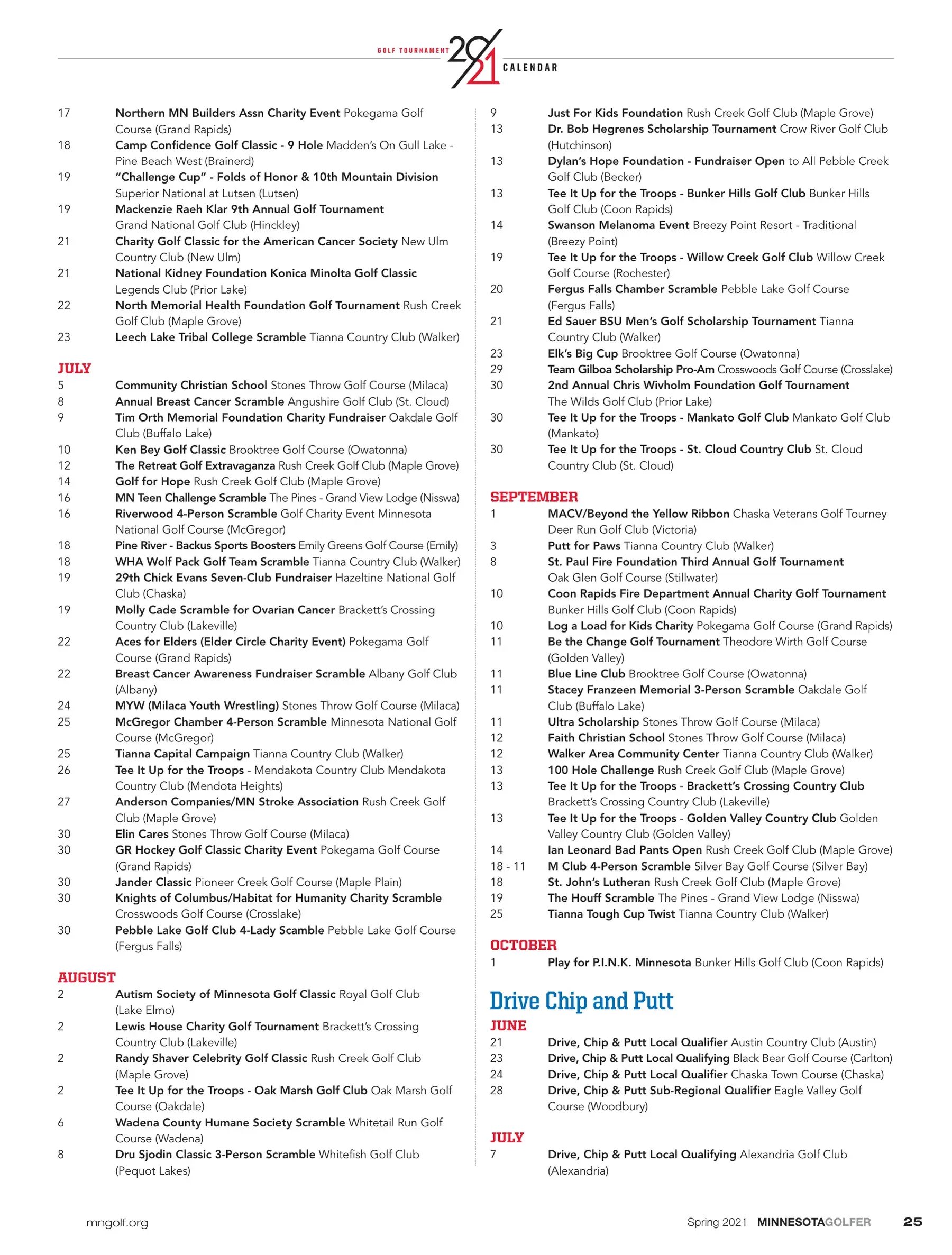
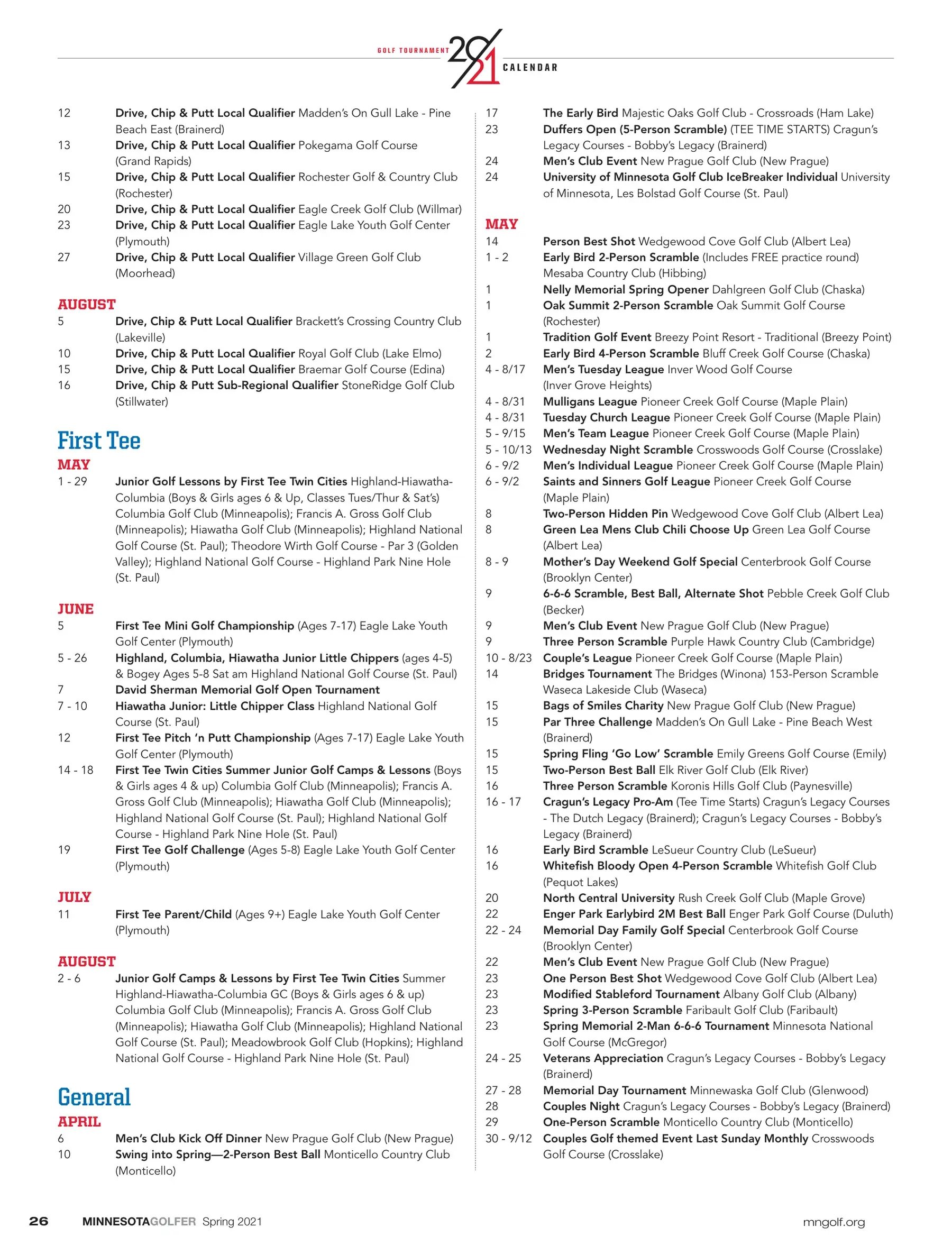
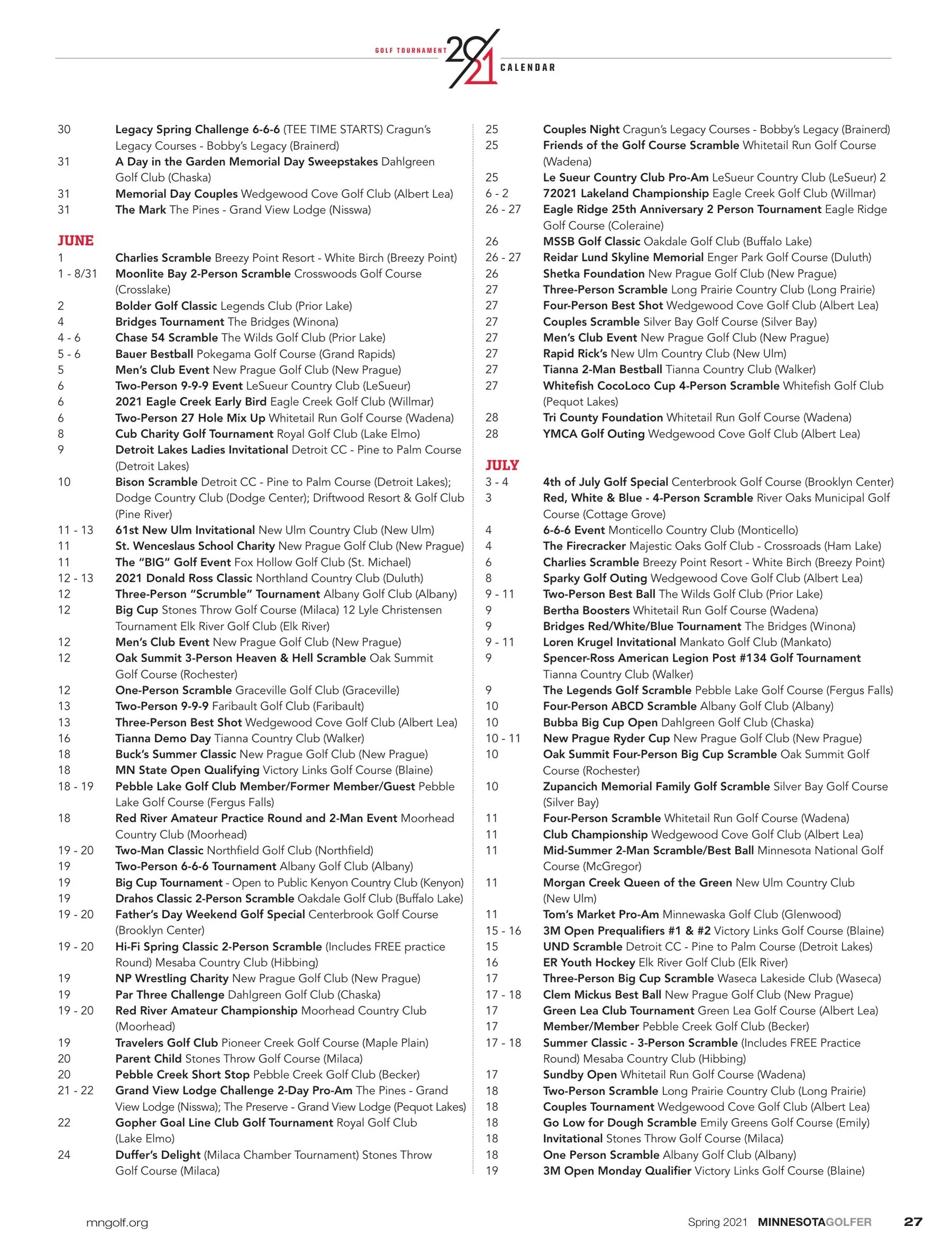
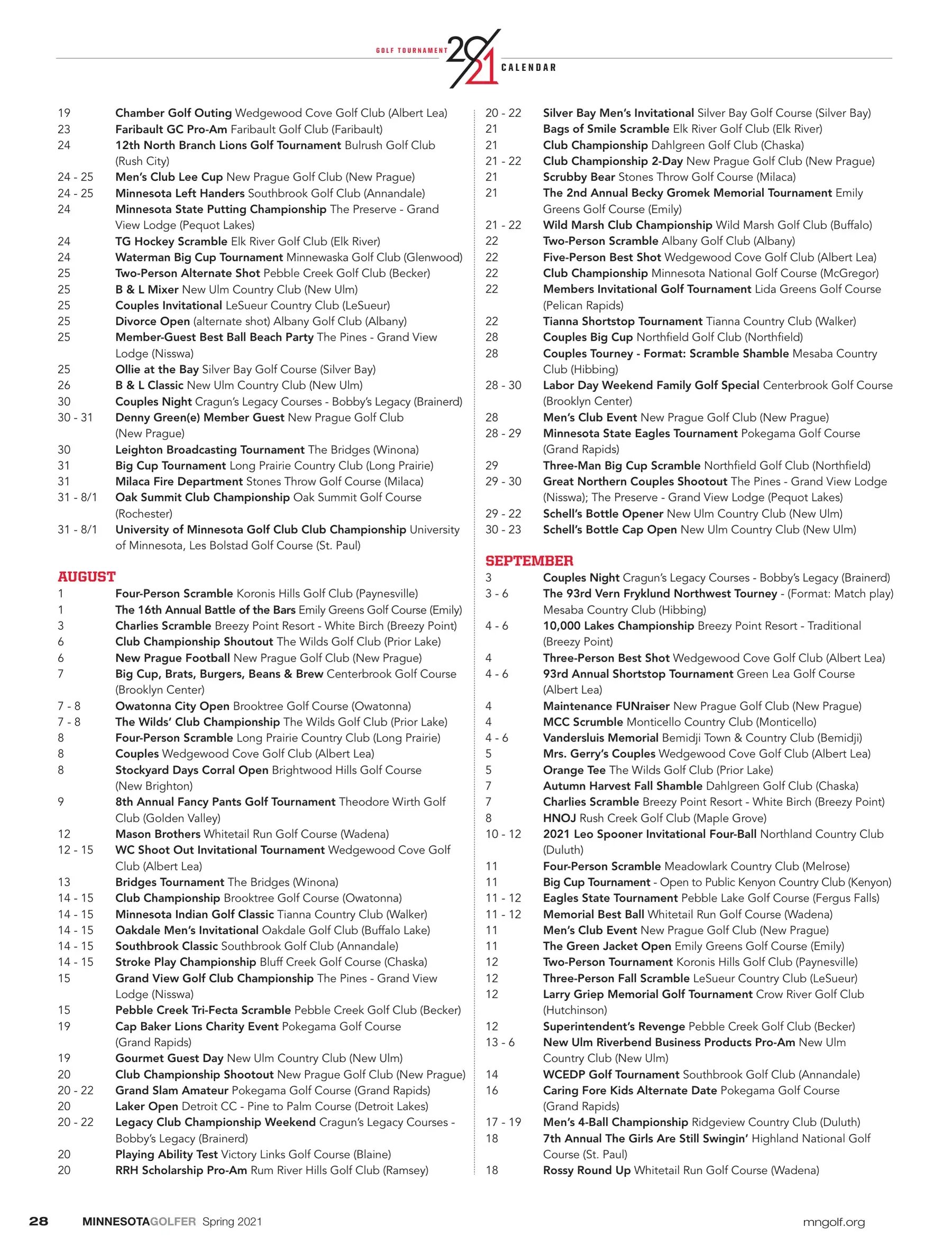
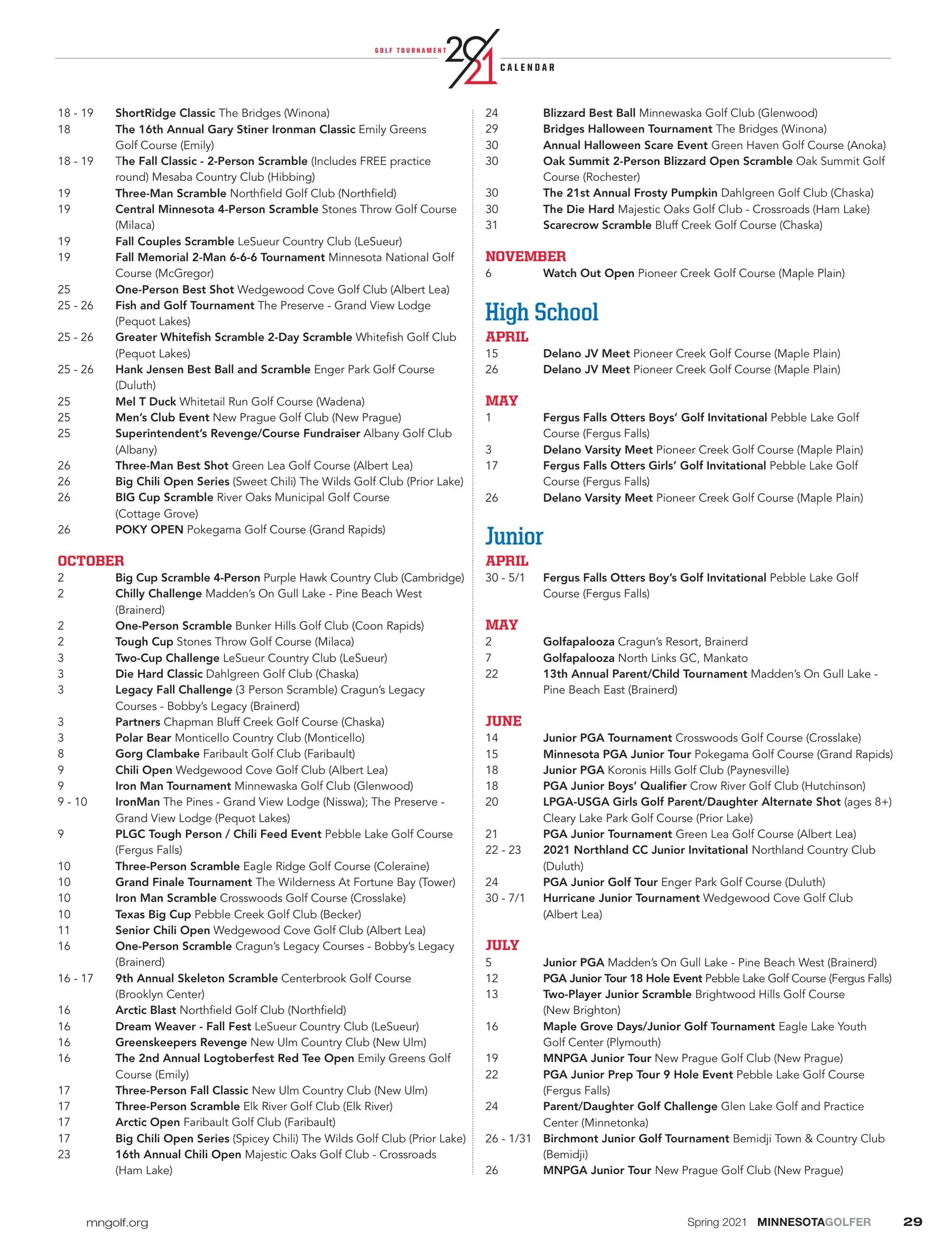
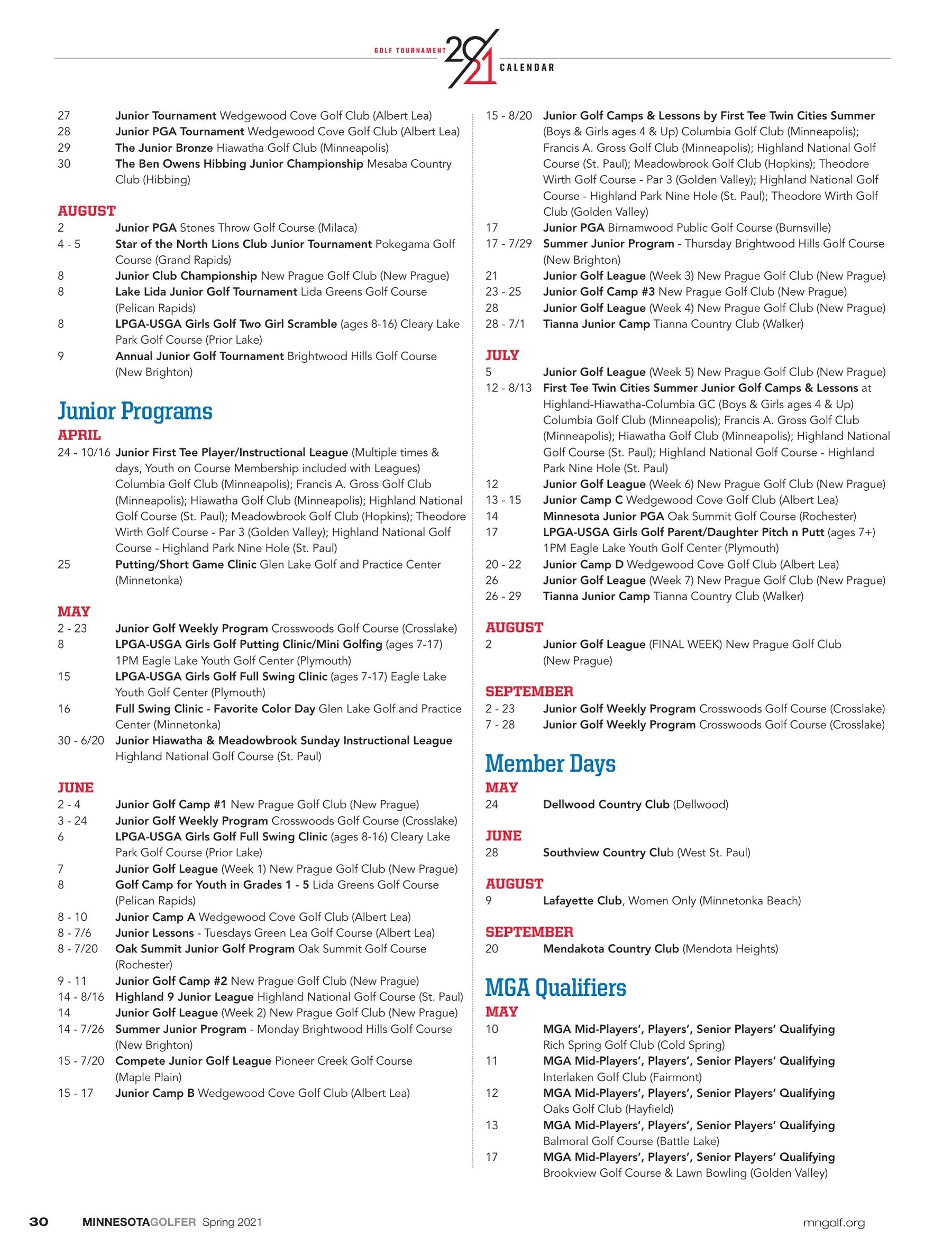
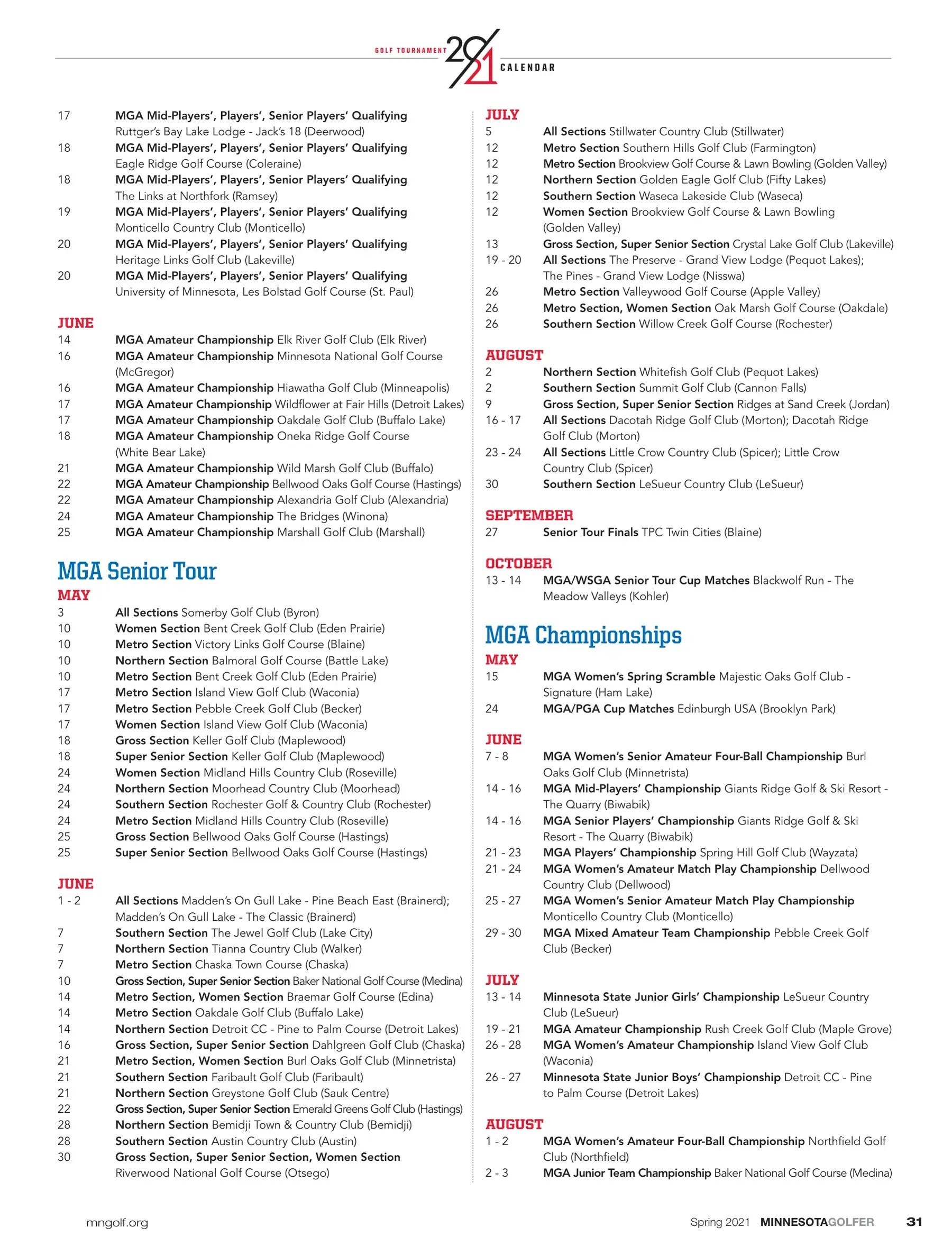
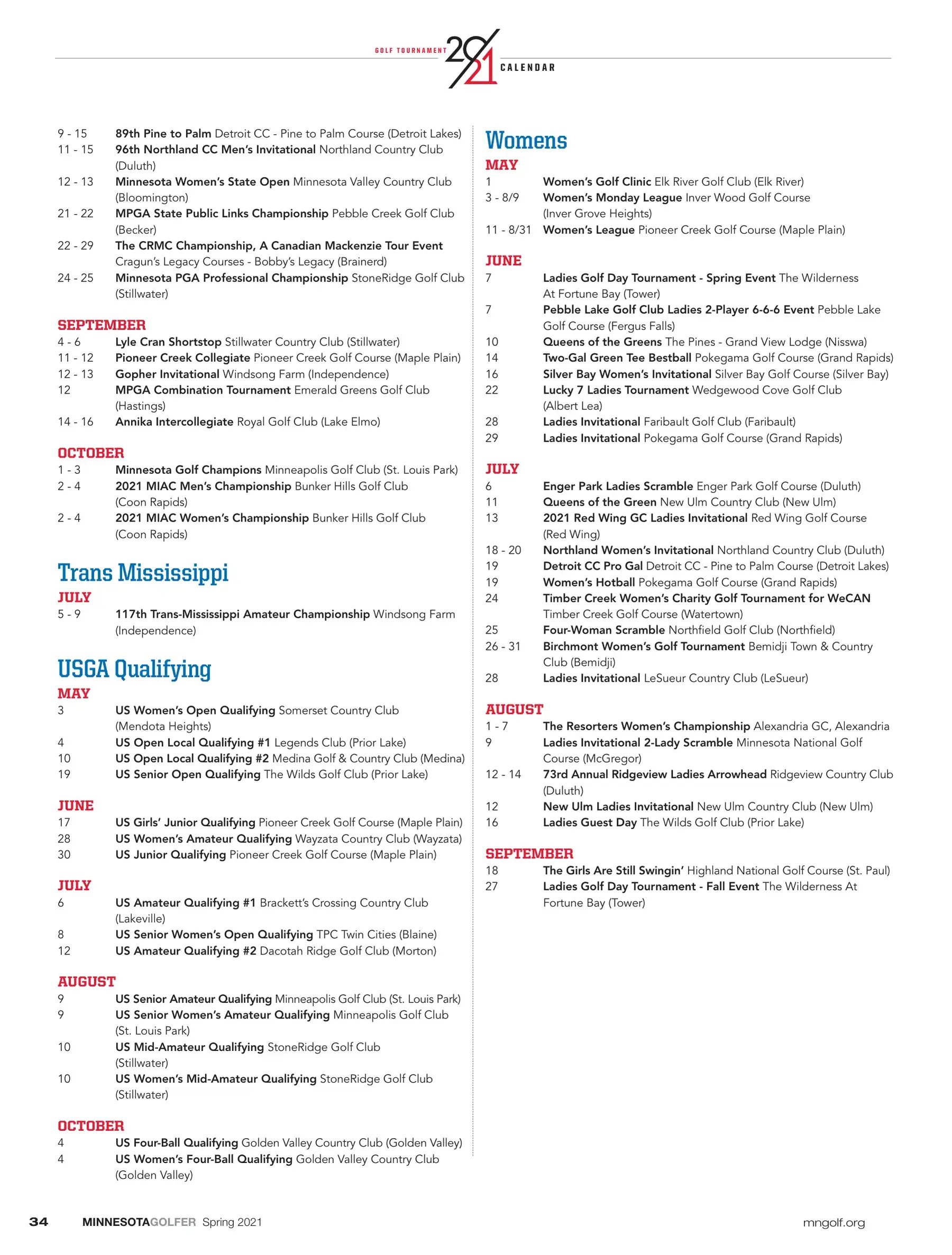
20 | GOLF TALES—A FAMILY AFFAIR By Joseph Oberle A local golf instructor passes his love of the game onto his talented daughters. 24 | 2021 MGA TOURNAMENT CALENDAR Nearly 600 listings, including junior programs and more.
32 | LESSONS FROM VETERANS By Dan Sachau Five pieces of wisdom gained from weekly golf with the vets league. Getting your handicap index revision via email?
Subscriptions: Regular U.S. one year (4 issues) $18. Directory issue of Minnesota Golfer: $9.95 plus shipping, pre-paid. Other single copies: $2.95 per copy plus shipping, pre-paid.
Copyright © 2021 MGA The MGA upholds and promotes the game of golf and its values for all golfers in Minnesota. Minnesota Golf Association Inc.
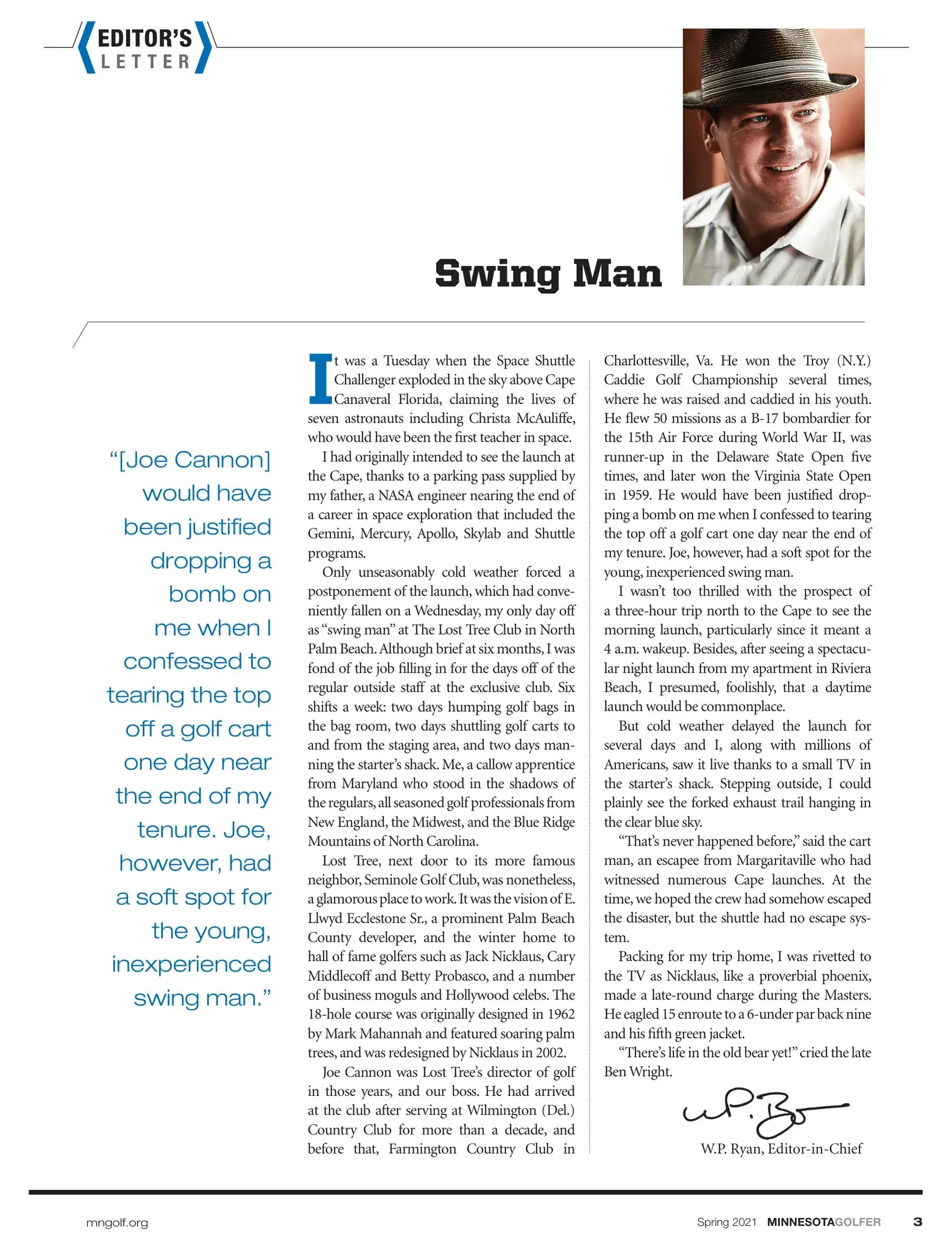
Legislative Counsel McGrann Shea Carnival Straughn & Lamb, Chartered OFFICE Volume 49, Number 2 Spring 2021 I t was a Tuesday when the Space Shuttle Challenger exploded in the sky above Cape Canaveral Florida, claiming the lives of seven astronauts including Christa McAuliffe, who would have been the first teacher in space.
I had originally intended to see the launch at the Cape, thanks to a parking pass supplied by my father, a NASA engineer nearing the end of a career in space exploration that included the Gemini, Mercury, Apollo, Skylab and Shuttle programs.
Only unseasonably cold weather forced a postponement of the launch, which had conveniently fallen on a Wednesday, my only day off as “swing man” at The Lost Tree Club in North Palm Beach. Although brief at six months, I was fond of the job filling in for the days off of the regular outside staff at the exclusive club. Six shifts a week: two days humping golf bags in the bag room, two days shuttling golf carts to and from the staging area, and two days manning the starter’s shack. Me, a callow apprentice from Maryland who stood in the shadows of the regulars, all seasoned golf professionals from New England, the Midwest, and the Blue Ridge Mountains of North Carolina.
Lost Tree, next door to its more famous neighbor, Seminole Golf Club, was nonetheless, a glamorous place to work. It was the vision of E. Llwyd Ecclestone Sr., a prominent Palm Beach County developer, and the winter home to hall of fame golfers such as Jack Nicklaus, Cary Middlecoff and Betty Probasco, and a number of business moguls and Hollywood celebs. The 18-hole course was originally designed in 1962 by Mark Mahannah and featured soaring palm trees, and was redesigned by Nicklaus in 2002.
Joe Cannon was Lost Tree’s director of golf in those years, and our boss. He had arrived at the club after serving at Wilmington (Del.) Country Club for more than a decade, and before that, Farmington Country Club in Charlottesville, Va. He won the Troy (N.Y.) Caddie Golf Championship several times, where he was raised and caddied in his youth.
He flew 50 missions as a B-17 bombardier for the 15th Air Force during World War II, was runner-up in the Delaware State Open five times, and later won the Virginia State Open in 1959. He would have been justified dropping a bomb on me when I confessed to tearing the top off a golf cart one day near the end of my tenure. Joe, however, had a soft spot for the young, inexperienced swing man.
I wasn’t too thrilled with the prospect of a three-hour trip north to the Cape to see the morning launch, particularly since it meant a 4 a.m. wakeup. Besides, after seeing a spectacular night launch from my apartment in Riviera Beach, I presumed, foolishly, that a daytime launch would be commonplace.
But cold weather delayed the launch for several days and I, along with millions of Americans, saw it live thanks to a small TV in the starter’s shack. Stepping outside, I could plainly see the forked exhaust trail hanging in the clear blue sky.
“That’s never happened before,” said the cart man, an escapee from Margaritaville who had witnessed numerous Cape launches. At the time, we hoped the crew had somehow escaped the disaster, but the shuttle had no escape system.
Packing for my trip home, I was rivetted to the TV as Nicklaus, like a proverbial phoenix, made a late-round charge during the Masters. He eagled 15 enroute to a 6-under par back nine and his fifth green jacket.
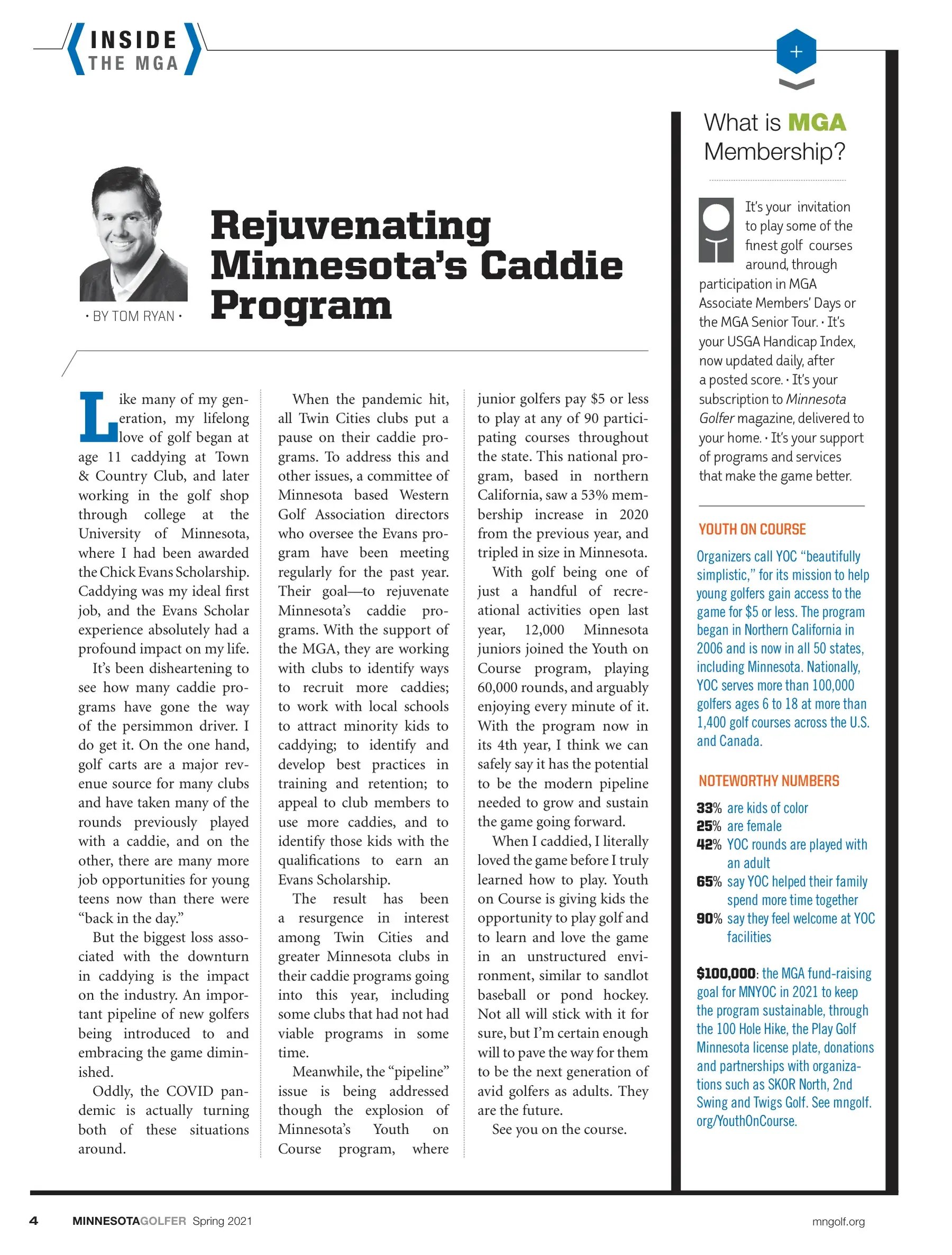
Caddying was my ideal first job, and the Evans Scholar experience absolutely had a profound impact on my life. It’s been disheartening to see how many caddie programs have gone the way of the persimmon driver. I do get it. On the one hand, golf carts are a major revenue source for many clubs and have taken many of the rounds previously played with a caddie, and on the other, there are many more job opportunities for young teens now than there were “back in the day.”
But the biggest loss associated with the downturn in caddying is the impact on the industry. An important pipeline of new golfers being introduced to and embracing the game diminished.
Oddly, the COVID pandemic is actually turning both of these situations around. When the pandemic hit, all Twin Cities clubs put a pause on their caddie programs. To address this and other issues, a committee of Minnesota based Western Golf Association directors who oversee the Evans program have been meeting regularly for the past year.
Their goal—to rejuvenate Minnesota’s caddie programs. With the support of the MGA, they are working with clubs to identify ways to recruit more caddies; to work with local schools to attract minority kids to caddying; to identify and develop best practices in training and retention; to appeal to club members to use more caddies, and to identify those kids with the qualifi cations to earn an Evans Scholarship.
The result has been a resurgence in interest among Twin Cities and greater Minnesota clubs in their caddie programs going into this year, including some clubs that had not had viable programs in some time.
Meanwhile, the “pipeline” issue is being addressed though the explosion of Minnesota’s Youth on Course program, where junior golfers pay $5 or less to play at any of 90 participating courses throughout the state. This national program, based in northern California, saw a 53% membership increase in 2020 from the previous year, and tripled in size in Minnesota.
With golf being one of just a handful of recreational activities open last year, 12,000 Minnesota juniors joined the Youth on Course program, playing 60,000 rounds, and arguably enjoying every minute of it.
With the program now in its 4th year, I think we can safely say it has the potential to be the modern pipeline needed to grow and sustain the game going forward.
When I caddied, I literally loved the game before I truly learned how to play. Youth on Course is giving kids the opportunity to play golf and to learn and love the game in an unstructured environment, similar to sandlot baseball or pond hockey.
Not all will stick with it for sure, but I’m certain enough will to pave the way for them to be the next generation of avid golfers as adults. They are the future.
• BY TOM RYAN • Rejuvenating Minnesota’s Caddie Program YOUTH ON COURSE Organizers call YOC “beautifully simplistic,” for its mission to help young golfers gain access to the game for $5 or less. The program began in Northern California in 2006 and is now in all 50 states, including Minnesota. Nationally, YOC serves more than 100,000 golfers ages 6 to 18 at more than 1,400 golf courses across the U.S.
and Canada. NOTEWORTHY NUMBERS 33% are kids of color 25% are female 42% YOC rounds are played with an adult 65% say YOC helped their family spend more time together 90% say they feel welcome at YOC facilities $100,000: the MGA fund-raising goal for MNYOC in 2021 to keep the program sustainable, through the 100 Hole Hike, the Play Golf Minnesota license plate, donations and partnerships with organizations such as SKOR North, 2nd Swing and Twigs Golf. See mngolf.
org/YouthOnCourse. Book Your Getaway! Set in natural beauty and surrounded by rugged prairieland, Dacotah Ridge golf course offers challenges and exciting play for golfers of all skill levels. A Rees Jones Designed Course.
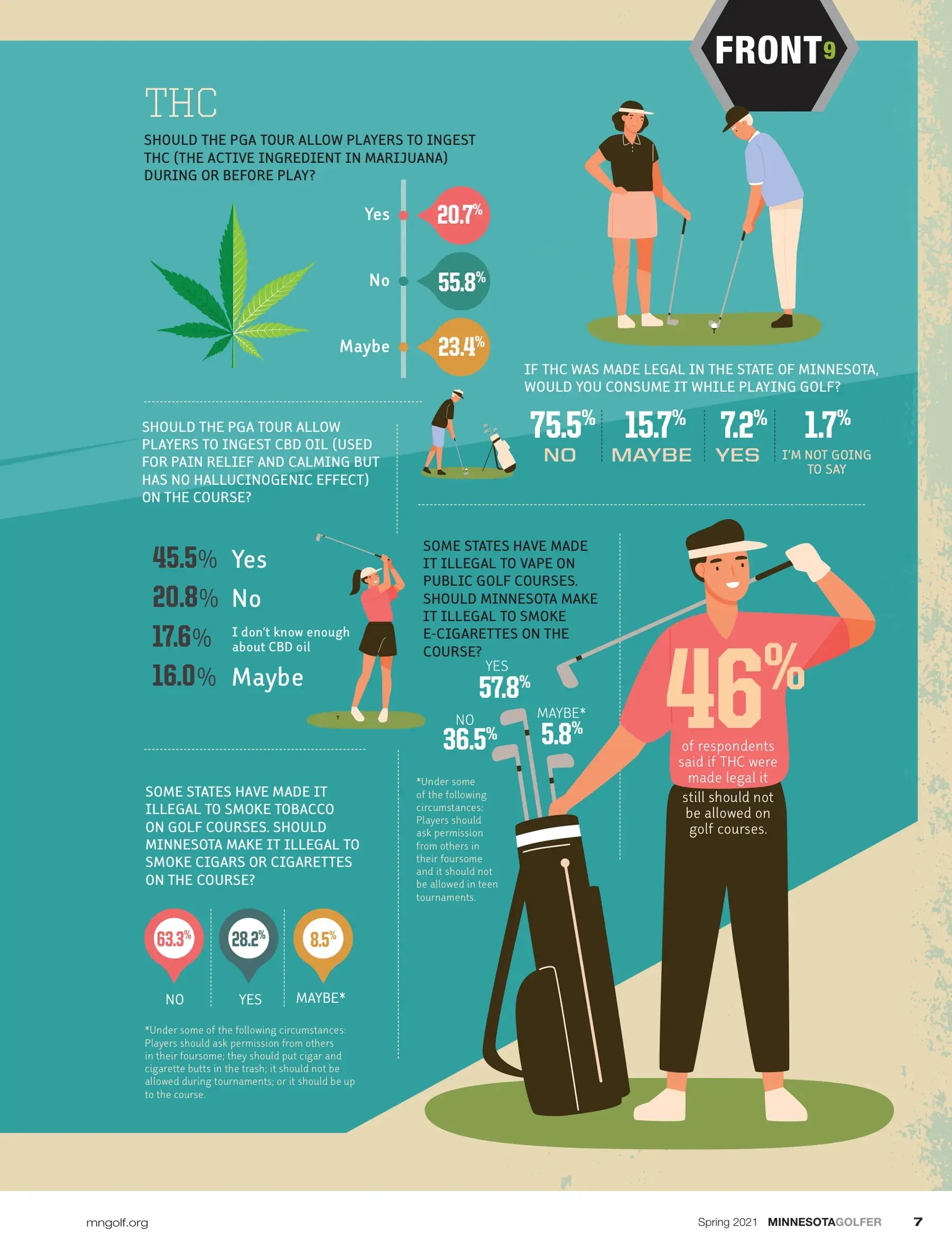
Greatly Enhance Greatly Interfere Slightly Interfere Interfere Enhance Slightly Enhance No Effect ALWAYS 11.6% NEVER 17.8% VERY RARELY 24.0% OCCASIONALLY 46.6% GUNS Golfers are limited to carrying 14 clubs in their bag for a round of golf, but can haul just about anything else that will improve their golf experience. Cold weather gear, rangefinders, sunscreen and plenty of water are common items.
For some, tobacco and alcohol are frequent carry-alongs, but not every golfer appreciates them in their foursome. And with conceal-and-carry permitted in Minnesota and recreational use of marijuana (THC) being considered by the state legislature, what do local golfers’ think of those items on the course?
*Under some of the following circumstances: Players should ask permission from others in their foursome and it should not be allowed in teen tournaments.
*Under some of the following circumstances: Players should ask permission from others in their foursome; they should put cigar and cigarette butts in the trash; it should not be allowed during tournaments; or it should be up to the course.
63.3% 28.2% 8.5% MAYBE* YES NO 7.2% YES MAYBE 75.5% NO I’M NOT GOING TO SAY PHOTO BY MATT SEEFELDT, ILLUSTRATION BY DEAN LAVATO W ith gorgeous fairways rolling through towering trees, The Jewel beckons golfers to come experience its remarkable beauty. A variety of holes and unique green structures won’t overwhelm higher handicap players, yet allow lower handicappers to revel in the challenge.
No. 11 fits that bill. A curving par 3 nestled between encroaching hardwoods left and an unforgiving pond right includes five different tees (two that avoid a watery forced carry). A series of three bunkers front and right at water’s edge provides a small beach bailout for those fading (or drawing) a bit too much. Players should carry their ball all the way up the left side of the long, sloping green or risk fishing for it on the right.
“You don’t necessarily have to hit the green to make par,” says head golf professional Keith Kalny. “Three’s a good score, but a four isn’t bad either.” —Rachel Blauert GREAT DRIVES The Jewel Golf Club Lake City | No. 11 » par 3 » 128–209 yards Opened 2005 | Architect Hale Irwin | Superintendent Lucas Grieves Head Professional Keith Kalny | Course Record 64, Mark Giorgi “I’ve been here four years and can’t quite put my finger on it; it’s just a magical place to play.” —Keith Kalny Spring 2021 MINNESOTAGOLFER 9 TIPS FROM THE PROS PHOTO BY MATT SEEFELDT • BY MIKE BARGE • Mike Barge is the director of instruction at Hazeltine National GC, and a Class A member of the PGA of America and the Minnesota Golf Hall of Fame.
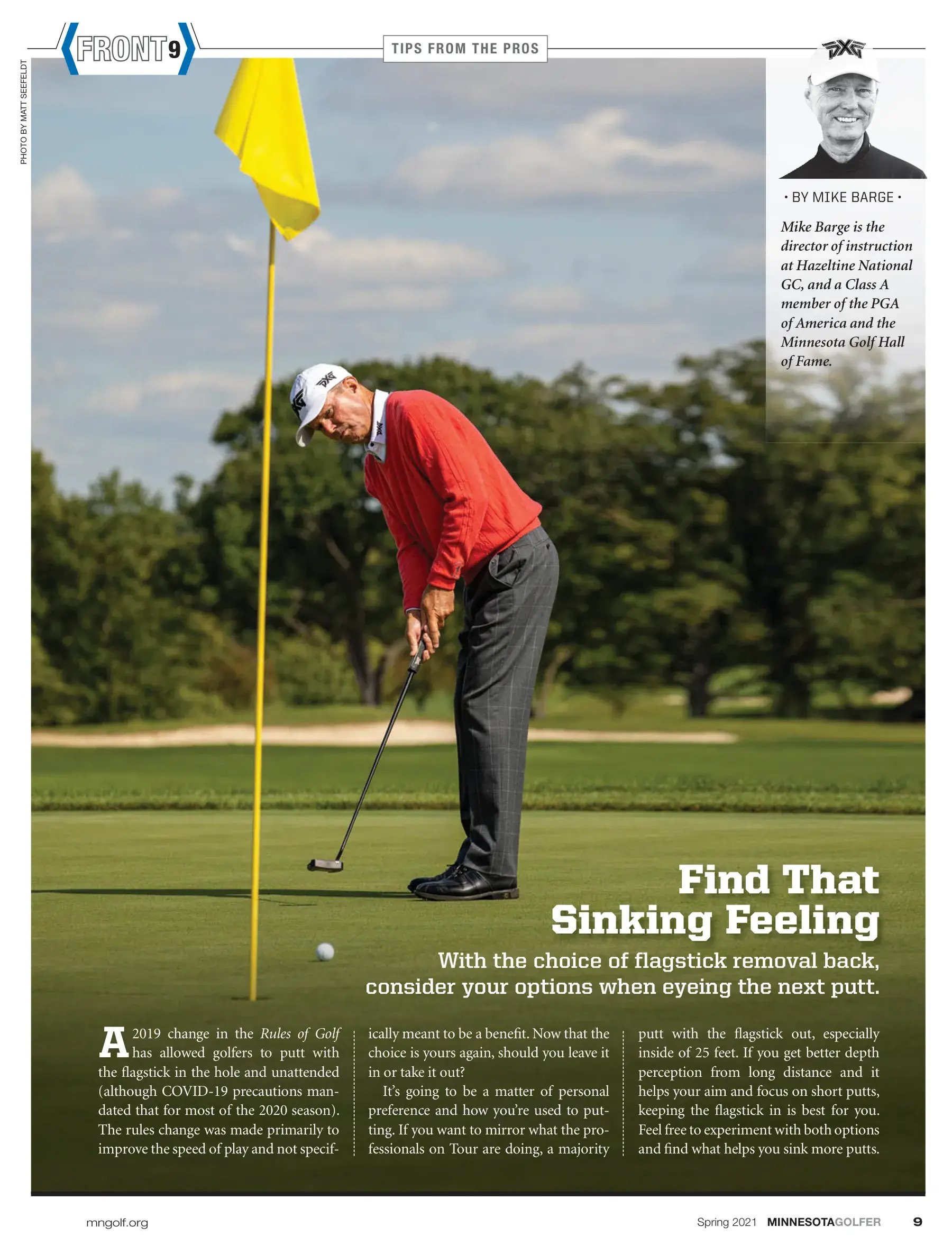
Find That Sinking Feeling A 2019 change in the Rules of Golf has allowed golfers to putt with the flagstick in the hole and unattended (although COVID-19 precautions mandated that for most of the 2020 season).
The rules change was made primarily to improve the speed of play and not specifically meant to be a benefi t. Now that the choice is yours again, should you leave it in or take it out?
It’s going to be a matter of personal preference and how you’re used to putting. If you want to mirror what the professionals on Tour are doing, a majority putt with the flagstick out, especially inside of 25 feet. If you get better depth perception from long distance and it helps your aim and focus on short putts, keeping the flagstick in is best for you.
Feel free to experiment with both options and find what helps you sink more putts. With the choice of flagstick removal back, consider your options when eyeing the next putt.
Knowledge is Power RULES PRIMER The first step in understanding the Rules of Golf is learning the definitions. • BY BILL HOMEYER • I n 2019, the USGA and R&A rewrote the Rules of Golf for clarity and simplification. Golfers should familiarize themselves with the rules, as this knowledge can often be a benefit.
Case in point: if you’ve ever accidently hit your golf ball with a practice swing, there’s no need to worsen the embarrassment with a misapplication of the rules. The first step in understanding the rules is to know the definitions. Let’s take a swing at it.
Below are three instances in which a golfer inadvertently hits his or her ball with a practice swing. The outcomes depend on where the ball was located and understanding the applicable defined terms (in bold).
1 Before making a stroke at his ball in the teeing area, Player A accidentally hits his ball several yards to the left with a practice swing.
2 With her ball in the fairway, Player B hits it four yards to the right with a practice swing. 3 On the putting green, Player C hits his ball two feet forward with a practice swing.
The outcomes: 1. No Penalty. Play a ball from anywhere in the teeing area (reteeing the ball is also allowed). A partial definition of stroke is “the forward movement of the club made to strike the ball ...
but a stroke has not been made if the player ... accidentally strikes the ball when making a practice swing.” In addition, a partial definition of ball in play is “a ball first becomes in play when a player makes a stroke at it in the teeing area.” In this situation, there has been no “stroke” and therefore no ball is “in play.”
2. One Penalty Stroke and the ball must be replaced. (See Rule 9.4, Ball Lifted or Moved by Player and Rule 14.2 for Replacing Ball on Spot) Player B did not make a stroke. However, since her ball in the fairway was in play before the practice swing, it results in a different outcome than in situation No. 1.
3. No Penalty and replace the ball. Even though Player C’s ball is in play, there is no penalty for accidentally causing a ball to move on the putting green. (See Rule 13.1d.) Note: In situations 2 and 3, if the player doesn’t replace the ball (for example, plays it from its new spot, which many people think they must do), the General Penalty applies— which is loss of hole in Match Play and two penalty strokes in Stroke Play.) We have similar occurrences taking place in three separate areas of the golf course—with three slightly different outcomes. There are 10 different definitions in these three instances, which illustrates the importance of the definitions.
As a longtime rules official, my initial advice to anyone who wants to learn the Rules of Golf is to start with the definitions. Knowing them will give you a solid foundation for learning the rules, and a good understanding of the rules can help golfers of any level.
Bill Homeyer has been the MWGA/MGA Women’s Rules & Competitions Consultant since 2002. A Couple Definitions to Consider Moved When a ball at rest has left its original spot and come to rest on any other spot, and this can be seen by the naked eye (whether or not anyone actually sees it do so).
Replace To place a ball by setting it down and letting it go, with the intent for it to be in play. If the player sets a ball down without intending it to be in play, the ball has not been replaced and is not in play (see Rule 14.4).
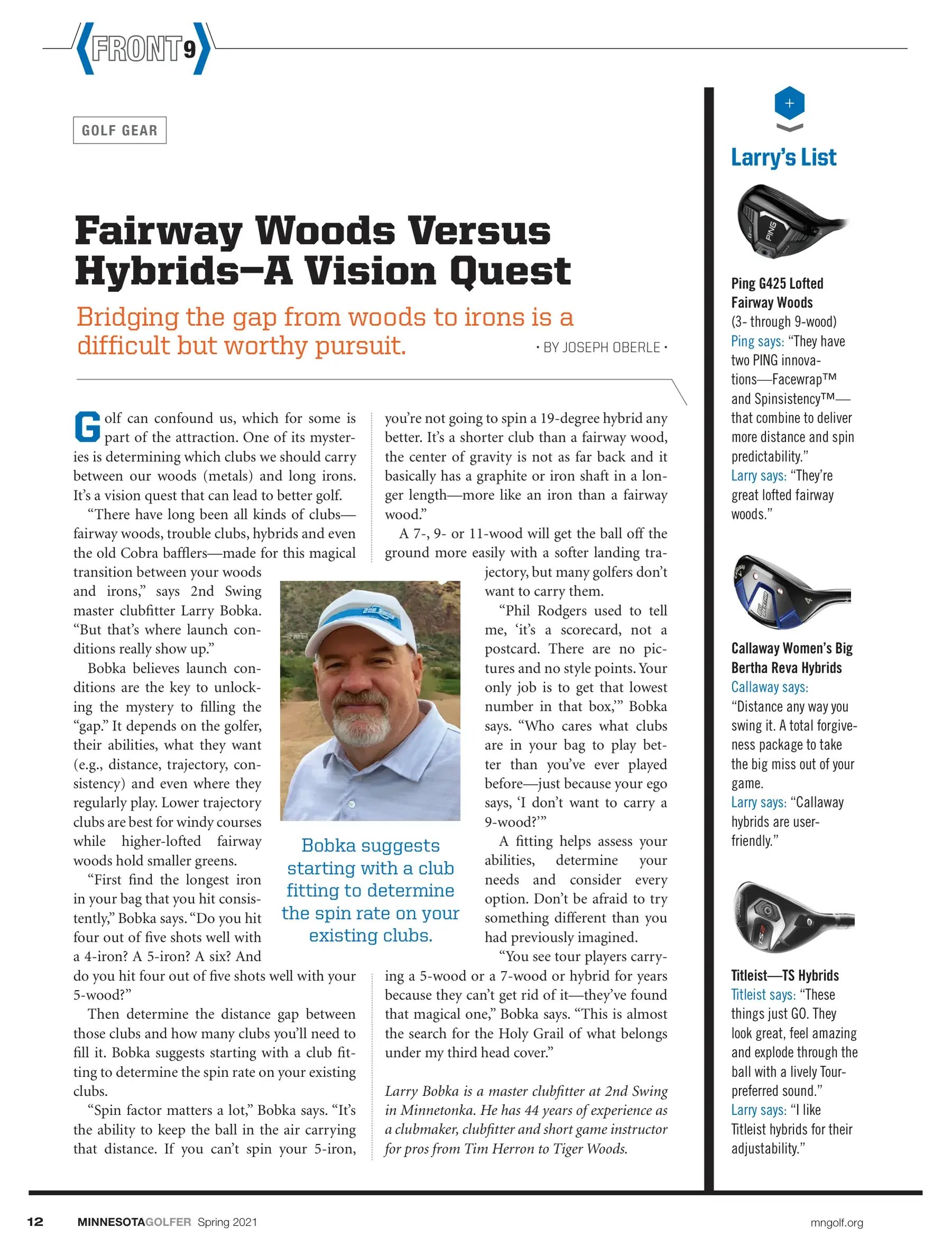
Fairway Woods Versus Hybrids—A Vision Quest Bridging the gap from woods to irons is a difficult but worthy pursuit. Ping G425 Lofted Fairway Woods (3- through 9-wood) Ping says: “They have two PING innovations—FacewrapTM and SpinsistencyTM— that combine to deliver more distance and spin predictability.”
Larry says: “They’re great lofted fairway woods.” Callaway Women’s Big Bertha Reva Hybrids Callaway says: “Distance any way you swing it. A total forgiveness package to take the big miss out of your game.
Larry says: “Callaway hybrids are userfriendly.” Titleist—TS Hybrids Titleist says: “These things just GO. They look great, feel amazing and explode through the ball with a lively Tourpreferred sound.”
Larry says: “I like Titleist hybrids for their adjustability.” Larry’s List • BY JOSEPH OBERLE • G olf can confound us, which for some is part of the attraction. One of its mysteries is determining which clubs we should carry between our woods (metals) and long irons.
It’s a vision quest that can lead to better golf. “There have long been all kinds of clubs— fairway woods, trouble clubs, hybrids and even the old Cobra baffl ers—made for this magical transition between your woods and irons,” says 2nd Swing master clubfi tter Larry Bobka.
“But that’s where launch conditions really show up.” Bobka believes launch conditions are the key to unlocking the mystery to filling the “gap.” It depends on the golfer, their abilities, what they want (e.g., distance, trajectory, consistency) and even where they regularly play. Lower trajectory clubs are best for windy courses while higher-lofted fairway woods hold smaller greens.
“First find the longest iron in your bag that you hit consistently,” Bobka says. “Do you hit four out of five shots well with a 4-iron? A 5-iron? A six? And do you hit four out of five shots well with your 5-wood?”
Then determine the distance gap between those clubs and how many clubs you’ll need to fill it. Bobka suggests starting with a club fitting to determine the spin rate on your existing clubs.
“Spin factor matters a lot,” Bobka says. “It’s the ability to keep the ball in the air carrying that distance. If you can’t spin your 5-iron, you’re not going to spin a 19-degree hybrid any better. It’s a shorter club than a fairway wood, the center of gravity is not as far back and it basically has a graphite or iron shaft in a longer length—more like an iron than a fairway wood.”
A 7-, 9- or 11-wood will get the ball off the ground more easily with a softer landing trajectory, but many golfers don’t want to carry them.
“Phil Rodgers used to tell me, ‘it’s a scorecard, not a postcard. There are no pictures and no style points. Your only job is to get that lowest number in that box,’” Bobka says. “Who cares what clubs are in your bag to play better than you’ve ever played before—just because your ego says, ‘I don’t want to carry a 9-wood?’”
A fitting helps assess your abilities, determine your needs and consider every option. Don’t be afraid to try something different than you had previously imagined.
“You see tour players carrying a 5-wood or a 7-wood or hybrid for years because they can’t get rid of it—they’ve found that magical one,” Bobka says. “This is almost the search for the Holy Grail of what belongs under my third head cover.”
Larry Bobka is a master clubfi tter at 2nd Swing in Minnetonka. He has 44 years of experience as a clubmaker, clubfi tter and short game instructor for pros from Tim Herron to Tiger Woods.
Bobka suggests starting with a club fitting to determine the spin rate on your existing clubs. S pring has arrived and the snow melt filling rivers and streams across the Minnesota landscape makes this the perfect time to chase waterfalls. Here are four, fully flowing falls worthy of your time. Don’t forget to take your golf clubs when you do. Check out the Minnesota Golf Association’s online course directory at g g to find a nearby course.
Eagle’s Landing Golf Club in Fort Ripley is a Dahl house. The course is the southern gateway to this tour and known as an excellent warm-up round en route. Josh Dahl is the head pro, and his dad James designed the course, which is an enigmatic par-72 eighteen with a course and slope of 72/117 from the blue tees.
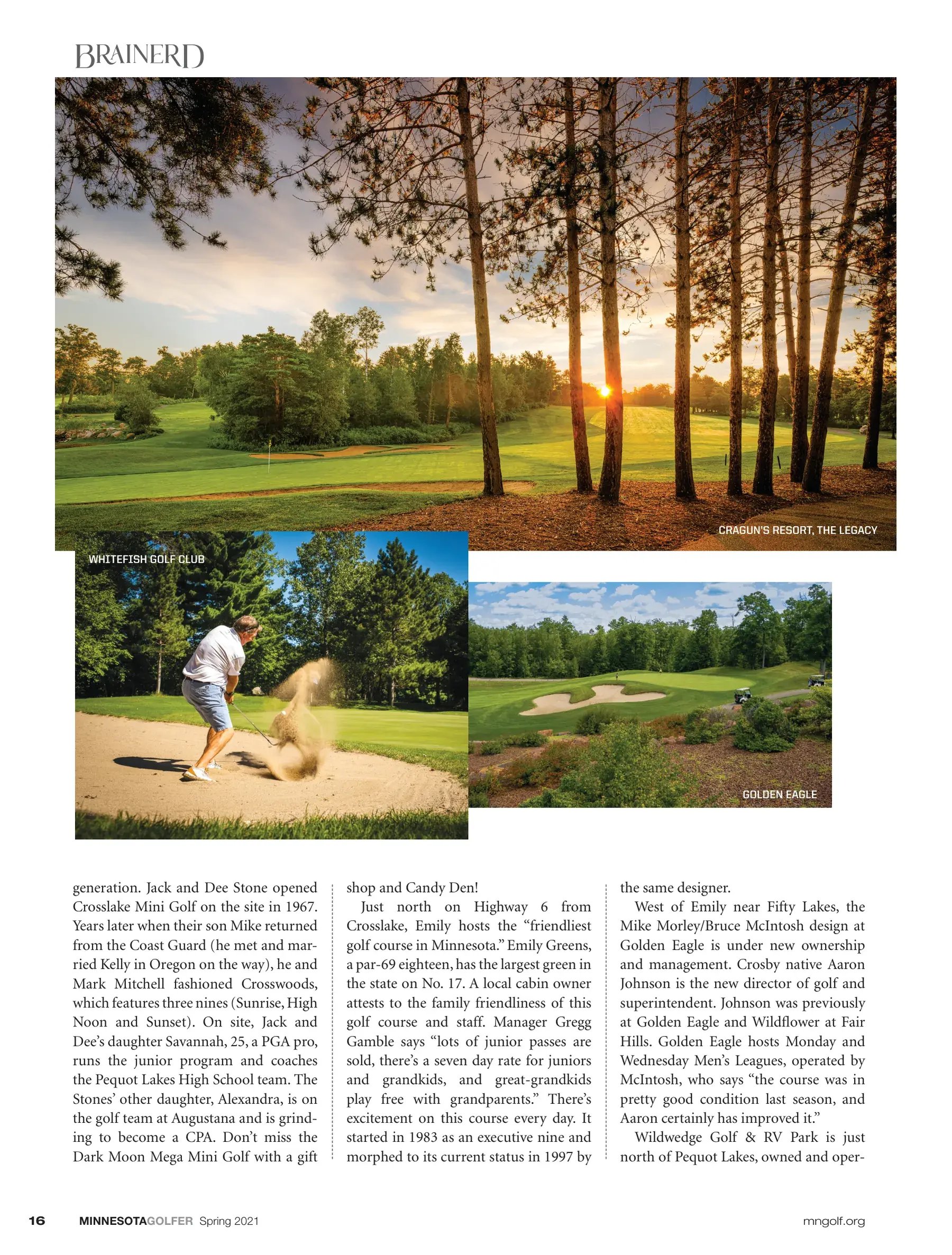
Eagle’s Landing and Whitefi sh Golf Club in Pequot Lakes are two of five stand-alone courses on this tour. Whitefi sh is a must-see course when staying and playing in the Brainerd area. It’s a great test in a captivating atmosphere. When asked, pro and manager Steve Bengston says, “it’s amazing that the birch and pine forest has remained intact all these years.”
Anyone who has played the course knows the joy of hearing an errant ball knocking around in the woods. Whitefi sh is a shareholder-owned course and Bengston affi rms they’ve had “plenty of members’ kids work at the course over the years.”
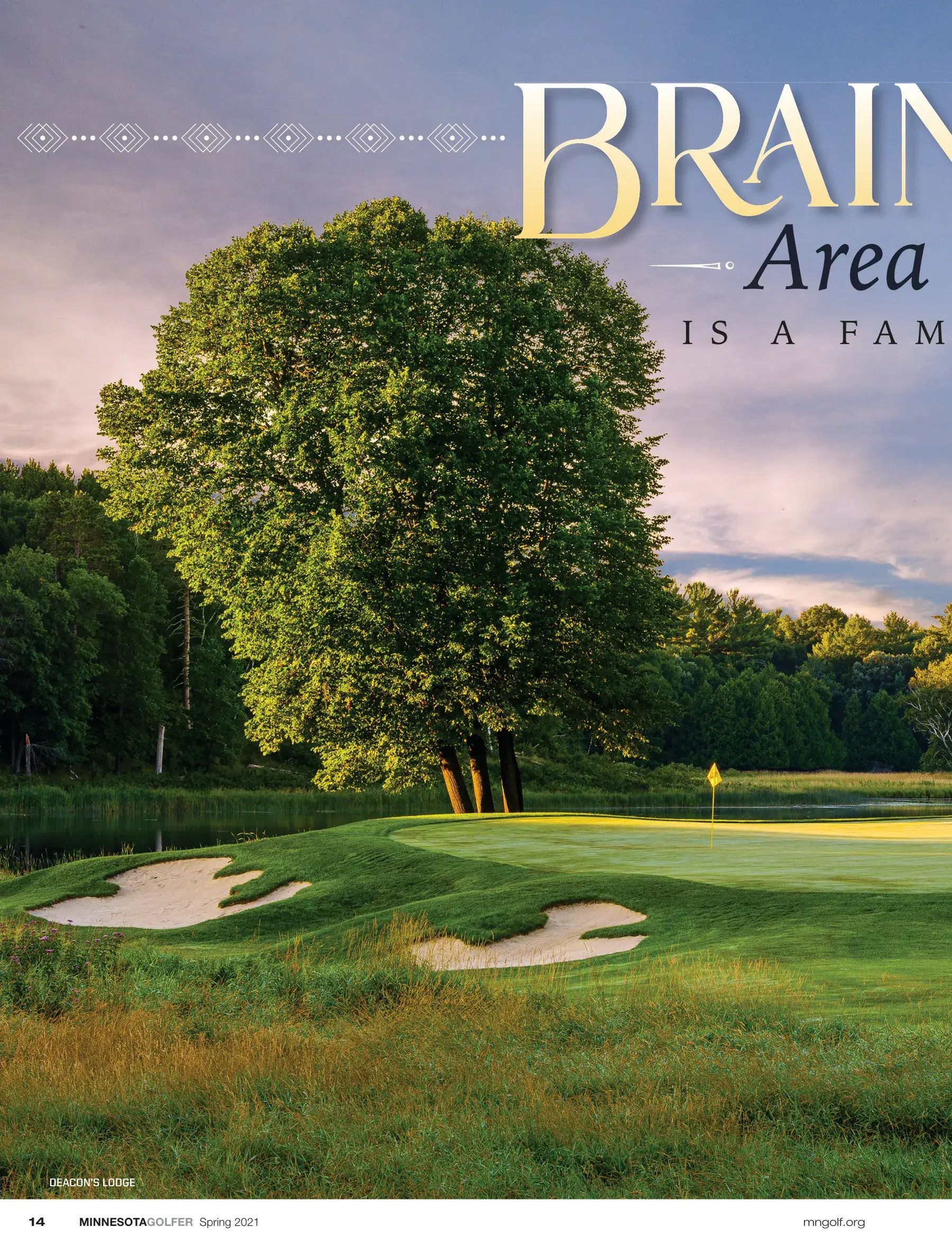
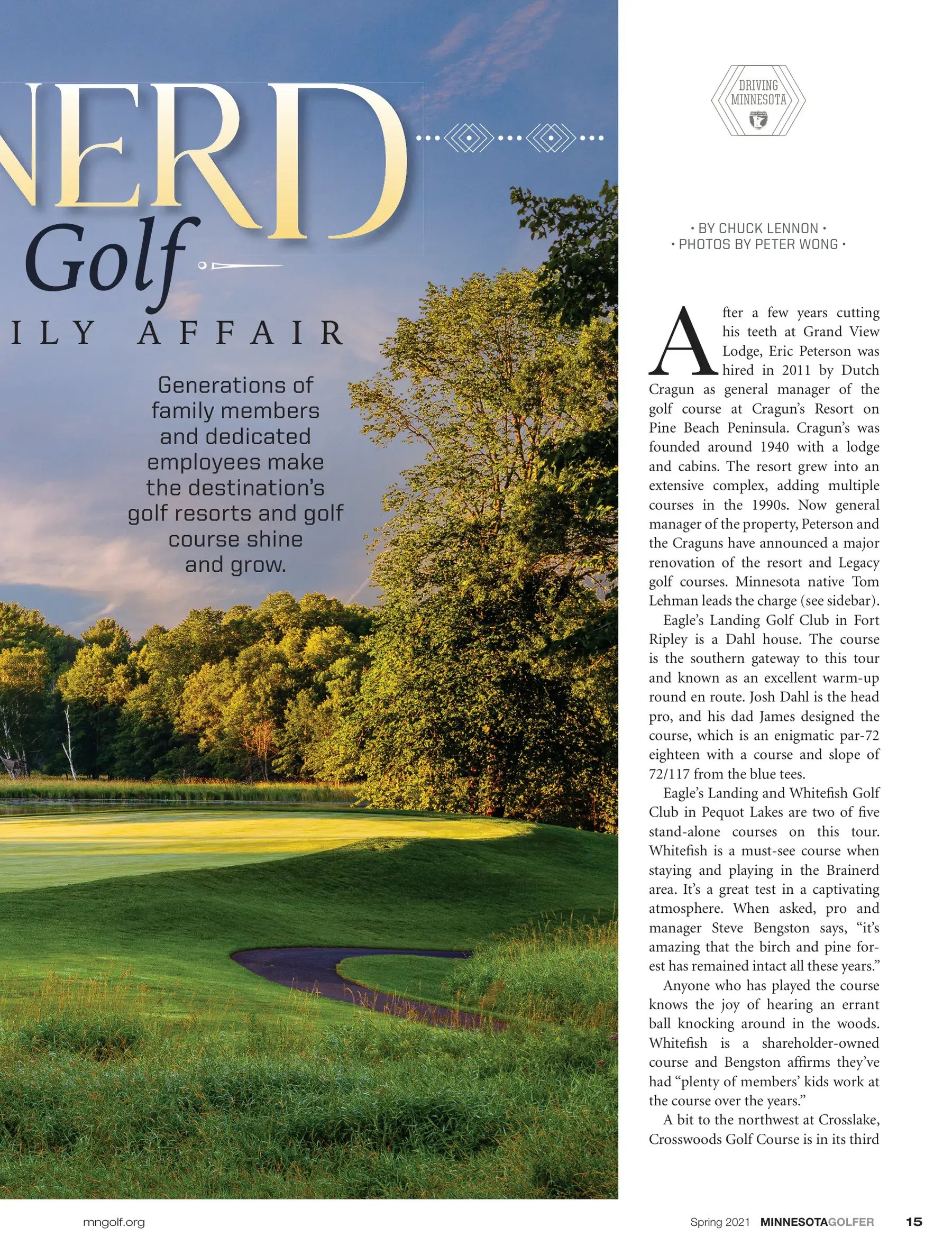
A bit to the northwest at Crosslake, Crosswoods Golf Course is in its third Generations of family members and dedicated employees make the destination’s golf resorts and golf course shine and grow.
Years later when their son Mike returned from the Coast Guard (he met and married Kelly in Oregon on the way), he and Mark Mitchell fashioned Crosswoods, which features three nines (Sunrise, High Noon and Sunset). On site, Jack and Dee’s daughter Savannah, 25, a PGA pro, runs the junior program and coaches the Pequot Lakes High School team. The Stones’ other daughter, Alexandra, is on the golf team at Augustana and is grinding to become a CPA. Don’t miss the Dark Moon Mega Mini Golf with a gift shop and Candy Den!
Just north on Highway 6 from Crosslake, Emily hosts the “friendliest golf course in Minnesota.” Emily Greens, a par-69 eighteen, has the largest green in the state on No. 17. A local cabin owner attests to the family friendliness of this golf course and staff. Manager Gregg Gamble says “lots of junior passes are sold, there’s a seven day rate for juniors and grandkids, and great-grandkids play free with grandparents.” There’s excitement on this course every day. It started in 1983 as an executive nine and morphed to its current status in 1997 by the same designer.
West of Emily near Fifty Lakes, the Mike Morley/Bruce McIntosh design at Golden Eagle is under new ownership and management. Crosby native Aaron Johnson is the new director of golf and superintendent. Johnson was previously at Golden Eagle and Wildflower at Fair Hills. Golden Eagle hosts Monday and Wednesday Men’s Leagues, operated by McIntosh, who says “the course was in pretty good condition last season, and Aaron certainly has improved it.”
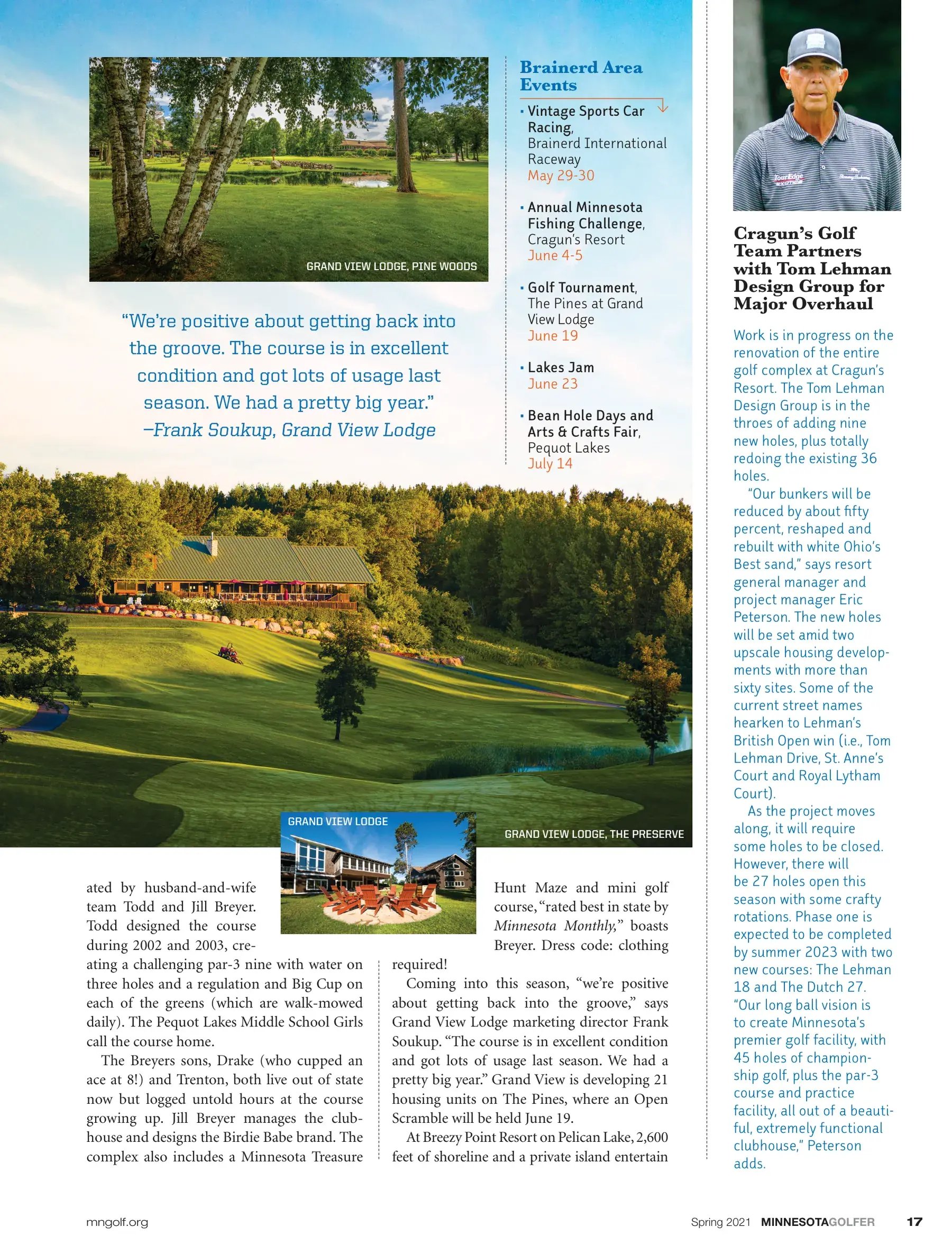
Wildwedge Golf & RV Park is just north of Pequot Lakes, owned and operCRAGUN’S RESORT, THE LEGACY WHITEFISH GOLF CLUB GOLDEN EAGLE Spring 2021 MINNESOTAGOLFER 17 Brainerd Area Events • Vintage Sports Car Racing, Brainerd International Raceway May 29-30 • Annual Minnesota Fishing Challenge, Cragun’s Resort June 4-5 • Golf Tournament, The Pines at Grand View Lodge June 19 • Lakes Jam June 23 • Bean Hole Days and Arts & Crafts Fair, Pequot Lakes July 14 Work is in progress on the renovation of the entire golf complex at Cragun’s Resort. The Tom Lehman Design Group is in the throes of adding nine new holes, plus totally redoing the existing 36 holes.
“Our bunkers will be reduced by about fifty percent, reshaped and rebuilt with white Ohio’s Best sand,” says resort general manager and project manager Eric Peterson. The new holes will be set amid two upscale housing developments with more than sixty sites. Some of the current street names hearken to Lehman’s British Open win (i.e., Tom Lehman Drive, St. Anne’s Court and Royal Lytham Court).
As the project moves along, it will require some holes to be closed. However, there will be 27 holes open this season with some crafty rotations. Phase one is expected to be completed by summer 2023 with two new courses: The Lehman 18 and The Dutch 27.
“Our long ball vision is to create Minnesota’s premier golf facility, with 45 holes of championship golf, plus the par-3 course and practice facility, all out of a beautiful, extremely functional clubhouse,” Peterson adds.
ated by husband-and-wife team Todd and Jill Breyer. Todd designed the course during 2002 and 2003, creating a challenging par-3 nine with water on three holes and a regulation and Big Cup on each of the greens (which are walk-mowed daily). The Pequot Lakes Middle School Girls call the course home.
The Breyers sons, Drake (who cupped an ace at 8!) and Trenton, both live out of state now but logged untold hours at the course growing up. Jill Breyer manages the clubhouse and designs the Birdie Babe brand. The complex also includes a Minnesota Treasure Hunt Maze and mini golf course, “rated best in state by Minnesota Monthly,” boasts Breyer. Dress code: clothing required!
Coming into this season, “we’re positive about getting back into the groove,” says Grand View Lodge marketing director Frank Soukup. “The course is in excellent condition and got lots of usage last season. We had a pretty big year.” Grand View is developing 21 housing units on The Pines, where an Open Scramble will be held June 19.
At Breezy Point Resort on Pelican Lake, 2,600 feet of shoreline and a private island entertain Cragun’s Golf Team Partners with Tom Lehman Design Group for Major Overhaul “We’re positive about getting back into the groove. The course is in excellent condition and got lots of usage last season. We had a pretty big year.”
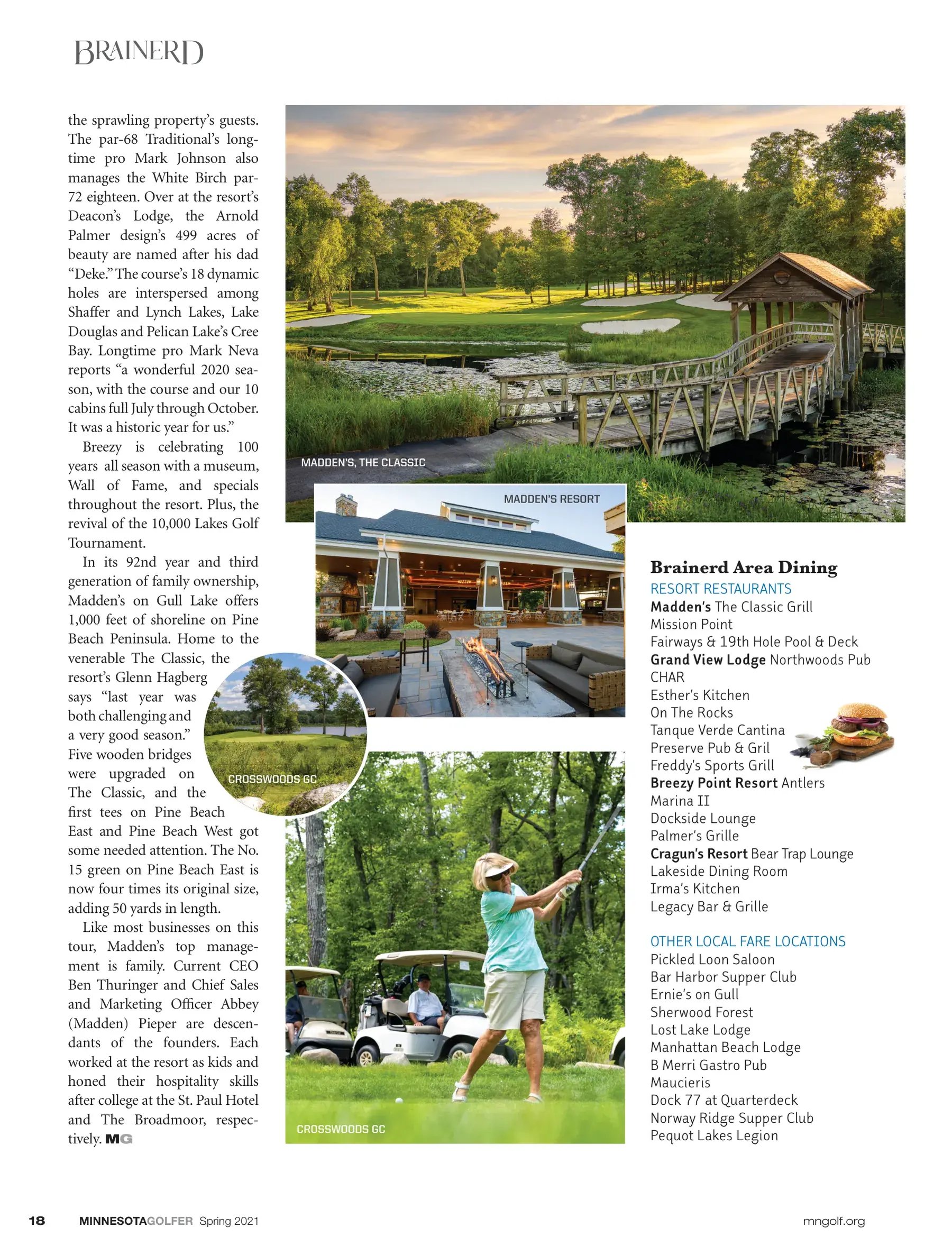
The par-68 Traditional’s longtime pro Mark Johnson also manages the White Birch par72 eighteen. Over at the resort’s Deacon’s Lodge, the Arnold Palmer design’s 499 acres of beauty are named after his dad “Deke.” The course’s 18 dynamic holes are interspersed among Shaffer and Lynch Lakes, Lake Douglas and Pelican Lake’s Cree Bay. Longtime pro Mark Neva reports “a wonderful 2020 season, with the course and our 10 cabins full July through October.
It was a historic year for us.” Breezy is celebrating 100 years all season with a museum, Wall of Fame, and specials throughout the resort. Plus, the revival of the 10,000 Lakes Golf Tournament.
In its 92nd year and third generation of family ownership, Madden’s on Gull Lake offers 1,000 feet of shoreline on Pine Beach Peninsula. Home to the venerable The Classic, the resort’s Glenn Hagberg says “last year was both challenging and a very good season.”
Five wooden bridges were upgraded on The Classic, and the first tees on Pine Beach East and Pine Beach West got some needed attention. The No.
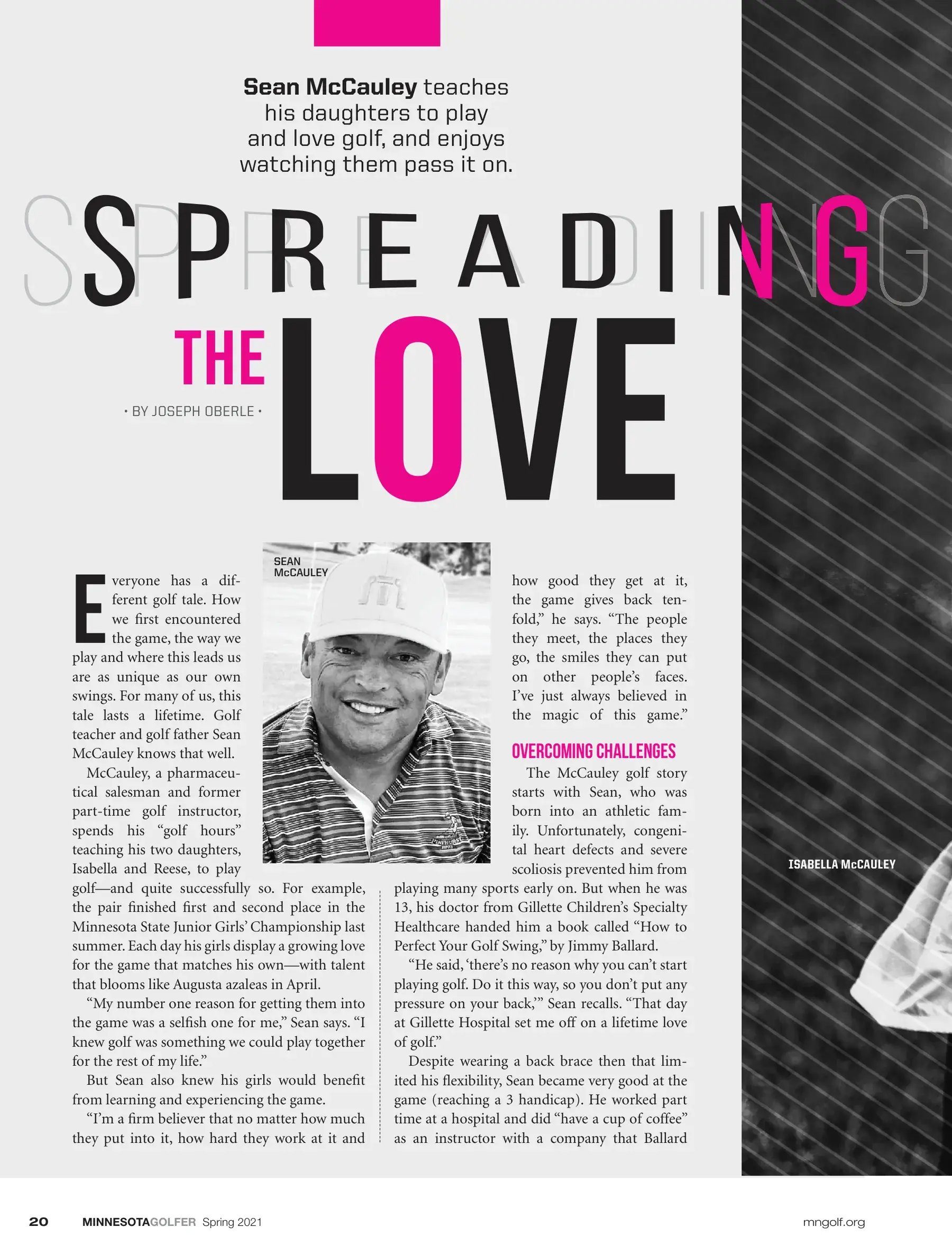
McCauley, a pharmaceutical salesman and former part-time golf instructor, spends his “golf hours” teaching his two daughters, Isabella and Reese, to play golf—and quite successfully so. For example, the pair finished first and second place in the Minnesota State Junior Girls’ Championship last summer. Each day his girls display a growing love for the game that matches his own—with talent that blooms like Augusta azaleas in April.
“My number one reason for getting them into the game was a selfi sh one for me,” Sean says. “I knew golf was something we could play together for the rest of my life.”
But Sean also knew his girls would benefi t from learning and experiencing the game. “I’m a firm believer that no matter how much they put into it, how hard they work at it and how good they get at it, the game gives back tenfold,” he says. “The people they meet, the places they go, the smiles they can put on other people’s faces.
I’ve just always believed in the magic of this game.” Overcoming Challenges The McCauley golf story starts with Sean, who was born into an athletic family. Unfortunately, congenital heart defects and severe scoliosis prevented him from playing many sports early on. But when he was 13, his doctor from Gillette Children’s Specialty Healthcare handed him a book called “How to Perfect Your Golf Swing,” by Jimmy Ballard.
“He said, ‘there’s no reason why you can’t start playing golf. Do it this way, so you don’t put any pressure on your back,’” Sean recalls. “That day at Gillette Hospital set me off on a lifetime love of golf.”
Despite wearing a back brace then that limited his flexibility, Sean became very good at the game (reaching a 3 handicap). He worked part time at a hospital and did “have a cup of coffee”
as an instructor with a company that Ballard • BY JOSEPH OBERLE • LOVE The Sean McCauley teaches his daughters to play and love golf, and enjoys watching them pass it on.
ISABELLA McCAULEY SEAN McCAULEY Spring 2021 MINNESOTAGOLFER 21 REESE McCAULEY “As a young kid, I would want to be at the golf course. As we got older, it just kind of progressed to where we loved golf.”
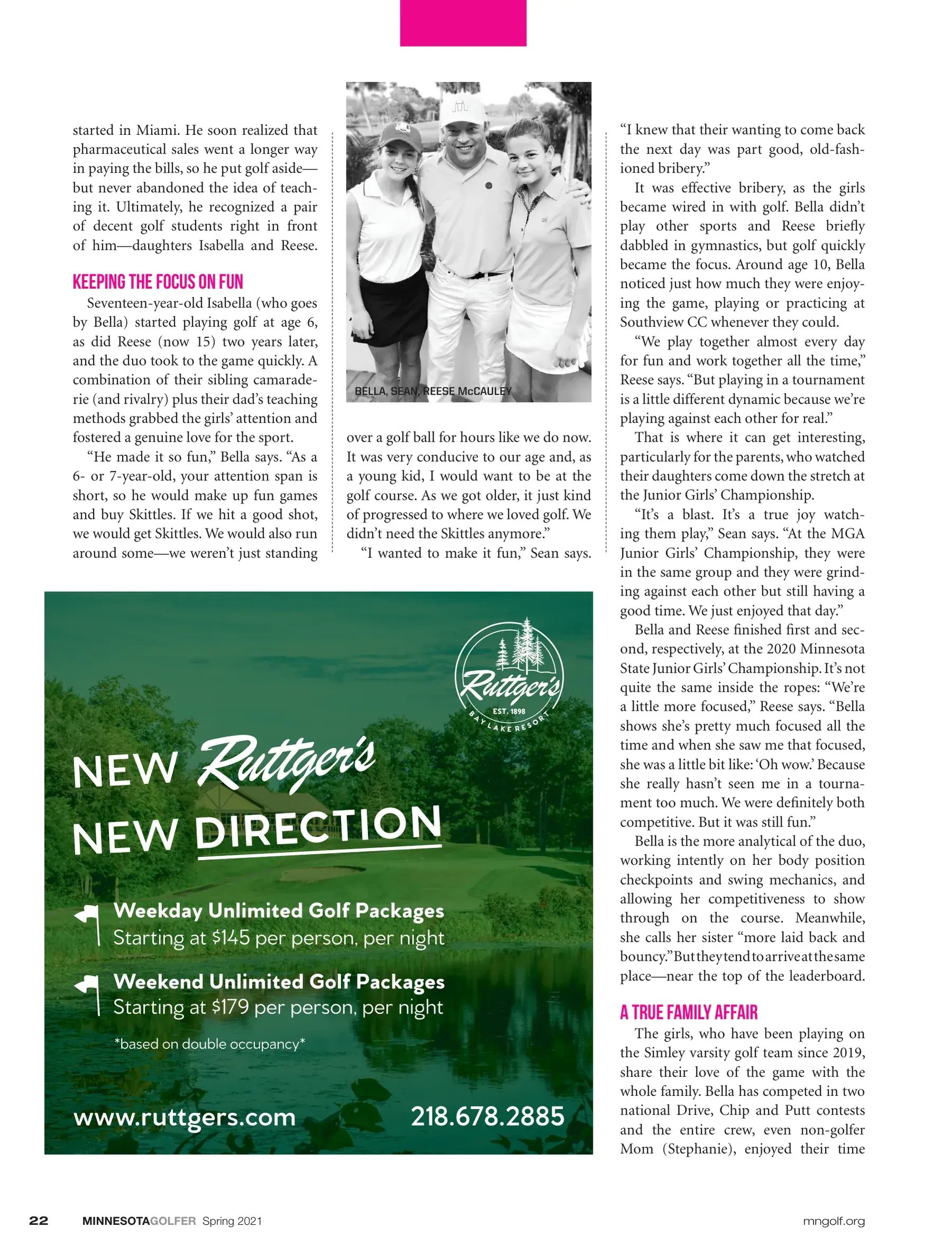
—Bella McCauley started in Miami. He soon realized that pharmaceutical sales went a longer way in paying the bills, so he put golf aside— but never abandoned the idea of teaching it. Ultimately, he recognized a pair of decent golf students right in front of him—daughters Isabella and Reese.
Keeping the Focus on Fun Seventeen-year-old Isabella (who goes by Bella) started playing golf at age 6, as did Reese (now 15) two years later, and the duo took to the game quickly. A combination of their sibling camaraderie (and rivalry) plus their dad’s teaching methods grabbed the girls’ attention and fostered a genuine love for the sport.
“He made it so fun,” Bella says. “As a 6- or 7-year-old, your attention span is short, so he would make up fun games and buy Skittles. If we hit a good shot, we would get Skittles. We would also run around some—we weren’t just standing over a golf ball for hours like we do now.
It was very conducive to our age and, as a young kid, I would want to be at the golf course. As we got older, it just kind of progressed to where we loved golf. We didn’t need the Skittles anymore.”
“I wanted to make it fun,” Sean says. “I knew that their wanting to come back the next day was part good, old-fashioned bribery.” It was effective bribery, as the girls became wired in with golf. Bella didn’t play other sports and Reese briefl y dabbled in gymnastics, but golf quickly became the focus. Around age 10, Bella noticed just how much they were enjoying the game, playing or practicing at Southview CC whenever they could.
“We play together almost every day for fun and work together all the time,” Reese says. “But playing in a tournament is a little different dynamic because we’re playing against each other for real.”
That is where it can get interesting, particularly for the parents, who watched their daughters come down the stretch at the Junior Girls’ Championship.
“It’s a blast. It’s a true joy watching them play,” Sean says. “At the MGA Junior Girls’ Championship, they were in the same group and they were grinding against each other but still having a good time. We just enjoyed that day.”
Bella and Reese finished first and second, respectively, at the 2020 Minnesota State Junior Girls’ Championship. It’s not quite the same inside the ropes: “We’re a little more focused,” Reese says. “Bella shows she’s pretty much focused all the time and when she saw me that focused, she was a little bit like: ‘Oh wow.’ Because she really hasn’t seen me in a tournament too much. We were defi nitely both competitive. But it was still fun.”
Bella is the more analytical of the duo, working intently on her body position checkpoints and swing mechanics, and allowing her competitiveness to show through on the course. Meanwhile, she calls her sister “more laid back and bouncy.” But they tend to arrive at the same place—near the top of the leaderboard.
A True Family Affair The girls, who have been playing on the Simley varsity golf team since 2019, share their love of the game with the whole family. Bella has competed in two national Drive, Chip and Putt contests and the entire crew, even non-golfer Mom (Stephanie), enjoyed their time BELLA, SEAN, REESE McCAULEY at Augusta. This past winter (when Sean was unable to attend) Stephanie took Bella to Kinder, La., for the Notah Begay III Junior Golf National Championship, where she finished second.
“I’m talking about golf all the time with my dad and my sister, and my mom brings the balance of a non-golf aspect,” Bella says. “She offers perspective on things, because you can get so wrapped up in things, and golf is obviously just a game. It’s not the beall and end-all. So she’s always been good at helping us see that a bit more.”
As the girls’ primary coach and instructor, Sean doesn’t miss much of the competition. He says they know enough about their swings to watch film and correct problems, but his counsel is never far away. Reese tells the story of hole No. 2 at Southview, where her dad told her the club she had was not the right one. Reese reluctantly changed to a 4-hybrid and made her first hole-in-one.
Bella has her own tale: “Before every big tournament, my dad will write a bible verse or some encouragement on a 3-by-5 index card and slip it into my golf bag. Normally, it has something to do with how I represent myself. He always says, ‘it’s not your score that counts, it’s your character.’ That’s very cool for me.”
As much as Sean says he’s “living the dream” watching his daughters enjoy the game he loves, he takes even more pride in how they carry themselves, whether playing with top players or someone just learning the game. Bella further hopes this article encourages young girls or parents to get their daughters into the game, emphasizing all the help and encouragement she’s received.
Would you like to see your favorite golf event listed here? Contact the MGA at editor@mngolf.org. JUNE 6th Annual Guardian Angels Golf Tournament Elk River Golf Club (Elk River) Burggrafs Ace Hardware Caring Fore Kids Charity Event Pokegama Golf Course (Grand Rapids) WHA Fine Arts Scramble Tianna Country Club (Walker) Military Family Foundation Crow River Golf Club (Hutchinson) University of Northwestern Golf Classic Rush Creek Golf Club (Maple Grove) William’s Wings Rush Creek Golf Club (Maple Grove) WDC Fundraiser Whitetail Run Golf Course (Wadena) Al Erickson Scholarship Scramble Whitetail Run Golf Course (Wadena) Cass County Youth Assoc. Tianna Country Club (Walker) 30th Annual Children’s Minnesota Golf Benefi t White Bear Yacht Club (Dellwood) Camp Odayin Fundraiser Whole Heart Golf Tournament Dellwood Country Club (Dellwood) Pain Free Patriots Rush Creek Golf Club (Maple Grove) PLAY AWAY!
Hold the outrage, this isn’t a story about stolen valor. We play nine holes every Wednesday in a league comprised of veterans of the five branches of service. All the members are comfortably into retirement, so we play the forward tees. The tees are assigned by age, which coincidentally, means that players who served during the Vietnam War play from the yellow tees and players who served in Korea hit from the reds. Refer to them as “women’s tees” at your own peril.
I was recruited to join, because frankly, there are not as many vets as there used to be. The boys needed an extra player, and in this kind of golf emergency, even a civilian would do. Although the league members know I’m not a vet, and they are very welcoming, I don’t really feel like I fit in. In addition to being a life-long civilian, I am five years younger than any other player.
I’ve only lived in town for 30 years, and I have a soft professor’s job. To make things worse, I’ve gained much more from playing with the vets than they have gained from playing with me. So in the spirit of confession and gratitude, here are five lessons I learned from playing golf with veterans.
Lesson One: Respect the flag. If it’s the 4th of July weekend and the greenkeeper has attached a U.S. flag to the flagstick, DO NOT lay the flagstick on the ground. As one vet mentioned, “letting the flag touch anything beneath it, like the ground, the floor, or water, violates the offi cial U.S. Flag Code.” Yes, there is such a thing. He also noted that some might consider flag pants, flag socks, flag gloves and flag towels a touch disrespectful. “The flag on your golf shirt is fine. The flag as your golf shirt is not.”
Lesson Two: A little rain never hurt anyone. A soft professor should not complain about playing in drizzle because he might be called “buttercup.” He might be told a story about sleeping in the rain, in the mud, in the jungle.
Lesson Three: A bogey is not a real problem. An angry drill instructor is a problem. Malaria is a problem. A bullet headed your direction is defi nitely a problem. And, as most seniors know, vets or not, heart attacks and cancer are real problems.
So carding a bogey means you’re on a golf course, and there are worse places you could be. As my playing partner, and stroke survivor, Byron Houg reminds me, “It’s better to be above the ground than below it.”
Lesson Four: Get over yourself. Despite being a veteran’s league, no one mentions or defers to former military rank. Similarly, some of the members are wealthy and some have modest incomes, but you couldn’t sort the high income from the low-income players by looking at them. Further, conversations seldom drift to topics that could refl ect social status. Golf is certainly a great equalizer. We are all fighting the course, our doubts, and our swings, but time in the military, and being part of something bigger than one’s self, adds a layer of humility that most of us non-vets can benefi t from.
Lesson Five: It’s nice to be one of the guys. Even though I’m not really one of the boys, I sure appreciate it that they treat me like I am. The players in the league are guy-guys. They have nicknames like Obie, Chick, Mickey, Woody, Cal, Chuck and Hog. Smoke a cigar on the course? No problem. A noonish beer?
Fine. Swear? It turns out, some sailors really do swear like sailors. The golfers in the Mankato Senior Servicemen’s League are proud of their country, tough, humble, and men among men. I am lucky to be in their company.
The MGA supports hundreds (if not thousands) of men’s, women’s and junior golf leagues at its more than 400 member golf clubs around the state. League membership affords golfers an active USGA Handicap Index through the GHIN service, a complimentary subscription to this magazine, free use of the USGA Tournament Management software (powered by GolfGenius) for event and league administrators, the free GHIN mobile app, and eligibility to participate in MGA championships and member events. For more information, contact Stacy Sazama, Membership Services Director, stacy@mngolf.org.
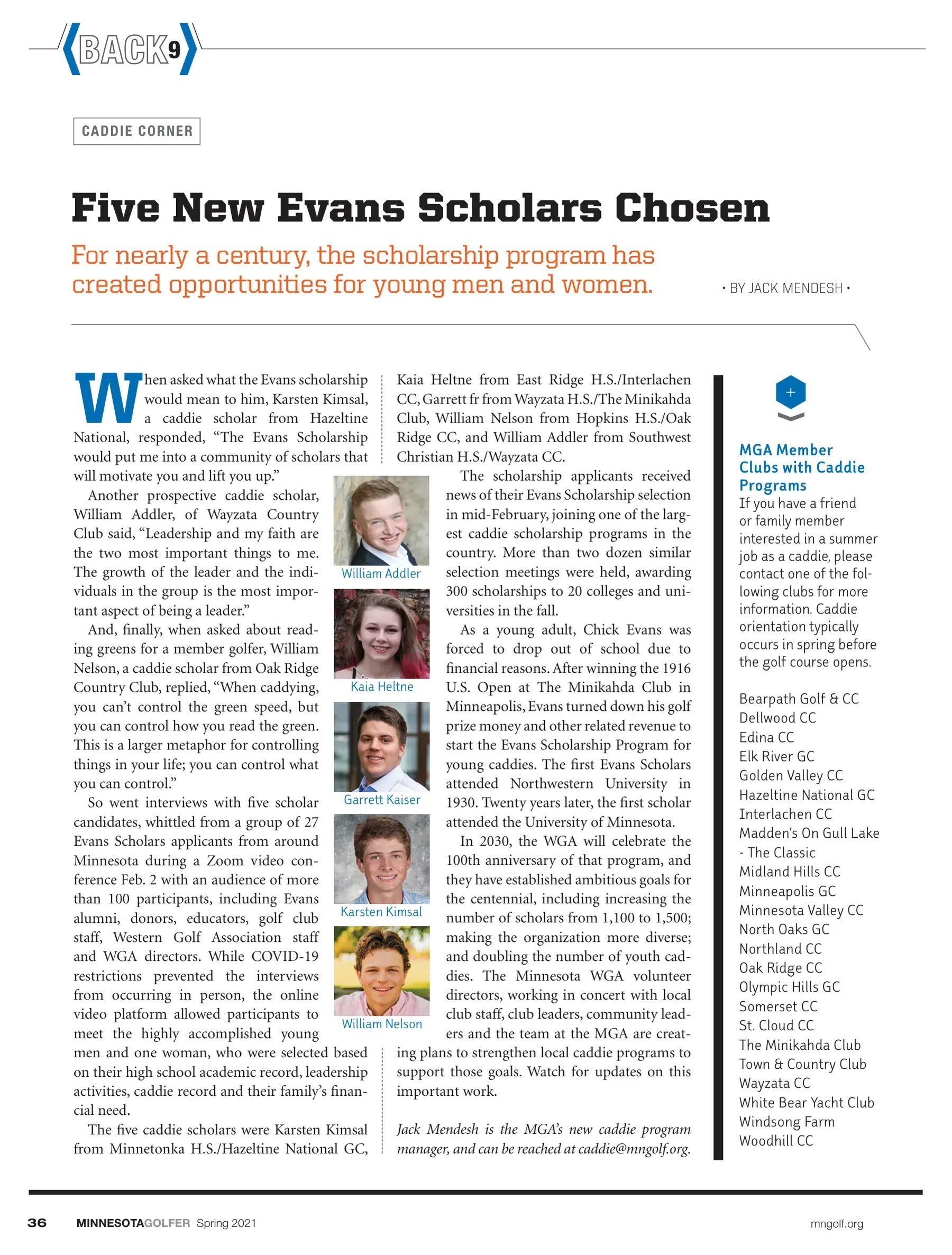
• BY JACK MENDESH • W hen asked what the Evans scholarship would mean to him, Karsten Kimsal, a caddie scholar from Hazeltine National, responded, “The Evans Scholarship would put me into a community of scholars that will motivate you and lift you up.”
Another prospective caddie scholar, William Addler, of Wayzata Country Club said, “Leadership and my faith are the two most important things to me.
The growth of the leader and the individuals in the group is the most important aspect of being a leader.” And, finally, when asked about reading greens for a member golfer, William Nelson, a caddie scholar from Oak Ridge Country Club, replied, “When caddying, you can’t control the green speed, but you can control how you read the green.
This is a larger metaphor for controlling things in your life; you can control what you can control.” So went interviews with five scholar candidates, whittled from a group of 27 Evans Scholars applicants from around Minnesota during a Zoom video conference Feb. 2 with an audience of more than 100 participants, including Evans alumni, donors, educators, golf club staff, Western Golf Association staff and WGA directors. While COVID-19 restrictions prevented the interviews from occurring in person, the online video platform allowed participants to meet the highly accomplished young men and one woman, who were selected based on their high school academic record, leadership activities, caddie record and their family’s financial need.
The five caddie scholars were Karsten Kimsal from Minnetonka H.S./Hazeltine National GC, Kaia Heltne from East Ridge H.S./Interlachen CC, Garrett fr from Wayzata H.S./The Minikahda Club, William Nelson from Hopkins H.S./Oak Ridge CC, and William Addler from Southwest Christian H.S./Wayzata CC.
The scholarship applicants received news of their Evans Scholarship selection in mid-February, joining one of the largest caddie scholarship programs in the country. More than two dozen similar selection meetings were held, awarding 300 scholarships to 20 colleges and universities in the fall.
As a young adult, Chick Evans was forced to drop out of school due to financial reasons. After winning the 1916 U.S. Open at The Minikahda Club in Minneapolis, Evans turned down his golf prize money and other related revenue to start the Evans Scholarship Program for young caddies. The first Evans Scholars attended Northwestern University in 1930. Twenty years later, the first scholar attended the University of Minnesota.
In 2030, the WGA will celebrate the 100th anniversary of that program, and they have established ambitious goals for the centennial, including increasing the number of scholars from 1,100 to 1,500; making the organization more diverse; and doubling the number of youth caddies. The Minnesota WGA volunteer directors, working in concert with local club staff, club leaders, community leaders and the team at the MGA are creating plans to strengthen local caddie programs to support those goals. Watch for updates on this important work.
Jack Mendesh is the MGA’s new caddie program manager, and can be reached at caddie@mngolf.org. MGA Member Clubs with Caddie Programs If you have a friend or family member interested in a summer job as a caddie, please contact one of the following clubs for more information. Caddie orientation typically occurs in spring before the golf course opens.
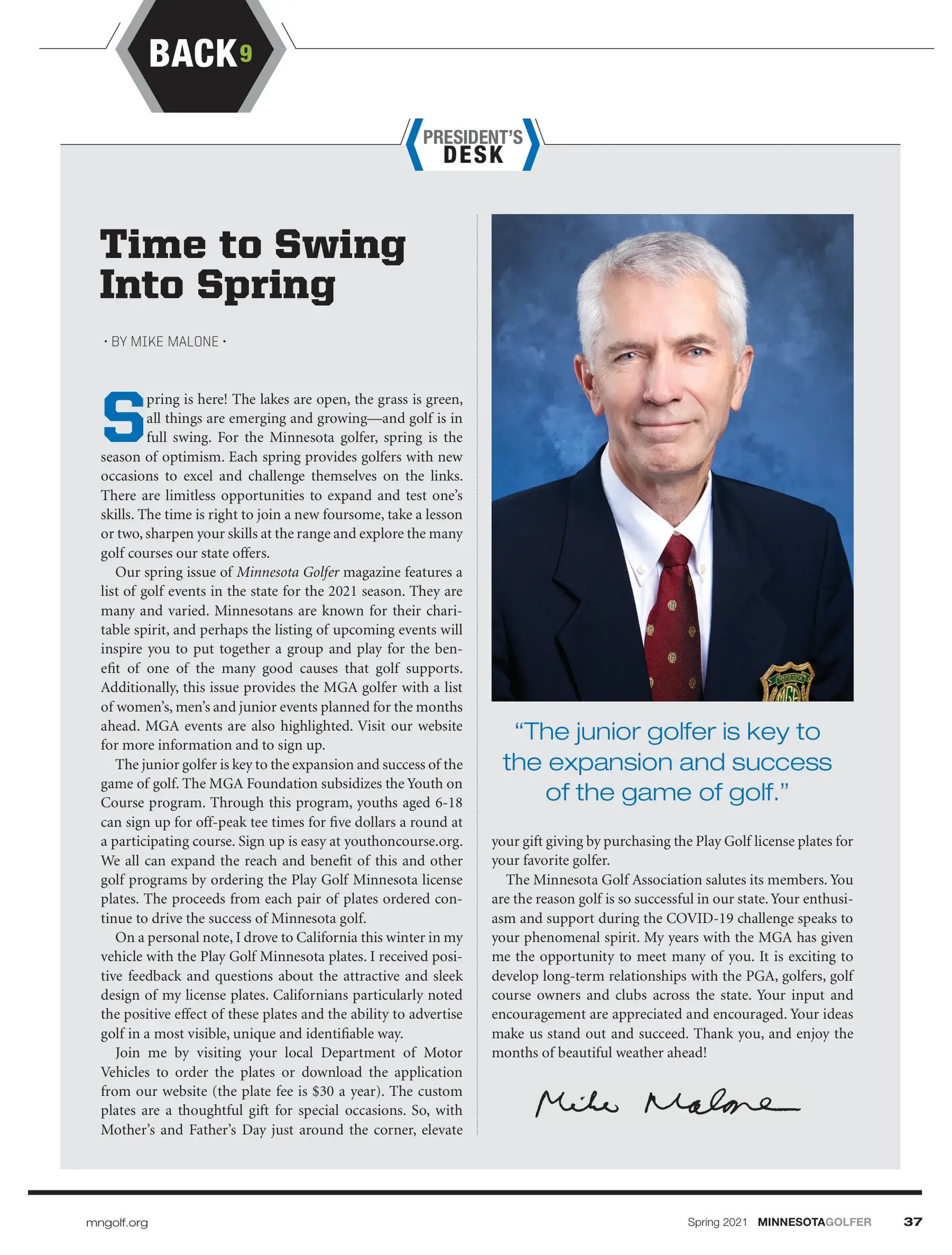
Bearpath Golf & CC Dellwood CC Edina CC Elk River GC Golden Valley CC Hazeltine National GC Interlachen CC Madden’s On Gull Lake - The Classic Midland Hills CC Minneapolis GC Minnesota Valley CC North Oaks GC Northland CC Oak Ridge CC Olympic Hills GC Somerset CC St. Cloud CC The Minikahda Club Town & Country Club Wayzata CC White Bear Yacht Club Windsong Farm Woodhill CC William Addler Kaia Heltne Garrett Kaiser Karsten Kimsal William Nelson BACK PRESIDENT’S DESK Time to Swing Into Spring S pring is here! The lakes are open, the grass is green, all things are emerging and growing—and golf is in full swing. For the Minnesota golfer, spring is the season of optimism. Each spring provides golfers with new occasions to excel and challenge themselves on the links.
There are limitless opportunities to expand and test one’s skills. The time is right to join a new foursome, take a lesson or two, sharpen your skills at the range and explore the many golf courses our state offers.
Our spring issue of Minnesota Golfer magazine features a list of golf events in the state for the 2021 season. They are many and varied. Minnesotans are known for their charitable spirit, and perhaps the listing of upcoming events will inspire you to put together a group and play for the benefi t of one of the many good causes that golf supports.
Additionally, this issue provides the MGA golfer with a list of women’s, men’s and junior events planned for the months ahead. MGA events are also highlighted. Visit our website for more information and to sign up.
The junior golfer is key to the expansion and success of the game of golf. The MGA Foundation subsidizes the Youth on Course program. Through this program, youths aged 6-18 can sign up for off-peak tee times for five dollars a round at a participating course. Sign up is easy at youthoncourse.org.
We all can expand the reach and benefi t of this and other golf programs by ordering the Play Golf Minnesota license plates. The proceeds from each pair of plates ordered continue to drive the success of Minnesota golf.
On a personal note, I drove to California this winter in my vehicle with the Play Golf Minnesota plates. I received positive feedback and questions about the attractive and sleek design of my license plates. Californians particularly noted the positive effect of these plates and the ability to advertise golf in a most visible, unique and identifi able way.
Join me by visiting your local Department of Motor Vehicles to order the plates or download the application from our website (the plate fee is $30 a year). The custom plates are a thoughtful gift for special occasions. So, with Mother’s and Father’s Day just around the corner, elevate your gift giving by purchasing the Play Golf license plates for your favorite golfer.
The Minnesota Golf Association salutes its members. You are the reason golf is so successful in our state. Your enthusiasm and support during the COVID-19 challenge speaks to your phenomenal spirit. My years with the MGA has given me the opportunity to meet many of you. It is exciting to develop long-term relationships with the PGA, golfers, golf course owners and clubs across the state. Your input and encouragement are appreciated and encouraged. Your ideas make us stand out and succeed. Thank you, and enjoy the months of beautiful weather ahead!
• BY MIKE MALONE • “The junior golfer is key to the expansion and success of the game of golf.” Spring 2021 MINNESOTAGOLFER 37 Lost courses don’t often return from the beyond, but recent news of the longdefunct Lido Club of Long Island, N.Y., being resurrected near Nekoosa, Wisc. has delighted golf course architecture enthusiasts.
Michael and Chris Keiser (whose father Mike founded Bandon Dunes) have contracted architect Tom Doak to build the Lido near their celebrated Sand Valley Golf Resort and restore it to C.B.
McDonald’s original design. “We are restoring the Lido,” Michael Keiser said on the Lido website. “We are restoring it as it originally was.”
McDonald and his chief engineer and protégé Seth Reynor built the Lido Club in 1918 with an assist from a promising architect, Dr. Alister MacKensie, who won a magazine contest of design suggestions for the 18th hole. Upon completion, it quickly garnered acclaim as one of the finest courses in the world. In 1942, the U.S. Navy commandeered the land as a strategic defense site and the course was demolished. Although another course nearby bears its named, the Lido’s original design that included Biarritz, Redan and Eden holes, was lost—until now.
Thanks to the help of course architecture hobbyist Peter Flory’s research and digital design, Doak and the Kaisers are restoring the “masterpiece”
to its original glory on the sand-filled plains of central Wisconsin. Already underway, the private club is slated for preview play in 2022 and weekday access to Sand Valley resort guests the following season.
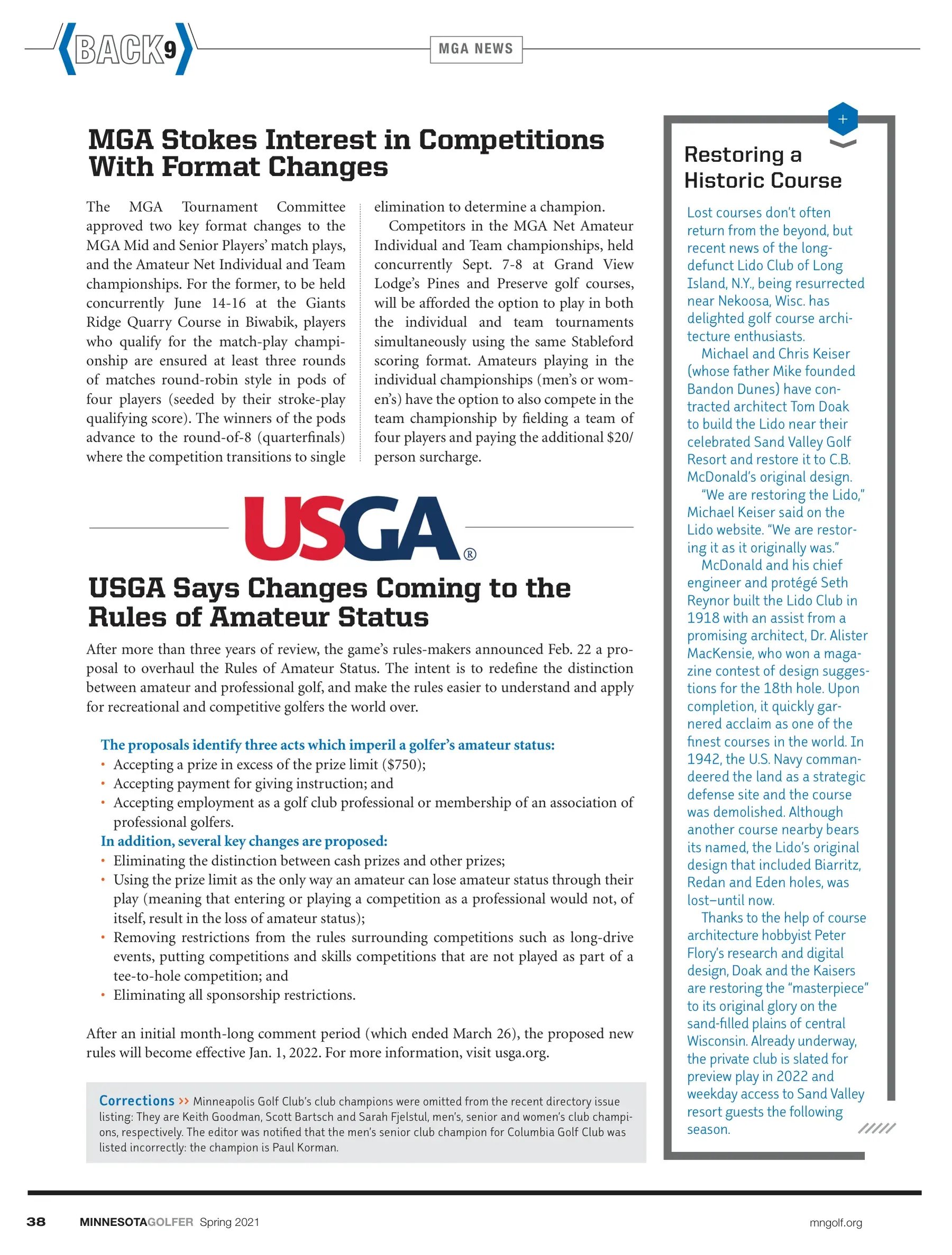
Restoring a Historic Course The MGA Tournament Committee approved two key format changes to the MGA Mid and Senior Players’ match plays, and the Amateur Net Individual and Team championships. For the former, to be held concurrently June 14-16 at the Giants Ridge Quarry Course in Biwabik, players who qualify for the match-play championship are ensured at least three rounds of matches round-robin style in pods of four players (seeded by their stroke-play qualifying score). The winners of the pods advance to the round-of-8 (quarterfinals) where the competition transitions to single elimination to determine a champion.
Competitors in the MGA Net Amateur Individual and Team championships, held concurrently Sept. 7-8 at Grand View Lodge’s Pines and Preserve golf courses, will be afforded the option to play in both the individual and team tournaments simultaneously using the same Stableford scoring format. Amateurs playing in the individual championships (men’s or women’s) have the option to also compete in the team championship by fielding a team of four players and paying the additional $20/ person surcharge.
MGA Stokes Interest in Competitions With Format Changes Corrections >> Minneapolis Golf Club’s club champions were omitted from the recent directory issue listing: They are Keith Goodman, Scott Bartsch and Sarah Fjelstul, men’s, senior and women’s club champions, respectively. The editor was notified that the men’s senior club champion for Columbia Golf Club was listed incorrectly: the champion is Paul Korman.
MGA NEWS After more than three years of review, the game’s rules-makers announced Feb. 22 a proposal to overhaul the Rules of Amateur Status. The intent is to redefine the distinction between amateur and professional golf, and make the rules easier to understand and apply for recreational and competitive golfers the world over.
The proposals identify three acts which imperil a golfer’s amateur status: • Accepting a prize in excess of the prize limit ($750); • Accepting payment for giving instruction; and • Accepting employment as a golf club professional or membership of an association of professional golfers.
In addition, several key changes are proposed: • Eliminating the distinction between cash prizes and other prizes; • Using the prize limit as the only way an amateur can lose amateur status through their play (meaning that entering or playing a competition as a professional would not, of itself, result in the loss of amateur status); • Removing restrictions from the rules surrounding competitions such as long-drive events, putting competitions and skills competitions that are not played as part of a tee-to-hole competition; and • Eliminating all sponsorship restrictions.
After an initial month-long comment period (which ended March 26), the proposed new rules will become effective Jan. 1, 2022. For more information, visit usga.org.
USGA Says Changes Coming to the Rules of Amateur Status MGA NEWS Spring 2021 MINNESOTAGOLFER 39 Midwest Golf Course Owners Association, MGCOA The MGCOA represents privately owned public and private golf courses. For more information, contact Curt Walker, executive director, via email at MWGCOA@aol.com.
The Fairway Foundation The Fairway Foundation uses the game of golf to teach lifetime values and skills to youth who would not otherwise have an opportunity to be exposed to the game.
The First Tee The First Tee was established to impact the lives of young people around the world by creating affordable and accessible golf facilities to primarily serve those not previously exposed to the game and its positive values. For more information, go to thefirsttee.org.
The Ladies Professional Golf Association, LPGA The Ladies Professional Golf Association encompasses both the LPGA Tour and the LPGA Teaching and Club Professionals.
A three-sided heated structure allows use between March through November. The project, which began last year, includes a complete reconstruction of the driving range and four target greens. Albany is home to 231 MGA members and features two nines designed by Minnesota Golf Hall of Famers Bill Kidd Jr. and John Harris.
Braemar Golf Course, a 27-hole municipal facility in Edina, has featured Toptracer driving range technology in its indoor practice range for nearly two years. With 44 stations, Toptracer has doubled the dome’s business, says Joe Abood, Braemar general manager.
Pebble Lake Golf Course to Host State’s First Blind Championship The U.S. Blind Golfers Association announced plans to bring its regional championship to Fergus Falls, Minn., and the Pebble Lake Golf Course, July 18-20. “We are celebrating our 75th year of blind golf and this will be the first time that a blind golf tournament has been held in Minnesota,”
stated Curt Jones, a USBGA board member, in an email to the MGA. Tournament organizers expect blind competitors from around the U.S. and Canada should pandemic travel restrictions ease.
PHOTO COURTESY OF LUDWIG PHOTOGRAPHY D o I look like a guy who needs funeral insurance and a walk-in tub? On second thought, don’t answer that.
Apparently, I do. Or at least Big Brother thinks so based on emails sent from the information superhighway through the land of nosey algorithms and into my overflowing inbox.
All told, there were 6,192 unread emails. The golf-related ones numbered 651. And, yes, a great deal of them assumed the worst about the abilities of my driver, long irons, short game, putter and overall fitness to play this beloved game.
One email offered to “literally flatten and tighten your tummy overnight” by taking one sip of magic liquid after dinner. I won’t say where it came from, but my tummy and I can confirm that it was not sent from the Surly Brewing Co.
Another email informed me that in order to drain putts, “you must be able to hit the ball dead straight.” Huh. Who knew? Apparently, I’ll never make another threefooter without expensive laser technology.
Another email promised miraculous eyesight. Apparently, there’s a “little-known secret” set of exercises pro athletes do. The “must-watch” video was quite tempting since it swore that “someone’s mom’s vision went from blind to 20/20.”
Many an email was dedicated to the driver. And why not? Nothing gets an American male to open his wallet faster than an email informing him that his buddies are reading an email that’s guaranteeing 300-yard drives.
One such email told how a man taught himself to “regularly launch 300-yard tee shots doing the opposite of what all the overpaid golf ‘pros’ teach.” Apparently, this fella knows a “golf swing biomechanics expert who knows three secrets the golf equipment industry is scared to death golfers will discover.”
Then there was an email about how to choose a club when hitting from the rough. I was told to listen to this particular teacher because “he knows more about wedges than anybody on the planet.”
The entire planet, people. That’s when this 14-handicapper decided that he, too, must find something he knows more about than anybody on the planet.
Think, man, think. Got it. It’s 2008 and I’m playing Interlachen during the U.S. Women’s Open media day. I’m riding with Tom Ryan, executive director and COO of the MGA.
Tom was shooting a 74 like it was first-grade math. I was struggling somewhere far north of 74. In the words of Drew Willim, a golf buddy from Arkansas, my “towards” was off. Everything I hit went “towards” the trees.
Each hole went something like this: Tom hit it in the fairway and waited while our forecaddie and I found my golf ball under a tree. But something happened that day. A confidence grew stronger with each awkward recovery shot. The right long iron was pulled, the proper stance taken, a low exit window located.
Tiger Who? I asked Mike Barge, Hazeltine’s great director of instruction, to help describe where confidence like this comes from. “Previous success and good feelings with the club, and a proper fit,” he said.
Our forecaddie—a teenage lad standing 6 feet 4 inches tall and weighing far too little—might have put it better after one of my blistering recovery shots came racing from the woods.
The only words I heard him say that day were, and I quote, “Dude! I don’t know if this is a compliment or not. But you own that shot!” Ha! So keep your emails about funeral insurance and walkin tubs. And don’t be surprised if you get an email saying this fella “knows more about the punch shot to save double bogey than anybody on the planet!”
Mark Craig is the NFL/Vikings columnist and a golf writer for the Star Tribune. Swing Your Swing You can answer every email with a new “fix” for your game, or perhaps listen to a seasoned golf professional.
• BY MARK CRAIG • BACKSPIN “I asked Mike Barge, Hazeltine’s great director of instruction, to help describe where confidence like this comes from. ‘Previous success and good feelings with the club, and a proper fit,’ he said.”
There’s no better place for a change of scenery than Gulf Shores and Orange Beach. Our beaches are open and our destination is ready to welcome you back to our shores. We’ve missed you.