




Summer 2019

























Back to The Minnesota Golfer Archive
Read the text of this issue
Text from the printed pages, so it can be searched and read by screen readers. Layout and photography are in the reader above.
16 | 3M OPEN PREVIEW By Joseph Oberle Tom Lehman preps the TPC for the Tour. 20 | GET YOUR GOPHER ON By Mike Fermoyle A Gopher tourney review and preview.
24 | COURSE CREATORS By Rick Shefchik A look at the great golf course architects of Minnesota. 28 | INTERLAKEN CELEBRATION By W.P. Ryan A century of history and competition.
Subscriptions: Regular U.S. one year (4 issues) $18. Directory issue of Minnesota Golfer: $9.95 plus shipping, pre-paid. Other single copies: $2.95 per copy plus shipping, pre-paid.
Copyright © 2019 MGA The MGA upholds and promotes the game of golf and its values for all golfers in Minnesota. Minnesota Golf Association Inc.
Legislative Counsel McGrann Shea Carnival Straughn & Lamb, Chartered OFFICE Volume 47, Number 3 Summer 2019 A merica was on its way to the moon to put a man on it when the Twin Cities last hosted a professional tour stop. It’s been 50 years almost to the day. July 13, 1969, Frank Beard, who would be the leading money winner on the tour that year, arrived in Edina to play the Minnesota Classic (formerly the St. Paul Open) at Braemar Golf Course, less than enthusiastic about the golf.
He was tired of the grind of travel on tour, didn’t like the golf course and rightly labeled the field as “weak,” because most of the tour stars were at the British Open. One aspect of the Minnesota Classic which did impress Beard, enough to mention it in his book, “Pro: Frank Beard on the Golf Tour,” (Times Mirror, 1970): the bachelors especially “love to play [in Minnesota] because of the hospitality of the local hostesses,” he wrote. There was more to the hostess angle, but this is a family magazine.
Still, Beard managed a 15-under par 269, won handily, pocketed the $20,000 winner’s check, paid his caddie $750 and celebrated by taking his family out to Howard Johnson’s for the filet of fish and chocolate milkshakes.
The tab was $6. No doubt fans will want to see birdies and eagles at this year’s 3M Open, July 4–7 at the TPC Twin Cities, former home to the longrunning 3M Championship of the senior circuit. The course—along with Bryson DeChambeau, Jason Day, Phil Mickelson and reigning U.S. Open and PGA champ Brooks Koepka—will oblige. It’ll be interesting to see what 15-under par wins half a century later, or if the score will even merit a top-five finish.
Mickelson, who confided he has a soft spot for Minnesota when he committed to the 3M Open, does not feel that way about the USGA and its U.S. Open setup. He flamed the organization during an interview at the Memorial May 30, saying he has played in 29 U.S. Opens and the USGA has gotten the course setup wrong 100 percent of the time—except if it rains, he qualified.
This from a guy who has finished runner up or tied for second at our national open championship six times in his career, and who called himself “an idiot” for playing too aggressively at the 72nd hole during the 2006 U.S. Open at Winged Foot, won by Aussie Geoff Ogilvy.
Mickelson had the lead. A par at 18 was the smart play, but he grabbed his driver and missed the world. He never saw the fairway and eventually hit his third shot into the greenside bunker, where he failed to get up and down for par or bogey (he scored 6).
“In that position you just win ugly,” Johnny Miller commented as the catastrophe unfolded. Perhaps Mickelson is trying to get inside the head of John Bodenhamer, the USGA guru in charge of the championship setup.
For a guy who likes to come across as smart and thoughtful, and who, at least from outward appearances, is mentally and physically suited to win the U.S. Open, it’s a strange ploy to complain about the championship before teeing it up.
It may not be as thrifty as a space-age family dinner at Ho-Jo’s, but tickets to the 3M Open start at $45. Don’t expect an “amazing collapse” a la Winged Foot, but watch for a dramatic finish at TPC’s newly refashioned 18th.
Women’s Opens—as well as five PGA Championships and one Ryder Cup. Over the next 10 years, Hazeltine is slated to host this summer’s KPMG Women’s PGA, the 2020 U.S. Junior, the 2024 U.S. Amateur and the Ryder Cup again in 2028—the first time that the Ryder Cup will visit a U.S.
venue twice. Starting this year we also have a regular PGA Tour stop at the TPC of Blaine. Hand in hand with our championship pedigree, world-famous golfers have earned victories here. After winning the U.S. Open in 2016 at Minikahda, Chick Evans established the Evans Scholar Caddie Scholarship Program. Bobby Jones won twice here—first the U.S.
Amateur at Minikahda in 1927 and then the U.S. Open at Interlachen in 1930, on his way to winning the original Grand Slam later that summer. A few of our own have won majors as well: Patty Berg, Jerilyn Britz and Hilary Lunke are former U.S. Women’s Open champions, and Tom Lehman grasped the Claret Jug at The Open in 1996.
It’s not surprising that the USGA, PGA and professional tours love to come to Minnesota: Corporate support is strong, fans are knowledgeable and enthusiastic, and the volunteer ethos is second to none.
But the bedrock of our history has to begin with the quality of our golf courses. Minnesota currently has 447 facilities, of which 90 percent are open to the public—well above the national average (75 percent). Our courses consistently rank on the nation’s Top 100 and “best places to play” lists.
Many were designed by the game’s greatest architects, led by Donald Ross, with six to his name, and including Seth Raynor, A.W. Tillinghast, Robert Trent Jones and Stanley Thompson. Contemporary architects with Minnesota credits include Tom Fazio, Jack Nicklaus, Arnold Palmer, Rees Jones, Tom Lehman and Joel Goldstrand. Ninety of our courses have either recently celebrated or will soon celebrate their century mark.
When the MGA was founded in 1901, there were just seven golf courses in the state. By 1920, there were 26. By 1930, there were 100. The first course open to the public was Minneapolis’ Theodore Wirth in 1916, followed by Columbia in 1919. The first public course in St. Paul was Phalen in 1924.
Courses quickly sprung up not just in the metro area, but all across the state: Austin, Breezy Point, Hibbing Municipal, St. Cloud, Owatonna, Alexandria, Mankato, Soldiers Field and Ridgeview golf clubs were all built during this time. These and other courses founded during this “Golden Age” of golf are lasting tributes to the era and remain integral parts of their communities.
You should be proud of our state’s contribution to the history of golf—as well as the vision and grassroots enthusiasm it took to get the game off the ground more than 100 years ago.
Minnesota’s golf roots run deep and strong. MGA MEMBER CLUB CENTENNIAL BENCHMARKS Austin CC 1919 Columbia GC 1919 Great Life Golf & Fitness 1919 (Worthington CC) Mankato GC 1919 Midland Hills CC 1919 Owatonna CC 1919 Somerset CC 1919 Southview CC 1919 Breezy Point Resort 1920 Canby GC 1920 Castlewood Golf-The Rock 1920 Olivia GC 1920 St. Cloud CC 1920 The Bridges 1920 Oak Ridge CC 1921 Old Course Sauk Centre 1921 Ridgeview CC 1921 Riverside Town & CC 1921 University of Minnesota, Les Bolstad GC 1921 Westfi eld GC 1921 Cloquet CC 1922 Crow River GC 1922 Izatys Resort 1922 Minnewaska GC 1922 Redwood Falls GC 1922 Ruttger’s Bay Lake Lodge 1922 • BY TOM RYAN • W hen Tiger Woods putted out on No. 18 at Augusta National Golf Club for his fifth Green Jacket this past April, the golf industry received a boost that will likely ripple throughout the rest of the season. How much of a Tiger-bump remains to be seen, but Woods’ return to form was already in play last season, and the National Golf Foundation (NGF) measured that and other factors in its 2019 Golf Industry Report.
“Golf is an $84 billion industry that is adapting to cultural and behavioral shifts, like many other aspects of society,” the report said. “The NGF’s annual Golf Industry Report takes a high-level view of this evolution, presenting a balanced state-ofthe-industry overview that aggregates many of the game’s key metrics.”
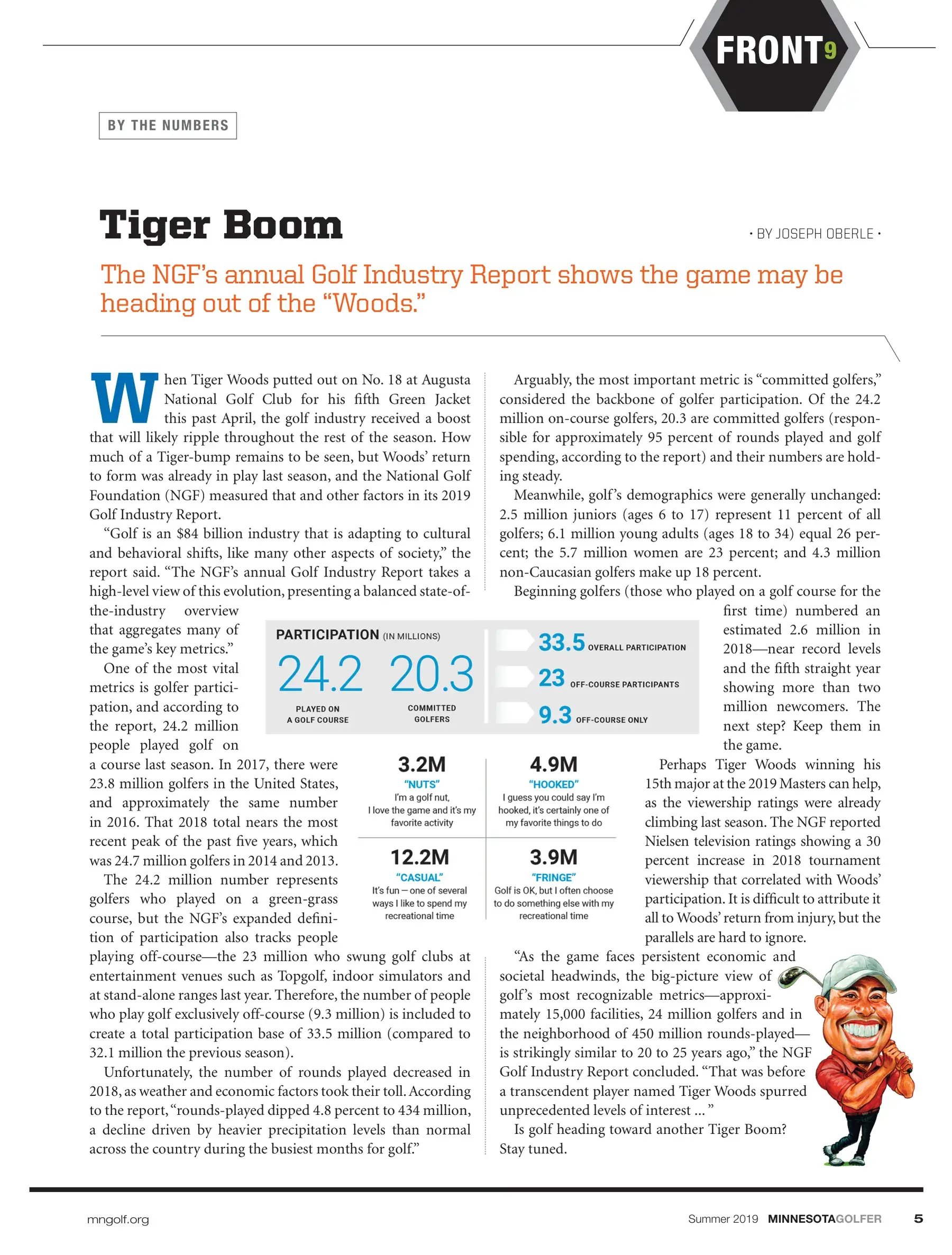
One of the most vital metrics is golfer participation, and according to the report, 24.2 million people played golf on a course last season. In 2017, there were 23.8 million golfers in the United States, and approximately the same number in 2016. That 2018 total nears the most recent peak of the past five years, which was 24.7 million golfers in 2014 and 2013.
The 24.2 million number represents golfers who played on a green-grass course, but the NGF’s expanded defi nition of participation also tracks people playing off-course—the 23 million who swung golf clubs at entertainment venues such as Topgolf, indoor simulators and at stand-alone ranges last year. Therefore, the number of people who play golf exclusively off-course (9.3 million) is included to create a total participation base of 33.5 million (compared to 32.1 million the previous season).
Unfortunately, the number of rounds played decreased in 2018, as weather and economic factors took their toll. According to the report, “rounds-played dipped 4.8 percent to 434 million, a decline driven by heavier precipitation levels than normal across the country during the busiest months for golf.”
Arguably, the most important metric is “committed golfers,” considered the backbone of golfer participation. Of the 24.2 million on-course golfers, 20.3 are committed golfers (responsible for approximately 95 percent of rounds played and golf spending, according to the report) and their numbers are holding steady.
Meanwhile, golf’s demographics were generally unchanged: 2.5 million juniors (ages 6 to 17) represent 11 percent of all golfers; 6.1 million young adults (ages 18 to 34) equal 26 percent; the 5.7 million women are 23 percent; and 4.3 million non-Caucasian golfers make up 18 percent.
Beginning golfers (those who played on a golf course for the first time) numbered an estimated 2.6 million in 2018—near record levels and the fifth straight year showing more than two million newcomers. The next step? Keep them in the game.
Perhaps Tiger Woods winning his 15th major at the 2019 Masters can help, as the viewership ratings were already climbing last season. The NGF reported Nielsen television ratings showing a 30 percent increase in 2018 tournament viewership that correlated with Woods’ participation. It is diffi cult to attribute it all to Woods’ return from injury, but the parallels are hard to ignore.
“As the game faces persistent economic and societal headwinds, the big-picture view of golf’s most recognizable metrics—approximately 15,000 facilities, 24 million golfers and in the neighborhood of 450 million rounds-played— is strikingly similar to 20 to 25 years ago,” the NGF Golf Industry Report concluded. “That was before a transcendent player named Tiger Woods spurred unprecedented levels of interest ... ”
Is golf heading toward another Tiger Boom? Stay tuned. Tiger Boom The NGF’s annual Golf Industry Report shows the game may be heading out of the “Woods.”
“It’s a great risk-reward par 4,” head pro Luke Liebel says. “You can cut the corner [carrying upwards of 290 yards] to just in front of the green. Otherwise, hit out to the corner and play it like a normal par 4.”
Risk aversion doesn’t sound fun, especially since the second shot from the turn is more than 200 yards into a heavily sloped (back-tofront) green with a bunker front/ right and Great Northern Lake long. Liebel advises to stay below the hole.
“It’s very diffi cult to make a putt from above the hole,” he says. “I’d rather have a 20-footer up the hill than a 5-footer down the hill.” At least that decision is easy.
—Joseph Oberle “Keep the ball below the hole. If you go over the green, you are in the lake.” —Luke Liebel Summer 2019 MINNESOTAGOLFER 9 TIPS FROM THE PROS Stand Up Against Back Pain • BY MIKE BARGE • Mike Barge is the director of instruction at Hazeltine National GC and a Class A member of the PGA of America.
I t’s common knowledge that golfers and their lower backs don’t get along. If you’ve ever experienced pain and discomfort in that area, you know what I mean. Lower back pain is a career-ender for some; for others, such as Tiger Woods, it’s a long process of multiple surgeries and rehabilitation.
There are many possible causes of lower back issues, but let’s make sure your golf swing isn’t one of them. It all starts with good posture. We’re taught to lift from the legs when hoisting something heavy. Get that sensation in your setup. Finish tall and avoid a backward bend, or “reverse C” swing. Take as much pressure as possible off the lower back, and you can enjoy this game for a long time.
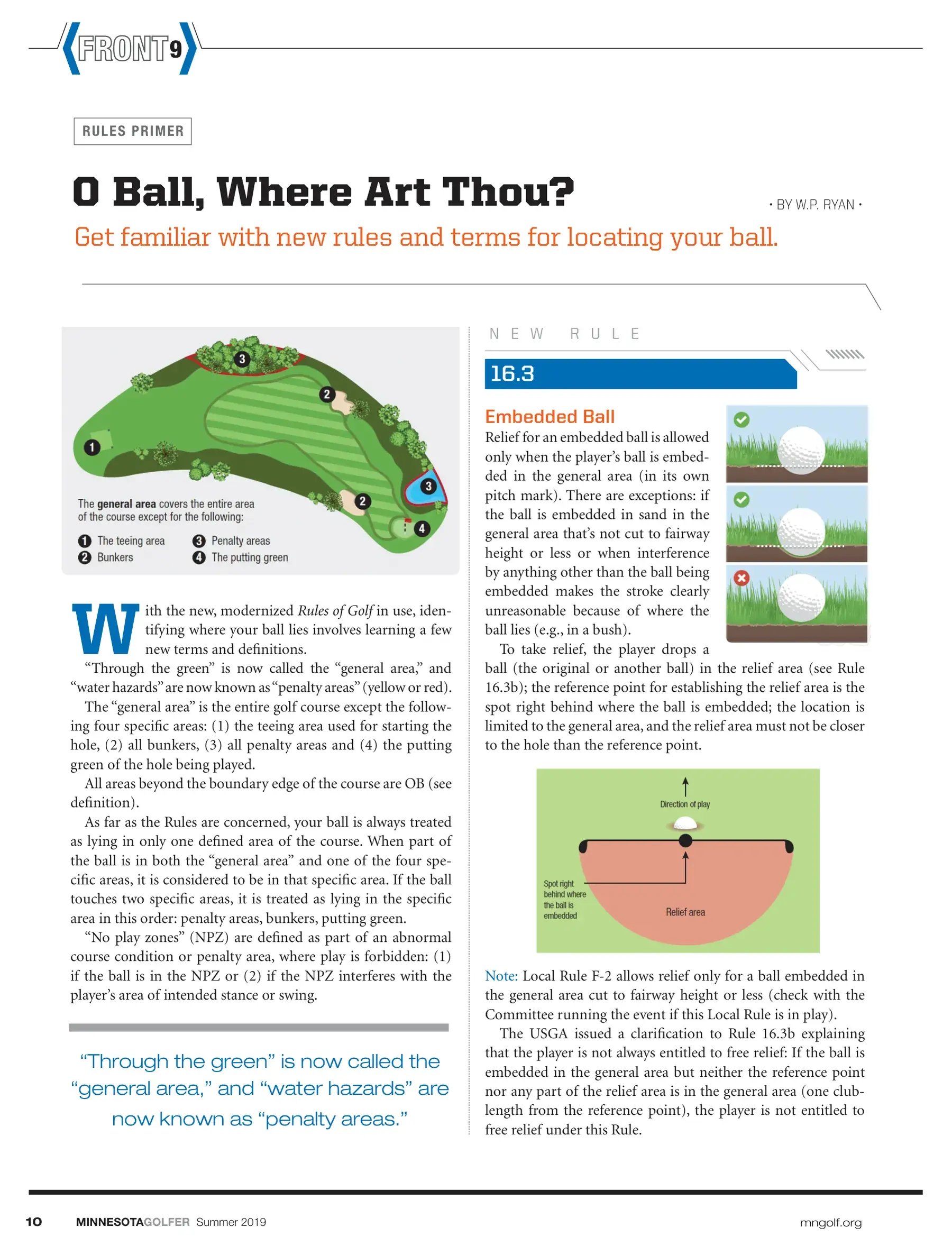
W ith the new, modernized Rules of Golf in use, identifying where your ball lies involves learning a few new terms and definitions. “Through the green” is now called the “general area,” and “water hazards” are now known as “penalty areas” (yellow or red).
The “general area” is the entire golf course except the following four specific areas: (1) the teeing area used for starting the hole, (2) all bunkers, (3) all penalty areas and (4) the putting green of the hole being played.
All areas beyond the boundary edge of the course are OB (see definition). As far as the Rules are concerned, your ball is always treated as lying in only one defined area of the course. When part of the ball is in both the “general area” and one of the four specific areas, it is considered to be in that specific area. If the ball touches two specific areas, it is treated as lying in the specific area in this order: penalty areas, bunkers, putting green.
“No play zones” (NPZ) are defined as part of an abnormal course condition or penalty area, where play is forbidden: (1) if the ball is in the NPZ or (2) if the NPZ interferes with the player’s area of intended stance or swing.
O Ball, Where Art Thou? Get familiar with new rules and terms for locating your ball. • BY W.P. RYAN • RULES PRIMER 16.3 Embedded Ball Relief for an embedded ball is allowed only when the player’s ball is embedded in the general area (in its own pitch mark). There are exceptions: if the ball is embedded in sand in the general area that’s not cut to fairway height or less or when interference by anything other than the ball being embedded makes the stroke clearly unreasonable because of where the ball lies (e.g., in a bush).
To take relief, the player drops a ball (the original or another ball) in the relief area (see Rule 16.3b); the reference point for establishing the relief area is the spot right behind where the ball is embedded; the location is limited to the general area, and the relief area must not be closer to the hole than the reference point.
Note: Local Rule F-2 allows relief only for a ball embedded in the general area cut to fairway height or less (check with the Committee running the event if this Local Rule is in play).
The USGA issued a clarification to Rule 16.3b explaining that the player is not always entitled to free relief: If the ball is embedded in the general area but neither the reference point nor any part of the relief area is in the general area (one clublength from the reference point), the player is not entitled to free relief under this Rule.
N E W R U L E “Through the green” is now called the “general area,” and “water hazards” are now known as “penalty areas.” Carry On! Dress up your clubs and your game with these lightweight carry bags.
G olf bags don’t typically top one’s list of game improvement gear, but consider one of these lightweight options—and see if carrying effi ciency doesn’t help your golf experience.
» Waterproof Protection Titleist offers several new bags for the 2019 season. The Players 4 Plus is for the pros and was introduced at the Waste Management Phoenix Open in February; the new Hybrid 14 model has 14 slots to separate each club (the Hybrid 5 has five); and the revamped Players 4 StaDry is 14 percent lighter than the Players 4 Plus and features a nylon material construct and waterproof seams and zippers. Titleist says the new bags are all lighter while not sacrifi cing any storage space—leaving the ultimate carrying weight up to each golfer.
$225 for the Players 4 Plus $230 for the Hybrid 5 $240 for the Hybrid 14 $255 for the Players 4 StaDry; titleist.com » Structured Storage Sun Mountain has a great reputation with light carry bags, and their new model, the Sun Mountain 2.5+, is basically an updated version of the 2.5 model. At just 2.8 pounds, the 2.5+ features high-density foam shoulder straps for carrying comfort, a roomy, 9-inch four-way top and five storage pockets (including a beverage pouch)—impressive for a bag this light. The golf ball pocket has a twoway zipper, and the bag itself is made of a higher denier fabric for more durability. The enhancements added only .3 pounds in weight, so it’s still classifi ed in the ultra-light category. But no need to substantially change what’s working.
$225; sunmountain.com » Ultra-Lightweight Stand System Callaway weighs in with a couple of very light bags for the walkers among us. The Hyper Lite Zero Stand Bag and Hyper Lite 1+ “are engineered to be the lightest stand bag ever,” according to Callaway, and at less than 2.5 pounds, it’s hard not to believe them. The bags are purportedly lighter than two dozen golf balls. They feature three-way club dividers, an ergonomic double strap and three zippered storage pockets (the Hyper Lite Zero has four). The Hyper Lite 1+ is the newer model and includes an “integrated stand system to keep your bag off the ground.”
Compare the stands on both models to find what works. $120 for the Hyper Lite 1+ $250 for the Hyper Lite Zero Stand Bag; callawaygolf.com » Effortless Organization If you can handle a bit more weight, the 5.1-pound Wilson Staff EXO Carry bag might be the one for you. The EXO’s five-way top contains five large dividers for easy club handling, and the bag’s six functional storage pockets provide ample space for gear. “The organization and design of each pocket make things effortless for golfers,” says Jean-Pierre Degembe, Wilson’s global product director. The EXO also features a two-in-one self-balancing four-point double strap system for carrying comfort. With all the storage space in this bag, you can tote everything you need and not get bogged down under the weight.
$160; wilson.com Summer 2019 MINNESOTAGOLFER 11 Carry a bit of Augusta National in your golf bag thanks to a head cover design collaboration between Callaway Golf, Seamus Golf Co.
and Minnesota’s own Olivia Herrick, an accomplished amateur player and designer. Inspired by the flowers and trees (including Golden Bell and Pink Dogwood) that lend their name to the iconic holes at Augusta, Herrick designed driver, putter, fairway wood and hybrid covers that Seamus handcrafted.
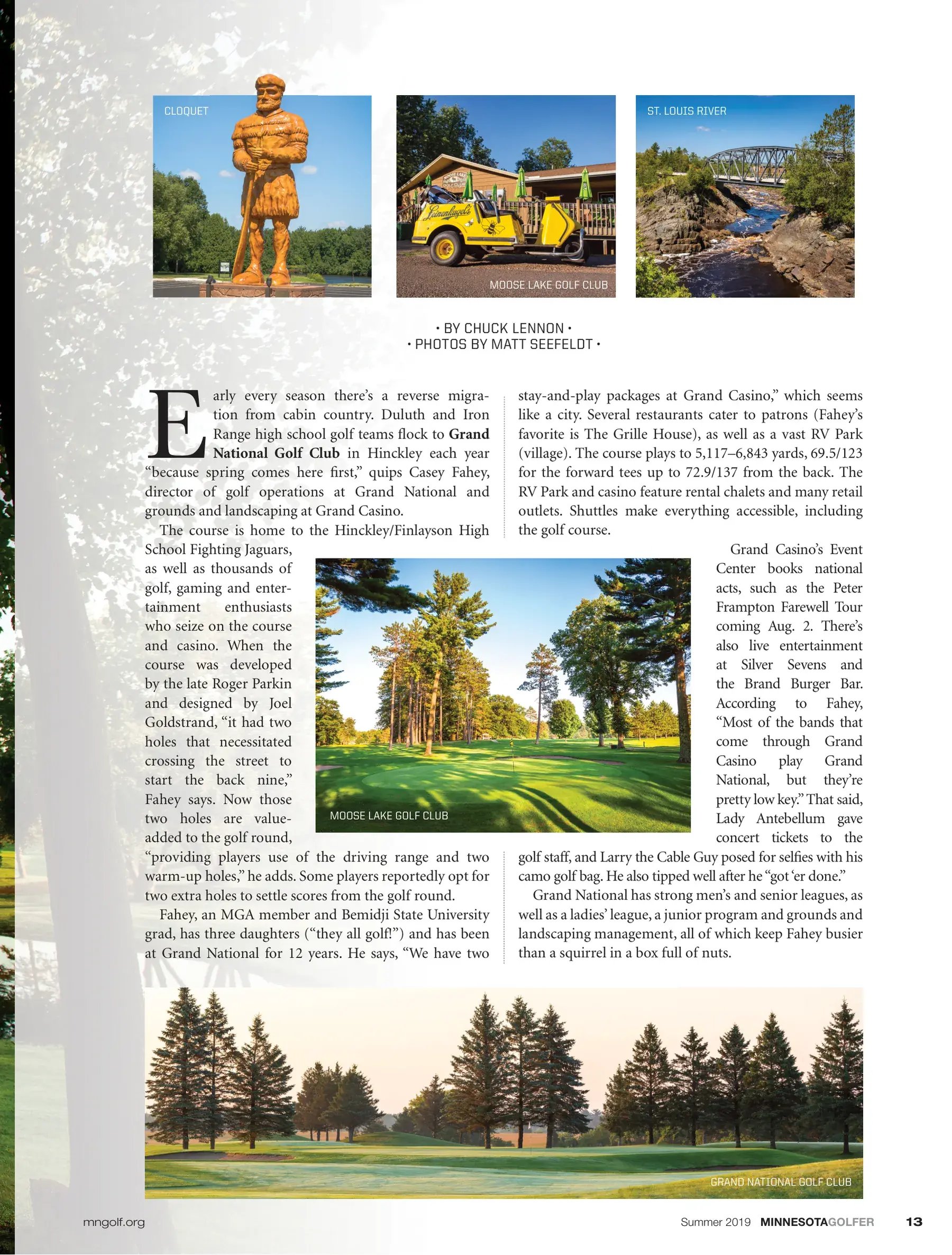
Masterful Designs • BY JOSEPH OBERLE • Wilson Staff EXO Carry Discover golf, gaming and more on the Moose Lake driving tour. GRAND NATIONAL GOLF CLUB Summer 2019 MINNESOTAGOLFER 13 E arly every season there’s a reverse migration from cabin country. Duluth and Iron Range high school golf teams flock to Grand National Golf Club in Hinckley each year “because spring comes here first,” quips Casey Fahey, director of golf operations at Grand National and grounds and landscaping at Grand Casino.
The course is home to the Hinckley/Finlayson High School Fighting Jaguars, as well as thousands of golf, gaming and entertainment enthusiasts who seize on the course and casino. When the course was developed by the late Roger Parkin and designed by Joel Goldstrand, “it had two holes that necessitated crossing the street to start the back nine,”
Fahey says. Now those two holes are valueadded to the golf round, “providing players use of the driving range and two warm-up holes,” he adds. Some players reportedly opt for two extra holes to settle scores from the golf round.
Fahey, an MGA member and Bemidji State University grad, has three daughters (“they all golf!”) and has been at Grand National for 12 years. He says, “We have two stay-and-play packages at Grand Casino,” which seems like a city. Several restaurants cater to patrons (Fahey’s favorite is The Grille House), as well as a vast RV Park (village). The course plays to 5,117–6,843 yards, 69.5/123 for the forward tees up to 72.9/137 from the back. The RV Park and casino feature rental chalets and many retail outlets. Shuttles make everything accessible, including the golf course.
Grand Casino’s Event Center books national acts, such as the Peter Frampton Farewell Tour coming Aug. 2. There’s also live entertainment at Silver Sevens and the Brand Burger Bar.
According to Fahey, “Most of the bands that come through Grand Casino play Grand National, but they’re pretty low key.” That said, Lady Antebellum gave concert tickets to the golf staff, and Larry the Cable Guy posed for selfi es with his camo golf bag. He also tipped well after he “got ‘er done.”
Grand National has strong men’s and senior leagues, as well as a ladies’ league, a junior program and grounds and landscaping management, all of which keep Fahey busier than a squirrel in a box full of nuts.
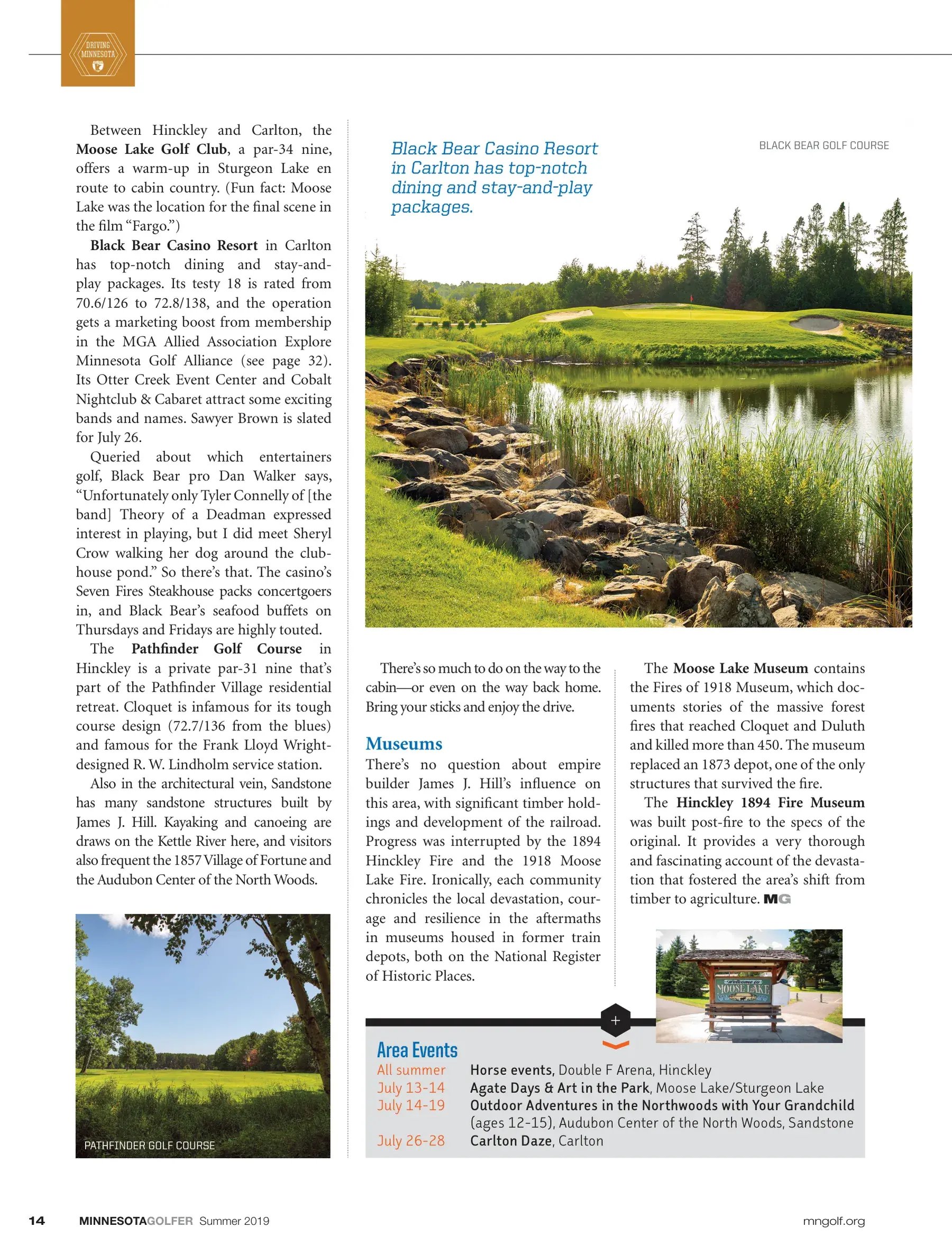
• BY CHUCK LENNON • • PHOTOS BY MATT SEEFELDT • GRAND NATIONAL GOLF CLUB MOOSE LAKE GOLF CLUB MOOSE LAKE GOLF CLUB ST. LOUIS RIVER CLOQUET DRIVING MINNESOTA Between Hinckley and Carlton, the Moose Lake Golf Club, a par-34 nine, offers a warm-up in Sturgeon Lake en route to cabin country. (Fun fact: Moose Lake was the location for the final scene in the film “Fargo.”) Black Bear Casino Resort in Carlton has top-notch dining and stay-andplay packages. Its testy 18 is rated from 70.6/126 to 72.8/138, and the operation gets a marketing boost from membership in the MGA Allied Association Explore Minnesota Golf Alliance (see page 32).
Its Otter Creek Event Center and Cobalt Nightclub & Cabaret attract some exciting bands and names. Sawyer Brown is slated for July 26. Queried about which entertainers golf, Black Bear pro Dan Walker says, “Unfortunately only Tyler Connelly of [the band] Theory of a Deadman expressed interest in playing, but I did meet Sheryl Crow walking her dog around the clubhouse pond.” So there’s that. The casino’s Seven Fires Steakhouse packs concertgoers in, and Black Bear’s seafood buffets on Thursdays and Fridays are highly touted.
The Pathfi nder Golf Course in Hinckley is a private par-31 nine that’s part of the Pathfi nder Village residential retreat. Cloquet is infamous for its tough course design (72.7/136 from the blues) and famous for the Frank Lloyd Wrightdesigned R. W. Lindholm service station.
Also in the architectural vein, Sandstone has many sandstone structures built by James J. Hill. Kayaking and canoeing are draws on the Kettle River here, and visitors also frequent the 1857 Village of Fortune and the Audubon Center of the North Woods.
There’s so much to do on the way to the cabin—or even on the way back home. Bring your sticks and enjoy the drive. Museums There’s no question about empire builder James J. Hill’s infl uence on this area, with signifi cant timber holdings and development of the railroad.
Progress was interrupted by the 1894 Hinckley Fire and the 1918 Moose Lake Fire. Ironically, each community chronicles the local devastation, courage and resilience in the aftermaths in museums housed in former train depots, both on the National Register of Historic Places.
The Moose Lake Museum contains the Fires of 1918 Museum, which documents stories of the massive forest fires that reached Cloquet and Duluth and killed more than 450. The museum replaced an 1873 depot, one of the only structures that survived the fire.
The Hinckley 1894 Fire Museum was built post-fire to the specs of the original. It provides a very thorough and fascinating account of the devastation that fostered the area’s shift from timber to agriculture. MG Area Events All summer Horse events, Double F Arena, Hinckley July 13–14 Agate Days & Art in the Park, Moose Lake/Sturgeon Lake July 14–19 Outdoor Adventures in the Northwoods with Your Grandchild (ages 12–15), Audubon Center of the North Woods, Sandstone July 26–28 Carlton Daze, Carlton Black Bear Casino Resort in Carlton has top-notch dining and stay-and-play packages.
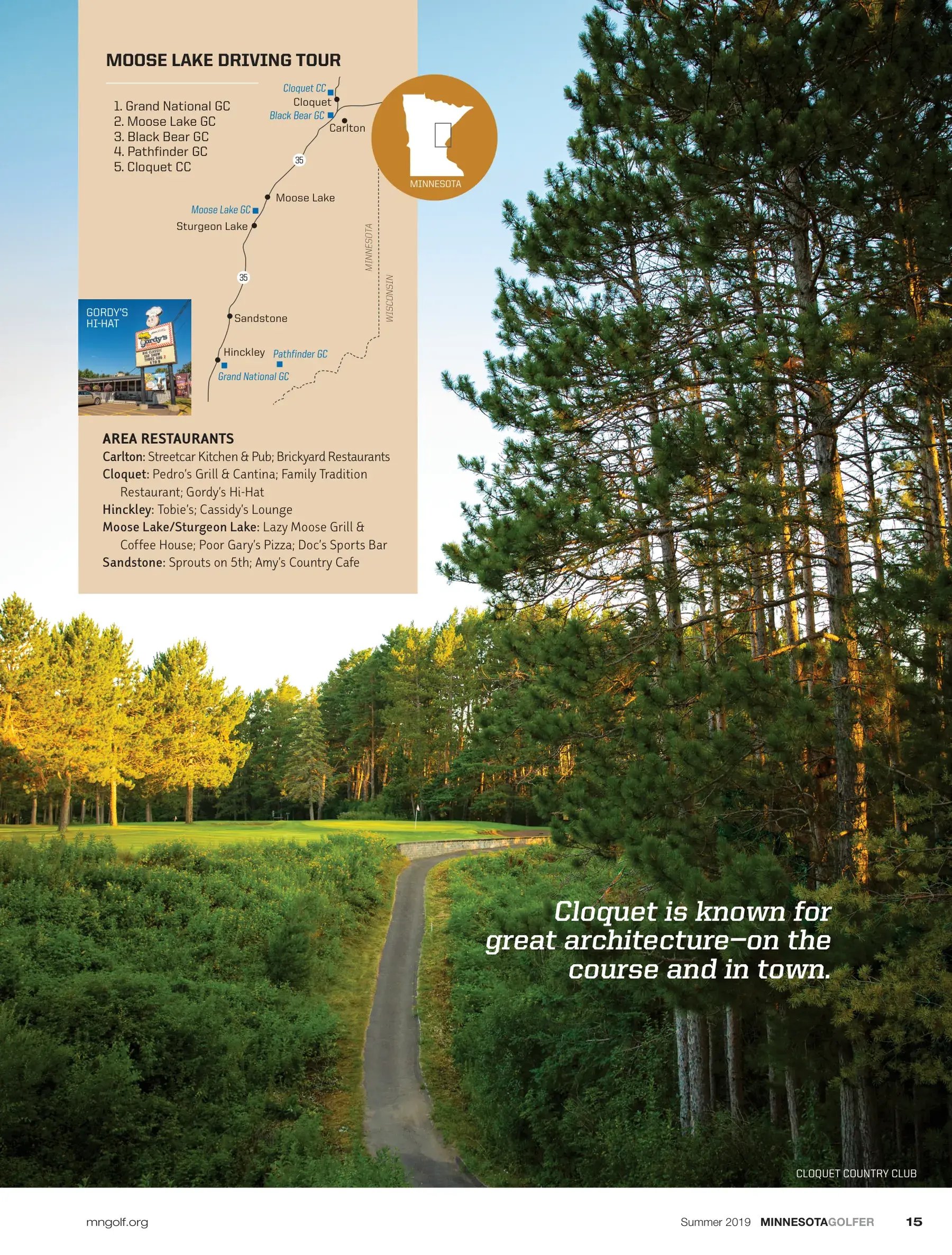
BLACK BEAR GOLF COURSE PATHFINDER GOLF COURSE Summer 2019 MINNESOTAGOLFER 15 MOOSE LAKE DRIVING TOUR 1. Grand National GC 2. Moose Lake GC 3. Black Bear GC 4. Pathfinder GC 5. Cloquet CC AREA RESTAURANTS Carlton: Streetcar Kitchen & Pub; Brickyard Restaurants Cloquet: Pedro’s Grill & Cantina; Family Tradition Restaurant; Gordy’s Hi-Hat Hinckley: Tobie’s; Cassidy’s Lounge Moose Lake/Sturgeon Lake: Lazy Moose Grill & Coffee House; Poor Gary’s Pizza; Doc’s Sports Bar Sandstone: Sprouts on 5th; Amy’s Country Cafe Cloquet Moose Lake Sandstone Hinckley Sturgeon Lake Grand National GC Moose Lake GC Black Bear GC Cloquet CC Pathfinder GC Carlton MINNESOTA WISCONSIN MINNESOTA Cloquet is known for great architecture—on the course and in town.
GORDY’S HI-HAT CLOQUET COUNTRY CLUB G olf and Minnesota are a great combination. Last year, the PGA of America announced that the Ryder Cup will hold a repeat engagement at Hazeltine National—the firstever U.S. course to accomplish that feat. Now, the PGA Tour returns to the Twin Cities—for the first time in 50 years. From July 4–7, the TPC Twin Cities course hosts the inaugural 3M Open, and some of the best golfers in the world have signed on to play. For local golf fans, it’s a mustsee event.
“It’s a huge honor for Minnesota,” says Hollis Cavner, CEO of Pro Links Sports Management, the firm running the event. “For years, everybody said they wanted a tournament here, and it took a long time to get one. We finally found the right date and jumped on it. It’s summertime, it’s part of the Fed-Ex playoffs race—there is so much excitement going on.”
Cavner has worked for more than 10 years to bring a PGA Tour event to Minnesota. When the week of July 4 opened up, he grabbed it. He enlisted local golf legend Tom Lehman, president/designer of Lehman Design Group, to prepare the course for the event.
“It’s kind of a mixed feeling for me,” Lehman says. “Missing the opportunity to play in Minneapolis on the Champions Tour is kind of a bummer. But getting all the top players in the world there for a week in July more than makes up for that. It’s an exciting event for Minnesota golf.”
Readying the TPC Twin Cities course for the Tour pros was one of the biggest concerns at the outset. The 3M Championship, which had determined champions at the course since 2001, compiled a winner’s scoring average of 17-under par for the three-day event. In fact, David Frost won by seven strokes in 2010 with a total of 191 (a record 25-under par). That course setup, which was intended to be a birdie-fest for the fans, would have to be stiffened with the PGA Tour pros coming to town.
“We did a really good job designing a golf course for its purpose—for the public to enjoy it,” says Lehman, the player consultant to Arnold Palmer’s architecture firm on the original design. “The fairways are nice and wide, the greens are big, it’s pretty looking. You have to play good golf to shoot a good score, but there is room to miss and recover.
“To challenge the best players in the world is a different story; I’m not really sure any course is capable of that at this point. The guys are so good—they hit it so far and have such amazing short games. I don’t know if you can do anything to safeguard against that. But I think the things that we did will make the course stand up a bit more. We’re still going to see some low scores, but it will require some better driving in order to shoot those low scores.”
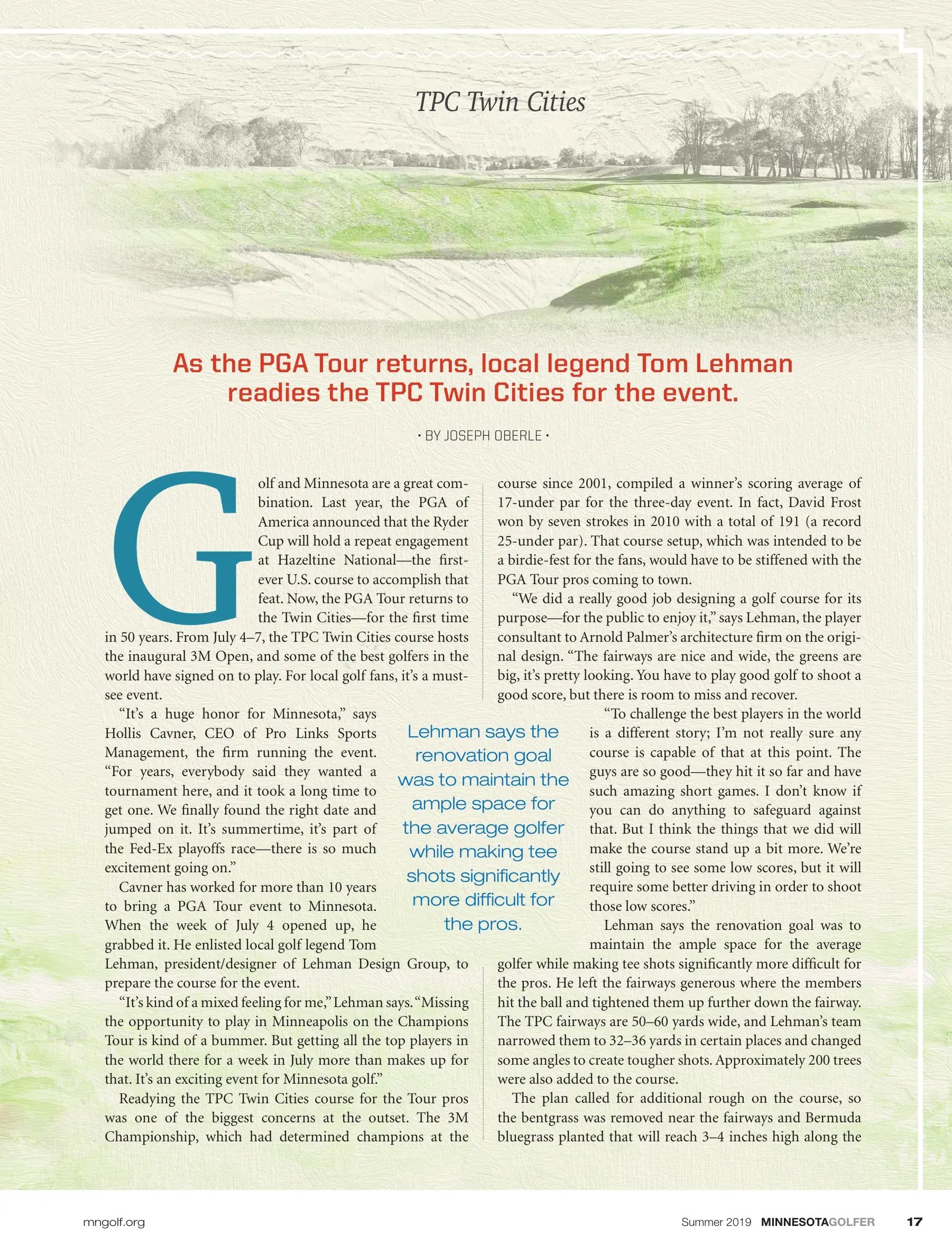
Lehman says the renovation goal was to maintain the ample space for the average golfer while making tee shots significantly more difficult for the pros. He left the fairways generous where the members hit the ball and tightened them up further down the fairway.
The TPC fairways are 50–60 yards wide, and Lehman’s team narrowed them to 32–36 yards in certain places and changed some angles to create tougher shots. Approximately 200 trees were also added to the course.
The plan called for additional rough on the course, so the bentgrass was removed near the fairways and Bermuda bluegrass planted that will reach 3–4 inches high along the Lehman says the renovation goal was to maintain the ample space for the average golfer while making tee shots significantly more difficult for the pros.
As the PGA Tour returns, local legend Tom Lehman readies the TPC Twin Cities for the event. • BY JOSEPH OBERLE • TPC Twin Cities Summer 2019 MINNESOTAGOLFER 17 fairway edges. And Lehman says they grabbed length where they could, most dramatically on the par-5 finishing hole.
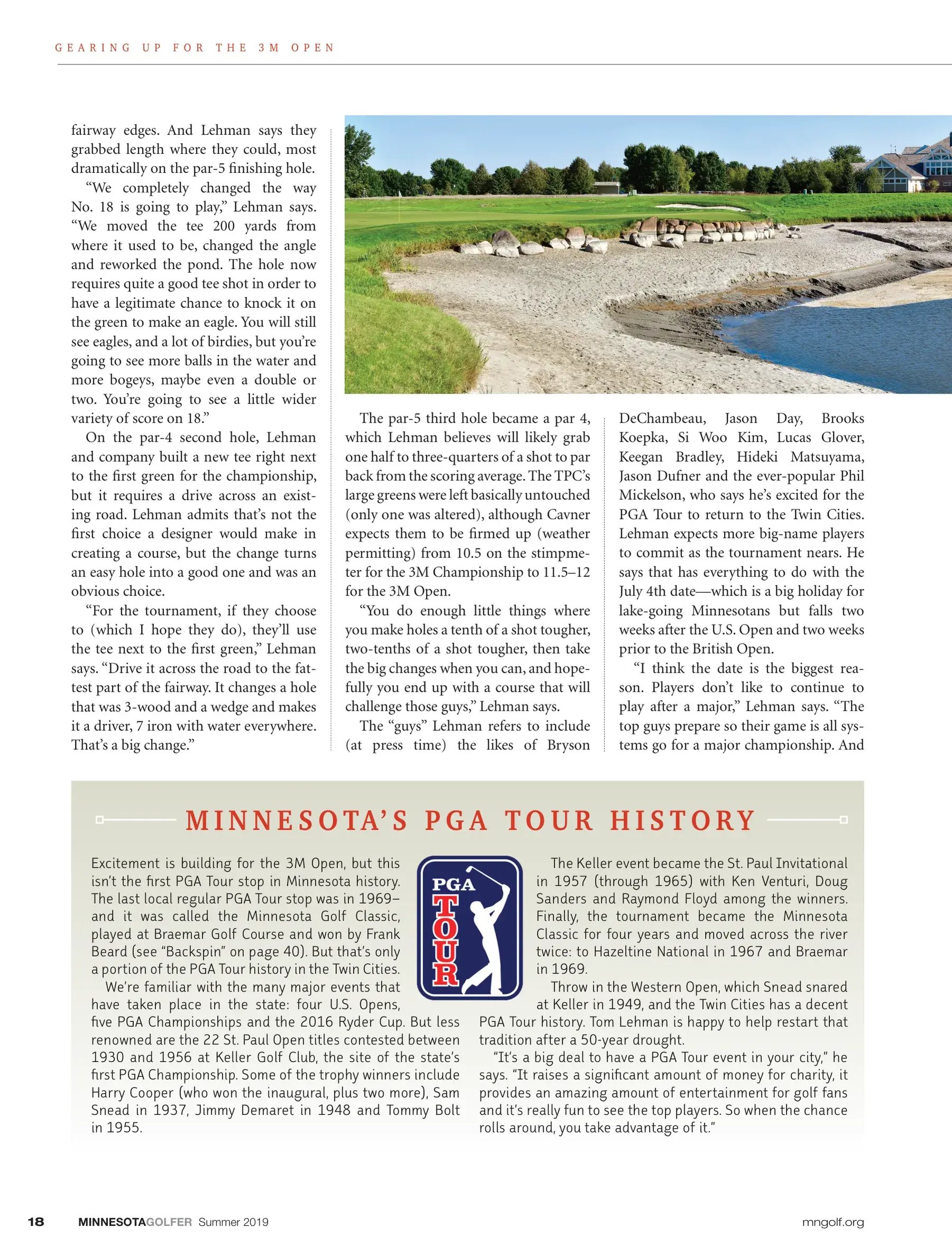
“We completely changed the way No. 18 is going to play,” Lehman says. “We moved the tee 200 yards from where it used to be, changed the angle and reworked the pond. The hole now requires quite a good tee shot in order to have a legitimate chance to knock it on the green to make an eagle. You will still see eagles, and a lot of birdies, but you’re going to see more balls in the water and more bogeys, maybe even a double or two. You’re going to see a little wider variety of score on 18.”
On the par-4 second hole, Lehman and company built a new tee right next to the first green for the championship, but it requires a drive across an existing road. Lehman admits that’s not the first choice a designer would make in creating a course, but the change turns an easy hole into a good one and was an obvious choice.
“For the tournament, if they choose to (which I hope they do), they’ll use the tee next to the first green,” Lehman says. “Drive it across the road to the fattest part of the fairway. It changes a hole that was 3-wood and a wedge and makes it a driver, 7 iron with water everywhere.
That’s a big change.” The par-5 third hole became a par 4, which Lehman believes will likely grab one half to three-quarters of a shot to par back from the scoring average. The TPC’s large greens were left basically untouched (only one was altered), although Cavner expects them to be firmed up (weather permitting) from 10.5 on the stimpmeter for the 3M Championship to 11.5–12 for the 3M Open.
“You do enough little things where you make holes a tenth of a shot tougher, two-tenths of a shot tougher, then take the big changes when you can, and hopefully you end up with a course that will challenge those guys,” Lehman says.
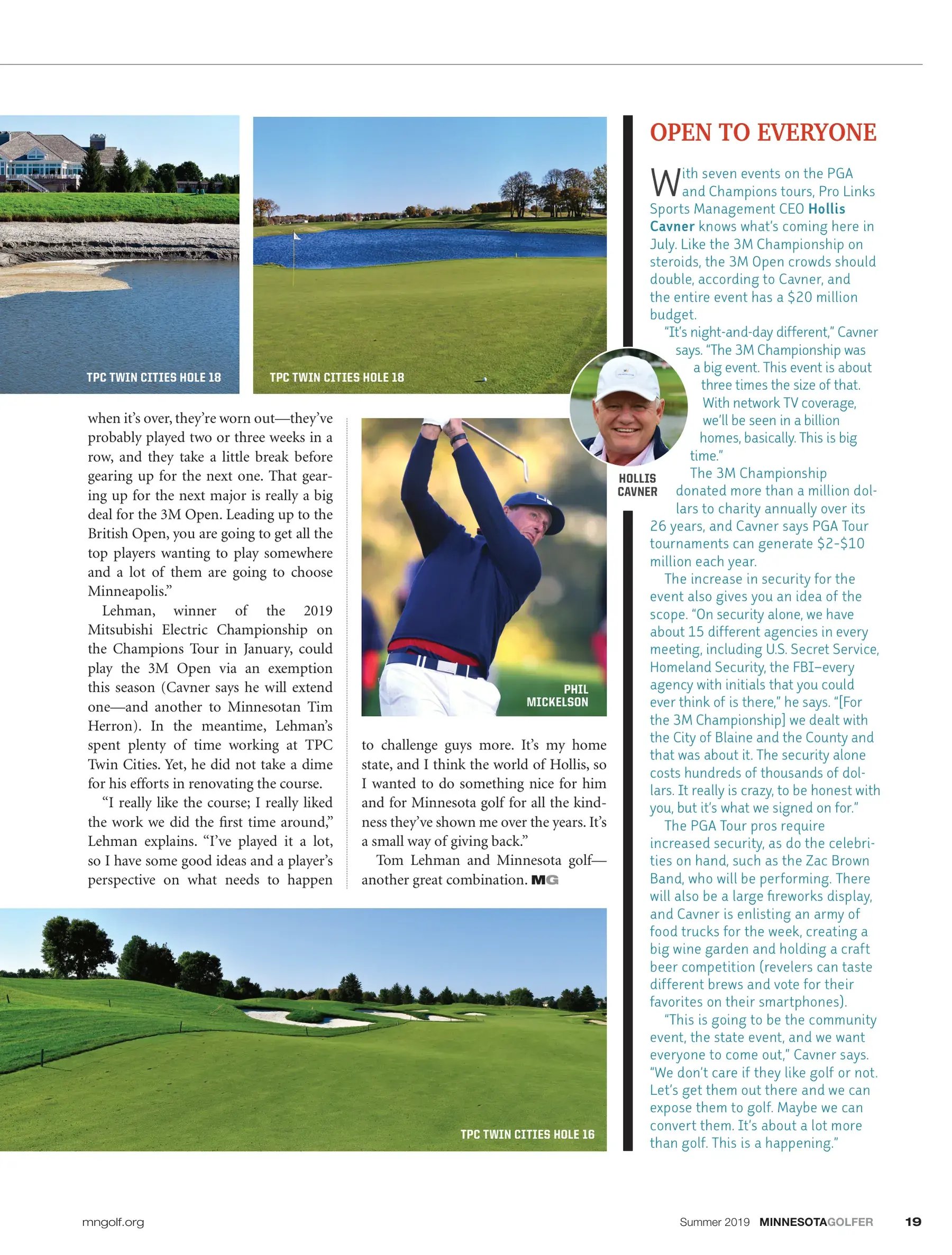
The “guys” Lehman refers to include (at press time) the likes of Bryson DeChambeau, Jason Day, Brooks Koepka, Si Woo Kim, Lucas Glover, Keegan Bradley, Hideki Matsuyama, Jason Dufner and the ever-popular Phil Mickelson, who says he’s excited for the PGA Tour to return to the Twin Cities.
Lehman expects more big-name players to commit as the tournament nears. He says that has everything to do with the July 4th date—which is a big holiday for lake-going Minnesotans but falls two weeks after the U.S. Open and two weeks prior to the British Open.
“I think the date is the biggest reason. Players don’t like to continue to play after a major,” Lehman says. “The top guys prepare so their game is all systems go for a major championship. And Excitement is building for the 3M Open, but this isn’t the first PGA Tour stop in Minnesota history.
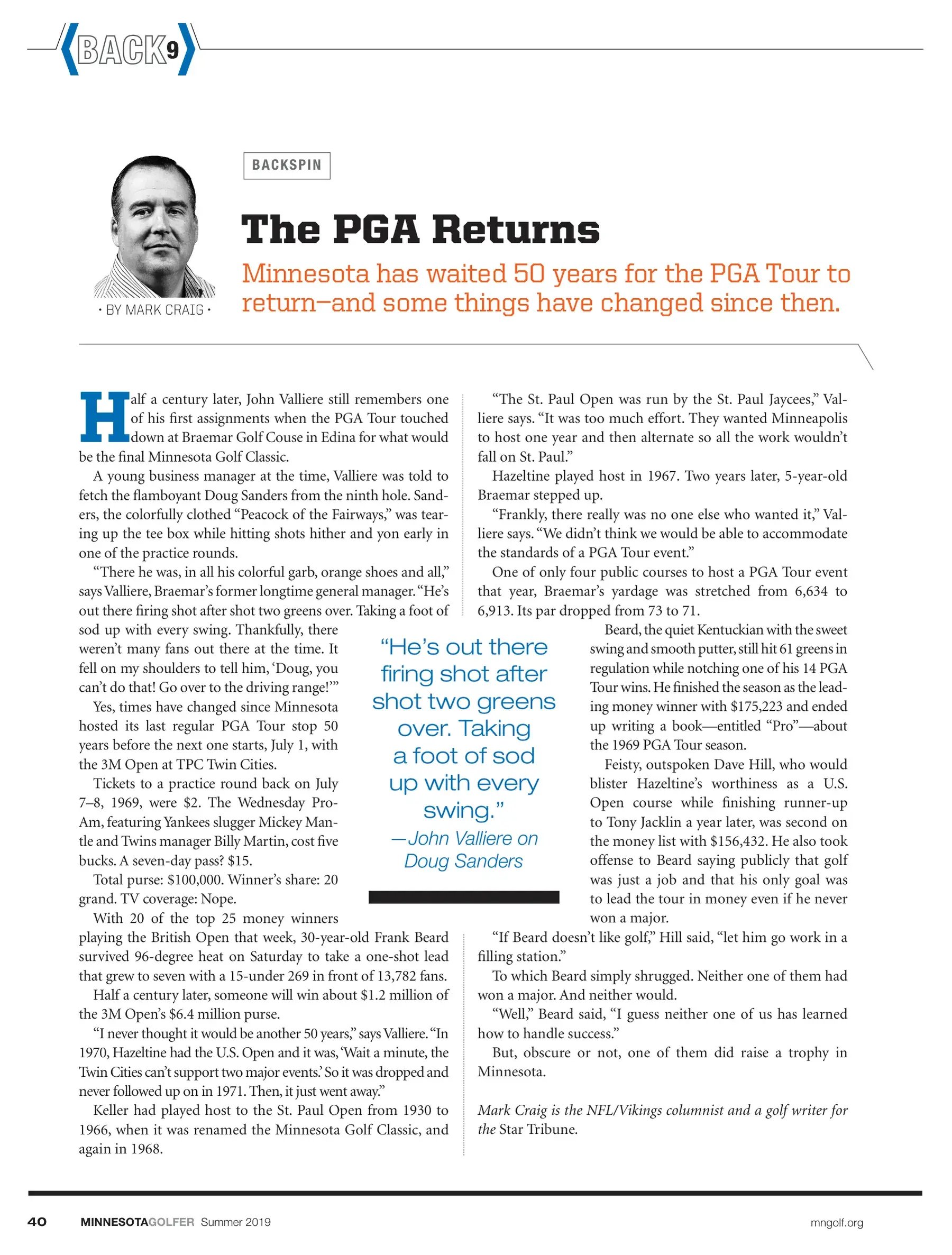
The last local regular PGA Tour stop was in 1969— and it was called the Minnesota Golf Classic, played at Braemar Golf Course and won by Frank Beard (see “Backspin” on page 40). But that’s only a portion of the PGA Tour history in the Twin Cities.
We’re familiar with the many major events that have taken place in the state: four U.S. Opens, five PGA Championships and the 2016 Ryder Cup. But less renowned are the 22 St. Paul Open titles contested between 1930 and 1956 at Keller Golf Club, the site of the state’s first PGA Championship. Some of the trophy winners include Harry Cooper (who won the inaugural, plus two more), Sam Snead in 1937, Jimmy Demaret in 1948 and Tommy Bolt in 1955.
The Keller event became the St. Paul Invitational in 1957 (through 1965) with Ken Venturi, Doug Sanders and Raymond Floyd among the winners. Finally, the tournament became the Minnesota Classic for four years and moved across the river twice: to Hazeltine National in 1967 and Braemar in 1969.
Throw in the Western Open, which Snead snared at Keller in 1949, and the Twin Cities has a decent PGA Tour history. Tom Lehman is happy to help restart that tradition after a 50-year drought.
“It’s a big deal to have a PGA Tour event in your city,” he says. “It raises a signifi cant amount of money for charity, it provides an amazing amount of entertainment for golf fans and it’s really fun to see the top players. So when the chance rolls around, you take advantage of it.”
Lehman, winner of the 2019 Mitsubishi Electric Championship on the Champions Tour in January, could play the 3M Open via an exemption this season (Cavner says he will extend one—and another to Minnesotan Tim Herron). In the meantime, Lehman’s spent plenty of time working at TPC Twin Cities. Yet, he did not take a dime for his efforts in renovating the course.
“I really like the course; I really liked the work we did the first time around,” Lehman explains. “I’ve played it a lot, so I have some good ideas and a player’s perspective on what needs to happen to challenge guys more. It’s my home state, and I think the world of Hollis, so I wanted to do something nice for him and for Minnesota golf for all the kindness they’ve shown me over the years. It’s a small way of giving back.”
Tom Lehman and Minnesota golf— another great combination. MG W ith seven events on the PGA and Champions tours, Pro Links Sports Management CEO Hollis Cavner knows what’s coming here in July. Like the 3M Championship on steroids, the 3M Open crowds should double, according to Cavner, and the entire event has a $20 million budget.
“It’s night-and-day different,” Cavner says. “The 3M Championship was a big event. This event is about three times the size of that. With network TV coverage, we’ll be seen in a billion homes, basically. This is big time.”
The 3M Championship donated more than a million dollars to charity annually over its 26 years, and Cavner says PGA Tour tournaments can generate $2–$10 million each year.
The increase in security for the event also gives you an idea of the scope. “On security alone, we have about 15 different agencies in every meeting, including U.S. Secret Service, Homeland Security, the FBI—every agency with initials that you could ever think of is there,” he says. “[For the 3M Championship] we dealt with the City of Blaine and the County and that was about it. The security alone costs hundreds of thousands of dollars. It really is crazy, to be honest with you, but it’s what we signed on for.”
The PGA Tour pros require increased security, as do the celebrities on hand, such as the Zac Brown Band, who will be performing. There will also be a large fireworks display, and Cavner is enlisting an army of food trucks for the week, creating a big wine garden and holding a craft beer competition (revelers can taste different brews and vote for their favorites on their smartphones).
“This is going to be the community event, the state event, and we want everyone to come out,” Cavner says. “We don’t care if they like golf or not.
Basically, he was right. Palmer won the Masters that year in a spectacularly dramatic fashion, making a 35-foot birdie putt at the 17th hole and a 6-footer for birdie at the 18th to beat Ken Venturi by a single stroke. When he followed that up two months later by winning the U.S. Open, the charismatic Wake Forest dropout established himself as the most popular golfer in the world. In the process, he made golf seem cooler than ever before.
What happened this spring on that same Augusta course in the inaugural Augusta National Women’s Amateur may not hold the same cultural signifi cance as the events that took place 59 years ago, but it defi nitely gave women’s amateur golf a massive shot in the arm. Fittingly, it was another Wake Forest golfer who took the victory with another spectacular finish, as Deacons senior Jennifer Kupcho played the last six holes in 5-under par to win. But the final-day drama also made a TV star of the runner-up, Maria Fassi.
Fassi, who was a senior at Arkansas, impressed anyone who was watching (and this was the highestrated telecast of women’s amateur golf in 16 years) with her power, talent and sportsmanship. To most viewers, Maria Fassi was a revelation—but not to any of the college golf fans who watched either of the first two Annika Intercollegiate tournaments in the Twin Cities.
The Annika Intercollegiate, named after the Hall of Fame LPGA Tour player Annika Sorenstam, came to the Twin Cities in 2017. The University of Minnesota’s women’s team hosts the 3M-sponsored tournament, which boasts the strongest field of • BY MIKE FERMOYLE • The most star-studded Gopher Invitational field was probably the one that assembled at Spring Hill in 2012.
A brief history of three University of Minnesota-hosted golf tournaments provides a glimpse of golf to come. Summer 2019 MINNESOTAGOLFER 21 any women’s college tournament, other than the NCAA Championships.
“Well, obviously anything that has any connection with Annika Sorenstam is going to be a pretty big draw,” Gophers head coach Michele Redman notes. “But the main reason the tournament gets the field that it does is that there’s a banquet that goes with the tournament, and that’s where they give out the awards for the previous season, including the Annika Award for the player of the year.”
In 2017, the Annika was played at Olympic Hills. Fassi won the individual competition and led Arkansas to the team championship. Last year, the tournament moved to the Royal Golf Club in Lake Elmo. The course, co-designed by Sorenstam and Arnold Palmer, is the tournament’s new permanent site.
The top four teams in the national rankings—No. 1 USC, No. 2 Texas, No. 3 Duke and No. 4 Stanford—were there. Ten of the top 12 teams were in the field. It’s a testament to the quality of the field that the defending champion, Fassi, could do no better than a tie for 25th.
Patty Tavatanakit, a sophomore from UCLA, put on a sensational show by shooting 63 in the final round to win the individual medal by a stroke over USC All-American Malia Nam. Fassi’s Arkansas teammate Dylan Kim finished third, and Duke’s Ana Belic took fourth. Stanford sophomore Andrea Lee, the No. 1-ranked college player in the country for most of the 2018–19 season, finished fifth.
The Minnesota women’s team hosts a second tournament in the fall, the season-opening Minnesota Invitational at Prestwick Golf Course. San Jose State will defend the title it won last fall. Last year’s second-place finisher, Virginia Tech, will also be back.
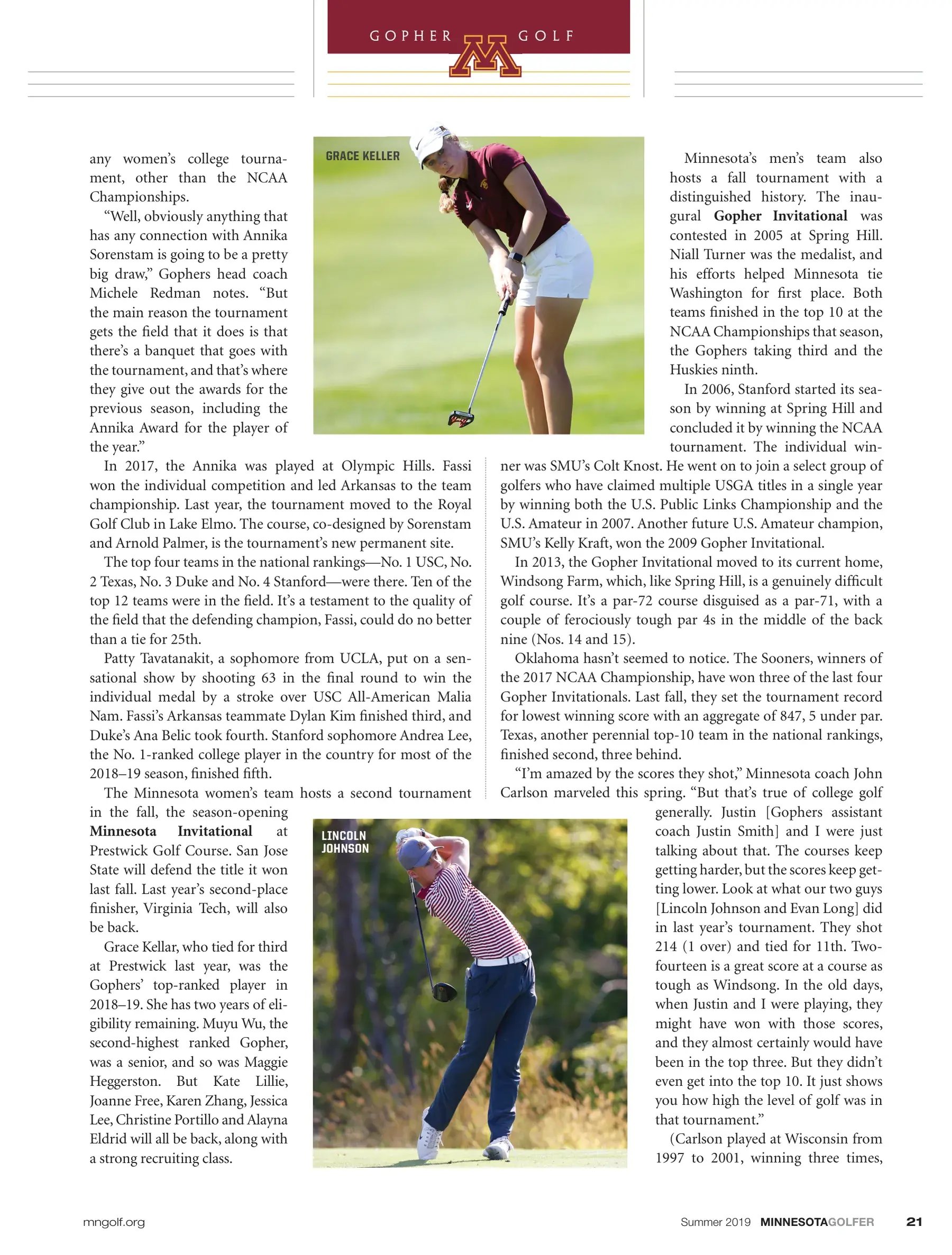
Grace Kellar, who tied for third at Prestwick last year, was the Gophers’ top-ranked player in 2018–19. She has two years of eligibility remaining. Muyu Wu, the second-highest ranked Gopher, was a senior, and so was Maggie Heggerston. But Kate Lillie, Joanne Free, Karen Zhang, Jessica Lee, Christine Portillo and Alayna Eldrid will all be back, along with a strong recruiting class.
Minnesota’s men’s team also hosts a fall tournament with a distinguished history. The inaugural Gopher Invitational was contested in 2005 at Spring Hill.
Niall Turner was the medalist, and his efforts helped Minnesota tie Washington for first place. Both teams finished in the top 10 at the NCAA Championships that season, the Gophers taking third and the Huskies ninth.
In 2006, Stanford started its season by winning at Spring Hill and concluded it by winning the NCAA tournament. The individual winner was SMU’s Colt Knost. He went on to join a select group of golfers who have claimed multiple USGA titles in a single year by winning both the U.S. Public Links Championship and the U.S. Amateur in 2007. Another future U.S. Amateur champion, SMU’s Kelly Kraft, won the 2009 Gopher Invitational.
In 2013, the Gopher Invitational moved to its current home, Windsong Farm, which, like Spring Hill, is a genuinely diffi cult golf course. It’s a par-72 course disguised as a par-71, with a couple of ferociously tough par 4s in the middle of the back nine (Nos. 14 and 15).
Oklahoma hasn’t seemed to notice. The Sooners, winners of the 2017 NCAA Championship, have won three of the last four Gopher Invitationals. Last fall, they set the tournament record for lowest winning score with an aggregate of 847, 5 under par.
Texas, another perennial top-10 team in the national rankings, finished second, three behind. “I’m amazed by the scores they shot,” Minnesota coach John Carlson marveled this spring. “But that’s true of college golf generally. Justin [Gophers assistant coach Justin Smith] and I were just talking about that. The courses keep getting harder, but the scores keep getting lower. Look at what our two guys [Lincoln Johnson and Evan Long] did in last year’s tournament. They shot 214 (1 over) and tied for 11th. Twofourteen is a great score at a course as tough as Windsong. In the old days, when Justin and I were playing, they might have won with those scores, and they almost certainly would have been in the top three. But they didn’t even get into the top 10. It just shows you how high the level of golf was in that tournament.”
(Carlson played at Wisconsin from 1997 to 2001, winning three times, GRACE KELLER LINCOLN JOHNSON and then turned pro. He has won 15 times since then, including two Tapemark Charity Pro-Am titles. Smith was an AllAmerican at Minnesota, and he was the one who made the putt that clinched the Gophers’ NCAA team championship in 2002.
He, too, turned pro and played on the Nationwide Tour—now the Web.com Tour—nearly making it to the PGA Tour.) Minnesota finished fifth as a team at the 2018 Gopher Invite, 17 shots behind Oklahoma. That may sound like a lot, but it’s not—especially when you consider that the Gophers’ best player last year was Angus Flanagan, and he had his worst finish at Windsong, tying for 64th. Flanagan was a freshman, and that was his first college tournament. Seven months later, he tied for medalist honors at the Big Ten Conference Championships. If Minnesota is going to challenge teams like Oklahoma and Texas for the title, they will need strong performances once again from Johnson and Long and from Thomas Longbella, who finished 18th last year.
The most star-studded Gopher Invitational field was probably the one that assembled at Spring Hill in 2012. Kent State’s Corey Conners won the first of his two individual medals that year. (He was the medalist again in 2013.) Until this year, that name wouldn’t have meant much. Then he won for the first time on the PGA Tour, at the Valero Open in May, with a remarkable final round of 66 that included 10 birdies, 4 bogeys (in a row) and only 4 pars.
Cal was the 2012 team champion, and the Bears claimed the next three places in the individual standings behind Conners. Max Homa and Michael Kim tied for second, and their teammate Brandon Hagy finished fourth. Homa won the 2013 NCAA individual championship; Kim won the Haskins Award for player of the year; and Hagy was named freshman of the year.
What’s more, an SMU player with some strange ideas about golf named Bryson DeChambeau finished seventh. He would eventually become the third Gopher Invitational alum to win the NCAA (LSU’s John Peterson, who played at Spring Hill in 2010, was the first; Homa was the second) and the third to win the U.S. Am (following Knost and Kraft). He’s since won multiple tournaments on the PGA Tour.
Pretty much lost in the shuffl e at that 2012 tournament was a kid from Spain playing in his first tournament as a freshman for Arizona State. Not many people paid any attention to him. For one thing, he could barely speak a word of English. For another, he shot 81-73-78—232 and tied for 41st.
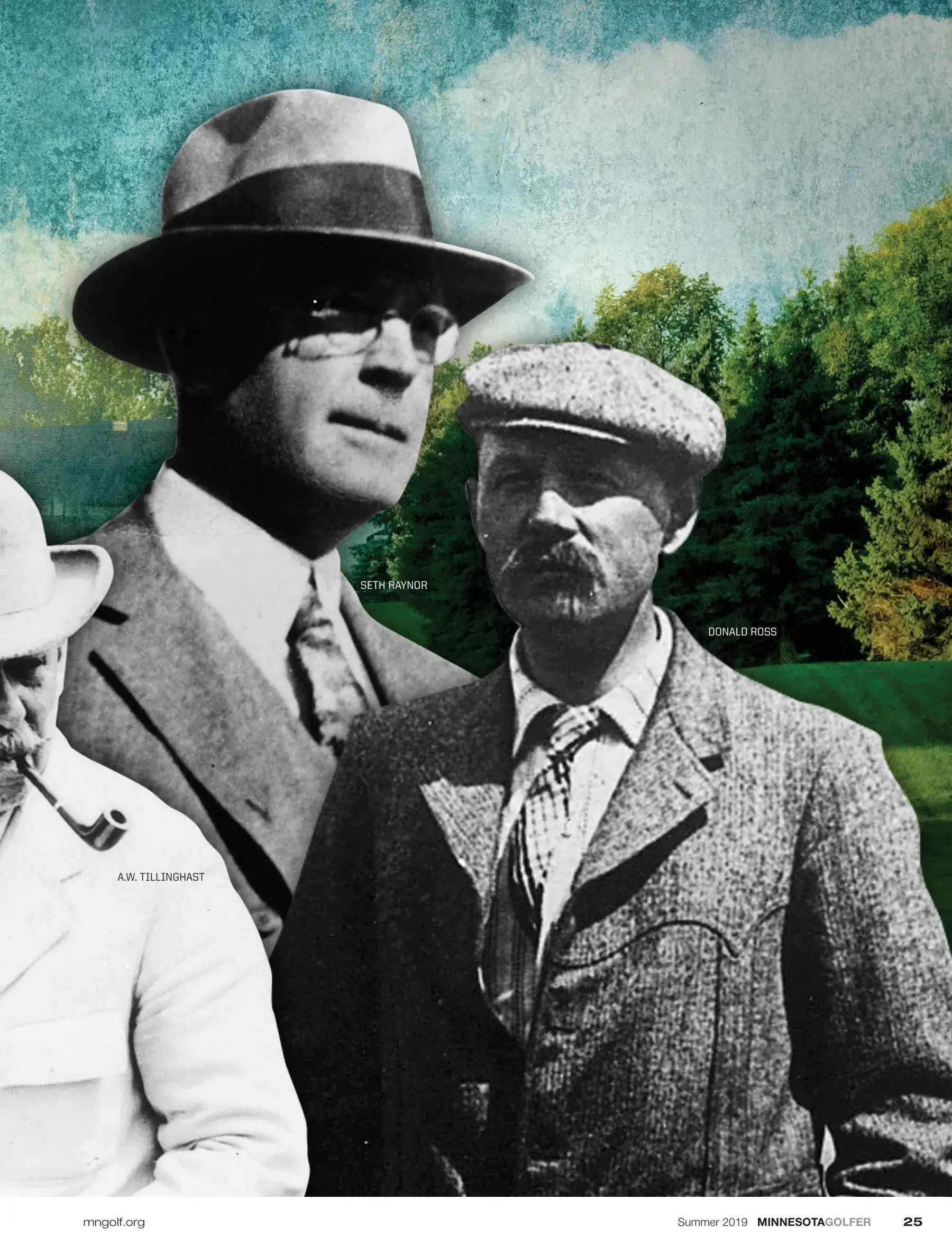
tcgateway.com Home of the 3M Open PGA Tournament July 4–7, 2019 o you really care who designed the golf course you’re playing? There is an undeniable hint of pride when a club advertises itself as a Donald Ross course, or a Seth Raynor, or an A.W. Tillinghast or a Robert Trent Jones. These and other luminaries of golf course architecture created the historical standards by which courses are judged today.
Digging into lost details surrounding famous architects of local golf courses. of Minnesota Golf the • BY RICK SHEFCHIK • Summer 2019 MINNESOTAGOLFER 25 DONALD ROSS SETH RAYNOR A.W. TILLINGHAST For that reason, the matter of attribution is taken seriously by some.
In the modern era, attribution is easy. Joel Goldstrand has been a prolifi c golf architect in Minnesota (the Links at Northfork, Ridges at Sand Creek, Blueberry Pines, etc.) and his work has been well documented. So, too, has the work of the late Don Herfort (Dellwood Hills, Indian Hills, Oak Glen, etc.).
But when it comes to the so-called Golden Age architects, attribution mysteries have lingered for decades due to poor recordkeeping, clubhouse fires and the fact that some clubs simply didn’t think later generations would find architectural credit all that important.
Older clubs that have maintained their records can accurately identify their architectural pedigree. Golden Valley Country Club and Rochester Country Club both take pride in their Tillinghast-designed courses; North Oaks boasts a course laid out by Canadian master Stanley Thompson; Edina Country Club traces its roots back to early architecture pioneer Tom Bendelow; and Hazeltine is a product of mid-century kingpin Robert Trent Jones.
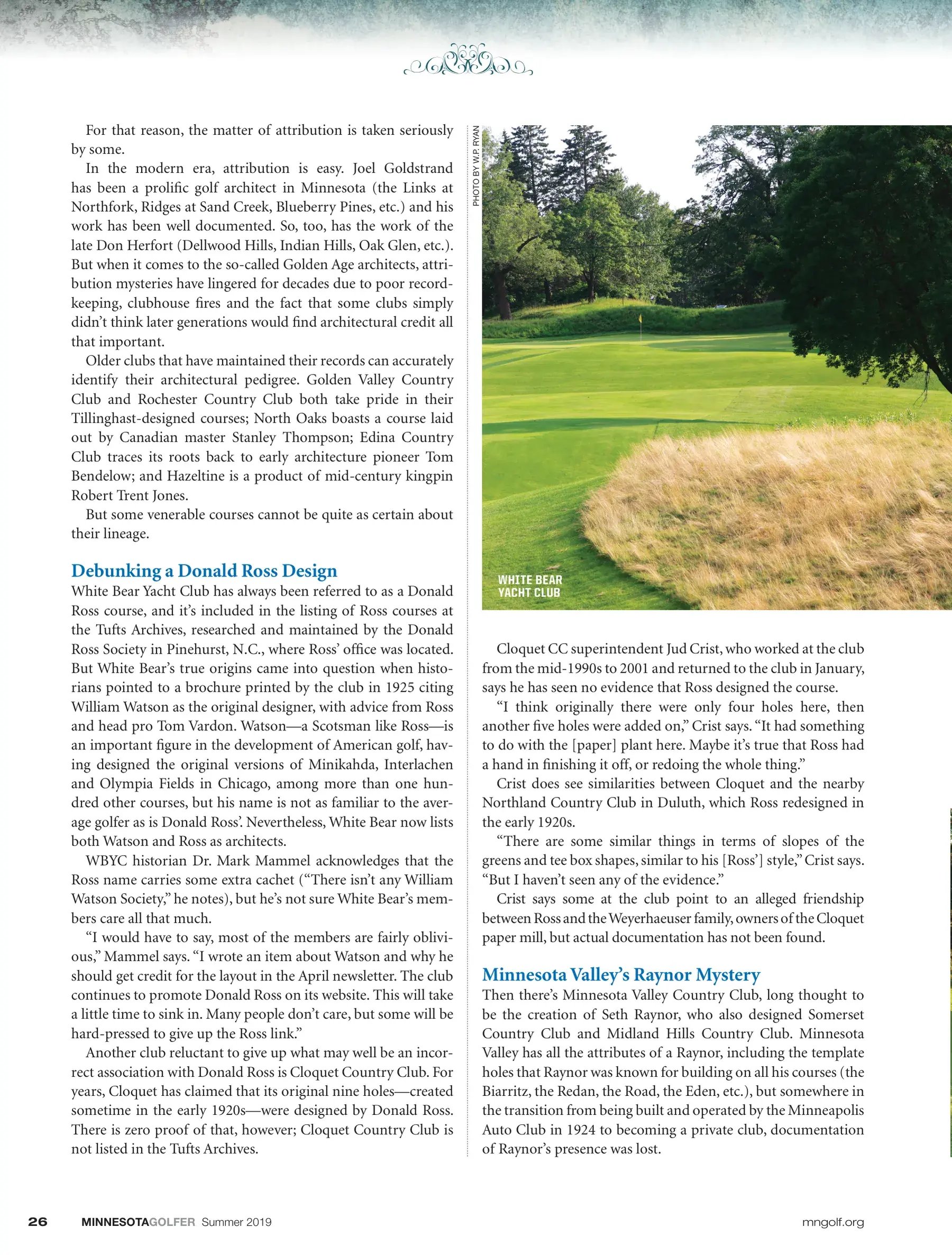
But some venerable courses cannot be quite as certain about their lineage. Debunking a Donald Ross Design White Bear Yacht Club has always been referred to as a Donald Ross course, and it’s included in the listing of Ross courses at the Tufts Archives, researched and maintained by the Donald Ross Society in Pinehurst, N.C., where Ross’ offi ce was located.
But White Bear’s true origins came into question when historians pointed to a brochure printed by the club in 1925 citing William Watson as the original designer, with advice from Ross and head pro Tom Vardon. Watson—a Scotsman like Ross—is an important figure in the development of American golf, having designed the original versions of Minikahda, Interlachen and Olympia Fields in Chicago, among more than one hundred other courses, but his name is not as familiar to the average golfer as is Donald Ross’. Nevertheless, White Bear now lists both Watson and Ross as architects.
WBYC historian Dr. Mark Mammel acknowledges that the Ross name carries some extra cachet (“There isn’t any William Watson Society,” he notes), but he’s not sure White Bear’s members care all that much.
“I would have to say, most of the members are fairly oblivious,” Mammel says. “I wrote an item about Watson and why he should get credit for the layout in the April newsletter. The club continues to promote Donald Ross on its website. This will take a little time to sink in. Many people don’t care, but some will be hard-pressed to give up the Ross link.”
Another club reluctant to give up what may well be an incorrect association with Donald Ross is Cloquet Country Club. For years, Cloquet has claimed that its original nine holes—created sometime in the early 1920s—were designed by Donald Ross.
There is zero proof of that, however; Cloquet Country Club is not listed in the Tufts Archives. Cloquet CC superintendent Jud Crist, who worked at the club from the mid-1990s to 2001 and returned to the club in January, says he has seen no evidence that Ross designed the course.
“I think originally there were only four holes here, then another five holes were added on,” Crist says. “It had something to do with the [paper] plant here. Maybe it’s true that Ross had a hand in finishing it off, or redoing the whole thing.”
Crist does see similarities between Cloquet and the nearby Northland Country Club in Duluth, which Ross redesigned in the early 1920s. “There are some similar things in terms of slopes of the greens and tee box shapes, similar to his [Ross’] style,” Crist says.
“But I haven’t seen any of the evidence.” Crist says some at the club point to an alleged friendship between Ross and the Weyerhaeuser family, owners of the Cloquet paper mill, but actual documentation has not been found.
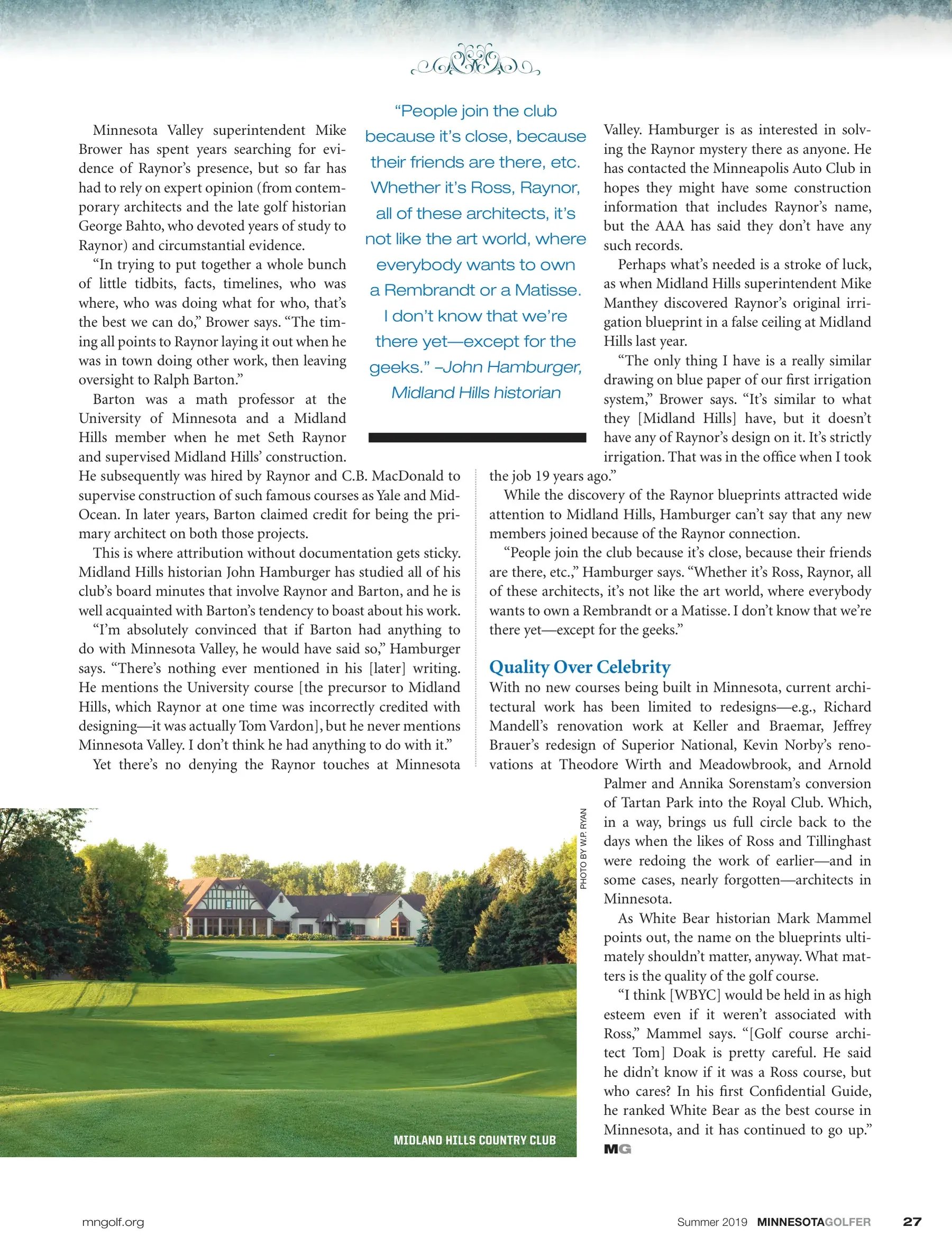
Minnesota Valley’s Raynor Mystery Then there’s Minnesota Valley Country Club, long thought to be the creation of Seth Raynor, who also designed Somerset Country Club and Midland Hills Country Club. Minnesota Valley has all the attributes of a Raynor, including the template holes that Raynor was known for building on all his courses (the Biarritz, the Redan, the Road, the Eden, etc.), but somewhere in the transition from being built and operated by the Minneapolis Auto Club in 1924 to becoming a private club, documentation of Raynor’s presence was lost.
WHITE BEAR YACHT CLUB PHOTO BY W.P. RYAN Summer 2019 MINNESOTAGOLFER 27 Minnesota Valley superintendent Mike Brower has spent years searching for evidence of Raynor’s presence, but so far has had to rely on expert opinion (from contemporary architects and the late golf historian George Bahto, who devoted years of study to Raynor) and circumstantial evidence.
“In trying to put together a whole bunch of little tidbits, facts, timelines, who was where, who was doing what for who, that’s the best we can do,” Brower says. “The timing all points to Raynor laying it out when he was in town doing other work, then leaving oversight to Ralph Barton.”
Barton was a math professor at the University of Minnesota and a Midland Hills member when he met Seth Raynor and supervised Midland Hills’ construction.
He subsequently was hired by Raynor and C.B. MacDonald to supervise construction of such famous courses as Yale and MidOcean. In later years, Barton claimed credit for being the primary architect on both those projects.
This is where attribution without documentation gets sticky. Midland Hills historian John Hamburger has studied all of his club’s board minutes that involve Raynor and Barton, and he is well acquainted with Barton’s tendency to boast about his work.
“I’m absolutely convinced that if Barton had anything to do with Minnesota Valley, he would have said so,” Hamburger says. “There’s nothing ever mentioned in his [later] writing.
He mentions the University course [the precursor to Midland Hills, which Raynor at one time was incorrectly credited with designing—it was actually Tom Vardon], but he never mentions Minnesota Valley. I don’t think he had anything to do with it.”
Yet there’s no denying the Raynor touches at Minnesota Valley. Hamburger is as interested in solving the Raynor mystery there as anyone. He has contacted the Minneapolis Auto Club in hopes they might have some construction information that includes Raynor’s name, but the AAA has said they don’t have any such records.
Perhaps what’s needed is a stroke of luck, as when Midland Hills superintendent Mike Manthey discovered Raynor’s original irrigation blueprint in a false ceiling at Midland Hills last year.
“The only thing I have is a really similar drawing on blue paper of our first irrigation system,” Brower says. “It’s similar to what they [Midland Hills] have, but it doesn’t have any of Raynor’s design on it. It’s strictly irrigation. That was in the offi ce when I took the job 19 years ago.”
While the discovery of the Raynor blueprints attracted wide attention to Midland Hills, Hamburger can’t say that any new members joined because of the Raynor connection.
“People join the club because it’s close, because their friends are there, etc.,” Hamburger says. “Whether it’s Ross, Raynor, all of these architects, it’s not like the art world, where everybody wants to own a Rembrandt or a Matisse. I don’t know that we’re there yet—except for the geeks.”
Quality Over Celebrity With no new courses being built in Minnesota, current architectural work has been limited to redesigns—e.g., Richard Mandell’s renovation work at Keller and Braemar, Jeffrey Brauer’s redesign of Superior National, Kevin Norby’s renovations at Theodore Wirth and Meadowbrook, and Arnold Palmer and Annika Sorenstam’s conversion of Tartan Park into the Royal Club. Which, in a way, brings us full circle back to the days when the likes of Ross and Tillinghast were redoing the work of earlier—and in some cases, nearly forgotten—architects in Minnesota.
As White Bear historian Mark Mammel points out, the name on the blueprints ultimately shouldn’t matter, anyway. What matters is the quality of the golf course.
“I think [WBYC] would be held in as high esteem even if it weren’t associated with Ross,” Mammel says. “[Golf course architect Tom] Doak is pretty careful. He said he didn’t know if it was a Ross course, but who cares? In his first Confi dential Guide, he ranked White Bear as the best course in Minnesota, and it has continued to go up.”
MG “People join the club because it’s close, because their friends are there, etc. Whether it’s Ross, Raynor, all of these architects, it’s not like the art world, where everybody wants to own a Rembrandt or a Matisse.
I don’t know that we’re there yet—except for the geeks.” –John Hamburger, Midland Hills historian MIDLAND HILLS COUNTRY CLUB PHOTO BY W.P. RYAN W illiam Jennings Bryan stepped off the 10:10 a.m. train from Milwaukee on July 13, 1918, for a speaking engagement in Fairmont, Minn., a railway town of 3,000 built around a chain of lakes in Martin County near Iowa.
Pre-television, pre-radio, pre-Twitter, Bryan’s job was to drum up support for the war in Europe by stressing the “fundamentals of citizenship.”
Threatening weather at Interlaken Park sent the crowds home early that Saturday, but not before Bryan, known as the “Great American Orator,” thrilled some 3,000 people with his speech on citizenship, patriotism, religion and the allied push in France, reported the local newspaper, the Fairmont Daily Sentinel.
Odds are long that golf was on the minds of the thousands who assembled on the Interlaken Park grounds that summer day, but a discerning few would have remarked upon the park’s newest amenity: a nine-hole golf course.
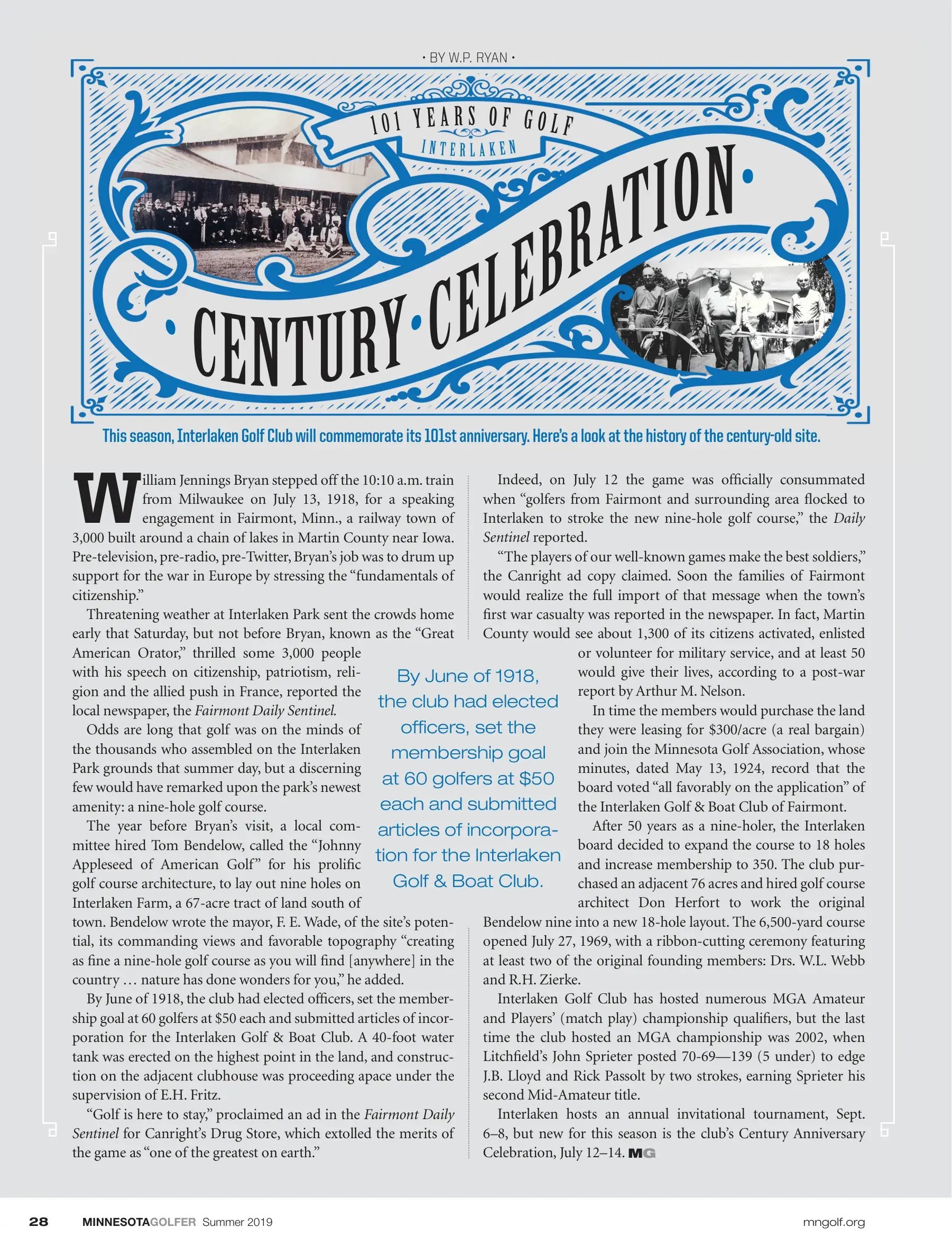
The year before Bryan’s visit, a local committee hired Tom Bendelow, called the “Johnny Appleseed of American Golf” for his prolifi c golf course architecture, to lay out nine holes on Interlaken Farm, a 67-acre tract of land south of town. Bendelow wrote the mayor, F. E. Wade, of the site’s potential, its commanding views and favorable topography “creating as fine a nine-hole golf course as you will find [anywhere] in the country ... nature has done wonders for you,” he added.
By June of 1918, the club had elected offi cers, set the membership goal at 60 golfers at $50 each and submitted articles of incorporation for the Interlaken Golf & Boat Club. A 40-foot water tank was erected on the highest point in the land, and construction on the adjacent clubhouse was proceeding apace under the supervision of E.H. Fritz.
“Golf is here to stay,” proclaimed an ad in the Fairmont Daily Sentinel for Canright’s Drug Store, which extolled the merits of the game as “one of the greatest on earth.”
Indeed, on July 12 the game was offi cially consummated when “golfers from Fairmont and surrounding area flocked to Interlaken to stroke the new nine-hole golf course,” the Daily Sentinel reported.
“The players of our well-known games make the best soldiers,” the Canright ad copy claimed. Soon the families of Fairmont would realize the full import of that message when the town’s first war casualty was reported in the newspaper. In fact, Martin County would see about 1,300 of its citizens activated, enlisted or volunteer for military service, and at least 50 would give their lives, according to a post-war report by Arthur M. Nelson.
In time the members would purchase the land they were leasing for $300/acre (a real bargain) and join the Minnesota Golf Association, whose minutes, dated May 13, 1924, record that the board voted “all favorably on the application” of the Interlaken Golf & Boat Club of Fairmont.
After 50 years as a nine-holer, the Interlaken board decided to expand the course to 18 holes and increase membership to 350. The club purchased an adjacent 76 acres and hired golf course architect Don Herfort to work the original Bendelow nine into a new 18-hole layout. The 6,500-yard course opened July 27, 1969, with a ribbon-cutting ceremony featuring at least two of the original founding members: Drs. W.L. Webb and R.H. Zierke.
Interlaken Golf Club has hosted numerous MGA Amateur and Players’ (match play) championship qualifi ers, but the last time the club hosted an MGA championship was 2002, when Litchfi eld’s John Sprieter posted 70-69—139 (5 under) to edge J.B. Lloyd and Rick Passolt by two strokes, earning Sprieter his second Mid-Amateur title.
Interlaken hosts an annual invitational tournament, Sept. 6–8, but new for this season is the club’s Century Anniversary Celebration, July 12–14. MG By June of 1918, the club had elected offi cers, set the membership goal at 60 golfers at $50 each and submitted articles of incorporation for the Interlaken Golf & Boat Club.
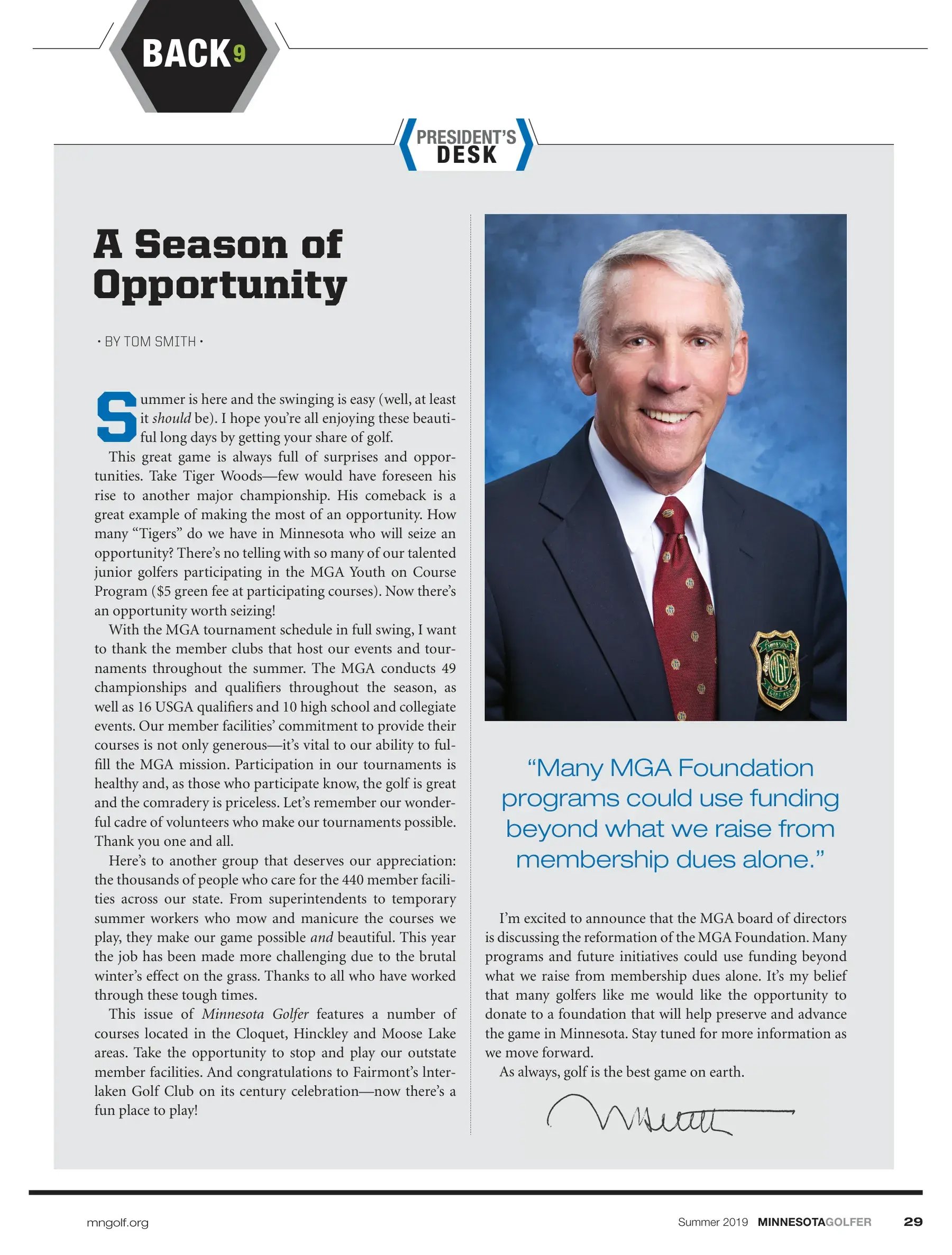
This season, Interlaken Golf Club will commemorate its 101st anniversary. Here’s a look at the history of the century-old site. • BY W.P. RYAN • BACK PRESIDENT’S DESK A Season of Opportunity S ummer is here and the swinging is easy (well, at least it should be). I hope you’re all enjoying these beautiful long days by getting your share of golf.
This great game is always full of surprises and opportunities. Take Tiger Woods—few would have foreseen his rise to another major championship. His comeback is a great example of making the most of an opportunity. How many “Tigers” do we have in Minnesota who will seize an opportunity? There’s no telling with so many of our talented junior golfers participating in the MGA Youth on Course Program ($5 green fee at participating courses). Now there’s an opportunity worth seizing!