




Summer 2020





















Back to The Minnesota Golfer Archive
Read the text of this issue
Text from the printed pages, so it can be searched and read by screen readers. Layout and photography are in the reader above.
16 | THE PEOPLE’S GAME, PART 2 By Joe Bissen Public golf takes off and thrives throughout the state. 21 | FIVE LOCAL GOLF TALES By Nick Hunter, Joseph Oberle, W.P. Ryan From a legendary club designer to burgeoning stars, a collection of Minnesota golf stories.
21 Club Maker Larry Bobka 24 Youth on Course Scholarship Winners: Taylor Gonsalez and John Traxler 26 LPGA Sophomore Sarah Burnham 28 Author Doug deGrood LOCAL GOLF TALES Getting your handicap index revision via email?
Subscriptions: Regular U.S. one year (4 issues) $18. Directory issue of Minnesota Golfer: $9.95 plus shipping, pre-paid. Other single copies: $2.95 per copy plus shipping, pre-paid.
Copyright © 2020 MGA The MGA upholds and promotes the game of golf and its values for all golfers in Minnesota. Minnesota Golf Association Inc.
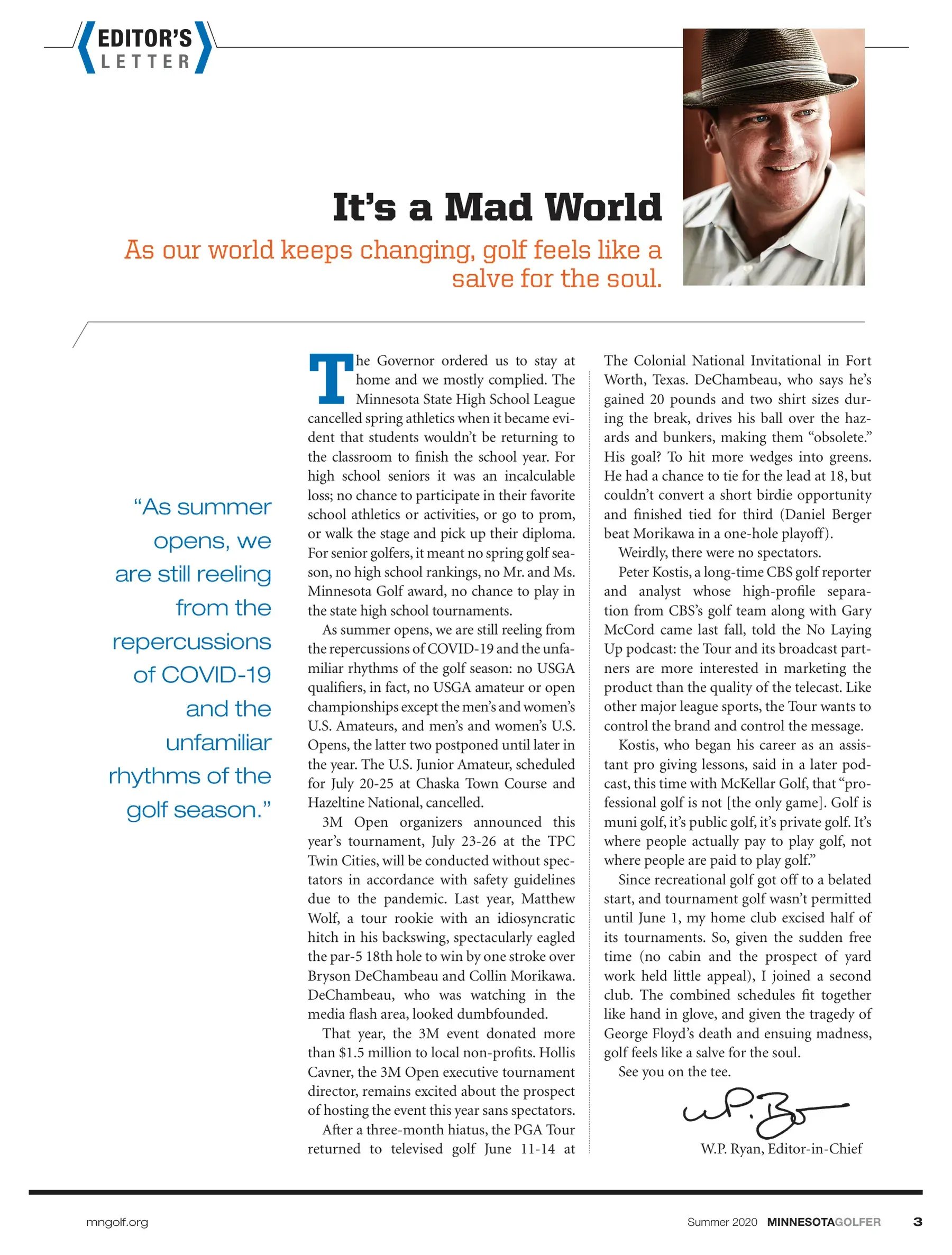
Legislative Counsel McGrann Shea Carnival Straughn & Lamb, Chartered OFFICE Volume 48, Number 3 Summer 2020 T he Governor ordered us to stay at home and we mostly complied. The Minnesota State High School League cancelled spring athletics when it became evident that students wouldn’t be returning to the classroom to finish the school year. For high school seniors it was an incalculable loss; no chance to participate in their favorite school athletics or activities, or go to prom, or walk the stage and pick up their diploma.
For senior golfers, it meant no spring golf season, no high school rankings, no Mr. and Ms. Minnesota Golf award, no chance to play in the state high school tournaments.
As summer opens, we are still reeling from the repercussions of COVID-19 and the unfamiliar rhythms of the golf season: no USGA qualifiers, in fact, no USGA amateur or open championships except the men’s and women’s U.S. Amateurs, and men’s and women’s U.S.
Opens, the latter two postponed until later in the year. The U.S. Junior Amateur, scheduled for July 20-25 at Chaska Town Course and Hazeltine National, cancelled.
3M Open organizers announced this year’s tournament, July 23-26 at the TPC Twin Cities, will be conducted without spectators in accordance with safety guidelines due to the pandemic. Last year, Matthew Wolf, a tour rookie with an idiosyncratic hitch in his backswing, spectacularly eagled the par-5 18th hole to win by one stroke over Bryson DeChambeau and Collin Morikawa.
DeChambeau, who was watching in the media flash area, looked dumbfounded. That year, the 3M event donated more than $1.5 million to local non-profits. Hollis Cavner, the 3M Open executive tournament director, remains excited about the prospect of hosting the event this year sans spectators.
After a three-month hiatus, the PGA Tour returned to televised golf June 11-14 at The Colonial National Invitational in Fort Worth, Texas. DeChambeau, who says he’s gained 20 pounds and two shirt sizes during the break, drives his ball over the hazards and bunkers, making them “obsolete.”
His goal? To hit more wedges into greens. He had a chance to tie for the lead at 18, but couldn’t convert a short birdie opportunity and finished tied for third (Daniel Berger beat Morikawa in a one-hole playoff).
Weirdly, there were no spectators. Peter Kostis, a long-time CBS golf reporter and analyst whose high-profile separation from CBS’s golf team along with Gary McCord came last fall, told the No Laying Up podcast: the Tour and its broadcast partners are more interested in marketing the product than the quality of the telecast. Like other major league sports, the Tour wants to control the brand and control the message.
Kostis, who began his career as an assistant pro giving lessons, said in a later podcast, this time with McKellar Golf, that “professional golf is not [the only game]. Golf is muni golf, it’s public golf, it’s private golf. It’s where people actually pay to play golf, not where people are paid to play golf.”
Since recreational golf got off to a belated start, and tournament golf wasn’t permitted until June 1, my home club excised half of its tournaments. So, given the sudden free time (no cabin and the prospect of yard work held little appeal), I joined a second club. The combined schedules fit together like hand in glove, and given the tragedy of George Floyd’s death and ensuing madness, golf feels like a salve for the soul.
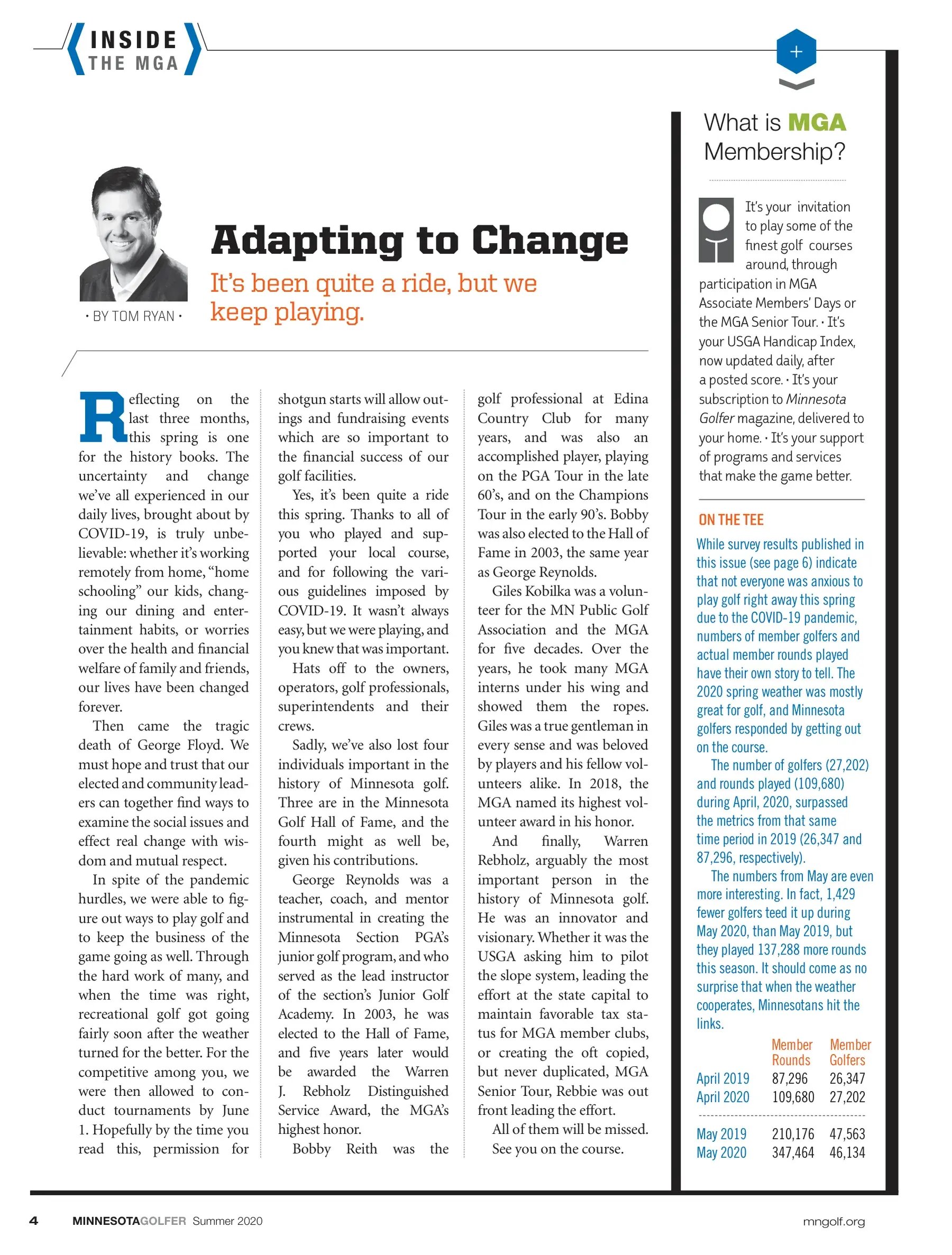
Then came the tragic death of George Floyd. We must hope and trust that our elected and community leaders can together find ways to examine the social issues and effect real change with wisdom and mutual respect.
In spite of the pandemic hurdles, we were able to figure out ways to play golf and to keep the business of the game going as well. Through the hard work of many, and when the time was right, recreational golf got going fairly soon after the weather turned for the better. For the competitive among you, we were then allowed to conduct tournaments by June 1. Hopefully by the time you read this, permission for shotgun starts will allow outings and fundraising events which are so important to the financial success of our golf facilities.
Yes, it’s been quite a ride this spring. Thanks to all of you who played and supported your local course, and for following the various guidelines imposed by COVID-19. It wasn’t always easy, but we were playing, and you knew that was important.
Hats off to the owners, operators, golf professionals, superintendents and their crews. Sadly, we’ve also lost four individuals important in the history of Minnesota golf.
Three are in the Minnesota Golf Hall of Fame, and the fourth might as well be, given his contributions. George Reynolds was a teacher, coach, and mentor instrumental in creating the Minnesota Section PGA’s junior golf program, and who served as the lead instructor of the section’s Junior Golf Academy. In 2003, he was elected to the Hall of Fame, and five years later would be awarded the Warren J.
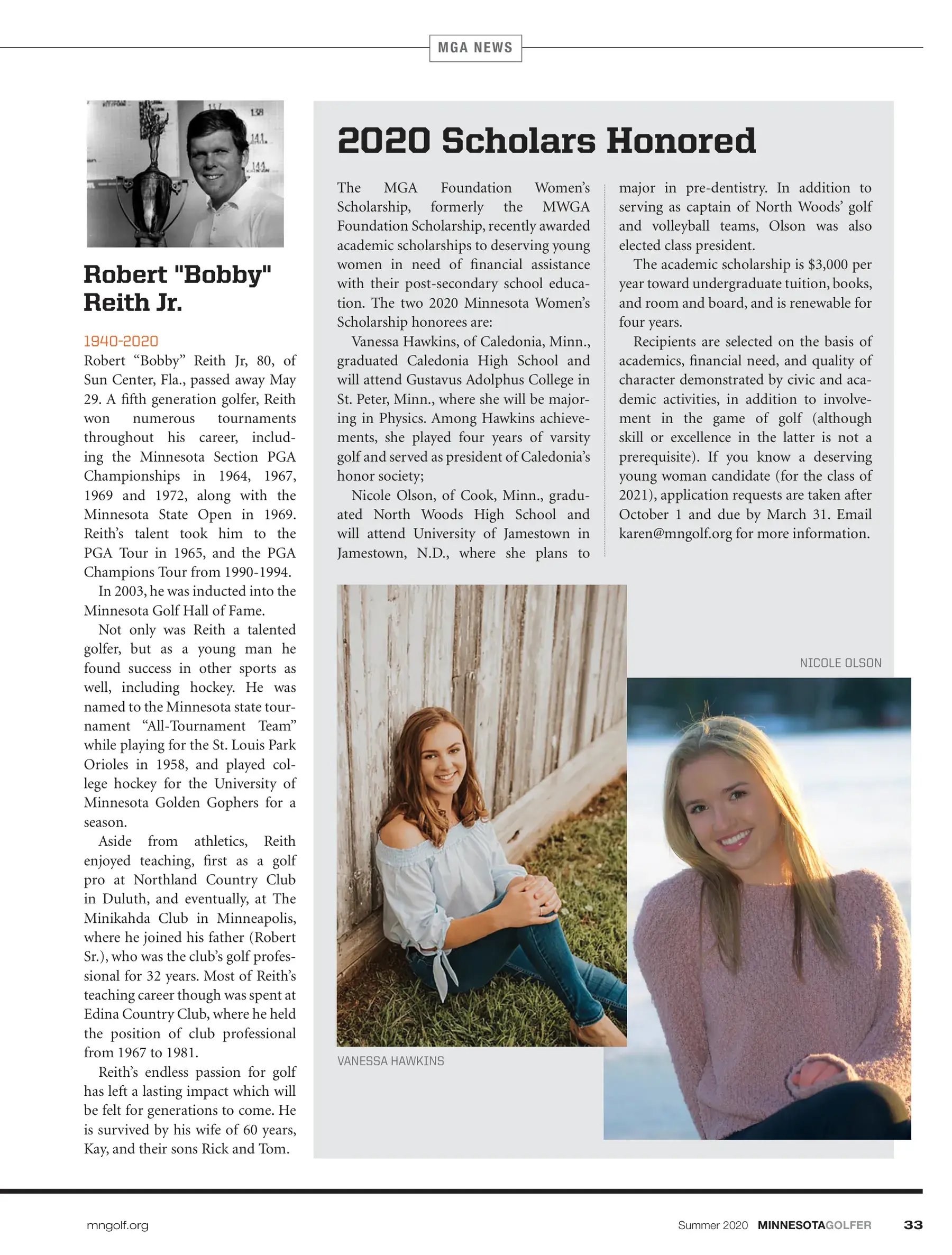
Rebholz Distinguished Service Award, the MGA’s highest honor. Bobby Reith was the golf professional at Edina Country Club for many years, and was also an accomplished player, playing on the PGA Tour in the late 60’s, and on the Champions Tour in the early 90’s. Bobby was also elected to the Hall of Fame in 2003, the same year as George Reynolds.
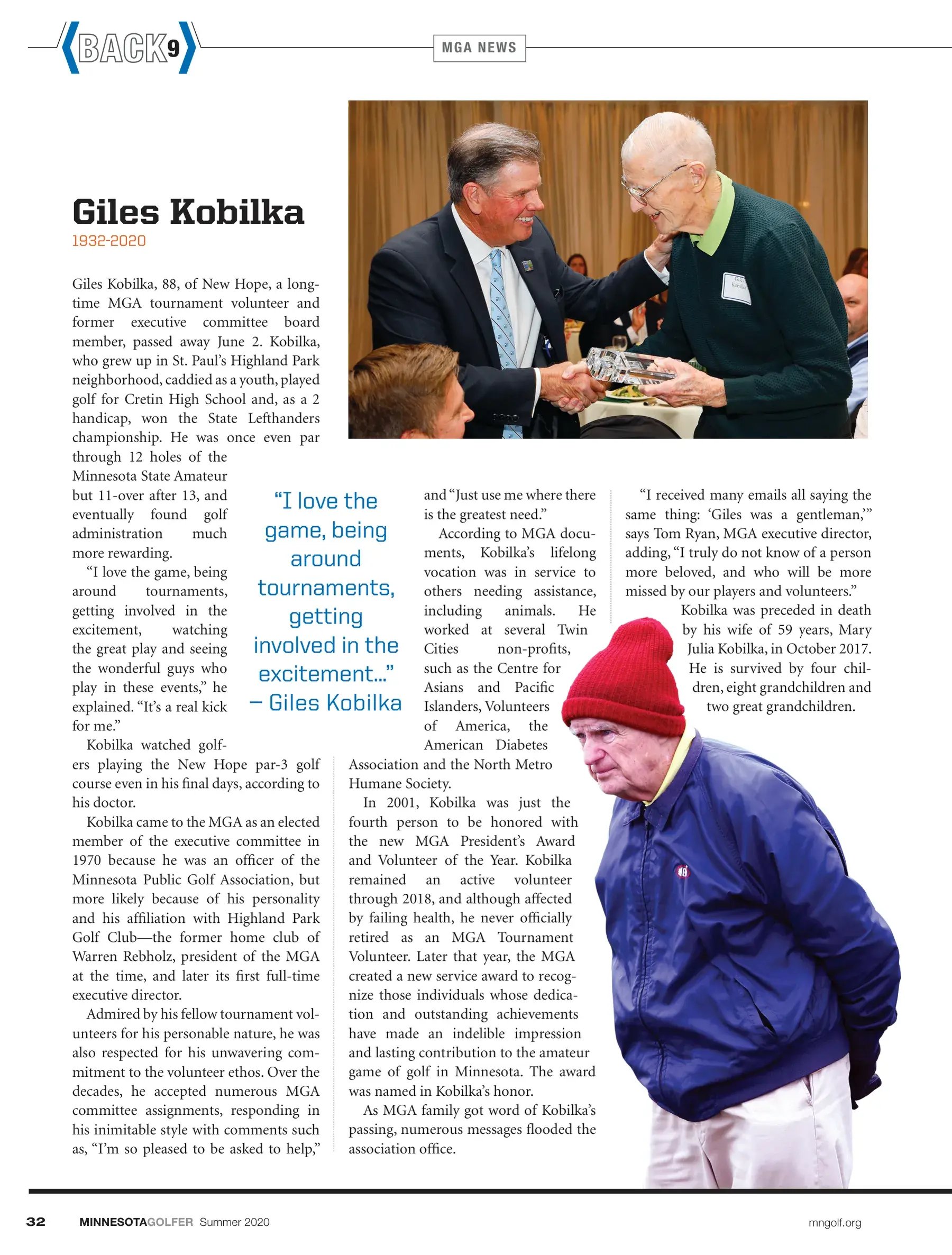
Giles Kobilka was a volunteer for the MN Public Golf Association and the MGA for five decades. Over the years, he took many MGA interns under his wing and showed them the ropes.
Giles was a true gentleman in every sense and was beloved by players and his fellow volunteers alike. In 2018, the MGA named its highest volunteer award in his honor.
And finally, Warren Rebholz, arguably the most important person in the history of Minnesota golf. He was an innovator and visionary. Whether it was the USGA asking him to pilot the slope system, leading the effort at the state capital to maintain favorable tax status for MGA member clubs, or creating the oft copied, but never duplicated, MGA Senior Tour, Rebbie was out front leading the effort.
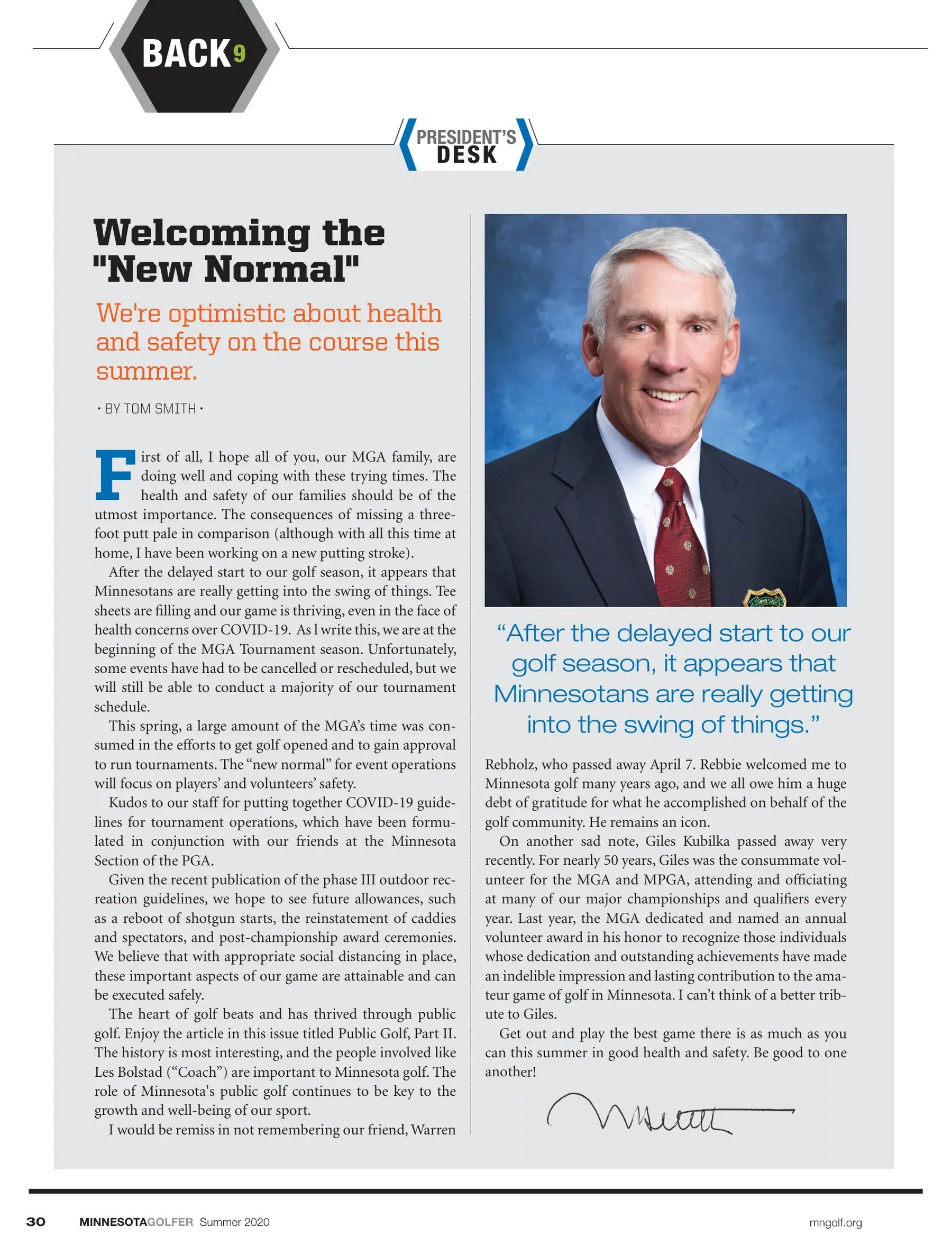
• BY TOM RYAN • Adapting to Change It’s been quite a ride, but we keep playing. ON THE TEE While survey results published in this issue (see page 6) indicate that not everyone was anxious to play golf right away this spring due to the COVID-19 pandemic, numbers of member golfers and actual member rounds played have their own story to tell. The 2020 spring weather was mostly great for golf, and Minnesota golfers responded by getting out on the course.
The number of golfers (27,202) and rounds played (109,680) during April, 2020, surpassed the metrics from that same time period in 2019 (26,347 and 87,296, respectively).
The numbers from May are even more interesting. In fact, 1,429 fewer golfers teed it up during May 2020, than May 2019, but they played 137,288 more rounds this season. It should come as no surprise that when the weather cooperates, Minnesotans hit the links.
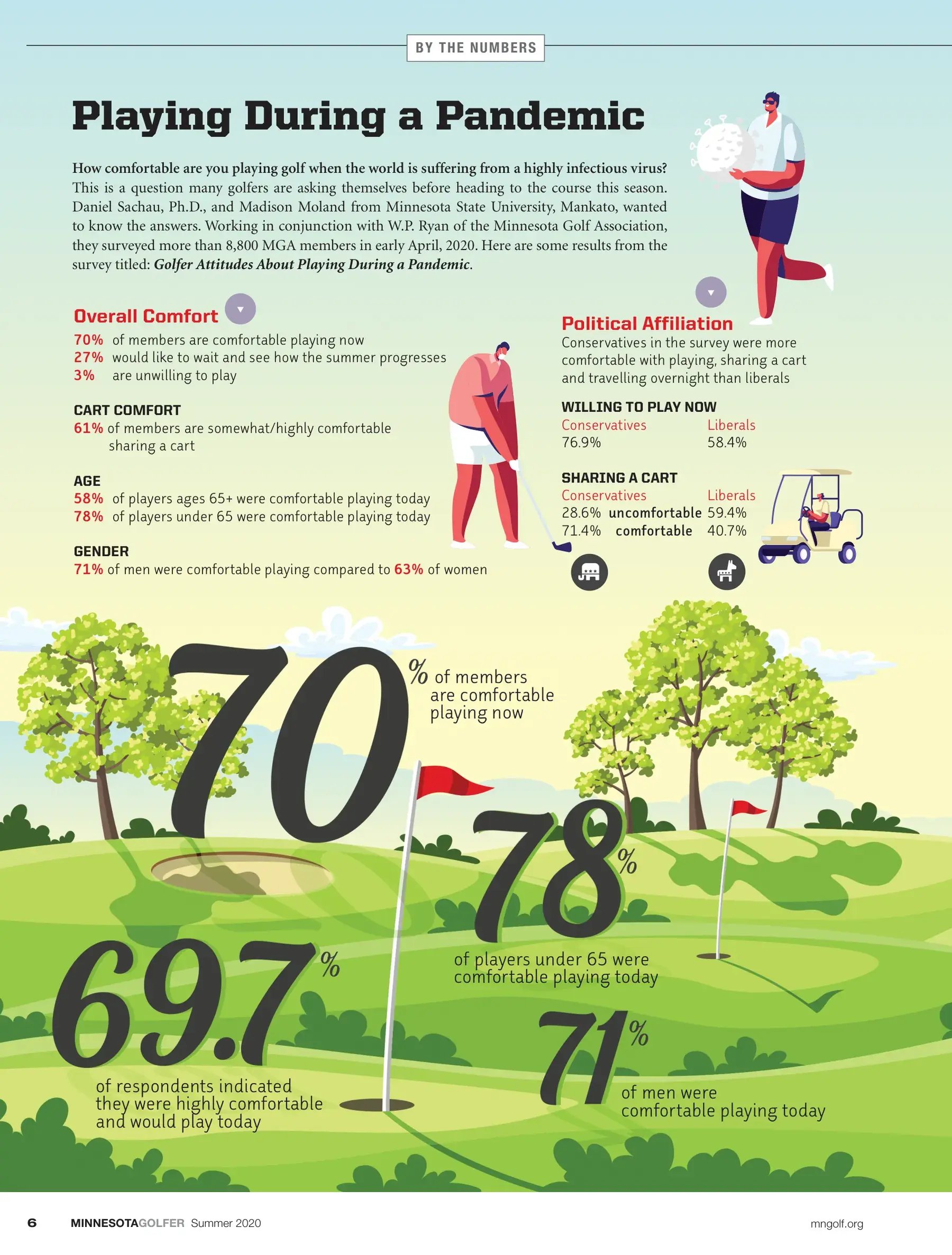
PGA TOUR TOURNAMENT: July 23-26 Playing During a Pandemic How comfortable are you playing golf when the world is suffering from a highly infectious virus?
This is a question many golfers are asking themselves before heading to the course this season. Daniel Sachau, Ph.D., and Madison Moland from Minnesota State University, Mankato, wanted to know the answers. Working in conjunction with W.P. Ryan of the Minnesota Golf Association, they surveyed more than 8,800 MGA members in early April, 2020. Here are some results from the survey titled: Golfer Attitudes About Playing During a Pandemic.
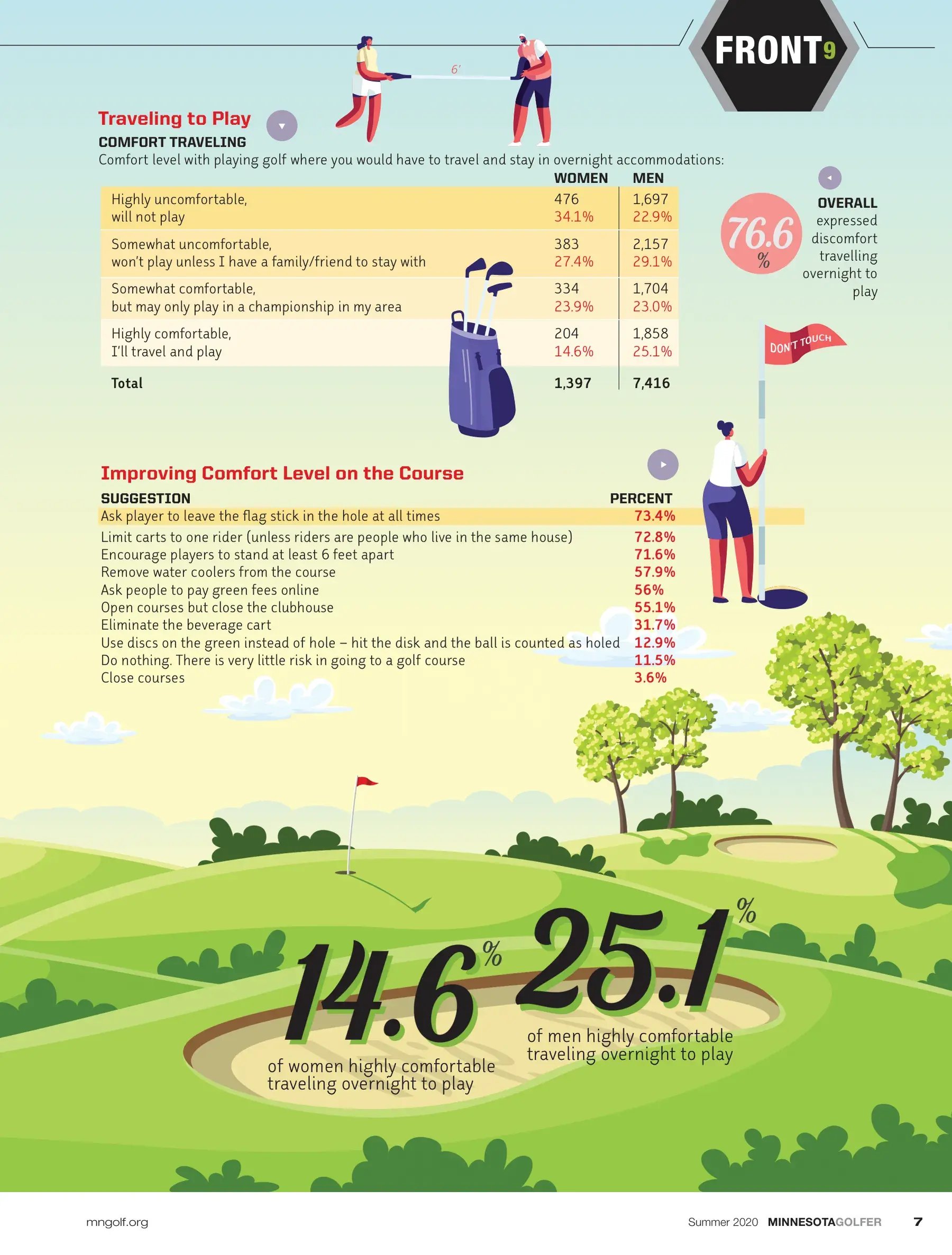
Overall Comfort 70% of members are comfortable playing now 27% would like to wait and see how the summer progresses 3% are unwilling to play CART COMFORT 61% of members are somewhat/highly comfortable sharing a cart AGE 58% of players ages 65+ were comfortable playing today 78% of players under 65 were comfortable playing today GENDER 71% of men were comfortable playing compared to 63% of women Political Affiliation Conservatives in the survey were more comfortable with playing, sharing a cart and travelling overnight than liberals of members are comfortable playing now of respondents indicated they were highly comfortable and would play today of players under 65 were comfortable playing today of men were comfortable playing today WILLING TO PLAY NOW Conservatives Liberals 76.9% 58.4% SHARING A CART Conservatives Liberals 28.6% uncomfortable 59.4% 71.4% comfortable 40.7% FRONT Summer 2020 MINNESOTAGOLFER 7 Traveling to Play Improving Comfort Level on the Course SUGGESTION PERCENT Ask player to leave the flag stick in the hole at all times 73.4% Limit carts to one rider (unless riders are people who live in the same house) 72.8% Encourage players to stand at least 6 feet apart 71.6% Remove water coolers from the course 57.9% Ask people to pay green fees online 56% Open courses but close the clubhouse 55.1% Eliminate the beverage cart 31.7% Use discs on the green instead of hole — hit the disk and the ball is counted as holed 12.9% Do nothing. There is very little risk in going to a golf course 11.5% Close courses 3.6% OVERALL expressed discomfort travelling overnight to play COMFORT TRAVELING Comfort level with playing golf where you would have to travel and stay in overnight accommodations: WOMEN MEN Highly uncomfortable, 1,697 will not play 34.1% 22.9% Somewhat uncomfortable, 2,157 won’t play unless I have a family/friend to stay with 27.4% 29.1% Somewhat comfortable, 1,704 but may only play in a championship in my area 23.9% 23.0% Highly comfortable, 1,858 I’ll travel and play 14.6% 25.1% Total 1,397 7,416 of women highly comfortable traveling overnight to play 6’ of men highly comfortable traveling overnight to play PHOTO BY PAUL MARKERT, ILLUSTRATION BY DEAN LAVATO S ome golfers don’t prefer a par-3 finishing hole, but No. 18 at Ruttger’s will certainly get their attention.
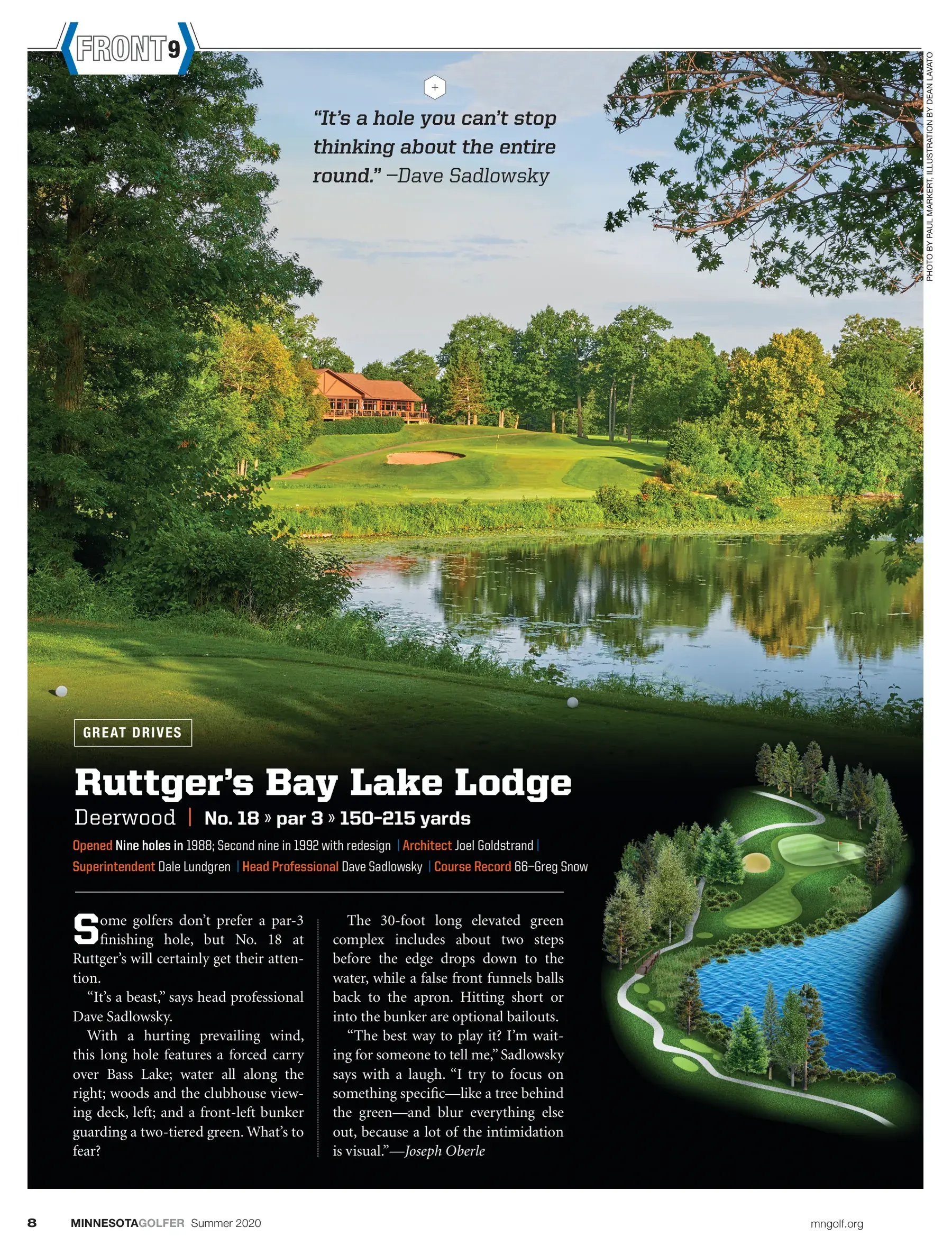
“It’s a beast,” says head professional Dave Sadlowsky. With a hurting prevailing wind, this long hole features a forced carry over Bass Lake; water all along the right; woods and the clubhouse viewing deck, left; and a front-left bunker guarding a two-tiered green. What’s to fear?
The 30-foot long elevated green complex includes about two steps before the edge drops down to the water, while a false front funnels balls back to the apron. Hitting short or into the bunker are optional bailouts.
“The best way to play it? I’m waiting for someone to tell me,” Sadlowsky says with a laugh. “I try to focus on something specific—like a tree behind the green—and blur everything else out, because a lot of the intimidation is visual.”—Joseph Oberle GREAT DRIVES Ruttger’s Bay Lake Lodge Deerwood | No. 18 » par 3 » 150–215 yards Opened Nine holes in 1988; Second nine in 1992 with redesign | Architect Joel Goldstrand | Superintendent Dale Lundgren | Head Professional Dave Sadlowsky | Course Record 66—Greg Snow “It’s a hole you can’t stop thinking about the entire round.” —Dave Sadlowsky + Summer 2020 MINNESOTAGOLFER 9 TIPS FROM THE PROS PHOTO BY MATT SEEFELDT Commit to a Fitting A golf ball fitting is recommended for all golfers— no matter your swing speed.
T here is only one piece of equipment you use on every single shot: your golf ball. Unlike many other sports, golf doesn’t have a shared ball. This allows players to choose one that is best for their personal game. In picking a ball, you must decide what’s most important to you—it could be distance, control, feel or price.
I recommend choosing a ball where the majority of shots occur, which is inside of 100 yards. Picking a ball based on driver distance and 14 shots maximum doesn’t make sense if that ball doesn’t include short game control.
And don’t think that your swing speed is too slow to compress a premium ball. All balls compress at various swing speeds, and the difference between high and low speeds is minimal.
Compression relates more to softness, so if you prefer a softer feel, a low compression ball will be right for you. Once you find a ball, commit to it for consistency and familiarity.
• BY MIKE BARGE • Mike Barge is the director of instruction at Hazeltine National GC, a Class A member of the PGA of America and a 2019 inductee to the Minnesota Golf Hall of Fame.
Change Agent In the summer of touchless golf, COVID-19 has been a catalyst for change or adaptation in nearly all aspects of how we navigate the golf course and play the game recreationally and competitively. The MGA has adopted new Local Rules* for all of its events and competitions to deal with the pandemic. A few are summarized below.
Bunkers With the removal of rakes, the MGA has put into effect a Local Rule that deems damaged areas in bunkers as Ground Under Repair. Damaged areas include footprints and other disturbances that may have been caused by players, animals or other sources. The player has the option to play the ball as it lies, or take free relief under Rule 16.1c, but the ball must remain in the bunker. In the event that the player cannot drop without going closer to the hole, the player may drop at the nearest point of relief even if that spot is closer to the hole. Another option for the player, which incurs a penalty of one stroke, is to drop outside of the bunker along a line formed by the hole and the spot where the ball came to rest in the bunker, going back on the line as far as the player likes.
Flagsticks For safety’s sake, the flagstick is not to be touched and must remain in the hole at all times. The MGA has modified Rule 13.2 this way: a player is prohibited from making a stroke with the flagstick removed from the hole. Accidently touching or removing the flagstick is not of itself a penalty.
The Hole Hole inserts allow players to remove the ball without touching the hole or flagstick. Consequently, the definition of holed has been modified thusly: if any part of the ball is in the hole below the surface of the green, the ball is treated as holed even if the entire ball is not below the surface.
Scoring With paper scorecards one of the first casualties of touchless golf, a player’s digital scorecard is considered returned after agreeing to the hole-by-hole scores and leaving the scoring area. The MGA uses the USGA Tournament Management program and the Golf Genius app for digital scoring (and leaderboard display). With the app, the digital scorecard is considered returned to the Committee after the player agrees to the holeby-hole scores and leaves the scoring area.
In cases where the Committee provides printed scorecards (via an email or website link), the player verifies the hole-byhole scores and returns to the Committee a photo of the card via cell phone camera.
For recreational golf and handicap score posting purposes, the USGA GHIN mobile app features hole-by-hole scoring and stat tracking (number of putts and greens hit in regulation, and driving accuracy). The GHIN app automatically adjusts maximum hole scores (no more than a net double bogey, per Rule 3.1), and with a click, the score is posted and the player’s handicap index updates the next day.
The GHIN Mobile app is available in the Apple IOS and Android app stores. * Subject to change. Check mngolf.org for the latest information. Navigating the MGA’s New Local Rules* RULES PRIMER Here’s what to know about playing during the pandemic.
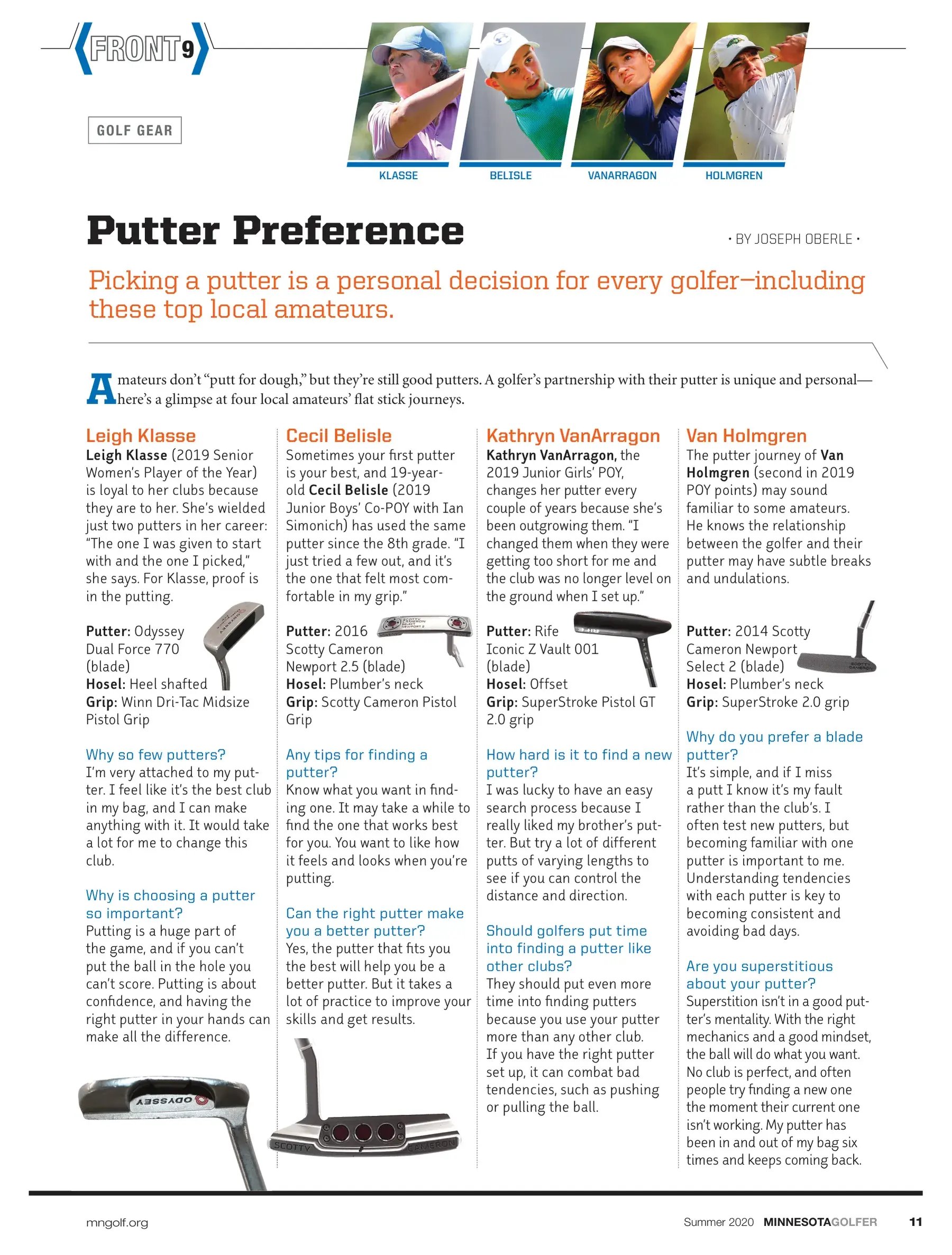
• BY W.P. RYAN • Putter Preference Picking a putter is a personal decision for every golfer—including these top local amateurs. • BY JOSEPH OBERLE • KLASSE BELISLE VANARRAGON HOLMGREN Leigh Klasse Leigh Klasse (2019 Senior Women’s Player of the Year) is loyal to her clubs because they are to her. She’s wielded just two putters in her career: “The one I was given to start with and the one I picked,”
she says. For Klasse, proof is in the putting. Putter: Odyssey Dual Force 770 (blade) Hosel: Heel shafted Grip: Winn Dri-Tac Midsize Pistol Grip Why so few putters?
I’m very attached to my putter. I feel like it’s the best club in my bag, and I can make anything with it. It would take a lot for me to change this club.
Why is choosing a putter so important? Putting is a huge part of the game, and if you can’t put the ball in the hole you can’t score. Putting is about confi dence, and having the right putter in your hands can make all the difference.
Cecil Belisle Sometimes your first putter is your best, and 19-yearold Cecil Belisle (2019 Junior Boys’ Co-POY with Ian Simonich) has used the same putter since the 8th grade. “I just tried a few out, and it’s the one that felt most comfortable in my grip.”
Putter: 2016 Scotty Cameron Newport 2.5 (blade) Hosel: Plumber’s neck Grip: Scotty Cameron Pistol Grip Any tips for finding a putter? Know what you want in finding one. It may take a while to find the one that works best for you. You want to like how it feels and looks when you’re putting.
Can the right putter make you a better putter? Yes, the putter that fits you the best will help you be a better putter. But it takes a lot of practice to improve your skills and get results.
Kathryn VanArragon Kathryn VanArragon, the 2019 Junior Girls’ POY, changes her putter every couple of years because she’s been outgrowing them. “I changed them when they were getting too short for me and the club was no longer level on the ground when I set up.”
Putter: Rife Iconic Z Vault 001 (blade) Hosel: Offset Grip: SuperStroke Pistol GT 2.0 grip How hard is it to find a new putter? I was lucky to have an easy search process because I really liked my brother’s putter. But try a lot of different putts of varying lengths to see if you can control the distance and direction.
Should golfers put time into finding a putter like other clubs? They should put even more time into finding putters because you use your putter more than any other club.
If you have the right putter set up, it can combat bad tendencies, such as pushing or pulling the ball. Van Holmgren The putter journey of Van Holmgren (second in 2019 POY points) may sound familiar to some amateurs.
He knows the relationship between the golfer and their putter may have subtle breaks and undulations. Putter: 2014 Scotty Cameron Newport Select 2 (blade) Hosel: Plumber’s neck Grip: SuperStroke 2.0 grip Why do you prefer a blade putter?
It’s simple, and if I miss a putt I know it’s my fault rather than the club’s. I often test new putters, but becoming familiar with one putter is important to me.
Understanding tendencies with each putter is key to becoming consistent and avoiding bad days. Are you superstitious about your putter? Superstition isn’t in a good putter’s mentality. With the right mechanics and a good mindset, the ball will do what you want.
No club is perfect, and often people try finding a new one the moment their current one isn’t working. My putter has been in and out of my bag six times and keeps coming back.
A mateurs don’t “putt for dough,” but they’re still good putters. A golfer’s partnership with their putter is unique and personal— here’s a glimpse at four local amateurs’ flat stick journeys.
The TGP in Minnesota is a patchwork of lands, and some of the flora and fauna of the TGP can be seen in pockets on these golf courses. “There’s no ornamental grass on the course, but we do have some in our landscape areas,” says Redwood Falls Golf Club manager Ryan Fernelius.
The Redwood River skims the northern boundary of the golf course along the 12th and 13th holes, and a pond is in play on No. 2 and No. 7, with an island green challenging on No. 3. Roseann Schauer, of the Minnesota Department of Natural Resources at Lake Shetek State Park, explains that “only 1 to 2 percent of the TGP is native, and on a threeyear burn rotation in April through May,” just as the golf season gets underway.
Highway 19 hosts Mayflower Country Club in Fairfax, a par-36 nine-hole course, with the renowned Dacotah Ridge Golf Course just down the road in Morton, on the Minnesota River Valley Scenic Byway. At Dacotah Ridge, when the prairie winds blow and the tall grasses sway at the Rees Jones design, it’s a factor. Recalling the course’s grand opening event in 2000, the temperature reached 100 degrees, and the full force of southwestern Minnesota summer was real.
Dine and rehydrate at the course in the Wabasha Creek Restaurant, or hop over to Jackpot Junction Casino Hotel, Southwestern Minnesota is a unique region with hidden treasures and unexpected surprises.
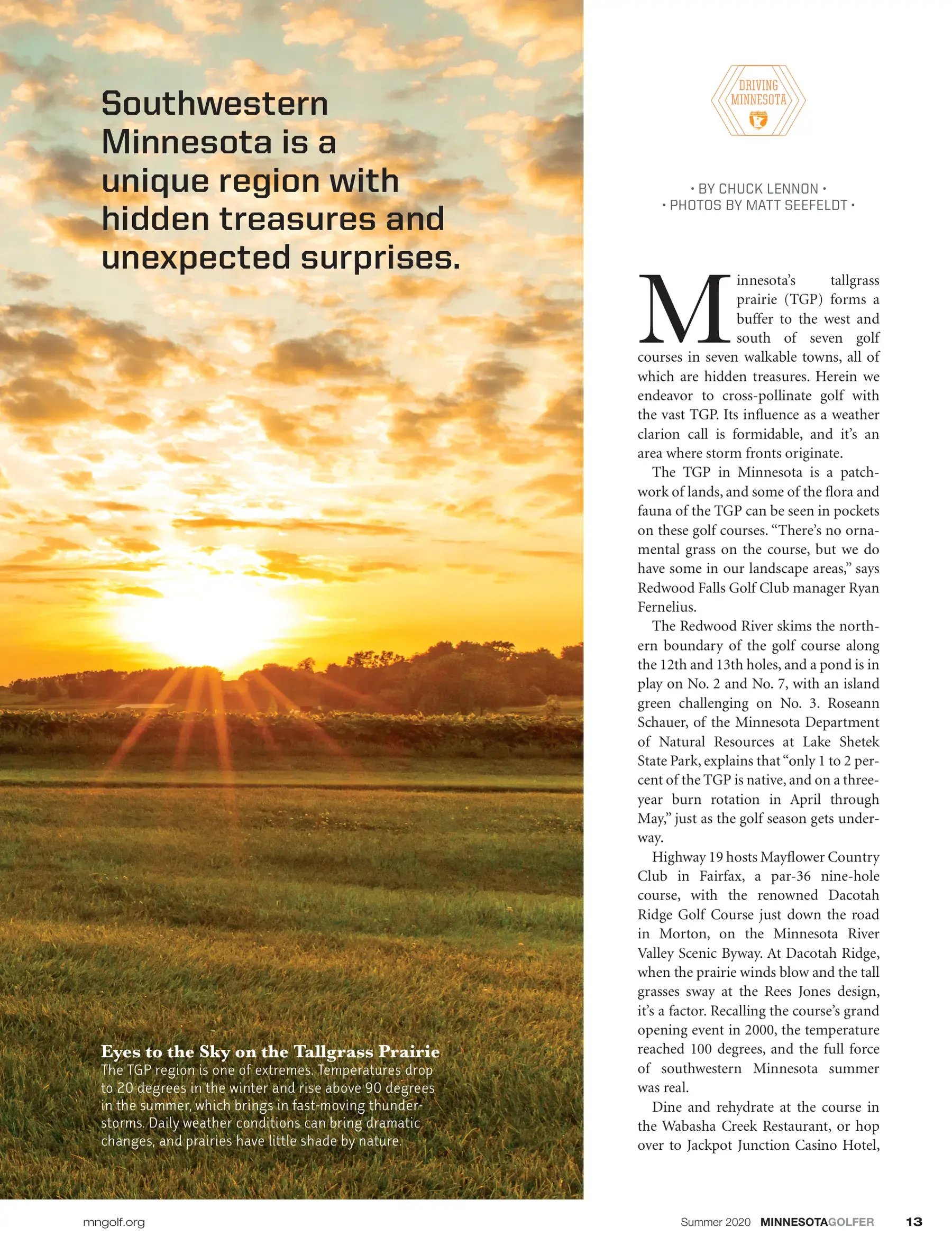
• BY CHUCK LENNON • • PHOTOS BY MATT SEEFELDT • Eyes to the Sky on the Tallgrass Prairie The TGP region is one of extremes. Temperatures drop to 20 degrees in the winter and rise above 90 degrees in the summer, which brings in fast-moving thunderstorms. Daily weather conditions can bring dramatic changes, and prairies have little shade by nature.
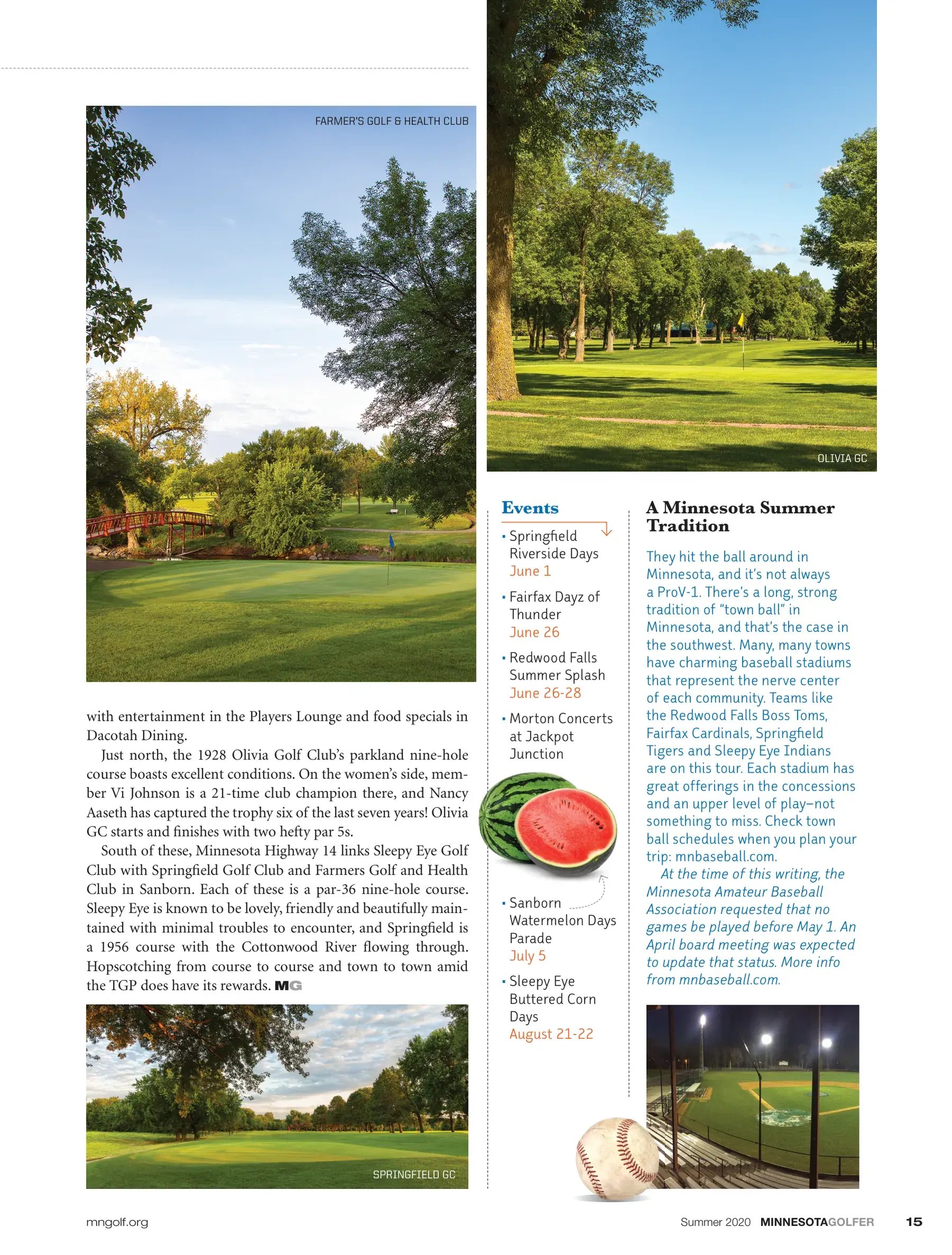
Just north, the 1928 Olivia Golf Club’s parkland nine-hole course boasts excellent conditions. On the women’s side, member Vi Johnson is a 21-time club champion there, and Nancy Aaseth has captured the trophy six of the last seven years! Olivia GC starts and finishes with two hefty par 5s.
South of these, Minnesota Highway 14 links Sleepy Eye Golf Club with Springfi eld Golf Club and Farmers Golf and Health Club in Sanborn. Each of these is a par-36 nine-hole course.
Sleepy Eye is known to be lovely, friendly and beautifully maintained with minimal troubles to encounter, and Springfi eld is a 1956 course with the Cottonwood River flowing through.
Hopscotching from course to course and town to town amid the TGP does have its rewards. MG A Minnesota Summer Tradition They hit the ball around in Minnesota, and it’s not always a ProV-1. There’s a long, strong tradition of “town ball” in Minnesota, and that’s the case in the southwest. Many, many towns have charming baseball stadiums that represent the nerve center of each community. Teams like the Redwood Falls Boss Toms, Fairfax Cardinals, Springfi eld Tigers and Sleepy Eye Indians are on this tour. Each stadium has great offerings in the concessions and an upper level of play—not something to miss. Check town ball schedules when you plan your trip: mnbaseball.com.
At the time of this writing, the Minnesota Amateur Baseball Association requested that no games be played before May 1. An April board meeting was expected to update that status. More info from mnbaseball.com.
Events • Springfi eld Riverside Days June 1 • Fairfax Dayz of Thunder June 26 • Redwood Falls Summer Splash June 26-28 • Morton Concerts at Jackpot Junction • Sanborn Watermelon Days Parade July 5 • Sleepy Eye Buttered Corn Days August 21-22 FARMER’S GOLF & HEALTH CLUB SPRINGFIELD GC OLIVIA GC The first installment of this story, published in our spring issue, examined the 1916 introduction of Minnesota public golf.
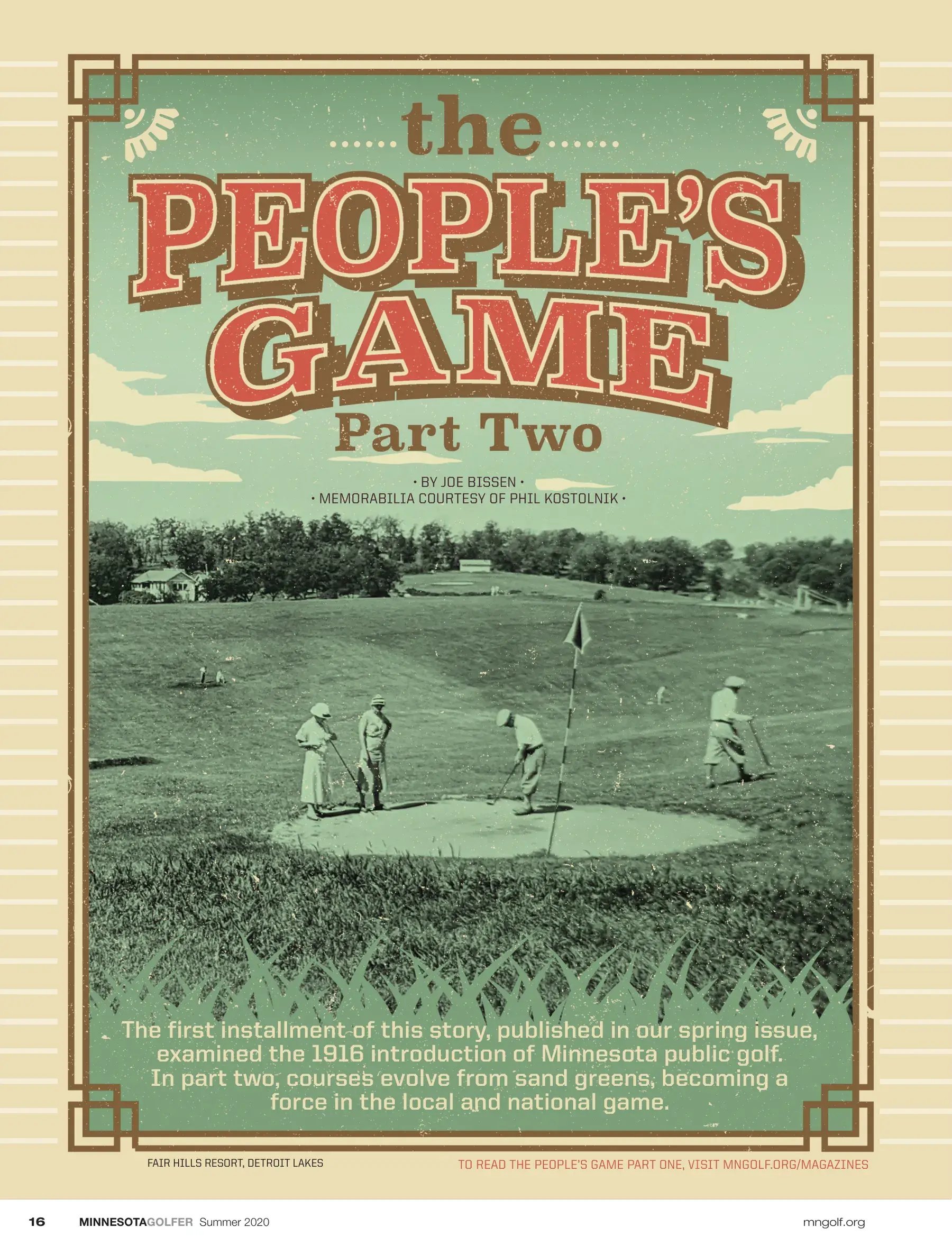
In part two, courses evolve from sand greens, becoming a force in the local and national game. • BY JOE BISSEN • • MEMORABILIA COURTESY OF PHIL KOSTOLNIK • FAIR HILLS RESORT, DETROIT LAKES TO READ THE PEOPLE’S GAME PART ONE, VISIT MNGOLF.ORG/MAGAZINES Summer 2020 MINNESOTAGOLFER 17 I n the years following public golf’s 1916 introduction to Minnesota, paying customers stampeded to the state’s public courses like it was no-fee day at Pebble Beach. At first, the number of public venues was limited to just three—Glenwood (now named Wirth) and Columbia in Minneapolis and Phalen Park in St. Paul—but the players’ flow was unbridled.
In 1918, Phalen’s first full year of operation, 47,000 rounds were played, according to Minnesota golf historian Rick Shefchik’s book, “From Fields to Fairways: Classic Golf Clubs of Minnesota.” Phalen expanded to 18 holes the following year, and a staggering 98,763 rounds ensued.
Columbia opened with six holes in 1919, expanded to nine in 1920 and then to 18 the next year, when it hosted 53,692 rounds, according to Shefchik.
By 1922, the course at Glenwood played host to “more than 12,000 persons, an average of 400 a day” in the month of July alone, according to the Minneapolis Tribune.
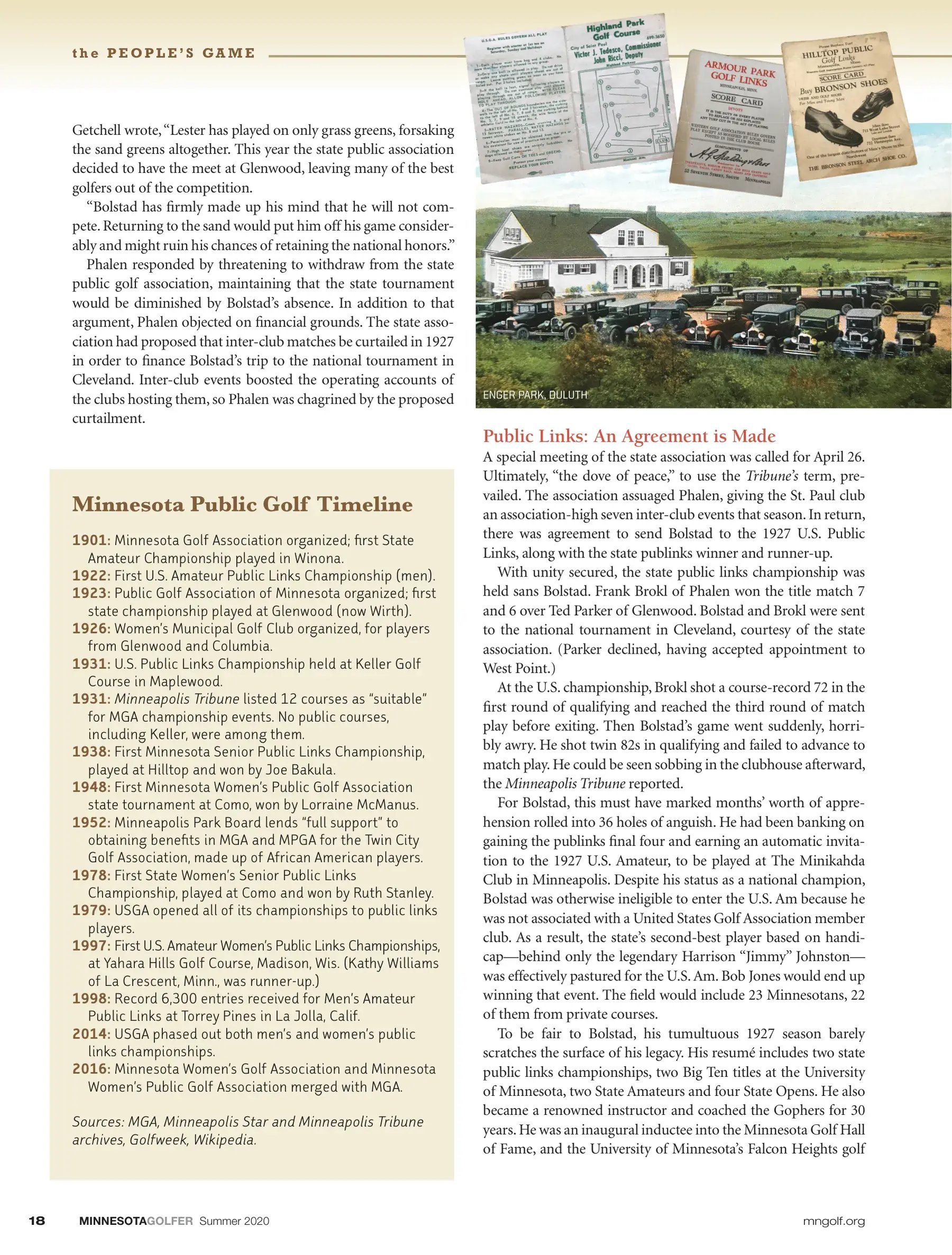
Public golf was bursting at the seams, and the spillover would create more places to play. Twin Cities municipal courses Armour (now Gross), Meadowbrook, Highland Park and Keller were all built in the 1920s. Outside the metro area, Duluth (Enger Park), Rochester (Soldiers’ Field), Hibbing and Winona were among the cities with early municipal or public courses. Hilltop in Columbia Heights (now defunct), Superior (now Brookview) in Golden Valley and Minnepau in Falcon Heights, a predecessor to the current Bolstad University course, were early public courses that were privately owned. Phalen Park became so crowded that some of its regulars split off and founded a course named Lakeview, which opened in the northeast corner of St. Paul in 1921. It was renamed Hillcrest shortly afterward and carried on for 96 years before closing in 2017.
Public Golf Shifts From Organic to Organized “Better golf on the public links of Minnesota,” the Minneapolis Tribune wrote on April 26, 1923, “is the aim of the new Public Golf Association of Minnesota, which organization was perfected at a meeting in the St. Francis hotel, St. Paul, Tuesday night.”
The new organization had but three founding clubs— Columbia, Glenwood and Phalen. Harry Edmunds of Phalen was elected the first president. That year’s docket included a regular series of inter-club matches, the first state public links championship and perhaps a women’s state championship, a May 1923 Tribune story suggested.
As for whether anything was “perfected” that Tuesday night, well, maybe not so much. The first state championship was to be held at Glenwood.
Controversy arose before the first ball could be propelled toward the first green—which was anything but green. “New Rules for Glenwood Meet,” read the headline on a Tribune story on June 19, 1923.
“Special rules will be made to govern the play of the Minnesota State Public Golf association tournament at Glenwood course,” the story began. “One rule is: There will be no sweeping of the greens with the clubhead before putting.” This rule was made after many golfers complained that players were doing this in match play.
“The sweeping of the green is a big help on a sand green. The player brushes the sand to one side making a clear path to the cup. Tom Comer [who was in charge of the tournament] thinks that it is fair to one as the other to leave the greens the same and have the players putt through whatever amount of sand happens to be on the green.”
What was that all about? Good question. Glenwood, Phalen and Columbia all had sand greens, along with scores of other Minnesota courses in the 1920s and ’30s. Their surfaces were literally circles of sand, generally mixed with motor oil or a similar synthetic substance.
The ground was then raked or groomed to keep this surface as smooth as possible. Though it was a less-than-transcendent way to play the short game, the lower building and maintenance costs dictated that it was the right way to go for many.
The show went on for that inaugural state public links, and in July 1923, Hardy Feichtinger of Glenwood won the inaugural MPGA championship—presumably without any undetected or nefarious sweeping of sand. (Insert Patrick Reed wisecrack here, if you wish.) But the sand greens issue was far from dead.
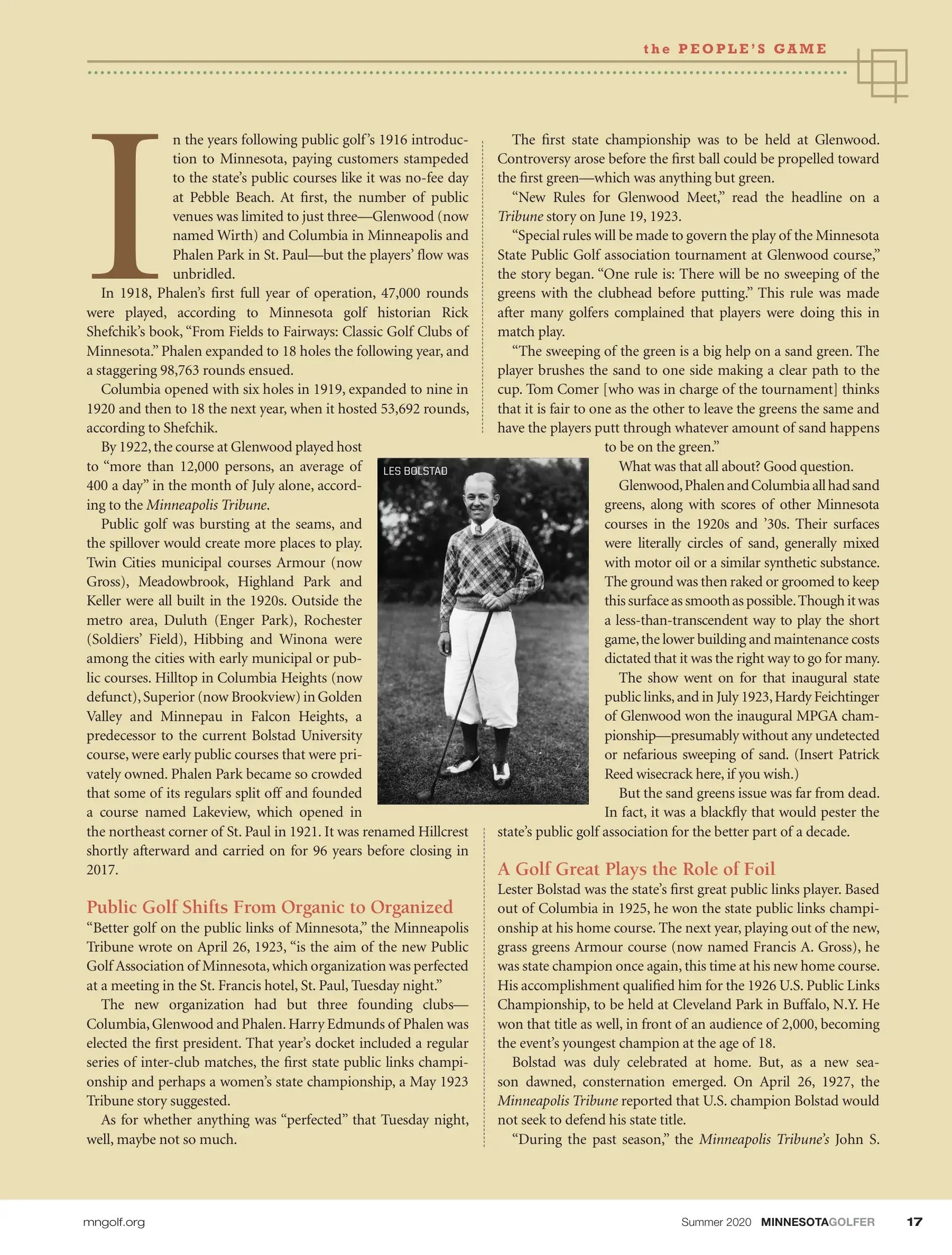
In fact, it was a blackfly that would pester the state’s public golf association for the better part of a decade. A Golf Great Plays the Role of Foil Lester Bolstad was the state’s first great public links player. Based out of Columbia in 1925, he won the state public links championship at his home course. The next year, playing out of the new, grass greens Armour course (now named Francis A. Gross), he was state champion once again, this time at his new home course.
His accomplishment qualified him for the 1926 U.S. Public Links Championship, to be held at Cleveland Park in Buffalo, N.Y. He won that title as well, in front of an audience of 2,000, becoming the event’s youngest champion at the age of 18.
Bolstad was duly celebrated at home. But, as a new season dawned, consternation emerged. On April 26, 1927, the Minneapolis Tribune reported that U.S. champion Bolstad would not seek to defend his state title.
“Bolstad has firmly made up his mind that he will not compete. Returning to the sand would put him off his game considerably and might ruin his chances of retaining the national honors.”
Phalen responded by threatening to withdraw from the state public golf association, maintaining that the state tournament would be diminished by Bolstad’s absence. In addition to that argument, Phalen objected on financial grounds. The state association had proposed that inter-club matches be curtailed in 1927 in order to finance Bolstad’s trip to the national tournament in Cleveland. Inter-club events boosted the operating accounts of the clubs hosting them, so Phalen was chagrined by the proposed curtailment.
Public Links: An Agreement is Made A special meeting of the state association was called for April 26. Ultimately, “the dove of peace,” to use the Tribune’s term, prevailed. The association assuaged Phalen, giving the St. Paul club an association-high seven inter-club events that season. In return, there was agreement to send Bolstad to the 1927 U.S. Public Links, along with the state publinks winner and runner-up.
With unity secured, the state public links championship was held sans Bolstad. Frank Brokl of Phalen won the title match 7 and 6 over Ted Parker of Glenwood. Bolstad and Brokl were sent to the national tournament in Cleveland, courtesy of the state association. (Parker declined, having accepted appointment to West Point.) At the U.S. championship, Brokl shot a course-record 72 in the first round of qualifying and reached the third round of match play before exiting. Then Bolstad’s game went suddenly, horribly awry. He shot twin 82s in qualifying and failed to advance to match play. He could be seen sobbing in the clubhouse afterward, the Minneapolis Tribune reported.
For Bolstad, this must have marked months’ worth of apprehension rolled into 36 holes of anguish. He had been banking on gaining the publinks final four and earning an automatic invitation to the 1927 U.S. Amateur, to be played at The Minikahda Club in Minneapolis. Despite his status as a national champion, Bolstad was otherwise ineligible to enter the U.S. Am because he was not associated with a United States Golf Association member club. As a result, the state’s second-best player based on handicap—behind only the legendary Harrison “Jimmy” Johnston— was effectively pastured for the U.S. Am. Bob Jones would end up winning that event. The field would include 23 Minnesotans, 22 of them from private courses.
1922: First U.S. Amateur Public Links Championship (men). 1923: Public Golf Association of Minnesota organized; first state championship played at Glenwood (now Wirth).
1926: Women’s Municipal Golf Club organized, for players from Glenwood and Columbia. 1931: U.S. Public Links Championship held at Keller Golf Course in Maplewood.
1931: Minneapolis Tribune listed 12 courses as “suitable” for MGA championship events. No public courses, including Keller, were among them. 1938: First Minnesota Senior Public Links Championship, played at Hilltop and won by Joe Bakula.
1948: First Minnesota Women’s Public Golf Association state tournament at Como, won by Lorraine McManus. 1952: Minneapolis Park Board lends “full support” to obtaining benefi ts in MGA and MPGA for the Twin City Golf Association, made up of African American players.
1978: First State Women’s Senior Public Links Championship, played at Como and won by Ruth Stanley. 1979: USGA opened all of its championships to public links players.
1997: First U.S. Amateur Women’s Public Links Championships, at Yahara Hills Golf Course, Madison, Wis. (Kathy Williams of La Crescent, Minn., was runner-up.) 1998: Record 6,300 entries received for Men’s Amateur Public Links at Torrey Pines in La Jolla, Calif.
2014: USGA phased out both men’s and women’s public links championships. 2016: Minnesota Women’s Golf Association and Minnesota Women’s Public Golf Association merged with MGA.
Sources: MGA, Minneapolis Star and Minneapolis Tribune archives, Golfweek, Wikipedia. Minnesota Public Golf Timeline ENGER PARK, DULUTH course is named after him.
Many other outstanding players from the early years of Minnesota golf were either partially or wholly public links players, and several won multiple state championships. Brokl, Al Clasen, Ade Fordham, Joe Coria and John Lakotas were just a few of these standout players.
Minnesota Golf Becomes Nationally Known After mid-1927, discontent around state public golf association interests abated but did not disappear. In November 1927, Columbia Golf Club—the club, not the sand greens golf course—dissolved, with the Minneapolis Tribune reporting that most members would move to Armour “because of the more pleasant playing facilities,” or in other words, grass greens and “regulation” length. In 1929, the men’s club at Phalen dissolved, with membership protesting the course’s sand greens. Some moved to the grass greens course at St. Paul’s Highland Park, which had opened the year before.
Regardless of local tumult, public golf in Minnesota had gained a solid reputation in national circles by the late 1920s— enough so that the national public links association awarded its 1931 championship to Keller, which had opened in 1929 as a grass greens, 18-hole course just up the road from Phalen.
(See related story.) The ’29 public links came amid a remarkable six-year period for golf in Minnesota. In that time, the state played host to the 1927 U.S. Amateur at Minikahda (won by Jones), the 1930 U.S. Open at Interlachen (Jones again), the inaugural PGA Tour St. Paul Open at Keller in 1930 (“Lighthorse” Harry Cooper), the 1931 publinks at Keller (Charles Ferrera) and the 1932 PGA Championship at Keller (Olin Dutra). To boot, Johnston won the 1929 U.S. Amateur at Pebble Beach.
By the early 1930s, public links golf in Minnesota had largely found tranquility, despite challenges posed to the sport by the Great Depression. Sand greens at Twin Cities courses eventually went the way of the horseless carriage. By 1933, there were 10 member clubs in the state association—new members that year were Galls (now Manitou Ridge) in White Bear Lake and Riverview (now Mendakota and private) in Mendota Heights.
The 1937 state publinks at Hiawatha was expected to draw a record field of 125 entrants, the Minneapolis Tribune reported in June. Nineteen clubs were association members, including Nemadji of Superior, Wis.
The 1940s marked a relatively static period for public golf, One of the first and brightest stars of Minnesota public golf was not a person, but rather a plot of rolling land—Keller Golf Course.
Owned and operated by Ramsey County, Keller opened for play on May 29, 1929 in Maplewood—just north of Phalen Park and the city of St. Paul. It was designed not by a famed architect but rather by county engineer Paul Coates, who meticulously studied and visited renowned courses before going to work on Keller. Upon completion, he proved that he would not need a course architect’s mulligan.
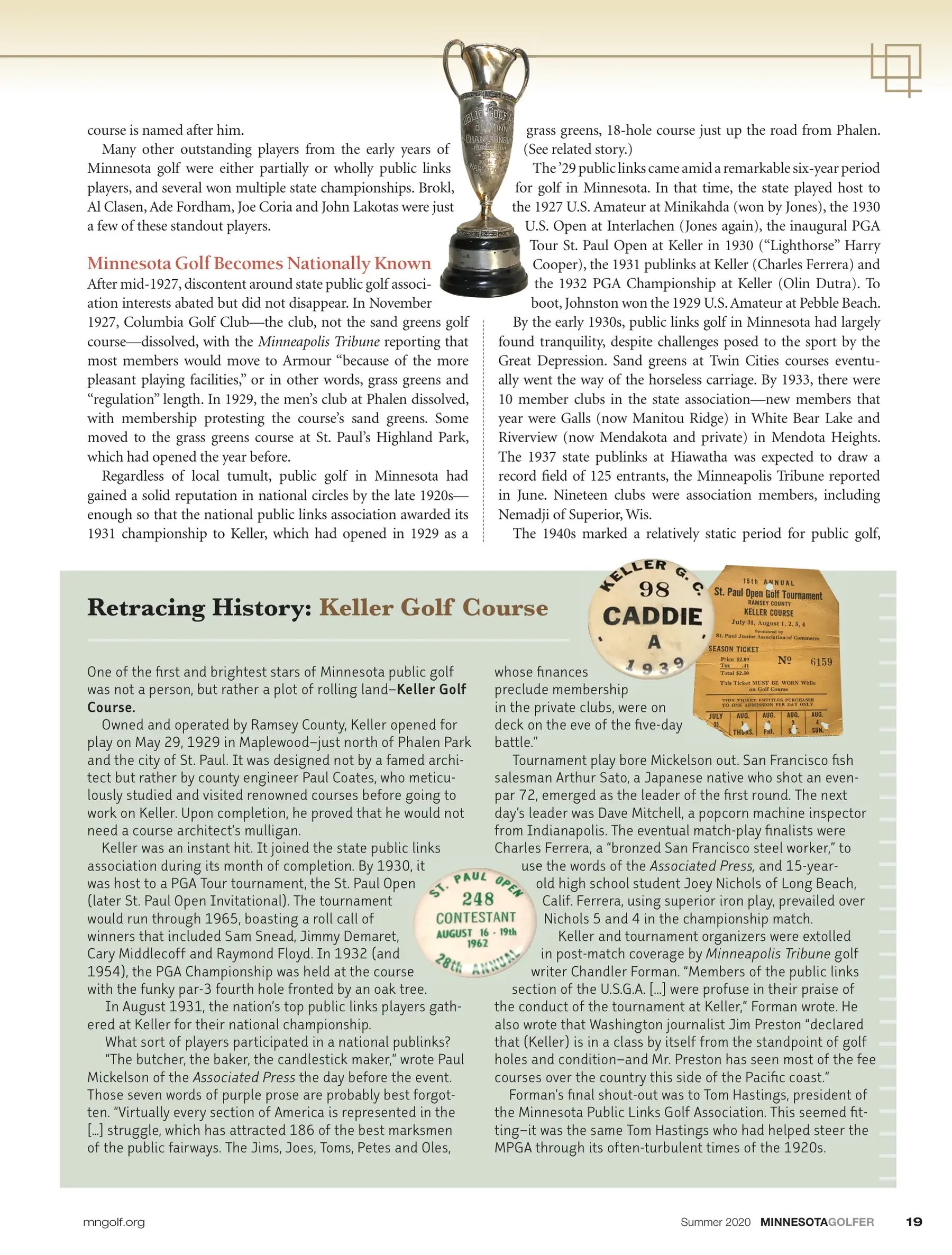
Keller was an instant hit. It joined the state public links association during its month of completion. By 1930, it was host to a PGA Tour tournament, the St. Paul Open (later St. Paul Open Invitational). The tournament would run through 1965, boasting a roll call of winners that included Sam Snead, Jimmy Demaret, Cary Middlecoff and Raymond Floyd. In 1932 (and 1954), the PGA Championship was held at the course with the funky par-3 fourth hole fronted by an oak tree.
In August 1931, the nation’s top public links players gathered at Keller for their national championship. What sort of players participated in a national publinks?
“The butcher, the baker, the candlestick maker,” wrote Paul Mickelson of the Associated Press the day before the event. Those seven words of purple prose are probably best forgotten. “Virtually every section of America is represented in the [...] struggle, which has attracted 186 of the best marksmen of the public fairways. The Jims, Joes, Toms, Petes and Oles, whose finances preclude membership in the private clubs, were on deck on the eve of the five-day battle.”
Tournament play bore Mickelson out. San Francisco fish salesman Arthur Sato, a Japanese native who shot an evenpar 72, emerged as the leader of the first round. The next day’s leader was Dave Mitchell, a popcorn machine inspector from Indianapolis. The eventual match-play finalists were Charles Ferrera, a “bronzed San Francisco steel worker,” to use the words of the Associated Press, and 15-yearold high school student Joey Nichols of Long Beach, Calif. Ferrera, using superior iron play, prevailed over Nichols 5 and 4 in the championship match.
Keller and tournament organizers were extolled in post-match coverage by Minneapolis Tribune golf writer Chandler Forman. “Members of the public links section of the U.S.G.A. [...] were profuse in their praise of the conduct of the tournament at Keller,” Forman wrote. He also wrote that Washington journalist Jim Preston “declared that (Keller) is in a class by itself from the standpoint of golf holes and condition—and Mr. Preston has seen most of the fee courses over the country this side of the Pacifi c coast.”
Forman’s final shout-out was to Tom Hastings, president of the Minnesota Public Links Golf Association. This seemed fitting—it was the same Tom Hastings who had helped steer the MPGA through its often-turbulent times of the 1920s.
Retracing History: Keller Golf Course Summer 2020 MINNESOTAGOLFER 19 in terms of oversight, and judging by daily newspaper coverage.
Meadowbrook in Minneapolis played host to the 1947 national championship, won by Wilfred Crossley. (Other national publinks were hosted by Gross in 1964, Bunker Hills in 1976, Edinburgh USA in 1992 and Rush Creek in 1994. The women’s national public links was held at Braemar in 1979.) Through the MPGA’s first three decades, barriers between it and the broader Minnesota Golf Association had been erected. The 1950s brought efforts to remove them. “During the middle ’50s, we sat down and got this thing organized a lot tighter,” former MGA president Warren Rebholz was quoted as saying in George E. Brown III’s book “100 Years of Minnesota Golf: Our Great Tradition.” “The smartest decision the [MGA] board made during those years was that there was not going to be any difference between a private club and a public club.
Everybody is a golfer and any club can join the organization.” Today, the Minnesota Public Golf Association is an all-volunteer, allied association of the MGA.
It serves about 80 member men’s clubs in the state, according to its website, and conducts state-level and inter-club competitions. The “Why Public Golf” entry on its home page concludes with this notion: “Public golf is a microcosm of society. You can get a game with all and sundry. Exclusivity is not a big item. The public golf course can be a melting pot not unlike the ideal of America.”
Joe Bissen is a copy editor at the Minneapolis Star Tribune and author of “Fore! Gone. Minnesota’s Lost Golf Courses, 1897-1999.” He has a second book on lost courses planned for release later this year.
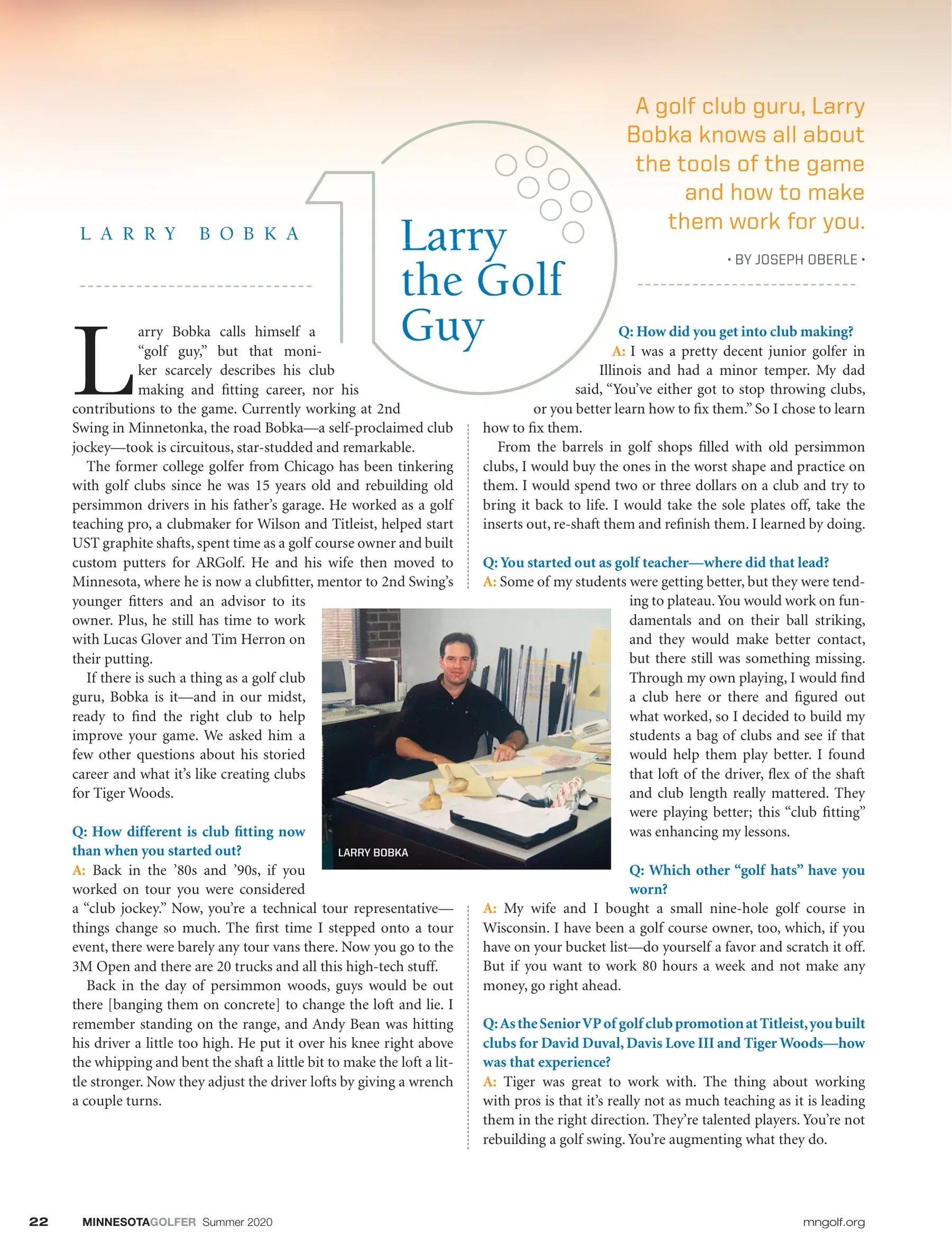
L arry Bobka calls himself a “golf guy,” but that moniker scarcely describes his club making and fitting career, nor his contributions to the game. Currently working at 2nd Swing in Minnetonka, the road Bobka—a self-proclaimed club jockey—took is circuitous, star-studded and remarkable.
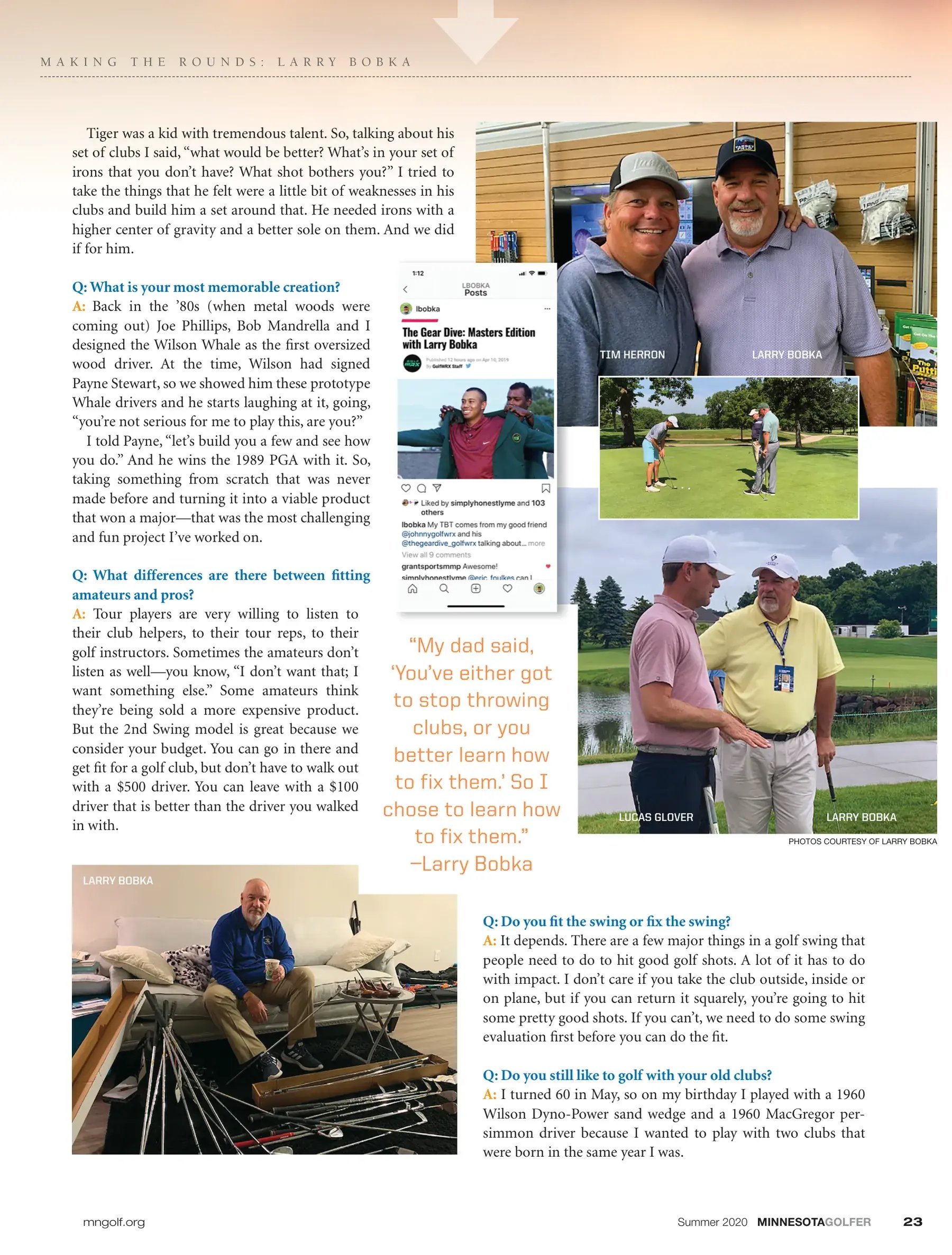
The former college golfer from Chicago has been tinkering with golf clubs since he was 15 years old and rebuilding old persimmon drivers in his father’s garage. He worked as a golf teaching pro, a clubmaker for Wilson and Titleist, helped start UST graphite shafts, spent time as a golf course owner and built custom putters for ARGolf. He and his wife then moved to Minnesota, where he is now a clubfi tter, mentor to 2nd Swing’s younger fitters and an advisor to its owner. Plus, he still has time to work with Lucas Glover and Tim Herron on their putting.
If there is such a thing as a golf club guru, Bobka is it—and in our midst, ready to find the right club to help improve your game. We asked him a few other questions about his storied career and what it’s like creating clubs for Tiger Woods.
Q: How different is club fitting now than when you started out? A: Back in the ’80s and ’90s, if you worked on tour you were considered a “club jockey.” Now, you’re a technical tour representative— things change so much. The first time I stepped onto a tour event, there were barely any tour vans there. Now you go to the 3M Open and there are 20 trucks and all this high-tech stuff.
Back in the day of persimmon woods, guys would be out there [banging them on concrete] to change the loft and lie. I remember standing on the range, and Andy Bean was hitting his driver a little too high. He put it over his knee right above the whipping and bent the shaft a little bit to make the loft a little stronger. Now they adjust the driver lofts by giving a wrench a couple turns.
Q: How did you get into club making? A: I was a pretty decent junior golfer in Illinois and had a minor temper. My dad said, “You’ve either got to stop throwing clubs, or you better learn how to fix them.” So I chose to learn how to fix them.
From the barrels in golf shops filled with old persimmon clubs, I would buy the ones in the worst shape and practice on them. I would spend two or three dollars on a club and try to bring it back to life. I would take the sole plates off, take the inserts out, re-shaft them and refi nish them. I learned by doing.
Q: You started out as golf teacher—where did that lead? A: Some of my students were getting better, but they were tending to plateau. You would work on fundamentals and on their ball striking, and they would make better contact, but there still was something missing.
Through my own playing, I would find a club here or there and figured out what worked, so I decided to build my students a bag of clubs and see if that would help them play better. I found that loft of the driver, flex of the shaft and club length really mattered. They were playing better; this “club fitting”
was enhancing my lessons. Q: Which other “golf hats” have you worn? A: My wife and I bought a small nine-hole golf course in Wisconsin. I have been a golf course owner, too, which, if you have on your bucket list—do yourself a favor and scratch it off.
But if you want to work 80 hours a week and not make any money, go right ahead. Q: As the Senior VP of golf club promotion at Titleist, you built clubs for David Duval, Davis Love III and Tiger Woods—how was that experience?
A: Tiger was great to work with. The thing about working with pros is that it’s really not as much teaching as it is leading them in the right direction. They’re talented players. You’re not rebuilding a golf swing. You’re augmenting what they do.
Q: What is your most memorable creation? A: Back in the ’80s (when metal woods were coming out) Joe Phillips, Bob Mandrella and I designed the Wilson Whale as the first oversized wood driver. At the time, Wilson had signed Payne Stewart, so we showed him these prototype Whale drivers and he starts laughing at it, going, “you’re not serious for me to play this, are you?”
I told Payne, “let’s build you a few and see how you do.” And he wins the 1989 PGA with it. So, taking something from scratch that was never made before and turning it into a viable product that won a major—that was the most challenging and fun project I’ve worked on.
Q: What differences are there between fitting amateurs and pros? A: Tour players are very willing to listen to their club helpers, to their tour reps, to their golf instructors. Sometimes the amateurs don’t listen as well—you know, “I don’t want that; I want something else.” Some amateurs think they’re being sold a more expensive product.
But the 2nd Swing model is great because we consider your budget. You can go in there and get fit for a golf club, but don’t have to walk out with a $500 driver. You can leave with a $100 driver that is better than the driver you walked in with.
Q: Do you fit the swing or fix the swing? A: It depends. There are a few major things in a golf swing that people need to do to hit good golf shots. A lot of it has to do with impact. I don’t care if you take the club outside, inside or on plane, but if you can return it squarely, you’re going to hit some pretty good shots. If you can’t, we need to do some swing evaluation first before you can do the fit.
Q: Do you still like to golf with your old clubs? A: I turned 60 in May, so on my birthday I played with a 1960 Wilson Dyno-Power sand wedge and a 1960 MacGregor persimmon driver because I wanted to play with two clubs that were born in the same year I was.
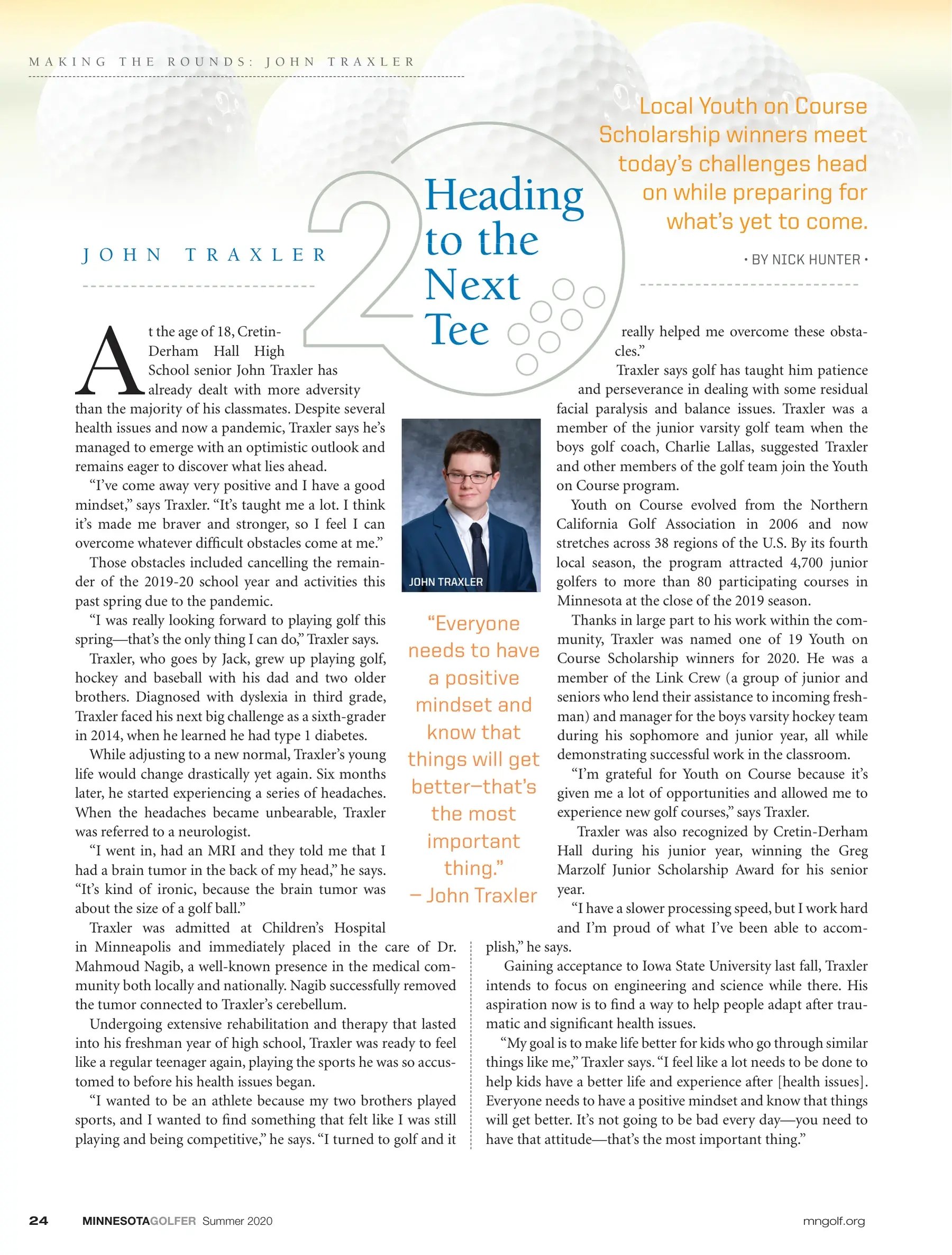
“My dad said, ‘You’ve either got to stop throwing clubs, or you better learn how to fix them.’ So I chose to learn how to fix them.” —Larry Bobka LARRY BOBKA TIM HERRON LARRY BOBKA LUCAS GLOVER LARRY BOBKA PHOTOS COURTESY OF LARRY BOBKA A t the age of 18, CretinDerham Hall High School senior John Traxler has already dealt with more adversity than the majority of his classmates. Despite several health issues and now a pandemic, Traxler says he’s managed to emerge with an optimistic outlook and remains eager to discover what lies ahead.
“I’ve come away very positive and I have a good mindset,” says Traxler. “It’s taught me a lot. I think it’s made me braver and stronger, so I feel I can overcome whatever diffi cult obstacles come at me.”
Those obstacles included cancelling the remainder of the 2019-20 school year and activities this past spring due to the pandemic. “I was really looking forward to playing golf this spring—that’s the only thing I can do,” Traxler says.
Traxler, who goes by Jack, grew up playing golf, hockey and baseball with his dad and two older brothers. Diagnosed with dyslexia in third grade, Traxler faced his next big challenge as a sixth-grader in 2014, when he learned he had type 1 diabetes.
While adjusting to a new normal, Traxler’s young life would change drastically yet again. Six months later, he started experiencing a series of headaches.
When the headaches became unbearable, Traxler was referred to a neurologist. “I went in, had an MRI and they told me that I had a brain tumor in the back of my head,” he says.
“It’s kind of ironic, because the brain tumor was about the size of a golf ball.” Traxler was admitted at Children’s Hospital in Minneapolis and immediately placed in the care of Dr.
Mahmoud Nagib, a well-known presence in the medical community both locally and nationally. Nagib successfully removed the tumor connected to Traxler’s cerebellum.
Undergoing extensive rehabilitation and therapy that lasted into his freshman year of high school, Traxler was ready to feel like a regular teenager again, playing the sports he was so accustomed to before his health issues began.
“I wanted to be an athlete because my two brothers played sports, and I wanted to find something that felt like I was still playing and being competitive,” he says. “I turned to golf and it really helped me overcome these obstacles.”
Traxler says golf has taught him patience and perseverance in dealing with some residual facial paralysis and balance issues. Traxler was a member of the junior varsity golf team when the boys golf coach, Charlie Lallas, suggested Traxler and other members of the golf team join the Youth on Course program.
Youth on Course evolved from the Northern California Golf Association in 2006 and now stretches across 38 regions of the U.S. By its fourth local season, the program attracted 4,700 junior golfers to more than 80 participating courses in Minnesota at the close of the 2019 season.
Thanks in large part to his work within the community, Traxler was named one of 19 Youth on Course Scholarship winners for 2020. He was a member of the Link Crew (a group of junior and seniors who lend their assistance to incoming freshman) and manager for the boys varsity hockey team during his sophomore and junior year, all while demonstrating successful work in the classroom.
“I’m grateful for Youth on Course because it’s given me a lot of opportunities and allowed me to experience new golf courses,” says Traxler. Traxler was also recognized by Cretin-Derham Hall during his junior year, winning the Greg Marzolf Junior Scholarship Award for his senior year.
“I have a slower processing speed, but I work hard and I’m proud of what I’ve been able to accomplish,” he says. Gaining acceptance to Iowa State University last fall, Traxler intends to focus on engineering and science while there. His aspiration now is to find a way to help people adapt after traumatic and signifi cant health issues.
“My goal is to make life better for kids who go through similar things like me,” Traxler says. “I feel like a lot needs to be done to help kids have a better life and experience after [health issues].
Everyone needs to have a positive mindset and know that things will get better. It’s not going to be bad every day—you need to have that attitude—that’s the most important thing.”
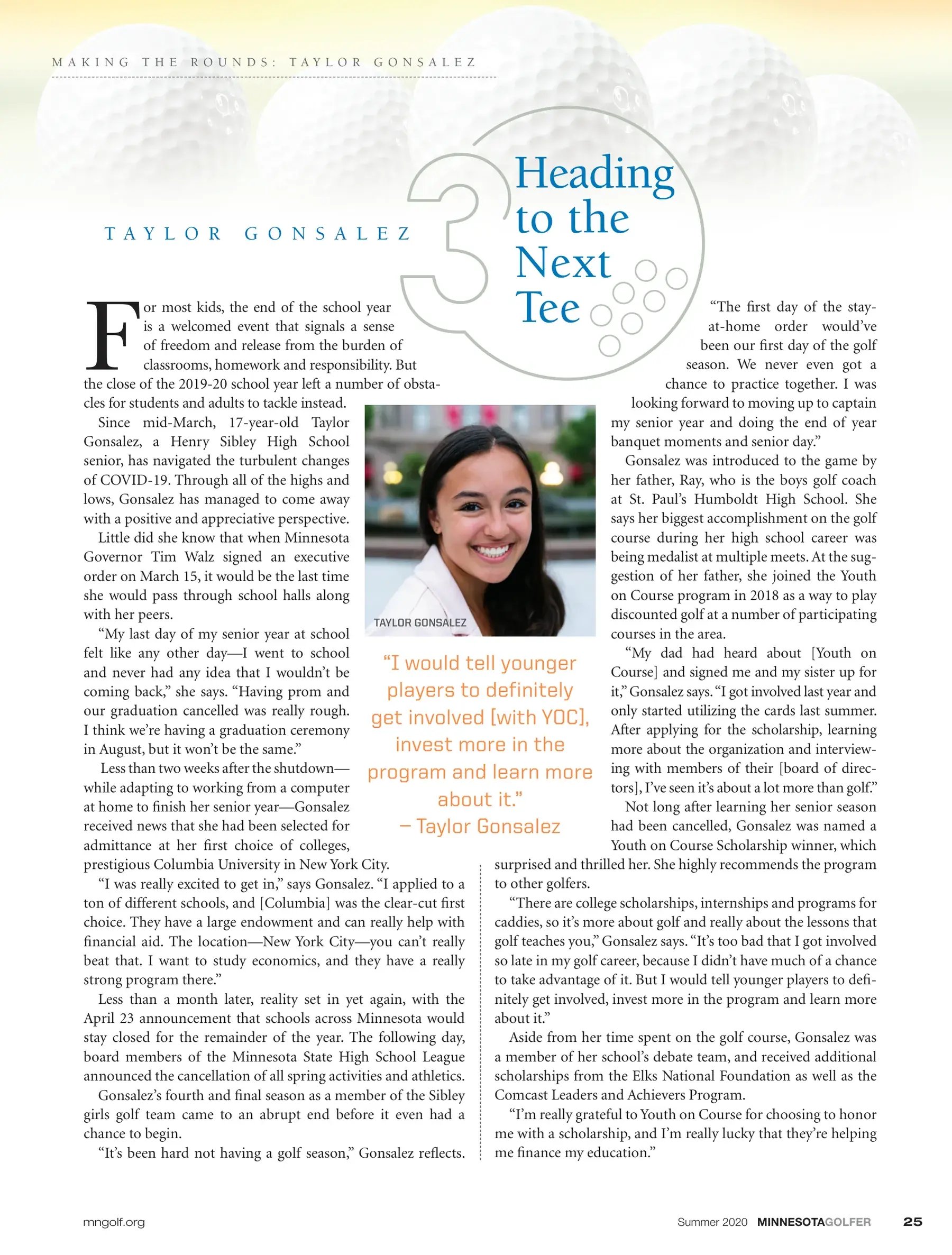
Since mid-March, 17-year-old Taylor Gonsalez, a Henry Sibley High School senior, has navigated the turbulent changes of COVID-19. Through all of the highs and lows, Gonsalez has managed to come away with a positive and appreciative perspective.
Little did she know that when Minnesota Governor Tim Walz signed an executive order on March 15, it would be the last time she would pass through school halls along with her peers.
“My last day of my senior year at school felt like any other day—I went to school and never had any idea that I wouldn’t be coming back,” she says. “Having prom and our graduation cancelled was really rough.
I think we’re having a graduation ceremony in August, but it won’t be the same.” Less than two weeks after the shutdown— while adapting to working from a computer at home to finish her senior year—Gonsalez received news that she had been selected for admittance at her first choice of colleges, prestigious Columbia University in New York City.
“I was really excited to get in,” says Gonsalez. “I applied to a ton of different schools, and [Columbia] was the clear-cut first choice. They have a large endowment and can really help with financial aid. The location—New York City—you can’t really beat that. I want to study economics, and they have a really strong program there.”
Less than a month later, reality set in yet again, with the April 23 announcement that schools across Minnesota would stay closed for the remainder of the year. The following day, board members of the Minnesota State High School League announced the cancellation of all spring activities and athletics.
Gonsalez’s fourth and final season as a member of the Sibley girls golf team came to an abrupt end before it even had a chance to begin. “It’s been hard not having a golf season,” Gonsalez refl ects.
“The first day of the stayat-home order would’ve been our first day of the golf season. We never even got a chance to practice together. I was looking forward to moving up to captain my senior year and doing the end of year banquet moments and senior day.”
Gonsalez was introduced to the game by her father, Ray, who is the boys golf coach at St. Paul’s Humboldt High School. She says her biggest accomplishment on the golf course during her high school career was being medalist at multiple meets. At the suggestion of her father, she joined the Youth on Course program in 2018 as a way to play discounted golf at a number of participating courses in the area.
“My dad had heard about [Youth on Course] and signed me and my sister up for it,” Gonsalez says. “I got involved last year and only started utilizing the cards last summer.
After applying for the scholarship, learning more about the organization and interviewing with members of their [board of directors], I’ve seen it’s about a lot more than golf.”
Not long after learning her senior season had been cancelled, Gonsalez was named a Youth on Course Scholarship winner, which surprised and thrilled her. She highly recommends the program to other golfers.
“There are college scholarships, internships and programs for caddies, so it’s more about golf and really about the lessons that golf teaches you,” Gonsalez says. “It’s too bad that I got involved so late in my golf career, because I didn’t have much of a chance to take advantage of it. But I would tell younger players to defi - nitely get involved, invest more in the program and learn more about it.”
Aside from her time spent on the golf course, Gonsalez was a member of her school’s debate team, and received additional scholarships from the Elks National Foundation as well as the Comcast Leaders and Achievers Program.
“I’m really grateful to Youth on Course for choosing to honor me with a scholarship, and I’m really lucky that they’re helping me finance my education.”
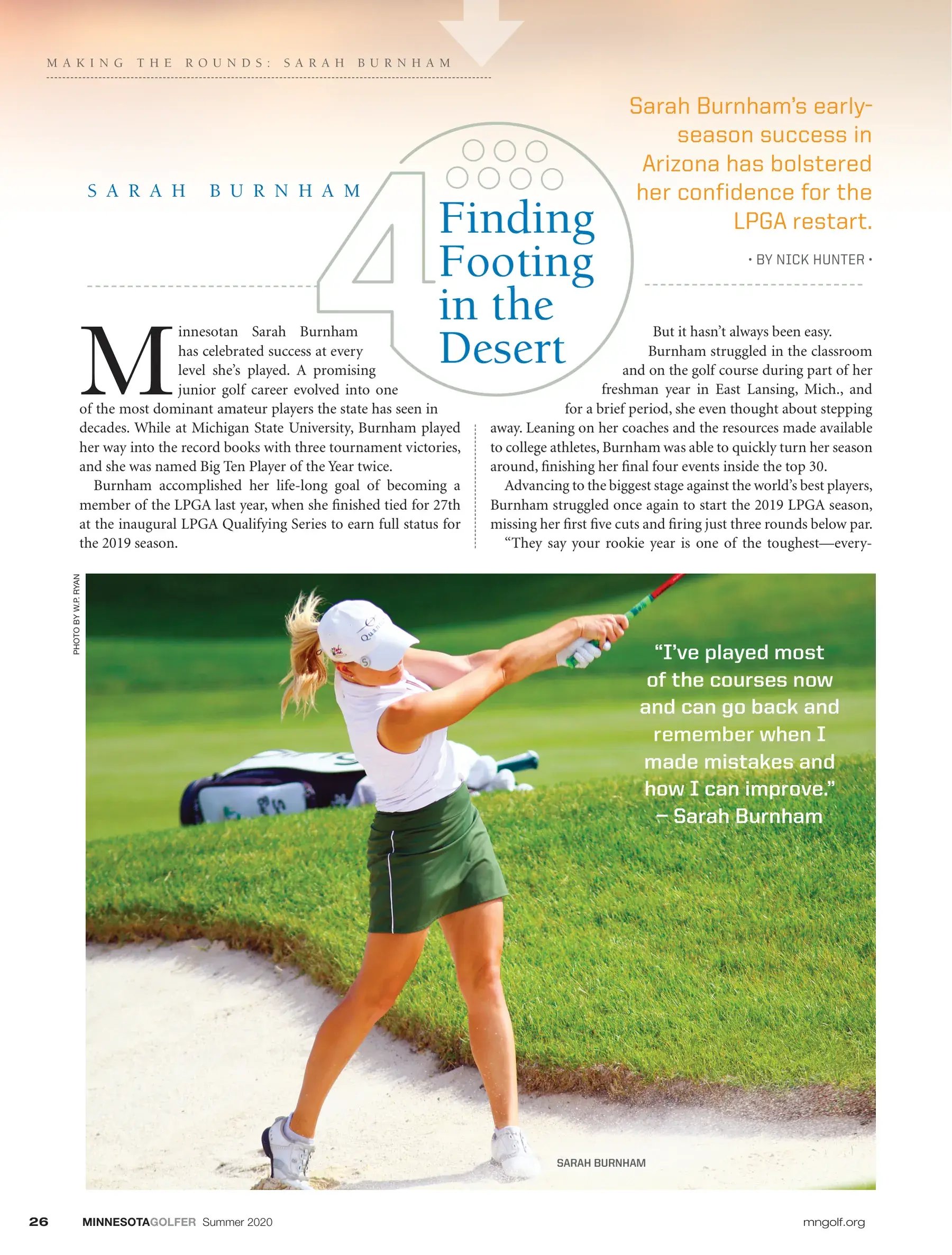
Next Tee “I would tell younger players to definitely get involved [with YOC], invest more in the program and learn more about it.” — Taylor Gonsalez TAYLOR GONSALEZ M innesotan Sarah Burnham has celebrated success at every level she’s played. A promising junior golf career evolved into one of the most dominant amateur players the state has seen in decades. While at Michigan State University, Burnham played her way into the record books with three tournament victories, and she was named Big Ten Player of the Year twice.
Burnham accomplished her life-long goal of becoming a member of the LPGA last year, when she finished tied for 27th at the inaugural LPGA Qualifying Series to earn full status for the 2019 season.
But it hasn’t always been easy. Burnham struggled in the classroom and on the golf course during part of her freshman year in East Lansing, Mich., and for a brief period, she even thought about stepping away. Leaning on her coaches and the resources made available to college athletes, Burnham was able to quickly turn her season around, finishing her final four events inside the top 30.
Advancing to the biggest stage against the world’s best players, Burnham struggled once again to start the 2019 LPGA season, missing her first five cuts and firing just three rounds below par.
“They say your rookie year is one of the toughest—everyg Footing in the Desert Sarah Burnham’s earlyseason success in Arizona has bolstered her confidence for the LPGA restart.
— Sarah Burnham SARAH BURNHAM PHOTO BY W.P. RYAN Summer 2020 MINNESOTAGOLFER 27 thing is new, the courses are new again,” says Burnham. “I just wanted to experience as much as I could, get through the year and learn for the upcoming season.”
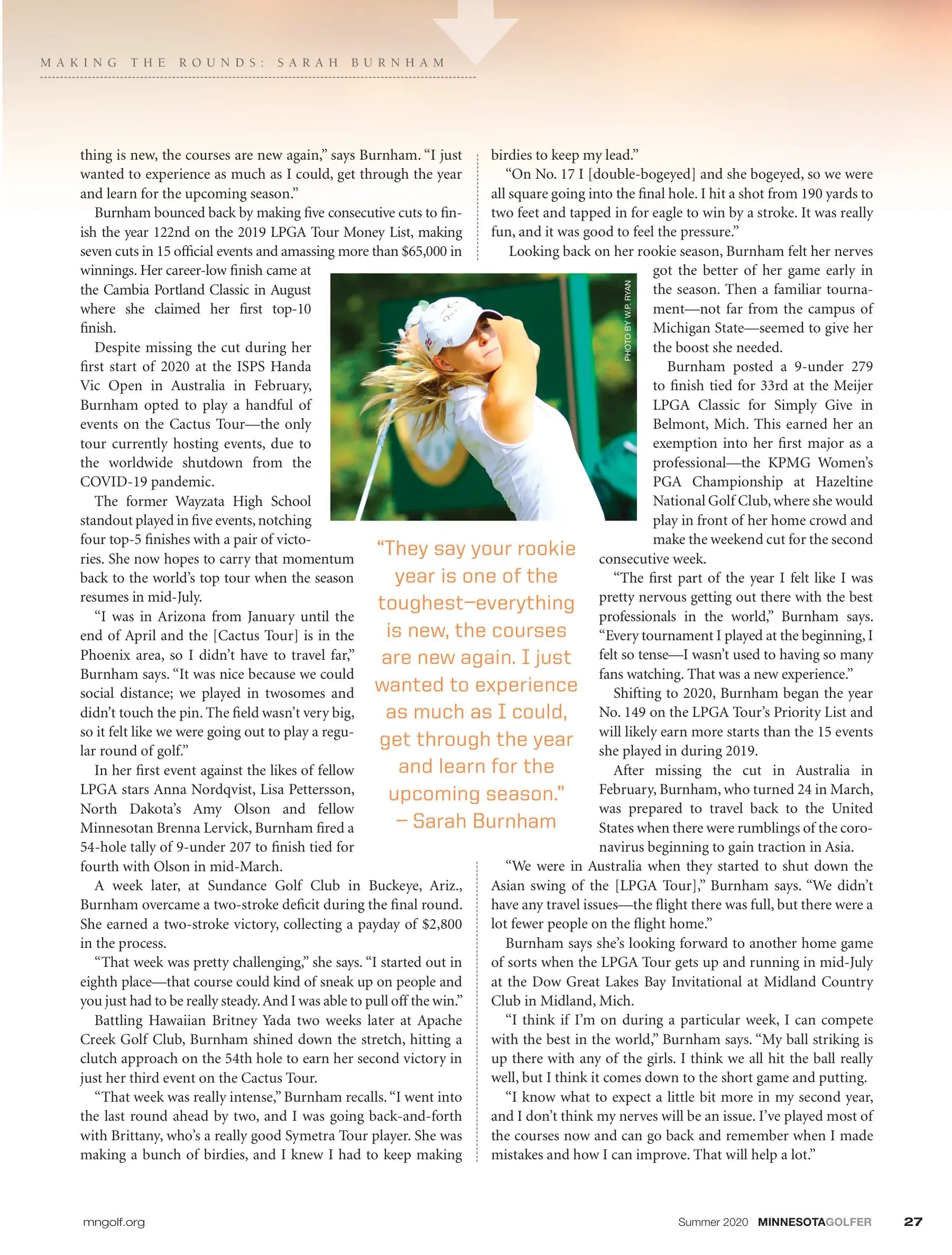
Burnham bounced back by making five consecutive cuts to finish the year 122nd on the 2019 LPGA Tour Money List, making seven cuts in 15 offi cial events and amassing more than $65,000 in winnings. Her career-low finish came at the Cambia Portland Classic in August where she claimed her first top-10 finish.
Despite missing the cut during her first start of 2020 at the ISPS Handa Vic Open in Australia in February, Burnham opted to play a handful of events on the Cactus Tour—the only tour currently hosting events, due to the worldwide shutdown from the COVID-19 pandemic.
The former Wayzata High School standout played in five events, notching four top-5 finishes with a pair of victories. She now hopes to carry that momentum back to the world’s top tour when the season resumes in mid-July.
“I was in Arizona from January until the end of April and the [Cactus Tour] is in the Phoenix area, so I didn’t have to travel far,” Burnham says. “It was nice because we could social distance; we played in twosomes and didn’t touch the pin. The field wasn’t very big, so it felt like we were going out to play a regular round of golf.”
In her first event against the likes of fellow LPGA stars Anna Nordqvist, Lisa Pettersson, North Dakota’s Amy Olson and fellow Minnesotan Brenna Lervick, Burnham fired a 54-hole tally of 9-under 207 to finish tied for fourth with Olson in mid-March.
A week later, at Sundance Golf Club in Buckeye, Ariz., Burnham overcame a two-stroke defi cit during the final round. She earned a two-stroke victory, collecting a payday of $2,800 in the process.
“That week was pretty challenging,” she says. “I started out in eighth place—that course could kind of sneak up on people and you just had to be really steady. And I was able to pull off the win.”
Battling Hawaiian Britney Yada two weeks later at Apache Creek Golf Club, Burnham shined down the stretch, hitting a clutch approach on the 54th hole to earn her second victory in just her third event on the Cactus Tour.
“That week was really intense,” Burnham recalls. “I went into the last round ahead by two, and I was going back-and-forth with Brittany, who’s a really good Symetra Tour player. She was making a bunch of birdies, and I knew I had to keep making birdies to keep my lead.”
“On No. 17 I [double-bogeyed] and she bogeyed, so we were all square going into the final hole. I hit a shot from 190 yards to two feet and tapped in for eagle to win by a stroke. It was really fun, and it was good to feel the pressure.”
Looking back on her rookie season, Burnham felt her nerves got the better of her game early in the season. Then a familiar tournament—not far from the campus of Michigan State—seemed to give her the boost she needed.