




Summer 2021


















Back to The Minnesota Golfer Archive
Read the text of this issue
Text from the printed pages, so it can be searched and read by screen readers. Layout and photography are in the reader above.
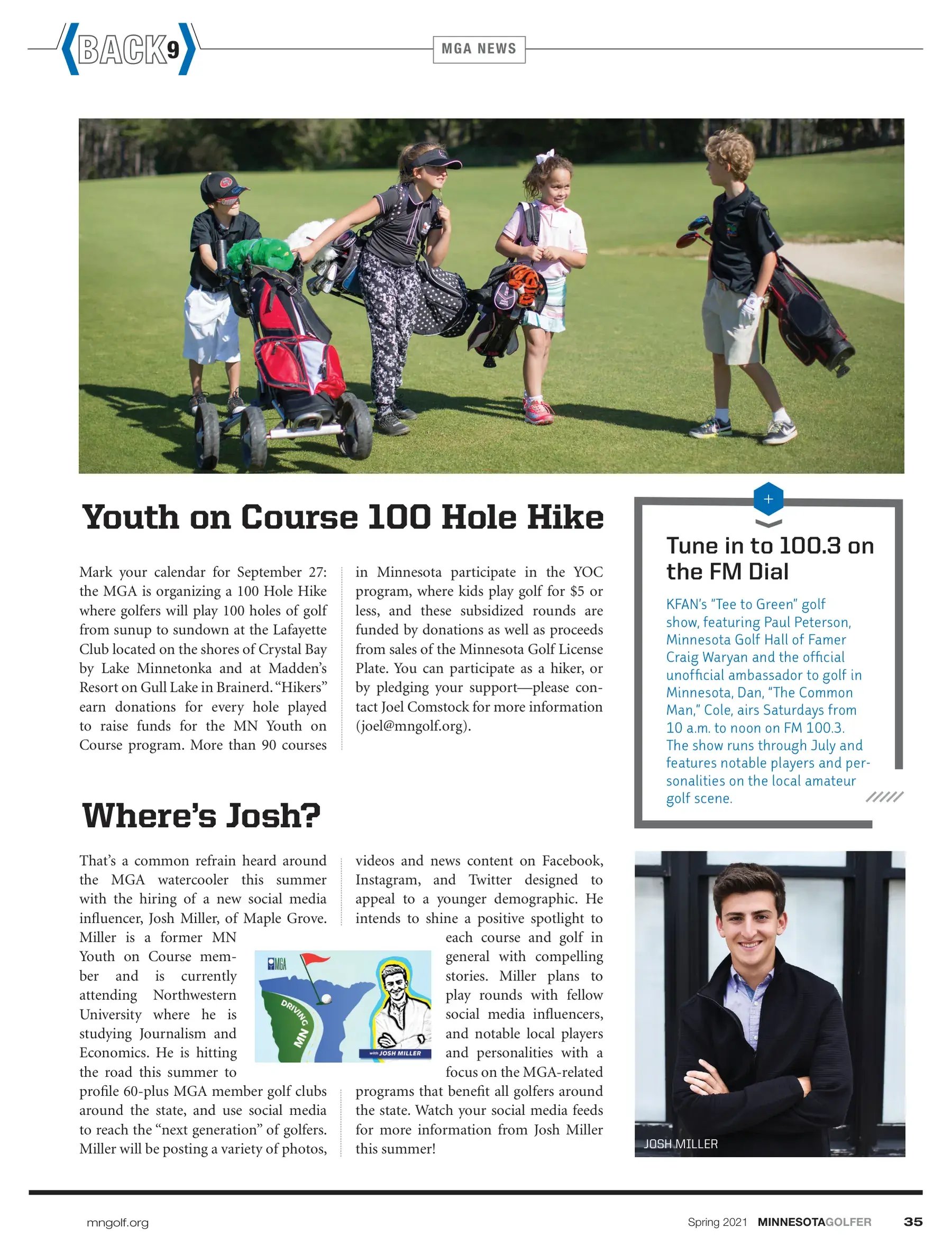
MGA is now mobile. Smartphone owners will find web content displayed in a mobilefriendly format, while MGA members who log in with their GHIN ID and last name will be able to post scores, search for courses by “nearest” location, and follow live scoring during MGA and USGA events.
22 | GREAT GOLF VIEWING By Joseph Oberle A preview of several big tournaments in the area for fans to attend this season. 26 | COVID GOLF RESPONSE 2.0 By W.P. Ryan What COVID concessions we can expect to remain in golf going forward.
28 | GOLF TALES By Joseph Oberle How the Smiths of Detroit Lakes are building a Minnesota golf legacy. Getting your handicap index revision via email?
Subscriptions: Regular U.S. one year (4 issues) $18. Directory issue of Minnesota Golfer: $9.95 plus shipping, pre-paid. Other single copies: $2.95 per copy plus shipping, pre-paid.
Copyright © 2021 MGA The MGA upholds and promotes the game of golf and its values for all golfers in Minnesota. Minnesota Golf Association Inc.
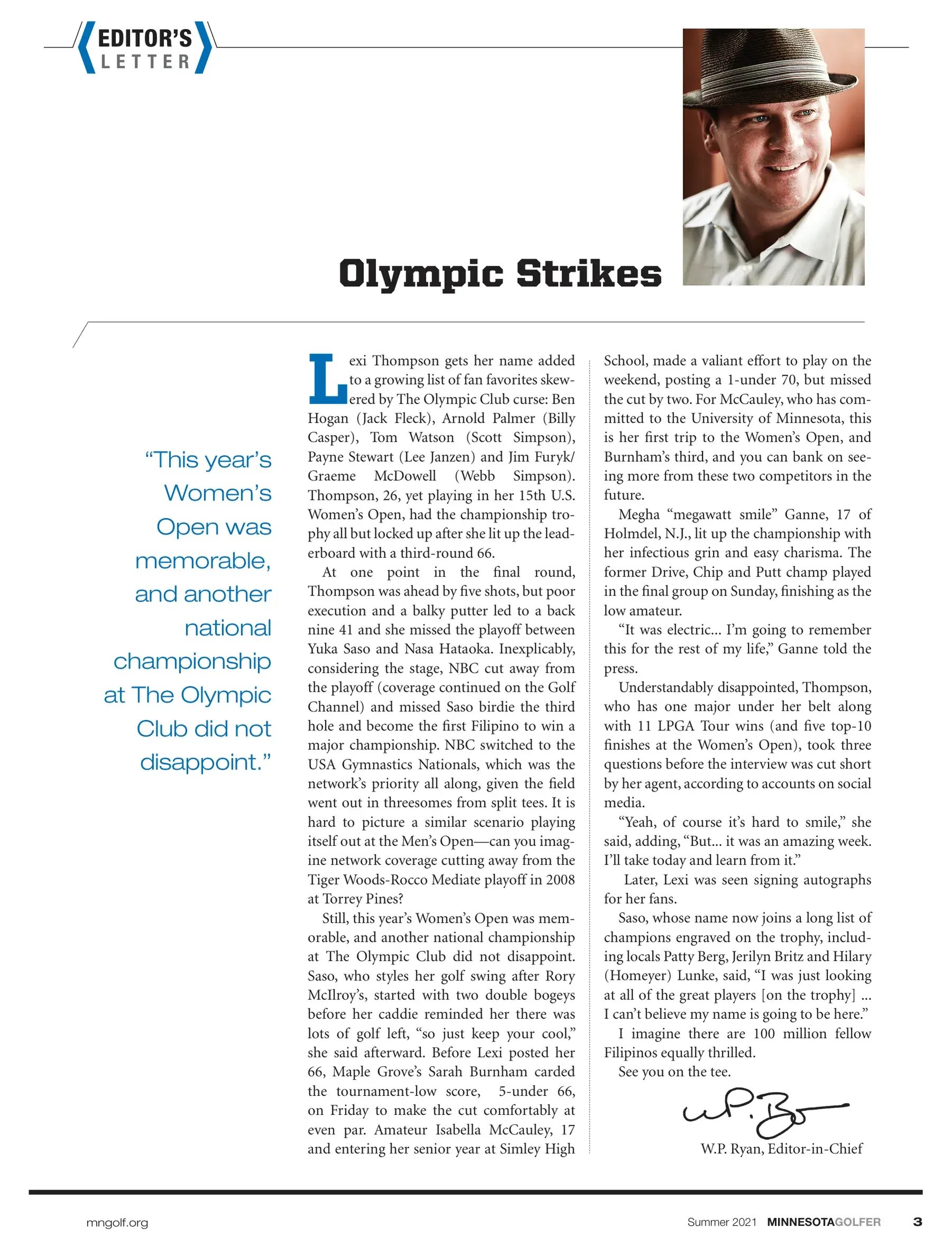
Legislative Counsel McGrann Shea Carnival Straughn & Lamb, Chartered OFFICE Volume 49, Number 3 Summer 2021 L exi Thompson gets her name added to a growing list of fan favorites skewered by The Olympic Club curse: Ben Hogan (Jack Fleck), Arnold Palmer (Billy Casper), Tom Watson (Scott Simpson), Payne Stewart (Lee Janzen) and Jim Furyk/ Graeme McDowell (Webb Simpson).
Thompson, 26, yet playing in her 15th U.S. Women’s Open, had the championship trophy all but locked up after she lit up the leaderboard with a third-round 66.
At one point in the final round, Thompson was ahead by five shots, but poor execution and a balky putter led to a back nine 41 and she missed the playoff between Yuka Saso and Nasa Hataoka. Inexplicably, considering the stage, NBC cut away from the playoff (coverage continued on the Golf Channel) and missed Saso birdie the third hole and become the first Filipino to win a major championship. NBC switched to the USA Gymnastics Nationals, which was the network’s priority all along, given the field went out in threesomes from split tees. It is hard to picture a similar scenario playing itself out at the Men’s Open—can you imagine network coverage cutting away from the Tiger Woods-Rocco Mediate playoff in 2008 at Torrey Pines?
Still, this year’s Women’s Open was memorable, and another national championship at The Olympic Club did not disappoint. Saso, who styles her golf swing after Rory McIlroy’s, started with two double bogeys before her caddie reminded her there was lots of golf left, “so just keep your cool,”
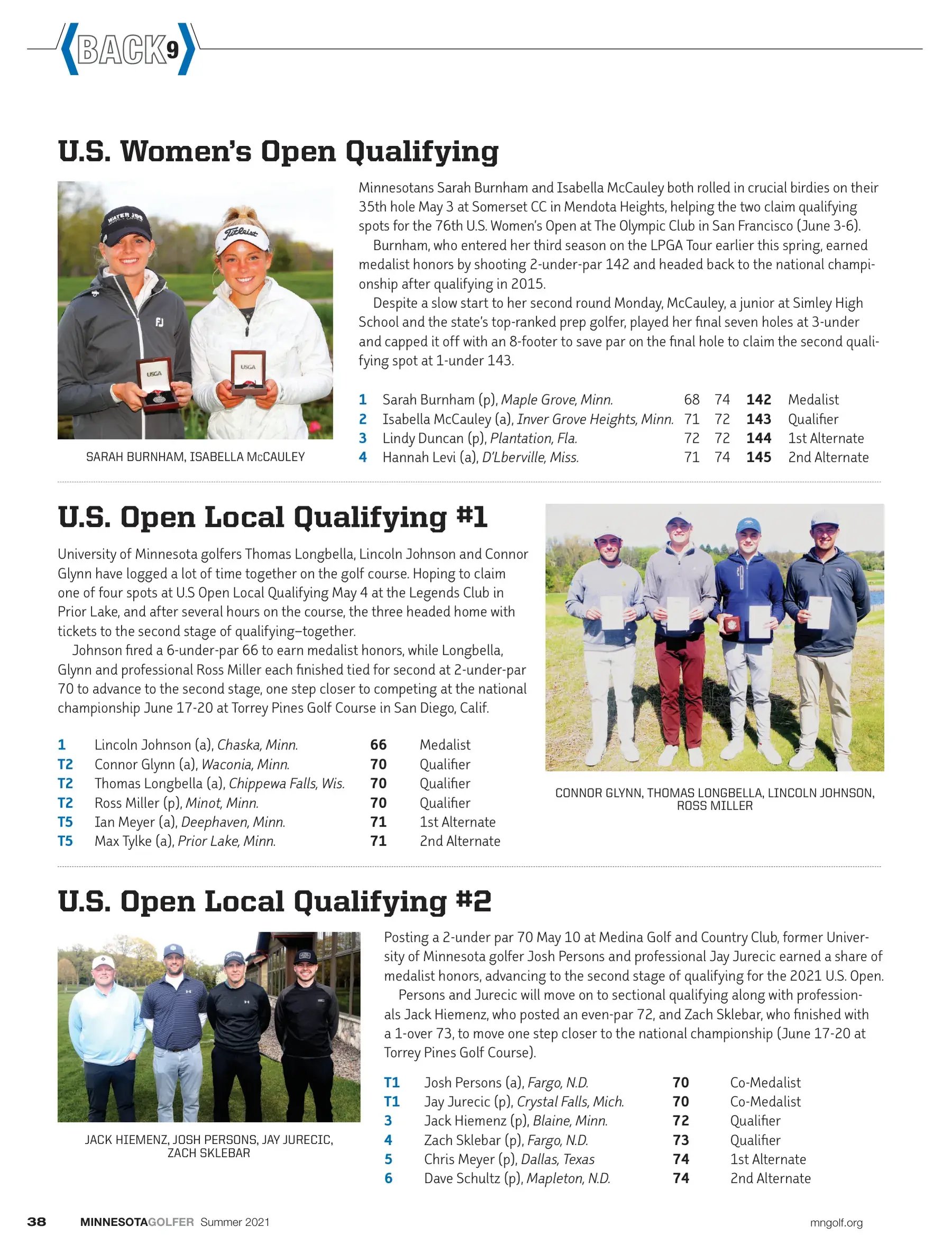
she said afterward. Before Lexi posted her 66, Maple Grove’s Sarah Burnham carded the tournament-low score, 5-under 66, on Friday to make the cut comfortably at even par. Amateur Isabella McCauley, 17 and entering her senior year at Simley High School, made a valiant effort to play on the weekend, posting a 1-under 70, but missed the cut by two. For McCauley, who has committed to the University of Minnesota, this is her first trip to the Women’s Open, and Burnham’s third, and you can bank on seeing more from these two competitors in the future.
Megha “megawatt smile” Ganne, 17 of Holmdel, N.J., lit up the championship with her infectious grin and easy charisma. The former Drive, Chip and Putt champ played in the final group on Sunday, finishing as the low amateur.
“It was electric... I’m going to remember this for the rest of my life,” Ganne told the press. Understandably disappointed, Thompson, who has one major under her belt along with 11 LPGA Tour wins (and five top-10 finishes at the Women’s Open), took three questions before the interview was cut short by her agent, according to accounts on social media.
“Yeah, of course it’s hard to smile,” she said, adding, “But... it was an amazing week. I’ll take today and learn from it.” Later, Lexi was seen signing autographs for her fans.
Saso, whose name now joins a long list of champions engraved on the trophy, including locals Patty Berg, Jerilyn Britz and Hilary (Homeyer) Lunke, said, “I was just looking at all of the great players [on the trophy] ...
Mike Davis, CEO of the USGA, often says USGA championships provide inspiration to golfers and nongolfers alike. While he focused on how the championships motivate people to take up or improve their game, I believe the stories of golfers at the highest level can also inspire us in more ways beyond the golf course.
Amy Olson of Fargo found herself just one shot off the lead after three rounds of the U.S. Women’s Open at the Champions Club in Houston this past December. That evening, she received the news that her father-in-law had passed away suddenly. Her husband, who had traveled to Houston to follow her, rushed home the next morning to be with family. Amy stayed to finish competing, playing that final round with the loss clearly on her mind. She played very well, and only a late charge by A Lim Kim kept her from victory in the world’s most prestigious women’s championship.
But more impressive than her play was how she handled herself in the postround interviews. Everyone wanted to know how she was able to play so well under those circumstances.
She referenced her faith, the love and support of her family back home, and her fellow competitors, who supported her throughout the day. She did each interview with grace, humility, and with a calmness and clarity that was too impressive for words.
I wasn’t inspired to play golf that day, or go work on my game, but instead remember having a tremendous sense of pride to be associated with a game that can produce a story with such power and impact, highlighting life’s highs and lows. Amy Olson has every quality we admire in people that play golf.
Now fast forward to the story of Bella McCauley, a high school junior, who recently qualifi ed for the U.S. Women’s Open at The Olympic Club in San Francisco, at 17 years, three months and 27 days old, the youngest Minnesotan to ever qualify.
While her golf was inspiring, birdieing three of her last seven holes along with a clutch 8-foot par putt on the 18th hole to earn her spot, how she handled herself over the next few days doing interviews and TV spots was equally impressive.
In a Star Tribune article following her qualifying, Bella talked about being inspired herself. As a 12-year-old, she won a 13-15 age group event and said of the win, “that was against all my peers, people I looked up to. I was able to do well under pressure ... it gave me a lot of confi dence.”
Just as she was once inspired, I’m quite certain Bella and her obvious skill and love of the game will inspire many young girls to work on improving their games; to “be like” Bella.
We’re fortunate to play a game where inspiration can come from anywhere, from anyone, and in many different ways. It’s more than the skill at which people play, but the character of those who play, that not only gives us the enthusiasm to improve, but more importantly, to be better as a person.
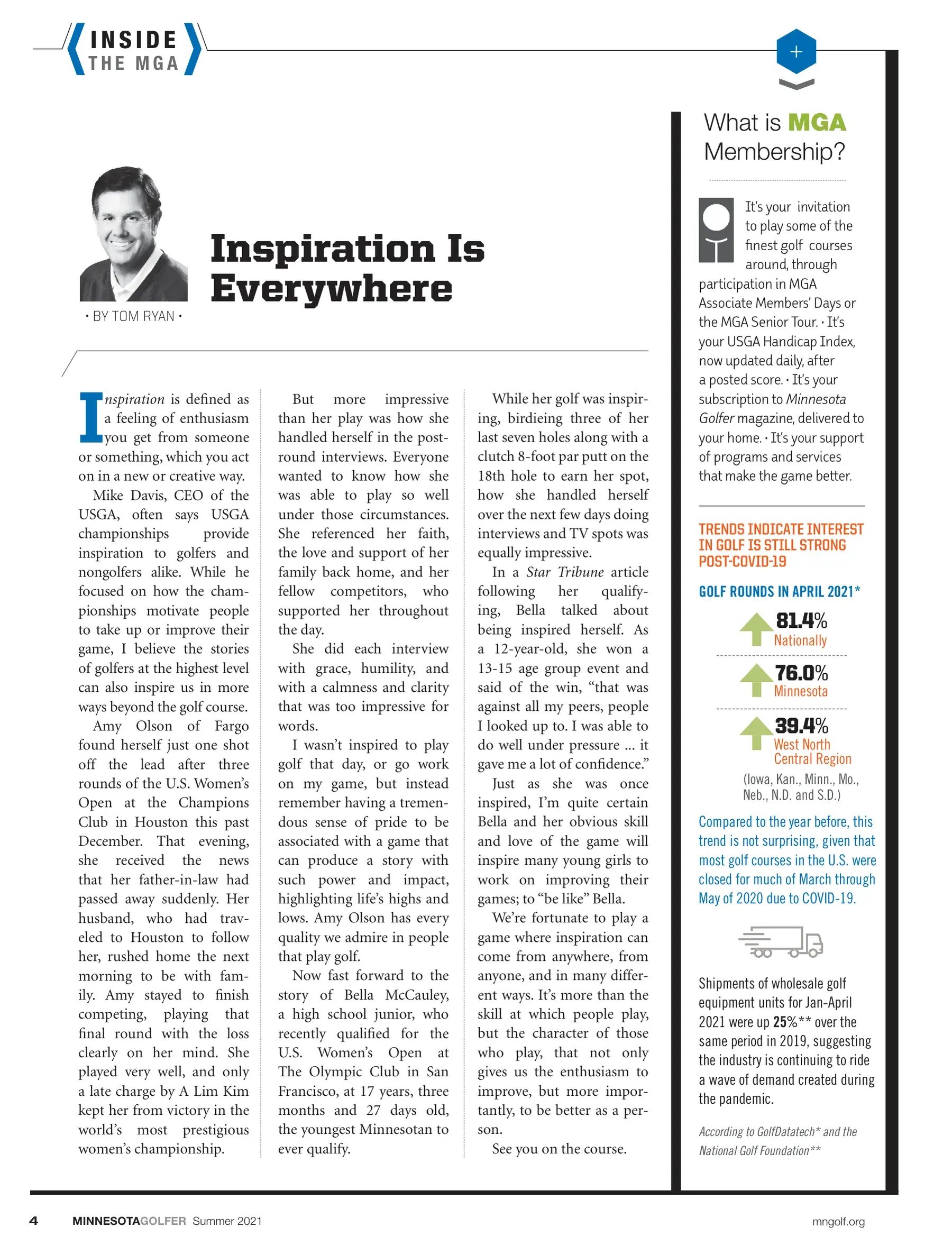
• BY TOM RYAN • Inspiration Is Everywhere TRENDS INDICATE INTEREST IN GOLF IS STILL STRONG POST-COVID-19 GOLF ROUNDS IN APRIL 2021* 81.4% Nationally 76.0% Minnesota 39.4% West North Central Region (Iowa, Kan., Minn., Mo., Neb., N.D. and S.D.) Compared to the year before, this trend is not surprising, given that most golf courses in the U.S. were closed for much of March through May of 2020 due to COVID-19.
Shipments of wholesale golf equipment units for Jan-April 2021 were up 25%** over the same period in 2019, suggesting the industry is continuing to ride a wave of demand created during the pandemic.
According to GolfDatatech* and the National Golf Foundation** G olf course superintendents’ jobs are dependent upon the weather. If rain and shine are ample, balanced, and timely, all is generally well for growing grass.
Geographic location is a factor, too, and knowing Minnesota’s unpredictable weather patterns (particularly during challenging summer months) is important.
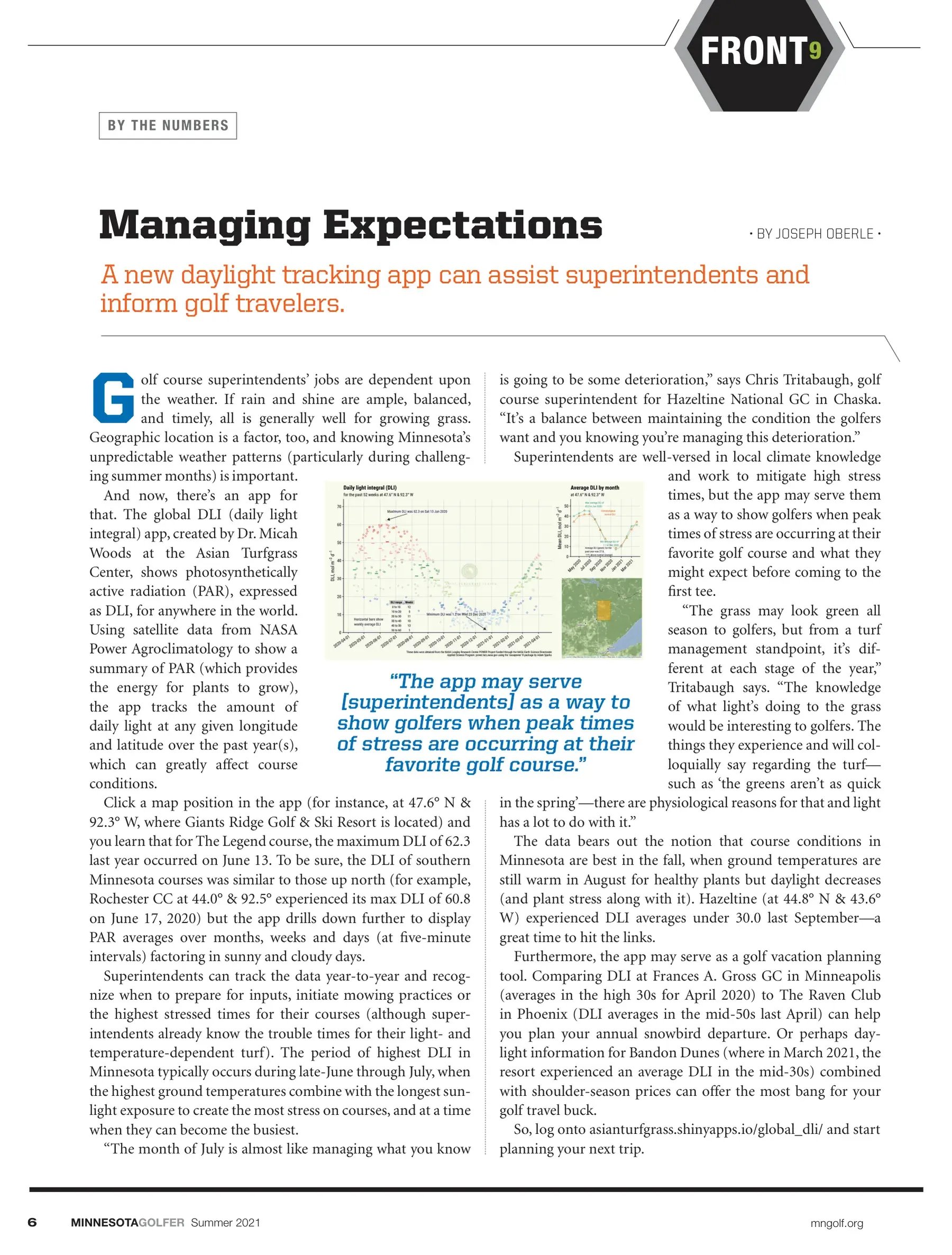
And now, there’s an app for that. The global DLI (daily light integral) app, created by Dr. Micah Woods at the Asian Turfgrass Center, shows photosynthetically active radiation (PAR), expressed as DLI, for anywhere in the world.
Using satellite data from NASA Power Agroclimatology to show a summary of PAR (which provides the energy for plants to grow), the app tracks the amount of daily light at any given longitude and latitude over the past year(s), which can greatly affect course conditions.
Click a map position in the app (for instance, at 47.6° N & 92.3° W, where Giants Ridge Golf & Ski Resort is located) and you learn that for The Legend course, the maximum DLI of 62.3 last year occurred on June 13. To be sure, the DLI of southern Minnesota courses was similar to those up north (for example, Rochester CC at 44.0° & 92.5° experienced its max DLI of 60.8 on June 17, 2020) but the app drills down further to display PAR averages over months, weeks and days (at five-minute intervals) factoring in sunny and cloudy days.
Superintendents can track the data year-to-year and recognize when to prepare for inputs, initiate mowing practices or the highest stressed times for their courses (although superintendents already know the trouble times for their light- and temperature-dependent turf). The period of highest DLI in Minnesota typically occurs during late-June through July, when the highest ground temperatures combine with the longest sunlight exposure to create the most stress on courses, and at a time when they can become the busiest.
“The month of July is almost like managing what you know is going to be some deterioration,” says Chris Tritabaugh, golf course superintendent for Hazeltine National GC in Chaska.
“It’s a balance between maintaining the condition the golfers want and you knowing you’re managing this deterioration.” Superintendents are well-versed in local climate knowledge and work to mitigate high stress times, but the app may serve them as a way to show golfers when peak times of stress are occurring at their favorite golf course and what they might expect before coming to the first tee.
“The grass may look green all season to golfers, but from a turf management standpoint, it’s different at each stage of the year,” Tritabaugh says. “The knowledge of what light’s doing to the grass would be interesting to golfers. The things they experience and will colloquially say regarding the turf— such as ‘the greens aren’t as quick in the spring’—there are physiological reasons for that and light has a lot to do with it.”
The data bears out the notion that course conditions in Minnesota are best in the fall, when ground temperatures are still warm in August for healthy plants but daylight decreases (and plant stress along with it). Hazeltine (at 44.8° N & 43.6° W) experienced DLI averages under 30.0 last September—a great time to hit the links.
Furthermore, the app may serve as a golf vacation planning tool. Comparing DLI at Frances A. Gross GC in Minneapolis (averages in the high 30s for April 2020) to The Raven Club in Phoenix (DLI averages in the mid-50s last April) can help you plan your annual snowbird departure. Or perhaps daylight information for Bandon Dunes (where in March 2021, the resort experienced an average DLI in the mid-30s) combined with shoulder-season prices can offer the most bang for your golf travel buck.
So, log onto asianturfgrass.shinyapps.io/global_dli/ and start planning your next trip. Managing Expectations A new daylight tracking app can assist superintendents and inform golf travelers.
• BY JOSEPH OBERLE • FRONT “The app may serve [superintendents] as a way to show golfers when peak times of stress are occurring at their favorite golf course.”
The greens challenge visitors with their disparity in size, slope and undulation, while the thick trees stand in silent warning against spraying the ball.
The round begins with a five-tee par 5 that doglegs slightly to the left. A strong and straight 300-yard tee shot carries the creek that bisects the fairway before the dogleg.
With a sloping green, protected by a bunker on the right and marshland on the left, it’s best to leave the approach shot 80-90 yards short. For big hitters trying to get home in two, trust head pro, Gary Yeager: “The safe play is to hook around the pines.”
Walking away with a par is a victory to start your round. —Rachel Blauert GREAT DRIVES Mesaba Country Club Hibbing | No. 1 » par 5 » 465–492 yards Opened 1921 | Architect Holm & Olson Landscaping | Superintendent Jake Curtiss Head Professional Gary Yeager | Course Record 64 | World Record Rounds Played in a Season—679 in 2006 by John Furin at age 65 “It’s a really good opening hole because it allows an easy par.”
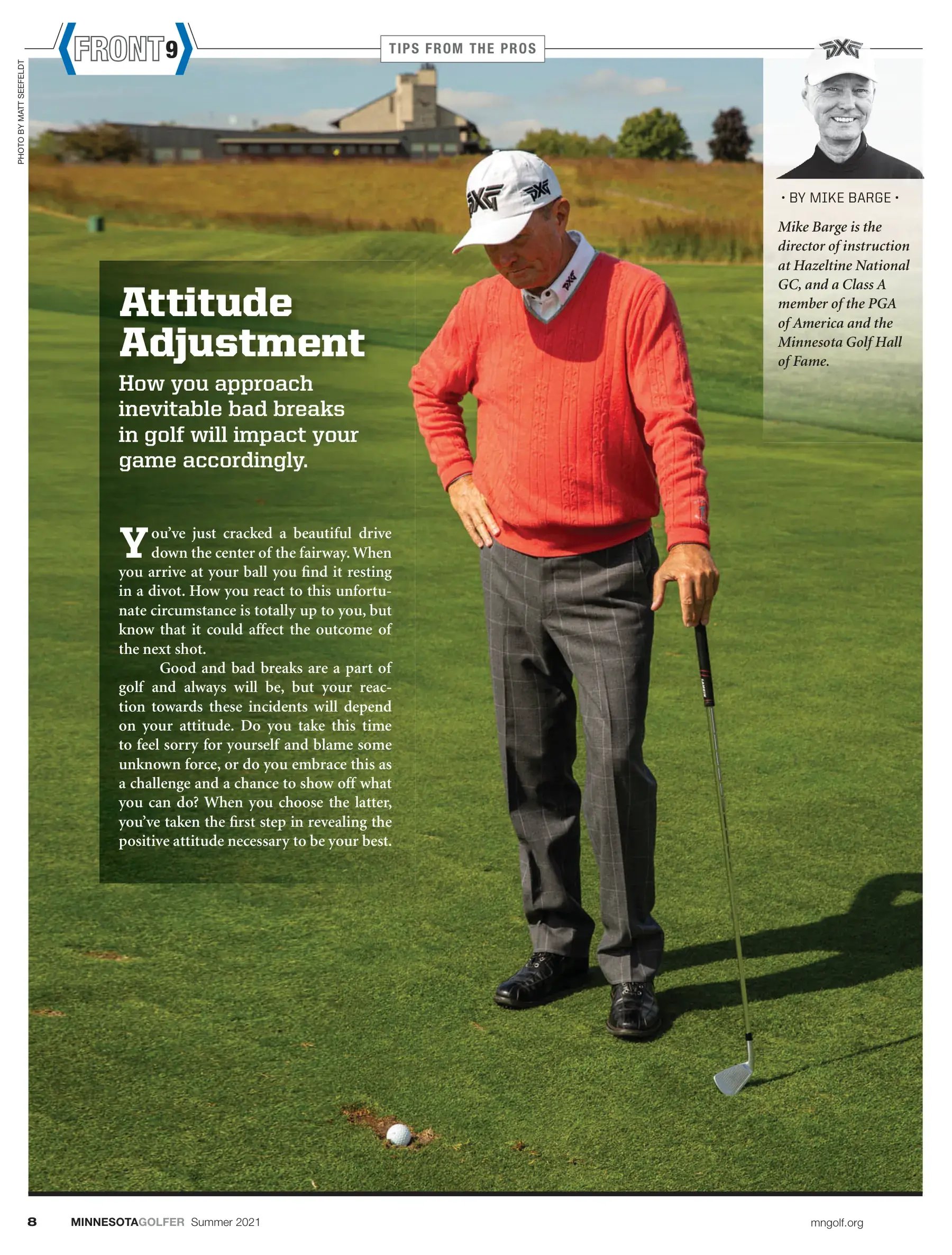
Attitude Adjustment Y ou’ve just cracked a beautiful drive down the center of the fairway. When you arrive at your ball you find it resting in a divot. How you react to this unfortunate circumstance is totally up to you, but know that it could affect the outcome of the next shot.
Good and bad breaks are a part of golf and always will be, but your reaction towards these incidents will depend on your attitude. Do you take this time to feel sorry for yourself and blame some unknown force, or do you embrace this as a challenge and a chance to show off what you can do? When you choose the latter, you’ve taken the first step in revealing the positive attitude necessary to be your best.
How you approach inevitable bad breaks in golf will impact your game accordingly. HOLE HI K E The Great Stake Debate RULES PRIMER Another look at our old familiar Rules for red and yellow markers on penalty areas.
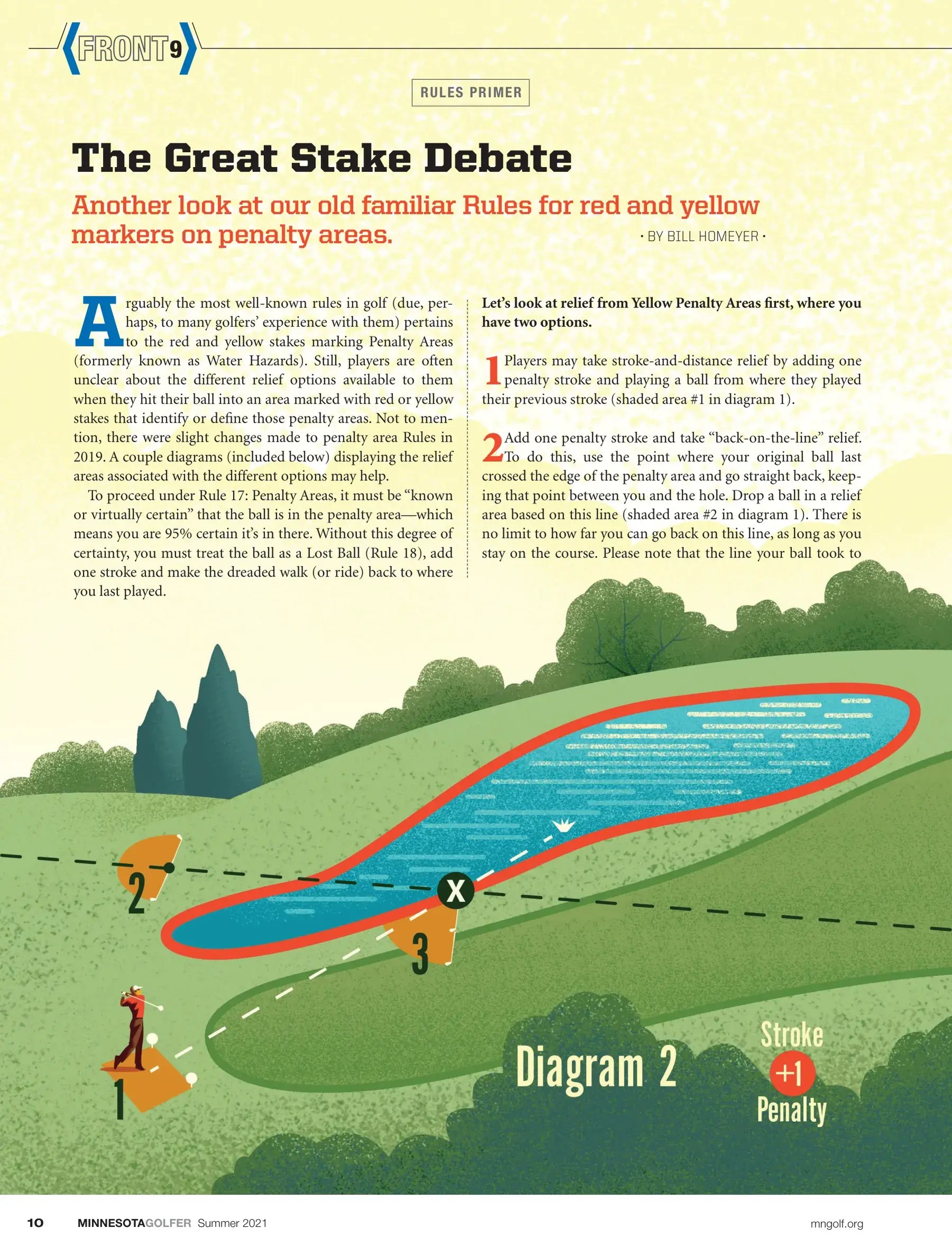
A rguably the most well-known rules in golf (due, perhaps, to many golfers’ experience with them) pertains to the red and yellow stakes marking Penalty Areas (formerly known as Water Hazards). Still, players are often unclear about the different relief options available to them when they hit their ball into an area marked with red or yellow stakes that identify or define those penalty areas. Not to mention, there were slight changes made to penalty area Rules in 2019. A couple diagrams (included below) displaying the relief areas associated with the different options may help.
To proceed under Rule 17: Penalty Areas, it must be “known or virtually certain” that the ball is in the penalty area—which means you are 95% certain it’s in there. Without this degree of certainty, you must treat the ball as a Lost Ball (Rule 18), add one stroke and make the dreaded walk (or ride) back to where you last played.
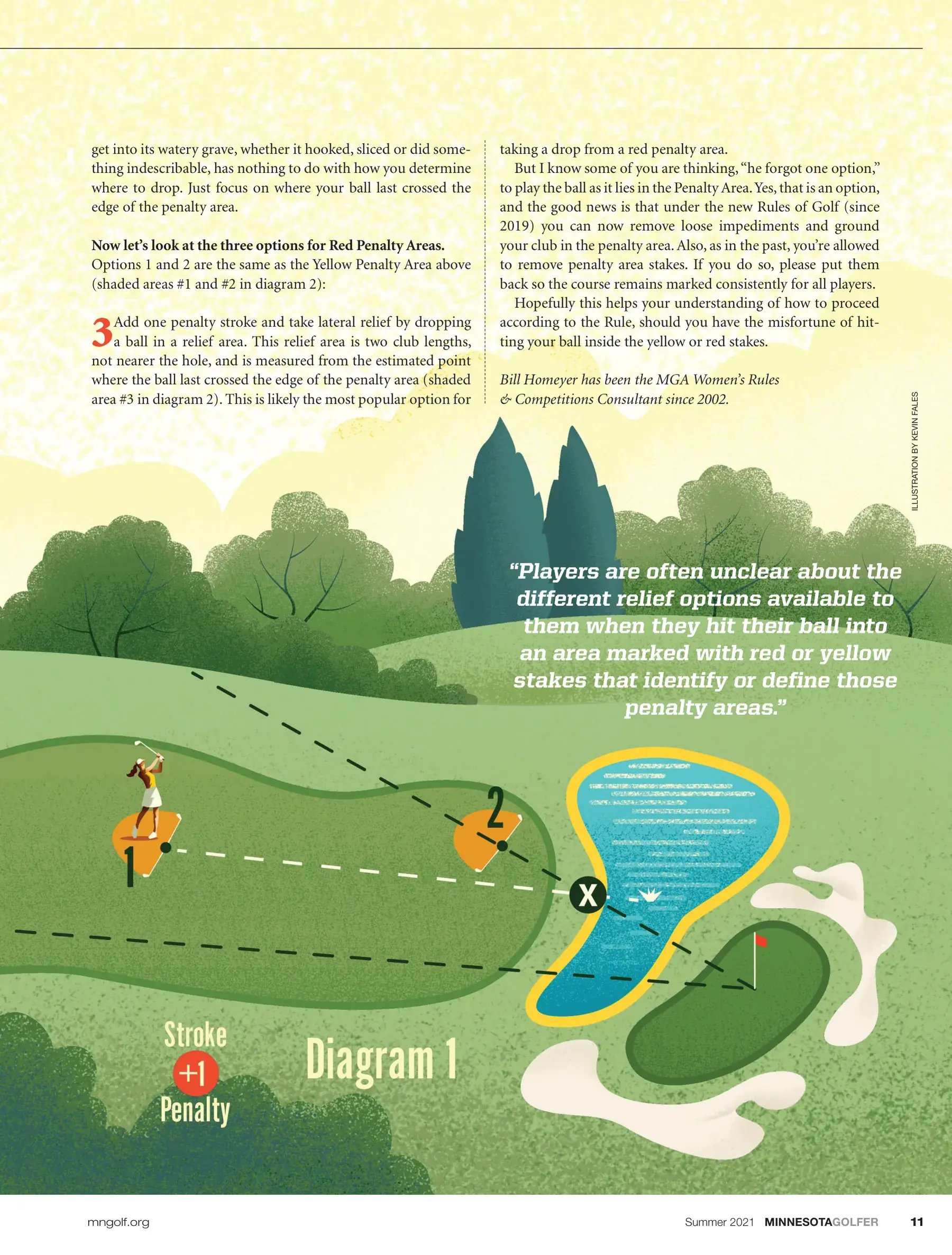
Let’s look at relief from Yellow Penalty Areas first, where you have two options. Players may take stroke-and-distance relief by adding one penalty stroke and playing a ball from where they played their previous stroke (shaded area #1 in diagram 1).
Add one penalty stroke and take “back-on-the-line” relief. To do this, use the point where your original ball last crossed the edge of the penalty area and go straight back, keeping that point between you and the hole. Drop a ball in a relief area based on this line (shaded area #2 in diagram 1). There is no limit to how far you can go back on this line, as long as you stay on the course. Please note that the line your ball took to • BY BILL HOMEYER • get into its watery grave, whether it hooked, sliced or did something indescribable, has nothing to do with how you determine where to drop. Just focus on where your ball last crossed the edge of the penalty area.
Now let’s look at the three options for Red Penalty Areas. Options 1 and 2 are the same as the Yellow Penalty Area above (shaded areas #1 and #2 in diagram 2): Add one penalty stroke and take lateral relief by dropping a ball in a relief area. This relief area is two club lengths, not nearer the hole, and is measured from the estimated point where the ball last crossed the edge of the penalty area (shaded area #3 in diagram 2). This is likely the most popular option for taking a drop from a red penalty area.
But I know some of you are thinking, “he forgot one option,” to play the ball as it lies in the Penalty Area. Yes, that is an option, and the good news is that under the new Rules of Golf (since 2019) you can now remove loose impediments and ground your club in the penalty area. Also, as in the past, you’re allowed to remove penalty area stakes. If you do so, please put them back so the course remains marked consistently for all players.
Hopefully this helps your understanding of how to proceed according to the Rule, should you have the misfortune of hitting your ball inside the yellow or red stakes.
Bill Homeyer has been the MGA Women’s Rules & Competitions Consultant since 2002. “Players are often unclear about the different relief options available to them when they hit their ball into an area marked with red or yellow stakes that identify or define those penalty areas.”
Summer 2021 MINNESOTAGOLFER 11 ILLUSTRATION BY KEVIN FALES GOLF CLUB Experience Deacon’s Lodge Named in honor of Arnolds Father “Deek” by Arnold, with 18 championship holes equally deserving of signature status, Deacons Lodge is a must play when visiting the Brainerd lakes area.
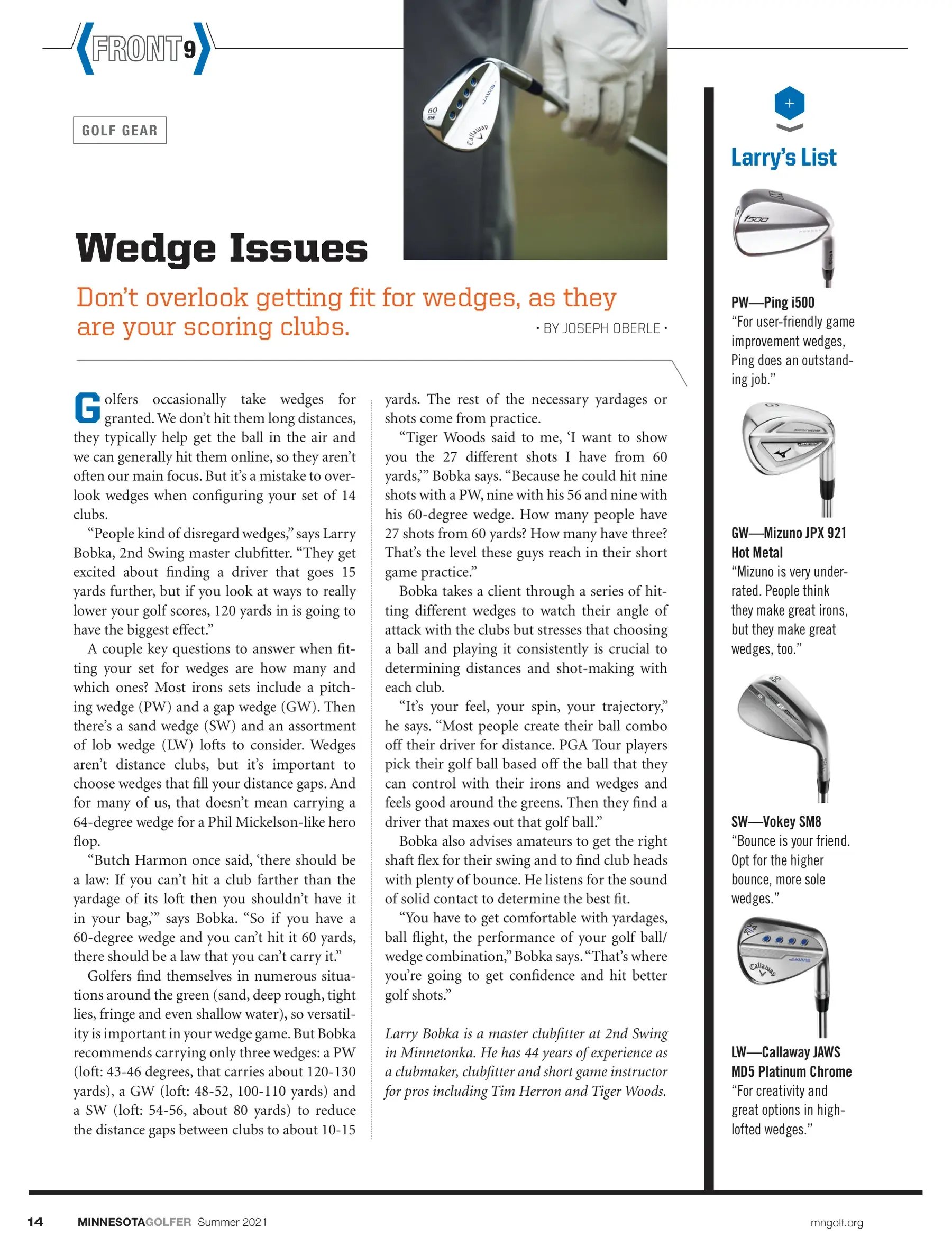
PW—Ping i500 “For user-friendly game improvement wedges, Ping does an outstanding job.” GW—Mizuno JPX 921 Hot Metal “Mizuno is very underrated. People think they make great irons, but they make great wedges, too.”
SW—Vokey SM8 “Bounce is your friend. Opt for the higher bounce, more sole wedges.” LW—Callaway JAWS MD5 Platinum Chrome “For creativity and great options in highlofted wedges.”
Larry’s List • BY JOSEPH OBERLE • G olfers occasionally take wedges for granted. We don’t hit them long distances, they typically help get the ball in the air and we can generally hit them online, so they aren’t often our main focus. But it’s a mistake to overlook wedges when configuring your set of 14 clubs.
“People kind of disregard wedges,” says Larry Bobka, 2nd Swing master clubfitter. “They get excited about finding a driver that goes 15 yards further, but if you look at ways to really lower your golf scores, 120 yards in is going to have the biggest effect.”
A couple key questions to answer when fitting your set for wedges are how many and which ones? Most irons sets include a pitching wedge (PW) and a gap wedge (GW). Then there’s a sand wedge (SW) and an assortment of lob wedge (LW) lofts to consider. Wedges aren’t distance clubs, but it’s important to choose wedges that fill your distance gaps. And for many of us, that doesn’t mean carrying a 64-degree wedge for a Phil Mickelson-like hero flop.
“Butch Harmon once said, ‘there should be a law: If you can’t hit a club farther than the yardage of its loft then you shouldn’t have it in your bag,’” says Bobka. “So if you have a 60-degree wedge and you can’t hit it 60 yards, there should be a law that you can’t carry it.”
Golfers find themselves in numerous situations around the green (sand, deep rough, tight lies, fringe and even shallow water), so versatility is important in your wedge game. But Bobka recommends carrying only three wedges: a PW (loft: 43-46 degrees, that carries about 120-130 yards), a GW (loft: 48-52, 100-110 yards) and a SW (loft: 54-56, about 80 yards) to reduce the distance gaps between clubs to about 10-15 yards. The rest of the necessary yardages or shots come from practice.
“Tiger Woods said to me, ‘I want to show you the 27 different shots I have from 60 yards,’” Bobka says. “Because he could hit nine shots with a PW, nine with his 56 and nine with his 60-degree wedge. How many people have 27 shots from 60 yards? How many have three?
That’s the level these guys reach in their short game practice.” Bobka takes a client through a series of hitting different wedges to watch their angle of attack with the clubs but stresses that choosing a ball and playing it consistently is crucial to determining distances and shot-making with each club.
“It’s your feel, your spin, your trajectory,” he says. “Most people create their ball combo off their driver for distance. PGA Tour players pick their golf ball based off the ball that they can control with their irons and wedges and feels good around the greens. Then they find a driver that maxes out that golf ball.”
Bobka also advises amateurs to get the right shaft flex for their swing and to find club heads with plenty of bounce. He listens for the sound of solid contact to determine the best fit.
“You have to get comfortable with yardages, ball flight, the performance of your golf ball/ wedge combination,” Bobka says. “That’s where you’re going to get confidence and hit better golf shots.”
Larry Bobka is a master clubfitter at 2nd Swing in Minnetonka. He has 44 years of experience as a clubmaker, clubfitter and short game instructor for pros including Tim Herron and Tiger Woods.
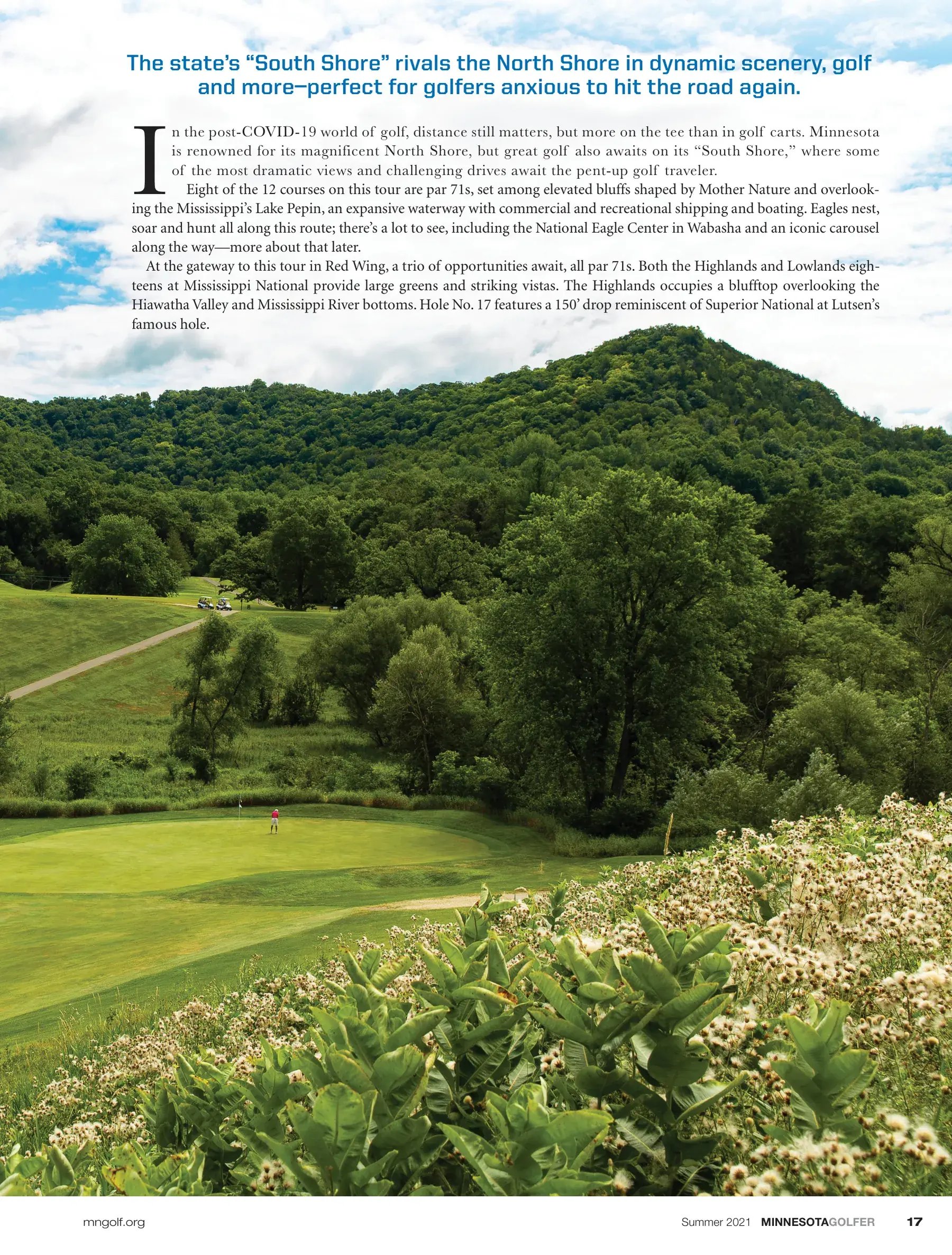
Eight of the 12 courses on this tour are par 71s, set among elevated bluffs shaped by Mother Nature and overlooking the Mississippi’s Lake Pepin, an expansive waterway with commercial and recreational shipping and boating. Eagles nest, soar and hunt all along this route; there’s a lot to see, including the National Eagle Center in Wabasha and an iconic carousel along the way—more about that later.
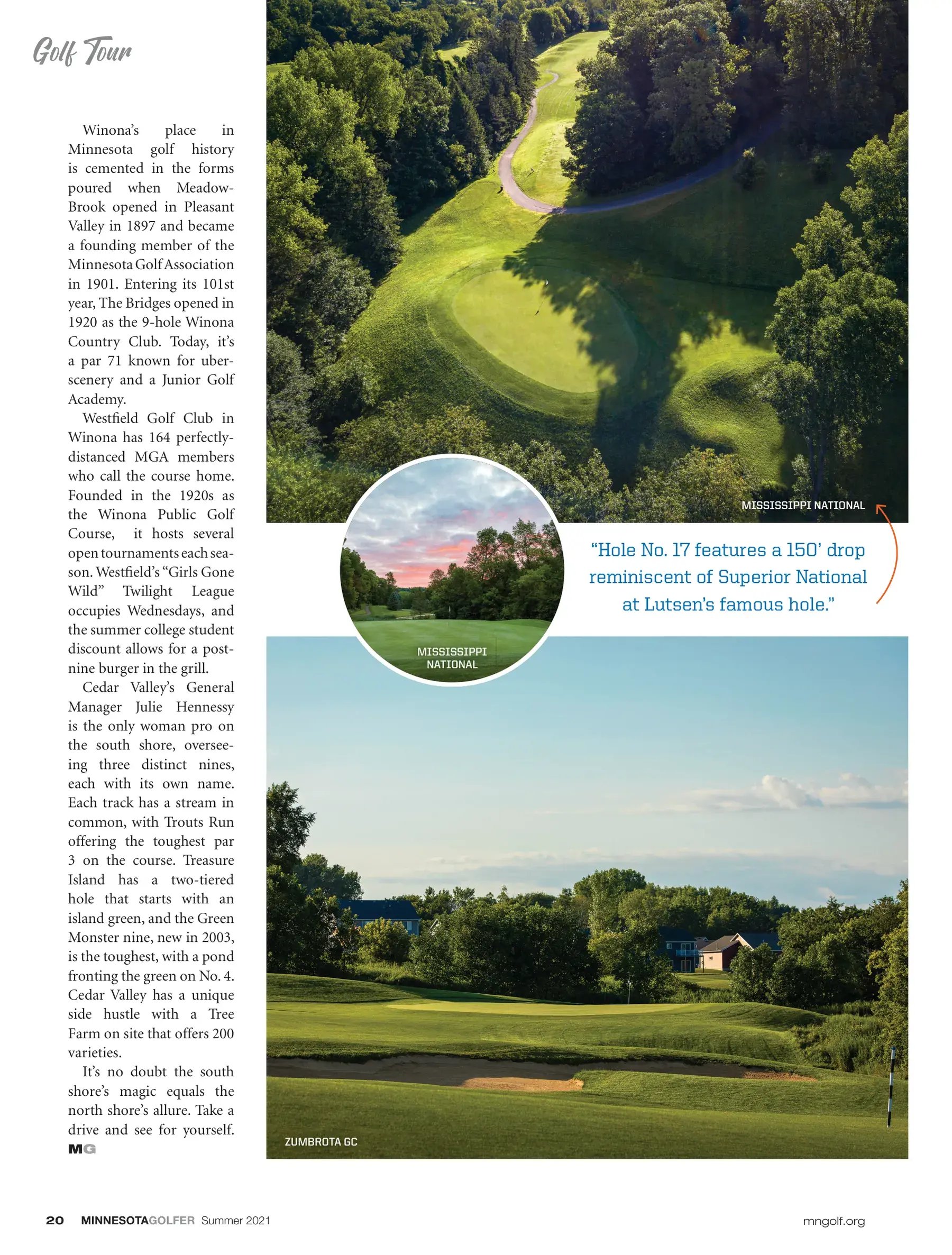
At the gateway to this tour in Red Wing, a trio of opportunities await, all par 71s. Both the Highlands and Lowlands eighteens at Mississippi National provide large greens and striking vistas. The Highlands occupies a blufftop overlooking the Hiawatha Valley and Mississippi River bottoms. Hole No. 17 features a 150’ drop reminiscent of Superior National at Lutsen’s famous hole.
The state’s “South Shore” rivals the North Shore in dynamic scenery, golf and more—perfect for golfers anxious to hit the road again. Another par 71 in town, Red Wing Golf Club was dubbed the #3 course in Minnesota last year (golfadvisor.com) and celebrates 100 years this year. A bonus on site is the rentable Walsh House, a fourbedroom four-bath Victorian that overlooks the 18th green.
Just down shore from these gems is Mount Frontenac, which was once a ski hill, and you can tell if you walk and carry. They call the course “breathtaking” and the views indeed provide pause.
Many years ago, a friend and I played the course and on the very elevated No. 8 tee, we were readying for our drives when a ginormous buck exploded from the woodline! We both dropped our golf balls and caught our breaths.
South of that bone rattler, we played Lake City Golf, (a par 71!) across from Lake Pepin on gently climbing slopes with fairways open enough not to be penal. There are shrub-lined ponds throughout the course. On No. 18, get over the creek and avoid the pond to the left of the green and you’re good to go!
Coffee Mill Golf Course has pinelined fairways, lovely conditions and splendid views of Lake Pepin, where Manager Chris Sill confi rms all precautions are in the past, and the Bluff View Grill is open with specials.
Keith Kalney is in his fifth year as General Manager & Director of Golf at The Jewel of Lake City, an Audubon course and the highest-end track on the south shore. The Jewel was designed by former University of Colorado football star and PGA Tour pro Hale Irwin.
The Jewel hosts open events with varied formats on the second Monday of each month (check website). “Lake City Golf is a par 71 across from Lake Pepin on gently climbing slopes with fairways open enough not to be penal.”
WESTFIELD GC LAKE CITY GOLF CEDAR VALLEY Summer 2021 MINNESOTAGOLFER 19 Lake Pepin Golf Course is the third Lake City course on this tour and the second (Mount Frontenac) designed by Dr. Gordon Emerson, who also designed a bevy of courses in the state to our east.
Owned by the Schmidt family, the course has big views of Lake Pepin from 12 holes and the clubhouse. While both Zumbrota Golf Club and Piper Hills (Plainview) lean a bit west toward bluff country, they still maintain the ambiance of the shore. Zumbrota is a par-69 eighteen with nine parkland holes out and a linksy touch back in.
The Piper Hills nine is busy with five leagues on four nights a week under new owners, the Sawyer and Montgomery families. In-season tourney examples include the Fire Department, Corn Cob and Minneiska Opens. Looking at the course rating and slope, it appears the course is a tough track for women at 75/131 compared to men, 69/127 from the white tees. When I asked about it, the fellow in the clubhouse pondered, then revealed that there are ponds smack dab in front of the tee boxes on three forward holes.
LARK Toys, Kellogg Highly recommended by USA Today, Travel & Leisure, Readers Digest, Oprah, WCCO TV4 and more, Lark Toys is a must-see for families on the go, and golfers to boot. Visitors will find handmade playthings, a gallery of historic and retro trinkets and three llamas for petting. There’s a retail store, workshops, curiosity shoppe, cafe and mini-golf. Then there’s the carousel, hand-carved from Minnesota basswood.
Winona Tour Boat Get out on the water for an informative cruise in a fully-enclosed tour boat, hosted by the Skipper and his son. Enjoy great views of the city from the water, as well as this waterway with fascinating historic boathouses. Snacks and refreshing beverages on board. winonatourboat.com National Eagle Center, Wabasha This impressive 15,000 square foot interpretive center is dedicated to bald and golden eagles. You can see them up close, as well as view them in the wild (best in winter) from a large observation deck on the river.
Clubhouse dining on the South Shore • Mississippi National Baggers’ Pub Restaurant • Red Wing Golf Course Nineteen Bar & Grill • Coffee Mill The Bluff View Grill • The Jewel Bluffside Bar & Grill • Westfi eld Whalen’s at Westfi eld • Cedar Valley Cedar Valley Pub & Restaurant; After Par Pub & Grill More worthwhile stops Red Wing: Red Wing Brewery; Staghead; The Port Lake City: Marion Street Bistro & Brewhouse; Gator’s Dockside Wabasha: Slippery’s Bar & Grill; Hoppy Girl Brewery; Stacy’s Kitchen Winona: Boat House; Signatures RED WING CC THE JEWEL Winona’s place in Minnesota golf history is cemented in the forms poured when MeadowBrook opened in Pleasant Valley in 1897 and became a founding member of the Minnesota Golf Association in 1901. Entering its 101st year, The Bridges opened in 1920 as the 9-hole Winona Country Club. Today, it’s a par 71 known for uberscenery and a Junior Golf Academy.
Westfi eld Golf Club in Winona has 164 perfectlydistanced MGA members who call the course home. Founded in the 1920s as the Winona Public Golf Course, it hosts several open tournaments each season. Westfi eld’s “Girls Gone Wild”
Twilight League occupies Wednesdays, and the summer college student discount allows for a postnine burger in the grill. Cedar Valley’s General Manager Julie Hennessy is the only woman pro on the south shore, overseeing three distinct nines, each with its own name.
Each track has a stream in common, with Trouts Run offering the toughest par 3 on the course. Treasure Island has a two-tiered hole that starts with an island green, and the Green Monster nine, new in 2003, is the toughest, with a pond fronting the green on No. 4.
Cedar Valley has a unique side hustle with a Tree Farm on site that offers 200 varieties. It’s no doubt the south shore’s magic equals the north shore’s allure. Take a drive and see for yourself.
MG “Hole No. 17 features a 150’ drop reminiscent of Superior National at Lutsen’s famous hole.” MISSISSIPPI NATIONAL MISSISSIPPI NATIONAL ZUMBROTA GC www.tcgateway.com Twin Cities Gateway, proud partner of the 3M Open.
Welcome back Golf Fans! PGA TOUR Tournament: July 19-25 GATE REOPENING THE While several big tournaments were postponed last season due to COVID, this summer they return — with golf spectators now joining in on the fun.
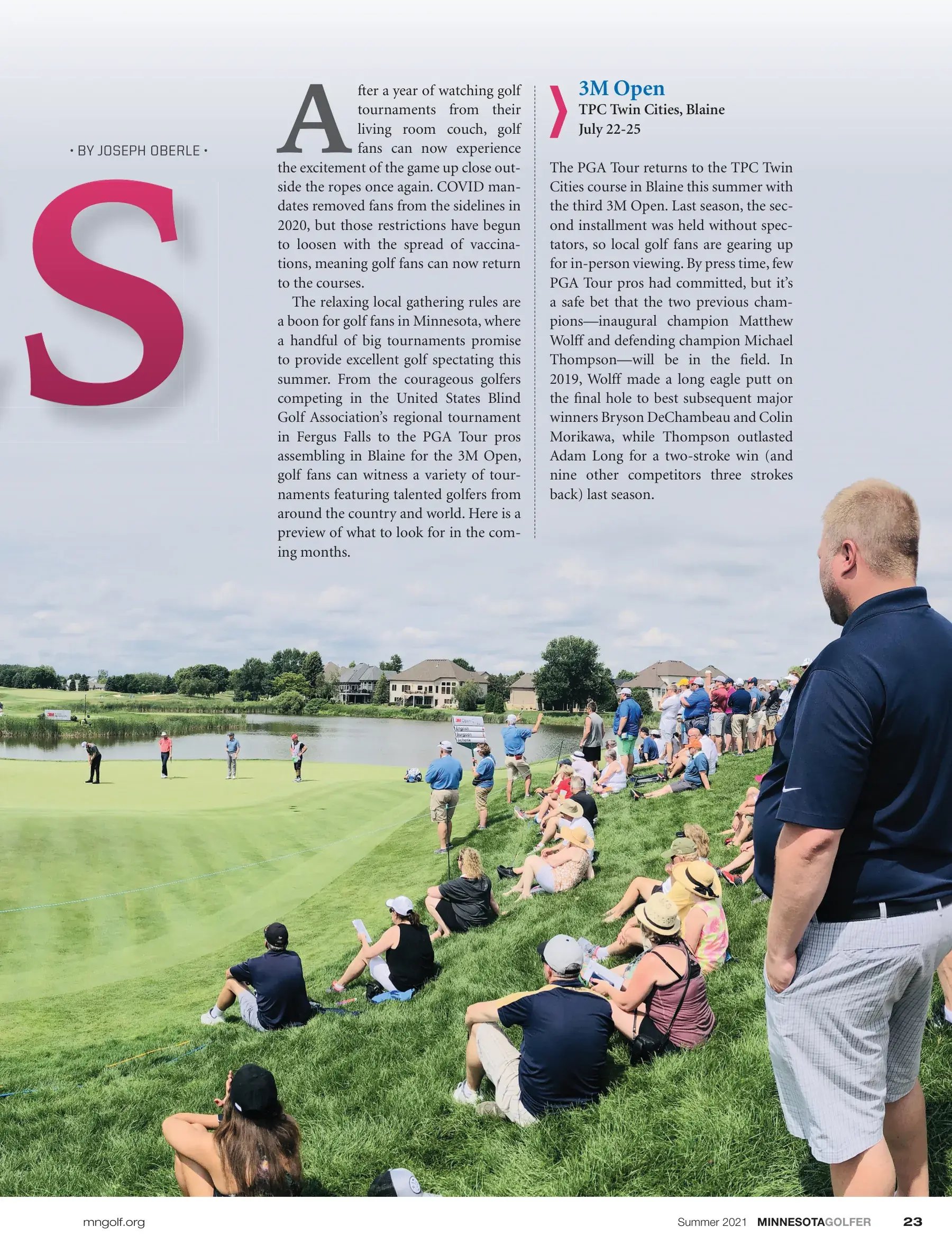
Summer 2021 MINNESOTAGOLFER 23 S A fter a year of watching golf tournaments from their living room couch, golf fans can now experience the excitement of the game up close outside the ropes once again. COVID mandates removed fans from the sidelines in 2020, but those restrictions have begun to loosen with the spread of vaccinations, meaning golf fans can now return to the courses.
The relaxing local gathering rules are a boon for golf fans in Minnesota, where a handful of big tournaments promise to provide excellent golf spectating this summer. From the courageous golfers competing in the United States Blind Golf Association’s regional tournament in Fergus Falls to the PGA Tour pros assembling in Blaine for the 3M Open, golf fans can witness a variety of tournaments featuring talented golfers from around the country and world. Here is a preview of what to look for in the coming months.
3M Open TPC Twin Cities, Blaine July 22-25 The PGA Tour returns to the TPC Twin Cities course in Blaine this summer with the third 3M Open. Last season, the second installment was held without spectators, so local golf fans are gearing up for in-person viewing. By press time, few PGA Tour pros had committed, but it’s a safe bet that the two previous champions—inaugural champion Matthew Wolff and defending champion Michael Thompson—will be in the field. In 2019, Wolff made a long eagle putt on the final hole to best subsequent major winners Bryson DeChambeau and Colin Morikawa, while Thompson outlasted Adam Long for a two-stroke win (and nine other competitors three strokes back) last season.
• BY JOSEPH OBERLE • Wolff set the tournament record of -21 under the first year, and Thompson’s winning number was two shots higher at -19 the following season, after the course was toughened up a bit in the interim.
According to Tournament Media Director Lee Patterson, no alterations were made to the course this offseason. So, when fans return this summer for the tournament, they will see the course as Thompson and his cohorts found it in 2020.
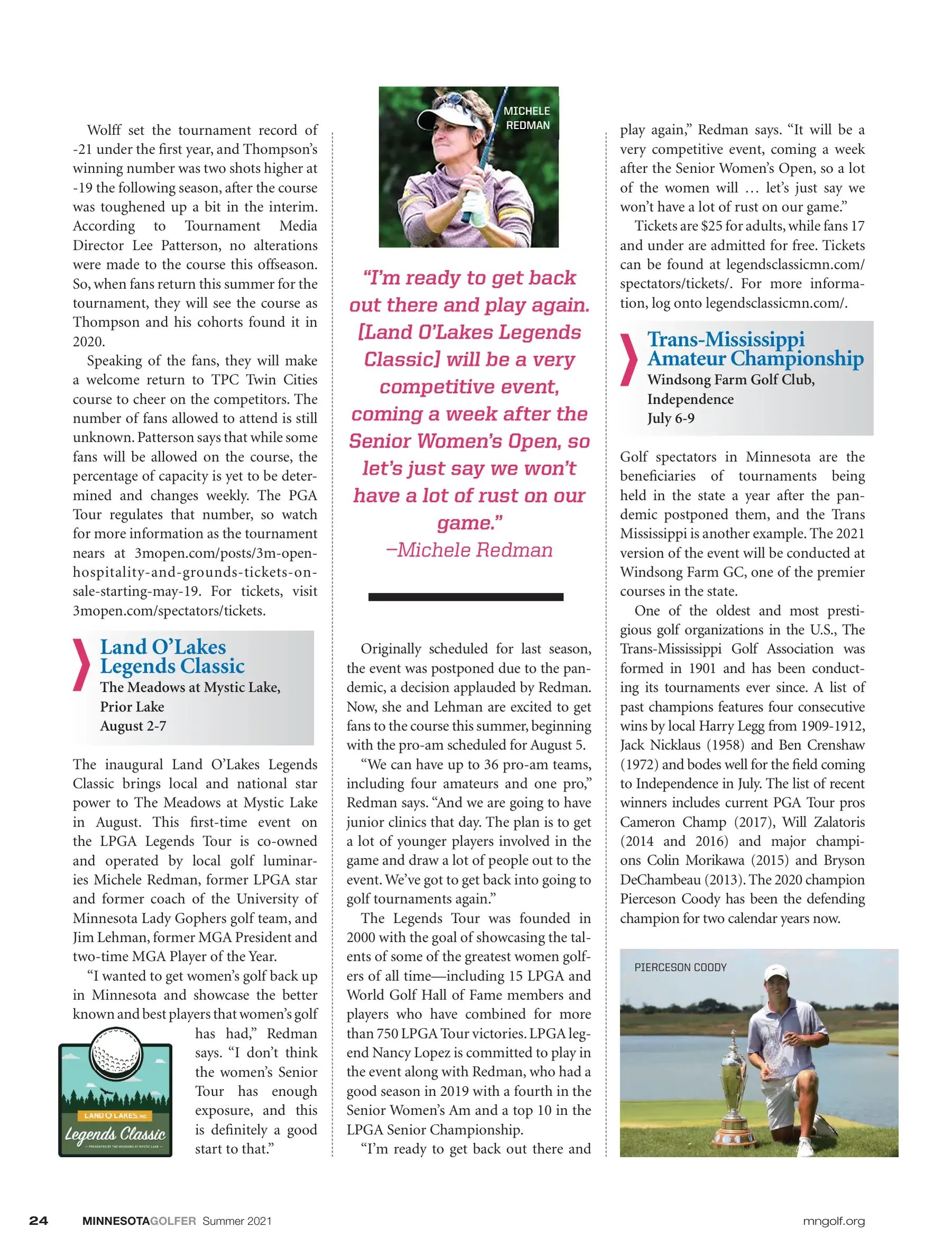
Land O’Lakes Legends Classic The Meadows at Mystic Lake, Prior Lake August 2-7 The inaugural Land O’Lakes Legends Classic brings local and national star power to The Meadows at Mystic Lake in August. This first-time event on the LPGA Legends Tour is co-owned and operated by local golf luminaries Michele Redman, former LPGA star and former coach of the University of Minnesota Lady Gophers golf team, and Jim Lehman, former MGA President and two-time MGA Player of the Year.
“I wanted to get women’s golf back up in Minnesota and showcase the better known and best players that women’s golf has had,” Redman says. “I don’t think the women’s Senior Tour has enough exposure, and this is defi nitely a good start to that.”
Originally scheduled for last season, the event was postponed due to the pandemic, a decision applauded by Redman. Now, she and Lehman are excited to get fans to the course this summer, beginning with the pro-am scheduled for August 5.
“We can have up to 36 pro-am teams, including four amateurs and one pro,” Redman says. “And we are going to have junior clinics that day. The plan is to get a lot of younger players involved in the game and draw a lot of people out to the event. We’ve got to get back into going to golf tournaments again.”
The Legends Tour was founded in 2000 with the goal of showcasing the talents of some of the greatest women golfers of all time—including 15 LPGA and World Golf Hall of Fame members and players who have combined for more than 750 LPGA Tour victories. LPGA legend Nancy Lopez is committed to play in the event along with Redman, who had a good season in 2019 with a fourth in the Senior Women’s Am and a top 10 in the LPGA Senior Championship.
“I’m ready to get back out there and play again,” Redman says. “It will be a very competitive event, coming a week after the Senior Women’s Open, so a lot of the women will ... let’s just say we won’t have a lot of rust on our game.”
Trans-Mississippi Amateur Championship Windsong Farm Golf Club, Independence July 6-9 Golf spectators in Minnesota are the benefi ciaries of tournaments being held in the state a year after the pandemic postponed them, and the Trans Mississippi is another example. The 2021 version of the event will be conducted at Windsong Farm GC, one of the premier courses in the state.
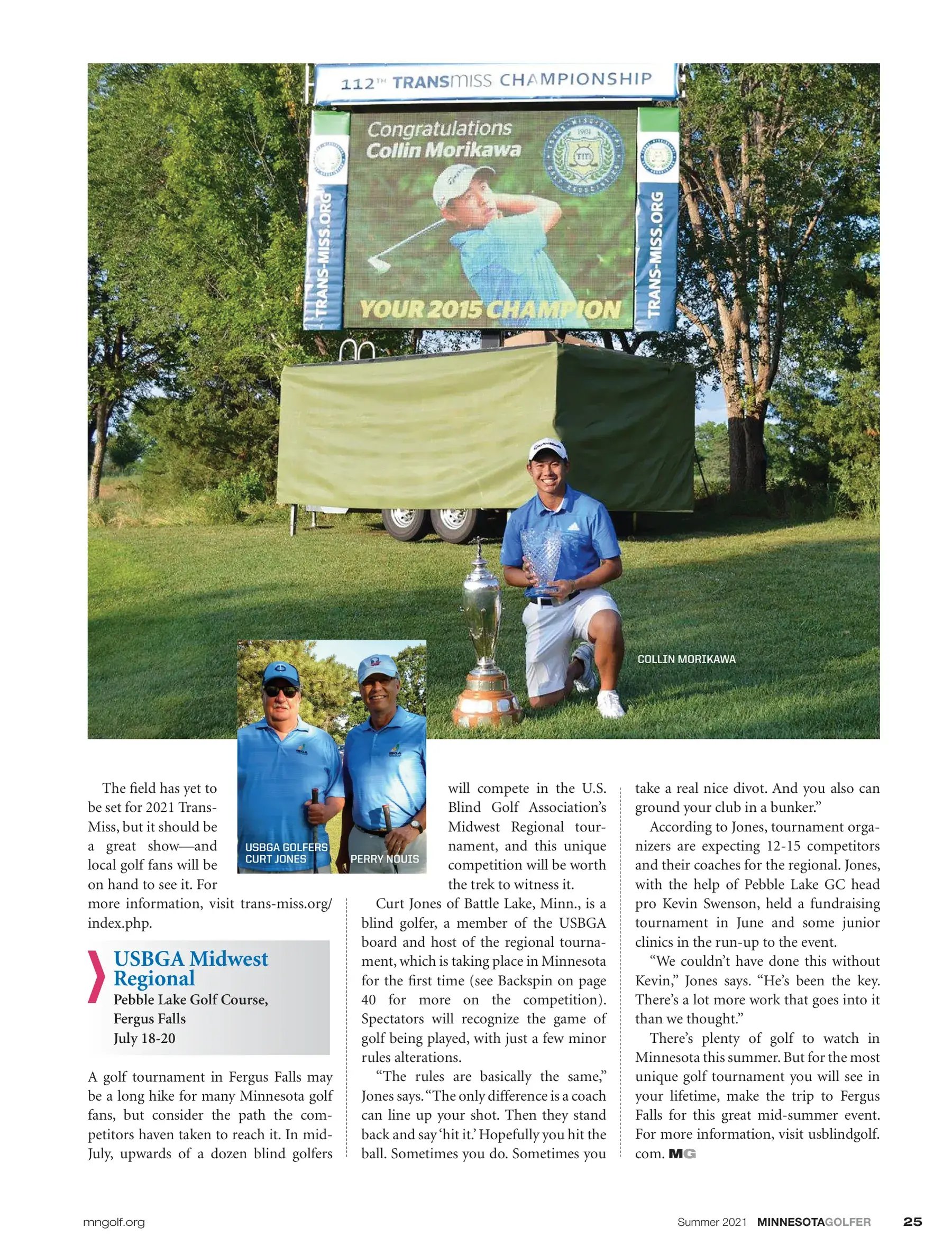
One of the oldest and most prestigious golf organizations in the U.S., The Trans-Mississippi Golf Association was formed in 1901 and has been conducting its tournaments ever since. A list of past champions features four consecutive wins by local Harry Legg from 1909-1912, Jack Nicklaus (1958) and Ben Crenshaw (1972) and bodes well for the field coming to Independence in July. The list of recent winners includes current PGA Tour pros Cameron Champ (2017), Will Zalatoris (2014 and 2016) and major champions Colin Morikawa (2015) and Bryson DeChambeau (2013). The 2020 champion Pierceson Coody has been the defending champion for two calendar years now.
“I’m ready to get back out there and play again. [Land O’Lakes Legends Classic] will be a very competitive event, coming a week after the Senior Women’s Open, so let’s just say we won’t have a lot of rust on our game.”
—Michele Redman PIERCESON COODY MICHELE REDMAN Summer 2021 MINNESOTAGOLFER 25 The field has yet to be set for 2021 TransMiss, but it should be a great show—and local golf fans will be on hand to see it. For more information, visit trans-miss.org/ index.php.
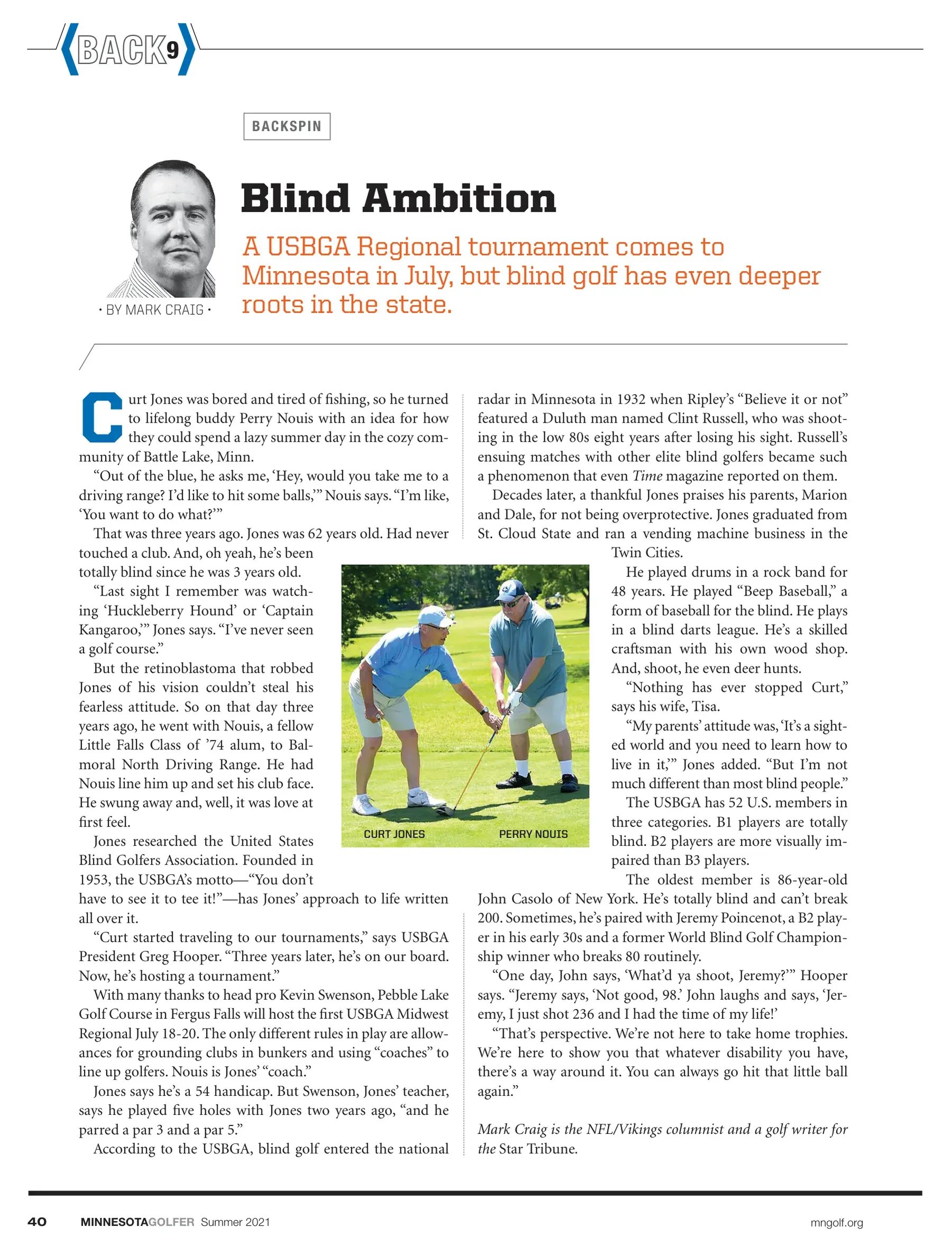
USBGA Midwest Regional Pebble Lake Golf Course, Fergus Falls July 18-20 A golf tournament in Fergus Falls may be a long hike for many Minnesota golf fans, but consider the path the competitors haven taken to reach it. In midJuly, upwards of a dozen blind golfers will compete in the U.S.
Blind Golf Association’s Midwest Regional tournament, and this unique competition will be worth the trek to witness it. Curt Jones of Battle Lake, Minn., is a blind golfer, a member of the USBGA board and host of the regional tournament, which is taking place in Minnesota for the first time (see Backspin on page 40 for more on the competition).
Spectators will recognize the game of golf being played, with just a few minor rules alterations. “The rules are basically the same,” Jones says. “The only difference is a coach can line up your shot. Then they stand back and say ‘hit it.’ Hopefully you hit the ball. Sometimes you do. Sometimes you take a real nice divot. And you also can ground your club in a bunker.”
According to Jones, tournament organizers are expecting 12-15 competitors and their coaches for the regional. Jones, with the help of Pebble Lake GC head pro Kevin Swenson, held a fundraising tournament in June and some junior clinics in the run-up to the event.
“We couldn’t have done this without Kevin,” Jones says. “He’s been the key. There’s a lot more work that goes into it than we thought.” There’s plenty of golf to watch in Minnesota this summer. But for the most unique golf tournament you will see in your lifetime, make the trip to Fergus Falls for this great mid-summer event.
For more information, visit usblindgolf. com. MG COLLIN MORIKAWA USBGA GOLFERS CURT JONES PERRY NOUIS • BY W.P. RYAN • W hether it chafed or not, most golfers abided by the COVID-19 social distancing protocols practiced on the golf course during the 2020 golf season, if, for no other reason than to keep golf courses open by staying safe and keeping other golfers healthy. And golf we did: Minnesota witnessed record rounds last year, up an average of 29.7%.
It turns out that navigating the links without touching anything except our own golf equipment had a signifi cant impact on the way we played the game.
Remove the flagstick to putt? Not an option. Reach into the cup to retrieve the ball? With hole inserts fashioned out of foam floatation toys, aka “pool worms,”
or ingeniously designed contraptions that ejected the ball out of the hole with the flick of the putter, we no longer had to reach to the bottom of the cup to retrieve our ball.
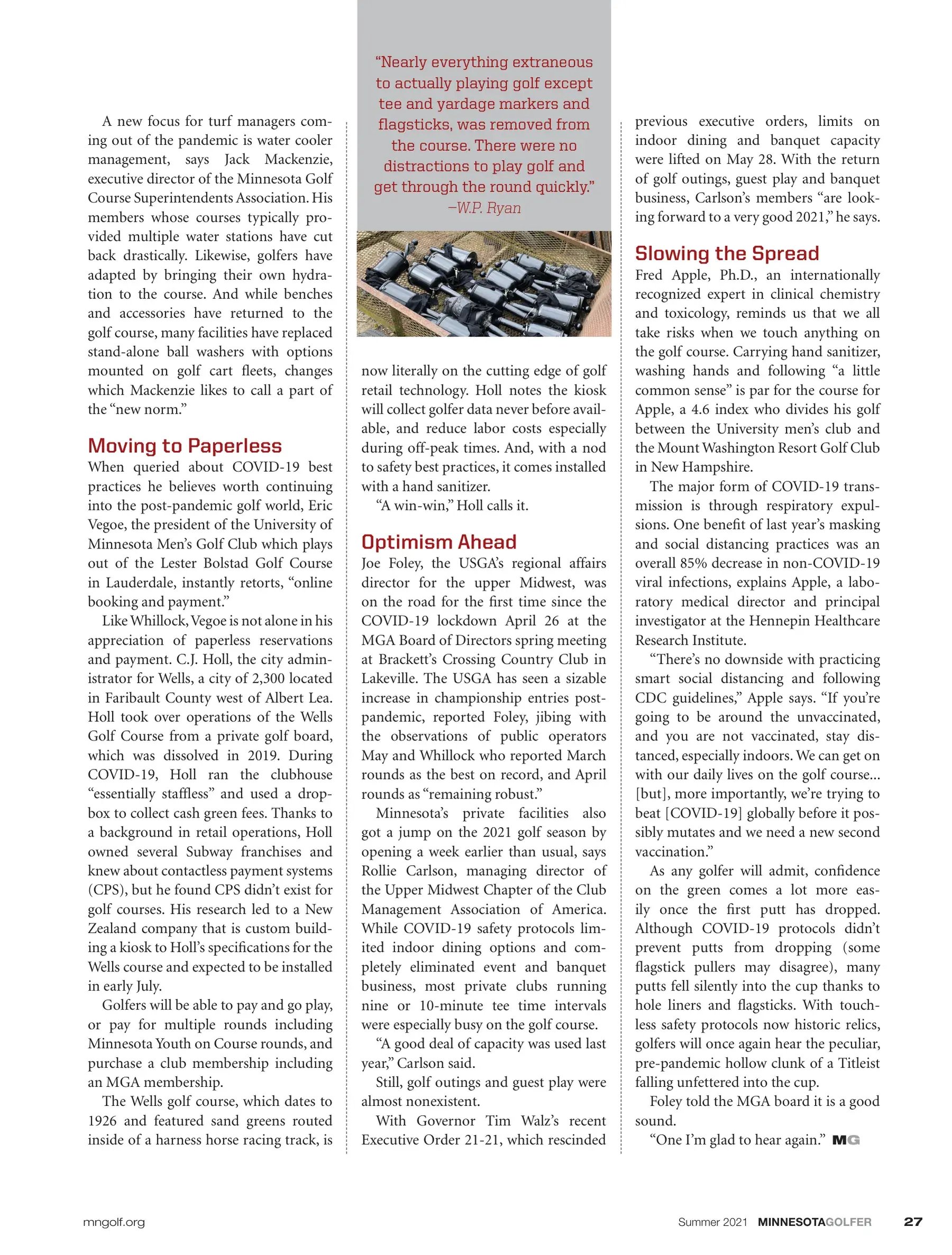
Rake a bunker? Along with bunker rakes, ball washers, waste baskets, water stations and benches, nearly everything extraneous to actually playing golf except tee and yardage markers and flagsticks, was removed from the course.
There were no distractions to play golf and get through the round quickly. For anyone who has played the links courses of Scotland or Ireland, there was an uncanny sense of déjà vu.
Improving Pace of Play According to Jeff May, the golf manager at Baker National Golf Course, during the pandemic golfers made their way around the beautiful but challenging 18-hole layout adjacent to the Baker Park Preserve area in record time.
“Rounds were consistently 15 minutes better in 2020 versus 2019,” May says, explaining that the average round went from four hours and forty-five minutes, or longer, to an average of four hours and thirty minutes—a better-than-5% improvement in pace of play.
May points to the lack of bunker rakes and the flagstick left untouched in the cup as the main reasons for the faster rounds. For that reason, he prefers that golfers continue to leave the flagstick in the hole.
“I’m hoping that will stick,” he says. At Oak Marsh Golf Course, an 18-hole public course in Woodbury, water stations and seven-to-eight-minute tee time intervals are a thing of the past.
“Water coolers may never come back,” says Steve Whillock, the golf professional and general manager. A combination of touchless check-in and pre-paid green fees for league play, Oak Marsh has 17 leagues, many with wait lists, and “The Cup Lifter,” an ejector device attached to the flagstick, all contribute to better flow around the golf course, says Whillock.
But the most signifi cant change forced by COVID-19 on the popular daily-fee located in the East Metro was a permanent shift to 10-minute tee-time intervals and the addition of a fulltime starter on the first tee.
COVID-19 brought record rounds last year while introducing new components of play. EMBRACING CHANGE WHAT WE LEARNED FROM SOCIALLY-DISTANT GOLF Summer 2021 MINNESOTAGOLFER 27 A new focus for turf managers coming out of the pandemic is water cooler management, says Jack Mackenzie, executive director of the Minnesota Golf Course Superintendents Association. His members whose courses typically provided multiple water stations have cut back drastically. Likewise, golfers have adapted by bringing their own hydration to the course. And while benches and accessories have returned to the golf course, many facilities have replaced stand-alone ball washers with options mounted on golf cart fleets, changes which Mackenzie likes to call a part of the “new norm.”
Moving to Paperless When queried about COVID-19 best practices he believes worth continuing into the post-pandemic golf world, Eric Vegoe, the president of the University of Minnesota Men’s Golf Club which plays out of the Lester Bolstad Golf Course in Lauderdale, instantly retorts, “online booking and payment.”
Like Whillock, Vegoe is not alone in his appreciation of paperless reservations and payment. C.J. Holl, the city administrator for Wells, a city of 2,300 located in Faribault County west of Albert Lea.
Holl took over operations of the Wells Golf Course from a private golf board, which was dissolved in 2019. During COVID-19, Holl ran the clubhouse “essentially staffl ess” and used a dropbox to collect cash green fees. Thanks to a background in retail operations, Holl owned several Subway franchises and knew about contactless payment systems (CPS), but he found CPS didn’t exist for golf courses. His research led to a New Zealand company that is custom building a kiosk to Holl’s specifi cations for the Wells course and expected to be installed in early July.
Golfers will be able to pay and go play, or pay for multiple rounds including Minnesota Youth on Course rounds, and purchase a club membership including an MGA membership.
The Wells golf course, which dates to 1926 and featured sand greens routed inside of a harness horse racing track, is now literally on the cutting edge of golf retail technology. Holl notes the kiosk will collect golfer data never before available, and reduce labor costs especially during off-peak times. And, with a nod to safety best practices, it comes installed with a hand sanitizer.
“A win-win,” Holl calls it. Optimism Ahead Joe Foley, the USGA’s regional affairs director for the upper Midwest, was on the road for the first time since the COVID-19 lockdown April 26 at the MGA Board of Directors spring meeting at Brackett’s Crossing Country Club in Lakeville. The USGA has seen a sizable increase in championship entries postpandemic, reported Foley, jibing with the observations of public operators May and Whillock who reported March rounds as the best on record, and April rounds as “remaining robust.”
Minnesota’s private facilities also got a jump on the 2021 golf season by opening a week earlier than usual, says Rollie Carlson, managing director of the Upper Midwest Chapter of the Club Management Association of America.
While COVID-19 safety protocols limited indoor dining options and completely eliminated event and banquet business, most private clubs running nine or 10-minute tee time intervals were especially busy on the golf course.
“A good deal of capacity was used last year,” Carlson said. Still, golf outings and guest play were almost nonexistent. With Governor Tim Walz’s recent Executive Order 21-21, which rescinded previous executive orders, limits on indoor dining and banquet capacity were lifted on May 28. With the return of golf outings, guest play and banquet business, Carlson’s members “are looking forward to a very good 2021,” he says.
Slowing the Spread Fred Apple, Ph.D., an internationally recognized expert in clinical chemistry and toxicology, reminds us that we all take risks when we touch anything on the golf course. Carrying hand sanitizer, washing hands and following “a little common sense” is par for the course for Apple, a 4.6 index who divides his golf between the University men’s club and the Mount Washington Resort Golf Club in New Hampshire.
The major form of COVID-19 transmission is through respiratory expulsions. One benefi t of last year’s masking and social distancing practices was an overall 85% decrease in non-COVID-19 viral infections, explains Apple, a laboratory medical director and principal investigator at the Hennepin Healthcare Research Institute.
“There’s no downside with practicing smart social distancing and following CDC guidelines,” Apple says. “If you’re going to be around the unvaccinated, and you are not vaccinated, stay distanced, especially indoors. We can get on with our daily lives on the golf course...
[but], more importantly, we’re trying to beat [COVID-19] globally before it possibly mutates and we need a new second vaccination.” As any golfer will admit, confi dence on the green comes a lot more easily once the first putt has dropped.
Although COVID-19 protocols didn’t prevent putts from dropping (some flagstick pullers may disagree), many putts fell silently into the cup thanks to hole liners and flagsticks. With touchless safety protocols now historic relics, golfers will once again hear the peculiar, pre-pandemic hollow clunk of a Titleist falling unfettered into the cup.
Foley told the MGA board it is a good sound. “One I’m glad to hear again.” MG “Nearly everything extraneous to actually playing golf except tee and yardage markers and flagsticks, was removed from the course. There were no distractions to play golf and get through the round quickly.”
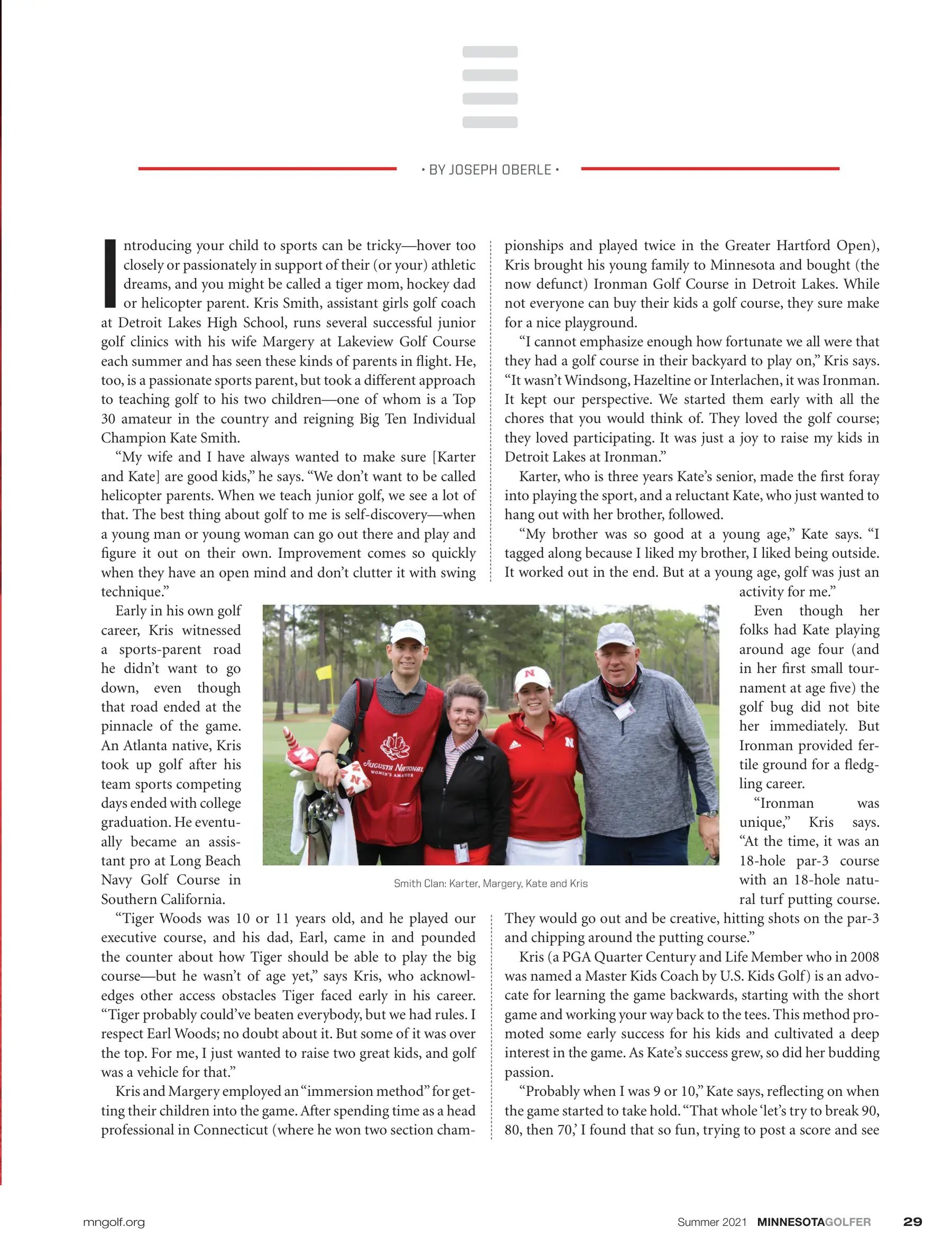
—W.P. Ryan The Smiths of Detroit Lakes are helping build a Minnesota golf legacy in that far corner of the state. Summer 2021 MINNESOTAGOLFER 29 I ntroducing your child to sports can be tricky—hover too closely or passionately in support of their (or your) athletic dreams, and you might be called a tiger mom, hockey dad or helicopter parent. Kris Smith, assistant girls golf coach at Detroit Lakes High School, runs several successful junior golf clinics with his wife Margery at Lakeview Golf Course each summer and has seen these kinds of parents in flight. He, too, is a passionate sports parent, but took a different approach to teaching golf to his two children—one of whom is a Top 30 amateur in the country and reigning Big Ten Individual Champion Kate Smith.
“My wife and I have always wanted to make sure [Karter and Kate] are good kids,” he says. “We don’t want to be called helicopter parents. When we teach junior golf, we see a lot of that. The best thing about golf to me is self-discovery—when a young man or young woman can go out there and play and figure it out on their own. Improvement comes so quickly when they have an open mind and don’t clutter it with swing technique.”
Early in his own golf career, Kris witnessed a sports-parent road he didn’t want to go down, even though that road ended at the pinnacle of the game.
An Atlanta native, Kris took up golf after his team sports competing days ended with college graduation. He eventually became an assistant pro at Long Beach Navy Golf Course in Southern California.
“Tiger Woods was 10 or 11 years old, and he played our executive course, and his dad, Earl, came in and pounded the counter about how Tiger should be able to play the big course—but he wasn’t of age yet,” says Kris, who acknowledges other access obstacles Tiger faced early in his career.
“Tiger probably could’ve beaten everybody, but we had rules. I respect Earl Woods; no doubt about it. But some of it was over the top. For me, I just wanted to raise two great kids, and golf was a vehicle for that.”
Kris and Margery employed an “immersion method” for getting their children into the game. After spending time as a head professional in Connecticut (where he won two section championships and played twice in the Greater Hartford Open), Kris brought his young family to Minnesota and bought (the now defunct) Ironman Golf Course in Detroit Lakes. While not everyone can buy their kids a golf course, they sure make for a nice playground.
“I cannot emphasize enough how fortunate we all were that they had a golf course in their backyard to play on,” Kris says. “It wasn’t Windsong, Hazeltine or Interlachen, it was Ironman.
It kept our perspective. We started them early with all the chores that you would think of. They loved the golf course; they loved participating. It was just a joy to raise my kids in Detroit Lakes at Ironman.”
Karter, who is three years Kate’s senior, made the first foray into playing the sport, and a reluctant Kate, who just wanted to hang out with her brother, followed.
“My brother was so good at a young age,” Kate says. “I tagged along because I liked my brother, I liked being outside. It worked out in the end. But at a young age, golf was just an activity for me.”
Even though her folks had Kate playing around age four (and in her first small tournament at age five) the golf bug did not bite her immediately. But Ironman provided fertile ground for a fledgling career.
“Ironman was unique,” Kris says. “At the time, it was an 18-hole par-3 course with an 18-hole natural turf putting course. They would go out and be creative, hitting shots on the par-3 and chipping around the putting course.”
Kris (a PGA Quarter Century and Life Member who in 2008 was named a Master Kids Coach by U.S. Kids Golf) is an advocate for learning the game backwards, starting with the short game and working your way back to the tees. This method promoted some early success for his kids and cultivated a deep interest in the game. As Kate’s success grew, so did her budding passion.
“Probably when I was 9 or 10,” Kate says, refl ecting on when the game started to take hold. “That whole ‘let’s try to break 90, 80, then 70,’ I found that so fun, trying to post a score and see • BY JOSEPH OBERLE • Smith Clan: Karter, Margery, Kate and Kris what I could do. It just became more and more fun the better I got, the more competitive it was. When I was 8 or 9, I was like the only girl in my division. When you got into 9, 10, 11, you could compete with more girls in the area and that competition was really exciting.”
Kate competed with boys, as well—specifi cally her brother and his friends. She started on the forward tees, but it wasn’t long before she teed it up next to them.
“At the beginning, I struggled,” she says. “But I didn’t want to [hold] them up. So, the less strokes I took, I knew that was better. By the end, I could shoot better scores than some guys in the group.
That was exciting to be able to just keep up with them from their tees. It made me feel like I belonged in that group.” Karter put together a nice high school career, finishing second at state twice and then playing at Drake for four years.
According to his dad, who admits his bias, Karter was one of the best high school golfers coming out of Detroit Lakes—a place that claims two boys team state titles (one featuring Minnesota Viking Adam Thielen). But then Kate came along, and the golf mecca of “DL” had another star. And nobody has enjoyed it more than big brother Karter.
“We joke constantly that [Kate’s golf] is such a family project,” Kris says. “It’s something that Karter has been so instrumental in. He has reveled in her success. He’s just her biggest fan.”
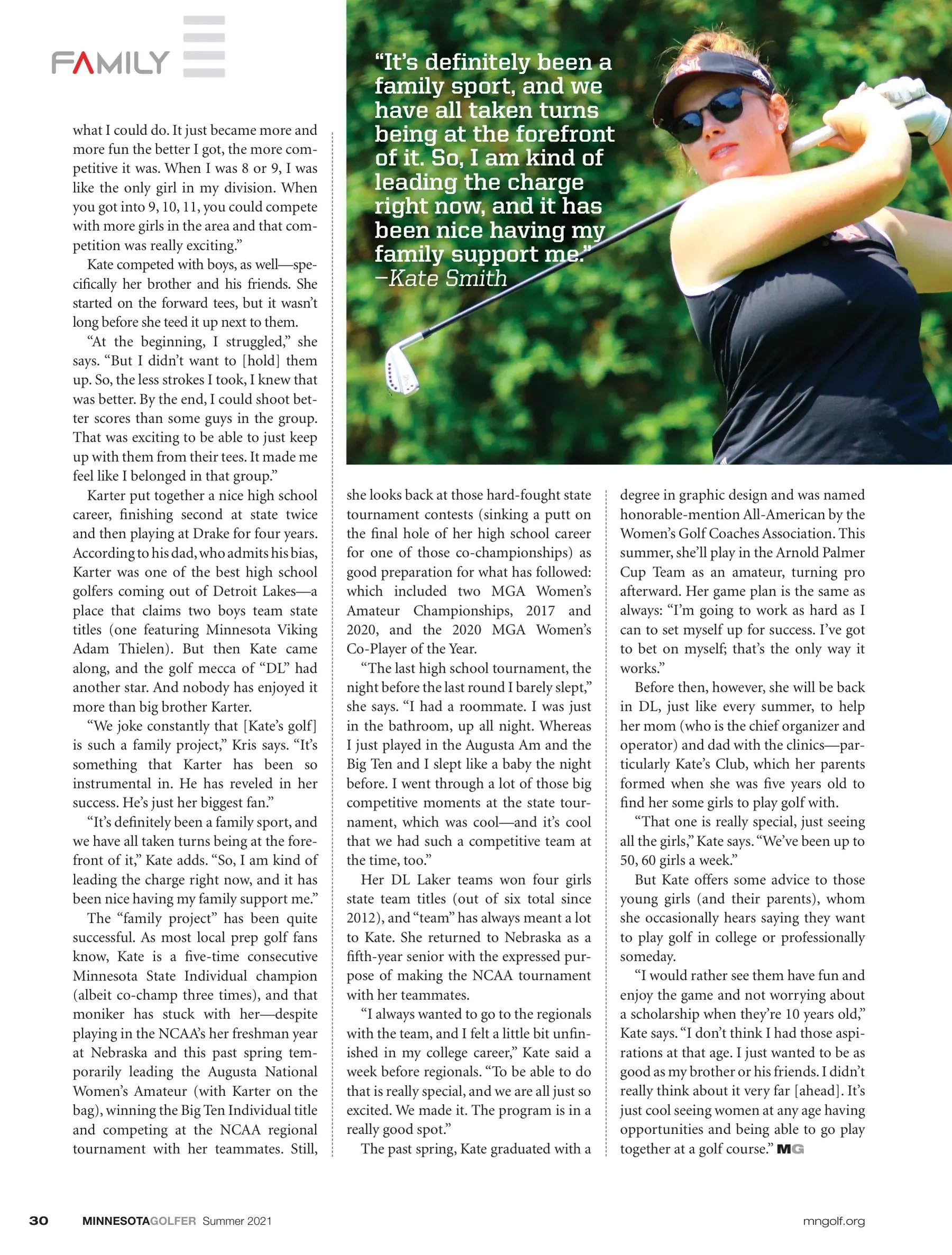
“It’s defi nitely been a family sport, and we have all taken turns being at the forefront of it,” Kate adds. “So, I am kind of leading the charge right now, and it has been nice having my family support me.”
The “family project” has been quite successful. As most local prep golf fans know, Kate is a five-time consecutive Minnesota State Individual champion (albeit co-champ three times), and that moniker has stuck with her—despite playing in the NCAA’s her freshman year at Nebraska and this past spring temporarily leading the Augusta National Women’s Amateur (with Karter on the bag), winning the Big Ten Individual title and competing at the NCAA regional tournament with her teammates. Still, she looks back at those hard-fought state tournament contests (sinking a putt on the final hole of her high school career for one of those co-championships) as good preparation for what has followed: which included two MGA Women’s Amateur Championships, 2017 and 2020, and the 2020 MGA Women’s Co-Player of the Year.
“The last high school tournament, the night before the last round I barely slept,” she says. “I had a roommate. I was just in the bathroom, up all night. Whereas I just played in the Augusta Am and the Big Ten and I slept like a baby the night before. I went through a lot of those big competitive moments at the state tournament, which was cool—and it’s cool that we had such a competitive team at the time, too.”
Her DL Laker teams won four girls state team titles (out of six total since 2012), and “team” has always meant a lot to Kate. She returned to Nebraska as a fifth-year senior with the expressed purpose of making the NCAA tournament with her teammates.
“I always wanted to go to the regionals with the team, and I felt a little bit unfi nished in my college career,” Kate said a week before regionals. “To be able to do that is really special, and we are all just so excited. We made it. The program is in a really good spot.”
The past spring, Kate graduated with a degree in graphic design and was named honorable-mention All-American by the Women’s Golf Coaches Association. This summer, she’ll play in the Arnold Palmer Cup Team as an amateur, turning pro afterward. Her game plan is the same as always: “I’m going to work as hard as I can to set myself up for success. I’ve got to bet on myself; that’s the only way it works.”
Before then, however, she will be back in DL, just like every summer, to help her mom (who is the chief organizer and operator) and dad with the clinics—particularly Kate’s Club, which her parents formed when she was five years old to find her some girls to play golf with.
“That one is really special, just seeing all the girls,” Kate says. “We’ve been up to 50, 60 girls a week.” But Kate offers some advice to those young girls (and their parents), whom she occasionally hears saying they want to play golf in college or professionally someday.
“I would rather see them have fun and enjoy the game and not worrying about a scholarship when they’re 10 years old,” Kate says. “I don’t think I had those aspirations at that age. I just wanted to be as good as my brother or his friends. I didn’t really think about it very far [ahead]. It’s just cool seeing women at any age having opportunities and being able to go play together at a golf course.” MG “It’s definitely been a family sport, and we have all taken turns being at the forefront of it. So, I am kind of leading the charge right now, and it has been nice having my family support me.”
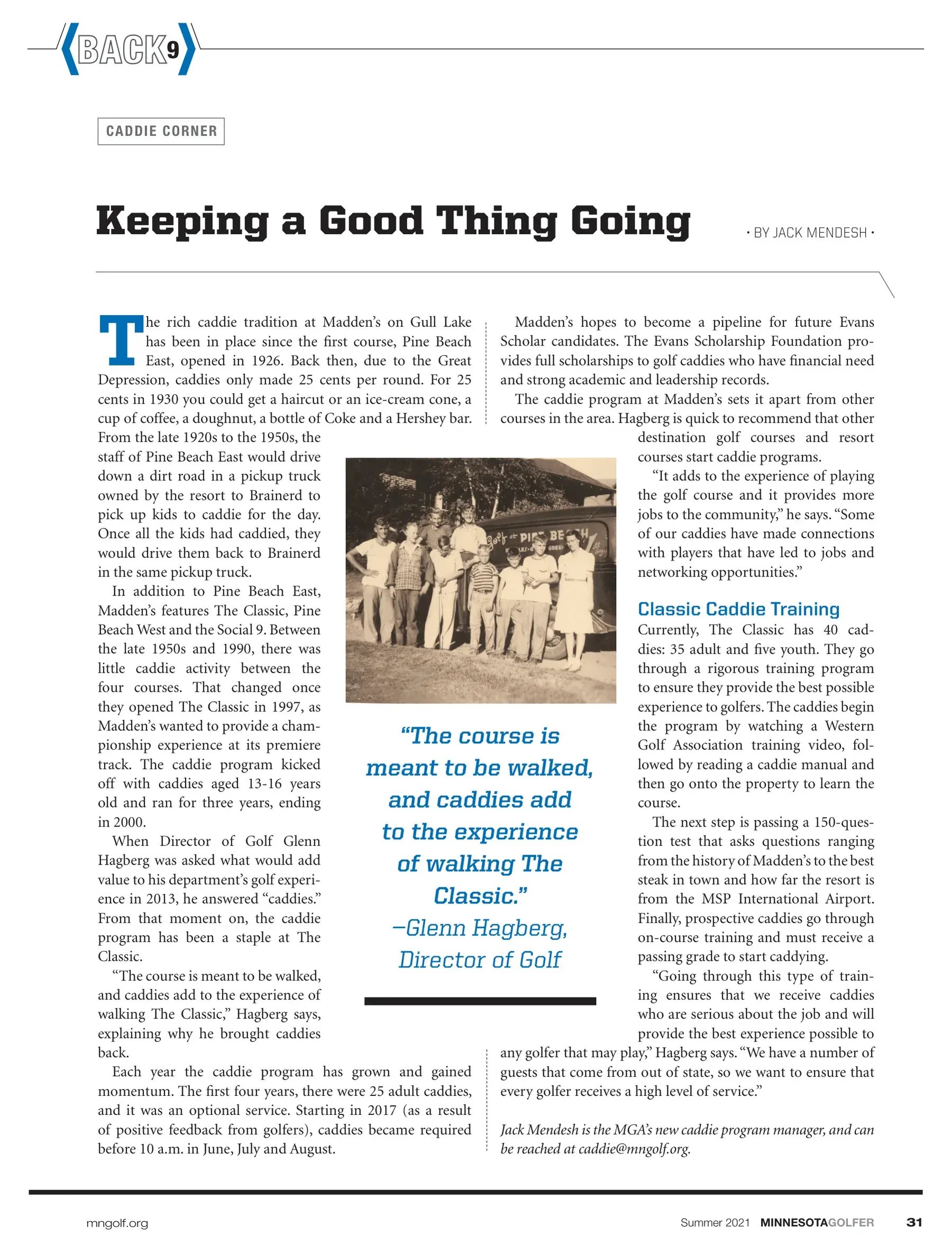
—Kate Smith Keeping a Good Thing Going CADDIE CORNER • BY JACK MENDESH • T he rich caddie tradition at Madden’s on Gull Lake has been in place since the first course, Pine Beach East, opened in 1926. Back then, due to the Great Depression, caddies only made 25 cents per round. For 25 cents in 1930 you could get a haircut or an ice-cream cone, a cup of coffee, a doughnut, a bottle of Coke and a Hershey bar.
From the late 1920s to the 1950s, the staff of Pine Beach East would drive down a dirt road in a pickup truck owned by the resort to Brainerd to pick up kids to caddie for the day.
Once all the kids had caddied, they would drive them back to Brainerd in the same pickup truck. In addition to Pine Beach East, Madden’s features The Classic, Pine Beach West and the Social 9. Between the late 1950s and 1990, there was little caddie activity between the four courses. That changed once they opened The Classic in 1997, as Madden’s wanted to provide a championship experience at its premiere track. The caddie program kicked off with caddies aged 13-16 years old and ran for three years, ending in 2000.
When Director of Golf Glenn Hagberg was asked what would add value to his department’s golf experience in 2013, he answered “caddies.” From that moment on, the caddie program has been a staple at The Classic.
“The course is meant to be walked, and caddies add to the experience of walking The Classic,” Hagberg says, explaining why he brought caddies back.
Each year the caddie program has grown and gained momentum. The first four years, there were 25 adult caddies, and it was an optional service. Starting in 2017 (as a result of positive feedback from golfers), caddies became required before 10 a.m. in June, July and August.
Madden’s hopes to become a pipeline for future Evans Scholar candidates. The Evans Scholarship Foundation provides full scholarships to golf caddies who have financial need and strong academic and leadership records.
The caddie program at Madden’s sets it apart from other courses in the area. Hagberg is quick to recommend that other destination golf courses and resort courses start caddie programs.
“It adds to the experience of playing the golf course and it provides more jobs to the community,” he says. “Some of our caddies have made connections with players that have led to jobs and networking opportunities.”
Classic Caddie Training Currently, The Classic has 40 caddies: 35 adult and five youth. They go through a rigorous training program to ensure they provide the best possible experience to golfers. The caddies begin the program by watching a Western Golf Association training video, followed by reading a caddie manual and then go onto the property to learn the course.
The next step is passing a 150-question test that asks questions ranging from the history of Madden’s to the best steak in town and how far the resort is from the MSP International Airport.
Finally, prospective caddies go through on-course training and must receive a passing grade to start caddying. “Going through this type of training ensures that we receive caddies who are serious about the job and will provide the best experience possible to any golfer that may play,” Hagberg says. “We have a number of guests that come from out of state, so we want to ensure that every golfer receives a high level of service.”
Jack Mendesh is the MGA’s new caddie program manager, and can be reached at caddie@mngolf.org. “The course is meant to be walked, and caddies add to the experience of walking The Classic.”
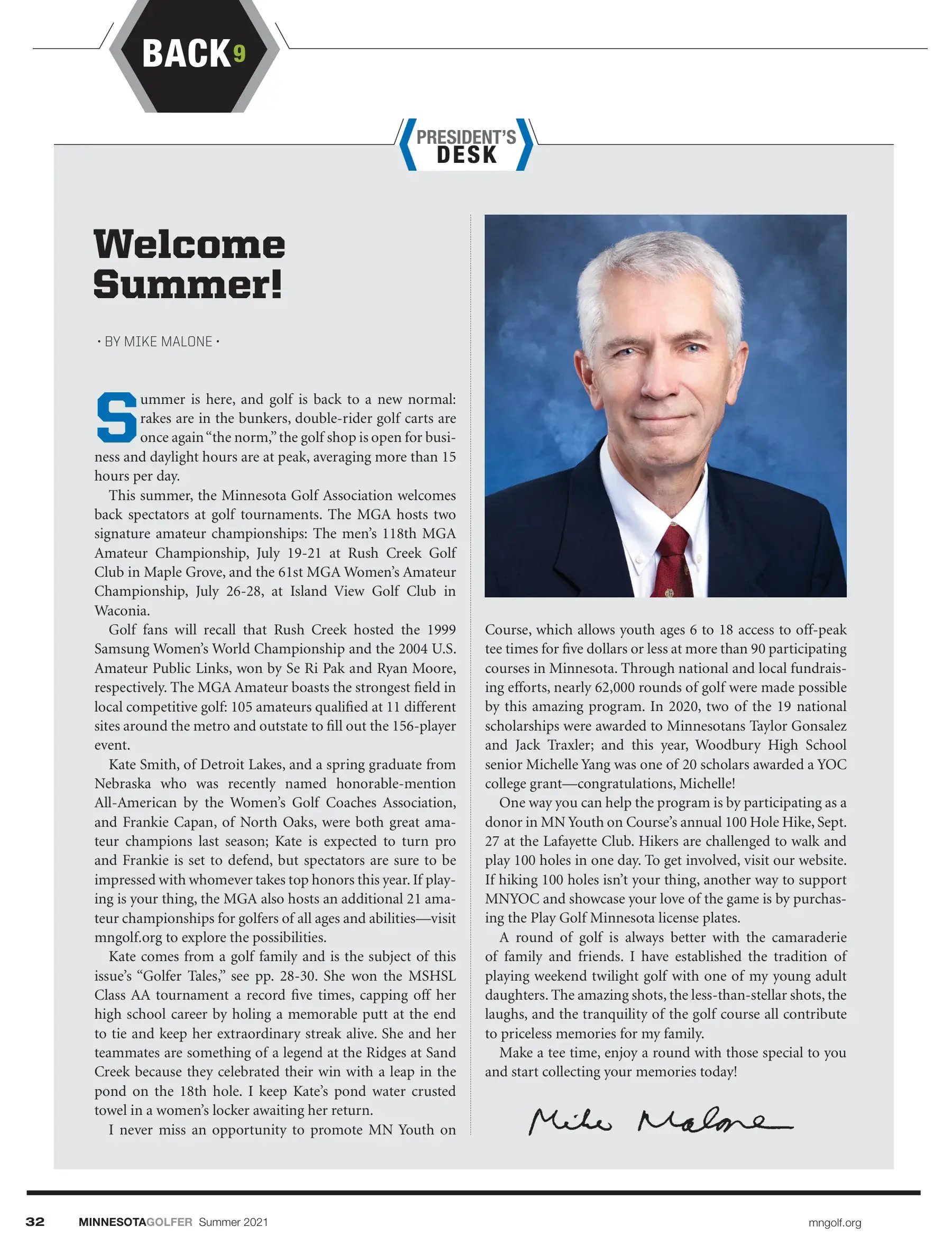
—Glenn Hagberg, Director of Golf Summer 2021 MINNESOTAGOLFER 31 BACK PRESIDENT’S DESK Welcome Summer! S ummer is here, and golf is back to a new normal: rakes are in the bunkers, double-rider golf carts are once again “the norm,” the golf shop is open for business and daylight hours are at peak, averaging more than 15 hours per day.
This summer, the Minnesota Golf Association welcomes back spectators at golf tournaments. The MGA hosts two signature amateur championships: The men’s 118th MGA Amateur Championship, July 19-21 at Rush Creek Golf Club in Maple Grove, and the 61st MGA Women’s Amateur Championship, July 26-28, at Island View Golf Club in Waconia.
Golf fans will recall that Rush Creek hosted the 1999 Samsung Women’s World Championship and the 2004 U.S. Amateur Public Links, won by Se Ri Pak and Ryan Moore, respectively. The MGA Amateur boasts the strongest field in local competitive golf: 105 amateurs qualifi ed at 11 different sites around the metro and outstate to fill out the 156-player event.
Kate Smith, of Detroit Lakes, and a spring graduate from Nebraska who was recently named honorable-mention All-American by the Women’s Golf Coaches Association, and Frankie Capan, of North Oaks, were both great amateur champions last season; Kate is expected to turn pro and Frankie is set to defend, but spectators are sure to be impressed with whomever takes top honors this year. If playing is your thing, the MGA also hosts an additional 21 amateur championships for golfers of all ages and abilities—visit Kate comes from a golf family and is the subject of this issue’s “Golfer Tales,” see pp. 28-30. She won the MSHSL Class AA tournament a record five times, capping off her high school career by holing a memorable putt at the end to tie and keep her extraordinary streak alive. She and her teammates are something of a legend at the Ridges at Sand Creek because they celebrated their win with a leap in the pond on the 18th hole. I keep Kate’s pond water crusted towel in a women’s locker awaiting her return.