




Summer 2022

















Back to The Minnesota Golfer Archive
Read the text of this issue
Text from the printed pages, so it can be searched and read by screen readers. Layout and photography are in the reader above.
Copyright © 2022 MGA The MGA upholds and promotes the game of golf and its values for all golfers in Minnesota. Minnesota Golf Association Inc.
Legislative Counsel McGrann Shea Carnival Straughn & Lamb, Chartered OFFICE Volume 50, Number 3 Summer 2022 GOLF CLUB Experience Deacon’s Lodge Named in honor of Arnolds Father “Deke” by Arnold, with 18 championship holes equally deserving of signature status, Deacons Lodge is a must play when visiting the Brainerd lakes area.
Here is the situation: given the supply chain problem, and the abrupt rise in paper costs, the MGA Board approved a modified print/digital plan to delivering the magazine to our more than 80,000 members. Going forward, we’ll print and mail the directory and year-end issues, and email two or three digital editions during the summer. Once the paper situation resets, we’ll revisit this strategy. If you would like to share an opinion about the print or digital edition of Minnesota Golfer, or anything related to the magazine, please email me at editor@mngolf.org.
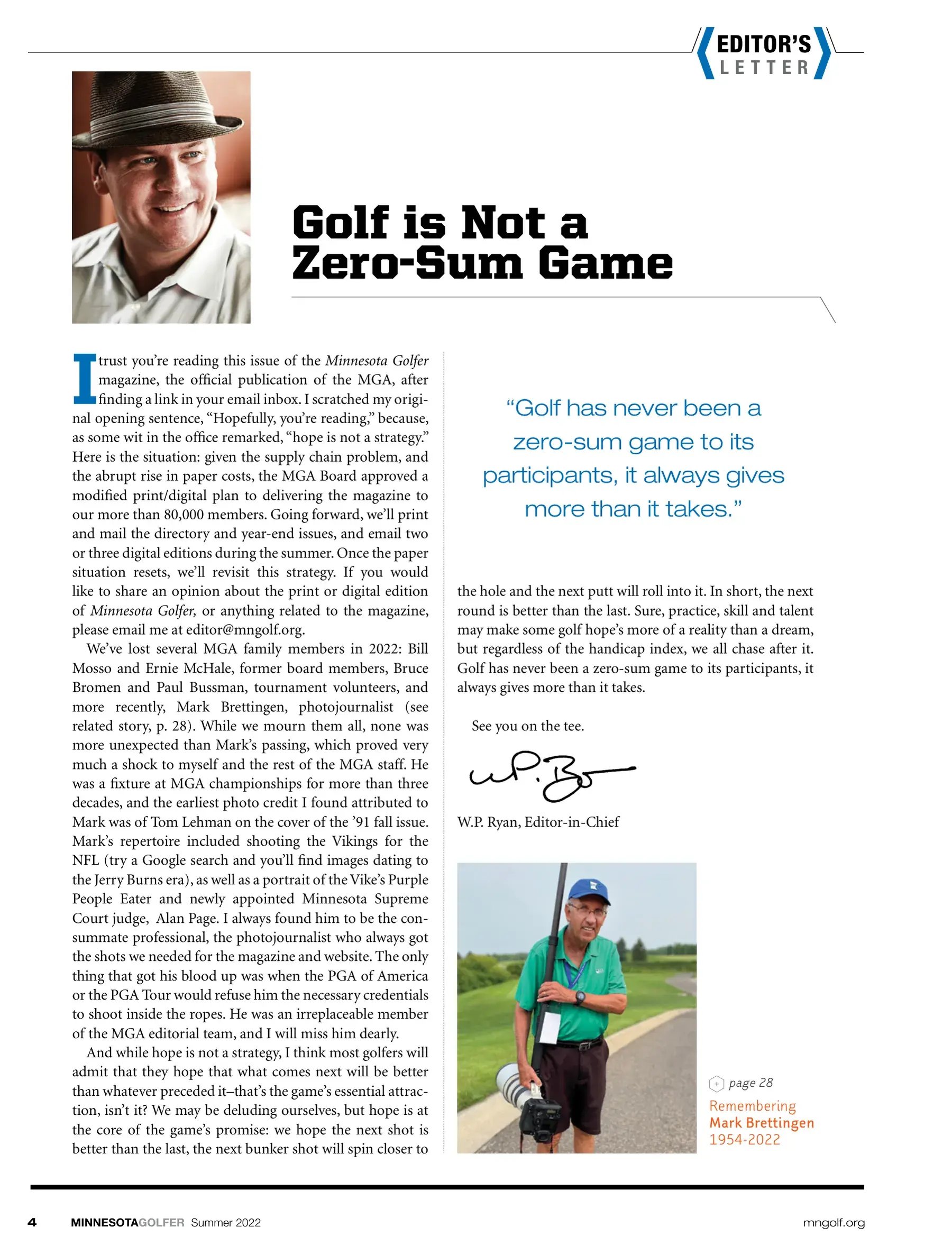
We’ve lost several MGA family members in 2022: Bill Mosso and Ernie McHale, former board members, Bruce Bromen and Paul Bussman, tournament volunteers, and more recently, Mark Brettingen, photojournalist (see related story, p. 28). While we mourn them all, none was more unexpected than Mark’s passing, which proved very much a shock to myself and the rest of the MGA staff. He was a fixture at MGA championships for more than three decades, and the earliest photo credit I found attributed to Mark was of Tom Lehman on the cover of the ’91 fall issue.
Mark’s repertoire included shooting the Vikings for the NFL (try a Google search and you’ll find images dating to the Jerry Burns era), as well as a portrait of the Vike’s Purple People Eater and newly appointed Minnesota Supreme Court judge, Alan Page. I always found him to be the consummate professional, the photojournalist who always got the shots we needed for the magazine and website. The only thing that got his blood up was when the PGA of America or the PGA Tour would refuse him the necessary credentials to shoot inside the ropes. He was an irreplaceable member of the MGA editorial team, and I will miss him dearly.
And while hope is not a strategy, I think most golfers will admit that they hope that what comes next will be better than whatever preceded it–that’s the game’s essential attraction, isn’t it? We may be deluding ourselves, but hope is at the core of the game’s promise: we hope the next shot is better than the last, the next bunker shot will spin closer to the hole and the next putt will roll into it. In short, the next round is better than the last. Sure, practice, skill and talent may make some golf hope’s more of a reality than a dream, but regardless of the handicap index, we all chase after it.
Remembering Mark Brettingen 1954-2022 + page 28 Sunday – Thursday Packages start at $99 per person for one night, one round of golf, double occupancy.
Packages start at $124 for single occupancy. Friday & Saturday Packages start at $115 per person for one night, one round of golf, double occupancy.
Packages start at $154 for single occupancy. Stay and Play Golf Packages This season, enjoy a round of golf at Dacotah Ridge Golf Club! With a beautiful prairie landscape and expansive emerald fairways, this 18-hole championship course offers an exciting challenge for golfers of all levels. Then, after a day on the links, stay the night!
All packages include guest room, golf with cart, range access, club cleaning, and a Wabasha Creek restaurant or pro shop coupon. Specific packages may also include Free Play.
With only social media promoting it in the spring, it’s been a surprising success so far, with the majority of the golfers never previously having had an index. We expect it to grow exponentially once it’s advertised during televised USGA championships beginning in June.
The MGA’s own Join Online program, accessible through the MGA website, is a very similar program, having been around for several years. A golfer can choose the facility they would like to be aligned with, and with a just a few clicks, is registered and on the way to receiving a GHIN handicap through the MGA. I would encourage your family and friends who are not members of an organized club to check this out. As you know, a handicap levels the playing field when competing with your friends, as well as providing a barometer of improvement as you post your scores throughout the season.
With spring also comes the MGA tournament season. Men’s and Women’s U.S. Open qualifiers were held in May, with several local names vying for spots in the championship fields. Our men’s and women’s championship seasons also got going, with qualifying for our three men’s match play events, the Players’ Championships, being held in May as well. The season opening Women’s Scramble and Senior Women’s Four Ball have already crowned champions, and our senior tour’s 28th season is well underway.
I’d like to remind you that all MGA championships are open to spectators, and if you’ve never attended one, this is a great year to do it. Our championships are held on great golf courses, providing you the chance to see many of these courses up close while watching great golf. It’s a wonderful opportunity to see the top-level talent we have throughout the state, from high school to the senior circuit. Check out the tournament schedule on our website for the dates and locations of all our championships.
We are also going through a transition in how we provide golf information to you, recently making the decision to move from four print issues of the magazine to two issues–one in the spring and one in the fall– while providing two or three digital issues in between. This will allow us to be timelier in providing tournament content to you, while still delivering the features we’ve done in the past. This issue is our first digital-only issue.
Finally, I would like to mention the passing the spring of Mark Brettingen, longtime MGA tournament photographer, and an important member of the MGA family. Mark was a wonderful person and absolutely loved what he did. Many of our tournament players had personal memories of Mark they shared with us upon the news. His memorial service was truly a celebration of life! Mark will be missed by everyone connected with the MGA.
See you on the course. What is MGA Membership? It’s your invitation to play some of the finest golf courses around, through participation in MGA Associate Members’ Days or the MGA Senior Tour.
• It’s your USGA Handicap Index, now updated daily, after a posted score. • It’s your subscription to delivered to your home or email. • It’s your support of programs and services that make the game better.
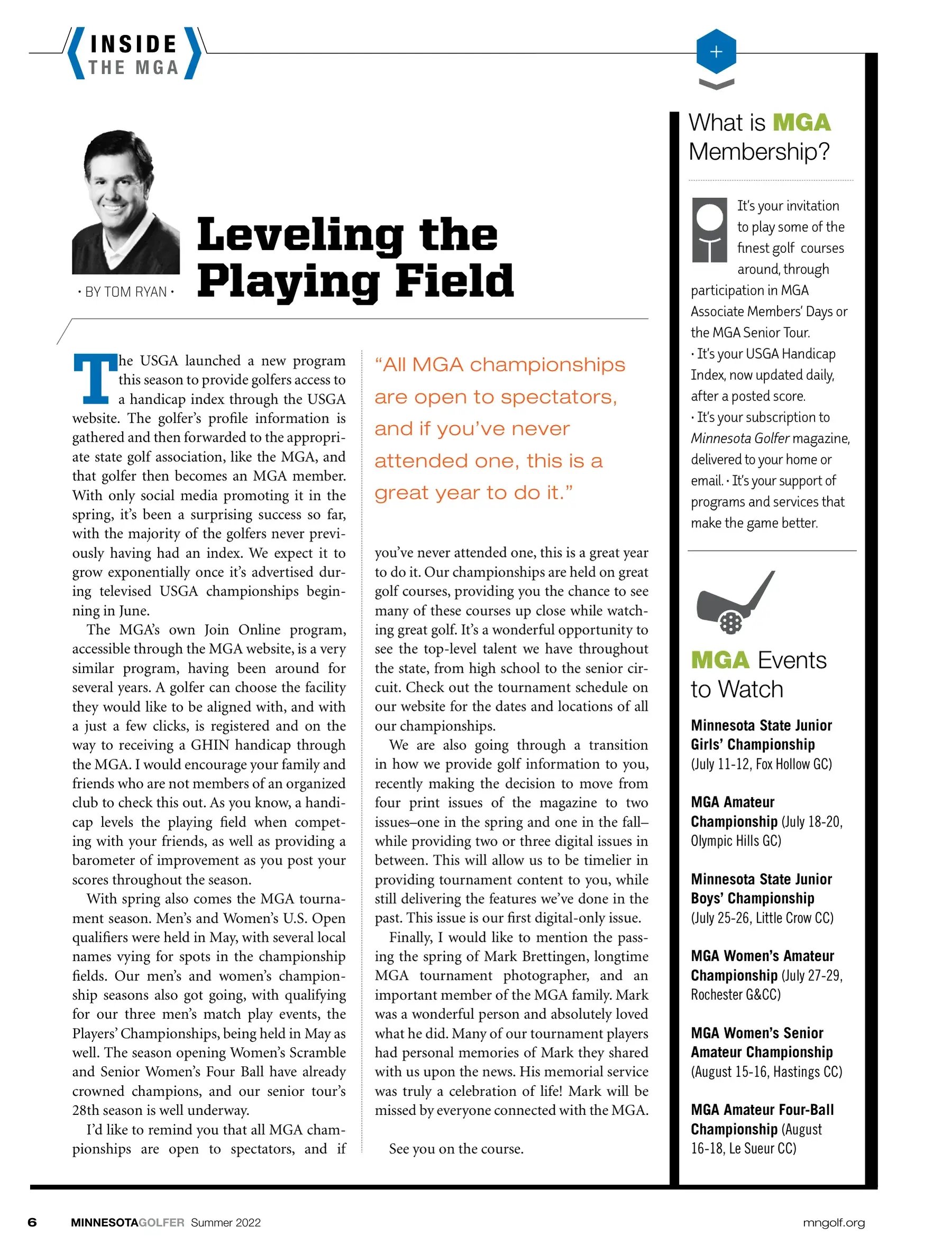
• BY TOM RYAN • Leveling the Playing Field MGA Events to Watch Minnesota State Junior Girls’ Championship (July 11-12, Fox Hollow GC) MGA Amateur Championship (July 18-20, Olympic Hills GC) Minnesota State Junior Boys’ Championship (July 25-26, Little Crow CC) MGA Women’s Amateur Championship (July 27-29, Rochester G&CC) MGA Women’s Senior Amateur Championship (August 15-16, Hastings CC) MGA Amateur Four-Ball Championship (August 16-18, Le Sueur CC) “All MGA championships are open to spectators, and if you’ve never attended one, this is a great year to do it.”
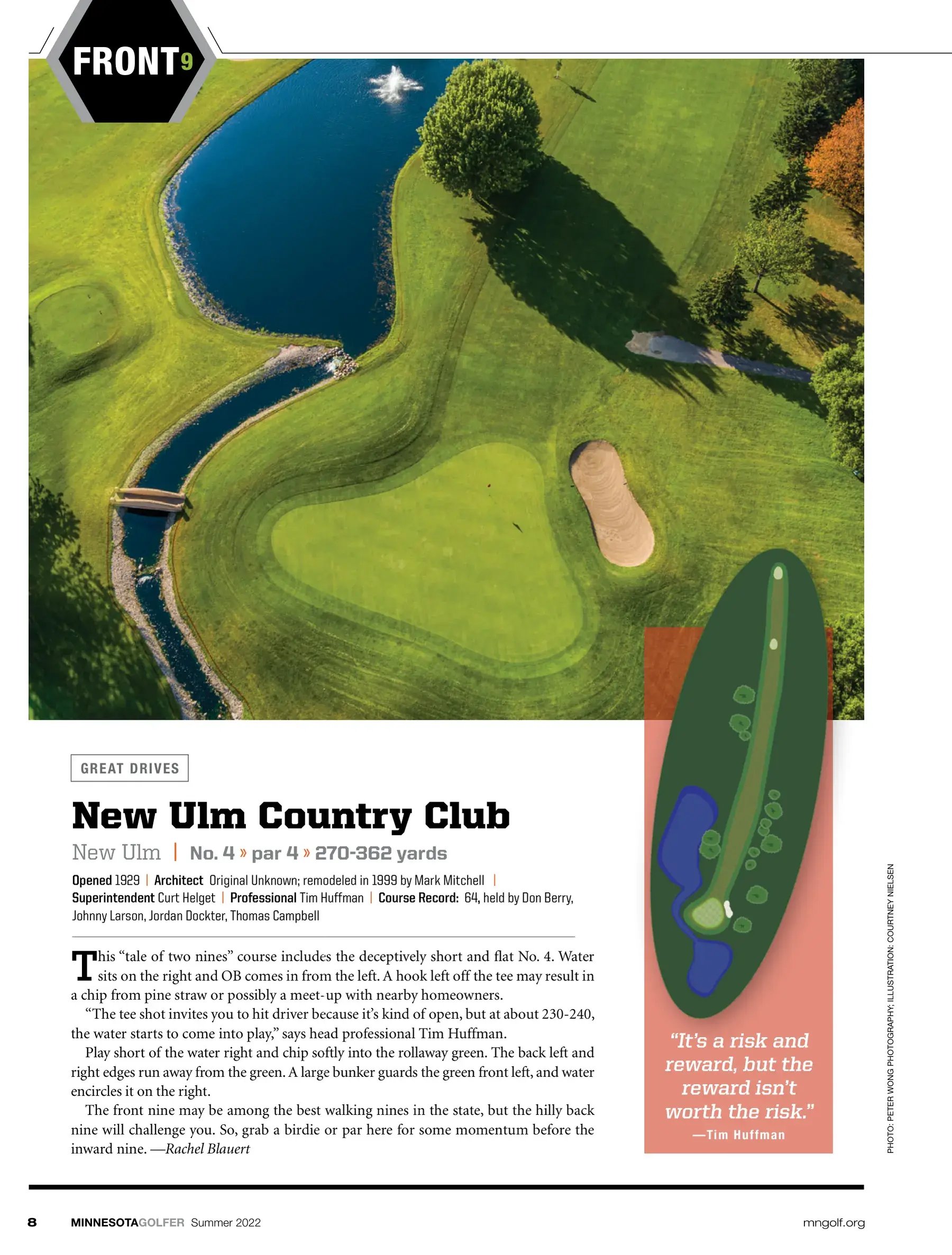
“The tee shot invites you to hit driver because it’s kind of open, but at about 230-240, the water starts to come into play,” says head professional Tim Huffman.
Play short of the water right and chip softly into the rollaway green. The back left and right edges run away from the green. A large bunker guards the green front left, and water encircles it on the right.
The front nine may be among the best walking nines in the state, but the hilly back nine will challenge you. So, grab a birdie or par here for some momentum before the inward nine. —Rachel Blauert New Ulm Country Club New Ulm | No. 4 » par 4 » 270-362 yards Opened 1929 | Architect Original Unknown; remodeled in 1999 by Mark Mitchell | Superintendent Curt Helget | Professional Tim Huffman | Course Record: 64, held by Don Berry, Johnny Larson, Jordan Dockter, Thomas Campbell GREAT DRIVES “It’s a risk and reward, but the reward isn’t worth the risk.”
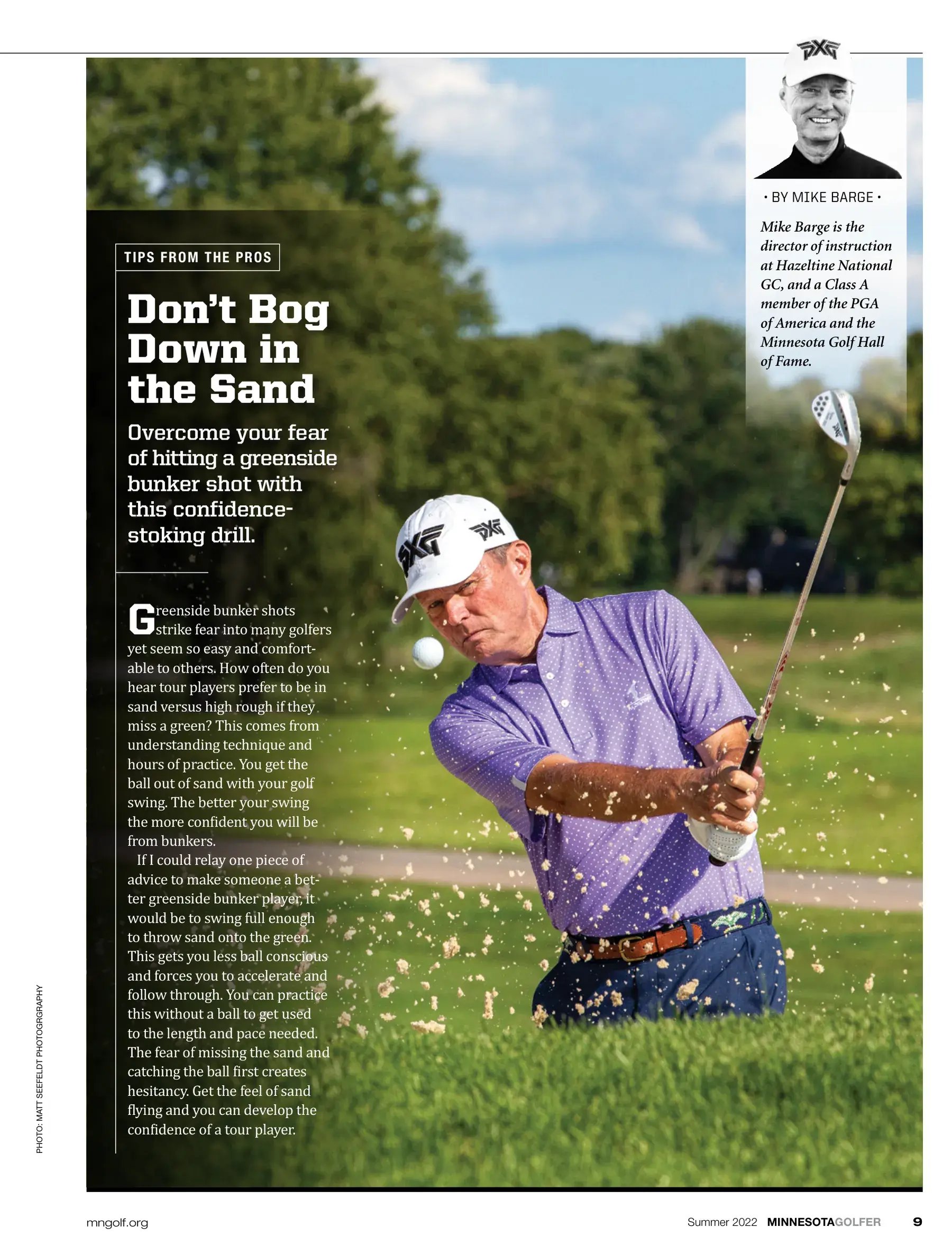
Don’t Bog Down in the Sand Overcome your fear of hitting a greenside bunker shot with this confidencestoking drill. G reenside bunker shots strike fear into many golfers yet seem so easy and comfortable to others. How often do you hear tour players prefer to be in sand versus high rough if they miss a green? This comes from understanding technique and hours of practice. You get the ball out of sand with your golf swing. The better your swing the more confident you will be from bunkers.
If I could relay one piece of advice to make someone a better greenside bunker player, it would be to swing full enough to throw sand onto the green.
This gets you less ball conscious and forces you to accelerate and follow through. You can practice this without a ball to get used to the length and pace needed.
The fear of missing the sand and catching the ball first creates hesitancy. Get the feel of sand flying and you can develop the confidence of a tour player.
TIPS FROM THE PROS PHOTO: MATT SEEFELDT PHOTOGRGRAPHY W hen golf’s governing bodies released changes for modernizing and simplifying the Rules of Golf in 2019, they revisited everything in the book. That included the rules governing a lost ball or a ball hit out of bounds (OB). But those Rules were not changed.
Instead, the USGA and R&A added the option for the adoption of a Local Rule that will change the way these Rules can be handled. The lost ball and OB rules have long been troublesome for golfers who play without marshals or fans on the course to find their wayward strikes, but now Weekend Warriors out for a casual round or players in non-championship flights of local tournaments in which the Local Ruling is adopted can benefit from this Local Rule.
But before we examine the local rule, we should revisit the long-standing rules governing lost balls or balls hit OB, and that starts with recognizing that both “Lost” and “Out of Bounds” are defined terms in the Rules of Golf. (Please see sidebar for the complete definitions in the Rules Book.) A ball is lost if it is not found within three minutes after the player or his or her caddie (or in Four-Ball or Foursomes, the player’s partner or partner’s caddie) begins to search for it. A ball is out of bounds (OB) when the entire ball lies outside the boundary edge of the course.
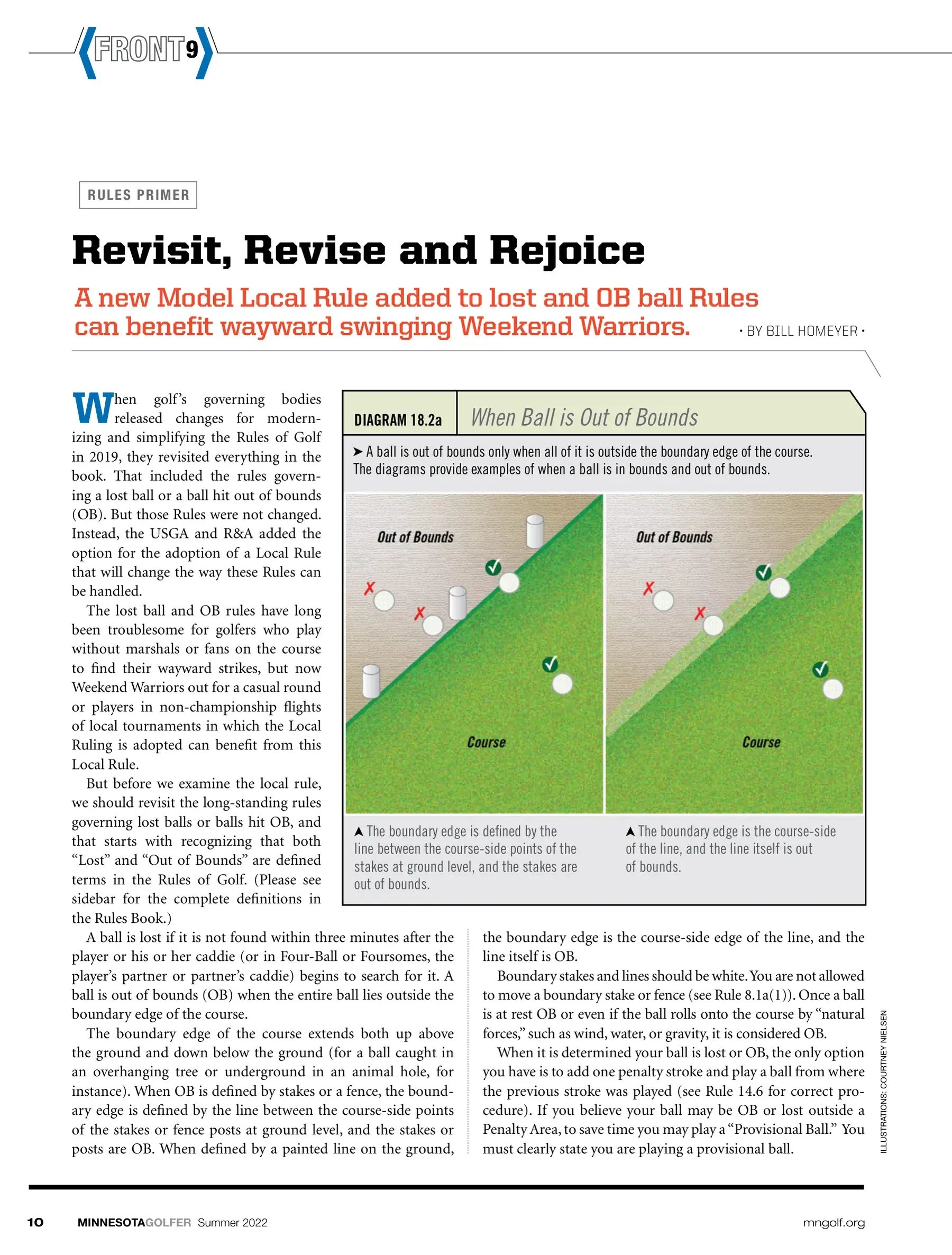
The boundary edge of the course extends both up above the ground and down below the ground (for a ball caught in an overhanging tree or underground in an animal hole, for instance). When OB is defined by stakes or a fence, the boundary edge is defined by the line between the course-side points of the stakes or fence posts at ground level, and the stakes or posts are OB. When defined by a painted line on the ground, the boundary edge is the course-side edge of the line, and the line itself is OB.
Boundary stakes and lines should be white. You are not allowed to move a boundary stake or fence (see Rule 8.1a(1)). Once a ball is at rest OB or even if the ball rolls onto the course by “natural forces,” such as wind, water, or gravity, it is considered OB.
When it is determined your ball is lost or OB, the only option you have is to add one penalty stroke and play a ball from where the previous stroke was played (see Rule 14.6 for correct procedure). If you believe your ball may be OB or lost outside a Penalty Area, to save time you may play a “Provisional Ball.” You must clearly state you are playing a provisional ball.
RULES PRIMER ILLUSTRATIONS: COURTNEY NIELSEN Revisit, Revise and Rejoice A new Model Local Rule added to lost and OB ball Rules can benefit wayward swinging Weekend Warriors.
• BY BILL HOMEYER • A ball is out of bounds only when all of it is outside the boundary edge of the course. The diagrams provide examples of when a ball is in bounds and out of bounds.
The boundary edge is defined by the line between the course-side points of the stakes at ground level, and the stakes are out of bounds. The boundary edge is the course-side of the line, and the line itself is out of bounds.
DIAGRAM 18.2a When Ball is Out of Bounds Summer 2022 MINNESOTAGOLFER 11 If your original ball is found on the course within the three-minute search period, the “Provisional Ball” must be abandoned, and you must proceed with the original ball. If your ball is not found or is OB, you must continue to play with the “Provisional Ball” which now is the ball in play.
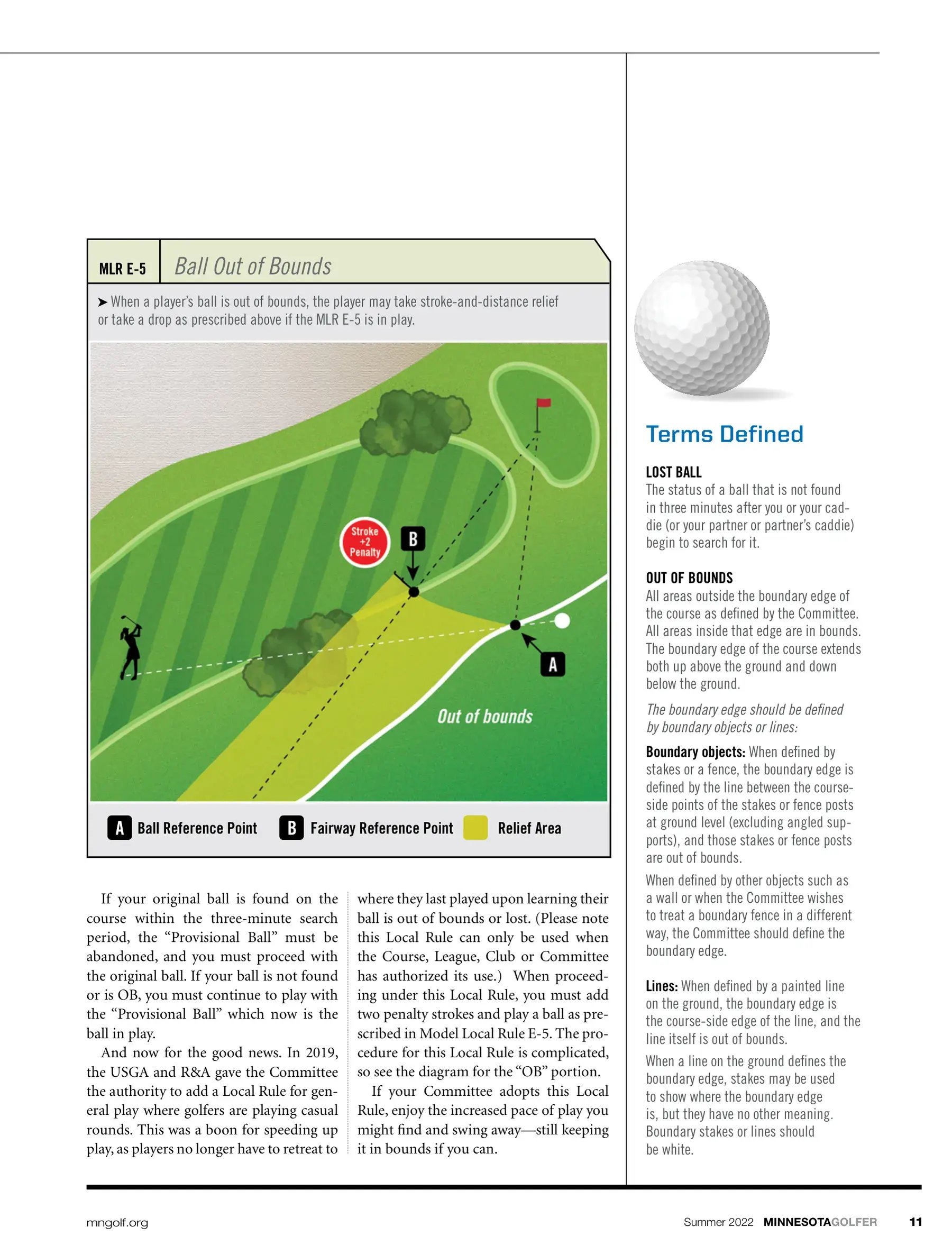
And now for the good news. In 2019, the USGA and R&A gave the Committee the authority to add a Local Rule for general play where golfers are playing casual rounds. This was a boon for speeding up play, as players no longer have to retreat to where they last played upon learning their ball is out of bounds or lost. (Please note this Local Rule can only be used when the Course, League, Club or Committee has authorized its use.) When proceeding under this Local Rule, you must add two penalty strokes and play a ball as prescribed in Model Local Rule E-5. The procedure for this Local Rule is complicated, so see the diagram for the “OB” portion.
If your Committee adopts this Local Rule, enjoy the increased pace of play you might find and swing away—still keeping it in bounds if you can.
Terms Defined LOST BALL The status of a ball that is not found in three minutes after you or your caddie (or your partner or partner’s caddie) begin to search for it.
OUT OF BOUNDS All areas outside the boundary edge of the course as defined by the Committee. All areas inside that edge are in bounds. The boundary edge of the course extends both up above the ground and down below the ground.
The boundary edge should be defined by boundary objects or lines: Boundary objects: When defined by stakes or a fence, the boundary edge is defined by the line between the courseside points of the stakes or fence posts at ground level (excluding angled supports), and those stakes or fence posts are out of bounds.
When defined by other objects such as a wall or when the Committee wishes to treat a boundary fence in a different way, the Committee should define the boundary edge.
Lines: When defined by a painted line on the ground, the boundary edge is the course-side edge of the line, and the line itself is out of bounds.
When a line on the ground defines the boundary edge, stakes may be used to show where the boundary edge is, but they have no other meaning. Boundary stakes or lines should be white.
When a player’s ball is out of bounds, the player may take stroke-and-distance relief or take a drop as prescribed above if the MLR E-5 is in play.
MLR E-5 Ball Out of Bounds A B Ball Reference Point Fairway Reference Point Relief Area Building Back Better 2nd Swing clubfitter and renowned clubmaker Larry Bobka looked to past inspiration for his new putter design.
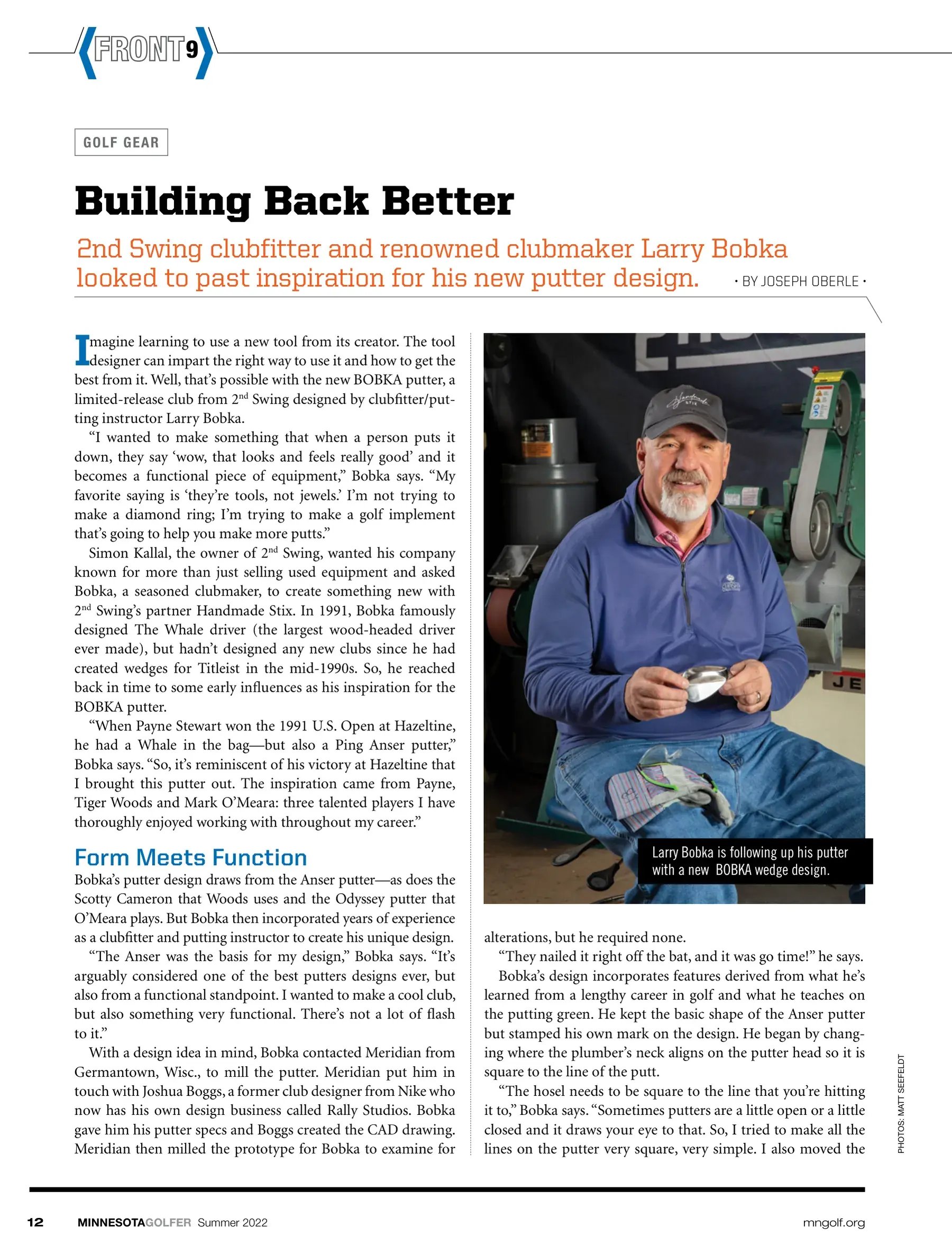
I magine learning to use a new tool from its creator. The tool designer can impart the right way to use it and how to get the best from it. Well, that’s possible with the new BOBKA putter, a limited-release club from 2nd Swing designed by clubfitter/putting instructor Larry Bobka.
“I wanted to make something that when a person puts it down, they say ‘wow, that looks and feels really good’ and it becomes a functional piece of equipment,” Bobka says. “My favorite saying is ‘they’re tools, not jewels.’ I’m not trying to make a diamond ring; I’m trying to make a golf implement that’s going to help you make more putts.”
Simon Kallal, the owner of 2nd Swing, wanted his company known for more than just selling used equipment and asked Bobka, a seasoned clubmaker, to create something new with 2nd Swing’s partner Handmade Stix. In 1991, Bobka famously designed The Whale driver (the largest wood-headed driver ever made), but hadn’t designed any new clubs since he had created wedges for Titleist in the mid-1990s. So, he reached back in time to some early influences as his inspiration for the BOBKA putter.
“When Payne Stewart won the 1991 U.S. Open at Hazeltine, he had a Whale in the bag—but also a Ping Anser putter,” Bobka says. “So, it’s reminiscent of his victory at Hazeltine that I brought this putter out. The inspiration came from Payne, Tiger Woods and Mark O’Meara: three talented players I have thoroughly enjoyed working with throughout my career.”
Form Meets Function Bobka’s putter design draws from the Anser putter—as does the Scotty Cameron that Woods uses and the Odyssey putter that O’Meara plays. But Bobka then incorporated years of experience as a clubfitter and putting instructor to create his unique design.
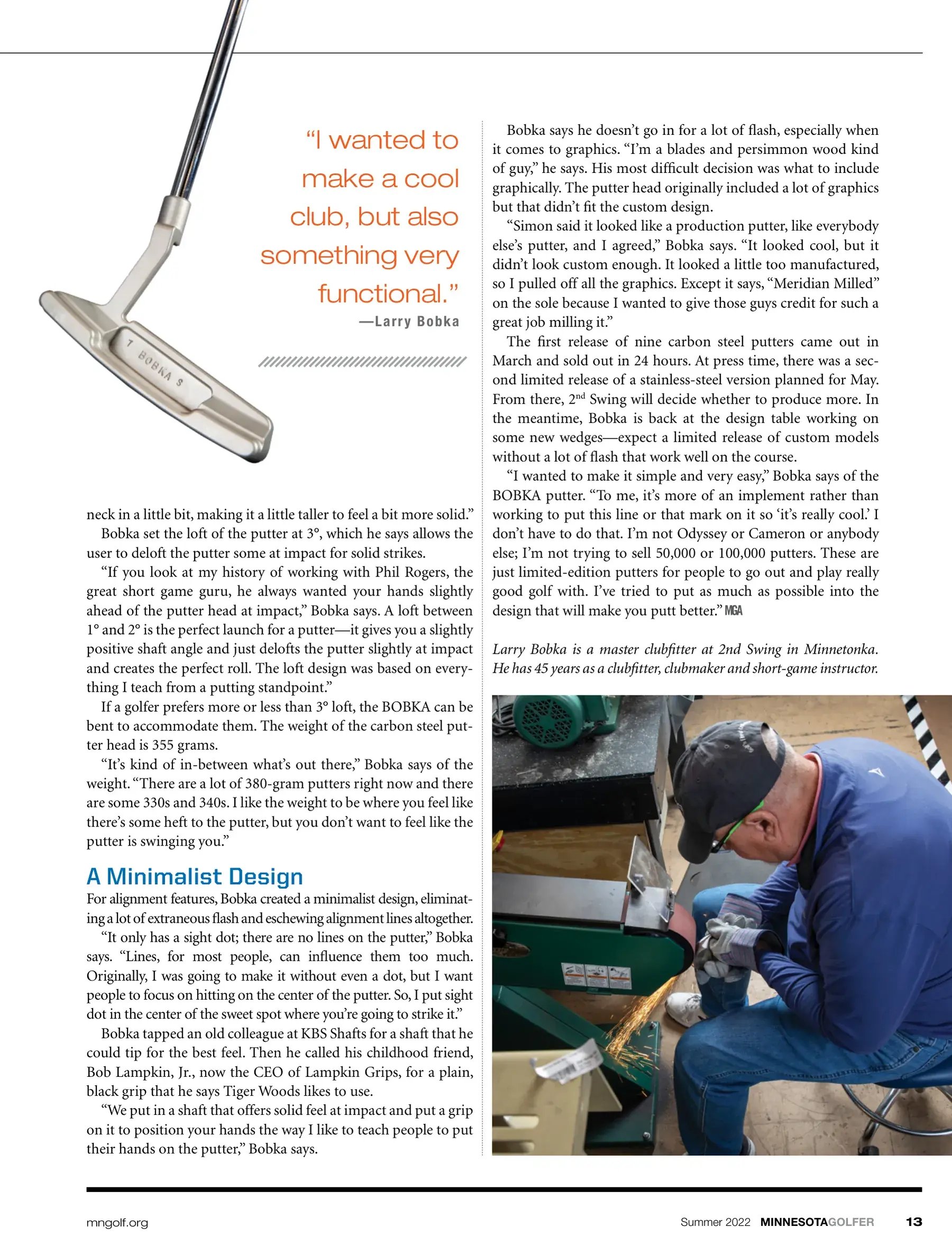
“The Anser was the basis for my design,” Bobka says. “It’s arguably considered one of the best putters designs ever, but also from a functional standpoint. I wanted to make a cool club, but also something very functional. There’s not a lot of flash to it.”
With a design idea in mind, Bobka contacted Meridian from Germantown, Wisc., to mill the putter. Meridian put him in touch with Joshua Boggs, a former club designer from Nike who now has his own design business called Rally Studios. Bobka gave him his putter specs and Boggs created the CAD drawing.
Meridian then milled the prototype for Bobka to examine for alterations, but he required none. “They nailed it right off the bat, and it was go time!” he says.
Bobka’s design incorporates features derived from what he’s learned from a lengthy career in golf and what he teaches on the putting green. He kept the basic shape of the Anser putter but stamped his own mark on the design. He began by changing where the plumber’s neck aligns on the putter head so it is square to the line of the putt.
“The hosel needs to be square to the line that you’re hitting it to,” Bobka says. “Sometimes putters are a little open or a little closed and it draws your eye to that. So, I tried to make all the lines on the putter very square, very simple. I also moved the • BY JOSEPH OBERLE • Larry Bobka is following up his putter with a new BOBKA wedge design.
PHOTOS: MATT SEEFELDT Summer 2022 MINNESOTAGOLFER 13 neck in a little bit, making it a little taller to feel a bit more solid.” Bobka set the loft of the putter at 3°, which he says allows the user to deloft the putter some at impact for solid strikes.
“If you look at my history of working with Phil Rogers, the great short game guru, he always wanted your hands slightly ahead of the putter head at impact,” Bobka says. A loft between 1° and 2° is the perfect launch for a putter—it gives you a slightly positive shaft angle and just delofts the putter slightly at impact and creates the perfect roll. The loft design was based on everything I teach from a putting standpoint.”
If a golfer prefers more or less than 3° loft, the BOBKA can be bent to accommodate them. The weight of the carbon steel putter head is 355 grams.
“It’s kind of in-between what’s out there,” Bobka says of the weight. “There are a lot of 380-gram putters right now and there are some 330s and 340s. I like the weight to be where you feel like there’s some heft to the putter, but you don’t want to feel like the putter is swinging you.”
A Minimalist Design For alignment features, Bobka created a minimalist design, eliminating a lot of extraneous flash and eschewing alignment lines altogether.
“It only has a sight dot; there are no lines on the putter,” Bobka says. “Lines, for most people, can influence them too much. Originally, I was going to make it without even a dot, but I want people to focus on hitting on the center of the putter. So, I put sight dot in the center of the sweet spot where you’re going to strike it.”
Bobka tapped an old colleague at KBS Shafts for a shaft that he could tip for the best feel. Then he called his childhood friend, Bob Lampkin, Jr., now the CEO of Lampkin Grips, for a plain, black grip that he says Tiger Woods likes to use.
“We put in a shaft that offers solid feel at impact and put a grip on it to position your hands the way I like to teach people to put their hands on the putter,” Bobka says.
Bobka says he doesn’t go in for a lot of flash, especially when it comes to graphics. “I’m a blades and persimmon wood kind of guy,” he says. His most difficult decision was what to include graphically. The putter head originally included a lot of graphics but that didn’t fit the custom design.
“Simon said it looked like a production putter, like everybody else’s putter, and I agreed,” Bobka says. “It looked cool, but it didn’t look custom enough. It looked a little too manufactured, so I pulled off all the graphics. Except it says, “Meridian Milled”
on the sole because I wanted to give those guys credit for such a great job milling it.” The first release of nine carbon steel putters came out in March and sold out in 24 hours. At press time, there was a second limited release of a stainless-steel version planned for May.
From there, 2nd Swing will decide whether to produce more. In the meantime, Bobka is back at the design table working on some new wedges—expect a limited release of custom models without a lot of flash that work well on the course.
“I wanted to make it simple and very easy,” Bobka says of the BOBKA putter. “To me, it’s more of an implement rather than working to put this line or that mark on it so ‘it’s really cool.’ I don’t have to do that. I’m not Odyssey or Cameron or anybody else; I’m not trying to sell 50,000 or 100,000 putters. These are just limited-edition putters for people to go out and play really good golf with. I’ve tried to put as much as possible into the design that will make you putt better.”
Larry Bobka is a master clubfitter at 2nd Swing in Minnetonka. He has 45 years as a clubfitter, clubmaker and short-game instructor. “I wanted to make a cool club, but also something very functional.”
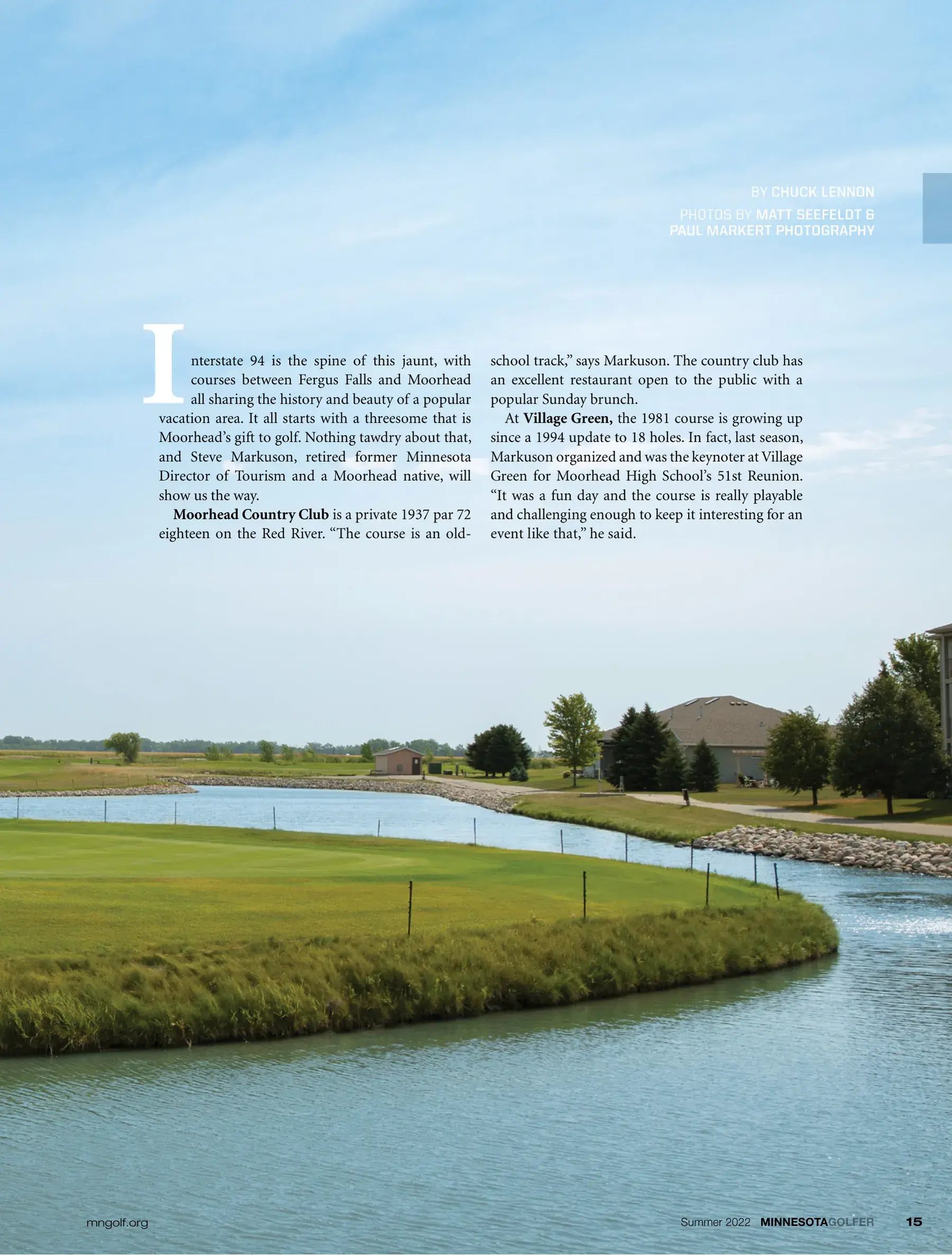
—Larry Bobka A River Runs Through It MEADOWS GOLF COURSE The I-94 tour is a grand drive to the northwest for great golf, food, attractions and unique topography along the Red River Valley.
Summer 2022 MINNESOTAGOLFER 15 BY CHUCK LENNON PHOTOS BY MATT SEEFELDT & PAUL MARKERT PHOTOGRAPHY nterstate 94 is the spine of this jaunt, with courses between Fergus Falls and Moorhead all sharing the history and beauty of a popular vacation area. It all starts with a threesome that is Moorhead’s gift to golf. Nothing tawdry about that, and Steve Markuson, retired former Minnesota Director of Tourism and a Moorhead native, will show us the way.
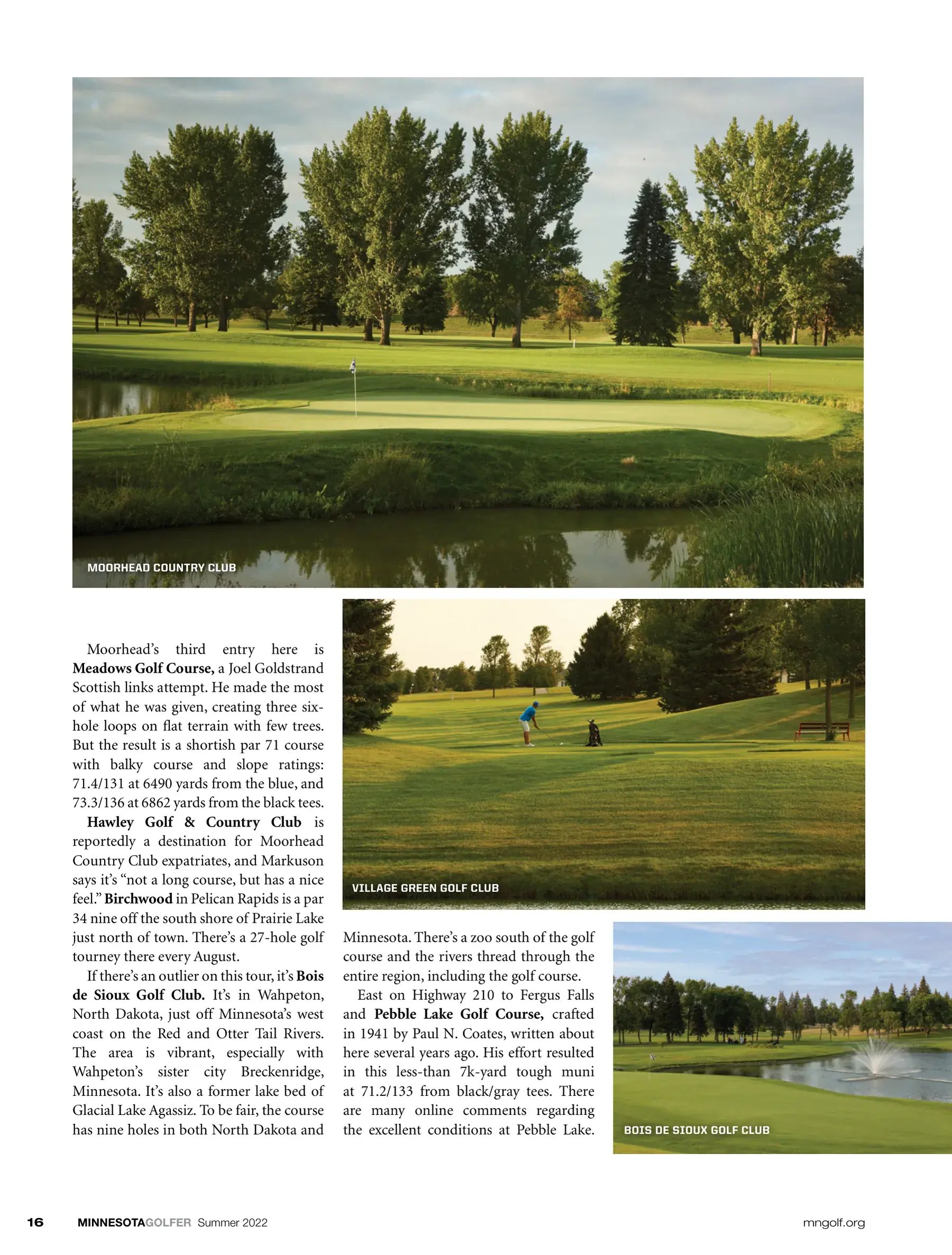
Moorhead Country Club is a private 1937 par 72 eighteen on the Red River. “The course is an oldschool track,” says Markuson. The country club has an excellent restaurant open to the public with a popular Sunday brunch.
At Village Green, the 1981 course is growing up since a 1994 update to 18 holes. In fact, last season, Markuson organized and was the keynoter at Village Green for Moorhead High School’s 51st Reunion.
“It was a fun day and the course is really playable and challenging enough to keep it interesting for an event like that,” he said. Moorhead’s third entry here is Meadows Golf Course, a Joel Goldstrand Scottish links attempt. He made the most of what he was given, creating three sixhole loops on flat terrain with few trees.
But the result is a shortish par 71 course with balky course and slope ratings: 71.4/131 at 6490 yards from the blue, and 73.3/136 at 6862 yards from the black tees.
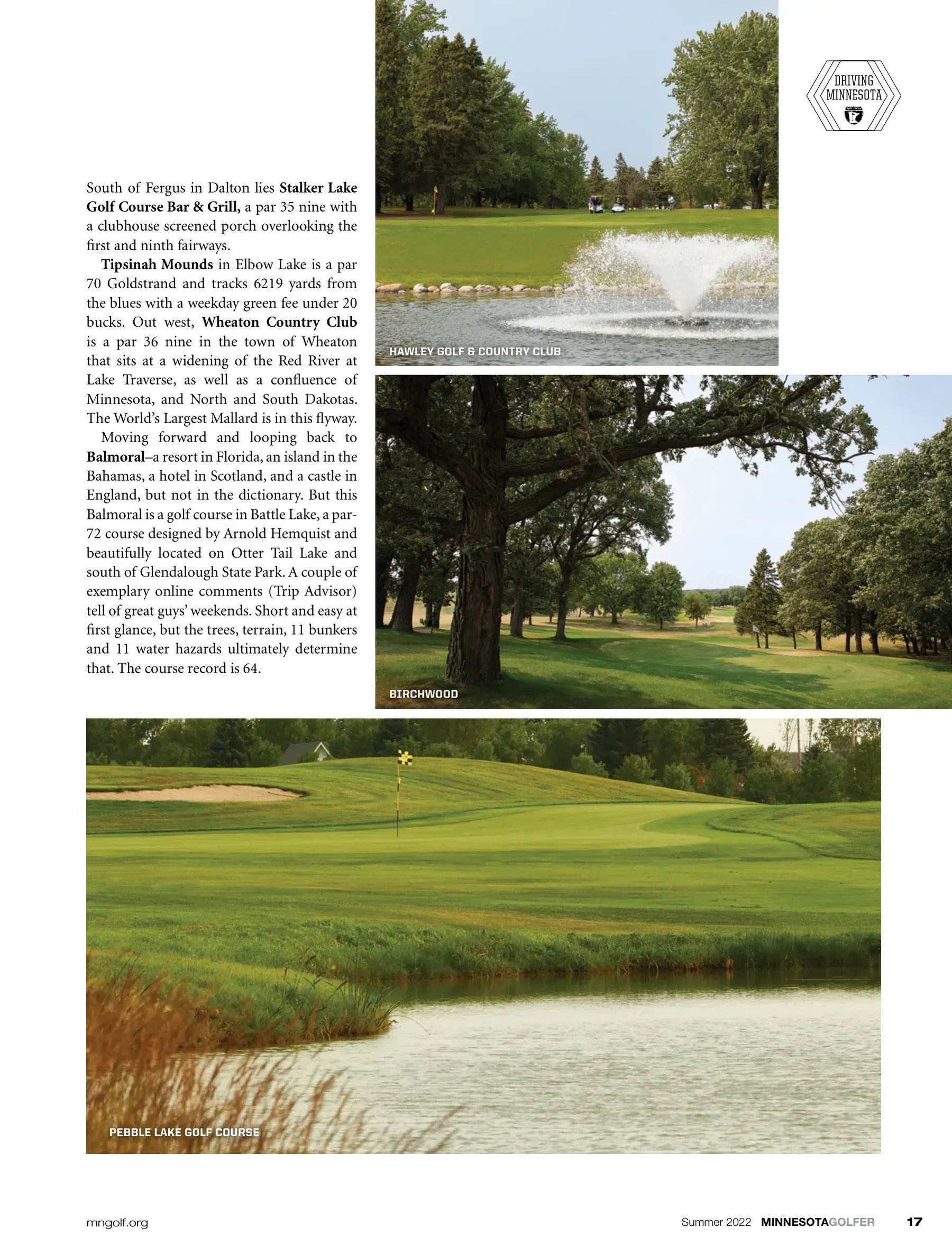
Hawley Golf & Country Club is reportedly a destination for Moorhead Country Club expatriates, and Markuson says it’s “not a long course, but has a nice feel.” Birchwood in Pelican Rapids is a par 34 nine off the south shore of Prairie Lake just north of town. There’s a 27-hole golf tourney there every August.
If there’s an outlier on this tour, it’s Bois de Sioux Golf Club. It’s in Wahpeton, North Dakota, just off Minnesota’s west coast on the Red and Otter Tail Rivers.
The area is vibrant, especially with Wahpeton’s sister city Breckenridge, Minnesota. It’s also a former lake bed of Glacial Lake Agassiz. To be fair, the course has nine holes in both North Dakota and Minnesota. There’s a zoo south of the golf course and the rivers thread through the entire region, including the golf course.
East on Highway 210 to Fergus Falls and Pebble Lake Golf Course, crafted in 1941 by Paul N. Coates, written about here several years ago. His effort resulted in this less-than 7k-yard tough muni at 71.2/133 from black/gray tees. There are many online comments regarding the excellent conditions at Pebble Lake.
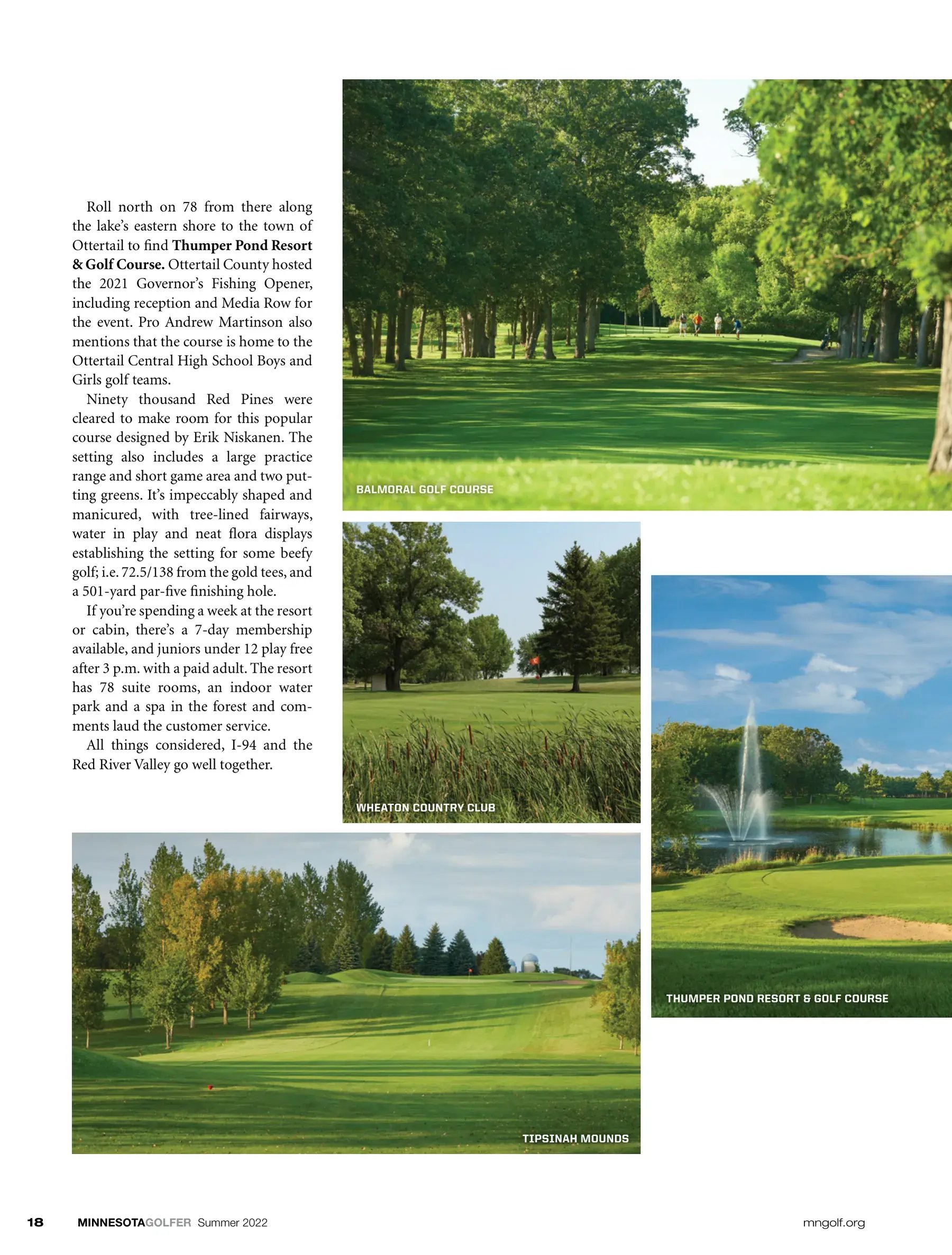
Tipsinah Mounds in Elbow Lake is a par 70 Goldstrand and tracks 6219 yards from the blues with a weekday green fee under 20 bucks. Out west, Wheaton Country Club is a par 36 nine in the town of Wheaton that sits at a widening of the Red River at Lake Traverse, as well as a confluence of Minnesota, and North and South Dakotas.
The World’s Largest Mallard is in this flyway. Moving forward and looping back to Balmoral–a resort in Florida, an island in the Bahamas, a hotel in Scotland, and a castle in England, but not in the dictionary. But this Balmoral is a golf course in Battle Lake, a par72 course designed by Arnold Hemquist and beautifully located on Otter Tail Lake and south of Glendalough State Park. A couple of exemplary online comments (Trip Advisor) tell of great guys’ weekends. Short and easy at first glance, but the trees, terrain, 11 bunkers and 11 water hazards ultimately determine that. The course record is 64.
TIPSINAH MOUNDS THUMPER POND RESORT & GOLF COURSE WHEATON COUNTRY CLUB BALMORAL GOLF COURSE Roll north on 78 from there along the lake’s eastern shore to the town of Ottertail to find Thumper Pond Resort & Golf Course. Ottertail County hosted the 2021 Governor’s Fishing Opener, including reception and Media Row for the event. Pro Andrew Martinson also mentions that the course is home to the Ottertail Central High School Boys and Girls golf teams.
Ninety thousand Red Pines were cleared to make room for this popular course designed by Erik Niskanen. The setting also includes a large practice range and short game area and two putting greens. It’s impeccably shaped and manicured, with tree-lined fairways, water in play and neat flora displays establishing the setting for some beefy golf; i.e. 72.5/138 from the gold tees, and a 501-yard par-five finishing hole.
If you’re spending a week at the resort or cabin, there’s a 7-day membership available, and juniors under 12 play free after 3 p.m. with a paid adult. The resort has 78 suite rooms, an indoor water park and a spa in the forest and comments laud the customer service.
All things considered, I-94 and the Red River Valley go well together. Summer 2022 MINNESOTAGOLFER 19 I-94 Tour RESTAURANTS Moorhead The Boulder Taphouse Rustica Eatery & Tavern Mezzaluna HoDo Lounge Hawley The Whistle Stop Breckenridge Bois de Sioux Grill Room The Wilkin Fergus Falls Viking Cafe Grey Duck Grill The Fabled Farmer Elbow Lake Hans House Knotty Pine Bar & Grill Furious Farmer Wheaton Dumont Bar & Grill Black Sheep Burger Battle Lake Shoreline Restaurant Bar & Bowl Battle Lake Boathouse Rusty Nail Stevelys Steakhouse Ottertail Willie T’s Tavern & Grill Thumper Pond Resort The Woodshed Bar & Grill Betty’s Pantry WINERIES & BREWPUBS Moorhead Swing Barrel Brewing Fergus Falls Fergus Brewing Company Outstate Brewing Elbow Lake Burr Vineyards EVENTS See events listings for cities on this tour at exploreminnesota.com/ events.
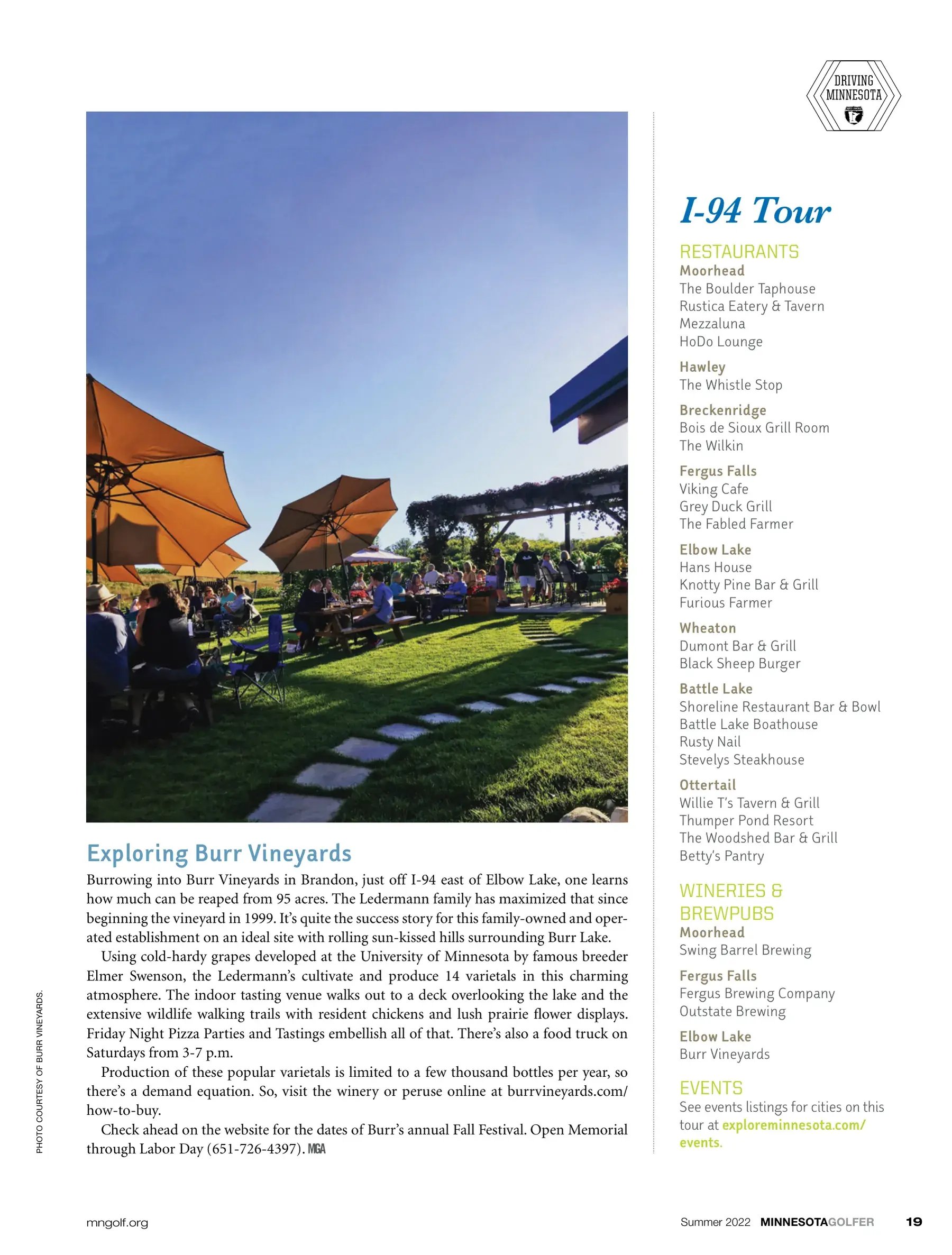
Exploring Burr Vineyards Burrowing into Burr Vineyards in Brandon, just off I-94 east of Elbow Lake, one learns how much can be reaped from 95 acres. The Ledermann family has maximized that since beginning the vineyard in 1999. It’s quite the success story for this family-owned and operated establishment on an ideal site with rolling sun-kissed hills surrounding Burr Lake.
Using cold-hardy grapes developed at the University of Minnesota by famous breeder Elmer Swenson, the Ledermann’s cultivate and produce 14 varietals in this charming atmosphere. The indoor tasting venue walks out to a deck overlooking the lake and the extensive wildlife walking trails with resident chickens and lush prairie flower displays.
Friday Night Pizza Parties and Tastings embellish all of that. There’s also a food truck on Saturdays from 3-7 p.m. Production of these popular varietals is limited to a few thousand bottles per year, so there’s a demand equation. So, visit the winery or peruse online at burrvineyards.com/ how-to-buy.
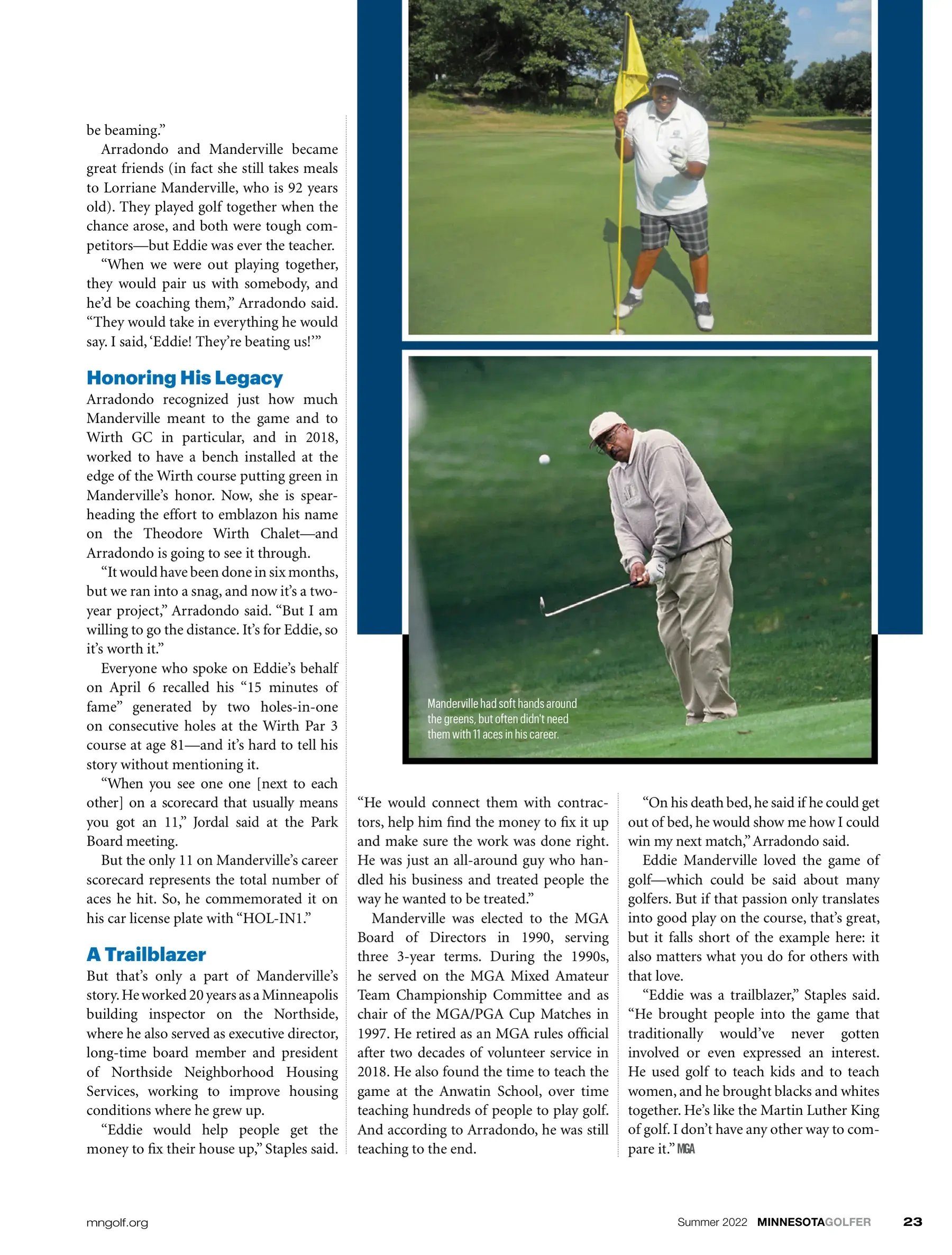
ocal golf icon “Fast Eddie” Manderville was known to enjoy a money game when playing a round or putting for quarters on Theodore Wirth GC practice green. According to his cousin, Jamez Staples, he was an “equal opportunist” when it came to identifying a mark and fleecing them with his smooth putting stroke. Perhaps the better hustle was that Eddie’s marks still appreciate him long after he took their money—because his legacy in the game far outpaces his reputation for mining his competitor’s quarters.
Case in point: On April 6, the Minneapolis Park Board held an open hearing on a proposal to rename the Wirth GC chalet for Eddie Manderville (who died in 2020 at age 88), and several people stood up in the crowded hearing room (many were also on hand to comment on the future of Hiawatha GC) to give testimony in support of the measure. Doug Jordal said the following: “I have been playing golf for a long time and I had the privilege of playing with Eddie Manderville many times. I am honored to be here to speak in favor of renaming the chalet the ‘Eddie Manderville Chalet.’ He was a great guy. I remember losing lots of money to him on the putting green.”
By all accounts, to know Eddie Manderville was to be his friend—not because he created the weekly gathering of the WPA (Wirth Putting Association) to relieve his friends of their spare change, but he was a character and one who treated everyone with respect and friendship.
Manderville grew up a talented archer and boxer in North Minneapolis and he stayed a friend and ally to the area his entire life. “He was just really a kind, gentle guy,” said Henry Crosby of his friend. “The last time I was out with him, my grandsons came along and he was so kind to them to encourage them to maybe hang around with Grandpa and play a little golf. He was a very classy A local golfer known for his putting wagers turned his love for the game into much more for his community.
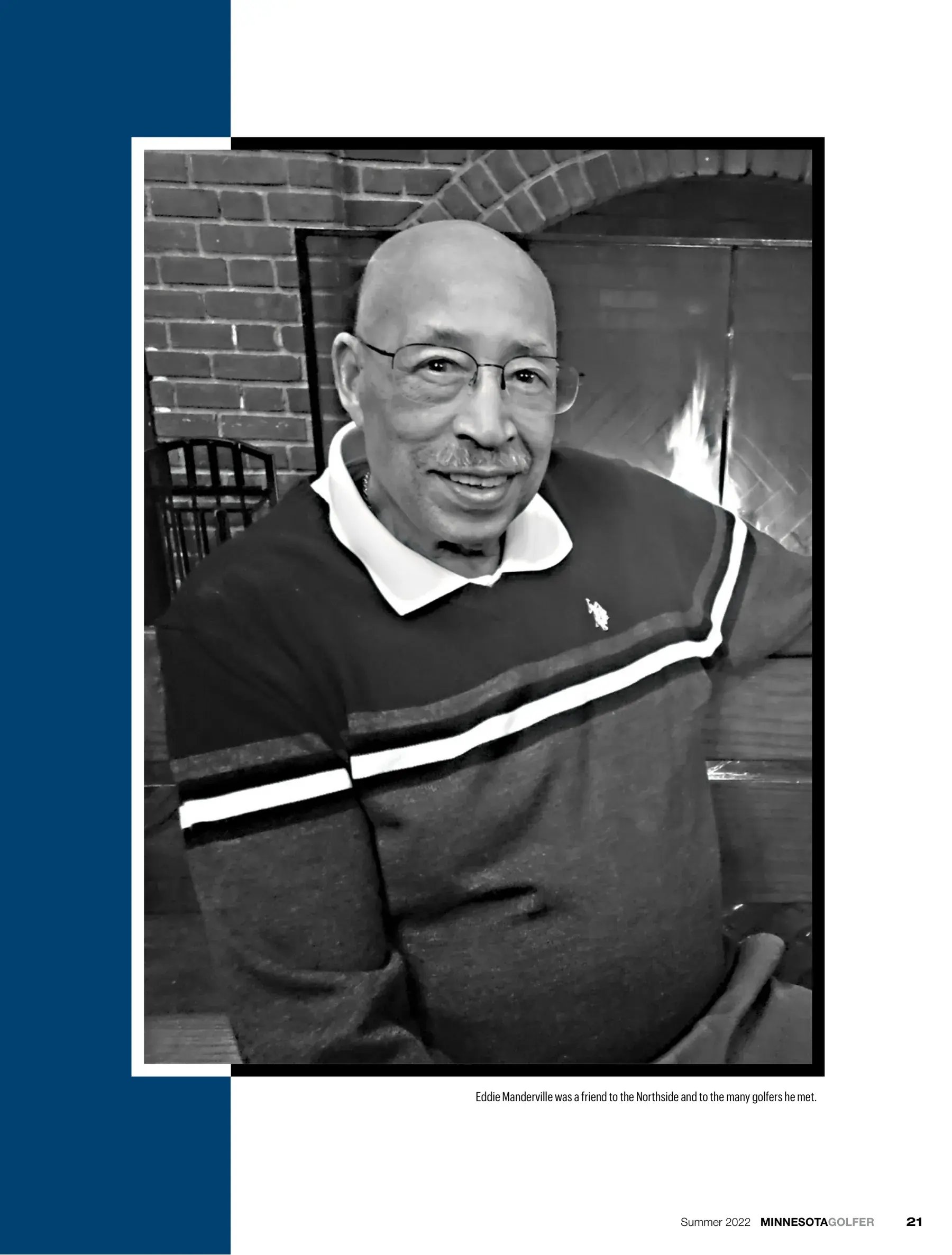
By Joseph Oberle Making Change Edward “Eddie” Manderville, 1932-2020 L Summer 2022 MINNESOTAGOLFER 21 Eddie Manderville was a friend to the Northside and to the many golfers he met.
guy. I’ve never heard anything derogatory from him; he was always upbeat and uplifting. Spiritually, he was grounded in his own way, but he loved the Northside and loved the people who played golf with him.”
Breaking Barriers Manderville discovered golf at age 26 when the game took hold of him, and he quickly played it with increasing skill. But doing so was not easy for an African American golfer. Manderville had to break into the game—which took courage, determination and a winning personality. But challenging norms was nothing new to him; Manderville married his wife (of 60 years), Lorraine, a white woman, at a time when that was looked down upon.
He told his black friends he was going to join a men’s club when that, too, wasn’t done. But he ultimately was credited with integrating the men’s club at Wirth GC at a time when most Twin Cities golf clubs didn’t allow black members.
“That speaks to the personality and character of Eddie,” Staples said. “He’s going to walk up and he’s going to smile and he’s going to talk to you. I know some people are confrontational; he wasn’t confrontational at all. He wanted it all to be easy-going, ‘let’s have a good time.’ Eddie liked to have a good time.”
Once in the door, Manderville became a fixture at the course. And when the other members saw him play, they were even more impressed. Manderville had big, strong hands that helped him hit the ball a long way. But they were soft and effective at “putting for dough.” And in the game of golf, those two skills can be a lethal combination and Manderville’s golf resume is proof: He won the 1972 Gross Invitational with his first sub-par round in competition, a 2-under 69. He also won the 1983 MPGA Senior Public Links Championship and the 1987 MGA Senior Amateur Four-Ball Championship’s senior division title with partner Dick Bolin. Manderville qualified and played in the U.S. Senior Open (1986), and the U.S. Senior Amateur (1991), he finished runner-up five out of six years at the Upper Midwest Bronze Amateur (1985-1991) and he won on the MGA Senior Tour (1998).
As Manderville’s golf prowess increased, he began spreading the wealth of that knowledge as a local instructor. Among many of his students was Crosby, former senior director for equity and development for the YMCA, greater Twin Cities (now retired), who was on hand at the Park Board meeting in support of his golf teacher. Though Manderville never won the Bronze tournament championship, Crosby felt his name is still associated with it for other reasons.
“There were courses we couldn’t even go to golf,” Crosby said. “You hear the stories about the Bronze, where people came into town and they weren’t allowed to stay in the hotels. But people like Eddie were in town, and he was able to help them navigate. If somebody needed a place to stay, Eddie would say ‘call Miss Brown, she’s got an extra room. She can give you a meal.’ It’s those kinds of humanitarian things that people can sometimes overlook because they don’t know the history.
But we played out at Hiawatha, and we played at Theodore Wirth and he was the guy. It was an honor to know him; that’s why I am here tonight.”
A Passion for Teaching Manderville loved the game and soon sowed that love as an instructor like a local Johnny Appleseed of golf. He could be seen at Hiawatha and Wirth or on the Columbia GC driving range, working with his students.
“He would analyze our swings as we hit the ball and would comment on how to position ourselves with each club,” Crosby said. “He would just kind of strip you naked about things you were doing wrong. And he wasn’t doing it for the money; that’s not who Eddie was. He just loved the game.”
One of Manderville’s students, Martha Arradondo, became quite accomplished in golf. Arradondo, an event planner by trade and an excellent racquetball player, won the Bronze Tournament twice. But she also, along with her friend Shirley Hughes (daughter of another local golf icon Solomon Hughes), founded the Black Women on Course (BWOC) league.
And those accomplishments would have been difficult to achieve without the assistance of Eddie Manderville. “He was a dear, dear friend. I met Eddie about 12 years ago and, at that time, I was just learning golf and someone told me about him,” Arradondo said. “I was at Brookview by myself with all these old guys golfing every morning—that’s when I met Eddie, and we just kind of clicked.
I told him I’m going to start an African American women’s golf league because I don’t know any other African American women in Minnesota who golf.”
But Manderville did, and he made the introductions, and soon the BWOC was formed. Manderville conducted clinics for the women and provided golf instruction and the program grew. Today, Arradondo has a database of nearly 135 women who have played golf through the BWOC. Manderville often attended their tournaments to see how “his girls” were playing and was always a great supporter of the BWOC.
“Eddie would take the ladies to 2nd Swing to help them buy clubs,” Arradondo said. “He would call us ‘his girls.’ He was like the Charlie of “Charlie’s Angels”
to us. He was so proud of us. He would watch us in tournaments and he would Eddie was a trailblazer. He brought people into the game that traditionally would’ve never gotten involved or even expressed an interest.”
—JAMEZ STAPLES Summer 2022 MINNESOTAGOLFER 23 be beaming.” Arradondo and Manderville became great friends (in fact she still takes meals to Lorriane Manderville, who is 92 years old). They played golf together when the chance arose, and both were tough competitors—but Eddie was ever the teacher.
“When we were out playing together, they would pair us with somebody, and he’d be coaching them,” Arradondo said. “They would take in everything he would say. I said, ‘Eddie! They’re beating us!’”
Honoring His Legacy Arradondo recognized just how much Manderville meant to the game and to Wirth GC in particular, and in 2018, worked to have a bench installed at the edge of the Wirth course putting green in Manderville’s honor. Now, she is spearheading the effort to emblazon his name on the Theodore Wirth Chalet—and Arradondo is going to see it through.
“It would have been done in six months, but we ran into a snag, and now it’s a twoyear project,” Arradondo said. “But I am willing to go the distance. It’s for Eddie, so it’s worth it.”
Everyone who spoke on Eddie’s behalf on April 6 recalled his “15 minutes of fame” generated by two holes-in-one on consecutive holes at the Wirth Par 3 course at age 81—and it’s hard to tell his story without mentioning it.
“When you see one one [next to each other] on a scorecard that usually means you got an 11,” Jordal said at the Park Board meeting. But the only 11 on Manderville’s career scorecard represents the total number of aces he hit. So, he commemorated it on his car license plate with “HOL-IN1.”
A Trailblazer But that’s only a part of Manderville’s story. He worked 20 years as a Minneapolis building inspector on the Northside, where he also served as executive director, long-time board member and president of Northside Neighborhood Housing Services, working to improve housing conditions where he grew up.
“Eddie would help people get the money to fix their house up,” Staples said. “He would connect them with contractors, help him find the money to fix it up and make sure the work was done right.
He was just an all-around guy who handled his business and treated people the way he wanted to be treated.” Manderville was elected to the MGA Board of Directors in 1990, serving three 3-year terms. During the 1990s, he served on the MGA Mixed Amateur Team Championship Committee and as chair of the MGA/PGA Cup Matches in 1997. He retired as an MGA rules official after two decades of volunteer service in 2018. He also found the time to teach the game at the Anwatin School, over time teaching hundreds of people to play golf.
And according to Arradondo, he was still teaching to the end. “On his death bed, he said if he could get out of bed, he would show me how I could win my next match,” Arradondo said.
Eddie Manderville loved the game of golf—which could be said about many golfers. But if that passion only translates into good play on the course, that’s great, but it falls short of the example here: it also matters what you do for others with that love.
“Eddie was a trailblazer,” Staples said. “He brought people into the game that traditionally would’ve never gotten involved or even expressed an interest.
He used golf to teach kids and to teach women, and he brought blacks and whites together. He’s like the Martin Luther King of golf. I don’t have any other way to compare it.”
Joe to add captions Manderville had soft hands around the greens, but often didn't need them with 11 aces in his career. Who to Watch S ince 2007, the MGA website has tracked, or at least attempted to track, all the players with Minnesota connections who were playing on professional tours, small or large, and called it “How They’re Doing (HTD).”
At the time, there were quite a few of the smaller tours, such as the Gateway—which, in 2011, had 14 players listed in How They’re Doing—the Hooters Tour, the Adams Tour and the Space Coast Tour. Those tours are all gone.
Now there are mainly the PGA Tour and the other two tours that it operates, the Champions and Korn Ferry, plus the two main women’s tours, the LPGA and its developmental tour, the Epson, which was the Symetra last year.
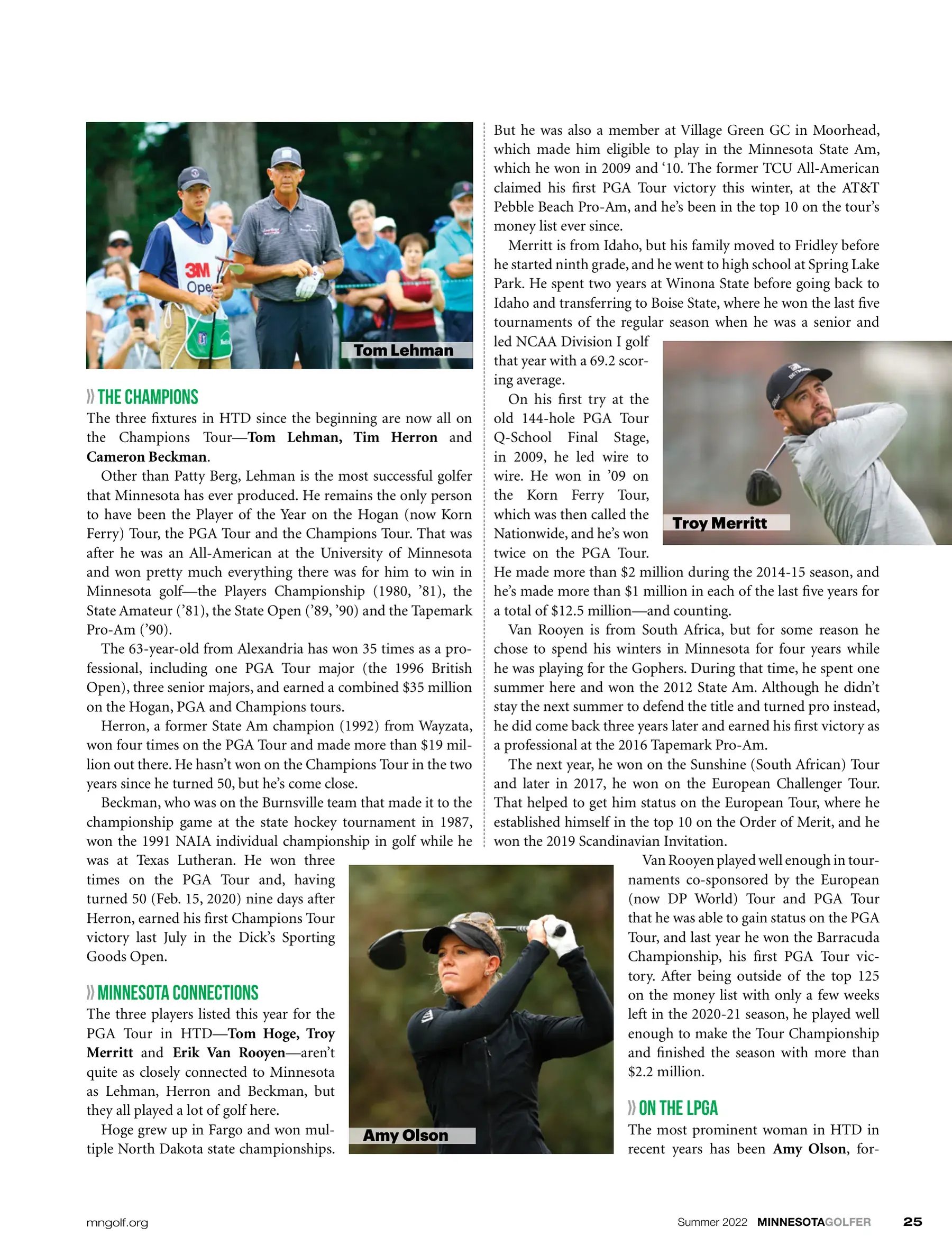
Betsy Kelly Epson Tour A look at how players with Minnesota connections are doing on professional tours. By Mike Fermoyle Summer 2022 MINNESOTAGOLFER 25 The Champions The three fixtures in HTD since the beginning are now all on the Champions Tour—Tom Lehman, Tim Herron and Cameron Beckman.
Other than Patty Berg, Lehman is the most successful golfer that Minnesota has ever produced. He remains the only person to have been the Player of the Year on the Hogan (now Korn Ferry) Tour, the PGA Tour and the Champions Tour. That was after he was an All-American at the University of Minnesota and won pretty much everything there was for him to win in Minnesota golf—the Players Championship (1980, ’81), the State Amateur (’81), the State Open (’89, ’90) and the Tapemark Pro-Am (’90).
The 63-year-old from Alexandria has won 35 times as a professional, including one PGA Tour major (the 1996 British Open), three senior majors, and earned a combined $35 million on the Hogan, PGA and Champions tours.
Herron, a former State Am champion (1992) from Wayzata, won four times on the PGA Tour and made more than $19 million out there. He hasn’t won on the Champions Tour in the two years since he turned 50, but he’s come close.
Beckman, who was on the Burnsville team that made it to the championship game at the state hockey tournament in 1987, won the 1991 NAIA individual championship in golf while he was at Texas Lutheran. He won three times on the PGA Tour and, having turned 50 (Feb. 15, 2020) nine days after Herron, earned his first Champions Tour victory last July in the Dick’s Sporting Goods Open.
Minnesota Connections The three players listed this year for the PGA Tour in HTD—Tom Hoge, Troy Merritt and Erik Van Rooyen—aren’t quite as closely connected to Minnesota as Lehman, Herron and Beckman, but they all played a lot of golf here.
Hoge grew up in Fargo and won multiple North Dakota state championships. But he was also a member at Village Green GC in Moorhead, which made him eligible to play in the Minnesota State Am, which he won in 2009 and ‘10. The former TCU All-American claimed his first PGA Tour victory this winter, at the AT&T Pebble Beach Pro-Am, and he’s been in the top 10 on the tour’s money list ever since.
Merritt is from Idaho, but his family moved to Fridley before he started ninth grade, and he went to high school at Spring Lake Park. He spent two years at Winona State before going back to Idaho and transferring to Boise State, where he won the last five tournaments of the regular season when he was a senior and led NCAA Division I golf that year with a 69.2 scoring average.
On his first try at the old 144-hole PGA Tour Q-School Final Stage, in 2009, he led wire to wire. He won in ’09 on the Korn Ferry Tour, which was then called the Nationwide, and he’s won twice on the PGA Tour.
He made more than $2 million during the 2014-15 season, and he’s made more than $1 million in each of the last five years for a total of $12.5 million—and counting.
Van Rooyen is from South Africa, but for some reason he chose to spend his winters in Minnesota for four years while he was playing for the Gophers. During that time, he spent one summer here and won the 2012 State Am. Although he didn’t stay the next summer to defend the title and turned pro instead, he did come back three years later and earned his first victory as a professional at the 2016 Tapemark Pro-Am.
The next year, he won on the Sunshine (South African) Tour and later in 2017, he won on the European Challenger Tour. That helped to get him status on the European Tour, where he established himself in the top 10 on the Order of Merit, and he won the 2019 Scandinavian Invitation.
Van Rooyen played well enough in tournaments co-sponsored by the European (now DP World) Tour and PGA Tour that he was able to gain status on the PGA Tour, and last year he won the Barracuda Championship, his first PGA Tour victory. After being outside of the top 125 on the money list with only a few weeks left in the 2020-21 season, he played well enough to make the Tour Championship and finished the season with more than $2.2 million.
On the LPGA The most prominent woman in HTD in recent years has been Amy Olson, forTom Lehman Troy Merritt Amy Olson merly Amy Anderson. She, like Hoge, is from North Dakota (Oxbow), but she was a two-time Minnesota PGA Junior Girls winner. Not long after she won the second of those titles, she won the 2009 U.S. Junior Girls Amateur at Trump National Bedminister, where Jordan Spieth was in the process of winning the U.S. Junior Boys Amateur.
When she was Amy Anderson and playing for North Dakota State, she set an NCAA record by winning 20 college tournaments. Although she hasn’t won on the LPGA Tour yet, she has come close twice in majors, finishing second in the 2018 Evian Championship and in the 2020 U.S. Women’s Open. In that Open, which was played at Champions Club in Houston in December, because of Covid-19, Olson led by two with four holes to go, and played the last four holes in even par. In most other years, that would have been good enough to win, but A Lim Kim birdied the last three holes to beat Olson by a single stroke.
Casey Danielson is also on the LPGA Tour this year, although she has shown a tendency to miss the cut by one shot and has yet to cash a check. Danielson, who won four consecutive Wisconsin state high school titles, earned her place on the 2022 LPGA Tour by winning twice and finishing third last year on the-then Symetra (now Epson) money list, with $114,534 in 19 events.
The Epson Tour There are now three players trying this year on the Epson Tour to duplicate Danielson’s success last year on the Symetra—Kate Smith, Kim Kaufman and Betsy Kelly. Kelly, who won a state high school championship in 2009, her senior year at Forest Lake, won’t get many chances to climb up the money list, because she has only limited status.
Smith, who won a record five state high school titles while she was at Detroit Lakes, is also a former MGA Women’s Player of the Year who capped off her senior year at Nebraska by winning the 2021 Big Ten individual championship, thanks to a closing round of 64.
Kaufman, a South Dakota native, was a regular on the LPGA Tour from 2014 through 2017, and made $1.25 million while she was at it, but she lost her fully exempt status in 2018, when she dropped out of the top 100 on the money list. Since then, she has spent most of her time on the Symentra/Epson Tour.
Sarah Burnham, the former state girls high school champ from Wayzata, was on the LPGA Tour for the combined season of 2020-21. But she finished 116th on the money list ($89,057 in 16 events), and she needed to be in the top 100 to retain full status.
All Eyes on the Canadian Tour Thomas Longbella, a former Gopher from Chippewa Falls— who won a Wisconsin state high school Division 3 championship—is a player of interest to Minnesota golf fans who will be competing on the PGA Tour Canada this summer. He tied for eighth in a Q-School at Howey in the Hills, Fla. The first tournament will be the Royal Beach Victoria Open, June 2-5, in Victoria, B.C. Longbella will be joined on the Canadian Tour by a former Minnesota state high school champ (Class AAA), Van Holmgren. In 2013, when he was an eighth-grader playing for Wayzata, the 5-foot-7 Holmgren made his first appearance at the state tournament. Four years later, as a 6-7 senior, he won the AAA title. A year later, he won the State Amateur.
Last year, as a senior at Florida Gulf Coast, he capped off the regular season by winning the Atlantic Sun Conference individual championship.
Now 6-8, Holmgren will have the distinction of being the tallest player ever to compete on the Canadian Tour, after tying for 15th in a Q-School event in Weston, Fla.
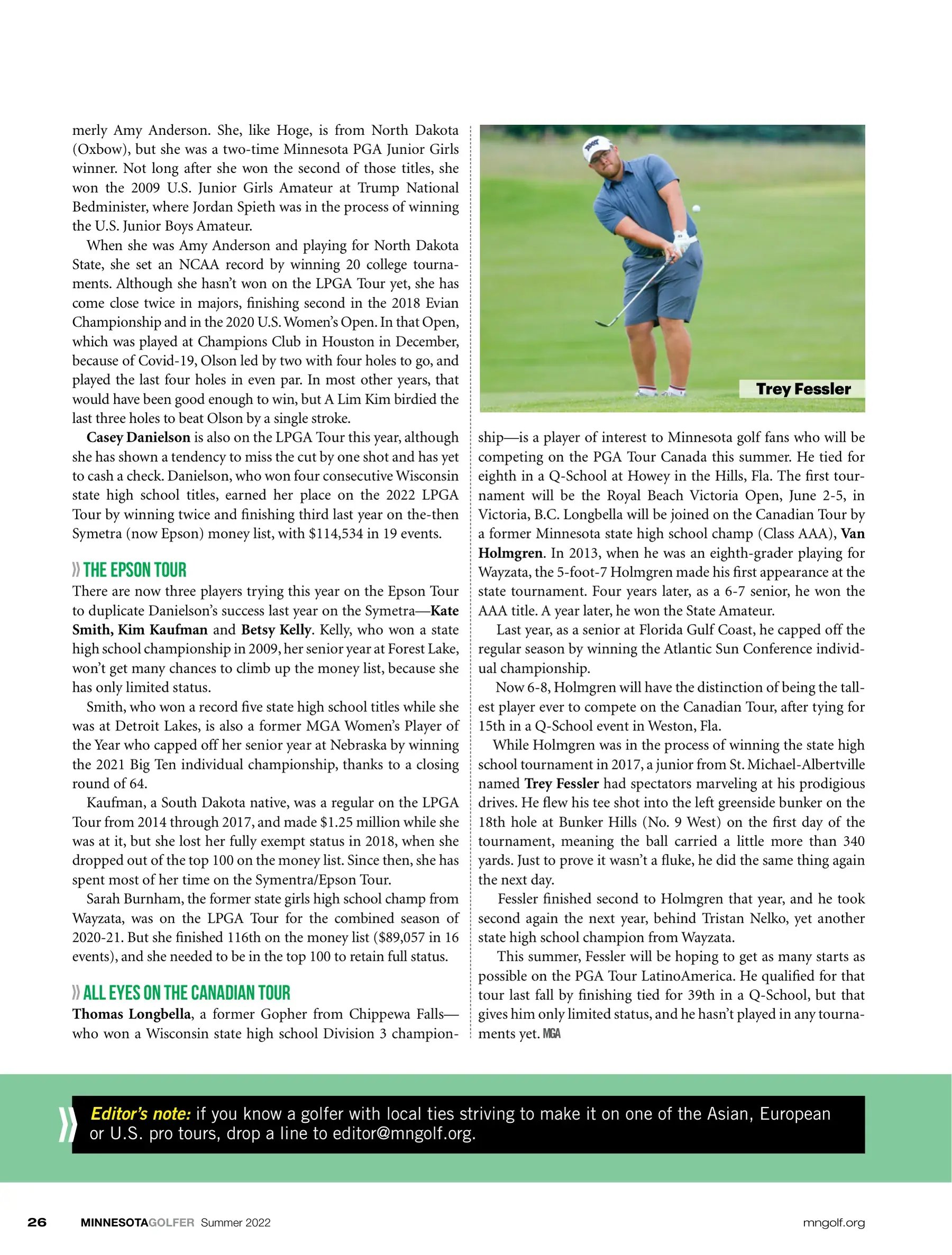
While Holmgren was in the process of winning the state high school tournament in 2017, a junior from St. Michael-Albertville named Trey Fessler had spectators marveling at his prodigious drives. He flew his tee shot into the left greenside bunker on the 18th hole at Bunker Hills (No. 9 West) on the first day of the tournament, meaning the ball carried a little more than 340 yards. Just to prove it wasn’t a fluke, he did the same thing again the next day.
Fessler finished second to Holmgren that year, and he took second again the next year, behind Tristan Nelko, yet another state high school champion from Wayzata.
This summer, Fessler will be hoping to get as many starts as possible on the PGA Tour LatinoAmerica. He qualified for that tour last fall by finishing tied for 39th in a Q-School, but that gives him only limited status, and he hasn’t played in any tournaments yet.
Editor’s note: if you know a golfer with local ties striving to make it on one of the Asian, European or U.S. pro tours, drop a line to editor@mngolf.org.
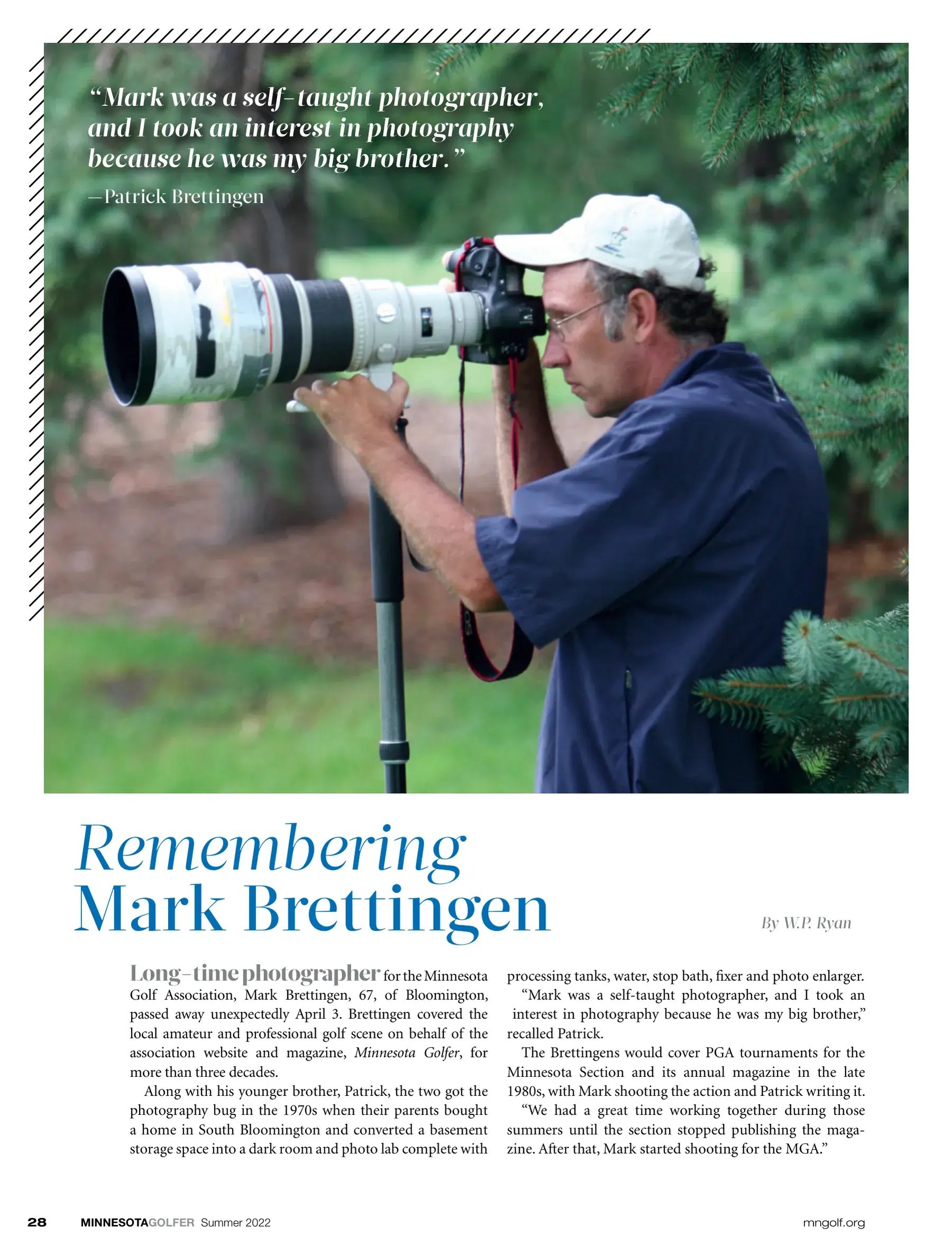
Trey Fessler BIWABIK MN LAKE VERMILION MN 3 TOP 10 PUBLIC COURSES IN MINNESOTA WITHIN 30 MILES The Legend & The Quarry at Giants Ridge | The Wilderness at Fortune Bay GOLF THE NORTH Remembering Mark Brettingen Long-time photographer for the Minnesota Golf Association, Mark Brettingen, 67, of Bloomington, passed away unexpectedly April 3. Brettingen covered the local amateur and professional golf scene on behalf of the association website and magazine, Minnesota Golfer, for more than three decades.
Along with his younger brother, Patrick, the two got the photography bug in the 1970s when their parents bought a home in South Bloomington and converted a basement storage space into a dark room and photo lab complete with processing tanks, water, stop bath, fixer and photo enlarger.
“Mark was a self-taught photographer, and I took an interest in photography because he was my big brother,” recalled Patrick. The Brettingens would cover PGA tournaments for the Minnesota Section and its annual magazine in the late 1980s, with Mark shooting the action and Patrick writing it.
“We had a great time working together during those summers until the section stopped publishing the magazine. After that, Mark started shooting for the MGA.”
“Mark was a self-taught photographer, and I took an interest in photography because he was my big brother.” —Patrick Brettingen By W.P. Ryan Brettingen was mainly focused with shooting the MGA’s major men’s, women’s and junior amateur championships and local USGA qualifiers, but he would also make time to cover many allied golf association tournaments including the annual high school state championships, the Men’s, Women’s, and Senior State Opens and the Public Links championships.
In addition, he was credentialed to cover a slew of major national and international golf events including the 1991 U.S. Open, the 1999 Samsung Women’s World Championship, the 2002 Solheim Cup, the 2002 and 2009 PGA Championships, the 2006 U.S. Amateur, the 2008 U.S. Women’s Open, the 2016 Ryder Cup, the 2017 U.S. Senior Amateur, and the 2019 KPMG Women’s PGA Championship.
Likewise, when the professional tours visited Minnesota, Brettingen also covered them for the MGA, including nearly every regular and senior PGA Tour event hosted by Bunker Hills and the TPC Twin Cities golf clubs, the Nationwide (now the Korn Ferry) Tour’s Scholarship America Showdown hosted by Troy Burne and Somerby golf clubs, and, less frequently, the LPGA Tour.
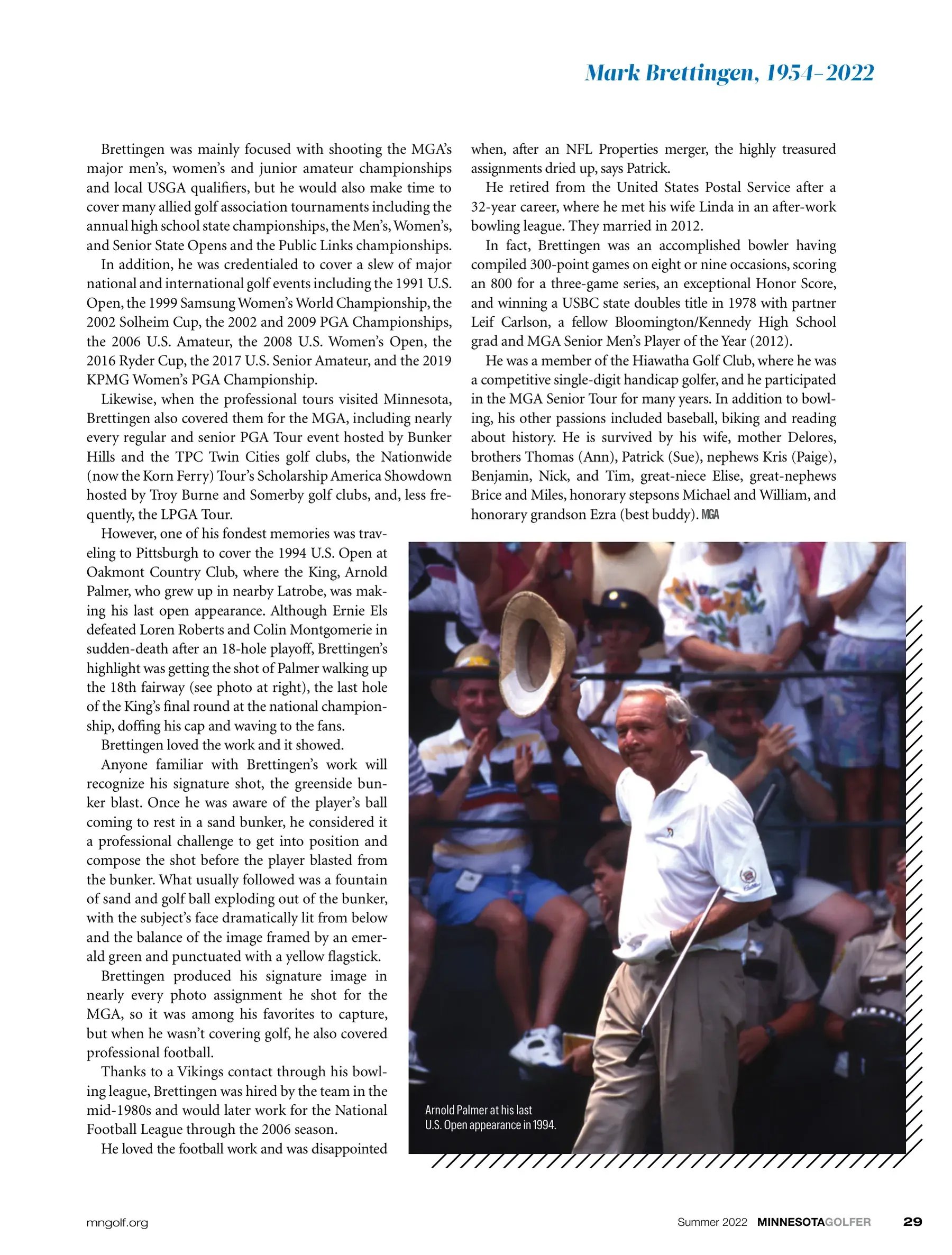
However, one of his fondest memories was traveling to Pittsburgh to cover the 1994 U.S. Open at Oakmont Country Club, where the King, Arnold Palmer, who grew up in nearby Latrobe, was making his last open appearance. Although Ernie Els defeated Loren Roberts and Colin Montgomerie in sudden-death after an 18-hole playoff, Brettingen’s highlight was getting the shot of Palmer walking up the 18th fairway (see photo at right), the last hole of the King’s final round at the national championship, doffing his cap and waving to the fans.
Brettingen loved the work and it showed. Anyone familiar with Brettingen’s work will recognize his signature shot, the greenside bunker blast. Once he was aware of the player’s ball coming to rest in a sand bunker, he considered it a professional challenge to get into position and compose the shot before the player blasted from the bunker. What usually followed was a fountain of sand and golf ball exploding out of the bunker, with the subject’s face dramatically lit from below and the balance of the image framed by an emerald green and punctuated with a yellow flagstick.
Brettingen produced his signature image in nearly every photo assignment he shot for the MGA, so it was among his favorites to capture, but when he wasn’t covering golf, he also covered professional football.
Thanks to a Vikings contact through his bowling league, Brettingen was hired by the team in the mid-1980s and would later work for the National Football League through the 2006 season.
He loved the football work and was disappointed when, after an NFL Properties merger, the highly treasured assignments dried up, says Patrick.
He retired from the United States Postal Service after a 32-year career, where he met his wife Linda in an after-work bowling league. They married in 2012.
In fact, Brettingen was an accomplished bowler having compiled 300-point games on eight or nine occasions, scoring an 800 for a three-game series, an exceptional Honor Score, and winning a USBC state doubles title in 1978 with partner Leif Carlson, a fellow Bloomington/Kennedy High School grad and MGA Senior Men’s Player of the Year (2012).
He was a member of the Hiawatha Golf Club, where he was a competitive single-digit handicap golfer, and he participated in the MGA Senior Tour for many years. In addition to bowling, his other passions included baseball, biking and reading about history. He is survived by his wife, mother Delores, brothers Thomas (Ann), Patrick (Sue), nephews Kris (Paige), Benjamin, Nick, and Tim, great-niece Elise, great-nephews Brice and Miles, honorary stepsons Michael and William, and honorary grandson Ezra (best buddy).
Mark Brettingen, 1954-2022 Summer 2022 MINNESOTAGOLFER 29 Arnold Palmer at his last U.S. Open appearance in 1994. BACK Hello, Summer!
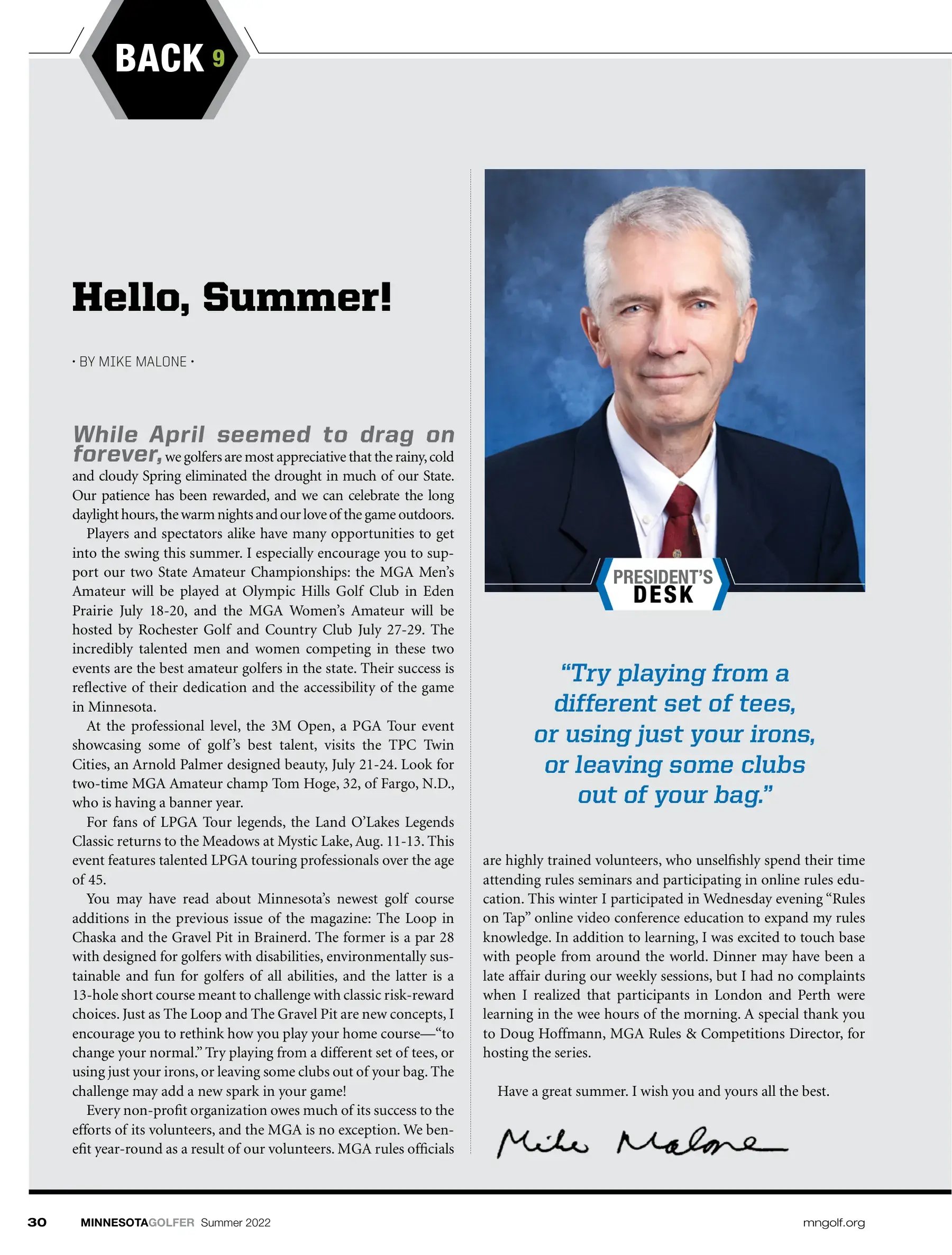
While April seemed to drag on forever, we golfers are most appreciative that the rainy, cold and cloudy Spring eliminated the drought in much of our State.
Our patience has been rewarded, and we can celebrate the long daylight hours, the warm nights and our love of the game outdoors. Players and spectators alike have many opportunities to get into the swing this summer. I especially encourage you to support our two State Amateur Championships: the MGA Men’s Amateur will be played at Olympic Hills Golf Club in Eden Prairie July 18-20, and the MGA Women’s Amateur will be hosted by Rochester Golf and Country Club July 27-29. The incredibly talented men and women competing in these two events are the best amateur golfers in the state. Their success is reflective of their dedication and the accessibility of the game in Minnesota.
At the professional level, the 3M Open, a PGA Tour event showcasing some of golf’s best talent, visits the TPC Twin Cities, an Arnold Palmer designed beauty, July 21-24. Look for two-time MGA Amateur champ Tom Hoge, 32, of Fargo, N.D., who is having a banner year.
For fans of LPGA Tour legends, the Land O’Lakes Legends Classic returns to the Meadows at Mystic Lake, Aug. 11-13. This event features talented LPGA touring professionals over the age of 45.
You may have read about Minnesota’s newest golf course additions in the previous issue of the magazine: The Loop in Chaska and the Gravel Pit in Brainerd. The former is a par 28 with designed for golfers with disabilities, environmentally sustainable and fun for golfers of all abilities, and the latter is a 13-hole short course meant to challenge with classic risk-reward choices. Just as The Loop and The Gravel Pit are new concepts, I encourage you to rethink how you play your home course—“to change your normal.” Try playing from a different set of tees, or using just your irons, or leaving some clubs out of your bag. The challenge may add a new spark in your game!
Every non-profit organization owes much of its success to the efforts of its volunteers, and the MGA is no exception. We benefit year-round as a result of our volunteers. MGA rules officials are highly trained volunteers, who unselfishly spend their time attending rules seminars and participating in online rules education. This winter I participated in Wednesday evening “Rules on Tap” online video conference education to expand my rules knowledge. In addition to learning, I was excited to touch base with people from around the world. Dinner may have been a late affair during our weekly sessions, but I had no complaints when I realized that participants in London and Perth were learning in the wee hours of the morning. A special thank you to Doug Hoffmann, MGA Rules & Competitions Director, for hosting the series.
Have a great summer. I wish you and yours all the best. • BY MIKE MALONE • “Try playing from a different set of tees, or using just your irons, or leaving some clubs out of your bag.”
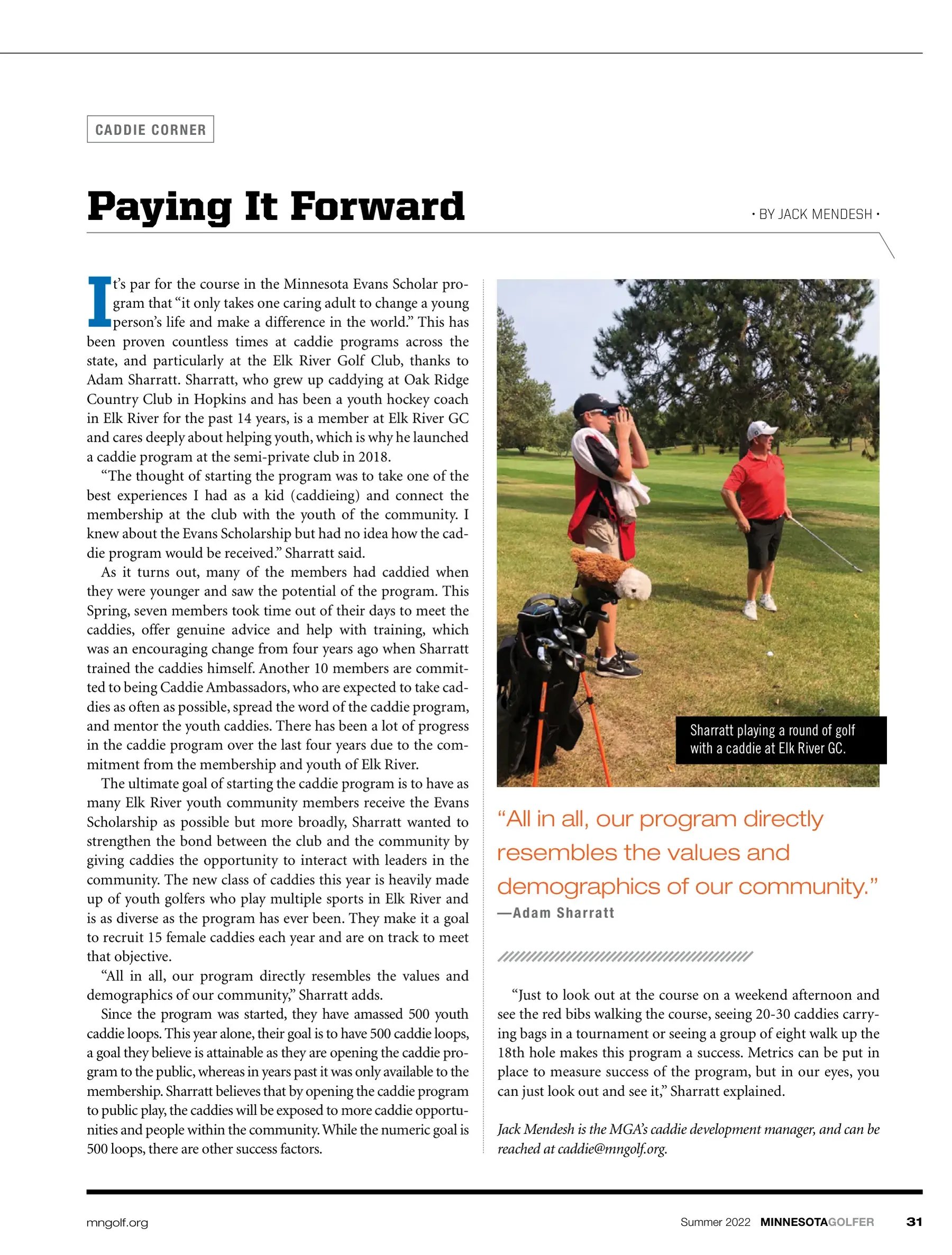
PRESIDENT’S DESK Summer 2022 MINNESOTAGOLFER 31 Paying It Forward CADDIE CORNER • BY JACK MENDESH • I t’s par for the course in the Minnesota Evans Scholar program that “it only takes one caring adult to change a young person’s life and make a difference in the world.” This has been proven countless times at caddie programs across the state, and particularly at the Elk River Golf Club, thanks to Adam Sharratt. Sharratt, who grew up caddying at Oak Ridge Country Club in Hopkins and has been a youth hockey coach in Elk River for the past 14 years, is a member at Elk River GC and cares deeply about helping youth, which is why he launched a caddie program at the semi-private club in 2018.
“The thought of starting the program was to take one of the best experiences I had as a kid (caddieing) and connect the membership at the club with the youth of the community. I knew about the Evans Scholarship but had no idea how the caddie program would be received.” Sharratt said.