




Travel 2023


















Back to The Minnesota Golfer Archive
Read the text of this issue
Text from the printed pages, so it can be searched and read by screen readers. Layout and photography are in the reader above.
Engulfed in greens. Escape to Alabama’s 32-mile island and experience a vacation like no other. Relax on sugar-white sand beaches, indulge in our coastal cuisine and challenge yourself on the greens, all in one unforgettable place.
20 | GOLF TALES By Mark Craig Vikings QB and Netflix’s “Quarterback” star Kirk Cousins is also a golf course owner. 24 | GETTING THE CALL By W.P. Ryan A look at the 2023 Minnesota Golf Hall of Fame class.
Subscriptions: Regular U.S. one year (4 issues) $18. Travel issue of Minnesota Golfer: $9.95 plus shipping, pre-paid. Other single copies: $2.95 per copy plus shipping, pre-paid.
Americans wouldn’t take up the game in significant numbers until after WWI, yet the first public golf course, Glenwood (renamed Theodore Wirth), opened in 1916. It would take several decades of growth but by the mid-twentieth century public golf would surpass its tony country club cousin. While private clubs represent the MGA’s oldest, and arguably staunchest, member golf clubs—T&C, The Minikahda Club and Rochester G&CC were among the seven founding clubs in 1901—it is a fact that public golf is more widespread: Of the 400 MGA member clubs, about 89% are open to the public.
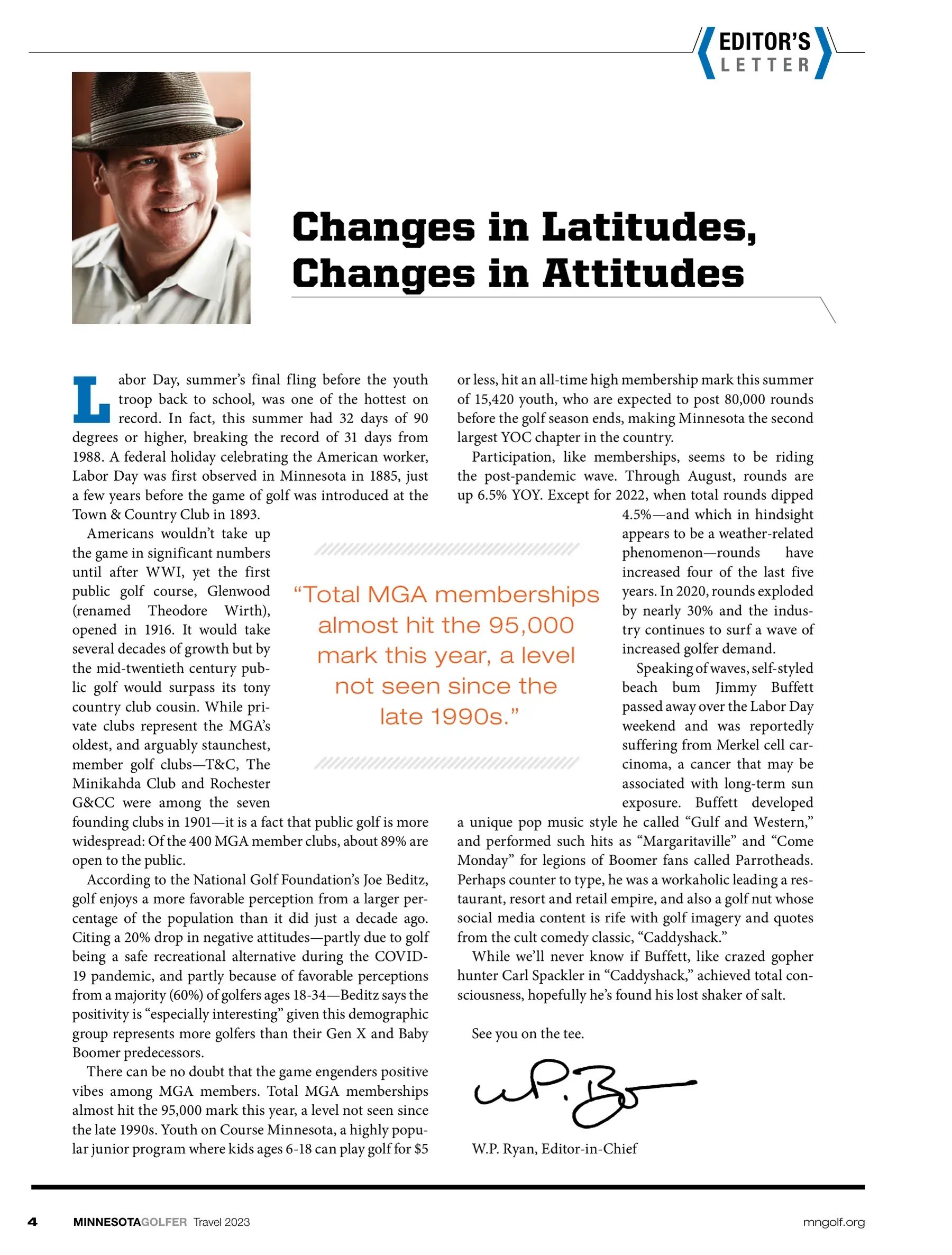
According to the National Golf Foundation’s Joe Beditz, golf enjoys a more favorable perception from a larger percentage of the population than it did just a decade ago.
Citing a 20% drop in negative attitudes—partly due to golf being a safe recreational alternative during the COVID19 pandemic, and partly because of favorable perceptions from a majority (60%) of golfers ages 18-34—Beditz says the positivity is “especially interesting” given this demographic group represents more golfers than their Gen X and Baby Boomer predecessors.
There can be no doubt that the game engenders positive vibes among MGA members. Total MGA memberships almost hit the 95,000 mark this year, a level not seen since the late 1990s. Youth on Course Minnesota, a highly popular junior program where kids ages 6-18 can play golf for $5 or less, hit an all-time high membership mark this summer of 15,420 youth, who are expected to post 80,000 rounds before the golf season ends, making Minnesota the second largest YOC chapter in the country.
Participation, like memberships, seems to be riding the post-pandemic wave. Through August, rounds are up 6.5% YOY. Except for 2022, when total rounds dipped 4.5%—and which in hindsight appears to be a weather-related phenomenon—rounds have increased four of the last five years. In 2020, rounds exploded by nearly 30% and the industry continues to surf a wave of increased golfer demand.
Speaking of waves, self-styled beach bum Jimmy Buffett passed away over the Labor Day weekend and was reportedly suffering from Merkel cell carcinoma, a cancer that may be associated with long-term sun exposure. Buffett developed a unique pop music style he called “Gulf and Western,”
and performed such hits as “Margaritaville” and “Come Monday” for legions of Boomer fans called Parrotheads. Perhaps counter to type, he was a workaholic leading a restaurant, resort and retail empire, and also a golf nut whose social media content is rife with golf imagery and quotes from the cult comedy classic, “Caddyshack.”
While we’ll never know if Buffett, like crazed gopher hunter Carl Spackler in “Caddyshack,” achieved total consciousness, hopefully he’s found his lost shaker of salt.
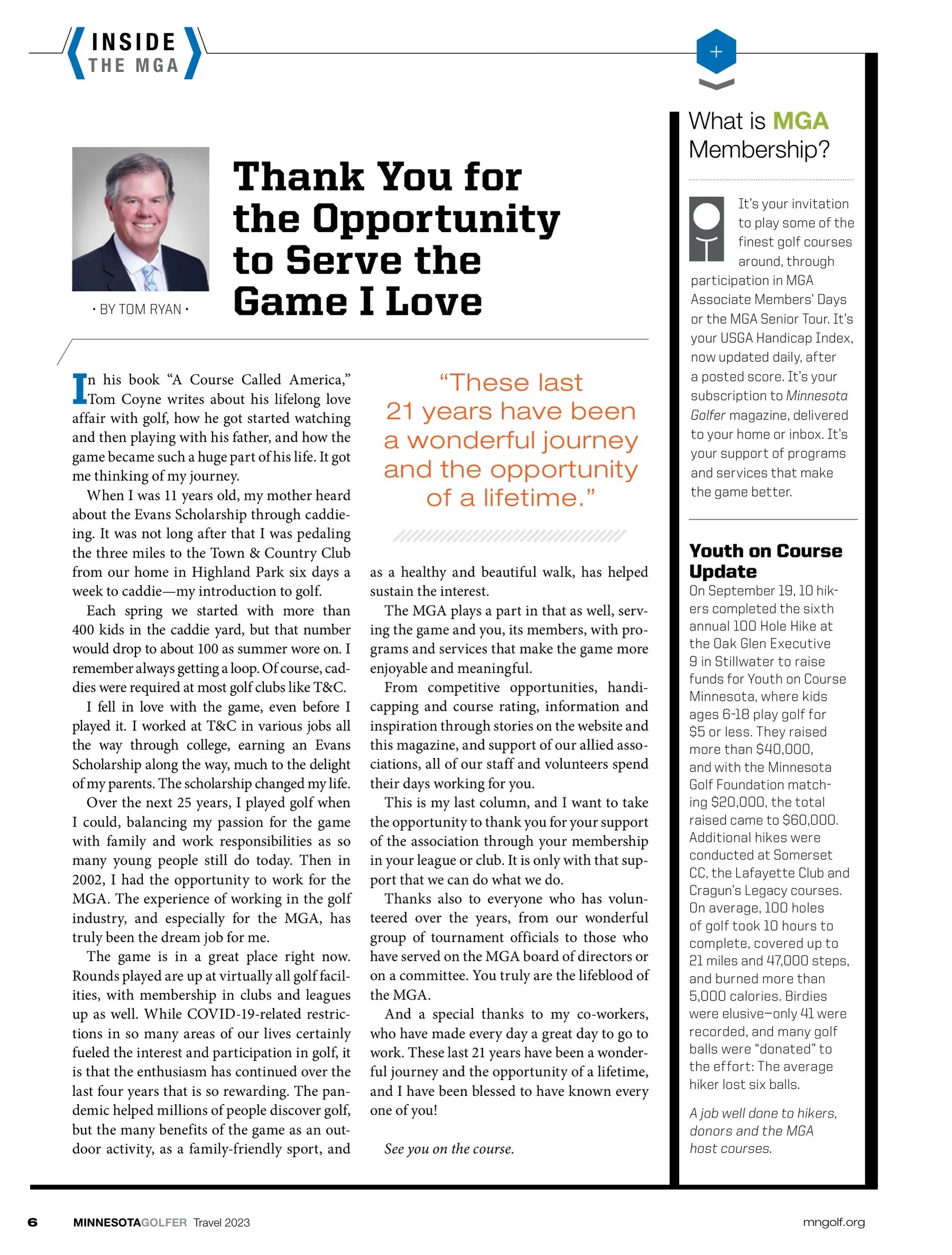
Tom Coyne writes about his lifelong love affair with golf, how he got started watching and then playing with his father, and how the game became such a huge part of his life. It got me thinking of my journey.
When I was 11 years old, my mother heard about the Evans Scholarship through caddieing. It was not long after that I was pedaling the three miles to the Town & Country Club from our home in Highland Park six days a week to caddie—my introduction to golf.
Each spring we started with more than 400 kids in the caddie yard, but that number would drop to about 100 as summer wore on. I remember always getting a loop. Of course, caddies were required at most golf clubs like T&C.
I fell in love with the game, even before I played it. I worked at T&C in various jobs all the way through college, earning an Evans Scholarship along the way, much to the delight of my parents. The scholarship changed my life.
Over the next 25 years, I played golf when I could, balancing my passion for the game with family and work responsibilities as so many young people still do today. Then in 2002, I had the opportunity to work for the MGA. The experience of working in the golf industry, and especially for the MGA, has truly been the dream job for me.
The game is in a great place right now. Rounds played are up at virtually all golf facilities, with membership in clubs and leagues up as well. While COVID-19-related restrictions in so many areas of our lives certainly fueled the interest and participation in golf, it is that the enthusiasm has continued over the last four years that is so rewarding. The pandemic helped millions of people discover golf, but the many benefits of the game as an outdoor activity, as a family-friendly sport, and as a healthy and beautiful walk, has helped sustain the interest.
The MGA plays a part in that as well, serving the game and you, its members, with programs and services that make the game more enjoyable and meaningful.
From competitive opportunities, handicapping and course rating, information and inspiration through stories on the website and this magazine, and support of our allied associations, all of our staff and volunteers spend their days working for you.
This is my last column, and I want to take the opportunity to thank you for your support of the association through your membership in your league or club. It is only with that support that we can do what we do.
Thanks also to everyone who has volunteered over the years, from our wonderful group of tournament officials to those who have served on the MGA board of directors or on a committee. You truly are the lifeblood of the MGA.
And a special thanks to my co-workers, who have made every day a great day to go to work. These last 21 years have been a wonderful journey and the opportunity of a lifetime, and I have been blessed to have known every one of you!
See you on the course. What is MGA Membership? It’s your invitation to play some of the finest golf courses around, through participation in MGA Associate Members’ Days or the MGA Senior Tour. It’s your USGA Handicap Index, now updated daily, after a posted score. It’s your subscription to Minnesota Golfer magazine, delivered to your home or inbox. It’s your support of programs and services that make the game better.
• BY TOM RYAN • Thank You for the Opportunity to Serve the Game I Love Youth on Course Update On September 19, 10 hikers completed the sixth annual 100 Hole Hike at the Oak Glen Executive 9 in Stillwater to raise funds for Youth on Course Minnesota, where kids ages 6-18 play golf for $5 or less. They raised more than $40,000, and with the Minnesota Golf Foundation matching $20,000, the total raised came to $60,000.
Additional hikes were conducted at Somerset CC, the Lafayette Club and Cragun’s Legacy courses. On average, 100 holes of golf took 10 hours to complete, covered up to 21 miles and 47,000 steps, and burned more than 5,000 calories. Birdies were elusive—only 41 were recorded, and many golf balls were “donated” to the effort: The average hiker lost six balls.
A job well done to hikers, donors and the MGA host courses. “These last 21 years have been a wonderful journey and the opportunity of a lifetime.”
“That was tough,” says Roger Sandberg, longtime Ortonville High School golf coach, about negotiating the tree. “Not many tears were shed when that big cottonwood came down.”
Your tee ball must carry a large pond to an elevated green with OB left and back. The large green slopes back to front and right to left, and features a small target area. Shots landing short of a middle hole location roll back down a false front to the apron or even the rough. A bailout right offers only marginal relief.
“Some people walk off with a four, feeling good,” says Sandberg. “You can run into some real difficulties there.” —Joseph Oberle “It’s a tough par 3. I am surprised the pond doesn’t have more clubs in it.”
–Roger Sandberg Travel 2023 MINNESOTAGOLFER 9 ILLUSTRATIONS COURTESY OF THE USGA RULES PRIMER Minjee Lee, Unplugged A recent ruling in the U.S. Women’s Open reminds us of the quirks of the embedded ball rule.
• BY BILL HOMEYER • O n the 14th hole of this year’s final round of the U.S. Women’s Open at Pebble Beach, Minjee Lee’s golf ball embedded in some fescue grass next to a green-side bunker. She asked for relief under Rule 16.3 “Embedded Ball” but was denied relief. A seemingly harsh ruling during an important moment, but the right decision according to the Rules of Golf. Read on to learn why.
Relief for an embedded ball is allowed only when a player’s ball lies in the General Area. There are two exceptions. There is NO relief under this Rule: (1) when the ball is embedded in sand in a part of the general area that is not cut to fairway height or less (embedded in sand in the rough—no relief) or (2) when playing the ball as it lies is clearly unreasonable because of something other than the ball being embedded (the player is unable to make a stroke because the ball lies wedged between tree roots but happens to be embedded—no relief).
A ball is embedded only if it’s in its own pitch-mark made as result of the player’s previous stroke, and part of the ball is below the level of the ground. Please note that the ball may bounce and still become embedded. The ball doesn’t have to “fly” into the ground.
Three things that do not qualify as an embedded ball are when: (1) the ball is pushed into the ground by someone stepping on it or something driving over it, (2) the ball is driven straight into the ground without it becoming airborne, or (3) the ball was dropped in taking relief under a Rule.
In situation 1, stepping on the ball, Rule 9 (Ball Moved) and Rule 14.2d (where to place a ball when the original lie is altered) would apply. In situations 2 and 3, the ball must be played as it lies, or the player must proceed under another applicable Rule, such as Rule 19 “Unplayable Ball.”
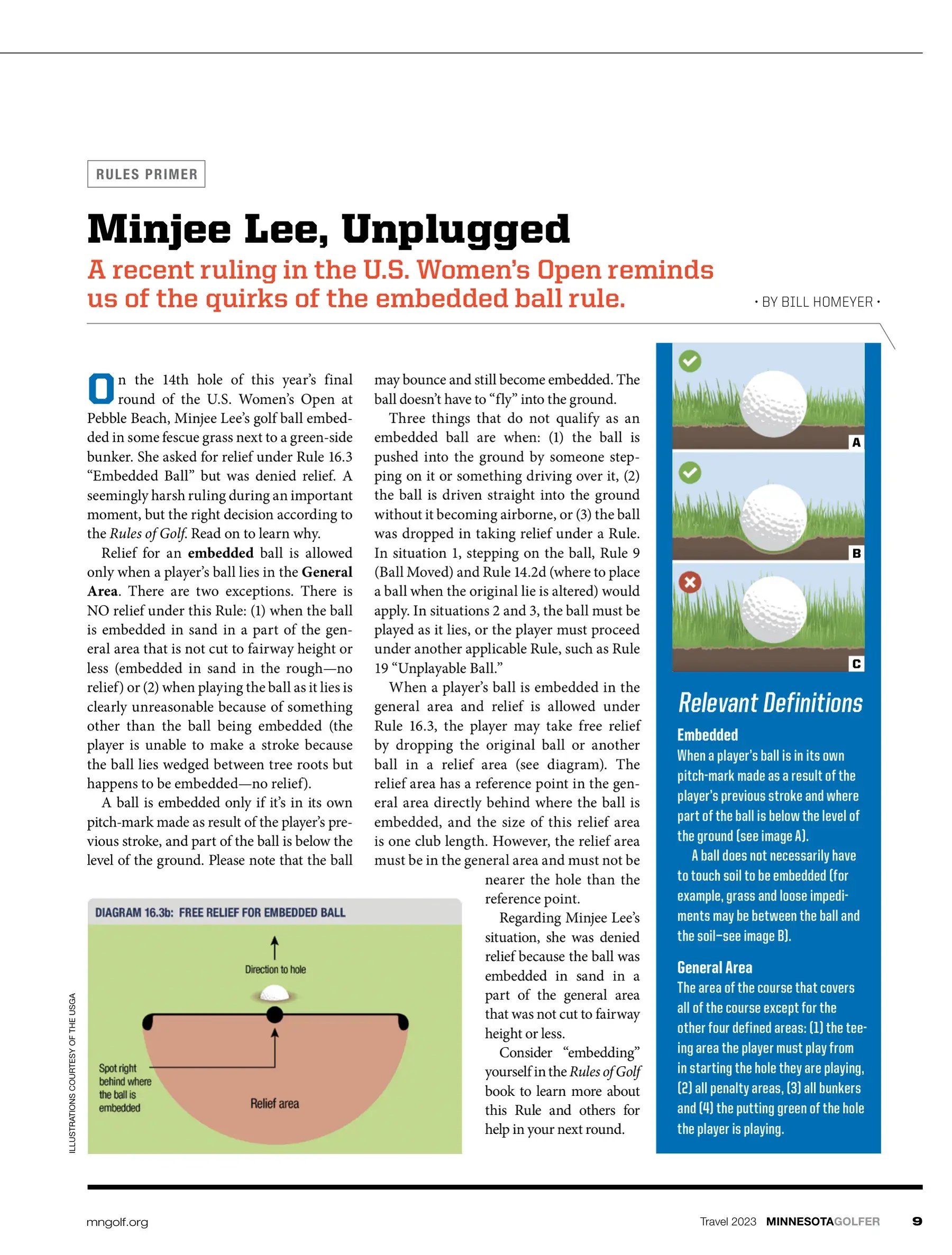
When a player’s ball is embedded in the general area and relief is allowed under Rule 16.3, the player may take free relief by dropping the original ball or another ball in a relief area (see diagram). The relief area has a reference point in the general area directly behind where the ball is embedded, and the size of this relief area is one club length. However, the relief area must be in the general area and must not be nearer the hole than the reference point.
Regarding Minjee Lee’s situation, she was denied relief because the ball was embedded in sand in a part of the general area that was not cut to fairway height or less.
Consider “embedding” yourself in the Rules of Golf book to learn more about this Rule and others for help in your next round. Relevant Definitions Embedded When a player’s ball is in its own pitch-mark made as a result of the player’s previous stroke and where part of the ball is below the level of the ground (see image A).
A ball does not necessarily have to touch soil to be embedded (for example, grass and loose impediments may be between the ball and the soil—see image B).
General Area The area of the course that covers all of the course except for the other four defined areas: (1) the teeing area the player must play from in starting the hole they are playing, (2) all penalty areas, (3) all bunkers and (4) the putting green of the hole the player is playing.
A Conservative Approach Don’t be blindsided by a short-sided lie— employ this advice to save some strokes. W hile watching golf on television, you may have heard an announcer say a golfer is “short sided.” That simply means the player has missed the green on the same side where the flagstick is located, usually leaving a small amount of green between the start of the putting surface and the hole.
Depending on the firmness and speed of the greens, it’s an undesirable place to miss your shot. Executing a shot from here takes tremendous touch and feel, along with discipline.
After assessing the lie, you can determine, with your level of talent, how much risk to take on. Trying to hit the perfect flop shot can result in two mistakes: blading it over the green or not hitting it hard enough and having nearly the same shot again.
“Never follow a bad shot with a dumb shot.” Use your highest lofted club and make sure your next shot is a putt. You probably hit an offline shot to wind up here, so following the rule of “never follow a bad shot with a dumb shot” will save you in the long run.
TIPS FROM THE PROS Get Connected Often overlooked, the club grip is an essential foundation for building an effective swing. A ny golf instructor worth their salt will emphasize the importance of a student’s grip in their golf swing. It should follow, then, that a properly fit rubber or leather grip on the end of a golf club is also a vital swing building block. Just ask golf club builder and swing instructor, Larry Bobka, master clubfitter at 2nd Swing: “It’s a very important part of the club because it’s your connection to the club,” Bobka says. “What are you holding onto? We’re not holding onto the shaft or the head.
We’re holding onto the grip.” Athletes work to create proper contact with their tools, such as wrapping tape on a hockey stick or dabbing rosin on a wooden baseball bat. To grip a golf club like “you’re holding a bird,” that club grip better fit your hands. Golfers have forever used tape under the club grips to find the right fit, as one size does not fit all.
“Phil Mickelson has 10 wraps of tape under his grips—five full wraps and then five extra on his top hand,” Bobka says. “The grip concoctions out on the PGA Tour are mind-boggling.”
But, for all golfers, finding the right connection and fit requires more than just pulling on a golf glove and swinging away. And club equipment manufacturers are developing better technology to help them find it. In the past 10 years, the grip market has exploded with newer rubber compounds resulting in softer and lighter grips.
“Grip manufacturing has changed from the standpoint of different materials, creating the ability to make grips different weights,” Bobka says. “So, we can change the balance and the feel of the golf club. In years past, if you needed a bigger grip, all you could do was build it up with layers of tape, and then you’d still have the same weight grip, and it would make the handles feel very heavy.”
Bobka says the goal of manufacturers has been to develop midsize and oversize grips with these lighter compounds so they don’t greatly affect the swing weight or the feel of that club.
While leather grips still exist, the new rubber compounds are designed for tackiness, feel and improved durometer (firmness of the grip). Not surprisingly, the key to maximizing your club grips is getting fit for them.
“The first thing to focus on is grip size,” Bobka says. “Doesn’t matter the material, the design or anything else; the grip size has to fit your hand and your ability to grip the club properly. That’s No. 1.”
At 2nd Swing, the clubfitters will look at the hand size of a customer, what glove size they wear and how they grip the club. They have several different sized grips on their fitting shafts so golfers can determine what feels comfortable.
“The fitting is a huge part of building a swing,” he says. “If I have a grip size that’s too big for me and it restricts my ability to release my hands at impact, then I’ve got a problem. As a right-hander, I am going to hit a lot of shots off to the right. And I’ll think my club lie angle’s wrong or my shafts are wrong. But it might be that I just have the wrong size grip on my golf club.”
Bobka suggests a conservative approach to changing your grips. Grips can cost anywhere from $5 to $12 per grip for corded grips (and up to $25 for leather), so try changing one club before you do the whole set.
“I always recommend that if you are changing size or compound in a grip, rather than doing the whole set, just do one club,” Bobka says. “Change out your driver grip or your pitching wedge—because the driver is the one that needs the most hand release and puts the most torque on the grip. Your pitching wedge is a feel club—so find out how that grip feels [before changing the whole set].”
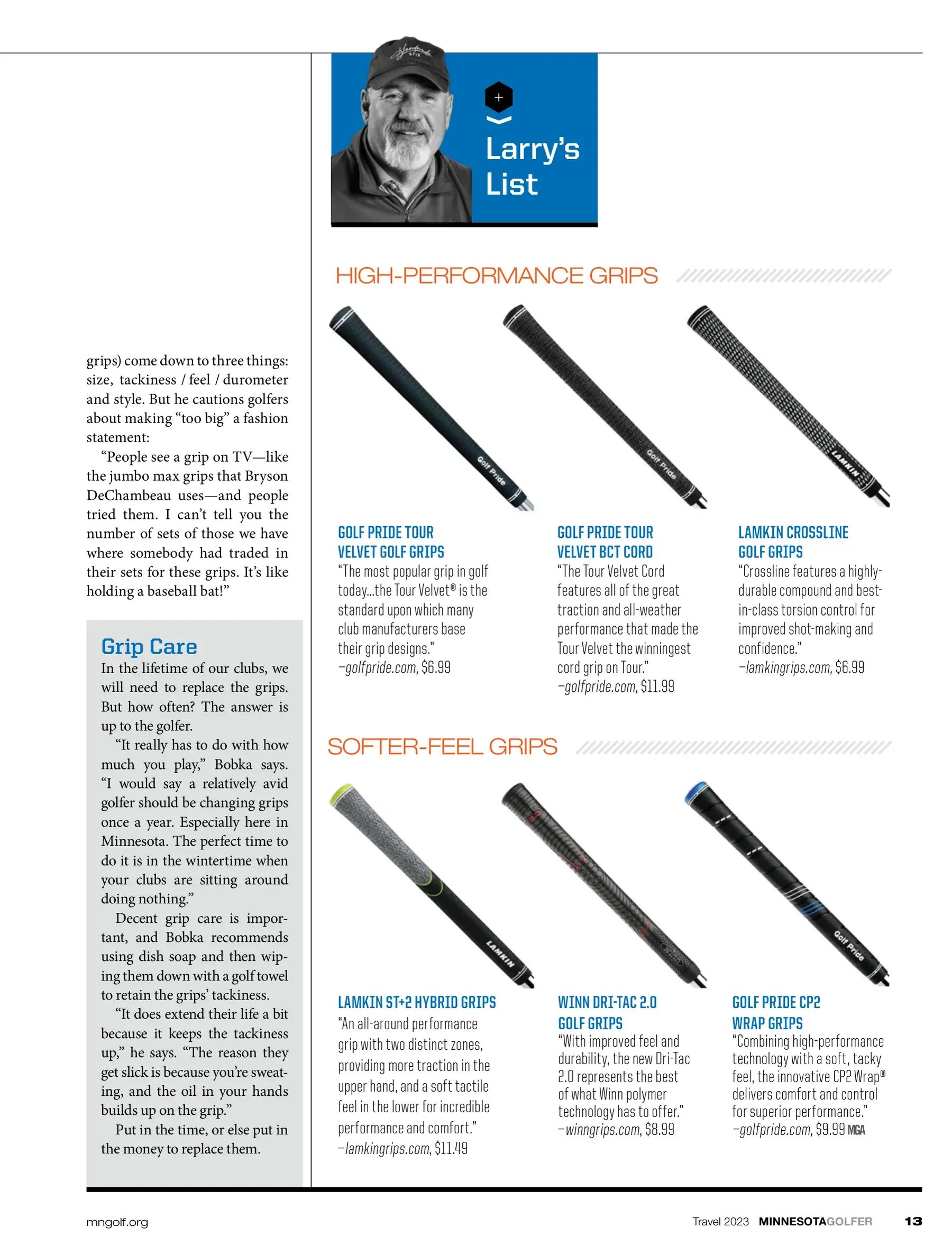
Ultimately, Bobka says playing grips (as opposed to putter • BY JOSEPH OBERLE • GOLF GEAR “The fitting is a huge part of building a swing.” —Larry Bobka Travel 2023 MINNESOTAGOLFER 13 Larry’s List HIGH-PERFORMANCE GRIPS SOFTER-FEEL GRIPS grips) come down to three things: size, tackiness / feel / durometer and style. But he cautions golfers about making “too big” a fashion statement: “People see a grip on TV—like the jumbo max grips that Bryson DeChambeau uses—and people tried them. I can’t tell you the number of sets of those we have where somebody had traded in their sets for these grips. It’s like holding a baseball bat!”
Grip Care In the lifetime of our clubs, we will need to replace the grips. But how often? The answer is up to the golfer. “It really has to do with how much you play,” Bobka says.
“I would say a relatively avid golfer should be changing grips once a year. Especially here in Minnesota. The perfect time to do it is in the wintertime when your clubs are sitting around doing nothing.”
Decent grip care is important, and Bobka recommends using dish soap and then wiping them down with a golf towel to retain the grips’ tackiness.
“It does extend their life a bit because it keeps the tackiness up,” he says. “The reason they get slick is because you’re sweating, and the oil in your hands builds up on the grip.”
Put in the time, or else put in the money to replace them. GOLF PRIDE TOUR VELVET GOLF GRIPS “The most popular grip in golf today...the Tour Velvet® is the standard upon which many club manufacturers base their grip designs.”
—golfpride.com, $6.99 LAMKIN ST+2 HYBRID GRIPS “An all-around performance grip with two distinct zones, providing more traction in the upper hand, and a soft tactile feel in the lower for incredible performance and comfort.”
—lamkingrips.com, $11.49 GOLF PRIDE TOUR VELVET BCT CORD “The Tour Velvet Cord features all of the great traction and all-weather performance that made the Tour Velvet the winningest cord grip on Tour.”
—golfpride.com, $11.99 WINN DRI-TAC 2.0 GOLF GRIPS “With improved feel and durability, the new Dri-Tac 2.0 represents the best of what Winn polymer technology has to offer.”
—winngrips.com, $8.99 LAMKIN CROSSLINE GOLF GRIPS “Crossline features a highlydurable compound and bestin-class torsion control for improved shot-making and confidence.”
—lamkingrips.com, $6.99 GOLF PRIDE CP2 WRAP GRIPS “Combining high-performance technology with a soft, tacky feel, the innovative CP2 Wrap® delivers comfort and control for superior performance.”
—golfpride.com, $9.99 PHOTOS: XXXXXXXXX Alabama’s Game-Changing Golf Travel 2023 MINNESOTAGOLFER 15 C hange in golf, like life, does not always come easy. For example, changing a golf swing takes time, effort and the right plan. But changing a public perception requires even more—creativity, commitment and some guts. In an attempt to augment its tourism dollars in the early 1990s, Alabama state tourism bureau officials looked to golf to draw more out-of-state visitors, and now golf travelers from all over the world reap the benefits.
The effort was born out of racial controversy. Public backlash arose surrounding the 1990 PGA Championship at Shoal Creek Golf and Country Club in Birmingham due to the club’s exclusionary membership policies, and the tournament was nearly moved. In the aftermath, the state made a bold commitment to constructing the Robert Trent Jones (RTJ) Golf Trail—an unprecedented effort to build numerous public courses simultaneously throughout the state—and now Alabama is a coveted golf destination for its courses on and off the Trail.
Digging it Out of the Dirt Although the RTJ Trail traverses the length and breadth of Alabama, its origin has roots in Minnesota. Dr. David G. Bronner (who grew up in Austin, Minnesota, and graduated from then-Mankato State University) has been CEO of the Retirement Systems of Alabama for 50 years, and in 1990 was looking for a way to diversify the investment of state retirement funds— and help rehabilitate the state’s image through golf. He became motivated by the famous “Field of Dreams” quote, “if you build it [they] will come,”
and sought out a big-name course architect to build his “links of dreams.” Bronner’s idea of building numerous public courses at the same time was laughed at by some architects—and turned down by both Arnold Palmer’s and Jack Nicklaus’ design firms—as he crisscrossed the state searching for suitable sites and acquiring land. But Robert Trent Jones, Sr., nearing the end of his career, signed on to the project, which opened with seven golf facilities in 1992. With Jones in failing health, his longtime associate Roger Rulewich did a lot of the design on the fly, formulating the holes to what the landforms offered and creating a vast array of unique golf.
“Most of it was site design. We would drive from site to site, designing holes as we went,” Rulewich said in The Trail Guide 25, a quartercentury anniversary publication. “It might sound crazy, but it was the greatest way in the world to work. It was very free-form.”
Between 1992 and 1993, all 11 Trail sites opened their doors, and they now include 26 courses with 468 holes. Since that time, numerous other non-Trail, high-end public courses have sprung up across Alabama to take advantage of all the visitors (see page 18). Now in its 31st year, the Trail courses host half a million rounds per year, with 50% of them played by golfers from outside the state.
“All of these people, many of them golfers, were driving like hell through Alabama, mostly going to Florida,” Bronner told the anniversary publication. “Our mission was to divert them. So far, I think, we’ve done pretty well.”
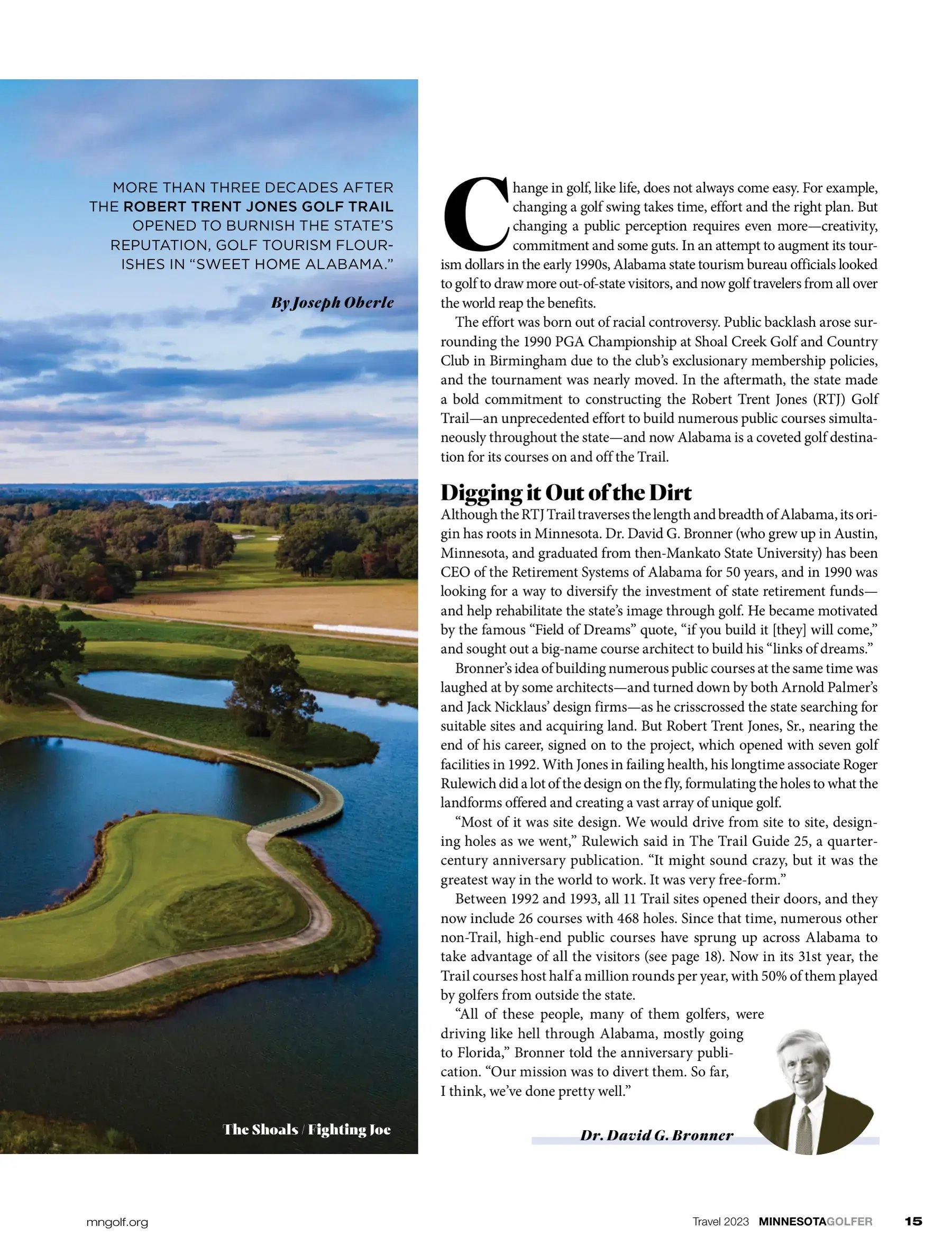
By Joseph Oberle The Shoals / Fighting Joe Dr. David G. Bronner Trail Mix The RTJ concept was unique for its time (inspiring other such “trails” in its wake), yet executed brilliantly. The Trail attracts significant tourism beyond golf (see sidebar) and has helped change the state’s image to one of welcoming hospitality. The Trail courses spread from the northern border of the state to the southern Gulf Coast, averaging a 1.5- to 2-hour drive time between locations, and typical green fees (including cart) are $69 ($54 during the summer and winter months). So, the Trail won’t empty your wallet and will make 36 holes per day split between two different locations an achievable goal.
Alabama may surprise the uninitiated with its topography— as verdant valleys, rolling hills and deep woods bracket the byways from the north to the beautiful and shimmering Gulf Coast. An RTJ Trail tour can begin in any region in the state, and ours started at the northernmost course and headed clockwise southeastward. Here’s a sampling of what we found on the Trail.
The Shoals (Opened 2004) Hard by the wide and beautiful Tennessee River, The Shoals (located in Florence), with its two impressive championship tracks—Fighting Joe and the Schoolmaster—is the perfect opener to RTJ golf. Fighting Joe tops out at 8,092 yards and offers expansive, manicured fairways and large, true-rolling bentgrass greens to soften the challenge. It’s a long-hitters course (all of 78.6/146 slope rating from the tips) with everything set out in front of the golfer on six sets of tees; the challenge is choosing the right length for reaching your target to score.
Meanwhile, the Schoolmaster may be a bit shorter in length (7,921 yards), but it’s narrower with more demanding approaches and certainly ratchets up the challenge (77.6/148 slope rating).
The views along the way can be breathtaking with a beautiful waterfall guarding the second green and a captivating view of the Tennessee River from the bluffs on No. 18.
Likewise, the expansive vista near the 18th green on Fighting Joe—called by one local with a vested interest “the best view on the RTJ Trail”—should not be missed. It is hard to argue with him as the wide Tennessee River viewed from the clubhouse balcony rolls effortlessly by and belies the frenetic challenge found just yards away.
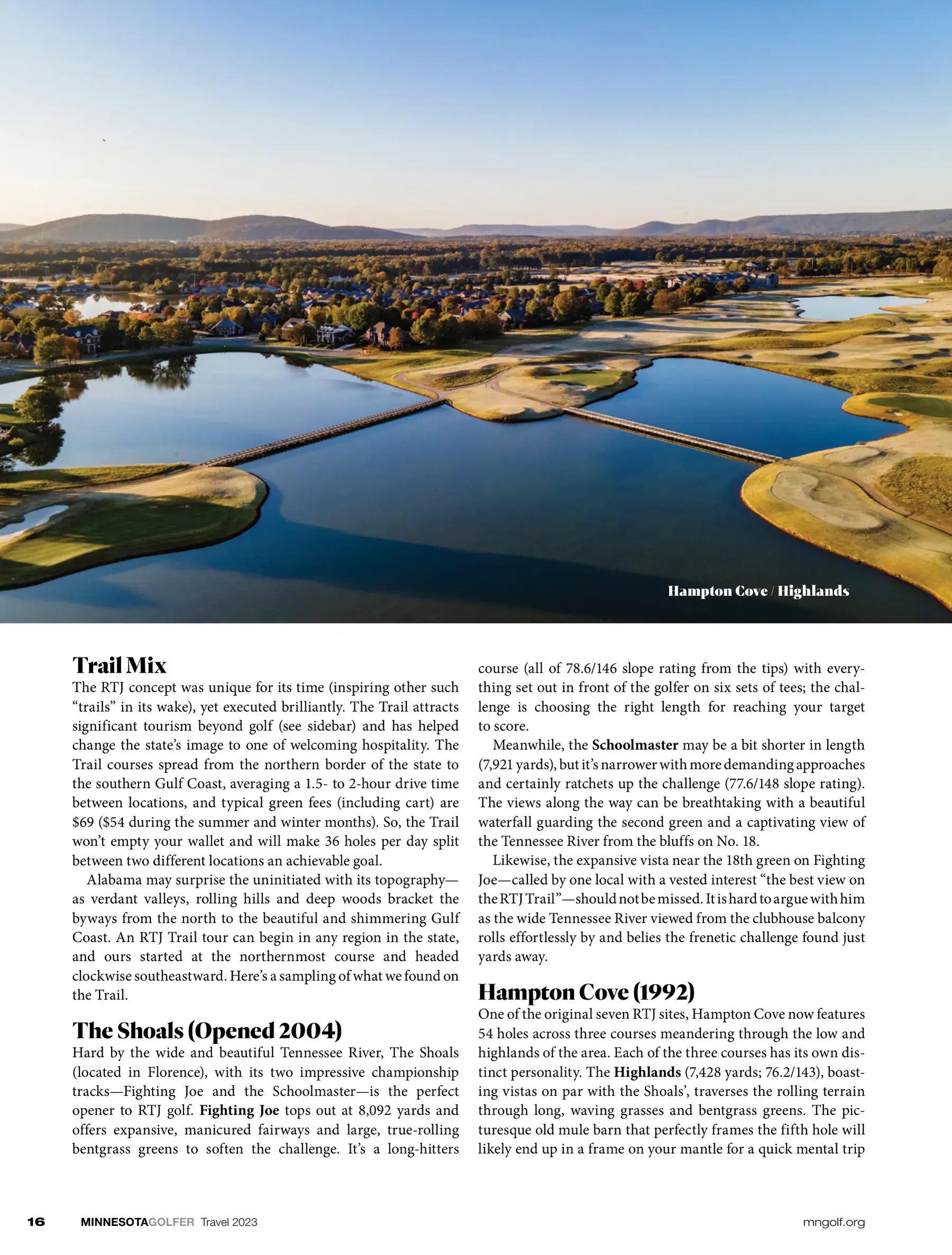
Hampton Cove (1992) One of the original seven RTJ sites, Hampton Cove now features 54 holes across three courses meandering through the low and highlands of the area. Each of the three courses has its own distinct personality. The Highlands (7,428 yards; 76.2/143), boasting vistas on par with the Shoals’, traverses the rolling terrain through long, waving grasses and bentgrass greens. The picturesque old mule barn that perfectly frames the fifth hole will likely end up in a frame on your mantle for a quick mental trip Hampton Cove / Highlands Travel 2023 MINNESOTAGOLFER 17 Food Science, Space and a Little Rock ‘n’ Roll In the 1980s’ Twin Cities, Prince, The Time, Jam and Lewis, and others created the “Minneapolis Sound,”
but decades earlier another music recording mecca developed in northern Alabama. Artists from all over the world traveled to Muscle Shoals to record their music with the talented local session musicians in search of the “Muscle Shoals” sound.
From Duane Allman sleeping in the parking lot to land a session gig to Keith Richards finishing the lyrics to the Rolling Stones’ “Wild Horses”
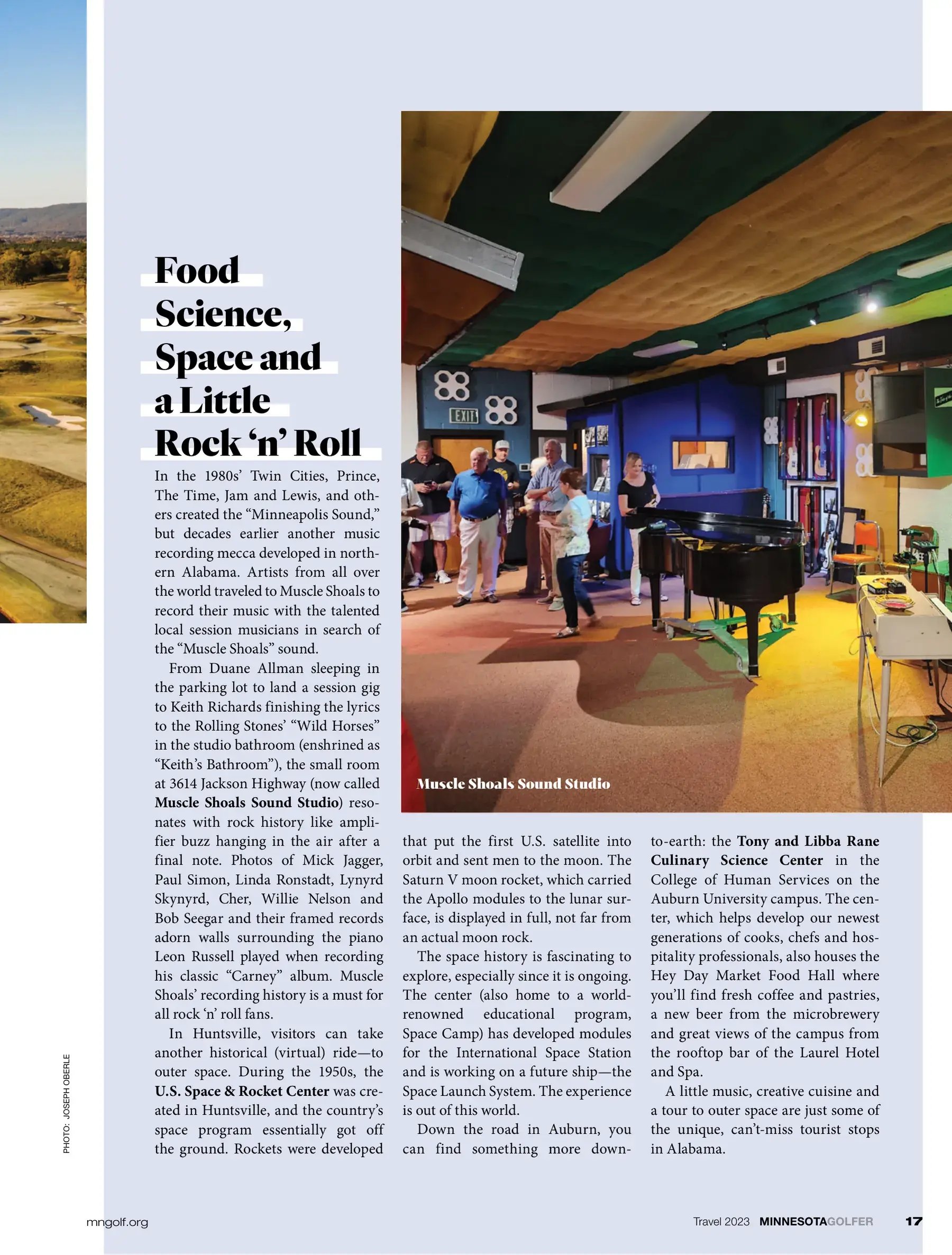
in the studio bathroom (enshrined as “Keith’s Bathroom”), the small room at 3614 Jackson Highway (now called Muscle Shoals Sound Studio) resonates with rock history like amplifier buzz hanging in the air after a final note. Photos of Mick Jagger, Paul Simon, Linda Ronstadt, Lynyrd Skynyrd, Cher, Willie Nelson and Bob Seegar and their framed records adorn walls surrounding the piano Leon Russell played when recording his classic “Carney” album. Muscle Shoals’ recording history is a must for all rock ‘n’ roll fans.
In Huntsville, visitors can take another historical (virtual) ride—to outer space. During the 1950s, the U.S. Space & Rocket Center was created in Huntsville, and the country’s space program essentially got off the ground. Rockets were developed that put the first U.S. satellite into orbit and sent men to the moon. The Saturn V moon rocket, which carried the Apollo modules to the lunar surface, is displayed in full, not far from an actual moon rock.
The space history is fascinating to explore, especially since it is ongoing. The center (also home to a worldrenowned educational program, Space Camp) has developed modules for the International Space Station and is working on a future ship—the Space Launch System. The experience is out of this world.
Down the road in Auburn, you can find something more downto-earth: the Tony and Libba Rane Culinary Science Center in the College of Human Services on the Auburn University campus. The center, which helps develop our newest generations of cooks, chefs and hospitality professionals, also houses the Hey Day Market Food Hall where you’ll find fresh coffee and pastries, a new beer from the microbrewery and great views of the campus from the rooftop bar of the Laurel Hotel and Spa.
A little music, creative cuisine and a tour to outer space are just some of the unique, can’t-miss tourist stops in Alabama. Muscle Shoals Sound Studio PHOTO: JOSEPH OBERLE back to the Trail.
The River course snakes through the lowlands of former soybean fields of the Flint River flood plains. Water is a theme, as it comes into play on 16 holes of this fun and playable track. It is known as the only RTJ course in the world designed without a bunker, but with all the water (threatening occasionally on both sides of the fairway), a little sand might be a welcome relief. Hit it straight, and the River course (7,668 yards; 77.5/140) can be managed.
The Short Course (3,635 yards; par 54) is “links-like and open” and has water in play on 11 of 18 holes. It features four sets of tees, and with the forward Teal tees set at 1,861 yards, players of all skill levels can enjoy golfing at Hampton Cove.
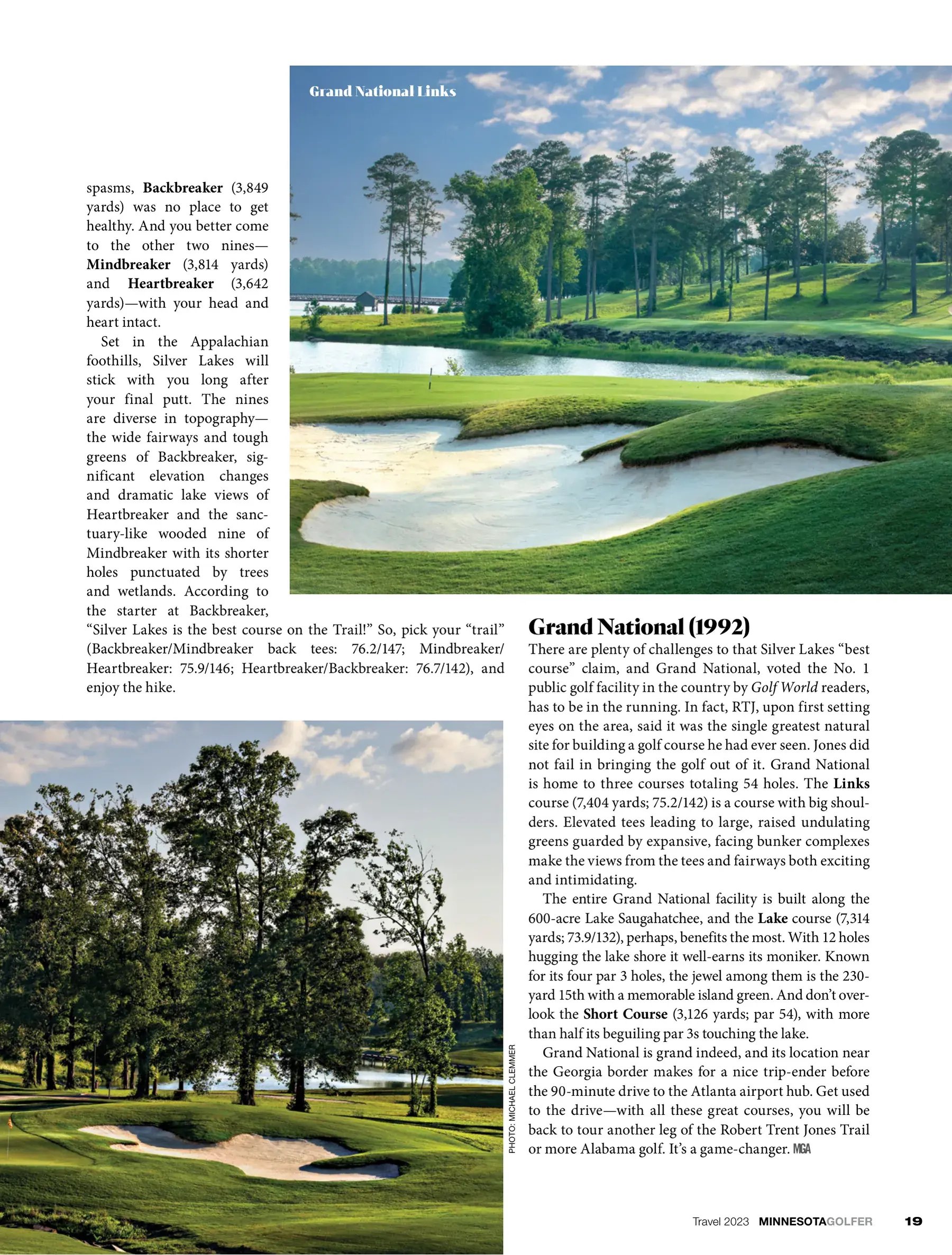
Silver Lakes (1993) Silver Lakes is something to behold. It has three different regulation nine-hole courses, plus the Short Course (1,994 yards; par 27) routed around Lee’s Lake. With huge elevation changes and spectacular views, every hole offers a new and exciting challenge.
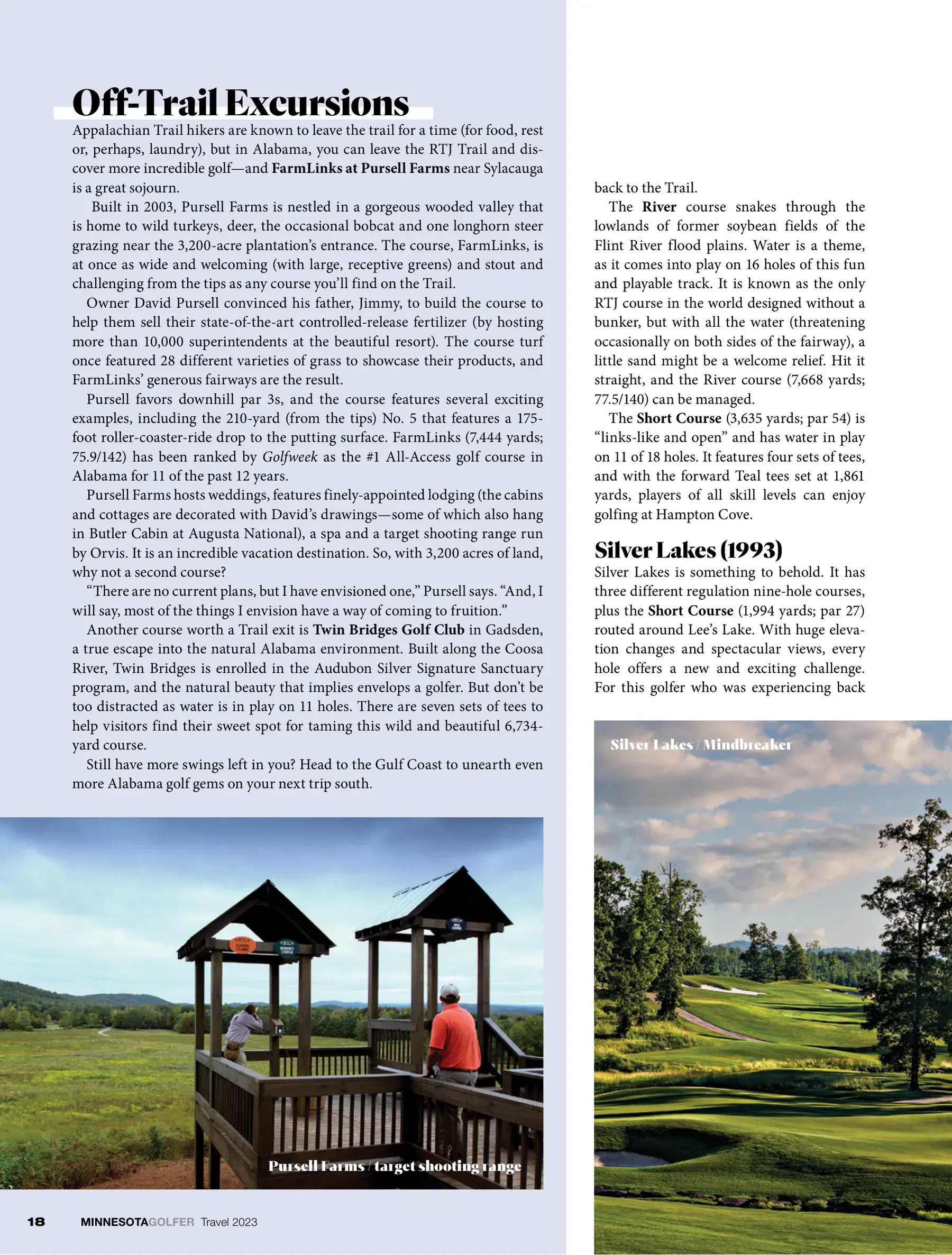
For this golfer who was experiencing back Silver Lakes / Mindbreaker Pursell Farms / target shooting range Off-Trail Excursions Appalachian Trail hikers are known to leave the trail for a time (for food, rest or, perhaps, laundry), but in Alabama, you can leave the RTJ Trail and discover more incredible golf—and FarmLinks at Pursell Farms near Sylacauga is a great sojourn.
Built in 2003, Pursell Farms is nestled in a gorgeous wooded valley that is home to wild turkeys, deer, the occasional bobcat and one longhorn steer grazing near the 3,200-acre plantation’s entrance. The course, FarmLinks, is at once as wide and welcoming (with large, receptive greens) and stout and challenging from the tips as any course you’ll find on the Trail.
Owner David Pursell convinced his father, Jimmy, to build the course to help them sell their state-of-the-art controlled-release fertilizer (by hosting more than 10,000 superintendents at the beautiful resort). The course turf once featured 28 different varieties of grass to showcase their products, and FarmLinks’ generous fairways are the result.
Pursell favors downhill par 3s, and the course features several exciting examples, including the 210-yard (from the tips) No. 5 that features a 175foot roller-coaster-ride drop to the putting surface. FarmLinks (7,444 yards; 75.9/142) has been ranked by Golfweek as the #1 All-Access golf course in Alabama for 11 of the past 12 years.
Pursell Farms hosts weddings, features finely-appointed lodging (the cabins and cottages are decorated with David’s drawings—some of which also hang in Butler Cabin at Augusta National), a spa and a target shooting range run by Orvis. It is an incredible vacation destination. So, with 3,200 acres of land, why not a second course?
“There are no current plans, but I have envisioned one,” Pursell says. “And, I will say, most of the things I envision have a way of coming to fruition.”
Another course worth a Trail exit is Twin Bridges Golf Club in Gadsden, a true escape into the natural Alabama environment. Built along the Coosa River, Twin Bridges is enrolled in the Audubon Silver Signature Sanctuary program, and the natural beauty that implies envelops a golfer. But don’t be too distracted as water is in play on 11 holes. There are seven sets of tees to help visitors find their sweet spot for taming this wild and beautiful 6,734yard course.
Still have more swings left in you? Head to the Gulf Coast to unearth even more Alabama golf gems on your next trip south. Travel 2023 MINNESOTAGOLFER 19 spasms, Backbreaker (3,849 yards) was no place to get healthy. And you better come to the other two nines— Mindbreaker (3,814 yards) and Heartbreaker (3,642 yards)—with your head and heart intact.
Set in the Appalachian foothills, Silver Lakes will stick with you long after your final putt. The nines are diverse in topography— the wide fairways and tough greens of Backbreaker, significant elevation changes and dramatic lake views of Heartbreaker and the sanctuary-like wooded nine of Mindbreaker with its shorter holes punctuated by trees and wetlands. According to the starter at Backbreaker, “Silver Lakes is the best course on the Trail!” So, pick your “trail”
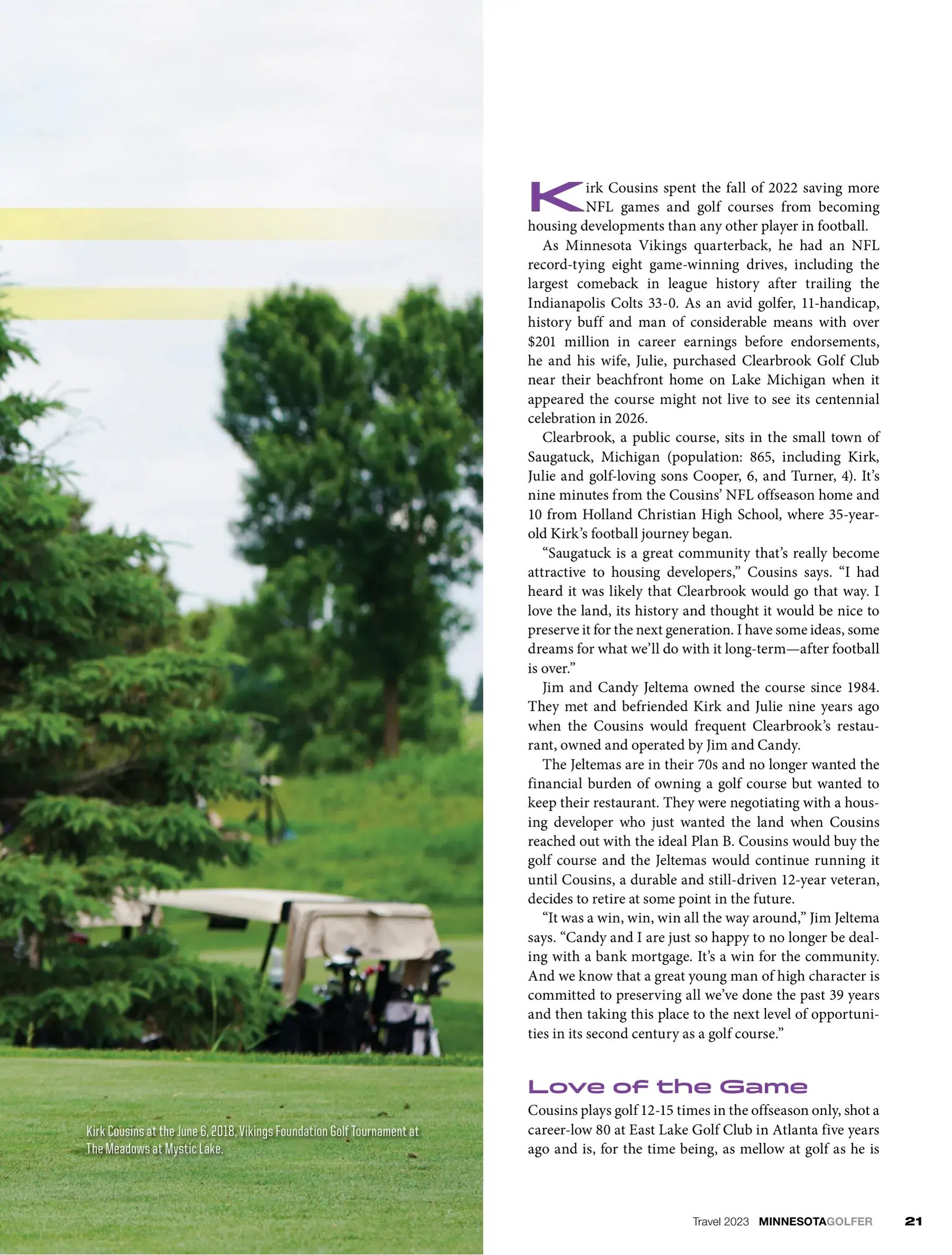
(Backbreaker/Mindbreaker back tees: 76.2/147; Mindbreaker/ Heartbreaker: 75.9/146; Heartbreaker/Backbreaker: 76.7/142), and enjoy the hike. Grand National Links Grand National (1992) There are plenty of challenges to that Silver Lakes “best course” claim, and Grand National, voted the No. 1 public golf facility in the country by Golf World readers, has to be in the running. In fact, RTJ, upon first setting eyes on the area, said it was the single greatest natural site for building a golf course he had ever seen. Jones did not fail in bringing the golf out of it. Grand National is home to three courses totaling 54 holes. The Links course (7,404 yards; 75.2/142) is a course with big shoulders. Elevated tees leading to large, raised undulating greens guarded by expansive, facing bunker complexes make the views from the tees and fairways both exciting and intimidating.
The entire Grand National facility is built along the 600-acre Lake Saugahatchee, and the Lake course (7,314 yards; 73.9/132), perhaps, benefits the most. With 12 holes hugging the lake shore it well-earns its moniker. Known for its four par 3 holes, the jewel among them is the 230yard 15th with a memorable island green. And don’t overlook the Short Course (3,126 yards; par 54), with more than half its beguiling par 3s touching the lake.
Grand National is grand indeed, and its location near the Georgia border makes for a nice trip-ender before the 90-minute drive to the Atlanta airport hub. Get used to the drive—with all these great courses, you will be back to tour another leg of the Robert Trent Jones Trail or more Alabama golf. It’s a game-changer.
PHOTO: MICHAEL CLEMMER FUTURE GAME PLAN Vikings quarterback Kirk Cousins is setting up his post-NFL life by purchasing a golf course near his hometown. By Mark Craig Travel 2023 MINNESOTAGOLFER 21 K irk Cousins spent the fall of 2022 saving more NFL games and golf courses from becoming housing developments than any other player in football.
As Minnesota Vikings quarterback, he had an NFL record-tying eight game-winning drives, including the largest comeback in league history after trailing the Indianapolis Colts 33-0. As an avid golfer, 11-handicap, history buff and man of considerable means with over $201 million in career earnings before endorsements, he and his wife, Julie, purchased Clearbrook Golf Club near their beachfront home on Lake Michigan when it appeared the course might not live to see its centennial celebration in 2026.
Clearbrook, a public course, sits in the small town of Saugatuck, Michigan (population: 865, including Kirk, Julie and golf-loving sons Cooper, 6, and Turner, 4). It’s nine minutes from the Cousins’ NFL offseason home and 10 from Holland Christian High School, where 35-yearold Kirk’s football journey began.
“Saugatuck is a great community that’s really become attractive to housing developers,” Cousins says. “I had heard it was likely that Clearbrook would go that way. I love the land, its history and thought it would be nice to preserve it for the next generation. I have some ideas, some dreams for what we’ll do with it long-term—after football is over.”
Jim and Candy Jeltema owned the course since 1984. They met and befriended Kirk and Julie nine years ago when the Cousins would frequent Clearbrook’s restaurant, owned and operated by Jim and Candy.
The Jeltemas are in their 70s and no longer wanted the financial burden of owning a golf course but wanted to keep their restaurant. They were negotiating with a housing developer who just wanted the land when Cousins reached out with the ideal Plan B. Cousins would buy the golf course and the Jeltemas would continue running it until Cousins, a durable and still-driven 12-year veteran, decides to retire at some point in the future.
“It was a win, win, win all the way around,” Jim Jeltema says. “Candy and I are just so happy to no longer be dealing with a bank mortgage. It’s a win for the community.
And we know that a great young man of high character is committed to preserving all we’ve done the past 39 years and then taking this place to the next level of opportunities in its second century as a golf course.”
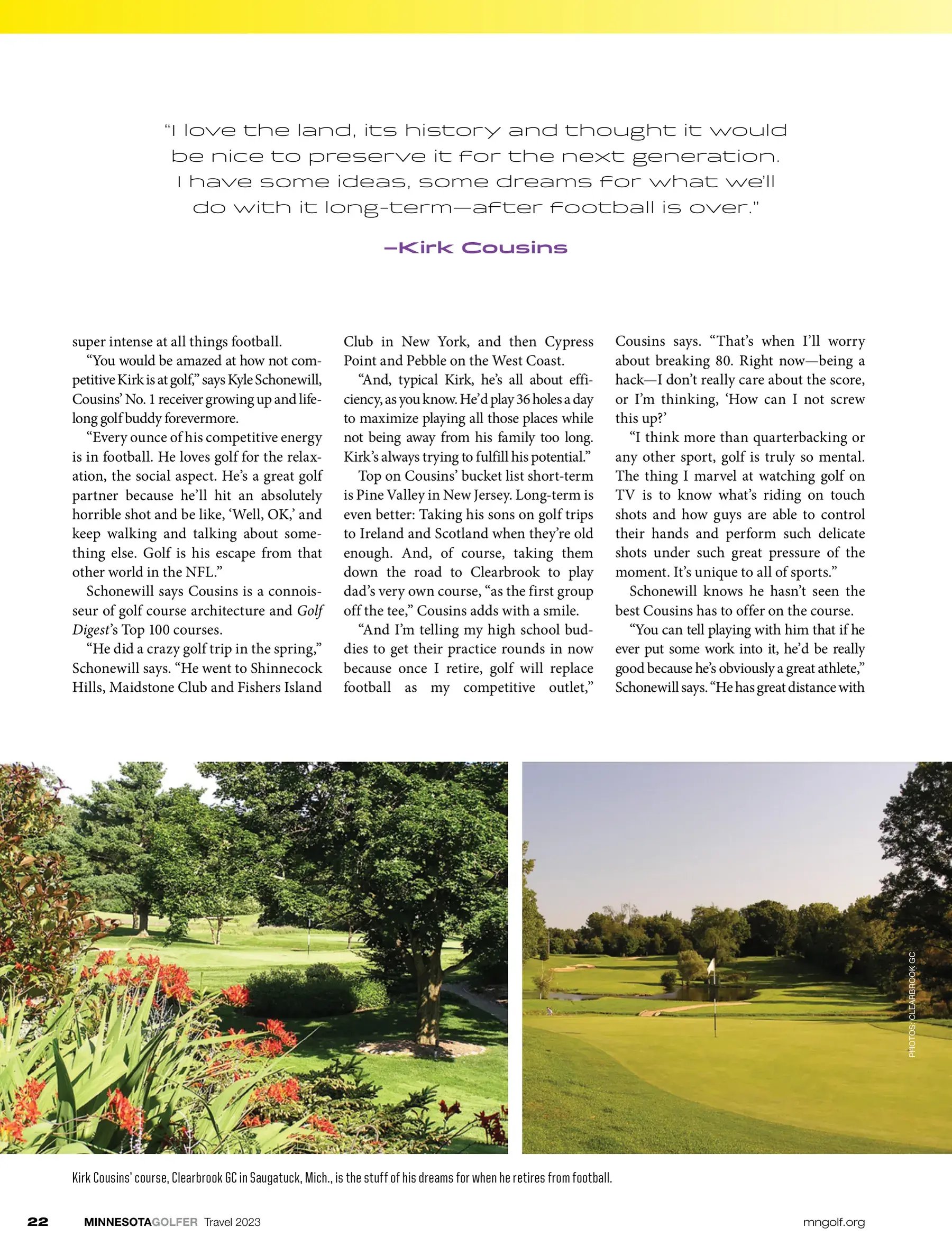
Love of the Game Cousins plays golf 12-15 times in the offseason only, shot a career-low 80 at East Lake Golf Club in Atlanta five years ago and is, for the time being, as mellow at golf as he is Kirk Cousins at the June 6, 2018, Vikings Foundation Golf Tournament at The Meadows at Mystic Lake.
Kirk Cousins’ course, Clearbrook GC in Saugatuck, Mich., is the stuff of his dreams for when he retires from football. “I love the land, its history and thought it would be nice to preserve it for the next generation.
I have some ideas, some dreams for what we’ll do with it long-term—after football is over.” –Kirk Cousins PHOTOS: CLEARBROOK GC super intense at all things football.
“You would be amazed at how not competitive Kirk is at golf,” says Kyle Schonewill, Cousins’ No. 1 receiver growing up and lifelong golf buddy forevermore.
“Every ounce of his competitive energy is in football. He loves golf for the relaxation, the social aspect. He’s a great golf partner because he’ll hit an absolutely horrible shot and be like, ‘Well, OK,’ and keep walking and talking about something else. Golf is his escape from that other world in the NFL.”
Schonewill says Cousins is a connoisseur of golf course architecture and Golf Digest’s Top 100 courses. “He did a crazy golf trip in the spring,”
Schonewill says. “He went to Shinnecock Hills, Maidstone Club and Fishers Island Club in New York, and then Cypress Point and Pebble on the West Coast.
“And, typical Kirk, he’s all about efficiency, as you know. He’d play 36 holes a day to maximize playing all those places while not being away from his family too long.
Kirk’s always trying to fulfill his potential.” Top on Cousins’ bucket list short-term is Pine Valley in New Jersey. Long-term is even better: Taking his sons on golf trips to Ireland and Scotland when they’re old enough. And, of course, taking them down the road to Clearbrook to play dad’s very own course, “as the first group off the tee,” Cousins adds with a smile.
“And I’m telling my high school buddies to get their practice rounds in now because once I retire, golf will replace football as my competitive outlet,”
Cousins says. “That’s when I’ll worry about breaking 80. Right now—being a hack—I don’t really care about the score, or I’m thinking, ‘How can I not screw this up?’ “I think more than quarterbacking or any other sport, golf is truly so mental.
The thing I marvel at watching golf on TV is to know what’s riding on touch shots and how guys are able to control their hands and perform such delicate shots under such great pressure of the moment. It’s unique to all of sports.”
Schonewill knows he hasn’t seen the best Cousins has to offer on the course. “You can tell playing with him that if he ever put some work into it, he’d be really good because he’s obviously a great athlete,”
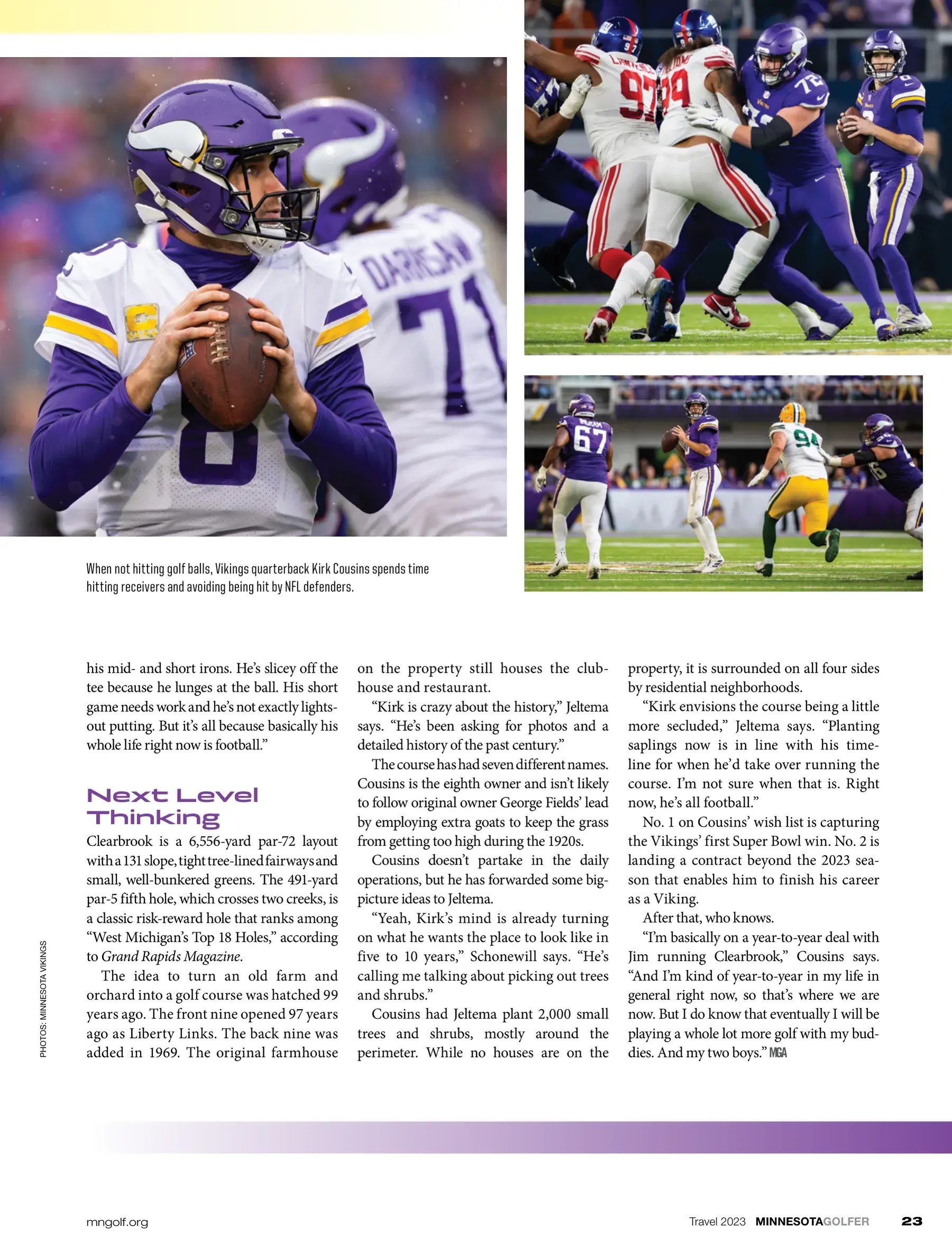
Schonewill says. “He has great distance with Travel 2023 MINNESOTAGOLFER 23 When not hitting golf balls, Vikings quarterback Kirk Cousins spends time hitting receivers and avoiding being hit by NFL defenders.
PHOTOS: MINNESOTA VIKINGS his mid- and short irons. He’s slicey off the tee because he lunges at the ball. His short game needs work and he’s not exactly lightsout putting. But it’s all because basically his whole life right now is football.”
Next Level Thinking Clearbrook is a 6,556-yard par-72 layout with a 131 slope, tight tree-lined fairways and small, well-bunkered greens. The 491-yard par-5 fifth hole, which crosses two creeks, is a classic risk-reward hole that ranks among “West Michigan’s Top 18 Holes,” according to Grand Rapids Magazine.
The idea to turn an old farm and orchard into a golf course was hatched 99 years ago. The front nine opened 97 years ago as Liberty Links. The back nine was added in 1969. The original farmhouse on the property still houses the clubhouse and restaurant.
“Kirk is crazy about the history,” Jeltema says. “He’s been asking for photos and a detailed history of the past century.” The course has had seven different names.
Cousins is the eighth owner and isn’t likely to follow original owner George Fields’ lead by employing extra goats to keep the grass from getting too high during the 1920s.
Cousins doesn’t partake in the daily operations, but he has forwarded some bigpicture ideas to Jeltema. “Yeah, Kirk’s mind is already turning on what he wants the place to look like in five to 10 years,” Schonewill says. “He’s calling me talking about picking out trees and shrubs.”
Cousins had Jeltema plant 2,000 small trees and shrubs, mostly around the perimeter. While no houses are on the property, it is surrounded on all four sides by residential neighborhoods.
“Kirk envisions the course being a little more secluded,” Jeltema says. “Planting saplings now is in line with his timeline for when he’d take over running the course. I’m not sure when that is. Right now, he’s all football.”
No. 1 on Cousins’ wish list is capturing the Vikings’ first Super Bowl win. No. 2 is landing a contract beyond the 2023 season that enables him to finish his career as a Viking.
After that, who knows. “I’m basically on a year-to-year deal with Jim running Clearbrook,” Cousins says. “And I’m kind of year-to-year in my life in general right now, so that’s where we are now. But I do know that eventually I will be playing a whole lot more golf with my buddies. And my two boys.”
“The reimagined mission and selection criteria for election to the Hall of Fame opens the door to individuals not previously considered, and better reflects what the Hall of Fame was always intended to be—a place where the people with the greatest impact on Minnesota golf are forever enshrined,”
says Tom Ryan, MGA executive director/COO and HOF selection committee co-chair. Beginning with this year’s class of inductees— who will be inducted at a special spring banquet in May of next year—the selection committee will induct vetted candidates on a biennial basis.
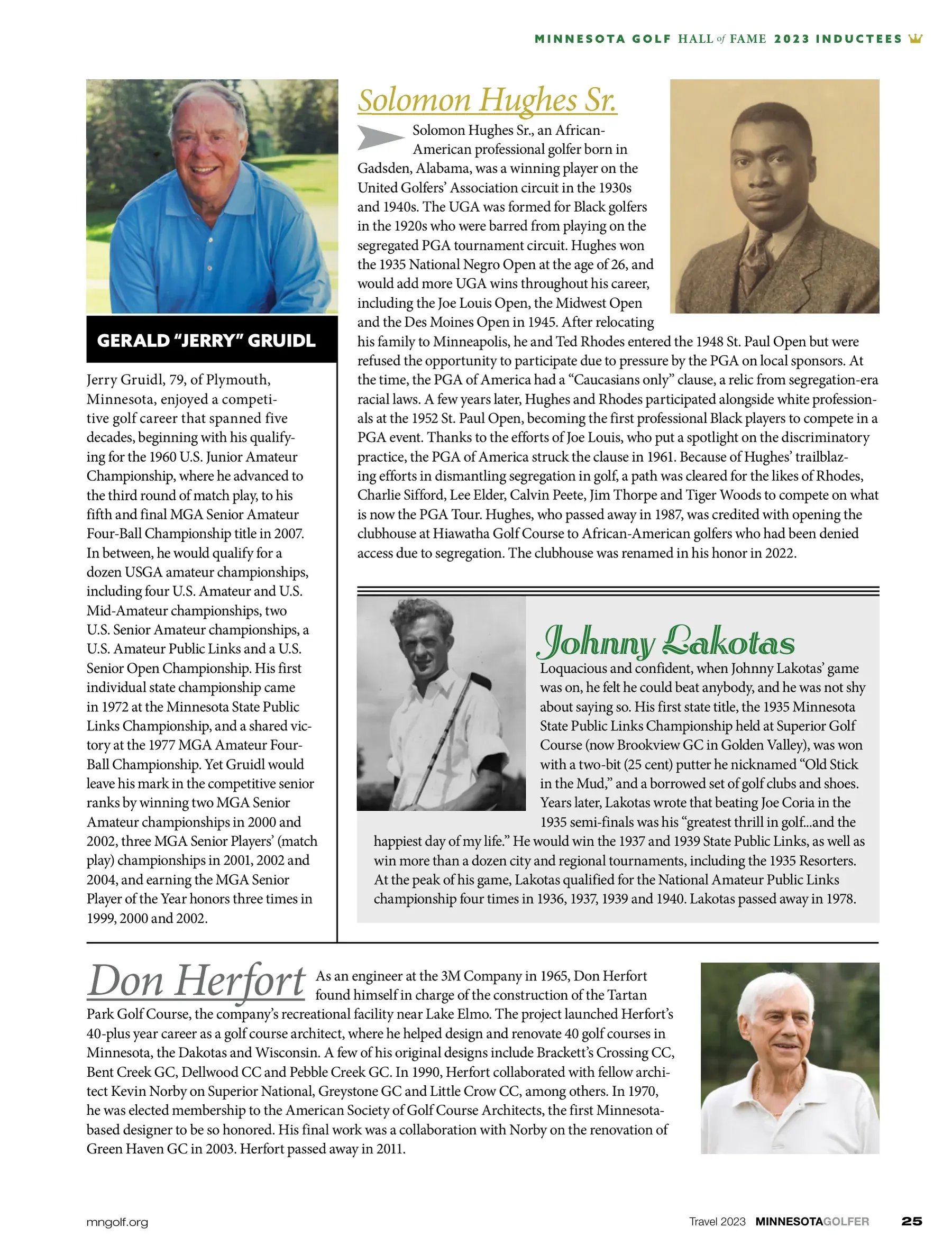
In HALL of FAME By W.P. Ryan Travel 2023 MINNESOTAGOLFER 25 Solomon Hughes Sr. Solomon Hughes Sr., an AfricanAmerican professional golfer born in Gadsden, Alabama, was a winning player on the United Golfers’ Association circuit in the 1930s and 1940s. The UGA was formed for Black golfers in the 1920s who were barred from playing on the segregated PGA tournament circuit. Hughes won the 1935 National Negro Open at the age of 26, and would add more UGA wins throughout his career, including the Joe Louis Open, the Midwest Open and the Des Moines Open in 1945. After relocating his family to Minneapolis, he and Ted Rhodes entered the 1948 St. Paul Open but were refused the opportunity to participate due to pressure by the PGA on local sponsors. At the time, the PGA of America had a “Caucasians only” clause, a relic from segregation-era racial laws. A few years later, Hughes and Rhodes participated alongside white professionals at the 1952 St. Paul Open, becoming the first professional Black players to compete in a PGA event. Thanks to the efforts of Joe Louis, who put a spotlight on the discriminatory practice, the PGA of America struck the clause in 1961. Because of Hughes’ trailblazing efforts in dismantling segregation in golf, a path was cleared for the likes of Rhodes, Charlie Sifford, Lee Elder, Calvin Peete, Jim Thorpe and Tiger Woods to compete on what is now the PGA Tour. Hughes, who passed away in 1987, was credited with opening the clubhouse at Hiawatha Golf Course to African-American golfers who had been denied access due to segregation. The clubhouse was renamed in his honor in 2022.
Johnny Lakotas Loquacious and confident, when Johnny Lakotas’ game was on, he felt he could beat anybody, and he was not shy about saying so. His first state title, the 1935 Minnesota State Public Links Championship held at Superior Golf Course (now Brookview GC in Golden Valley), was won with a two-bit (25 cent) putter he nicknamed “Old Stick in the Mud,” and a borrowed set of golf clubs and shoes.
Years later, Lakotas wrote that beating Joe Coria in the 1935 semi-finals was his “greatest thrill in golf...and the happiest day of my life.” He would win the 1937 and 1939 State Public Links, as well as win more than a dozen city and regional tournaments, including the 1935 Resorters.
At the peak of his game, Lakotas qualified for the National Amateur Public Links championship four times in 1936, 1937, 1939 and 1940. Lakotas passed away in 1978.
GERALD “JERRY” GRUIDL Jerry Gruidl, 79, of Plymouth, Minnesota, enjoyed a competitive golf career that spanned five decades, beginning with his qualifying for the 1960 U.S. Junior Amateur Championship, where he advanced to the third round of match play, to his fifth and final MGA Senior Amateur Four-Ball Championship title in 2007.
In between, he would qualify for a dozen USGA amateur championships, including four U.S. Amateur and U.S. Mid-Amateur championships, two U.S. Senior Amateur championships, a U.S. Amateur Public Links and a U.S.
Senior Open Championship. His first individual state championship came in 1972 at the Minnesota State Public Links Championship, and a shared victory at the 1977 MGA Amateur FourBall Championship. Yet Gruidl would leave his mark in the competitive senior ranks by winning two MGA Senior Amateur championships in 2000 and 2002, three MGA Senior Players’ (match play) championships in 2001, 2002 and 2004, and earning the MGA Senior Player of the Year honors three times in 1999, 2000 and 2002.
Jeff Sorenson Jeff Sorenson, 44, of Blaine, who grew up caddieing at Edinburgh USA under the tutelage of a father sporting a scratch handicap, made his mark on the Minnesota golf scene by compiling an impressive list of professional championships, including five Minnesota Section Professional Championships in 2006, 2008, 2010, 2012 and 2023, three Minnesota Section Match Play championships in 2006, 2011 and 2016, the 2006 Minnesota Golf Champions and the 2009 Tapemark Charity Pro-Am. Sorenson, a seven-time Minnesota Section PGA Player of the Year, is the Director of Instruction at the Minikahda Club in Minneapolis.
Eleanor Lightner Known as “Minnesota’s first women’s champion,” Eleanor Lightner, of St. Paul’s Town & Country Club, won the first state championship organized by the Women’s Minnesota Golf Association in 1915 in a match that went 19 holes against Marion Lanpher at Town & Country. Lightner would successfully defend the title the following year at Minikahda, defeating Mrs. W.A. McLeod, 3 and 1. There were no championships in 1917-1918 due to World War I, but Lightner would win her third and final state title at Town & Country in 1920, defeating Elizabeth Dean, 6 and 5. She won the inaugural Resorters tournament at Alexandria Golf Club in 1922, defeating Mrs. E.R.
Morrison, of Kansas City, Missouri, and she won a second Resorters title in 1925, defeating Mrs. Esther (Tallman) Freeman, of Willmar, Minnesota, 4 and 3. Lightner married and moved to Virginia, passing away in 1977.
Edward Manderville Edward “Eddie” Manderville was a leader, mentor and friend to many in Minneapolis’ AfricanAmerican community. He was honored by Mayor Jacob Frey with the “Ed Manderville Day” on July 28, 2018.
Manderville’s competitive golf achievements were many, including the 1988 MGA Senior Amateur Championship and the 1987 MGA Senior Amateur Four-Ball Championship. He qualified for the 1986 U.S. Senior Open and the 1991 U.S. Senior Amateur. Manderville’s innumerable contributions to the game included mentoring young and old alike. He conducted annual Rules of Golf workshops with Black Women on Course, a club without real estate of the MGA, and offered golf instruction to students at Anwatin Middle School. Manderville was a longtime MGA tournament volunteer, and he served on the MGA Board of Directors from 1990 to 1999. In every sense of the word, Manderville fulfilled the role of ambassador for the game of golf in Minnesota. Manderville passed away in 2018.
Travel 2023 MINNESOTAGOLFER 27 DAVID NORDEEN As a competitive amateur golfer, David Nordeen, 59, of Jacksonville, Florida, earned First Team All-Big Ten honors in 1984 at the University of Minnesota, where he captained the men’s golf squad. He would join an elite group of amateurs by winning the MGA Amateur and the Minnesota State Public Links championships in 1985, and by successfully defending the State Amateur in 1986.
As a professional, he won the Tapemark Charity Pro-Am in 1994, the Minnesota Section PGA Professional Championship in 1998 and the Minnesota Section Club Professionals Championship in 2002. As a senior player, Nordeen won the 2014 Minnesota Section Senior Match Play Championship, defeating two-time defending champ Don Berry in the quarterfinals, and beating Thomas Vizina, 3 and 2, in the finals. A Class A member of the PGA of America for a quarter century, Nordeen teaches golf instruction at the Ponte Vedra Inn & Club in Ponte Vedra Beach, Florida.
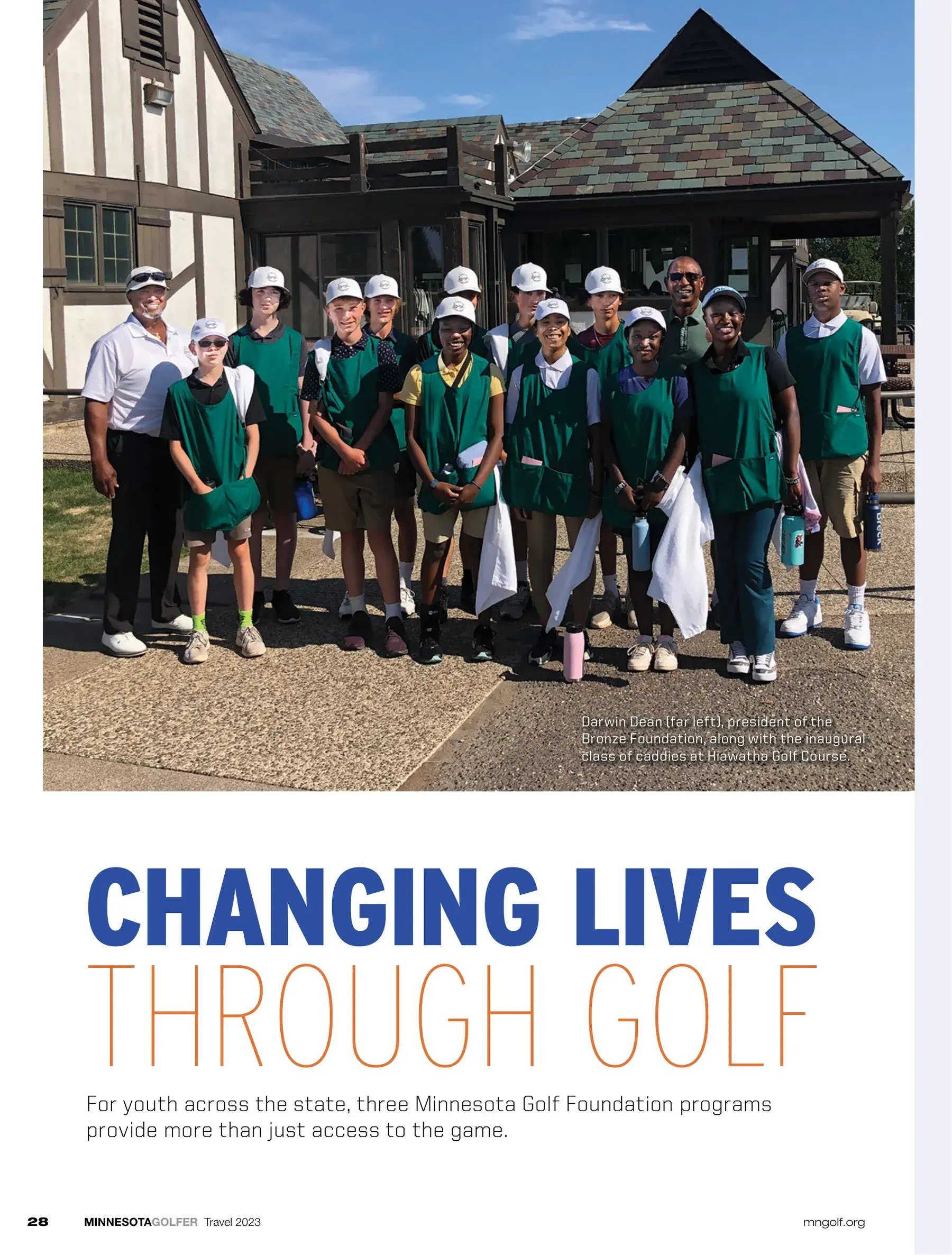
Darwin Dean (far left), president of the Bronze Foundation, along with the inaugural class of caddies at Hiawatha Golf Course. Travel 2023 MINNESOTAGOLFER 29 MGA members and readers of Minnesota Golfer will be familiar with the three core programs of the Minnesota Golf Foundation (MGF): the oldest program, the Women’s Scholarship; the fastest growing program, Youth on Course Minnesota; and the relatively rookie program, Caddie Development. All three are regularly featured in the pages of this magazine, but they are strikingly different in their approach to improving lives through the game of golf in Minnesota.
The Minnesota Women’s Scholarship provides a four-year scholarship to qualified candidates. For more than three decades, a network of dedicated volunteers ran events at their local public and private courses to fund the scholarships.
Due to a shrinking pool of applicants, the MGF plans to grow awareness and the available dollars to assist more young women attending a college, university or technical school.
The Caddie Development program provides existing caddie programs at private facilities with best practices and resource support, as well as introducing new caddie programs to public facilities. Its overall objective is to fill the pipeline of future candidates for the Evans Scholars program at the University of Minnesota.
Managed by MGA Caddie Development & Communications Manager Jack Mendesh, the initiative has helped launch new caddie programs at Keller Golf Course, Elk River Golf Club and the newest addition at the historic Hiawatha Golf Course in Minneapolis, in partnership with the Bronze Foundation.
“The difference this program has made in these young people’s lives is what mentoring young people is all about,” says Darwin Dean, president of the Bronze Foundation. “They learned how to interact with adults in a respectful manner and play the great game of golf. This has been a tremendous experience for them and will last for a lifetime.”
Youth on Course Minnesota (YOC MN) was introduced in 2017 mainly to overcome one of the game’s strategic barriers to youth: cost. Kids ages 6-18 pay $5 or less at more than 100 golf courses in Minnesota. YOC also provides career exploration and college scholarships. Under the watchful eye of Joel Comstock, YOC MN participation has exploded—this summer set an all-time high membership mark of 15,420 golfers who are forecasted to play 80,000 rounds this year.
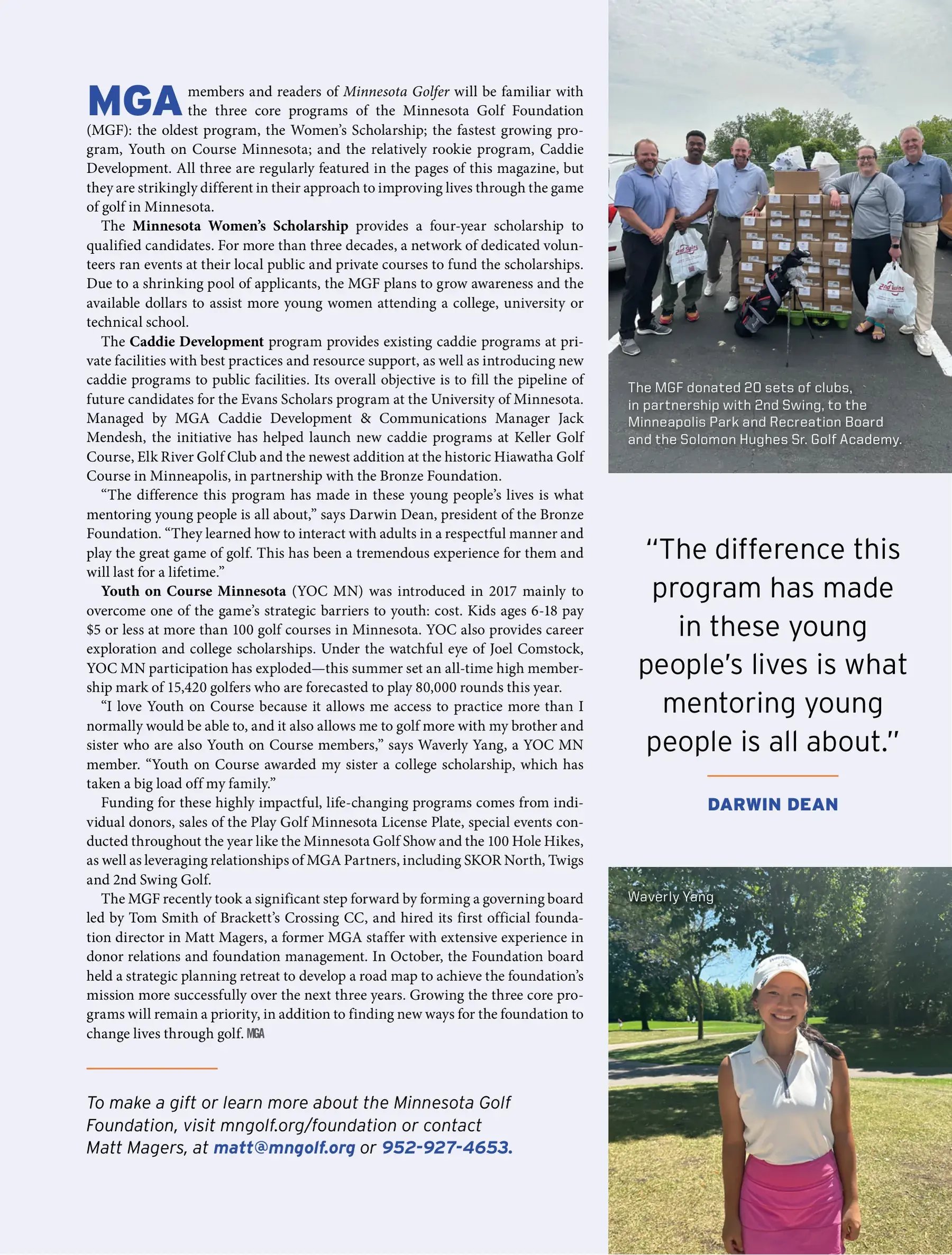
“I love Youth on Course because it allows me access to practice more than I normally would be able to, and it also allows me to golf more with my brother and sister who are also Youth on Course members,” says Waverly Yang, a YOC MN member. “Youth on Course awarded my sister a college scholarship, which has taken a big load off my family.”
Funding for these highly impactful, life-changing programs comes from individual donors, sales of the Play Golf Minnesota License Plate, special events conducted throughout the year like the Minnesota Golf Show and the 100 Hole Hikes, as well as leveraging relationships of MGA Partners, including SKOR North, Twigs and 2nd Swing Golf.
The MGF recently took a significant step forward by forming a governing board led by Tom Smith of Brackett’s Crossing CC, and hired its first official foundation director in Matt Magers, a former MGA staffer with extensive experience in donor relations and foundation management. In October, the Foundation board held a strategic planning retreat to develop a road map to achieve the foundation’s mission more successfully over the next three years. Growing the three core programs will remain a priority, in addition to finding new ways for the foundation to change lives through golf.
The MGF donated 20 sets of clubs, in partnership with 2nd Swing, to the Minneapolis Park and Recreation Board and the Solomon Hughes Sr. Golf Academy.
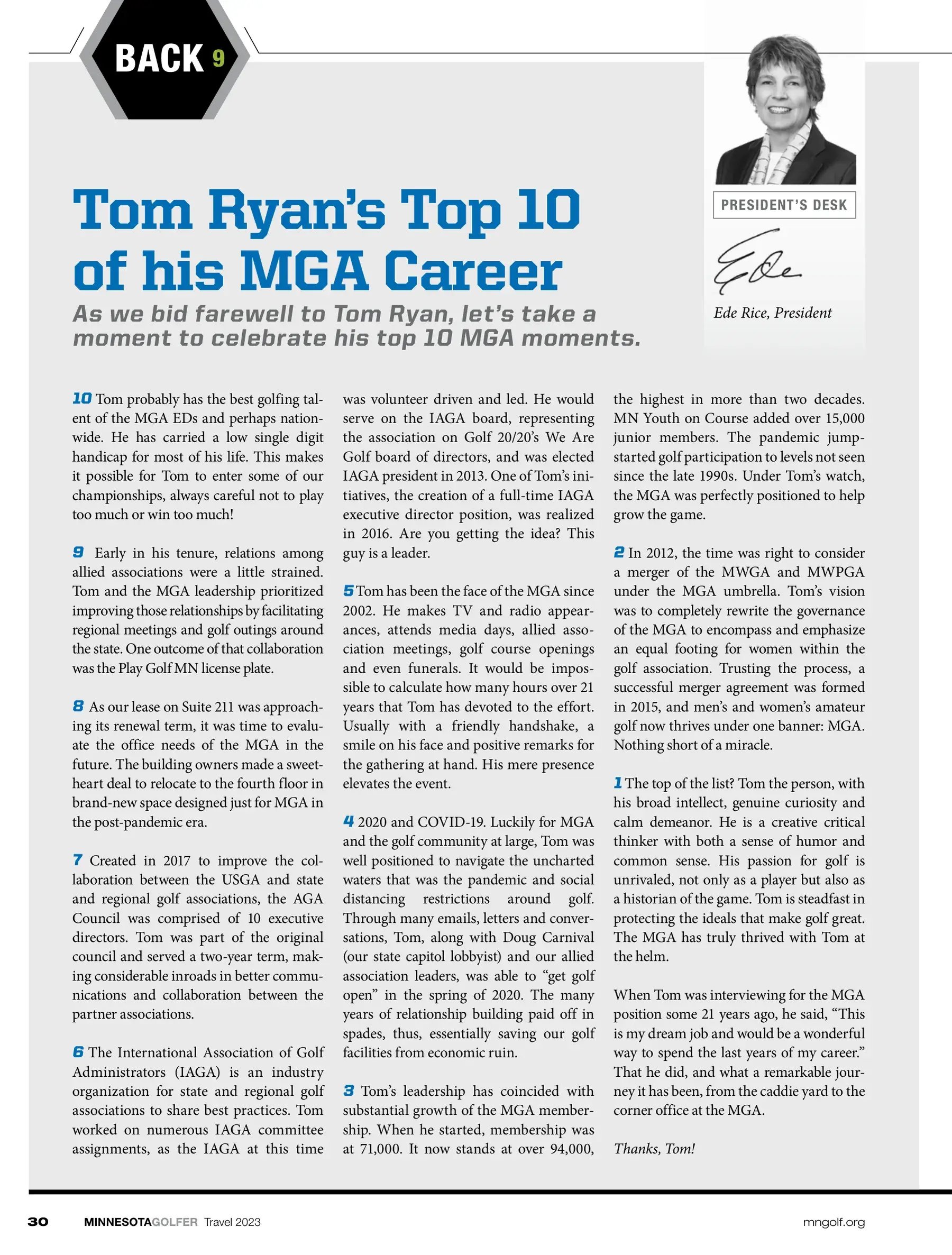
Waverly Yang 10 Tom probably has the best golfing talent of the MGA EDs and perhaps nationwide. He has carried a low single digit handicap for most of his life. This makes it possible for Tom to enter some of our championships, always careful not to play too much or win too much!
9 Early in his tenure, relations among allied associations were a little strained. Tom and the MGA leadership prioritized improving those relationships by facilitating regional meetings and golf outings around the state. One outcome of that collaboration was the Play Golf MN license plate.
8 As our lease on Suite 211 was approaching its renewal term, it was time to evaluate the office needs of the MGA in the future. The building owners made a sweetheart deal to relocate to the fourth floor in brand-new space designed just for MGA in the post-pandemic era.
7 Created in 2017 to improve the collaboration between the USGA and state and regional golf associations, the AGA Council was comprised of 10 executive directors. Tom was part of the original council and served a two-year term, making considerable inroads in better communications and collaboration between the partner associations.
6 The International Association of Golf Administrators (IAGA) is an industry organization for state and regional golf associations to share best practices. Tom worked on numerous IAGA committee assignments, as the IAGA at this time was volunteer driven and led. He would serve on the IAGA board, representing the association on Golf 20/20’s We Are Golf board of directors, and was elected IAGA president in 2013. One of Tom’s initiatives, the creation of a full-time IAGA executive director position, was realized in 2016. Are you getting the idea? This guy is a leader.
5 Tom has been the face of the MGA since 2002. He makes TV and radio appearances, attends media days, allied association meetings, golf course openings and even funerals. It would be impossible to calculate how many hours over 21 years that Tom has devoted to the effort.
Usually with a friendly handshake, a smile on his face and positive remarks for the gathering at hand. His mere presence elevates the event. 4 2020 and COVID-19. Luckily for MGA and the golf community at large, Tom was well positioned to navigate the uncharted waters that was the pandemic and social distancing restrictions around golf.
Through many emails, letters and conversations, Tom, along with Doug Carnival (our state capitol lobbyist) and our allied association leaders, was able to “get golf open” in the spring of 2020. The many years of relationship building paid off in spades, thus, essentially saving our golf facilities from economic ruin.
3 Tom’s leadership has coincided with substantial growth of the MGA membership. When he started, membership was at 71,000. It now stands at over 94,000, the highest in more than two decades.
MN Youth on Course added over 15,000 junior members. The pandemic jumpstarted golf participation to levels not seen since the late 1990s. Under Tom’s watch, the MGA was perfectly positioned to help grow the game.
2 In 2012, the time was right to consider a merger of the MWGA and MWPGA under the MGA umbrella. Tom’s vision was to completely rewrite the governance of the MGA to encompass and emphasize an equal footing for women within the golf association. Trusting the process, a successful merger agreement was formed in 2015, and men’s and women’s amateur golf now thrives under one banner: MGA.
Nothing short of a miracle. 1 The top of the list? Tom the person, with his broad intellect, genuine curiosity and calm demeanor. He is a creative critical thinker with both a sense of humor and common sense. His passion for golf is unrivaled, not only as a player but also as a historian of the game. Tom is steadfast in protecting the ideals that make golf great.
The MGA has truly thrived with Tom at the helm. When Tom was interviewing for the MGA position some 21 years ago, he said, “This is my dream job and would be a wonderful way to spend the last years of my career.”
That he did, and what a remarkable journey it has been, from the caddie yard to the corner office at the MGA. Thanks, Tom! Tom Ryan’s Top 10 of his MGA Career As we bid farewell to Tom Ryan, let’s take a moment to celebrate his top 10 MGA moments.
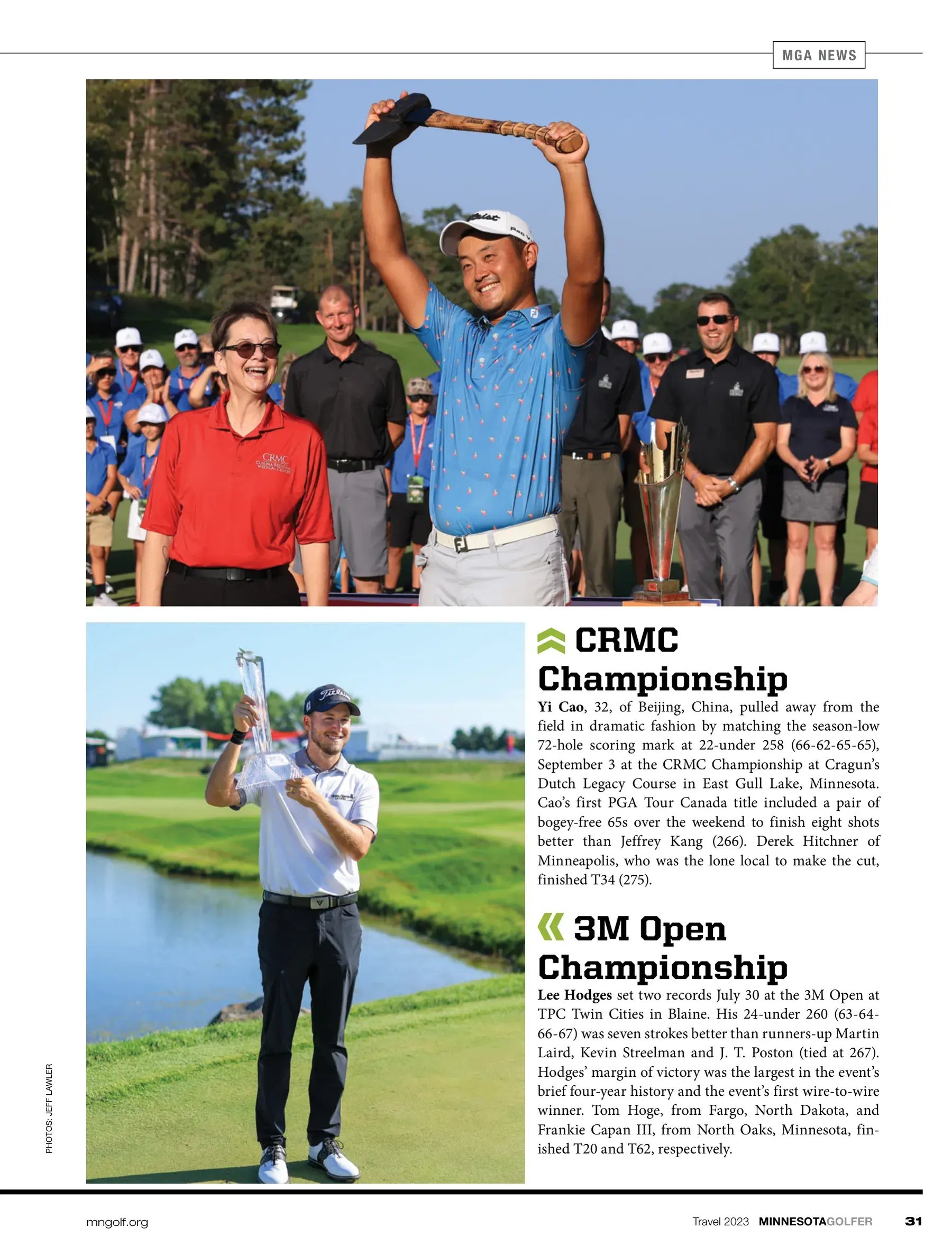
PRESIDENT’S DESK Ede Rice, President Travel 2023 MINNESOTAGOLFER 31 PHOTOS: JEFF LAWLER MGA NEWS CRMC Championship Yi Cao, 32, of Beijing, China, pulled away from the field in dramatic fashion by matching the season-low 72-hole scoring mark at 22-under 258 (66-62-65-65), September 3 at the CRMC Championship at Cragun’s Dutch Legacy Course in East Gull Lake, Minnesota.
Cao’s first PGA Tour Canada title included a pair of bogey-free 65s over the weekend to finish eight shots better than Jeffrey Kang (266). Derek Hitchner of Minneapolis, who was the lone local to make the cut, finished T34 (275).
3M Open Championship Lee Hodges set two records July 30 at the 3M Open at TPC Twin Cities in Blaine. His 24-under 260 (63-6466-67) was seven strokes better than runners-up Martin Laird, Kevin Streelman and J. T. Poston (tied at 267).
Hodges’ margin of victory was the largest in the event’s brief four-year history and the event’s first wire-to-wire winner. Tom Hoge, from Fargo, North Dakota, and Frankie Capan III, from North Oaks, Minnesota, finished T20 and T62, respectively.